Business writing is writing done to get work done: to request, inform, persuade, record, and decide. Its readers are busy, and they read to act. A good business message tells them at once what it is about and what is needed from them, gives the necessary facts, and leaves no doubt about the next step. This kind of professional writing has its own conventions, from the subject line of an email to the executive summary of a report, and its own grammar: it is formal enough to be respected and accessible enough to be understood quickly.
You will study the principles of business communication (clarity, conciseness, courtesy, correctness, and the reader-focused “you attitude”), the direct and indirect approaches, business emails, letters, reports, proposals, and memos, with their structures and typical phrases, business grammar (active voice, plain words, short sentences, parallel lists, tense), professional tone and the writing of bad news, writing for digital channels, and the common errors. The skills of corporate writing are those of the working world: plain, precise, and courteous. Thirty editing exercises and a quiz follow.
A business reader asks three questions: What is this? What do you want from me? By when? A message that answers them in the first lines is a good message. The rest of it supplies only what the reader needs to act.
Why it matters: Business writing is not “formal for its own sake”. The best business writers use plain words and short sentences, and keep the tone respectful and positive. Pompous language and long sentences make the reader’s job harder.
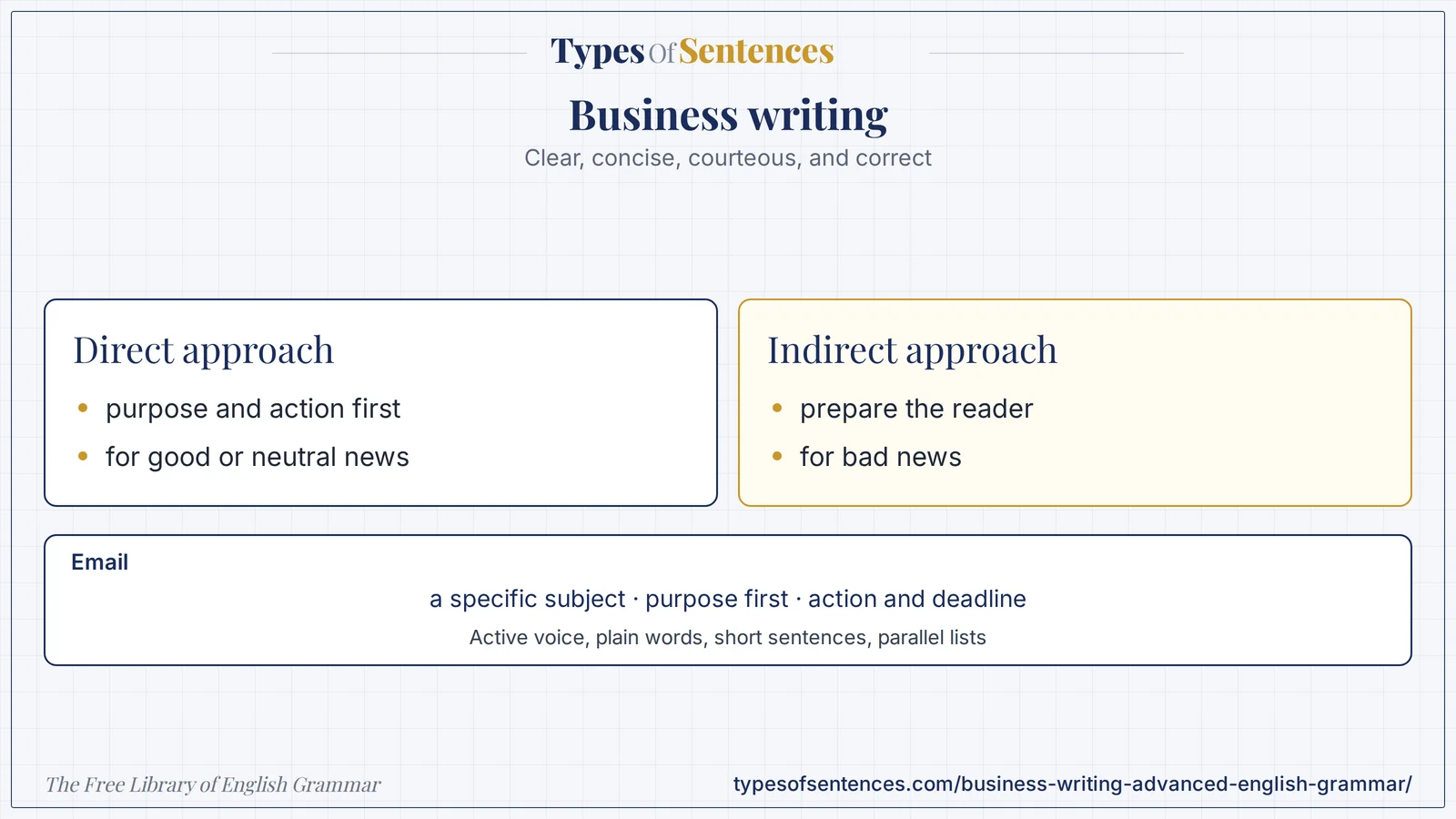
Summary: Business writing is clear, concise, courteous, and correct. It states the purpose and the action first (the direct approach) for neutral and good news, and prepares the reader (the indirect approach) for bad news. Emails have a specific subject line, a short body, and a clear call to action; letters follow a standard format; reports have an executive summary, findings, and recommendations; proposals argue for a project with a plan and a budget; memos are short internal messages. Business grammar prefers the active voice, strong verbs, plain words, short sentences, and parallel lists. The tone is positive and respectful, and the writer focuses on the reader’s needs.
- Clear, concise, courteous, correct.
- Direct approach for good or neutral news; indirect for bad news.
- Email: specific subject, purpose first, action and deadline.
- Active voice, plain words, short sentences, parallel lists.
What You’ll Learn
- 1. Business Writing: Principles of Professional Writing
- 2. Business Emails
- 3. Business Letters
- 4. Reports and Executive Summaries
- 5. Proposals
- 6. Memos
- 7. Business Grammar: Formal but Accessible
- 8. Professional Tone, Politeness, and Bad News
- 9. Digital Channels and Other Workplace Documents
- 10. Common Errors in Business Writing
- 11. Exercises
- 12. Test Your Knowledge
- 13. Frequently Asked Questions
- 14. Conclusion
1. Business Writing: Principles of Professional Writing
| Principle | Meaning | Example |
|---|---|---|
| clarity | one clear message; no ambiguity | Please send the signed contract by Friday, 15 March. |
| conciseness | no unnecessary words | We will meet on Monday. (not We are going to be having a meeting on Monday) |
| courtesy | respectful, positive tone | Thank you for your prompt reply. |
| correctness | accurate facts, grammar, spelling, and names | check the recipient’s name and the figures |
| completeness | everything the reader needs to act | date, time, place, amount, contact |
| concreteness | specific details | by 5 p.m. on 15 March (not soon) |
| consideration (“you attitude”) | the reader’s needs come first | You will receive the refund within five days. |
| coherence and order | logical structure | purpose → details → action |
| Question for planning | Answer |
|---|---|
| Who is the reader? | position, knowledge, relationship, expectation |
| What is my purpose? | inform, request, persuade, record, decide |
| What does the reader need to do or know? | the action or the information |
| What is the best channel? | email, letter, report, memo, chat, call |
| What is the right tone? | formal, neutral, or friendly |
| What is the deadline? | state it |
| Approach | When | Structure | Example opening |
|---|---|---|---|
| direct | good or neutral news; routine requests; instructions | main point first, then details | We are pleased to confirm your appointment on 15 March. |
| indirect | bad news; refusals; sensitive messages; persuasive requests | buffer → reasons → the decision → alternative or next step → positive close | Thank you for applying. We reviewed all applications carefully … |
The register and politeness choices in business messages follow the principles in the chapters on register and style and pragmatics: the larger the imposition and the greater the distance, the more indirect and polite the request. The key habit of the business writer is to put the reader first.
2. Business Emails
| Part | Practice | Example |
|---|---|---|
| subject line | specific; states the topic and, if needed, the action or deadline | Budget approval needed by Friday, 15 March |
| greeting | match the relationship: formal, neutral, or informal | Dear Dr. Rao, / Dear Ms. Gomez, / Hello Priya, / Hi team, |
| opening | state the purpose in the first sentence | I am writing to request approval of the 2024 training budget. |
| body | short paragraphs; one idea each; lists for several items | three short paragraphs or a bullet list |
| action | say who should do what by when | Could you confirm by 5 p.m. on Friday? |
| closing | a polite end and the next step | Thank you for your help. I will follow up on Monday. |
| sign-off | Kind regards / Best regards / Regards / Sincerely / Thanks | — |
| signature | name, title, company, contact | — |
| attachments | mention them in the text | I have attached the budget (Attachment 1). |
| Level of formality | Greeting | Request | Sign-off |
|---|---|---|---|
| formal (external, senior) | Dear Dr. Rao, | I would be grateful if you could … | Yours sincerely, / Kind regards, |
| neutral (colleagues) | Hello Priya, | Could you please …? | Best regards, / Regards, |
| informal (close team) | Hi Priya, | Can you …? | Thanks, / Cheers, |
| Poor subject line | Better |
|---|---|
| Hello | Meeting on Tuesday: agenda attached |
| Question | Question about invoice 4521 |
| Urgent!!! | Contract signature needed by 5 p.m. today |
| Update | Project Alpha: weekly update, 15 March |
| (no subject) | Request for leave: 18–22 March |
| Type of email | Model (invented names) |
|---|---|
| request | Dear Ms. Gomez, I am writing to request a copy of the 2023 sales report. Could you send it by Friday, 15 March? Thank you. Kind regards, Priya Rao |
| follow-up | Dear Mr. Lee, I am following up on my email of 8 March about the contract. Could you let me know the status by Wednesday? Thank you. Best regards, Priya Rao |
| apology | Dear Ms. Gomez, I apologize for the delay in sending the report. It is attached. I will send future reports on time. Kind regards, Priya Rao |
| meeting invitation | Dear all, I would like to invite you to a project review on Tuesday, 19 March, at 10:00 a.m. in Room 4. The agenda is attached. Please confirm your attendance by Monday. Best regards, Priya Rao |
| decline (polite) | Dear Mr. Lee, Thank you for the invitation. Unfortunately, I will not be able to attend because of a prior commitment. I hope the event goes well. Kind regards, Priya Rao |
- One email, one topic. Several topics are easier to handle in separate messages.
- Put the main point and the action first; the reader may read only the first lines.
- Use a short paragraph, a bullet list, or a numbered list for several items or steps.
- Mention the deadline as a date and a time (by 5 p.m. on Friday, 15 March), not ASAP.
- Check “Reply all”, “CC”, and “BCC” before sending; copy only those who need to know.
- Proofread the name, the numbers, and the attachment before sending.
- Be careful with tone. A message without voice can seem curt; add courtesy and avoid sarcasm and blame.
3. Business Letters
| Part | Content |
|---|---|
| letterhead | the sender’s name, address, and contact |
| date | 8 October 2026 or October 8, 2026 (consistent with the variety) |
| inside address | the recipient’s name, title, organization, address |
| salutation | Dear Mr. Rao, / Dear Dr. Gomez, / Dear Sir or Madam, / To whom it may concern |
| subject line (optional) | Re: Order No. 4521 |
| body | opening (purpose), middle (details), closing (action) |
| complimentary close | Yours sincerely, (named recipient, British) / Yours faithfully, (unnamed recipient, British) / Sincerely, (American) |
| signature | handwritten or typed name and title |
| enclosures and copies | Enclosure: invoice; cc: Finance |
| Format | Description |
|---|---|
| block | all lines flush left; no indentation; the most common |
| modified block | date and closing aligned to the right; paragraphs flush left |
| semi-block | as modified block, with indented first lines |
| Type | Purpose | Key language |
|---|---|---|
| request | ask for information or action | I am writing to ask whether … I would be grateful if you could … |
| complaint | report a problem and ask for a remedy | I am writing to complain about … I would appreciate a refund. |
| cover letter (application) | present yourself for a job | I am writing to apply for the post of … I have five years of experience in … |
| recommendation | support a person | I am pleased to recommend … in my experience, … |
| offer or confirmation | state terms | We are pleased to offer you … The terms are as follows. |
| refusal | decline politely | We regret that we are unable to … |
| thank-you | express thanks | Thank you for your time and hospitality. |
Letters are more formal than emails and are used for official, legal, and external communication, and for applications. If the recipient’s name is known, use it (Dear Ms. Gomez) and avoid the dated Dear Sir; use a title or a gender-neutral form when unsure. Letters follow the register conventions of the chapter on register and style: full forms, no contractions, courteous modals, and a formal close.
4. Reports and Executive Summaries
| Section | Content | Note |
|---|---|---|
| title page | title, author, date, organization | — |
| executive summary | purpose, key findings, recommendations in one page | written last; can be read alone |
| table of contents | headings and pages | for long reports |
| introduction | purpose, scope, background | — |
| method (if relevant) | how information was collected | brief |
| findings | what was found, with data | tables and charts |
| analysis or discussion | what the findings mean | — |
| conclusions | what follows | — |
| recommendations | what should be done, by whom, by when | numbered; specific |
| appendices | supporting material | — |
| Type of report | Purpose |
|---|---|
| informational | present facts |
| analytical | analyze data and interpret |
| progress | describe work done and remaining |
| feasibility | assess whether a plan is workable |
| incident | record an event and the response |
| annual or periodic | review a period |
| recommendation | argue for a decision |
| Executive summary (invented example) | Function |
|---|---|
| Purpose: This report assesses whether the company should open a second warehouse in Pune. Findings: Orders from the Pune region rose 35 percent in 2023, and delivery times exceed the target by two days. A second warehouse would cost 4.2 crore rupees and reduce delivery times by 40 percent. Recommendation: We recommend opening a warehouse by September 2024, subject to board approval in April. | states the purpose, key findings with figures, and a specific recommendation; stands alone |
| Phrases in reports | Examples |
|---|---|
| purpose | The purpose of this report is to …; This report examines … |
| findings | The data show that …; It was found that …; The main finding is … |
| analysis | This suggests that …; This is due to …; This indicates … |
| conclusion | It can be concluded that …; In summary, … |
| recommendation | We recommend that …; It is recommended that the company should …; The company should … |
| reference to figures | As shown in Table 2, …; Figure 1 illustrates … |
- Write for the reader who will read only the summary. Include the key numbers and the recommendation.
- Use headings, numbered lists, tables, and charts to help the reader find information.
- Be objective: the findings come before the interpretation, and the recommendation follows from the evidence.
- Be specific in recommendations: who, what, by when, and at what cost.
- Use the present tense for the report’s own contents (This report examines …) and the past for what was done (Data were collected). See the chapter on voice for the passive in reports.
5. Proposals
| Section | Content | Language |
|---|---|---|
| executive summary | the whole proposal in brief | We propose … The total cost is … |
| problem or need | why action is needed, with evidence | Currently, … This results in … |
| proposed solution | what you will do | We propose to … The project will … |
| benefits | what the client gains | The solution will reduce costs by 15 percent. |
| plan and method | how, step by step | Phase 1 … Phase 2 … |
| timeline | dates and milestones | The project will begin on … and be completed by … |
| budget | costs, clearly itemized | The total cost is …; the breakdown is as follows |
| qualifications | why you are the right provider | We have completed 20 similar projects. |
| risks and assumptions | honest limits | This estimate assumes that … |
| conclusion and call to action | next step | We would welcome the opportunity to discuss this proposal. |
| Type | Description |
|---|---|
| solicited | written in response to a request for proposals (RFP); follow the instructions exactly |
| unsolicited | submitted on your own initiative; must first create the need |
| internal | to a manager or committee within the organization |
| external | to a client or funder |
| Promising too much (avoid) | Realistic |
|---|---|
| We guarantee a 50 percent increase in sales. | We expect sales to increase by 10 to 15 percent, based on similar projects. |
| We will solve all your problems. | We will address the three issues identified in section 2. |
| We can do it in no time. | We will complete the project in 12 weeks. |
A proposal is a persuasive document, and the strategies of argument apply: a clear problem, evidence, a reasonable solution, an answer to likely objections, and a specific request. See the chapter on rhetorical strategies. The promises it makes are commitments, so use will only for what you will really do, and hedge predictions (we expect, is likely to).
6. Memos
| Part | Content | Example |
|---|---|---|
| heading | TO, FROM, DATE, SUBJECT (and CC) | TO: All staff / FROM: P. Rao, HR / DATE: 8 October 2026 / SUBJECT: New leave policy |
| opening (bottom line) | the purpose or decision, first | Effective 1 November, the leave policy changes as follows. |
| context | why | The change follows the annual review. |
| details | the points, in a list | 1. … 2. … 3. … |
| action | what the reader must do and by when | Please submit leave requests through the portal by the 25th of each month. |
| closing | contact and thanks | Questions? Contact HR at extension 245. |
| Type of memo | Purpose |
|---|---|
| announcement | inform about a policy or an event |
| request | ask for information or action |
| response | answer a request |
| summary or minutes | record a meeting and actions |
| directive | instruct |
| Memo | |
|---|---|
| a short, formal internal document | often replaces the memo; the same principles apply |
| a standard heading | a subject line and recipients |
| for official internal communication | for fast communication |
A memo is short, usually one page, and is organized by the “bottom line up front” principle. In many organizations the memo format is used as a document attached to an email or posted on an intranet.
7. Business Grammar: Formal but Accessible
| Feature | Guidance | Example |
|---|---|---|
| active voice | preferred for clarity and responsibility | We will send the invoice. (not The invoice will be sent) |
| passive | useful for tact or when the agent is unknown or unimportant | The form was not received. |
| strong verbs | prefer a verb to a nominalization | decide (not make a decision); analyze (not conduct an analysis of) |
| plain words | prefer short, common words | use, not utilize; begin, not commence; help, not facilitate |
| short sentences | one idea; about 15–20 words on average | — |
| parallel lists | items in the same form | We will (1) review the draft, (2) revise the figures, and (3) send the final report. |
| positive wording | say what can be done | We can deliver on Monday. (not We cannot deliver before Monday) |
| tense | present for the current state; present perfect for results to date; past for events; will for commitments | We have completed the first phase. We will begin the second in May. |
| modal verbs for politeness | could, would, might | Could you send the file? |
| conciseness | cut redundancy | at this point in time → now; due to the fact that → because |
| numbers | numerals for figures; define units and currency | 12 percent; 4.2 crore rupees (about 42 million) |
| dates and times | unambiguous | 15 March 2024, 3 p.m. IST |
| abbreviations | define at first use | Request for Proposals (RFP) |
| lists | numbered for steps; bullets for items | — |
| capitalization and titles | capitalize titles before names | Dr. Rao; Managing Director |
| Wordy or pompous | Plain |
|---|---|
| at this point in time | now |
| in the event that | if |
| due to the fact that | because |
| we are in receipt of | we have received |
| please find attached | I have attached / attached is |
| utilize | use |
| commence | start |
| terminate | end |
| subsequent to | after |
| with regard to | about |
| it is requested that | please |
| I would like to take this opportunity to thank you | Thank you |
| Common business phrases to handle with care | Comment |
|---|---|
| “kindly revert” | in Indian English, revert means “reply”; in other varieties it means “go back”; use reply or let me know for international readers |
| “please do the needful” | established in some varieties but vague; say what is needed |
| “PFA” (please find attached) | an abbreviation; write attached |
| “ASAP” | vague; give a date and time |
| “per my last email” | can sound critical; reword |
| “circle back”, “touch base”, “synergy”, “leverage”, “bandwidth” | buzzwords; use plain words |
| “kindly” (overuse) | can sound stiff or impatient; use please |
The preference for the active voice and strong verbs follows the discussion in the chapters on conciseness and wordiness and on voice. Business writers also need to avoid language that excludes (gendered job titles, Dear Sirs) and to be aware of the readers’ variety of English: a phrase that is normal in one place may be unclear in another.
8. Professional Tone, Politeness, and Bad News
| Negative or blaming | Positive and courteous |
|---|---|
| You failed to send the form. | We have not yet received the form. Could you send it by Friday? |
| You must pay now. | Please pay by 15 March to avoid a late fee. |
| Your complaint is wrong. | We reviewed your complaint carefully and found that … |
| We cannot do that. | What we can do is … |
| It is not our fault. | The delay occurred because of … We are working to … |
| As I said before … | To recap, … |
| That is impossible. | This is difficult within the current budget; one option is … |
| You don’t understand. | Let me clarify. |
| Step | Task in a bad-news message | Example |
|---|---|---|
| 1 buffer | a neutral or positive opening | Thank you for your interest in the position. |
| 2 reasons | explain the situation before the decision | We received 200 applications and reviewed each against the criteria. |
| 3 decision | state it clearly and kindly | We are unable to offer you the post at this time. |
| 4 alternative or next step | offer something useful | We will keep your CV on file for future openings. |
| 5 positive close | end courteously | We wish you every success. |
- Use the “you attitude”: write from the reader’s point of view (You will receive …).
- Focus on what can be done and on the solution.
- Do not blame. Describe the situation, not the person.
- Apologize sincerely and briefly when the company is at fault: We apologize for the error; we have corrected it.
- Be careful with humor and irony, which may not travel across readers and cultures.
- Respond promptly and say when you will answer fully if you cannot yet.
9. Digital Channels and Other Workplace Documents
| Channel or document | Features | Language |
|---|---|---|
| chat and messaging (workplace) | short, quick; threads; status | informal to neutral; clear requests; avoid ambiguity |
| meeting agenda | items, time, owner | noun phrases and verbs; times |
| meeting minutes | record decisions and actions with owner and date | past tense for discussion; “Action: Priya to send the report by 15 March” |
| presentation slides | headlines and bullets; one idea per slide | fragments allowed; parallel bullets |
| résumé (CV) | factual, achievement-focused | verbs in the past for earlier jobs and the present for the current one; no I |
| cover letter | persuasive; targeted | first person; concrete achievements |
| job description | duties and requirements | imperatives or nouns; parallel lists |
| professional social post | short, public, brand-aware | positive; clear; check for accuracy |
| website copy | scannable; benefits first | short sentences; active voice |
| customer service reply | courteous; solution-focused | thank, apologize, solve |
| contract and policy | precise; defined terms | see the chapter on legal writing |
| Weak achievement statement (résumé) | Strong achievement statement |
|---|---|
| Responsible for sales. | Increased regional sales by 18 percent in 2023. |
| Helped with training. | Trained 40 new staff in the order-processing system. |
| Worked on a project. | Led a six-person team that delivered the project two weeks early. |
Each channel has its own norms, and the best business writers adapt without losing clarity and courtesy. A written message lacks tone of voice, so check that it cannot be read as curt, and that any request is complete. The specialized registers of technical and legal writing are treated in the next chapters of this part.
10. Common Errors in Business Writing
| Error | Example | Fix |
|---|---|---|
| vague subject line | Hello | Meeting on Tuesday: agenda attached |
| buried purpose | three paragraphs of background first | state the purpose in the first sentence |
| vague deadline | Send it soon. / ASAP | Send it by 5 p.m. on Friday, 15 March. |
| too long a message | one email with ten topics | split or use a list |
| wordy phrases | at this point in time; due to the fact that | now; because |
| passive that hides responsibility | Mistakes were made. | We made mistakes, and we have corrected them. |
| blaming language | You failed to … | We have not received … |
| negative framing | We cannot deliver before Monday. | We can deliver on Monday. |
| a wrong name or title | Dear Mr. (for a woman) | check and use the correct form |
| informal in a formal context | Hey, wanna meet? | Could we meet on Tuesday? |
| overuse of exclamation marks | Thanks!!! Please!!! | Thank you. |
| jargon and buzzwords | Let’s circle back to leverage synergies. | Let’s discuss how to use our strengths together. |
| missing action | an email that informs but asks nothing | end with the next step |
| no proofreading | typos and wrong figures | proofread |
| unclear attachment | See attached. (nothing attached) | check the attachment |
| reply-all misuse | sending to everybody | reply only to those who need it |
| unclear “kindly revert” for international readers | Kindly revert. | Please reply by Friday. |
Edit: Hello, at this point in time we are in receipt of your complaint and you failed to send the form, so kindly revert ASAP, because it was not our fault, and mistakes were made, and let’s circle back to touch base!!!
- Hello (as a subject line and greeting): Dear Ms. Gomez, and a specific subject: Your complaint about order 4521.
- at this point in time we are in receipt of: we have received.
- you failed to send the form: blaming: we have not yet received the form.
- kindly revert ASAP: vague: Could you send it by 5 p.m. on Friday, 15 March?
- it was not our fault, and mistakes were made: defensive and evasive: We apologize for the delay in answering.
- circle back to touch base!!!: buzzwords and excess: I will call you on Monday.
- Result: Subject: Your complaint about order 4521. Dear Ms. Gomez, We have received your complaint. We have not yet received the form. Could you send it by 5 p.m. on Friday, 15 March? We apologize for the delay in answering, and I will call you on Monday. Kind regards, Priya Rao (the names and details are invented)
Recap in 12 seconds
Watch the lesson build itself: Business writing states the purpose first for good news and prepares the reader for bad news. The video has no sound.
Exercises
Part A: Principles (Exercises 1–7)
Exercise 1: Name four principles of business writing.
Show Answer
Answer: Clarity, conciseness, courtesy, correctness (also completeness, concreteness).
Exercise 2: Direct or indirect approach: good news
Show Answer
Answer: Direct.
Exercise 3: Direct or indirect approach: bad news
Show Answer
Answer: Indirect.
Exercise 4: What is the “you attitude”?
Show Answer
Answer: Writing from the reader’s point of view.
Exercise 5: What does the reader ask first?
Show Answer
Answer: What is this, what do you want, by when?
Exercise 6: Replace soon with a concrete deadline:
Show Answer
Answer: by 5 p.m. on Friday, 15 March.
Exercise 7: Why avoid ASAP?
Show Answer
Answer: It is vague; give a date and time.
Part B: Emails and Letters (Exercises 8–14)
Exercise 8: Improve the subject line: Hello
Show Answer
Answer: Meeting on Tuesday: agenda attached.
Exercise 9: Where should the purpose go in an email?
Show Answer
Answer: In the first sentence.
Exercise 10: Greeting for a formal email to Dr. Rao:
Show Answer
Answer: Dear Dr. Rao,
Exercise 11: Sign-off for a formal letter to a named person (British):
Show Answer
Answer: Yours sincerely,
Exercise 12: Sign-off for an unnamed recipient (British):
Show Answer
Answer: Yours faithfully,
Exercise 13: American sign-off:
Show Answer
Answer: Sincerely,
Exercise 14: Name a letter format.
Show Answer
Answer: Block, modified block, or semi-block.
Part C: Reports, Proposals, Memos (Exercises 15–20)
Exercise 15: What is an executive summary?
Show Answer
Answer: A one-page summary of the purpose, findings, and recommendations, readable alone.
Exercise 16: When is the executive summary written?
Show Answer
Answer: Last.
Exercise 17: Name two sections of a proposal.
Show Answer
Answer: Problem, solution, benefits, plan, timeline, budget.
Exercise 18: What is a memo’s “bottom line up front”?
Show Answer
Answer: The main point first.
Exercise 19: Name the heading of a memo.
Show Answer
Answer: TO, FROM, DATE, SUBJECT.
Exercise 20: Why avoid promising too much in a proposal?
Show Answer
Answer: Promises are commitments.
Part D: Grammar and Tone (Exercises 21–27)
Exercise 21: Plain for utilize:
Show Answer
Answer: use.
Exercise 22: Plain for due to the fact that:
Show Answer
Answer: because.
Exercise 23: Plain for at this point in time:
Show Answer
Answer: now.
Exercise 24: Strong verb for make a decision:
Show Answer
Answer: decide.
Exercise 25: Reword: You failed to send the form.
Show Answer
Answer: We have not yet received the form.
Exercise 26: Reword: We cannot deliver before Monday.
Show Answer
Answer: We can deliver on Monday.
Exercise 27: Name the steps of a bad-news message.
Show Answer
Answer: Buffer, reasons, decision, alternative, positive close.
Part E: Errors (Exercises 28–30)
Exercise 28: Fix: Kindly revert. (for an international reader)
Show Answer
Answer: Please reply by Friday.
Exercise 29: Fix: Mistakes were made.
Show Answer
Answer: We made mistakes, and we have corrected them.
Exercise 30: Fix: Let’s circle back to leverage synergies.
Show Answer
Answer: Let’s discuss how to use our strengths together.
Test Your Knowledge
Ready to check what you learned? Answer all 10 questions, then submit. You need 80% (8 of 10) to pass. Your answers are not stored.
View correct answers and explanations
Question 1: Which is a principle of business writing?
✓ Correct Answer: A – clarity
Clarity.
Question 2: When should you use the indirect approach?
✓ Correct Answer: B – for bad news
For bad news.
Question 3: Which is the best subject line?
✓ Correct Answer: C – Contract signature needed by 5 p.m. today
Specific.
Question 4: Which is plain English?
✓ Correct Answer: D – now
Now.
Question 5: Which is a strong verb?
✓ Correct Answer: C – decide
Decide.
Question 6: Which is positive wording?
✓ Correct Answer: A – We can deliver on Monday.
Positive.
Question 7: Which is a good deadline?
✓ Correct Answer: D – by 5 p.m. on Friday, 15 March
Concrete.
Question 8: Which is the first part of a memo’s body?
✓ Correct Answer: C – the bottom line
Bottom line up front.
Question 9: Which is written last in a report?
✓ Correct Answer: B – the executive summary
The summary.
Question 10: Which is the formal British close to an unnamed recipient?
✓ Correct Answer: B – Yours faithfully
Yours faithfully.
Frequently Asked Questions
What is business writing?
Business writing is writing used in the workplace to request, inform, persuade, and record: emails, letters, reports, proposals, and memos. It is clear, concise, courteous, and correct.
What is professional writing?
Professional writing is writing done for work, as opposed to personal or academic writing, which follows the conventions of the workplace: purpose first, reader-focused, and plain.
What is business communication?
Business communication is the exchange of information in an organization and with outsiders, by writing, speaking, and other channels. Business communication aims at action and understanding.
What is business grammar?
Business grammar is the set of grammar choices that suit workplace writing: the active voice, strong verbs, plain words, short sentences, parallel lists, positive wording, and the right tense.
What is corporate writing?
Corporate writing is writing produced by or for companies: reports, proposals, policies, websites, and internal documents. Corporate writing should be clear and avoid jargon.
How do I write a good business email?
Write a specific subject line, state the purpose and the action first, keep paragraphs short, give a deadline as a date and time, be courteous, and proofread.
How do I write bad news?
Use the indirect approach: a neutral buffer, the reasons, a clear decision, an alternative or next step, and a positive close.
Conclusion
You now have a deep study of business writing: its principles, emails, letters, reports, proposals, and memos, business grammar, professional tone and bad news, digital channels, and the common errors. You can write clear, concise, and courteous workplace documents.
When you write at work, ask what the reader needs to know and do, and put that first. Next, you will study technical writing.
- Guffey, Mary Ellen, and Dana Loewy. Business Communication: Process and Product. 9th ed. Cengage, 2017.: a standard textbook on business communication.
- Locker, Kitty O., and Donna S. Kienzler. Business and Administrative Communication. 12th ed. McGraw-Hill, 2018.: structures and strategies of business documents.
- Garner, Bryan A. HBR Guide to Better Business Writing. Harvard Business Review Press, 2013.: plain, effective business prose.
- Williams, Joseph M., and Joseph Bizup. Style: Lessons in Clarity and Grace. 12th ed. Pearson, 2017.: clarity in professional writing.
- Purdue Online Writing Lab: Professional, Technical Writing: reference pages on business and professional writing.
Last reviewed: October 29, 2026. How it was made: drafted with AI assistance, then checked with automated tests (structure, links, answer keys, spelling) and against the sources above. A person has not yet read this chapter line by line. Found a mistake? Report it.