Idiomatic expressions are phrases whose meaning is not the sum of their parts. Spill the beans has nothing to do with beans, kick the bucket with buckets, or a piece of cake with cake. A learner who knows every word in She’s under the weather may still not understand it, and a writer who uses hit the nail on the head in the wrong register may sound careless. These advanced English idioms are everywhere in speech and journalism, and the main skill is to know what they mean, how they behave grammatically, and when to use them.
You will study what makes an expression an idiom, the main types (verb idioms, noun idioms, adjective and adverb idioms, and whole-clause idioms), the grammatical features that make them fixed or flexible, idioms in context and register, the common idioms of business, everyday life, sport, and literature, proverbs and sayings, ways of learning idiom meanings, and the usual errors, from eggcorns (for all intensive purposes) to mixed metaphors. These fixed phrases and advanced idioms are a major part of lexical sophistication. Thirty editing exercises and a quiz follow.
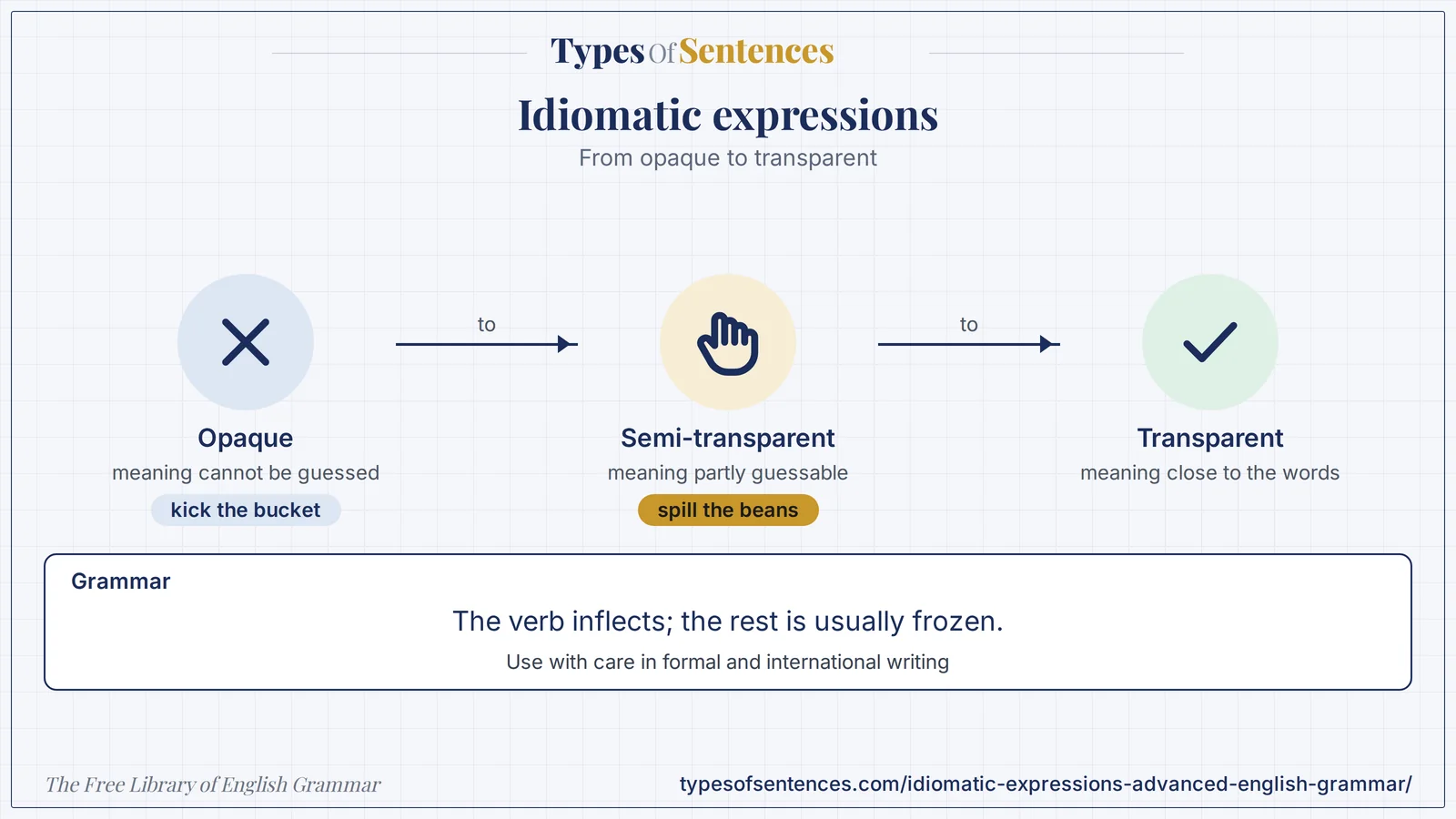
An idiom is a fixed phrase that means something different from its words taken literally. You cannot work it out from the grammar; you have to know it. Native speakers learn thousands of them without noticing.
Why it matters: Because idioms are fixed, they resist change: you cannot say kick the buckets or the bucket was kicked and keep the idiomatic meaning. And because they are informal and often tied to a culture, a careful writer chooses them with the reader in mind.
Summary: An idiom is a conventionalized multi-word expression whose meaning cannot be predicted from the meanings of its parts. Idioms range from opaque (kick the bucket) to semi-transparent (spill the beans) and transparent (on the other hand). They take many forms: verb phrases, noun phrases, adjective and adverb phrases, similes, binomials, and whole sentences. Most are syntactically restricted: the words, their order, and often the number and the determiner are fixed, though the verb can inflect and some idioms allow the passive or modification. Idioms are generally informal and are used sparingly in formal and international writing. Common errors include changing a word of the idiom, mixing two metaphors, and eggcorns.
- Idiom = fixed, non-literal, conventional.
- Degrees: opaque, semi-transparent, transparent.
- Grammar: the verb inflects; the rest is usually frozen.
- Use with care in formal and international writing.
What You’ll Learn
- 1. Idiomatic Expressions: What Are Idioms?
- 2. Types of Idioms
- 3. Grammatical Features of Idioms
- 4. Idioms in Context: Appropriate Use and Register
- 5. Common Idioms by Area
- 6. Proverbs and Sayings
- 7. Learning and Using Idioms
- 8. Idioms and Ambiguity: Literal vs. Figurative
- 9. Common Errors with Idioms
- 10. Exercises
- 11. Test Your Knowledge
- 12. Frequently Asked Questions
- 13. Conclusion
1. Idiomatic Expressions: What Are Idioms?
An idiom is a multi-word expression with a figurative or conventional meaning that is not predictable from its parts. Three properties are usually mentioned: non-compositionality (the meaning is not the sum of the words), conventionality (speakers have to learn it), and fixedness (the form resists change).
| Degree | Description | Examples | Meaning |
|---|---|---|---|
| opaque (pure idiom) | no link between the literal and the idiomatic meaning | kick the bucket; red herring; by and large | die; a misleading clue; mostly |
| semi-transparent (figurative idiom) | a metaphor that can be understood once explained | spill the beans; break the ice; hit the nail on the head; under the weather | reveal a secret; relieve tension; be exactly right; feel unwell |
| transparent (literal-like) | the idiomatic meaning follows from the words, but the phrase is fixed | on the other hand; in a nutshell; make a long story short | in contrast; briefly |
| collocation (not an idiom) | words that go together, with literal meaning | heavy rain; pay attention | — |
| Test | Result for an idiom | Example |
|---|---|---|
| paraphrase | a single word or phrase can replace it | kick the bucket = die |
| literal reading | possible but different | She kicked the bucket (a real bucket) / (she died) |
| substitution | synonyms usually fail | *kick the pail, *boot the bucket |
| translation | word-for-word translation fails | — |
| cultural knowledge | needed | a red herring (hunting dogs, a false trail) |
Many idioms were once metaphors, and the origins of some are known; the stories told about others (bite the bullet, raining cats and dogs) are often popular guesses with little evidence. An idiom is not the same as a collocation: a collocation such as heavy rain keeps its literal meaning, while an idiom has become a unit with a new meaning. The relation to collocation is treated in the previous chapter.
2. Types of Idioms
| Type | Pattern | Examples | Meaning |
|---|---|---|---|
| verb + noun phrase | verb + object | spill the beans; hit the road; break the ice; bite the bullet; pull someone’s leg; face the music; let the cat out of the bag | reveal a secret; leave; relieve tension; endure something unpleasant; tease; accept the consequences; reveal a secret |
| verb + preposition phrase | verb + PP | be in hot water; get out of hand; go to pieces; fall on deaf ears; come to light; run out of steam | be in trouble; become uncontrolled; collapse emotionally; be ignored; become known; lose energy |
| phrasal verb idioms | verb + particle (idiomatic) | call it a day; give up the ghost; come up with; put up with; run out of; look up to | stop work; die; think of; tolerate; have no more; admire |
| noun phrase idioms | noun phrase | a piece of cake; a red herring; a white elephant; a blessing in disguise; the tip of the iceberg; a storm in a teacup; a dark horse | something easy; a false clue; a costly useless thing; a hidden benefit; a small visible part; a fuss about nothing; a surprising competitor |
| adjective idioms | adjective phrase | under the weather; over the moon; on cloud nine; hard as nails; as cool as a cucumber; high and dry | unwell; delighted; very happy; tough; calm; stranded |
| adverbial and prepositional idioms | adverb or PP | by and large; at the drop of a hat; once in a blue moon; in a nutshell; on the fence; off the record; out of the blue | mostly; immediately; rarely; briefly; undecided; unofficially; unexpectedly |
| similes and comparisons | as … as; like … | as busy as a bee; as old as the hills; like a fish out of water; sleep like a log | very busy; very old; uncomfortable; sleep deeply |
| binomials | X and Y | odds and ends; safe and sound; rise and shine; trial and error; wear and tear | small items; unhurt; wake up; learning by trying; damage from use |
| whole-clause idioms | a clause or sentence | It’s raining cats and dogs. The ball is in your court. That’s the last straw. It takes two to tango. It’s not rocket science. | heavy rain; it is your decision; the final problem; both are responsible; it is easy |
Linguists also distinguish idiomatically combining expressions (spill the beans, where each word contributes a part of the meaning: spill = reveal, beans = secret) from idiomatic phrases (kick the bucket, where the meaning belongs to the whole), a difference that predicts how much grammatical change they tolerate. Phrasal verbs are treated in the chapters on complementation patterns and in the Basic and Intermediate chapters on idioms.
3. Grammatical Features of Idioms
| Feature | Rule | Example |
|---|---|---|
| verb inflection | the verb can change tense and agreement | He spills / spilled / has spilled the beans. |
| determiner and number | fixed | kick the bucket (not kick the buckets or kick a bucket) |
| word order | fixed | spill the beans (not the beans spill in the idiomatic sense) |
| possessive agreement | the possessive agrees with the subject | She lost her temper. They lost their tempers. (not lost his temper for she) |
| passive | possible only if the idiom is decomposable | The beans were spilled. / *The bucket was kicked. |
| internal modification | limited | She hit the nail squarely on the head. / *She spilled the tasty beans. |
| adverbs and negation | allowed | He didn’t spill the beans. She really kicked the bucket. |
| relative clause or question | limited | The beans (that) he spilled caused trouble. (acceptable) |
| nominalization | sometimes | the spilling of the beans |
| lexical substitution | not allowed | *hit the wall on the head |
| gerund and participle | allowed | Spilling the beans was a mistake. |
| tag question and ellipsis | allowed | He spilled the beans, didn’t he? |
| Idiom | Frozen or flexible | Evidence |
|---|---|---|
| kick the bucket | frozen | no passive, no modification, no pronoun for bucket |
| by and large | frozen | no variation at all |
| spill the beans | flexible | passive and modification are possible: The beans have been spilled. |
| break the ice | semi-flexible | The ice was broken. |
| pull strings | flexible | Strings were pulled. |
| hit the nail on the head | modifiable | hit the nail squarely on the head |
| take the bull by the horns | modifiable | take the bull firmly by the horns |
The more transparent an idiom, the more flexible its grammar. Pull strings allows the passive (Strings were pulled) because strings stands for influence, while kick the bucket does not. The change of one word in an idiom changes or destroys its meaning, except in playful variation (a leopard can’t change its spots → a leopard that changed its spots would be a news story). The restrictions are part of the study of syntax and meaning; see the chapter on voice for the passive.
4. Idioms in Context: Appropriate Use and Register
| Context | Use of idioms | Example |
|---|---|---|
| casual speech | natural and frequent | I’m under the weather. Let’s call it a day. |
| informal writing and journalism | common; headlines love them | Minister in hot water over expenses. |
| business (informal) | common jargon: use with care | Let’s touch base and get the ball rolling. |
| business (formal) | sparingly; plain language is often better | We will contact you and begin the project. |
| academic writing | generally avoided; plain precise words preferred | The project failed. (not The project went belly up) |
| international audiences | risky; may not be understood | avoid or explain |
| legal and technical | avoided | — |
| literary | used for voice, humor, or irony, sometimes with a twist | — |
| Idiom | Plain equivalent | Register |
|---|---|---|
| bite the bullet | accept an unpleasant necessity | informal |
| cut corners | do something less carefully to save time or money | informal |
| back to square one | start again | informal (British origin, from board games and football commentary) |
| the bottom line | the final result or the main point | business |
| think outside the box | think creatively | business; now a cliché |
| at the end of the day | in the end; ultimately | informal; a cliché |
| a drop in the ocean | a very small amount | neutral |
| leave no stone unturned | search thoroughly | neutral to formal |
| a double-edged sword | something with good and bad effects | neutral; common in writing |
- Match the idiom to the register. Many idioms are informal. In formal and academic writing prefer plain, precise words.
- Consider the reader. Idioms may be opaque to readers who are not native speakers, and they are hard to translate. Explain or avoid them for international audiences.
- Avoid clichés. An overused idiom (at the end of the day, think outside the box) adds nothing; Orwell’s advice was to avoid a stock figure of speech that one is used to seeing in print.
- Use idioms with a purpose: for voice, vividness, humor, or concision.
- Do not mix them: We’ll burn that bridge when we come to it mixes two idioms and amuses by mistake.
Style guides treat idioms and clichés under diction and register; see the chapters on register and style and diction. Writers can also play with idioms by remotivation: It’s raining cats and dogs, so mind the poodles.
5. Common Idioms by Area
| Area | Idioms | Meaning |
|---|---|---|
| business | get the ball rolling; touch base; on the same page; the bottom line; in the red; in the black; cut corners; a level playing field; move the goalposts; the learning curve; a ballpark figure; back to the drawing board | start; contact; in agreement; the main point; losing money; making a profit; do less carefully; fair conditions; change the rules; the time needed to learn; a rough estimate; start the planning again |
| everyday life | under the weather; call it a day; hit the sack; a piece of cake; for good; run out of steam; once in a blue moon; a dime a dozen (American); the last straw; on the ball; in a nutshell; the real deal | unwell; stop; go to bed; very easy; permanently; lose energy; rarely; very common; the final problem; alert; briefly; genuine |
| body | cold feet; keep an eye on; give someone a hand; lend an ear; break a leg; pull someone’s leg; get something off your chest; at arm’s length; by heart; head over heels | nervousness; watch; help; listen; good luck; tease; confess; at a distance; from memory; very much in love |
| animals | let the cat out of the bag; a red herring; a white elephant; the elephant in the room; a wild goose chase; the lion’s share; a dark horse; smell a rat; a snake in the grass; kill two birds with one stone | reveal a secret; a false clue; a costly useless possession; an obvious problem nobody mentions; a useless search; the largest part; a surprising competitor; suspect something wrong; a treacherous person; achieve two aims |
| money and time | a penny for your thoughts; break the bank; cost an arm and a leg; pay through the nose; time is money; against the clock; in the nick of time; behind the times; at a loose end | what are you thinking; cost too much; be very expensive; pay too much; time has value; under time pressure; just in time; old-fashioned; with nothing to do |
| weather and nature | a storm in a teacup; steal someone’s thunder; under a cloud; save for a rainy day; every cloud has a silver lining; a bolt from the blue; go with the flow; on thin ice | a fuss about nothing; take credit for another’s idea; suspected; save money; some good in the bad; a shock; accept events; in a risky position |
| sport | the ball is in your court; throw in the towel; hit below the belt; drop the ball; step up to the plate; a level playing field; on the back foot; a game changer; jump the gun; par for the course | it is your move; give up; act unfairly; fail to continue; take responsibility; fair conditions; at a disadvantage; something that changes everything; start too early; normal |
| classical and literary allusions | Achilles’ heel; Pandora’s box; a Pyrrhic victory; between Scylla and Charybdis; a Herculean task; the writing on the wall; a Trojan horse; to meet one’s Waterloo | a weak point; a source of unforeseen trouble; a victory with heavy cost; between two dangers; a very hard task; a warning; a hidden danger; to meet a final defeat |
These are only a selection. Many idioms have special variants in British and American English (back to square one and a dime a dozen, for example, are more British and more American respectively), and the chapter on British vs. American English discusses the differences. Allusions to classical and biblical sources depend on the reader’s cultural knowledge and are used by many writers as shorthand.
6. Proverbs and Sayings
| Proverb | Meaning | Feature |
|---|---|---|
| A stitch in time saves nine. | Fix a small problem early to avoid a large one. | rhyme |
| Actions speak louder than words. | What you do matters more than what you say. | comparison |
| Too many cooks spoil the broth. | Too many people spoil a task. | metaphor |
| Look before you leap. | Think before you act. | imperative; parallel |
| Better late than never. | It is better to do something late than not at all. | ellipsis |
| The early bird catches the worm. | Those who start early succeed. | — |
| Don’t count your chickens before they hatch. | Do not assume a result before it happens. | imperative |
| Birds of a feather flock together. | Similar people stay together. | — |
| When in Rome, do as the Romans do. | Follow local customs. | — |
| Haste makes waste. | Doing things quickly causes mistakes. | rhyme |
| Easy come, easy go. | What is gained easily is lost easily. | ellipsis and parallelism |
| A rolling stone gathers no moss. | A person who moves a lot has no ties (or no problems, depending on the speaker). | meaning varies |
| Feature | Example | Note |
|---|---|---|
| parallelism | Easy come, easy go. Out of sight, out of mind. | balanced clauses |
| rhyme and alliteration | Haste makes waste. Look before you leap. | memorable sound |
| imperatives | Don’t cry over spilled milk. | advice |
| general truths in the present tense | Time heals all wounds. | timeless |
| contradictory pairs | Look before you leap. / He who hesitates is lost. | each fits a situation |
| cultural source | proverbs reflect farming, sailing, trade, religion | — |
Proverbs are complete sentences that express a piece of traditional advice or wisdom. Unlike most idioms, they are not part of the grammar of the sentence in which they appear but are quoted or alluded to: As the saying goes, a stitch in time saves nine. They can be shortened (a stitch in time), twisted for humor, or turned into the title of an article. They depend on cultural knowledge, and every language has its own, so translation seldom works word for word. In writing, a proverb should be used lightly and, in formal work, with an introductory phrase.
7. Learning and Using Idioms
- Learn idioms in context: record the whole sentence and where you met it.
- Learn the meaning and the register: a note such as “informal” or “business” helps.
- Use the image: many idioms are metaphors; a mental picture helps recall (a storm in a teacup).
- Use an idiom dictionary: the Oxford Dictionary of Idioms, the Cambridge Idioms Dictionary, or Collins COBUILD Idioms.
- Do not translate word for word; find the English equivalent.
- Notice the fixed form: learn the determiner, number, and preposition with the idiom.
- Use sparingly: one well-chosen idiom works better than several.
- Check variety: some idioms are British (bob’s your uncle), others American (touch base).
| Reading strategy | Example |
|---|---|
| guess from context | The meeting dragged on, so the manager called it a day. (stopped) |
| check the literal meaning first | She’s skating on thin ice. (in a risky situation) |
| look for repeated patterns | under the weather; under pressure; under a cloud |
| group by theme | money idioms; body idioms |
8. Idioms and Ambiguity: Literal vs. Figurative
| Sentence | Idiomatic reading | Literal reading |
|---|---|---|
| He kicked the bucket. | He died. | He struck a bucket with his foot. |
| She broke the ice. | She started the conversation. | She cracked the ice on the pond. |
| They hit the road. | They left. | They struck the road. |
| I spilled the beans. | I revealed the secret. | I dropped some beans. |
| She is pulling my leg. | She is teasing me. | She is tugging my leg. |
Most of the time, the context makes clear which reading is meant, and a listener who knows the idiom hears it first. Writers use the ambiguity for jokes and headlines (Police Help Dog Bite Victim is a different kind of ambiguity, treated in the chapter on ambiguity in English). Translators and learners are the most affected: an idiom that is not known is understood literally, and the result is confusion.
9. Common Errors with Idioms
| Error | Correction | Type of error |
|---|---|---|
| for all intensive purposes | for all intents and purposes | eggcorn (a mishearing) |
| a mute point | a moot point | mishearing |
| nip it in the butt | nip it in the bud | mishearing |
| piece of mind | peace of mind | spelling and sense |
| bare with me | bear with me | homophone |
| wreck havoc | wreak havoc | homophone |
| tow the line | toe the line | homophone |
| hone in on | home in on | mishearing (debated) |
| on the other side of the coin | on the other hand / on the flip side | mixed idioms |
| I could care less | I couldn’t care less | logic (the first is common in American speech) |
| in the other hand | on the other hand | wrong preposition |
| we’ll burn that bridge when we come to it | we’ll cross that bridge when we come to it | mixed metaphor |
| kick the buckets | kick the bucket | number |
| She lost his temper. | She lost her temper. | possessive agreement |
| hit the nail on its head | hit the nail on the head | determiner |
| spill the bean | spill the beans | number |
| a drop on the ocean | a drop in the ocean | wrong preposition |
Edit: For all intensive purposes, it’s a mute point, so we’ll burn that bridge when we come to it, and she lost his temper, and he kicked the buckets, and in the other hand, bare with me while I nip it in the butt.
- for all intensive purposes: for all intents and purposes.
- a mute point: a moot point.
- burn that bridge when we come to it: cross that bridge when we come to it.
- lost his temper: lost her temper (agreement).
- kicked the buckets: kicked the bucket.
- in the other hand: on the other hand.
- bare with me: bear with me.
- nip it in the butt: nip it in the bud.
- Result: For all intents and purposes, it’s a moot point, so we’ll cross that bridge when we come to it, and she lost her temper, and he kicked the bucket, and on the other hand, bear with me while I nip it in the bud. (A better edit would use far fewer idioms.)
Recap in 12 seconds
Watch the lesson build itself: Idioms range from opaque to transparent; the verb inflects but the rest is usually frozen. The video has no sound.
Exercises
Part A: Nature of Idioms (Exercises 1–6)
Exercise 1: Name three properties of an idiom.
Show Answer
Answer: Non-compositionality, conventionality, and fixedness.
Exercise 2: Opaque or transparent: kick the bucket
Show Answer
Answer: Opaque.
Exercise 3: Opaque or transparent: on the other hand
Show Answer
Answer: Transparent.
Exercise 4: Is heavy rain an idiom?
Show Answer
Answer: No (a collocation with literal meaning).
Exercise 5: Explain the meaning: spill the beans
Show Answer
Answer: Reveal a secret.
Exercise 6: Explain the meaning: under the weather
Show Answer
Answer: Unwell.
Part B: Types and Meanings (Exercises 7–14)
Exercise 7: Name the type: a red herring
Show Answer
Answer: A noun phrase idiom.
Exercise 8: Name the type: over the moon
Show Answer
Answer: An adjective idiom.
Exercise 9: Name the type: safe and sound
Show Answer
Answer: A binomial.
Exercise 10: Name the type: as cool as a cucumber
Show Answer
Answer: A simile.
Exercise 11: Explain: a blessing in disguise
Show Answer
Answer: A hidden benefit.
Exercise 12: Explain: once in a blue moon
Show Answer
Answer: Rarely.
Exercise 13: Explain: the ball is in your court
Show Answer
Answer: It is your turn to act.
Exercise 14: Explain: cut corners
Show Answer
Answer: Do something less carefully to save time or money.
Part C: Grammar of Idioms (Exercises 15–20)
Exercise 15: Edit: He kicked the buckets.
Show Answer
Answer: He kicked the bucket.
Exercise 16: Edit: She lost his temper.
Show Answer
Answer: She lost her temper.
Exercise 17: Edit: spill the bean
Show Answer
Answer: spill the beans.
Exercise 18: Which is flexible: spill the beans or kick the bucket?
Show Answer
Answer: spill the beans (a passive is possible).
Exercise 19: Can the verb of an idiom inflect?
Show Answer
Answer: Yes (spilled, spills).
Exercise 20: Why is *kick the pail wrong?
Show Answer
Answer: Substituting a word destroys the idiom.
Part D: Context and Proverbs (Exercises 21–26)
Exercise 21: Which register generally avoids idioms: academic or casual?
Show Answer
Answer: Academic.
Exercise 22: Name a business idiom for start.
Show Answer
Answer: get the ball rolling.
Exercise 23: Name a cliché to avoid.
Show Answer
Answer: at the end of the day (or think outside the box).
Exercise 24: Complete the proverb: A stitch in time saves ___.
Show Answer
Answer: nine.
Exercise 25: Complete the proverb: Actions speak ___ than words.
Show Answer
Answer: louder.
Exercise 26: Give a contradictory pair of proverbs.
Show Answer
Answer: Look before you leap. / He who hesitates is lost.
Part E: Errors (Exercises 27–30)
Exercise 27: Edit: for all intensive purposes
Show Answer
Answer: for all intents and purposes.
Exercise 28: Edit: a mute point
Show Answer
Answer: a moot point.
Exercise 29: Edit: bare with me
Show Answer
Answer: bear with me.
Exercise 30: Edit: in the other hand
Show Answer
Answer: on the other hand.
Test Your Knowledge
Ready to check what you learned? Answer all 10 questions, then submit. You need 80% (8 of 10) to pass. Your answers are not stored.
View correct answers and explanations
Question 1: What is an idiom?
✓ Correct Answer: A – a fixed expression with a non-literal meaning
Idioms are non-compositional.
Question 2: What does spill the beans mean?
✓ Correct Answer: C – reveal a secret
Reveal a secret.
Question 3: What does kick the bucket mean?
✓ Correct Answer: D – die
Die.
Question 4: Which is correct?
✓ Correct Answer: B – kick the bucket
The form is fixed.
Question 5: Which is correct?
✓ Correct Answer: C – She lost her temper.
The possessive agrees with the subject.
Question 6: Which is correct?
✓ Correct Answer: B – for all intents and purposes
The standard phrase.
Question 7: Which is correct?
✓ Correct Answer: C – bear with me
Bear with me.
Question 8: Which is a proverb?
✓ Correct Answer: A – A stitch in time saves nine.
A complete saying.
Question 9: In which register are idioms generally avoided?
✓ Correct Answer: B – academic writing
Plain precise words are preferred.
Question 10: Which is a binomial?
✓ Correct Answer: D – safe and sound
Two words joined by and.
Frequently Asked Questions
What are idiomatic expressions?
Idiomatic expressions are fixed phrases whose meaning is not the sum of their parts, such as spill the beans, kick the bucket, and a piece of cake.
What are advanced English idioms?
Advanced English idioms are the less obvious and more varied idiomatic expressions, including business, sports, and literary idioms, idioms with fixed grammar, and allusions.
What are fixed phrases?
Fixed phrases are expressions that are stored and used as units, with little or no change in their wording: idioms, binomials, proverbs, similes, and discourse formulas. The study of fixed phrases overlaps with collocation.
What are idiom meanings?
Idiom meanings are the figurative or conventional meanings of idioms, which cannot be worked out from the words alone. They must be learned, usually from a dictionary or from context.
What are advanced idioms?
Advanced idioms are idioms that need cultural or contextual knowledge, such as classical allusions (Achilles’ heel) and business jargon (touch base), and idioms with grammatical restrictions.
Can I change the grammar of an idiom?
The verb can inflect, but the rest is usually fixed. More transparent idioms allow the passive and some modification; opaque ones do not.
When should I avoid idioms?
In formal, academic, legal, and technical writing, and for international readers who may not know them. Use plain, precise words there, and use idioms where they add voice and vividness.
Conclusion
You now have a deep study of idiomatic expressions: what idioms are and their degrees of transparency, their types, grammatical features, register, common idioms in different areas, proverbs and sayings, learning methods, the ambiguity of literal and figurative readings, and the common errors. You can use idioms with confidence and care.
When you use an idiom, check its form, its meaning, and its fit with your reader. Next, you will study morphology.
- Cowie, A. P., Ronald Mackin, and Isabel R. McCaig. Oxford Dictionary of Current Idiomatic English. Oxford University Press, 1975–1983.: a classic reference for idioms.
- Nunberg, Geoffrey, Ivan A. Sag, and Thomas Wasow. “Idioms.” Language 70 (1994): 491–538.: the analysis of idiomatically combining expressions and idiomatic phrases.
- Huddleston, Rodney, and Geoffrey K. Pullum. The Cambridge Grammar of the English Language. Cambridge University Press, 2002.: the treatment of idioms and fixed expressions.
- Orwell, George. “Politics and the English Language.” Horizon 13 (1946): 252–265.: the warning against stale figures of speech.
- Merriam-Webster Dictionary: idiom: the dictionary entry.
Last reviewed: October 29, 2026. How it was made: drafted with AI assistance, then checked with automated tests (structure, links, answer keys, spelling) and against the sources above. A person has not yet read this chapter line by line. Found a mistake? Report it.