Language change in modern English is not something that happened only to Chaucer or Shakespeare. English is changing now, in the grammar of the sentences in this paragraph. Words are being coined and abandoned every year, usages that were criticized a generation ago are now unremarkable, and entirely new forms of writing (the text message, the hashtag, the emoji) have appeared. A speaker born in 1950 and a speaker born in 2000 use slightly different English, and neither is wrong. Change is the normal condition of a living language, and only dead languages stand still.
This chapter looks at modern English changes as they can be observed today. You will study how languages change and why, the formation of new words, grammatical changes that have been documented by corpus research (the rise of semi-modals, the progressive, and the get-passive, the decline of whom and shall), singular they, the language of the internet and of texting, generational differences, and the long debate between prescriptivism and descriptivism. The study of contemporary grammar and of the evolving language is the basis of a practical question for every writer: which new forms are ready for use, and which should wait? The last section offers a method for deciding, and for adopting the new grammar with judgment. Thirty editing exercises and a quiz follow.
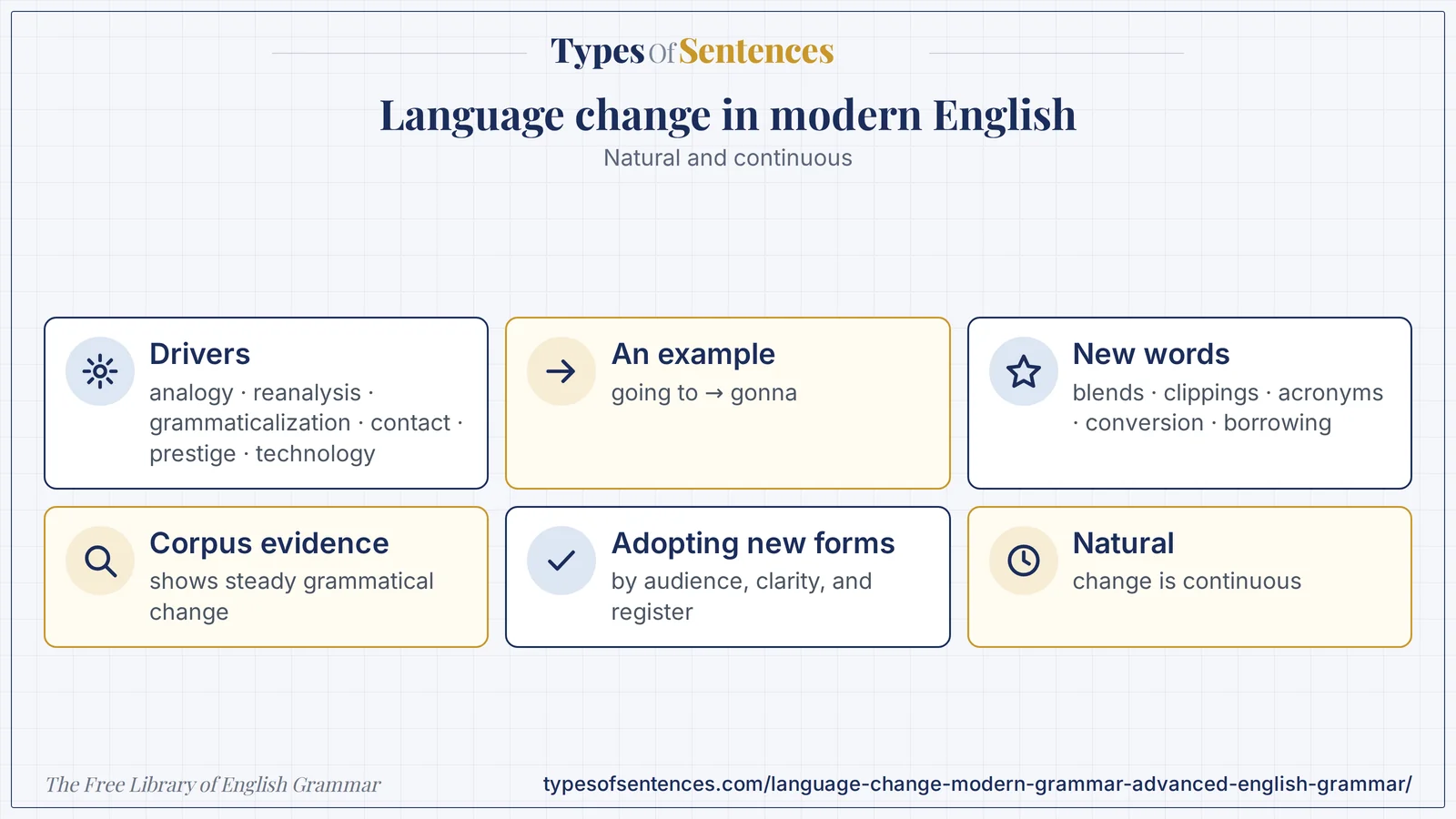
Language changes because people use it, and people are always doing small new things with it: a new word for a new object, a shorter way to say something, a form borrowed from a neighbor. When enough speakers adopt the new form, it becomes part of the language.
Why it matters: You do not have to accept every change, and you do not have to resist every change. You can ask who your reader is, how formal the occasion is, and whether the new form is clear. That is how good writers have always handled a language in motion.
Summary: Languages change through innovation and spread, driven by analogy, reanalysis, grammaticalization (going to becoming gonna), contact with other languages, social prestige, and technology. New words come from compounding, blending, clipping, acronyms, back-formation, conversion, and borrowing. Corpus studies document grammatical changes in recent English: more semi-modals (have to, want to), more progressives and get-passives, fewer shall and whom, more contractions, denser noun phrases, and growing use of singular they. Digital communication adds abbreviations, emoji, and punctuation as tone, without damaging literacy. Younger speakers often lead change, though some differences are age-related and temporary. Prescriptivists try to guard the standard; descriptivists record and explain change; a practical writer uses both, according to context and audience.
- Change is natural and continuous.
- New words: blends, clippings, acronyms, conversion, borrowing.
- Corpus evidence shows steady grammatical change.
- Adopt new forms by audience, clarity, and register.
What You’ll Learn
- 1. Language Change in Modern English: How and Why Languages Change
- 2. New Words and Expressions: How Neologisms Are Formed
- 3. Grammatical Changes in Contemporary English
- 4. Singular They: History and Modern Acceptance
- 5. Internet and Digital Language: Abbreviations, Emoji, and Texting
- 6. Generational Differences: Youth Language and Innovation
- 7. Prescriptivism vs Descriptivism: The Ongoing Debate
- 8. Writing in a Changing Language: Practical Guidance
- 9. Common Errors in Thinking About Language Change
- 10. Exercises
- 11. Test Your Knowledge
- 12. Frequently Asked Questions
- 13. Conclusion
1. Language Change in Modern English: How and Why Languages Change
| Process | Description | Example |
|---|---|---|
| innovation and spread | a new form appears in a few speakers and spreads through social networks; many innovations fail, some succeed | a new word for a new thing |
| analogy | a form is reshaped to match a more regular pattern | helped for older holp; dived versus dove |
| reanalysis | speakers reinterpret the structure of a form | a napron became an apron |
| grammaticalization | a content word or phrase becomes a grammatical marker, often with phonetic reduction | be going to → gonna; the verb will from a verb of wishing |
| borrowing (contact) | words and sometimes structures are adopted from other languages | pajamas (Hindi), bungalow (Hindi), tsunami (Japanese) |
| phonetic erosion and ease of articulation | frequent forms become shorter | going to → gonna; want to → wanna |
| semantic change | meanings widen, narrow, or shift | awful once meant “inspiring awe”; nice once meant “foolish” |
| social prestige and identity | forms spread because they are associated with admired groups, or abandoned because they are stigmatized | — |
| technology | new media create new forms and new vocabulary | email, hashtag, emoji |
| frequency | frequent forms resist regularization; rare irregular forms regularize | be and go remain irregular; snuck competes with sneaked |
| Level of change | Examples |
|---|---|
| sound | the shift in vowels of some American accents (the “Northern Cities” shift); -ing to -in’ in speech |
| vocabulary | selfie, podcast, unfriend, binge-watch |
| meaning | web, cloud, stream, viral |
| grammar | singular they, the quotative be like, semi-modals, the get-passive |
| pragmatics | new politeness formulas (no worries, I’m good); new discourse markers (so at the start of an answer) |
| spelling and punctuation | the decline of the hyphen in some compounds (email); texting conventions |
- Changes spread gradually. A change is often an S-curve: slow at first, then rapid, then complete.
- Changes happen in speech first, and reach formal writing later, if at all.
- Researchers can observe change in progress by comparing speakers of different ages (“apparent time”) and by comparing texts from different decades (“real time”) in corpora.
- Change is not progress or decay. It reshapes the language, and no language has ever stopped changing while it had speakers.
- Change varies by community. A change may advance in American English and lag in British English, or the reverse (for example gotten and the mandative subjunctive).
2. New Words and Expressions: How Neologisms Are Formed
| Process | How it works | Examples |
|---|---|---|
| compounding | two words joined | smartphone, screenshot, podcast (from iPod and broadcast), homeschool |
| blending | parts of two words merged | brunch, smog, motel, infotainment, staycation, Brexit, webinar |
| clipping | a word shortened | info, exam, app, vlog (from video blog) |
| acronyms (pronounced as words) | initials read as a word | laser, scuba, NASA, radar |
| initialisms (letters pronounced) | initials read as letters | FAQ, CEO, BTW |
| back-formation | a shorter word made from a longer one | edit from editor, enthuse from enthusiasm, babysit |
| conversion (functional shift) | a word changes class | to google, to text, to friend, a fail, an ask |
| derivation (affixation) | prefixes and suffixes added | unfriend, detox, -ify, -ish as a word |
| borrowing | a word taken from another language | sushi, emoji (Japanese), bungalow, avatar (Sanskrit) |
| eponyms | a word from a name | googling, boycott, sandwich |
| semantic shift of existing words | new senses for old words | mouse, tablet, stream, viral, cloud |
| phrase to word | a phrase becomes a word | whatever, no-brainer |
| reduplication and sound symbolism | — | bling, blog |
| abbreviation to full word | — | lol as a word (lols) |
| Word or expression | Type | Comment |
|---|---|---|
| selfie | derivation (self + -ie) | named Oxford Dictionaries’ Word of the Year for 2013 |
| hashtag | compound | from a symbol on social platforms |
| emoji | borrowing (Japanese) | a pictograph used in digital messages |
| podcast | blend | from iPod and broadcast |
| blog | clipping | from weblog |
| spam | semantic shift | from a food brand to unwanted email |
| meme | borrowing from a coinage by Richard Dawkins | spread through the internet |
| unfriend | derivation | on social networks |
| binge-watch | compound | of television series |
| staycation | blend | stay + vacation |
| webinar | blend | web + seminar |
| post-truth | compound | named Oxford’s Word of the Year for 2016 |
| they (singular, specific) | grammatical extension | Merriam-Webster’s Word of the Year for 2019 |
| ghost (verb) | conversion | to cut off contact without explanation |
| doomscroll | compound | to keep reading bad news online |
| bandwidth (figurative) | semantic shift | capacity for tasks |
| reach out | phrase | to contact |
| going forward | phrase | from now on (often criticized as jargon) |
| hack (life hack) | semantic shift | a clever shortcut |
| sharing economy | compound | — |
| crowdfunding | compound | — |
| photobomb | blend/compound | — |
| hangry | blend | hungry + angry |
| mansplain | blend | a contested coinage |
| upcycle | blend | — |
| phubbing | blend | phone + snubbing |
Dictionaries add new words after they have been in use for some time, and many publishers announce a “word of the year”; such choices reflect a moment and many words do not survive. A new word’s life cycle is usually: coinage; use in a community; spread to wider use; entry in dictionaries; and sometimes decline. Writers should check that a new word is established for their readers (see the chapter on diction), and the processes of word formation are treated in the chapter on morphology.
3. Grammatical Changes in Contemporary English
Grammar changes more slowly than vocabulary, but corpus studies (see the next chapter) have measured shifts in recent decades. The best-known studies compare matched collections of British and American texts from the early 1960s with those from the early 1990s and later, and the main trends were reported by Geoffrey Leech and colleagues (2009) and by others. The findings below are broad trends and not rules; they differ by genre and variety.
| Change | Direction | Notes |
|---|---|---|
| core modal verbs (must, shall, may, ought to) | declining in frequency in written English | shall especially; must in some genres |
| semi-modals (have to, need to, want to, be going to) | increasing | have to and want to grew steadily |
| progressive aspect (is working) | increasing | including with new verbs and in the passive |
| get-passive (got fired) | increasing | especially in speech and informal writing |
| mandative subjunctive (I insist that he be) | increasing in British English; stable in American | reflects American influence |
| whom | declining | confined to formal writing and fixed phrases |
| who/that and zero relatives | increasing in relation to which and whom | — |
| contractions (don’t, it’s) | increasing even in written genres | also an effect of informality |
| noun-phrase compression (noun + noun) | increasing, especially in news and academic writing | the council housing policy review |
| -ing clauses and informal structures in writing | increasing | written English becoming closer to speech |
| less before plural nouns | increasing in speech | fewer still preferred in formal writing |
| was versus were in unreal conditions (if I was) | was increasing informally | formal writing keeps were |
| me and X as subject | common in speech | nonstandard in writing |
| different than | used by educated speakers | mainly American |
| new intensifiers and quotatives (so, totally, be like) | spreading among younger speakers | — |
| singular they | increasing and increasingly accepted | see the next section |
| -ly adverb dropping (drive slow) | persists in speech | — |
| literally as an intensifier | established in informal use | — |
| y’all, you guys, youse | new second-person plural forms in different regions | a gap in the pronoun system that speakers fill |
| reply formulas (no worries, I’m good) | spreading | pragmatic change |
| Factor behind the change | Example |
|---|---|
| colloquialization | written English adopting the features of speech: contractions, first and second person pronouns, simpler clauses |
| densification | compact noun phrases in news and academic prose |
| Americanization | American forms spreading in British English (gotten remains rare in Britain; the mandative subjunctive spread) |
| democratization | writing for wider audiences, with less formality |
| technology | speech-like writing on screens |
| globalization | English as a second language influencing forms |
These changes show that grammar, too, is on the move, and that “correct” can mean different things in different decades. The comparisons in the chapter on grammar myths show how usage guides have lagged behind usage. Remember that change in progress produces variation: for a time, both the old and the new forms are in use, and the choice becomes a matter of register and audience.
4. Singular They: History and Modern Acceptance
| Use | Example | Status |
|---|---|---|
| generic indefinite (anyone, someone, everyone) | Everyone should bring their own lunch. | long-standing and widely accepted |
| an unknown or unspecified person | If a student is late, they must sign in. | widely accepted; recommended by many style guides |
| a specific person who uses they | Alex said they would come. | accepted by major style guides and increasingly general |
| after who | Whoever finished first, they won. | common |
| singular they with a plural verb | They are a good teacher. | standard (they takes are, as you does) |
| reflexive themself | Someone has hurt themself. | emerging; themselves is also used |
| two forms side by side | He or she / they | he or she is wordy; they is shorter |
| the old generic he | A student must submit his work. | dispreferred in modern guides because it excludes |
| Historical and recent evidence | Detail |
|---|---|
| early use | examples appear in the fourteenth century (in texts such as William and the Werewolf) and in many later writers, including Chaucer, Shakespeare, and Jane Austen |
| eighteenth-century objections | some grammarians objected that a plural pronoun cannot have a singular antecedent, and recommended generic he |
| twentieth-century reaction | the objection to generic he grew and singular they was promoted as an alternative |
| 2015 | the American Dialect Society chose singular they as its Word of the Year |
| 2019 | Merriam-Webster chose they (for a single person) as Word of the Year |
| style guides | major guides, including APA (7th edition, 2019), now endorse singular they; others accept it for specific people or in informal use |
| usage | corpus studies show it increasing in speech and writing |
| Objection | Response |
|---|---|
| It is plural, so it cannot be singular. | You was plural and is now singular and plural; English pronouns have changed number before. |
| It is ambiguous. | Context almost always resolves it; the same ambiguity applies to you. |
| It is new. | It has been used for more than six hundred years. |
| It is ungrammatical. | Grammar is defined by usage; it is used by respected writers. |
| It is hard to use. | It follows the pattern of you: they are. |
| I do not want to use it formally. | Many style guides allow rewording (a plural subject; one; the repeated noun). |
- Use singular they for an unknown person and for a person who uses it.
- Respect the pronouns that people use for themselves. Using the wrong pronoun deliberately can cause harm.
- Follow the house style for formal documents.
- You can avoid the issue by rewriting: Students must submit their work.
- Be consistent within a document.
5. Internet and Digital Language: Abbreviations, Emoji, and Texting
| Form | Examples | Notes |
|---|---|---|
| initialisms and abbreviations | LOL (laughing out loud), BTW (by the way), IMO (in my opinion), FYI, TBH (to be honest), OMG, BRB, IDK, TL;DR | often spoken as letters; many now serve as discourse markers (lol as a softener) |
| clippings and shortened spellings | thx, pls, u, ur, 2 (to), gr8 | mostly informal; less common in current texting than in older reports |
| emoticons and emoji | 😊 🙂 👍 | add tone and emotional cues that are missing in text |
| hashtags | #WritingTips, #MeToo | organize topics; a new kind of tag; each word capitalized helps readability |
| letter repetition | sooo, noooo | shows emphasis or tone |
| capitalization | ALL CAPS for loudness; all lowercase as a style | tone markers |
| punctuation | multiple !!!, ellipsis …, a period as a curt ending, a lack of punctuation | punctuation as tone |
| @ mentions | @name | direct address |
| URLs and links | — | a new kind of reference |
| memes and catchphrases | a repeated phrase or image format | spread rapidly and date quickly |
| acronym words | FOMO (fear of missing out), YOLO | often short-lived |
| Feature of speech-like writing | Example | Explanation |
|---|---|---|
| dropped subjects | Going home. Be there soon. | as in speech and notes |
| sentence fragments | Not yet. On my way. | common in chat |
| discourse markers | so, well, anyway, lol | speech features transferred to text |
| turn-taking in threads | short messages in sequence | mirrors conversation |
| abbreviation for speed | omw (on my way) | efficiency |
| tone repair with emoji | OK 🙂 (softens) vs OK. (curt) | tone must be built into the text |
| code-switching | formal in an email, informal in chat | writers adjust to the medium |
| Common claim | What research suggests |
|---|---|
| Texting is ruining young people’s writing. | Studies generally find no simple harmful effect; some find that texting is associated with literacy skills, and most young people switch registers. |
| Emoji are replacing words. | Emoji supplement words by supplying tone; they have not replaced language. |
| Internet language is full of errors. | It follows its own norms, which differ by community and are as regular as other registers. |
| Abbreviations make people unable to write properly. | Knowing an abbreviation presupposes knowing the full form; the skill is choosing the right register. |
Digital language is largely an extension of speech into writing: it is fast, personal, and shaped by the medium. The linguist David Crystal, in Txtng: The Gr8 Db8 (2008), argued that texting is a creative extension of language and not a threat to it. The skill for a writer is to adjust the register to the medium and the reader (see the chapter on register and style and on writing for digital media). Slang and meme language date very quickly, so avoid them in writing meant to last.
6. Generational Differences: Youth Language and Innovation
| Feature | Younger speakers (tendency) | Older speakers (tendency) | Note |
|---|---|---|---|
| quotative be like | She was like, “No way.” | She said, “No way.” | spread since the 1980s |
| intensifiers | so, totally, super, hella (regional) | very, really | the fashion in intensifiers changes quickly |
| approval words | awesome, dope, lit, fire | great, terrific | slang words date quickly |
| discourse markers | like, you know, I mean, literally | well, you see | — |
| politeness formulas | no worries, I’m good, my bad | you’re welcome, no thank you | — |
| second-person plural | you guys, y’all | you | by region |
| the get-passive | more frequent | less frequent | — |
| singular they | accepted | accepted less | — |
| punctuation in messages | minimal; a period can sound curt | full punctuation | a generational norm of tone |
| spelling and typography | informal conventions in digital media | formal conventions | by medium |
| Concept | Meaning |
|---|---|
| age grading | a feature typical of a particular age that each generation uses when young and abandons (for example certain slang) |
| generational change | a feature that the young adopt and keep as they age, so that the language changes |
| apparent time | comparing different age groups to infer change in progress |
| real time | comparing the same community at different times |
| slang lifecycle | coinage, trend, spread, mainstreaming, and decline or survival |
Complaints that “young people are ruining the language” are very old, and each generation’s innovations tend to become the next generation’s standard. Some features of youth language are age-graded and will fade as the speakers age; others will remain. A writer addressing a mixed audience will do best with the forms that are shared by most of the readers and will not date the text.
7. Prescriptivism vs Descriptivism: The Ongoing Debate
| Position | Attitude to change | Typical argument |
|---|---|---|
| prescriptivism (purism) | suspicious: change threatens clarity and standards | the standard should be preserved; the language should be taught as it should be |
| descriptivism | neutral: change is natural data to be recorded and explained | the language is what people use; judgments of “decay” are unscientific |
| moderate (practical) view | selective: some changes enter the standard when they are established, clear, and useful | guard clarity and the reader’s expectations; accept change where it is accepted by good writers |
| Test for adopting a new form in writing | Question |
|---|---|
| established? | Is it widely used by people the reader respects, in reputable publications, over time? |
| clear? | Does it avoid ambiguity? |
| necessary? | Does it fill a gap? |
| register? | Is it appropriate to the formality of the text? |
| audience? | Will the reader understand it and accept it? |
| durable? | Will it still be understood in a few years? |
| guide? | What does the relevant style guide say? |
Some languages have official bodies that regulate usage (the French Académie française is an example); English has none, and its “authorities” are dictionaries, usage guides, and style manuals, each with its own method. The question is not whether to prescribe or describe but how each tool serves the writer. The earlier chapter on grammar myths and controversies shows how to evaluate a claim, and the next chapter shows how corpora supply the evidence.
8. Writing in a Changing Language: Practical Guidance
- Know your reader. What do they expect, and what will they tolerate?
- Know the genre. Formal writing adopts changes later than informal writing.
- Check the style guide. House styles update at intervals (for example the acceptance of singular they and of email).
- Use dictionaries and corpora. A current dictionary records the status of a word; a corpus shows frequency.
- Prefer established forms in lasting documents and expect slang to date.
- Be consistent. Do not alternate old and new forms for the same function in one document.
- Be respectful of people’s own usage, such as the pronouns they use.
- Do not mock change. Today’s “error” may be tomorrow’s standard.
| Situation | Choice |
|---|---|
| a legal contract | established forms; no slang; no experimental grammar |
| a research article | follow the journal; singular they accepted in many |
| a business email | plain, current forms; moderate informality |
| a text to a friend | any register that fits; abbreviations and emoji |
| a novel | forms that fit the characters and period; dialect and slang as needed |
| a textbook | current standard forms, with notes on variation |
9. Common Errors in Thinking About Language Change
| Error | Example | Better |
|---|---|---|
| treating change as decay | “Texting is destroying English.” | Language changes; registers differ. |
| treating all change as good | “Anything people say is correct everywhere.” | Context and the reader’s expectation matter. |
| thinking that only young people change language | — | All speakers contribute; older speakers adopt some changes. |
| dating a text with slang | a manual with trendy phrases | use plain, durable language |
| mixing registers by accident | Dear Sir, lol, thanks! | choose one register |
| mocking singular they | — | follow the style guide and respect the writer |
| believing that neologisms are all bad | — | some fill real gaps (email, podcast) |
| claiming that “the dictionary decides” | — | dictionaries report usage; they do not legislate |
| over-using fashionable words | leverage, synergy, circle back | plain verbs |
| assuming that spelling is fixed | — | spelling conventions change (email, website) |
| using a new form without checking the audience | a slang word in a formal report | choose by the reader |
| treating a change as a mistake because it is new | hopefully as a sentence adverb | check the evidence |
| ignoring variety | forms that are standard in another variety | check the reader’s variety |
Edit for a formal report (audience: senior managers): So, like, the team totally leveraged the new app to hit the targets, and they’re literally crushing it, lol, going forward everyone should bring their laptop and no worries if someone doesn’t, they’ll sort themself out, hopefully.
- So, like, … totally: fillers and intensifiers inappropriate to a formal report: delete.
- leveraged the new app: jargon: used the new app.
- hit the targets: idiom: acceptable, or met the targets.
- they’re literally crushing it, lol: slang and an internet abbreviation: they exceeded the targets.
- going forward: jargon: from now on.
- everyone should bring their laptop: singular they: accepted in most guides; keep, or all staff should bring a laptop.
- no worries if someone doesn’t, they’ll sort themself out, hopefully: informal: Staff without a laptop will be given one.
- Result: The team used the new app and exceeded the targets. From now on, all staff should bring a laptop; staff without one will be given one. (the passage is invented)
Recap in 12 seconds
Watch the lesson build itself: Language changes through analogy, grammaticalization, contact, prestige, and technology; adopt new forms by audience, clarity, and register. The video has no sound.
Exercises
Part A: How Language Changes (Exercises 1–6)
Exercise 1: Is language change natural?
Show Answer
Answer: Yes.
Exercise 2: Name a process of change.
Show Answer
Answer: Analogy, reanalysis, grammaticalization, borrowing, semantic change.
Exercise 3: What is grammaticalization?
Show Answer
Answer: A word or phrase becoming a grammatical marker (going to → gonna).
Exercise 4: What is “apparent time”?
Show Answer
Answer: Comparing different age groups to infer change in progress.
Exercise 5: What is an S-curve of change?
Show Answer
Answer: Slow, then rapid, then complete.
Exercise 6: Does change always begin in writing?
Show Answer
Answer: No; usually in speech.
Part B: New Words (Exercises 7–13)
Exercise 7: Name the process: brunch
Show Answer
Answer: Blending.
Exercise 8: Name the process: info
Show Answer
Answer: Clipping.
Exercise 9: Name the process: to google
Show Answer
Answer: Conversion.
Exercise 10: Name the process: edit from editor
Show Answer
Answer: Back-formation.
Exercise 11: Name the process: laser
Show Answer
Answer: Acronym.
Exercise 12: Name the process: unfriend
Show Answer
Answer: Derivation (prefix).
Exercise 13: Name the process: emoji
Show Answer
Answer: Borrowing (Japanese).
Part C: Grammar Change and Singular They (Exercises 14–20)
Exercise 14: Which modal is declining: shall or have to?
Show Answer
Answer: shall.
Exercise 15: Which is increasing: the progressive or the dual?
Show Answer
Answer: The progressive.
Exercise 16: Name a declining pronoun.
Show Answer
Answer: whom.
Exercise 17: Since when has singular they been used?
Show Answer
Answer: The fourteenth century.
Exercise 18: Which verb form goes with singular they?
Show Answer
Answer: Plural: they are.
Exercise 19: Name two ways to avoid singular they.
Show Answer
Answer: Rewrite in the plural; repeat the noun; use one.
Exercise 20: Which guide endorsed singular they in 2019?
Show Answer
Answer: APA (7th edition).
Part D: Digital and Generational (Exercises 21–26)
Exercise 21: Expand: BTW
Show Answer
Answer: by the way.
Exercise 22: Expand: IMO
Show Answer
Answer: in my opinion.
Exercise 23: What do emoji supply?
Show Answer
Answer: Tone and emotion cues.
Exercise 24: Does research show texting ruins literacy?
Show Answer
Answer: No simple harmful effect has been shown.
Exercise 25: What is age grading?
Show Answer
Answer: A feature of a particular age that is abandoned later.
Exercise 26: Name a youth quotative.
Show Answer
Answer: be like.
Part E: Attitudes and Practice (Exercises 27–30)
Exercise 27: Define descriptivism.
Show Answer
Answer: Recording and explaining usage without judging change as decay.
Exercise 28: Name a test for a new form.
Show Answer
Answer: Established? Clear? Necessary? Appropriate to the register and audience?
Exercise 29: Should slang be used in lasting formal writing?
Show Answer
Answer: No; it dates quickly.
Exercise 30: Edit: going forward (plain)
Show Answer
Answer: from now on.
Test Your Knowledge
Ready to check what you learned? Answer all 10 questions, then submit. You need 80% (8 of 10) to pass. Your answers are not stored.
View correct answers and explanations
Question 1: Language change is
✓ Correct Answer: A – natural and continuous
Natural.
Question 2: Which process forms brunch?
✓ Correct Answer: B – blending
A blend.
Question 3: Which is a clipping?
✓ Correct Answer: C – info
Info.
Question 4: Singular they has been used since
✓ Correct Answer: D – the fourteenth century
Fourteenth century.
Question 5: LOL is best described as
✓ Correct Answer: C – an initialism
An initialism.
Question 6: Which change is documented in recent corpus studies?
✓ Correct Answer: A – an increase in semi-modals such as have to
Semi-modals rise.
Question 7: What is “apparent time”?
✓ Correct Answer: D – comparing different age groups to infer change
Age comparison.
Question 8: What is the best practice for slang in lasting writing?
✓ Correct Answer: C – use sparingly and expect it to date
Slang dates.
Question 9: Do studies show that texting ruins literacy?
✓ Correct Answer: B – research finds no such simple effect
No simple harm.
Question 10: Which is a descriptive attitude to change?
✓ Correct Answer: B – record and explain change
Record and explain.
Frequently Asked Questions
What is language change in modern English?
Language change in modern English is the continuing change in the words, grammar, and usage of English today: new words, new constructions such as singular they and get-passives, and new forms of digital writing.
What are modern English changes?
Modern English changes include new vocabulary (selfie, podcast), more semi-modals and progressives, fewer shall and whom, more contractions, singular they, and the language of texting and the internet.
What is contemporary grammar?
Contemporary grammar is the grammar of English as it is used now, as described by corpus studies and recent reference grammars. It includes both stable rules and changes in progress.
What is an evolving language?
An evolving language is one that changes over time, through use. Every living language is an evolving language.
What is new grammar?
New grammar means constructions and uses that have recently emerged or spread, for example the quotative be like, singular they for specific people, and you guys as a plural. New grammar often starts in speech.
Is texting ruining English?
Research does not support this claim. Texting uses its own conventions and most people adjust their register to the medium.
Should I use new words and constructions in formal writing?
Only when they are established, clear, and suited to the reader and the genre. Check the style guide and a current dictionary.
Conclusion
You now have a study of language change in modern English: how and why languages change, how new words are formed, the grammatical changes of recent decades, singular they, digital language, generational differences, the debate between prescriptivism and descriptivism, and a practical method for writing in a language that moves. You can observe change without panic and use it with judgment.
When you meet a new word or construction, ask whether it is established, clear, and right for your reader. Next, you will study corpus linguistics.
- Aitchison, Jean. Language Change: Progress or Decay? 4th ed. Cambridge University Press, 2013.: how and why languages change.
- Leech, Geoffrey, Marianne Hundt, Christian Mair, and Nicholas Smith. Change in Contemporary English: A Grammatical Study. Cambridge University Press, 2009.: corpus evidence of grammatical change.
- Crystal, David. Txtng: The Gr8 Db8. Oxford University Press, 2008.: the study of texting.
- Curzan, Anne. Gender Shifts in the History of English. Cambridge University Press, 2003.: historical background to gender and pronouns.
- Merriam-Webster Dictionary: change: the dictionary entry.
Last reviewed: October 29, 2026. How it was made: drafted with AI assistance, then checked with automated tests (structure, links, answer keys, spelling) and against the sources above. A person has not yet read this chapter line by line. Found a mistake? Report it.