The history of English grammar is the story of a language that began as a heavily inflected Germanic tongue and became one of the least inflected languages in Europe. Old English had four cases, three grammatical genders, and many verb endings; modern English has almost none of these, and relies on word order and small words (prepositions and auxiliaries) to show grammatical relations. Between them lie the Viking settlements, the Norman Conquest, the printing press, the Renaissance, and the codifying work of eighteenth-century grammarians. Every irregular form that a learner must memorize, from mice to went, is a fossil of this history.
This chapter gives an account of grammar evolution from Old English to the present. You will study the main periods (Old, Middle, Early Modern, and Modern English), the changes that defined each, the features that the language lost and gained, the way sound changes left irregular forms, the effect of contact with Old Norse, French, and Latin, and the rise of prescriptive grammar. Knowing English language history helps in reading older texts and in understanding why modern rules, and the myths that surround them, take the form they do. Historical grammar also shows that the language is in continuous language development, a theme taken up in the next chapter. Thirty editing exercises and a quiz follow.
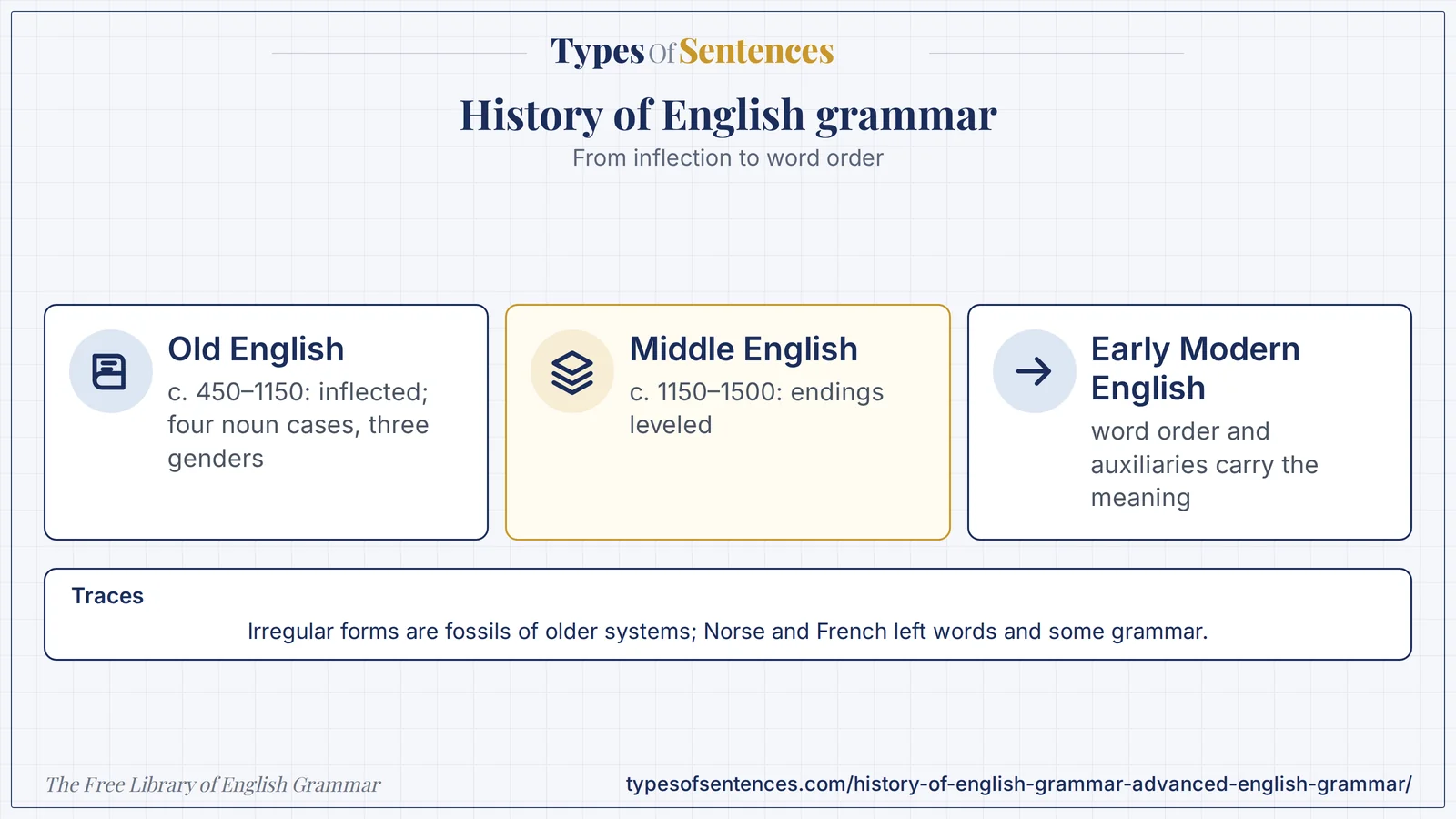
English has changed so much that Old English looks like a foreign language to a modern reader. The biggest change in grammar is that English stopped marking the job of a word with an ending (as Latin does) and began to mark it with word order and small words.
Why it matters: Many oddities of modern English have a historical reason: mice and geese come from old sound changes, went was once the past tense of another verb, and thou disappeared from standard English when you took over.
Summary: English is a West Germanic language. Old English (c. 450–1150) was inflected, with four noun cases, three genders, strong and weak verbs, and a freer word order. Middle English (c. 1150–1500), after the Norman Conquest of 1066 and contact with Old Norse and French, lost most inflections and grammatical gender and developed fixed subject–verb–object order. Early Modern English (c. 1500–1700) saw the printing press, the Great Vowel Shift, the rise of do-support, the progressive, and the first moves toward standardization. Modern English (from c. 1700) was shaped by dictionaries, prescriptive grammars, universal education, and global spread. Irregular plurals and verbs are survivals of earlier systems, and the loss of inflection is the defining grammatical change.
- Old English: inflected; Middle: leveled; Early Modern: standardizing; Modern: codified.
- Case endings and gender were lost; word order and auxiliaries took over.
- Contact with Norse and French left words and some grammar.
- Irregular forms are fossils of older systems.
What You’ll Learn
- 1. The History of English Grammar: Overview and Periods
- 2. Old English (c. 450–1150): A Synthetic Germanic Language
- 3. Middle English (c. 1150–1500): The Great Simplification
- 4. Early Modern English (c. 1500–1700): Print, Shakespeare, and the Beginnings of a Standard
- 5. Modern English (c. 1700–present): Standardization and Prescription
- 6. Grammar Changes Over Time: Lost and Gained Features
- 7. Why Historical Grammar Matters
- 8. How Do We Know? Methods and Limits of Historical Linguistics
- 9. Common Misconceptions About the History of English
- 10. Exercises
- 11. Test Your Knowledge
- 12. Frequently Asked Questions
- 13. Conclusion
1. The History of English Grammar: Overview and Periods
| Period | Approximate dates | Key events | Grammatical character |
|---|---|---|---|
| Old English (Anglo-Saxon) | c. 450–1150 | Germanic tribes settle in Britain; Christianity and Latin writing arrive (c. 600); Viking raids and settlement (from the 790s); the Danelaw | inflected: four cases, three genders, strong and weak verbs, freer word order |
| Middle English | c. 1150–1500 | Norman Conquest (1066); French as the language of the court; English revived as a written language in the fourteenth century (Chaucer, c. 1343–1400); the Black Death (1348–50) | inflections eroded; gender lost; plural -s and fixed word order spread; prepositions and auxiliaries grow |
| Early Modern English | c. 1500–1700 | printing introduced to England by Caxton (1476); the Great Vowel Shift (c. 1400–1700); the Renaissance and borrowing from Latin and Greek; Shakespeare (1564–1616); the King James Bible (1611) | thou/you, -eth/-s; do-support develops; the progressive grows; spelling begins to be fixed |
| Modern English | c. 1700–present | dictionaries (Johnson 1755); prescriptive grammars (Lowth 1762; Murray 1795); Webster’s American dictionary (1828); the Oxford English Dictionary (1884–1928); mass literacy; the spread of English worldwide | a largely analytic language; standardization; regional and global varieties; continuing change |
| Fact | Explanation |
|---|---|
| English is a Germanic language | it belongs to the West Germanic branch of the Indo-European family, with Dutch, German, and Frisian |
| most of its core vocabulary is Germanic | house, water, eat, is, and |
| much of its learned vocabulary is Latin or French | government, judge, science |
| its grammar is Germanic in origin | the verb system (strong/weak verbs, -ed past), pronouns, and basic structure |
| it has borrowed grammar words from Old Norse | they, them, their |
| sound correspondences link it to Latin and Greek | Latin pater, pes, piscis ~ English father, foot, fish (Germanic consonant shift) |
The dates are conventional. Languages change gradually, and the boundaries between the periods are blurred by regional variation and by the uneven survival of texts. Most surviving Old English is in the West Saxon dialect, and most Middle English in London and other regional dialects. The sections below describe what each period was like and what changed.
2. Old English (c. 450–1150): A Synthetic Germanic Language
| Feature | Old English | Modern English |
|---|---|---|
| noun cases | four main cases: nominative, accusative, genitive, dative (with a few traces of an instrumental) | one common case plus the genitive (’s) and the possessive pronouns |
| grammatical gender | masculine, feminine, neuter, assigned by form, not meaning (wif “woman” was neuter; sunne “sun” feminine; mona “moon” masculine) | natural gender only (he, she, it) |
| definite article | se, seo, þæt and other forms by case, gender, and number | one form: the |
| adjectives | agreed with nouns in case, gender, number, and had strong and weak forms | invariable |
| pronouns | ic, þu, he, heo, hit; we, ge, hie; a dual number (wit “we two”, git “you two”) | I, you, he, she, it, we, they; no dual |
| verbs | two simple tenses (present, past), strong verbs (vowel change: singan, sang, sungon, sungen) and weak verbs (dental suffix); subjunctive mood; personal endings | tenses made with auxiliaries; few endings (-s, -ed, -ing) |
| word order | freer, because case showed the roles; verb often second in main clauses, final in subordinate clauses | fixed subject–verb–object |
| negation | ne before the verb; multiple negation was normal | not with do-support; multiple negation nonstandard |
| questions | verb before subject (no do) | do-support with most verbs |
| Form (Old English) | Case and function | Modern meaning |
|---|---|---|
| se cyning | nominative (subject) | the king |
| þone cyning | accusative (object) | the king (as object) |
| þæs cyninges | genitive (possession) | of the king; the king’s |
| þæm cyninge | dative (indirect object, “to”) | to the king |
| stan | nominative, accusative singular | stone |
| stanes | genitive singular | of the stone |
| stane | dative singular | to the stone |
| stanas | nominative, accusative plural | stones |
| stana | genitive plural | of the stones |
| stanum | dative plural | to the stones |
| Old Norse and Latin influence | Examples | Effect |
|---|---|---|
| Old Norse (Viking settlement, from the late ninth century) | they, them, their; take, egg, sky, skin, window, law; possibly simplified endings, because Norse and English were mutually similar | new pronouns and many everyday words; may have speeded the loss of inflections |
| Latin (Christianity and learning) | school, priest, candle, monk | religious and learned vocabulary |
| Celtic | a few place names (Thames, Avon), possibly the progressive construction | small direct effect; debated influence on grammar |
Old English was a synthetic language: grammatical relations were shown by endings on words. Many forms survive in disguise: the plural -s of stanas, the -s of the genitive (stanes became stone’s), the -en plurals (oxen, children, brethren), and the vowel changes of sing/sang/sung. The adverb ending -ly comes from the Old English -lice (“-like”); the study of such word-building endings is the subject of the chapter on morphology in English. The verb-second tendency survives in a few formulas such as Here comes the bus and Never have I seen, which are treated in the chapter on inversion.
3. Middle English (c. 1150–1500): The Great Simplification
| Change | What happened | Result in modern English |
|---|---|---|
| loss of inflections | unstressed vowels in endings reduced to a weak e and then were lost; endings became unreliable | noun endings largely gone; adjectives invariable |
| loss of grammatical gender | by about 1300 in most dialects, gender stopped being marked on articles and adjectives; natural gender replaced it | he, she, it by meaning |
| a single article | se/þæt forms merged into the (from þe) | the |
| plural -s generalized | the -es plural spread from the northern and eastern dialects; a few older plurals remained | regular plural -s; irregular oxen, mice |
| fixed word order | without case endings, position showed the subject and object; subject–verb–object became normal | SVO |
| more prepositions | of, to, and for replaced case endings (of the king, to the king) | prepositional phrases |
| new auxiliaries | will/shall for the future; have + participle for the perfect; be for the passive | the compound tenses |
| pronouns | she (probably from a different source than Old English heo), they/them/their from Norse, its later | modern pronouns |
| thou and ye/you | thou (singular, familiar) versus ye/you (plural and polite), on the model of French tu and vous | you alone in standard English |
| French vocabulary | government, court, judge, beef (cow: beef), pork, mutton | a large Romance layer |
| strong verbs reduced | many strong verbs became weak (help, holp became help, helped) | a modest set of irregular verbs remains |
| Middle English example | Modern English | Features |
|---|---|---|
| Whan that Aprill with his shoures soote | When April with its sweet showers (Chaucer, Canterbury Tales, c. 1387–1400, opening line) | his for neuter its; spelling and pronunciation of earlier English |
| Ich wolde | I would | ich/ic becoming I |
| Nay, ne wol I | No, I will not | ne negation (older) |
| He nevere yet no vileynye ne sayde | He never yet said any rudeness to anyone (the Knight, in Chaucer) | multiple negation as reinforcement |
This is sometimes called the “great simplification”, because the language lost so much of its inflection. Scholars disagree on the causes: the shift of stress to the first syllable of words (which weakened endings), contact with Norse speakers (who could understand each other without the endings), and the effect of French (which gave English a prestige rival) have all been proposed. The French and Latin vocabulary that entered at this time is still visible in the language of law (see the chapter on legal writing). The dialects of the north, in contact with Norse, lost inflections earlier than the south, and the East Midlands dialect, spoken in London, became the base of the later standard.
4. Early Modern English (c. 1500–1700): Print, Shakespeare, and the Beginnings of a Standard
| Feature | Early Modern English | Example |
|---|---|---|
| printing and spelling | Caxton’s press (1476) and later printers fixed many spellings, often those of an earlier pronunciation (knight, though) | silent letters preserve older sounds |
| Great Vowel Shift | the long vowels rose and diphthongized (c. 1400–1700), separating spelling from pronunciation | bite was once “BEE-tuh” |
| thou/thee and you | thou for an intimate or inferior; you for polite or plural; by 1700 thou was dying out | “Thou art” versus “You are” |
| verb endings | -est (2nd person: thou lovest) and -eth or -s (3rd person: he loveth, he loves); -s became standard in the seventeenth century | doth and does coexist |
| do-support | do grew in questions and negatives; before about 1700 negatives and questions without do were still usual (I know not; Saw you him?) | Do you know?; I do not know |
| the progressive | more frequent; the passive progressive (is being built) appeared only in the late eighteenth century | the house is building (older) versus is being built |
| relative pronouns | which was used of persons (Our Father which art in heaven); who and that spread | who for persons |
| its | a new form; earlier his or it was used for neuter possession; its is rare in Shakespeare and absent from the King James Bible | its |
| double comparatives and superlatives | more better, most unkindest were acceptable | the most unkindest cut of all |
| be as a perfect auxiliary with intransitive verbs | He is come; she is gone | He has come (but He is gone survives) |
| negation | multiple negation was still common (Shakespeare) though condemned later | — |
| borrowing | Latin and Greek words (“inkhorn terms”: exaggerate, education, emphasis) | — |
| first dictionaries and grammars | Bullokar’s Pamphlet for Grammar (1586); Cawdrey’s Table Alphabeticall (1604) | the start of codification |
| Early Modern passage (public domain) | Modern equivalent | Features |
|---|---|---|
| To be, or not to be, that is the question (Shakespeare, Hamlet) | To be or not to be: that is the question. | modern in form |
| Our Father which art in heaven, hallowed be thy name (King James Bible, 1611) | Our Father who is in heaven, may your name be honored. | which for persons, art (2nd person singular of be), thy, the subjunctive be |
| What light through yonder window breaks? (Shakespeare, Romeo and Juliet) | What light is breaking through that window over there? | no do, yonder |
| Know you not? | Do you not know? | inversion without do |
The period saw the rise of the idea of a “standard” English, based on the speech of London and the court, and the beginning of the long debate about correctness. It also saw the English language expand enormously through borrowing and coinage, and the first attempts to describe its grammar, usually on the model of Latin. The relation between this tradition and today’s grammar “rules” is discussed in the chapter on modality for the modal verbs, which took their present form in this period, and in the earlier chapter on grammar myths.
5. Modern English (c. 1700–present): Standardization and Prescription
| Event or work | Date | Significance |
|---|---|---|
| Jonathan Swift, A Proposal for Correcting, Improving and Ascertaining the English Tongue | 1712 | called for an academy to fix the language (none was founded) |
| Samuel Johnson, A Dictionary of the English Language | 1755 | the first great authoritative English dictionary, based on examples from literature |
| Robert Lowth, A Short Introduction to English Grammar | 1762 | an influential prescriptive grammar; popularized many rules |
| Lindley Murray, English Grammar | 1795 | the best-selling school grammar for decades |
| Noah Webster, The American Spelling Book and An American Dictionary of the English Language | 1783; 1828 | promoted American spelling and a distinct American standard |
| Oxford English Dictionary (first edition) | 1884–1928 | a historical dictionary of English based on quotations |
| Otto Jespersen, A Modern English Grammar on Historical Principles | 1909–1949 | a major descriptive and historical grammar |
| Quirk, Greenbaum, Leech, and Svartvik, A Comprehensive Grammar of the English Language | 1985 | a comprehensive modern descriptive grammar |
| Huddleston and Pullum, The Cambridge Grammar of the English Language | 2002 | a modern descriptive reference grammar |
| Development | Description |
|---|---|
| prescriptive tradition | eighteenth-century grammarians sought to “fix” the language by rules, often based on Latin or logic |
| universal education | the nineteenth-century schools spread a standard written English |
| the passive progressive | is being built became established in the late eighteenth and the nineteenth century, against some objection |
| the get-passive | get + participle (He got hurt) grew in the twentieth century |
| phrasal verbs and modal idioms | give up, look into, have to, going to grew |
| regional standards | American, Indian, Australian, and other standards developed (see the chapter on British vs American English) |
| global English | English became a world language, used by more second-language than first-language speakers |
| corpus and descriptive study | twentieth-century linguistics emphasized description |
| digital communication | new forms in speech-like writing (see the chapter on language change) |
The prescriptive tradition left a large legacy, including many of the “rules” discussed in the chapter on grammar myths. Its influence on actual usage has been less than its influence on school teaching. Meanwhile, the real changes in grammar continued, largely unplanned, through the usage of millions of speakers, and are the subject of the next chapter.
6. Grammar Changes Over Time: Lost and Gained Features
| Feature lost | Period of decline | Trace in modern English |
|---|---|---|
| four noun cases | Old to Middle English | genitive -s; pronouns (he/him/his) |
| grammatical gender | Middle English | pronoun choice by meaning (she for a ship is a vestige) |
| dual number (wit, git) | Old to Middle English | both, either, neither |
| strong/weak adjective declension | Middle English | — |
| thou/thee/thy | Early Modern to Modern | dialects; religious and literary use |
| ye as nominative | Early Modern | you for all cases |
| verb endings -est, -eth | Early Modern | -s only (he loves) |
| plural verb endings (we loven) | Middle English | we love |
| ne negation and multiple negation as standard | Middle to Early Modern | dialects; emphasis |
| questions without do (Know you?) | Early Modern to Modern | forms with be, have, modals |
| negatives without do (I know not) | Early Modern to Modern | I do not know |
| impersonal verbs (methinks, it likes me) | Middle to Early Modern | methinks as an archaism |
| be as a perfect auxiliary (He is come) | Early Modern to Modern | He is gone |
| the genitive plural -a | Old English | — |
| inflected infinitive (to singanne) | Old to Middle English | to-infinitive |
| verb-second word order | Middle English | Here comes the bus; Never have I seen |
| whom | Modern English (declining) | formal writing |
| the subjunctive in many contexts | Modern English (declining) | if I were; I insist that he be |
| strong verbs becoming weak | Middle to Modern | helped for holp; climbed for clomb |
| Feature gained or expanded | Period | Example |
|---|---|---|
| do-support | Early Modern | Do you know? |
| the progressive aspect, widely used | Early Modern to Modern | is reading |
| the passive progressive | late eighteenth century | is being built |
| the perfect with have for all verbs | Middle to Early Modern | has gone |
| going to future | Early Modern to Modern | She is going to leave. |
| modal verbs as a separate class | Middle to Early Modern | can, may, will, must |
| semi-modals (have to, want to, gotta) | Modern | I have to go. |
| phrasal verbs | Middle to Modern | give up, look into |
| relative who and that | Middle to Early Modern | the man who came |
| its | around 1600 | its |
| singular you for everyone | Early Modern | you |
| singular they | Middle English onward | Everyone should bring their book. |
| the get-passive | Modern | got hurt |
| the plural -s as the norm | Middle English | stones |
| the -ing gerund and participle merger | Middle English | swimming |
| the possessive -’s (spelled with an apostrophe from the seventeenth century) | Early Modern | the king’s |
| new quotative like | late twentieth century | She was like, “No way.” |
| abbreviations and clippings (info, exam) | Modern | — |
| Sound change | Effect on grammar and form | Example |
|---|---|---|
| i-mutation (umlaut, Old English) | a vowel change caused by a following vowel produced irregular plurals and some verb forms | foot/feet, tooth/teeth, mouse/mice, man/men, goose/geese |
| ablaut (vowel gradation) | the vowel of strong verbs changes for tense | sing/sang/sung, drive/drove/driven |
| dental suffix (weak verbs) | -ed added | walk/walked |
| suppletion | a verb takes forms from different roots | go/went (went was the past of wend); be/am/was/were; good/better/best |
| Great Vowel Shift | spelling no longer matches long vowels | mice once pronounced “MEE-suh” |
| stress shift and loss of final syllables | endings weakened and lost | the loss of case and gender |
| Grimm’s law (Germanic consonant shift) | Indo-European p, t, k became f, th, h | Latin pater ~ father; tres ~ three; cor ~ heart |
| Further changes | Period | Note |
|---|---|---|
| plural -en in many nouns (eyen, shoon, kine) | Middle to Early Modern | replaced by -s (eyes, shoes, cows); oxen remains |
| interrogative hwa, hwam | Old to Middle English | who, whom |
| demonstratives agreeing in number | Old English | this/these, that/those survive |
| numeral an “one” becoming the article | Old to Middle English | a/an |
| negative nawiht “no whit” becoming not | Old to Middle English | not, naught |
| preterite-present verbs becoming modals | Old to Early Modern | can, shall, may, must have no -s: she can |
| ought from the past of owe; durst from dare | Middle to Early Modern | a past form used as a present modal |
| hit losing its h | Middle English | it |
| participle prefix ge- (gebunden) | Old to Middle English | lost; a relic in yclept |
| verb-final order in subordinate clauses | Old to Middle English | SVO throughout |
| object pronoun before the noun (He gave it him) | Middle to Early Modern | He gave it to him |
| reflexive -self forms | Middle English | himself from him + self |
| progressive from on + verbal noun (a-hunting) | Middle to Early Modern | is hunting |
| stranded prepositions | already found in Old and Middle English | not a modern invention |
| sc → sh (scip → ship) | Middle English | spelling and sound |
| cw → qu (cwen → queen) | Middle English | French spelling practice |
| hw → wh (hwæt → what) | Middle English | — |
| letters þ and ð replaced by th | Middle to Early Modern | — |
| adverb ending -lice → -ly | Old to Middle English | quickly |
| -ung verbal nouns merging with -ing participles | Middle English | gerund and participle |
| genitive -es → -’s with an apostrophe | Early Modern | the king’s |
| whom as the object form | Middle English (later declining) | formal writing |
These tables list more than sixty features. They show two main trends: a shift from synthetic to analytic grammar (endings replaced by word order, prepositions, and auxiliaries), and a continuing creation of new constructions (the progressive, the passive progressive, going to) alongside the loss of old ones, as the tense and aspect system of the chapter on tense and aspect reflects. The language of the earlier periods is also the source of the style choices discussed in the chapter on voice: the passive of English has long been formed with be and, later, get.
7. Why Historical Grammar Matters
| Benefit | Explanation | Example |
|---|---|---|
| reading older texts | knowing thou, -eth, and inversion makes Shakespeare and the King James Bible easier | Thou art = you are |
| understanding irregular forms | irregular plurals and verbs are fossils of older systems | mice, went, sang |
| explaining spelling | silent letters record older pronunciation | knight, though |
| seeing the origin of “rules” | many prescriptive rules come from Latin models and the eighteenth century | split infinitives; stranded prepositions |
| understanding variation | dialects often preserve older features that standard English lost | ain’t, I seen, double negation, thou in some northern dialects |
| language awareness | a sense that change is normal and not decay | — |
| learning other languages | Germanic and Romance relatives clarify English patterns | German Haus ~ house; French juge ~ judge |
| appreciating style | archaisms in legal, religious, and literary writing | hereby, wherefore |
| Reading older English: a quick guide | Modern equivalent |
|---|---|
| thou, thee, thy, thine | you (singular), you (object), your, yours |
| art, wast, wilt, shalt | are, were, will, shall |
| -est and -eth endings | -(e)s; the second-person ending |
| ye | you (plural) |
| hath, doth | has, does |
| yonder | over there |
| wherefore | why |
| prithee | please |
| “Know you?”, “I know not.” | Do you know? I do not know. |
| an before h (an hundred) | a hundred |
| ye olde | “ye” here is “the” (the letter thorn, þ, was written like y) |
Because English is spoken by so many people in so many ways, an understanding of its history also guards against false claims about its “purity” or its “decline”. English has always been a mixed language, and it has always changed. The extent and the pace of the changes, as well as the continuity of the basic structure, are the best arguments for the descriptive study of grammar.
8. How Do We Know? Methods and Limits of Historical Linguistics
| Method | What it does | Example |
|---|---|---|
| written texts | the main evidence for earlier periods, from inscriptions and manuscripts to printed books | Old English poems and law codes; Middle English literature |
| the comparative method | compares related languages to reconstruct a common ancestor and trace changes | English father, German Vater, Latin pater |
| internal reconstruction | uses irregularities within a language to infer earlier states | mouse/mice implies an earlier rule |
| dictionaries and corpora of old texts | record the dates of first and last uses | the Oxford English Dictionary; the Helsinki Corpus |
| dialect study | later or peripheral dialects preserve older features | northern dialects with thou |
| sociolinguistics | links change to social groups and contact | Norse and French contact |
| Limit | Explanation |
|---|---|
| texts are written, not spoken | we have no recordings of earlier periods |
| the surviving texts are a sample | dominated by certain dialects, genres, and social classes |
| spelling hides sound | changes in pronunciation are inferred |
| dates are approximate | change is gradual |
| causes are debated | contact, stress, analogy, and social factors interact |
| reconstruction is uncertain | forms with an asterisk are hypotheses |
9. Common Misconceptions About the History of English
| Misconception | Reality |
|---|---|
| Shakespeare wrote in Old English. | Old English is the language of about 450–1150; Shakespeare wrote in Early Modern English. |
| Chaucer wrote in Old English. | Chaucer wrote in Middle English. |
| English comes from Latin. | English is a Germanic language that borrowed many words from Latin and French. |
| Thou was a formal word. | Thou was the familiar singular; you was the polite or plural form. |
| Ye olde shoppe was pronounced with a “y” sound. | The “y” was a form of the letter thorn (þ), pronounced “th”. |
| English has no grammar rules in the past. | Old English had a complex grammar with many rules. |
| The language was “purer” in the past. | The language has always been mixed and changing. |
| Old English is easy to read. | It is largely unreadable to modern readers without study. |
| Spelling was always fixed. | Spelling varied widely until the seventeenth and eighteenth centuries. |
| The Normans made English into French. | English survived and absorbed French vocabulary and some structures. |
| All irregular forms are random. | Many are survivals of regular older systems. |
| Language change is decay. | Language change is normal; grammar changes but remains a system. |
| The Great Vowel Shift happened in one generation. | It took place over about three hundred years. |
| Went is the past of go in origin. | Went was the past of wend; it replaced the old past of go. |
| The first dictionary was Johnson’s. | Earlier word lists and dictionaries existed (Cawdrey, 1604); Johnson’s was the most authoritative. |
Analyze: Whan that thou art come, ich wol the helpe, for I know not the cause, and thy brethren doth love thee, the most unkindest of men.
- Whan that, ich, wol: Middle English forms (when, I, will).
- thou art come: thou (familiar singular) and be as the perfect auxiliary (art come = have come): Early Modern.
- the helpe: the as a form of thee; verb in the older infinitive.
- I know not: negation without do: Early Modern.
- thy brethren: thy and an old plural in -en.
- doth love: -th ending and do as an auxiliary.
- the most unkindest: double superlative, acceptable in Early Modern English.
- Modern version: When you have come, I will help you, for I do not know the cause, and your brothers love you, the unkindest of men. (an invented mixed-period passage for analysis)
Recap in 12 seconds
Watch the lesson build itself: English moved from an inflected system to one built on word order and auxiliaries. The video has no sound.
Exercises
Part A: Periods (Exercises 1–6)
Exercise 1: Name the four periods of English.
Show Answer
Answer: Old, Middle, Early Modern, Modern English.
Exercise 2: Approximate dates of Old English:
Show Answer
Answer: c. 450–1150.
Exercise 3: Which event of 1066 shaped Middle English?
Show Answer
Answer: The Norman Conquest.
Exercise 4: Which technology (1476) affected spelling?
Show Answer
Answer: The printing press (Caxton).
Exercise 5: Which family does English belong to?
Show Answer
Answer: West Germanic (Indo-European).
Exercise 6: Who wrote the Canterbury Tales?
Show Answer
Answer: Chaucer (Middle English).
Part B: Old English (Exercises 7–12)
Exercise 7: How many noun cases did Old English have (main)?
Show Answer
Answer: Four.
Exercise 8: Name its three genders.
Show Answer
Answer: Masculine, feminine, neuter.
Exercise 9: What was the dual number?
Show Answer
Answer: A pronoun form for two (wit “we two”).
Exercise 10: Give a strong-verb pattern.
Show Answer
Answer: sing, sang, sung.
Exercise 11: Which words came from Old Norse?
Show Answer
Answer: they, them, their, take, egg, sky.
Exercise 12: What is a synthetic language?
Show Answer
Answer: One that shows relations with endings.
Part C: Middle and Early Modern English (Exercises 13–19)
Exercise 13: Which major change marks Middle English?
Show Answer
Answer: The loss of most inflections and of grammatical gender.
Exercise 14: Which word order became fixed?
Show Answer
Answer: Subject–verb–object.
Exercise 15: What replaced case endings?
Show Answer
Answer: Prepositions and word order.
Exercise 16: Which pronoun was familiar singular?
Show Answer
Answer: thou.
Exercise 17: Which ending was the third-person singular -eth replaced by?
Show Answer
Answer: -s.
Exercise 18: Modernize: I know not.
Show Answer
Answer: I do not know.
Exercise 19: Name the vowel change of 1400–1700.
Show Answer
Answer: The Great Vowel Shift.
Part D: Modern English and Change (Exercises 20–26)
Exercise 20: Who published A Short Introduction to English Grammar (1762)?
Show Answer
Answer: Robert Lowth.
Exercise 21: Who published A Dictionary of the English Language (1755)?
Show Answer
Answer: Samuel Johnson.
Exercise 22: Name a feature lost from English.
Show Answer
Answer: Four cases; grammatical gender; thou; -eth endings.
Exercise 23: Name a feature gained.
Show Answer
Answer: Do-support; the passive progressive; going to.
Exercise 24: Explain mouse/mice.
Show Answer
Answer: A sound change (i-mutation) left an irregular plural.
Exercise 25: Explain go/went.
Show Answer
Answer: Suppletion: went was the past of wend.
Exercise 26: What is Grimm’s law?
Show Answer
Answer: The Germanic consonant shift: p, t, k became f, th, h.
Part E: Misconceptions (Exercises 27–30)
Exercise 27: Did Shakespeare write in Old English?
Show Answer
Answer: No; Early Modern English.
Exercise 28: Was thou formal?
Show Answer
Answer: No; it was the familiar singular.
Exercise 29: What was the “y” in ye olde?
Show Answer
Answer: The letter thorn (þ), “th”.
Exercise 30: Does English come from Latin?
Show Answer
Answer: No; it is Germanic, with many Latin and French borrowings.
Test Your Knowledge
Ready to check what you learned? Answer all 10 questions, then submit. You need 80% (8 of 10) to pass. Your answers are not stored.
View correct answers and explanations
Question 1: Which period is c. 450–1150?
✓ Correct Answer: A – Old English
Old English.
Question 2: What happened in 1066?
✓ Correct Answer: B – the Norman Conquest
The Norman Conquest.
Question 3: How many main cases did Old English nouns have?
✓ Correct Answer: C – four
Four.
Question 4: Which pronoun of Scandinavian origin replaced Old English hie?
✓ Correct Answer: D – they
They.
Question 5: What did Middle English lose most clearly?
✓ Correct Answer: C – most case endings and grammatical gender
Inflections and gender.
Question 6: Who published A Short Introduction to English Grammar in 1762?
✓ Correct Answer: A – Robert Lowth
Lowth.
Question 7: Which feature is typical of Early Modern English?
✓ Correct Answer: D – thou and -eth forms
Thou and -eth.
Question 8: What explains mouse/mice?
✓ Correct Answer: C – a sound change that left an irregular plural
A sound change.
Question 9: What was thou?
✓ Correct Answer: B – the familiar singular
Familiar singular.
Question 10: English is classified as
✓ Correct Answer: B – a Germanic language
Germanic.
Frequently Asked Questions
What is the history of English grammar?
The history of English grammar is the account of how English changed from an inflected Germanic language (Old English) to a largely analytic one, through Middle, Early Modern, and Modern English. It includes the loss of cases and gender and the rise of word order and auxiliaries.
What is grammar evolution?
Grammar evolution is the gradual change of a language’s grammar over time: endings lost, constructions created, and rules changed by the usage of speakers. Grammar evolution is slow and continuous.
What is English language history?
English language history is the study of English from its Germanic roots to the present, including contact with Old Norse, French, and Latin, the changes in sound, grammar, and vocabulary, and the standardization of the language.
What is historical grammar?
Historical grammar is the study of how the grammar of a language developed. Historical grammar uses old texts, comparison with related languages, and reconstruction.
What is language development in English?
Language development here means the change of English over time. It includes the great simplification of inflections, the growth of auxiliary verbs, and the spread of the standard.
Why does English have so many irregular forms?
Because they are survivals of older systems: sound changes (mouse/mice), old strong verbs (sing/sang/sung), and forms from different roots (go/went).
Did English come from Latin?
No. English is a Germanic language. It has borrowed a great deal of vocabulary from Latin and French, but its basic grammar and core words are Germanic.
Conclusion
You now have a survey of the history of English grammar: the four periods, Old English inflection, the Middle English simplification, Early Modern English and the printing press, Modern English standardization, the lost and gained features, the sound changes behind irregular forms, and the misconceptions to avoid. You can read the history in the grammar of today.
When you meet an irregular form or an odd rule, ask where it came from. Next, you will study language change in modern English.
- Baugh, Albert C., and Thomas Cable. A History of the English Language. 6th ed. Routledge, 2013.: a standard history of English.
- Crystal, David. The Stories of English. Penguin, 2005.: a history of English and its varieties.
- Barber, Charles, Joan Beal, and Philip Shaw. The English Language: A Historical Introduction. 2nd ed. Cambridge University Press, 2009.: the periods and the grammar of each.
- Mitchell, Bruce, and Fred C. Robinson. A Guide to Old English. 8th ed. Wiley-Blackwell, 2011.: the grammar of Old English.
- Merriam-Webster Dictionary: history: the dictionary entry.
Last reviewed: October 29, 2026. How it was made: drafted with AI assistance, then checked with automated tests (structure, links, answer keys, spelling) and against the sources above. A person has not yet read this chapter line by line. Found a mistake? Report it.