Pragmatics is the study of meaning in context: what speakers and writers mean by their words, as distinct from what the words mean on their own. Can you reach the salt? is, on its face, a question about ability, but nobody answers Yes and does nothing. Some of the students passed says nothing about the others, but a listener infers that not all did. I’ve stopped smoking assumes, without saying so, that the speaker once smoked. All three examples show pragmatic meaning: meaning that arises from the use of language in a situation.
This chapter takes the idea further than the discourse chapter did. You will study the difference between sentence meaning and speaker meaning, speech acts, felicity conditions, and indirect speech acts, conversational implicature, scalar implicature, and the neo-Gricean principles, presupposition and its triggers, politeness and impoliteness, deixis in context, irony, pragmatic competence and pragmatic failure across cultures, and the ways in which writers can avoid unintended implications. Pragmatics is the study of context meaning in action. Thirty editing exercises and a quiz follow.
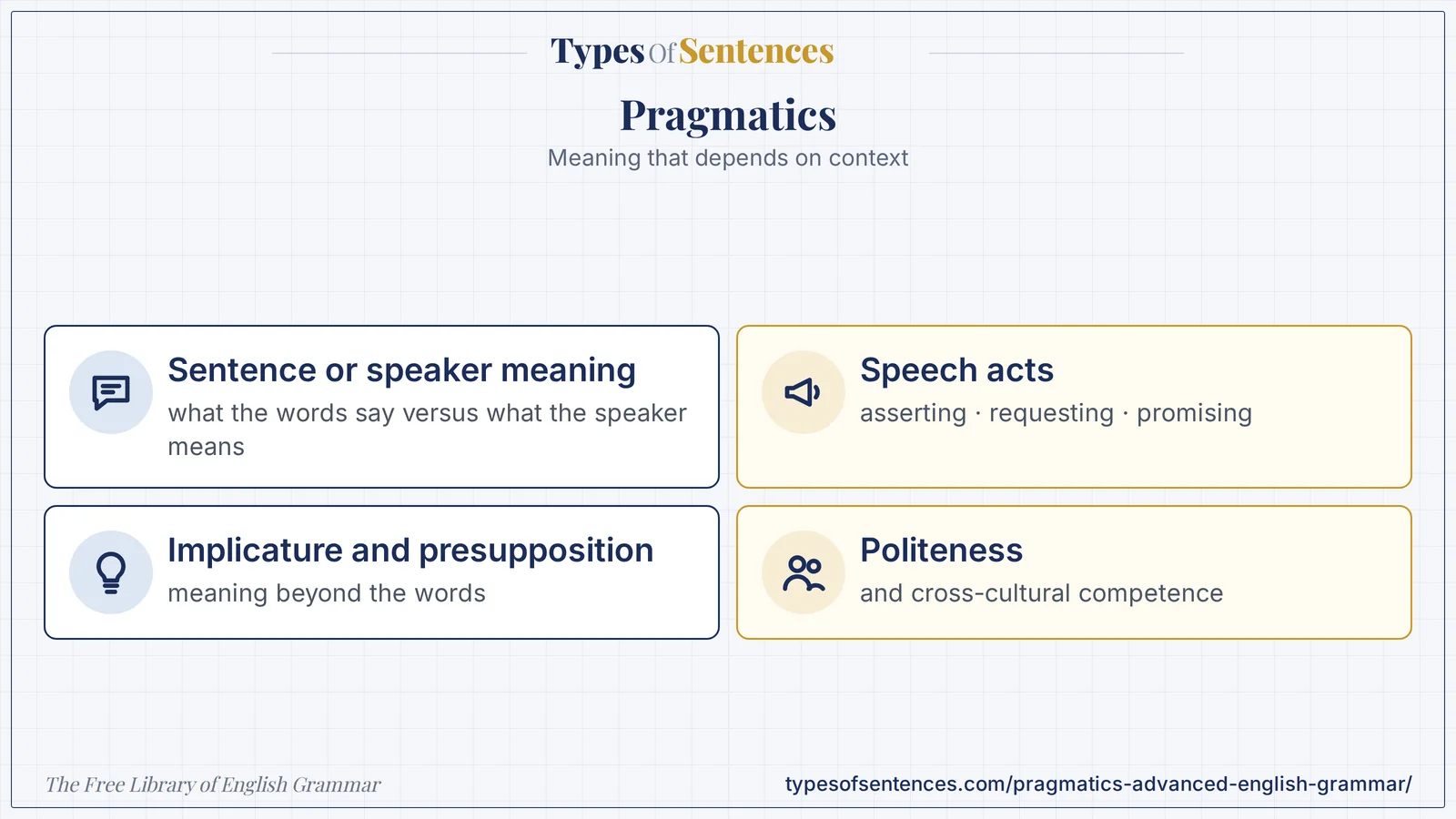
Grammar and vocabulary give a sentence its literal meaning. Pragmatics explains what speakers do with that meaning: they ask without questioning, request without commanding, and imply without stating. The listener fills the gap between what is said and what is meant by reasoning about the speaker’s intentions.
Why it matters: Pragmatic skill is a large part of being understood. A learner can have perfect grammar and still sound rude, cold, or confusing, because the pragmatic conventions of English were not followed.
Summary: Pragmatics studies meaning that depends on context: the speaker’s intention, the situation, and shared knowledge. Speech acts (Austin and Searle) show that utterances perform acts: asserting, requesting, promising; and that the form often differs from the function (indirect speech acts). Conversational implicature (Grice) is the meaning that is inferred when a speaker appears to break a maxim, as in scalar implicature (some implies not all). Presupposition is the background assumption of a sentence (stop smoking presupposes past smoking). Politeness protects face. Deixis depends on the context of utterance. Pragmatic competence is the ability to use and interpret language appropriately; pragmatic failure occurs when the speaker’s form or the speaker’s judgment of the situation is wrong.
- Sentence meaning versus speaker meaning.
- Speech acts: direct and indirect; felicity conditions.
- Implicature (Grice; scalar) and presupposition (triggers).
- Politeness and cross-cultural pragmatic competence.
What You’ll Learn
- 1. Pragmatics: What Is Pragmatics?
- 2. Speech Acts in Depth: Performatives, Felicity, and Indirectness
- 3. Conversational Implicature: Scalar and Neo-Gricean
- 4. Presupposition
- 5. Politeness, Face, and Impoliteness
- 6. Deixis in Context (Review)
- 7. Pragmatic Competence and Pragmatic Failure
- 8. Irony, Sarcasm, and Figurative Language
- 9. Pragmatics in Writing: Avoiding Unintended Implications
- 10. Common Problems in Pragmatics
- 11. Exercises
- 12. Test Your Knowledge
- 13. Frequently Asked Questions
- 14. Conclusion
1. Pragmatics: What Is Pragmatics?
The philosopher Charles Morris divided the study of signs into syntax (relations among signs), semantics (relations between signs and what they stand for), and pragmatics (relations between signs and their users). In linguistics, pragmatics is the study of how context contributes to meaning.
| Level of meaning | What it is | Example: Can you reach the salt? |
|---|---|---|
| sentence (literal) meaning | what the words and grammar say | a question about the hearer’s ability to reach the salt |
| speaker meaning | what the speaker intends | a request: please pass the salt |
| implicature | what is implied beyond what is said | the speaker wants the salt |
| presupposition | what is assumed | there is salt, and it is within reach of someone |
| perlocutionary effect | what the utterance achieves | the hearer passes the salt |
| Kind of context | Description | Example |
|---|---|---|
| linguistic context (co-text) | the surrounding words | Bank after river or after savings |
| situational context | the time, place, and participants | It’s cold in here said in a room with an open window |
| social context | relationship, status, setting | a request to a boss or to a friend |
| cultural context | shared customs and values | what counts as polite |
| cognitive context | what each participant knows and assumes | — |
The central topics of pragmatics are speech acts, implicature, presupposition, politeness, and deixis, and they are the topics of this chapter. The earlier chapter on discourse analysis introduced speech acts, implicature, and politeness as part of the study of discourse; this chapter takes each deeper.
2. Speech Acts in Depth: Performatives, Felicity, and Indirectness
J. L. Austin started from the observation that some sentences do not describe a state of affairs but perform an act: I promise to come, I apologize, I name this ship the Aurora. He called them performatives, and contrasted them with constatives, which state something true or false. Performatives are not true or false; they are felicitous or infelicitous, depending on conditions.
| Felicity condition (Austin) | Meaning | Example of failure |
|---|---|---|
| A. a conventional procedure with a conventional effect, correctly invoked | the right words in the right circumstances | saying I now pronounce you married as a joke |
| B. appropriate persons and circumstances | the right speaker and context | a passenger declaring a ship open |
| Γ. executed correctly and completely | nothing is missing or wrong | a bet not accepted |
| sincerity | the speaker has the thoughts and intentions | a promise made with no intention of keeping it (an “abuse”) |
| Condition (Searle) | Meaning | Promise: I will come tomorrow. |
|---|---|---|
| propositional content | the content of the act | a future act of the speaker |
| preparatory | the background conditions | the hearer wants the act; the speaker can do it |
| sincerity | the speaker’s attitude | the speaker intends to come |
| essential | the act counts as an attempt of a certain kind | it counts as an undertaking to come |
| Indirect speech act | Literal form | Function | Type |
|---|---|---|---|
| Can you pass the salt? | question about ability | request | conventional: very common |
| Could you possibly help me? | question | polite request | conventional |
| It’s cold in here. | statement | request to close the window | non-conventional (an inference) |
| Do you have the time? | question about possession | request for the time | conventional |
| I’d like some water. | statement of desire | request or order | conventional |
| Why don’t you try again? | negative question | advice | conventional |
| Would you like a coffee? | question | offer | conventional |
| I’m hungry. | statement | a hint, a request for food | non-conventional |
| Illocutionary-force indicating device | Example |
|---|---|
| performative verb | I warn you not to go. |
| mood and sentence type | Close the door. / Is the door closed? / The door is closed. |
| word order | Never will I forget it. |
| intonation and stress | You’re leaving? (rising) |
| modal verbs and adverbs | Could you possibly …? I promise … |
| hereby | I hereby declare the meeting open. |
Indirect speech acts are common because they are polite: a question about ability is less imposing than a command. Hearers recognize them by reasoning: if the speaker knows that I can pass the salt, the question must be a request. Many indirect forms have become conventional (Can you …?), so that they are understood directly. The grammar of questions as speech acts is described in the chapter on advanced question formation.
3. Conversational Implicature: Scalar and Neo-Gricean
Grice’s cooperative principle and the maxims of quantity, quality, relation, and manner were described in the discourse chapter. Here the focus is on how implicatures are calculated and classified.
| Type | Description | Example | Implicature |
|---|---|---|---|
| generalized conversational implicature | arises in most contexts, from the words used | Some of the students passed. | not all passed |
| particularized conversational implicature | depends on a particular context | A: Are you coming? B: I have an exam. | B is not coming |
| conventional implicature | tied to a word’s conventional meaning, not to the maxims | She is poor but honest. | there is a contrast between poor and honest |
| scalar implicature | from the use of a weaker item on a scale | It’s warm. | not hot |
| Horn scale (strong → weak) | Using the weaker item implies not the stronger |
|---|---|
| all > most > many > some | some → not all |
| always > usually > often > sometimes | sometimes → not always |
| and > or | or → not both (exclusive reading) |
| must > should > may | may → not must |
| certain > probable > possible | possible → not certain |
| hot > warm | warm → not hot |
| excellent > good > fair | good → not excellent |
| love > like | like → not love |
| Test and principle | Description | Example |
|---|---|---|
| cancelability | an implicature can be canceled | Some passed; in fact, all did. |
| reinforceability | an implicature can be added without redundancy | Some, but not all, passed. |
| calculability | a reasoner can derive it from the maxims | — |
| non-detachability | it attaches to the meaning, not the wording | Some and a few give similar implicatures |
| Q-principle (Levinson) | say as much as you can; so a weaker statement implies not stronger | Some → not all |
| I-principle | say as little as you need; the hearer enriches | If you mow the lawn, I’ll give you five dollars → only if |
| M-principle | a marked form suggests a marked meaning | She caused the car to stop (not by the usual means) |
| Flouting a maxim | Example | Effect |
|---|---|---|
| irony (quality) | “Lovely weather!” in a storm | the opposite is meant |
| understatement (quantity or quality) | “It was a bit warm.” (of a heat wave) | emphasis by restraint |
| hyperbole (quality) | “I’ve told you a million times.” | emphasis |
| tautology (quantity) | “Boys will be boys.” “War is war.” | a general attitude |
| irrelevance (relation) | A: Do you like my dress? B: The color is lovely. | a polite negative |
| obscurity (manner) | a deliberately vague answer | evasion |
| opting out | “I can’t say more.” | — |
Relevance theory (Sperber and Wilson) offers a different account: hearers look for the interpretation that gives the most effect for the least effort, and the enriched meaning of what is said (the explicature) is distinguished from what is implied (the implicature). In practice, the study of implicature is also a practice in careful writing: a statement that is literally true can mislead by implicature, as in I didn’t take the money from the drawer (perhaps I took it from the shelf). The related ideas of hedging are discussed in the next chapter.
4. Presupposition
A presupposition is a background assumption that a speaker takes for granted and that must be true for the sentence to be appropriate. It remains when the sentence is negated or questioned: Maria stopped smoking, Maria didn’t stop smoking, and Did Maria stop smoking? all presuppose that Maria smoked. This constancy under negation is the standard test.
| Trigger | Example | Presupposition |
|---|---|---|
| definite description | The king of France is bald. | there is a king of France |
| possessive | My sister is coming. | I have a sister |
| factive verbs (know, regret, realize, be glad) | She regrets lying. | she lied |
| change-of-state verbs (stop, start, begin, continue, become) | He stopped smoking. | he used to smoke |
| iteratives (again, return, another, too) | She came again. He is here too. | she came before; someone else is here |
| temporal clauses (before, after, while) | After she left, he called. | she left |
| cleft sentences | It was Tom who called. | someone called |
| wh-questions | When did you stop cheating? | you cheated |
| counterfactual conditionals | If I had known, I would have come. | I did not know |
| focus particles (even, only) | Even Tom knew. | others knew; Tom was the least likely |
| comparative or superlative | She is taller than Tom. | Tom has a height |
| implicative verbs (manage, forget) | He managed to finish. | he tried to finish |
| Entailment | Presupposition | Implicature | |
|---|---|---|---|
| survives negation? | no | yes | sometimes |
| cancelable? | no | sometimes | yes |
| example | She killed him → he died | She stopped smoking → she smoked | Some passed → not all |
| Use of presupposition | Example | Comment |
|---|---|---|
| accommodation (the hearer accepts the new information) | My sister is picking me up. (hearer did not know that I had a sister) | the hearer adds the information |
| loaded (leading) question | Have you stopped cheating on tests? | any answer admits the presupposition |
| advertising and news | The new, improved formula … | presupposes that the old was inferior |
| legal and political | When did you stop beating your wife? (a classic trap) | a trap for the respondent |
| presupposition failure | The present king of France is bald. | neither true nor false (Strawson), or false (Russell) |
Presuppositions are a way of packing information, and they can persuade without argument: a presupposition is harder to challenge than an assertion, because the hearer must interrupt to deny it (Wait, I never cheated!). A careful writer should be aware of what a sentence takes for granted. The negation test links this topic to the chapter on negation.
5. Politeness, Face, and Impoliteness
| Theory | Idea | Example |
|---|---|---|
| Goffman | face is the public self-image; interaction is face-work | saving someone’s face |
| Brown and Levinson | positive and negative face; face-threatening acts; five strategies | bald on-record, positive, negative, off-record, no act |
| Leech | politeness maxims: tact, generosity, approbation, modesty, agreement, sympathy | minimize cost to the other: Could I trouble you to …? |
| Lakoff | rules: don’t impose, give options, make the other feel good | — |
| Watts and Eelen | politeness is judged by the participants; first-order and second-order politeness | a society’s own ideas of polite behavior |
| Culpeper | impoliteness: face-attack strategies | insults, sarcasm, ignoring |
| Request (same act) | Directness | Politeness devices |
|---|---|---|
| Open the window. | direct imperative | none |
| Open the window, please. | imperative + please | a marker |
| Can you open the window? | conventionally indirect | a modal question |
| Could you possibly open the window? | indirect | modal remoteness, hedge |
| I was wondering if you could open the window. | very indirect | past progressive, embedding |
| It’s stuffy in here. | hint | off-record |
- Politeness is not the same as formality. A close friend may be polite in a casual way (Hey, could you grab the window?), and a stranger may be formal and rude.
- Choice of strategy depends on distance, power, and the size of the imposition.
- Norms differ across cultures, communities, and varieties of English; directness that is normal in one setting may seem rude in another, and indirectness that is polite in one may seem evasive in another. Avoid generalizations about whole nations.
- Politeness markers include please, thank you, sorry, titles and forms of address, hedges, and modal remoteness (see the chapter on modality).
6. Deixis in Context (Review)
| Deictic type | Pragmatic requirement | Example |
|---|---|---|
| person | identify speaker and addressee | I’ll call you; inclusive/exclusive we |
| place | locate the speaker | Put it here; come versus go |
| time | know the time of utterance | See you tomorrow (recorded message: the time of recording differs from the time of listening) |
| discourse | identify the stretch of text | As mentioned above |
| social | know the relationship | Sir, Dr. Rao |
Deixis is pragmatic by nature: a deictic expression has no reference until a context supplies it. The full treatment is in the chapter on reference and deixis. The pragmatic points are three: (1) the hearer must identify the deictic center; (2) the speaker may shift the center (to the addressee’s viewpoint, or to a character in a story); (3) deictic choices carry social meaning (we in political speech can include or exclude the audience).
7. Pragmatic Competence and Pragmatic Failure
Pragmatic competence is the ability to use language appropriately and to interpret what others mean. Jenny Thomas distinguished two kinds of pragmatic failure: pragmalinguistic failure (using a form that does not carry the intended force) and sociopragmatic failure (misjudging what is appropriate in the situation).
| Failure | Example | Problem | Better |
|---|---|---|---|
| pragmalinguistic | Give me water. (to a waiter) | a bald imperative; too direct | Could I have some water, please? |
| pragmalinguistic | I want a coffee. | a statement of desire may sound curt | I’d like a coffee, please. |
| pragmalinguistic | You must come to my party. (an invitation) | sounds like an order | I’d love it if you could come. |
| sociopragmatic | asking a stranger on a bus for money | misjudges the imposition | — |
| sociopragmatic | calling a professor by first name at first meeting (in a formal setting) | misjudges the distance | Dr. Rao |
| sociopragmatic | answering How are you? with a detailed account of an illness (in passing) | misreads a greeting as a question | Fine, thanks. And you? |
| interpretation | A: Can you tell me the time? B: Yes. (and no more) | takes an indirect request literally | It’s three o’clock. |
| interpretation | A: It’s cold in here. B: Yes, it is. | misses the request | B closes the window. |
| Speech act | Differences across communities (generalizations to be treated with care) |
|---|---|
| refusals | are often delayed, softened, and accompanied by reasons or alternatives; a bald No may be heard as rude |
| thanking | forms and frequency vary: some communities thank for small favors, others rarely |
| compliments and responses | a thank-you response, a deflection, or a return compliment are all found |
| apologies | the degree of explicitness and the use of sorry differ |
| requests | the preferred degree of directness differs by setting and by relationship |
| greetings | How are you? is a formula, not a question, in many varieties of English |
Indian English has its own conventions, such as the business phrases please do the needful and kindly revert (with revert meaning “reply”); these are established in that variety, though speakers of other varieties may not understand them or may find them stiff. No variety is “wrong”, but writing for an international audience calls for awareness of such differences. Research on the cross-cultural realization of speech acts has examined requests and apologies in several languages, and its main finding is that differences are of degree and are linked to the situation.
8. Irony, Sarcasm, and Figurative Language
| Device | Description | Example | Pragmatic explanation |
|---|---|---|---|
| irony | saying the opposite of what is meant, or a situation that contradicts expectation | “What a lovely day!” in the rain | flouts the maxim of quality |
| sarcasm | irony used to hurt or mock | “Great job,” after a mistake | a face-attack |
| understatement | saying less than is meant | “It’s a bit chilly.” (at minus twenty) | — |
| hyperbole | saying more than is meant | “I’m starving.” | — |
| metaphor | a statement not literally true | “Time is money.” | the hearer finds a relevant reading |
| rhetorical question | a question with no answer expected | “Who cares?” | — |
| euphemism | a mild expression for something unpleasant | “passed away” | politeness |
| pun | a double meaning | — | polysemy or homophony |
Sperber and Wilson’s account of irony is that an ironic remark is an echoic use of language: the speaker echoes a thought or expectation (What lovely weather) and expresses an attitude of disapproval or ridicule toward it. In writing, irony is harder to signal because there is no tone of voice; writers use context, exaggeration, quotation marks, or markers, and online writers sometimes add a label such as “/s”. An irony that is not recognized can be taken literally and cause offense.
9. Pragmatics in Writing: Avoiding Unintended Implications
| Context | Pragmatic risk | Example | Safer |
|---|---|---|---|
| email requests | too direct, or too indirect to be noticed | Send me the report. / I was wondering about the report. | Could you send me the report by Friday? |
| feedback | a face-threatening comment | This is wrong. | I think this section needs revision; could we look at it together? |
| claims and statistics | scalar implicature | Some of our products are safe. | All of our products are safe. / Of our 12 products, 9 are safe. |
| advertising and news | presuppositions | The new, safer design … | — |
| instructions | literal readings | Can you close the door? (as a rule) | Close the door. |
| legal and contracts | literal meaning matters | a promise or a condition | state the obligation explicitly |
| negation and quantifiers | scope and implicature | Not all students failed. (some did?) | Some students passed and some failed. |
| online writing | tone and irony are lost | Nice. (sarcastic?) | add context |
- Ask what the reader will infer from your wording, not only what it says.
- Watch weak scalar items (some, may, good): they implicate “not more”.
- Check your presuppositions: do you assume anything the reader may not accept?
- Choose the directness that fits the relationship and the imposition.
- Make the intended act clear in instructions, requests, and contracts.
- Signal irony and humor where tone cannot.
10. Common Problems in Pragmatics
| Problem | Example | Fix |
|---|---|---|
| taking an indirect request literally | Can you pass the salt? — Yes. | Pass the salt. |
| too direct a request | Give me the file. | Could you send me the file, please? |
| too indirect for a busy reader | I was perhaps wondering if it might be possible … | Could you send it today? |
| unintended implicature | Some of our staff are qualified. | All of our staff are qualified. |
| loaded presupposition | Have you stopped being late? | Are you late often? |
| misreading irony | A: Great, it’s raining. B: Yes, it is nice. | A is complaining. |
| an answer that violates relevance without reason | A: Where is the station? B: It’s a beautiful day. | The station is on the left. |
| a literal answer to a greeting | How are you? — I have a headache, my back hurts … | Fine, thanks. |
| misusing please | Please! Give it to me! | Could you give it to me, please? |
| ambiguous speech act | I’ll see what I can do. | I will do it. / I cannot do it. |
Edit (polite and clear): Give me the file, I was perhaps wondering if it might be possible that some of our staff are qualified, and have you stopped being late, and can you pass the salt? — Yes.
- Give me the file: too direct: Could you send me the file, please?
- I was perhaps wondering if it might be possible …: too indirect: Could you send it today?
- some of our staff are qualified: unintended implicature: All of our staff are qualified.
- have you stopped being late: a loaded presupposition: Are you often late?
- Can you pass the salt? — Yes.: the answer ignores the request: Here you are.
- Result: Could you send me the file today, please? All of our staff are qualified. Are you often late? — Can you pass the salt? — Here you are.
Recap in 12 seconds
Watch the lesson build itself: Pragmatics studies speaker meaning, speech acts, implicature, presupposition, and politeness. The video has no sound.
Exercises
Part A: Meaning and Context (Exercises 1–6)
Exercise 1: Define pragmatics.
Show Answer
Answer: The study of meaning in context.
Exercise 2: What is speaker meaning?
Show Answer
Answer: What the speaker intends, as distinct from the literal meaning.
Exercise 3: Name two kinds of context.
Show Answer
Answer: Linguistic, situational, social, cultural, or cognitive.
Exercise 4: Literal meaning of Can you reach the salt?:
Show Answer
Answer: A question about ability.
Exercise 5: Speaker meaning of Can you reach the salt?:
Show Answer
Answer: A request to pass the salt.
Exercise 6: Who divided semiotics into syntax, semantics, and pragmatics?
Show Answer
Answer: Charles Morris.
Part B: Speech Acts (Exercises 7–13)
Exercise 7: Performative or constative: I promise to come.
Show Answer
Answer: Performative.
Exercise 8: Performative or constative: It is raining.
Show Answer
Answer: Constative.
Exercise 9: Name the felicity condition: the speaker intends to keep a promise.
Show Answer
Answer: Sincerity.
Exercise 10: Direct or indirect: Can you pass the salt?
Show Answer
Answer: Indirect.
Exercise 11: Name the function of It’s cold in here. (to a host)
Show Answer
Answer: A request to close the window or turn up the heat.
Exercise 12: Name the function of Why don’t you try again?
Show Answer
Answer: Advice.
Exercise 13: What is an IFID?
Show Answer
Answer: An illocutionary-force indicating device (such as a performative verb or the mood).
Part C: Implicature and Presupposition (Exercises 14–21)
Exercise 14: Give the implicature: Some of the students passed.
Show Answer
Answer: Not all passed.
Exercise 15: Give the implicature: It’s warm.
Show Answer
Answer: It is not hot.
Exercise 16: Can an implicature be canceled?
Show Answer
Answer: Yes (Some passed; in fact, all did).
Exercise 17: Give the presupposition: Maria stopped smoking.
Show Answer
Answer: Maria used to smoke.
Exercise 18: Give the presupposition: My sister is coming.
Show Answer
Answer: I have a sister.
Exercise 19: Name the trigger: stop
Show Answer
Answer: A change-of-state verb.
Exercise 20: Name the trigger: again
Show Answer
Answer: An iterative.
Exercise 21: Why is Have you stopped cheating? a loaded question?
Show Answer
Answer: It presupposes that you cheated.
Part D: Politeness and Competence (Exercises 22–27)
Exercise 22: Name the strategy: Could you possibly open the window?
Show Answer
Answer: Negative politeness.
Exercise 23: Name the strategy: It’s stuffy in here.
Show Answer
Answer: Off-record.
Exercise 24: Name the failure: Give me water. (to a waiter)
Show Answer
Answer: Pragmalinguistic failure.
Exercise 25: Name the failure: misjudging the distance in a formal setting
Show Answer
Answer: Sociopragmatic failure.
Exercise 26: Name a politeness marker.
Show Answer
Answer: please, thank you, sorry, a hedge, a modal.
Exercise 27: Is politeness the same as formality?
Show Answer
Answer: No.
Part E: Irony and Writing (Exercises 28–30)
Exercise 28: Name the device: What lovely weather! (in a storm)
Show Answer
Answer: Irony.
Exercise 29: Fix the implicature: Some of our products are safe. (all are)
Show Answer
Answer: All of our products are safe.
Exercise 30: Name a way to signal irony in writing.
Show Answer
Answer: Context, quotation marks, exaggeration, or a marker.
Test Your Knowledge
Ready to check what you learned? Answer all 10 questions, then submit. You need 80% (8 of 10) to pass. Your answers are not stored.
View correct answers and explanations
Question 1: What is pragmatics?
✓ Correct Answer: A – meaning in context
Pragmatics studies meaning in context.
Question 2: Which is a performative?
✓ Correct Answer: B – I promise to come.
It performs an act.
Question 3: Which is an indirect speech act?
✓ Correct Answer: C – Can you close the door?
A question used as a request.
Question 4: What is the implicature of Some passed?
✓ Correct Answer: D – not all passed
Scalar implicature.
Question 5: What does Maria stopped smoking presuppose?
✓ Correct Answer: C – Maria smoked
A change-of-state verb.
Question 6: Which test shows a presupposition?
✓ Correct Answer: B – it survives negation
It remains under negation.
Question 7: Which is a loaded question?
✓ Correct Answer: C – Have you stopped cheating?
It presupposes cheating.
Question 8: Which is off-record politeness?
✓ Correct Answer: B – It’s stuffy in here.
A hint.
Question 9: What is pragmalinguistic failure?
✓ Correct Answer: D – using a form that does not carry the intended force
The form is wrong.
Question 10: Who proposed the cooperative principle?
✓ Correct Answer: A – Grice
H. P. Grice.
Frequently Asked Questions
What is pragmatics?
Pragmatics is the study of meaning in context: how speakers and writers use language to do things and how listeners infer what is meant beyond the words.
What is pragmatic meaning?
Pragmatic meaning is the meaning of an utterance in a context, including what the speaker intends, implies, and presupposes, and not only the literal sentence meaning.
What is context meaning?
Context meaning is the part of meaning that depends on the situation of use: the participants, the setting, the shared knowledge, and the purpose. Context meaning explains why one sentence can have different uses.
What are speech acts?
Speech acts are the acts performed by speaking: asserting, requesting, promising, thanking, apologizing, and so on. They can be direct or indirect (Can you pass the salt?).
What is conversational implicature?
Conversational implicature is the meaning inferred when a speaker seems to break a maxim of cooperative conversation, such as Some passed implying that not all did.
What is presupposition?
Presupposition is the background assumption of a sentence that remains when it is negated or questioned: Maria stopped smoking presupposes that she smoked.
How can I avoid unintended implications in writing?
Ask what a reader will infer from your wording, check scalar words such as some and may, check what you presuppose, choose the right directness, and signal irony.
Conclusion
You now have a deep study of pragmatics: sentence meaning and speaker meaning, speech acts and felicity conditions, indirect speech acts, conversational and scalar implicature, presupposition and its triggers, politeness, deixis in context, irony, pragmatic competence and failure, and care in writing. You can interpret and shape meaning in context.
When you write or speak, ask what you mean, what you say, and what the hearer will infer. Next, you will study hedging.
- Austin, J. L. How to Do Things with Words. Oxford University Press, 1962.: performatives and felicity conditions.
- Searle, John R. Speech Acts. Cambridge University Press, 1969.: the classification and conditions of speech acts.
- Grice, H. P. “Logic and Conversation.” In Syntax and Semantics 3: Speech Acts. Academic Press, 1975.: conversational implicature.
- Levinson, Stephen C. Pragmatics. Cambridge University Press, 1983; and Presumptive Meanings. MIT Press, 2000.: standard accounts of pragmatics and the Q, I, and M principles.
- Thomas, Jenny. “Cross-Cultural Pragmatic Failure.” Applied Linguistics 4 (1983): 91–112.: pragmalinguistic and sociopragmatic failure.
Last reviewed: October 29, 2026. How it was made: drafted with AI assistance, then checked with automated tests (structure, links, answer keys, spelling) and against the sources above. A person has not yet read this chapter line by line. Found a mistake? Report it.