Complement clauses are clauses that complete the meaning of another word. A verb such as want is incomplete on its own; it needs to go, him to go, or that he go. An adjective such as sure needs that she knows, and a noun such as fact needs that he lied. This relation is called complementation, and the clauses involved are the clausal complements. Which type of clause a word takes is a property of the word itself, so the topic is as much about vocabulary as about grammar.
This chapter studies complement structures systematically: that-clauses, to-infinitive clauses, wh-clauses, -ing clauses, and bare infinitive complements, the notion of control (who is the understood subject), verbs that take more than one pattern with a change in meaning, and complex complementation with more than one complement or nested clauses. These advanced complements are the source of many of the errors that learners make. Thirty editing exercises and a quiz follow.
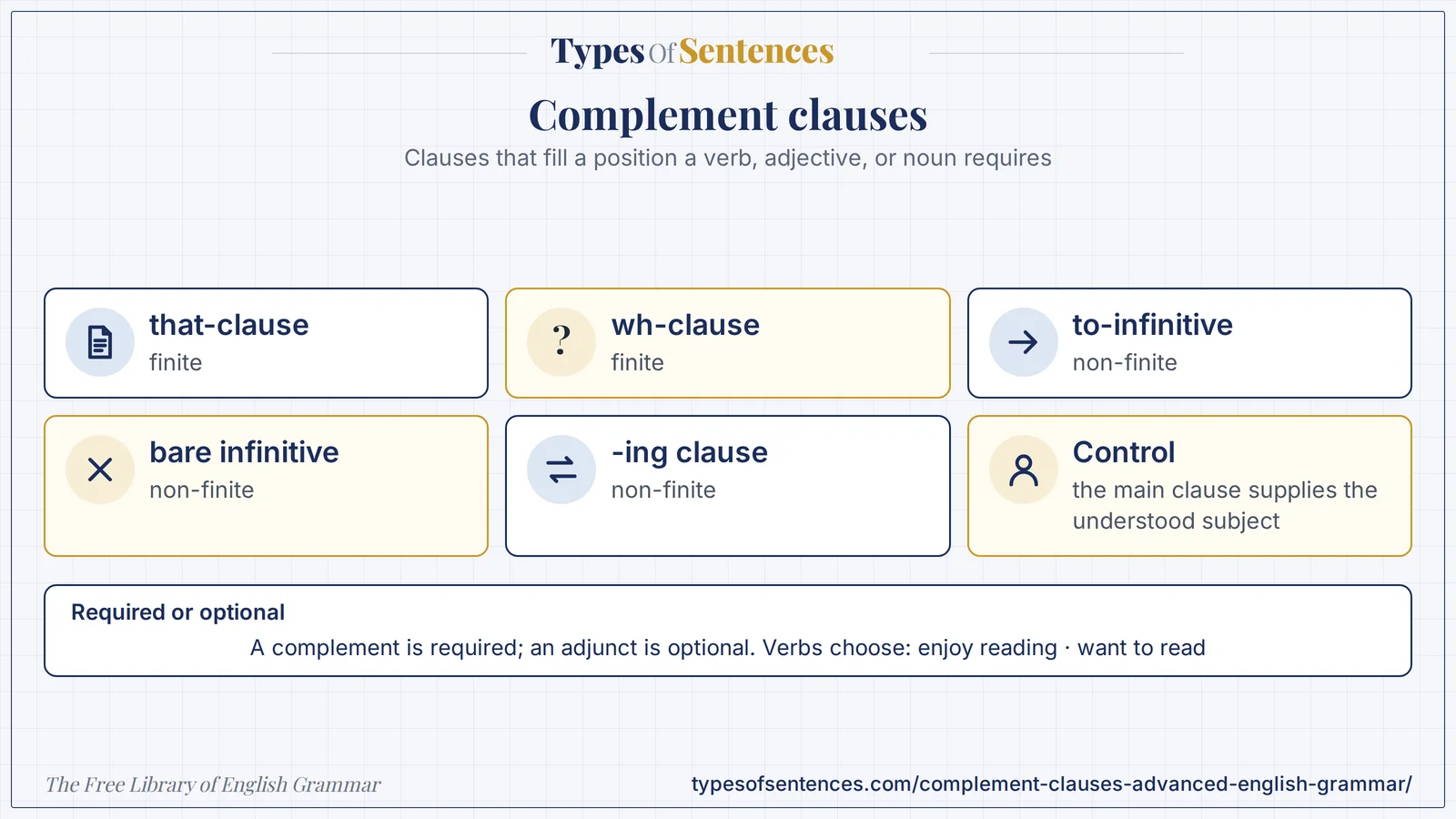
A complement is a part of the sentence that a word requires. In I want to leave, the infinitive clause to leave is not optional: take it away and I want is incomplete. In I left yesterday, yesterday is optional, so it is an adjunct, not a complement.
Why it matters: Each verb, adjective, and noun has its own pattern. Enjoy takes -ing, want takes to, suggest takes that or -ing. The patterns have to be learned with the word, and then they can be grouped and understood.
Summary: Complement clauses fill the position required by a verb, adjective, or noun. The main types are finite that-clauses and wh-clauses, and non-finite to-infinitive, bare infinitive, and -ing clauses. The understood subject of a non-finite complement is controlled by the subject or the object of the main clause (She promised to leave; She persuaded him to leave). Some verbs take more than one pattern, often with a difference in meaning (stop to talk, stop talking).
- Verbs choose complements: enjoy reading, want to read, suggest that he read.
- Control: the subject or object of the main clause supplies the subject of the non-finite clause.
- Some verbs change meaning with the pattern: remember to lock, remember locking.
- A complement is required; an adjunct is optional.
What You’ll Learn
- 1. Complement Clauses: What Is a Complement?
- 2. That-Clauses as Complements
- 3. To-Infinitive Clauses as Complements
- 4. Wh-Clauses and Whether/If Clauses as Complements
- 5. -ing Clauses as Complements
- 6. Bare Infinitive Complements
- 7. Verbs That Take More Than One Pattern
- 8. Control, Raising, and the Understood Subject
- 9. Complex and Nested Complementation
- 10. Choosing Among Complement Types in Writing
- 11. Common Errors with Complement Clauses
- 12. Exercises
- 13. Test Your Knowledge
- 14. Frequently Asked Questions
- 15. Conclusion
1. Complement Clauses: What Is a Complement?
A complement is an element that a word requires to be complete. It differs from an adjunct, which is optional. The words that take complements are verbs, adjectives, nouns, and prepositions.
| Head word | Complement | Example |
|---|---|---|
| verb | object, complement, or clause | She wants to leave. He said that it was late. |
| adjective | clause or prepositional phrase | I am sure that she knows. She is eager to learn. |
| noun | clause or prepositional phrase | the fact that he lied; the decision to leave |
| preposition | noun phrase or clause | He is worried about what might happen. |
| Test | Complement | Adjunct |
|---|---|---|
| can it be omitted without changing the verb’s meaning or making the sentence incomplete? | no: *She wants | yes: She left (yesterday) |
| does it answer a question that the verb requires? | What does she want? To leave. | When did she leave? (optional) |
| can it be replaced by do so, do it? | no | yes: She left, and he did so too (yesterday). |
| Type of complement clause | Introducer | Example |
|---|---|---|
| finite that-clause | that | I know that she left. |
| finite wh-clause | what, who, where, how, whether, if | I know where she lives. |
| to-infinitive clause | to | I want to leave. She is likely to win. |
| bare infinitive clause | none | I saw him leave. She made him wait. |
| -ing clause | none | I enjoy reading. I saw him running. |
| -ed clause | none | I had my car repaired. I want it done. |
The patterns of verbs and their objects are in the chapter on complementation patterns. This chapter concentrates on the clausal complements. The noun clauses that fill subject and object positions are in the previous chapters on nominal clauses, and the non-finite forms in the chapter on non-finite verbs.
2. That-Clauses as Complements
| After | Examples | Notes |
|---|---|---|
| verbs of communication | say, tell (+ object), claim, explain, announce, suggest, promise, admit, deny, insist, state, report, warn (+ object) | He said that it was late. She told me that she was leaving. |
| verbs of thinking and knowing | think, believe, know, realize, understand, decide, assume, suppose, discover, find, doubt, imagine, remember, forget | I think that she is right. He realized that he was late. |
| verbs of feeling and reaction | regret, hope, fear, expect, wish, mind, (be) glad, resent | I hope that you can come. She regrets that she left. |
| verbs of perception and result | see, hear, notice, show, prove, ensure, mean, imply, follow | The data show that prices rose. It follows that she is right. |
| adjectives | glad, sorry, sure, certain, afraid, aware, pleased, surprised, important, essential, likely, clear | I am glad that you came. It is essential that she attend. |
| nouns (appositive) | fact, idea, belief, claim, news, rumor, possibility, hope, fear, decision, evidence, proof | the fact that he lied; the hope that she would come |
The word that is often omitted after verbs and adjectives (I think she is right), but not after nouns (the fact that he lied) or when the clause is the subject. The omission is discussed in the chapter on nominal clauses. Some verbs are factive: they presuppose that the clause is true (know, regret, realize, notice), while others are non-factive (think, claim, suppose). Compare She regrets that she lied (she lied) and She claims that she lied (the claim may be false).
| Pattern | Examples | Notes |
|---|---|---|
| verb + that-clause | She said that it was late. | a clause as the only complement |
| verb + object + that-clause | She told me that it was late. He warned them that it was dangerous. | tell, warn, convince, remind, assure need an object |
| verb + that-clause with the mandative subjunctive | I insist that he go. She demanded that it be done. | the base form |
| adjective + that-clause with should (British) or the subjunctive | It is essential that she should attend. / It is essential that she attend. | — |
3. To-Infinitive Clauses as Complements
The to-infinitive complement is the most varied. The key to using it is to ask who is the understood subject of the infinitive, which is called control.
| Pattern | Understood subject of the infinitive | Examples |
|---|---|---|
| subject control | the subject of the main verb | She wants to leave. He decided to stay. They refused to help. She promised to call. |
| object control | the object of the main verb | She persuaded him to leave. He told her to go. They forced us to stay. She asked him to wait. |
| raising (subject) | the subject of the main verb, which has no role in the main clause | She seems to be tired. He appears to know. They tend to agree. It happens to be true. |
| exceptional case marking | an object that is really the subject of the infinitive | I want him to leave. I expect her to win. I believe him to be honest. We consider it to be a mistake. |
| for … to clause | a stated subject introduced by for | It is easy for him to say. I am waiting for you to call. |
| Complements of adjectives and nouns | Examples |
|---|---|
| adjective + to-infinitive (subject) | She is eager to learn. He is likely to win. They are ready to leave. |
| adjective + to-infinitive (object) | The book is easy to read. This is hard to explain. (the book is read; this is explained) |
| noun + to-infinitive | a chance to win; the decision to leave; her attempt to escape; the first to arrive |
| too / enough | too tired to continue; old enough to vote |
Promise is an exception to the object-control rule: She promised him to come still means that she will come, but this pattern is rare and formal. The usual form is She promised him that she would come. The verb ask is ambiguous: She asked him to leave (he leaves) and She asked to leave (she leaves). Both are controlled by the structure.
The infinitive phrase is described at the Intermediate level in the chapter on infinitives. The distinction between subject control and raising is subtle: She wants to be tired is odd because want assigns a role to she, but She seems to be tired is natural because seem does not.
4. Wh-Clauses and Whether/If Clauses as Complements
| After | Examples | Notes |
|---|---|---|
| verbs of knowing and asking | know, wonder, ask, tell, explain, decide, understand, forget, remember, find out, discover, wonder | I know where she lives. He asked what time it was. |
| verbs that take whether and if | ask, wonder, doubt, find out, not know, see, check, depend | I wonder whether (if) she knows. It depends on whether she comes. |
| adjectives | sure, certain, unsure, aware, clear, curious | I am not sure what to do. It is unclear whether it works. |
| nouns | question, problem, issue, matter, idea, doubt | the question of whether we can afford it; the problem of how to start |
| infinitive wh-clauses | what to do, where to go, how to swim, whether to leave | I know what to do. She asked where to go. |
| Rule | Example |
|---|---|
| statement word order | I know where she lives. (not where does she live) |
| whether after prepositions and with or not | It depends on whether she comes. whether or not she comes |
| if is common in informal indirect questions | I wonder if she knows. |
| whether with infinitive | I can’t decide whether to go. (not if to go) |
| that and wh-clauses are not interchangeable | I know that she left. I know when she left. |
Wh-complements are a type of nominal clause; the word order and the introducers are treated in the chapter on nominal clauses, and the tense changes in reported questions in the chapters on reported speech.
5. -ing Clauses as Complements
| Pattern | Examples | Notes |
|---|---|---|
| verb + -ing | enjoy, avoid, finish, keep, mind, suggest, consider, admit, deny, imagine, risk, practice, postpone, delay, resent, quit | I enjoy reading. She avoided answering. |
| verb + preposition + -ing | insist on, succeed in, look forward to, object to, apologize for, depend on, think of | He insisted on paying. She succeeded in finding it. |
| verb + object + -ing (perception) | see, hear, watch, notice, smell, feel, catch, find, leave + object + -ing | I saw him running. She caught them stealing. We found her sleeping. |
| verb + possessive or object + -ing | mind, dislike, resent, appreciate, imagine | Do you mind my/me opening the window? I appreciate your helping me. |
| adjective + -ing | busy, worth, (be) afraid of, good at, tired of, used to, keen on | She is busy cooking. It is worth trying. He is good at drawing. |
| noun + preposition + -ing | the possibility of leaving; the habit of working late; the idea of going | She dislikes the idea of moving. |
| go + -ing | go swimming, go shopping, go fishing | an activity |
The -ing form after a verb is the gerund, and the full treatment is in the chapter on gerunds. After a perception verb with an object, the -ing form is a participle that shows an action in progress (I saw him running). Compare the bare infinitive, which shows a completed event (I saw him run).
6. Bare Infinitive Complements
| After | Examples | Notes |
|---|---|---|
| modal verbs | can, could, may, might, will, would, shall, should, must | She can swim. You must leave. |
| let, make, have + object | let him go; make them wait; have him check it | the active; the passive adds to: They were made to wait |
| perception verbs + object | see, hear, watch, notice, feel + object + base form | I saw him leave. We heard her sing. |
| help + object | help him (to) carry it | to is optional |
| had better, would rather, why not | You had better go. I would rather stay. Why not ask her? | fixed patterns |
| do support | She did not know. | the auxiliary |
| Bare infinitive | -ing form | Difference |
|---|---|---|
| I saw him cross the street. | I saw him crossing the street. | the whole event (he crossed) versus part of it (he was crossing) |
| I heard her sing the song. | I heard her singing the song. | the song as a whole versus a stretch of it |
| I watched them play the game. | I watched them playing the game. | the whole game versus part of it |
7. Verbs That Take More Than One Pattern
| Verb | With to-infinitive | With -ing |
|---|---|---|
| stop | He stopped to talk. (paused in order to talk) | He stopped talking. (ceased) |
| remember | Remember to lock the door. (do not forget to) | I remember locking the door. (recall doing it) |
| forget | Don’t forget to call. (do not fail to) | I’ll never forget meeting her. (recall) |
| regret | I regret to tell you that … (sorry to say) | I regret telling her. (sorry that I did) |
| try | I tried to open it. (attempted) | Try opening it. (experiment) |
| go on | She went on to become a doctor. (next step) | She went on talking. (continued) |
| mean | I didn’t mean to hurt you. (intend) | This job means traveling. (involve) |
| need | The room needs to be cleaned. / I need to leave. | The room needs cleaning. (passive meaning) |
| Verb | Patterns | Notes |
|---|---|---|
| like, love, hate, prefer | to or -ing, with a similar meaning; would like to only with to | I like to swim. / I like swimming. I would like to swim. |
| begin, start, continue | to or -ing, with little difference | It began to rain. / It began raining. |
| advise, allow, permit, recommend | advise him to go; advise going; not *advise him going (after an object) | She advised going early. She advised me to go early. |
| suggest | that-clause or -ing; no object + to | He suggested that we go. / He suggested going. (not *suggested us to go) |
| enjoy, avoid, finish, mind | -ing only | I enjoy swimming. (not *to swim) |
| want, hope, decide, plan, manage, refuse, afford | to only (decide also takes that) | I want to swim. |
8. Control, Raising, and the Understood Subject
Every non-finite complement has an understood subject. In She wants to leave, she is the one who leaves. The main verb decides which element supplies the subject.
| Main clause | Complement | Who leaves? | Type |
|---|---|---|---|
| She promised to leave. | to leave | she | subject control |
| She persuaded him to leave. | to leave | he | object control |
| She asked him to leave. | to leave | he | object control |
| She asked to leave. | to leave | she | subject control |
| She seems to leave early. | to leave early | she | raising |
| I expect her to leave. | to leave | she | exceptional case marking |
| She was told to leave. | to leave | she | passive object control |
The understood subject of a participle or an infinitive phrase must match the subject of the main clause. Otherwise it dangles.
9. Complex and Nested Complementation
| Pattern | Example | Complements |
|---|---|---|
| object + that-clause | She told me that she was leaving. | me and that she was leaving |
| object + to-infinitive | He persuaded her to go. | her and to go |
| object + wh-clause | I told him where to go. She asked me whether I knew. | him and where to go |
| object + object complement | They made him happy. We elected her president. | him and happy |
| two clausal complements (coordinated) | He said that she was late and that the train was full. | two that-clauses |
| nested | I believe that she wants to know whether he left. | that-clause > to-infinitive > whether-clause |
| complement of a complement | It is easy for her to say that she is afraid to go. | — |
- Find the main verb and ask what it requires.
- Find its complement: noun phrase, clause, or both.
- If the complement is a clause, find its own verb and ask what that verb requires.
- Continue inward until there are no more clauses.
- Label each as finite or non-finite, and find the understood subject of each non-finite one.
Analyze: She convinced the committee that it was important to ask the staff whether to change the plan.
- Main verb: convinced with two complements: the committee (object) and that it was important to ask the staff whether to change the plan (that-clause).
- Inside the that-clause: was with the adjective complement important, which takes to ask the staff … (a to-infinitive, extraposed).
- ask takes two complements: the staff and whether to change the plan (a whether-infinitive clause).
- change takes the plan.
- Result: four clauses nested in each other, with one non-finite subject understood as the committee (or anyone).
10. Choosing Among Complement Types in Writing
| Alternatives | Notes |
|---|---|
| It is necessary that he leave. / It is necessary for him to leave. | the that-clause is more formal; the infinitive is shorter |
| I am glad that you came. / I am glad to see you. | the infinitive when the subjects are the same; the clause when they differ |
| The fact that he lied upset me. / His lying upset me. | the noun phrase with -ing is shorter |
| She decided to go. / She decided that she would go. | the infinitive is more direct |
| I suggest that we leave. / I suggest leaving. / I suggest we leave. | the that-clause is formal; the subject may be omitted |
- Use the shortest pattern that is clear. An infinitive or -ing clause is often shorter than a finite clause.
- Use a finite clause when the subjects differ. She suggested that he leave (not she suggested him to leave).
- Avoid wordy complements. The fact that is often unnecessary: Despite the fact that he lied can be Although he lied.
- Learn complements with the verb. When you learn suggest, learn suggest that and suggest -ing as well.
11. Common Errors with Complement Clauses
| Error | Correction | Rule |
|---|---|---|
| She suggested me to go. | She suggested that I go. / She suggested going. | suggest does not take object + to |
| I enjoy to read. | I enjoy reading. | enjoy takes -ing |
| She avoided to answer. | She avoided answering. | avoid takes -ing |
| I want that you come. | I want you to come. | want takes object + to |
| He insisted on that she come. | He insisted that she come. | no that-clause after a preposition |
| I look forward to see you. | I look forward to seeing you. | to is a preposition |
| She decided going. | She decided to go. | decide takes to |
| He made me to laugh. | He made me laugh. | bare infinitive after make |
| Let him to go. | Let him go. | bare infinitive after let |
| He explained me the rule. | He explained the rule to me. | explain takes no indirect object directly |
| She said me that she was late. | She told me that she was late. | tell takes an object |
| I am interested to learn about it. (meaning: curious) | I am interested in learning about it. | a more usual pattern |
| I know where is she. | I know where she is. | statement order |
Edit: She suggested me to go, and I enjoy to read, but I want that she explains me why she decided going, and he insisted on that she come, so I look forward to hear her.
- suggested me to go: suggested that I go.
- enjoy to read: enjoy reading.
- want that she explains me why: want her to explain why.
- decided going: decided to go.
- insisted on that she come: insisted that she come.
- look forward to hear: look forward to hearing.
- Result: She suggested that I go, and I enjoy reading, but I want her to explain why she decided to go, and he insisted that she come, so I look forward to hearing her.
Recap in 12 seconds
Watch the lesson build itself: Complement clauses are finite that- and wh-clauses or non-finite infinitive and -ing clauses, chosen by the verb. The video has no sound.
Exercises
Part A: Complement or Adjunct (Exercises 1–6)
Exercise 1: Complement or adjunct: to leave in She wants to leave.
Show Answer
Answer: Complement.
Exercise 2: Complement or adjunct: yesterday in She left yesterday.
Show Answer
Answer: Adjunct.
Exercise 3: Name the clause type: that she knows in I am sure that she knows.
Show Answer
Answer: A that-clause complement of an adjective.
Exercise 4: Name the clause type: that he lied in the fact that he lied
Show Answer
Answer: An appositive that-clause (complement of a noun).
Exercise 5: Factive or non-factive: regret
Show Answer
Answer: Factive.
Exercise 6: Factive or non-factive: claim
Show Answer
Answer: Non-factive.
Part B: That- and Wh-Clauses (Exercises 7–12)
Exercise 7: Edit: She said me that she was late.
Show Answer
Answer: She told me that she was late.
Exercise 8: Edit: I know where is she.
Show Answer
Answer: I know where she is.
Exercise 9: Edit: He insisted on that she come.
Show Answer
Answer: He insisted that she come.
Exercise 10: Choose: I can’t decide (if/whether) to go.
Show Answer
Answer: whether.
Exercise 11: Choose: I insist that he (go/goes).
Show Answer
Answer: go.
Exercise 12: Does warn require an object?
Show Answer
Answer: Yes (warn them that).
Part C: To-Infinitive and Control (Exercises 13–19)
Exercise 13: Who leaves: She promised to leave.
Show Answer
Answer: She.
Exercise 14: Who leaves: She persuaded him to leave.
Show Answer
Answer: He.
Exercise 15: Name the pattern: She seems to be tired.
Show Answer
Answer: Raising.
Exercise 16: Name the pattern: I expect her to win.
Show Answer
Answer: Exceptional case marking.
Exercise 17: Edit: I want that you come.
Show Answer
Answer: I want you to come.
Exercise 18: Edit: She decided going.
Show Answer
Answer: She decided to go.
Exercise 19: Name the pattern: It is easy for him to say.
Show Answer
Answer: A for … to clause.
Part D: -ing and Bare Infinitive (Exercises 20–25)
Exercise 20: Edit: I enjoy to read.
Show Answer
Answer: I enjoy reading.
Exercise 21: Edit: She avoided to answer.
Show Answer
Answer: She avoided answering.
Exercise 22: Edit: He made me to laugh.
Show Answer
Answer: He made me laugh.
Exercise 23: Edit: Let him to go.
Show Answer
Answer: Let him go.
Exercise 24: Explain: I saw him cross and I saw him crossing.
Show Answer
Answer: The whole event versus part of it.
Exercise 25: Edit: I look forward to see you.
Show Answer
Answer: I look forward to seeing you.
Part E: Meaning Change and Analysis (Exercises 26–30)
Exercise 26: Explain: He stopped to talk. and He stopped talking.
Show Answer
Answer: Paused in order to talk; ceased talking.
Exercise 27: Explain: Remember to lock the door. and I remember locking the door.
Show Answer
Answer: Do not forget to; recall doing it.
Exercise 28: Edit: She suggested me to go.
Show Answer
Answer: She suggested that I go.
Exercise 29: Count the clauses: I believe that she wants to know whether he left.
Show Answer
Answer: Four (main, that-clause, to-infinitive clause, whether-clause).
Exercise 30: Fix the dangling infinitive: To pass the exam, studying is necessary.
Show Answer
Answer: To pass the exam, you must study.
Test Your Knowledge
Ready to check what you learned? Answer all 10 questions, then submit. You need 80% (8 of 10) to pass. Your answers are not stored.
View correct answers and explanations
Question 1: In “She wants to leave”, what is “to leave”?
✓ Correct Answer: C – a complement
The infinitive is required by want.
Question 2: Which verb takes -ing only?
✓ Correct Answer: D – enjoy
Enjoy takes the -ing form.
Question 3: Which is correct?
✓ Correct Answer: A – She suggested that I go.
Suggest takes a that-clause or -ing.
Question 4: Who leaves in She persuaded him to leave?
✓ Correct Answer: C – he
Object control.
Question 5: Which is correct?
✓ Correct Answer: B – He made me laugh.
Bare infinitive after make.
Question 6: Which means “paused in order to talk”?
✓ Correct Answer: C – He stopped to talk.
Stop + to-infinitive.
Question 7: Which is correct?
✓ Correct Answer: D – I know where she is.
Statement word order.
Question 8: Which verb takes an object before a that-clause?
✓ Correct Answer: B – tell
Tell needs an object.
Question 9: What is a factive verb?
✓ Correct Answer: A – one that presupposes the clause is true
Factive verbs presuppose truth.
Question 10: Which describes “seems to be tired”?
✓ Correct Answer: B – raising
Seem is a raising verb.
Frequently Asked Questions
What are complement clauses?
Complement clauses are clauses that complete the meaning of a verb, adjective, or noun: I want to leave, I am sure that she knows, the fact that he lied.
What is complementation?
Complementation is the relation between a word and the elements that it requires to complete its meaning. It is a property of each word: enjoy takes -ing, want takes to.
What are complement structures?
Complement structures are the patterns of complements: that-clauses, wh-clauses, to-infinitive clauses, bare infinitive clauses, -ing clauses, and object plus complement patterns.
What are advanced complements?
Advanced complements are the finer points of complementation: control and raising, exceptional case marking, verbs with more than one pattern and a change in meaning, and nested complements.
What are clausal complements?
Clausal complements are complements that are clauses, finite (that-clauses, wh-clauses) or non-finite (infinitive and -ing clauses).
How do I learn which pattern a verb takes?
Learn the verb with its pattern: enjoy doing, want to do, suggest that he do or suggest doing. A learner’s dictionary shows the patterns for each verb.
What is the difference between control and raising?
In control, the main verb gives a role to its subject or object (She wants to leave). In raising, the subject has no role in the main verb and belongs to the infinitive (She seems to be tired).
Conclusion
You now have a deep study of complement clauses: what a complement is, that-clauses, to-infinitive clauses, wh-clauses, -ing and bare infinitive complements, control and raising, verbs with more than one pattern, and complex and nested complementation. You can use complements with expert control and avoid the usual errors.
Whenever you learn a new verb, learn its complement pattern at the same time. Next, you will study existential there.
- Huddleston, Rodney, and Geoffrey K. Pullum. The Cambridge Grammar of the English Language. Cambridge University Press, 2002.: the reference analysis of complementation, control, and raising.
- Quirk, Randolph, et al. A Comprehensive Grammar of the English Language. Longman, 1985.: the classic treatment of verb complementation.
- Biber, Douglas, et al. Longman Grammar of Spoken and Written English. Longman, 1999.: corpus evidence on complement clauses.
- Garner, Bryan A. Garner’s Modern English Usage, 5th ed. Oxford University Press, 2022.: usage guidance on verbs and their complements.
- The Chicago Manual of Style, 17th edition, chapter 5 (Grammar and Usage): American publishing conventions.
Last reviewed: October 29, 2026. How it was made: drafted with AI assistance, then checked with automated tests (structure, links, answer keys, spelling) and against the sources above. A person has not yet read this chapter line by line. Found a mistake? Report it.