Nominal clauses, also called noun clauses, are clauses that do the work of a noun phrase. In What you said was interesting, the clause What you said is the subject. In I wonder whether he knows, the clause whether he knows is the object. These advanced noun clauses are the basis of reported speech, indirect questions, and much formal writing, and they have patterns of their own that the Intermediate chapter on noun clauses only introduced.
This chapter takes complex noun clauses further. You will study the types of nominal clauses, their roles as subject, object, and complement, extraposition (It is clear that he is honest), appositive clauses after nouns (the fact that he lied), the subjunctive in nominal clauses (I suggest that he be present), the case of whoever and whomever, and the rules for omitting that. The result is noun clause mastery and expert noun clauses. Thirty editing exercises and a quiz follow.
Any noun phrase can be replaced by a clause. I know the answer becomes I know that she is right or I know what she said. The clause is a nominal clause because it fills a noun’s place.
Why it matters: Because the clause has its own subject and verb, it brings extra choices: which introducer to use, whether to omit that, whether to move the clause to the end, and what form the verb takes.
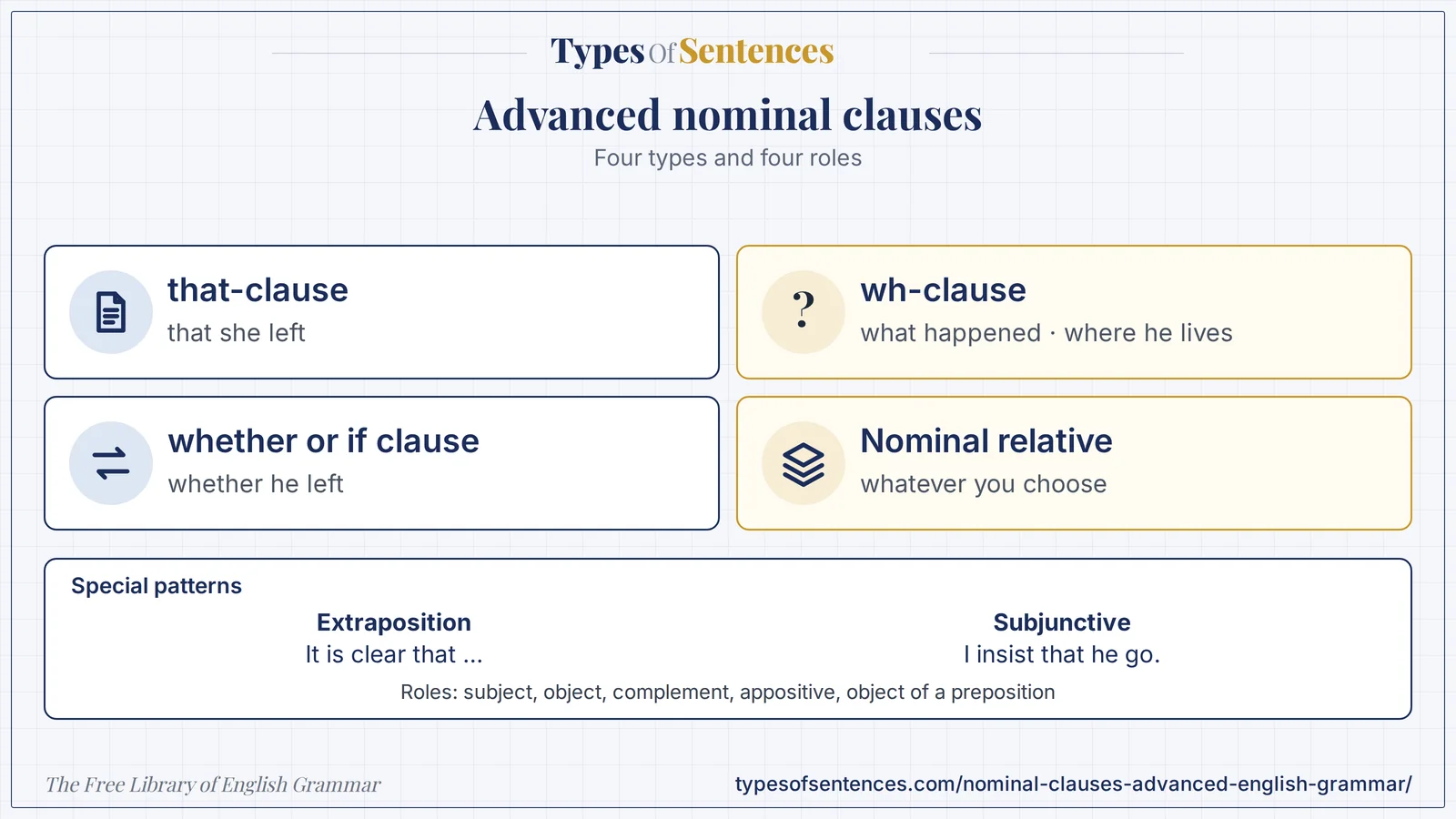
Summary: A nominal clause functions as a subject, object, complement, or appositive. The main types are that-clauses (that she left), wh-clauses (what happened, where he lives), whether and if clauses, and nominal relative clauses (whatever you choose). A long clause subject is often moved to the end with an anticipatory it (extraposition). Appositive clauses explain a noun (the fact that he lied). After verbs and adjectives of demand and recommendation, the mandative subjunctive uses the base verb (that she be present).
- Types: that-, wh-, whether/if, and nominal relative clauses.
- Roles: subject, object, complement, appositive, and object of a preposition.
- Extraposition: It is clear that ….
- Subjunctive: I insist that he go, It is vital that she be informed.
What You’ll Learn
- 1. Nominal Clauses: Types and Introducers
- 2. Nominal Clauses as Subjects
- 3. Nominal Clauses as Objects
- 4. Nominal Clauses as Complements
- 5. Extraposition
- 6. Appositive Clauses (Content Clauses)
- 7. The Subjunctive in Nominal Clauses
- 8. Nominal Relatives: Whoever, Whomever, and Whatever
- 9. Omitting That and Other Choices
- 10. Analyzing Nominal Clauses: A Worked Example
- 11. Common Errors with Nominal Clauses
- 12. Exercises
- 13. Test Your Knowledge
- 14. Frequently Asked Questions
- 15. Conclusion
1. Nominal Clauses: Types and Introducers
A nominal clause fills a position that a noun phrase could fill. The test is to replace it with something or it: I know that she left → I know it; What you said was true → That was true.
| Type | Introducer | Example | Function of the introducer |
|---|---|---|---|
| declarative that-clause | that (often omitted) | I know (that) she left. | a conjunction with no role in the clause |
| wh-interrogative clause | who, whom, whose, what, which, when, where, why, how | I know who called. I wonder how it works. | also the subject, object, or adverbial in the clause |
| yes/no interrogative clause | whether, if | I wonder whether (or if) she left. | a conjunction; asks about truth |
| nominal relative clause | what, whatever, whoever, whichever, whenever | I like what you wrote. Whoever calls, take a message. | a relative word with the meaning “the thing that”, “anyone who” |
| -ing and to-infinitive clauses (non-finite) | none | I enjoy reading. I know what to do. | no subject; see the chapter on non-finite verbs |
All the finite types have a subject and a finite verb. The first three are the ones that this chapter studies; the non-finite types are treated in the chapters on non-finite verbs and complementation. The chapter on complementation patterns shows which verbs take which types.
2. Nominal Clauses as Subjects
| Type | Example | Notes |
|---|---|---|
| that-clause | That he succeeded surprised everyone. | formal; often replaced by extraposition |
| wh-clause | What you said was interesting. Why she left remains a mystery. | common and natural |
| whether-clause | Whether he comes does not matter. | if cannot begin a subject clause |
| nominal relative | Whoever wins gets the prize. What happened next is unclear. | the clause names a person or thing |
| how-clause | How we did it is a secret. | — |
- A clause subject takes a singular verb: What he said is true, even when the content is plural: What we need is more books (the clause is singular, and the complement is plural).
- If cannot introduce a subject clause: *If he comes does not matter. Use whether.
- A that-clause subject is heavy and unusual in speech. It cannot easily start a question (*Is that he left surprising?), so writers move it to the end: Is it surprising that he left?
- Put a comma after a long clause subject only if the sentence would be misread; otherwise no comma separates a subject from its verb.
If introduces a conditional or an object clause, but not a subject clause.
3. Nominal Clauses as Objects
| Role | Example | Notes |
|---|---|---|
| direct object | I think (that) she left. He asked what time it was. I know who called. | the most common role |
| object of a preposition | He is worried about what might happen. It depends on whether she comes. | a that-clause cannot follow most prepositions |
| indirect (with a verb of telling) | She told me that she was late. | an object plus a clause |
| object with a verb of saying or thinking | She said that she would come. | tense often shifts (backshift) |
| object of an adjective | I am sure that she knows. I am afraid that he is late. | see the chapter on complement clauses |
| Question form | Indirect (nominal clause) form | Rule |
|---|---|---|
| Where does she live? | I know where she lives. | statement word order; no do |
| What time is it? | Do you know what time it is? | statement word order |
| Is she coming? | I wonder whether (if) she is coming. | whether or if |
| Who called? | I know who called. | a subject wh-word keeps its position |
| Where should I go? | I don’t know where to go. | an infinitive can replace the clause |
| Why did he leave? | Nobody knows why he left. | no did |
Indirect questions use statement word order and no question mark when the main clause is a statement: I wonder where she is. When the main clause is a question, the question mark remains: Do you know where she is? The backshift of tenses in reported speech is covered at the Intermediate level in the chapter on reported speech, and further in the Advanced level.
4. Nominal Clauses as Complements
| Role | Example | Notes |
|---|---|---|
| subject complement (after be) | The question is whether we can afford it. My worry is that she will fail. | links back to the subject |
| after the fact is, the problem is, the trouble is, the point is | The problem is that nobody knows. | that is often omitted in speech |
| after reason | The reason is that it rained. | not because in formal writing |
| complement of an adjective | I am sure that she knows. It is important that she comes. | see the chapter on complement clauses |
| complement of a noun (appositive) | The idea that we should leave is absurd. | see below |
The complement clause must match the subject in meaning. The pattern The reason is because … is criticized because reason and because say the same thing twice; formal writing prefers The reason is that …. Compare the two forms in the chapter on complement clauses, which treats clausal complements of verbs, adjectives, and nouns in detail.
5. Extraposition
Extraposition moves a heavy clause subject to the end of the sentence and puts the dummy pronoun it in the subject position. It is a matter of weight: English prefers heavy elements at the end.
| Clause as subject | Extraposed | Note |
|---|---|---|
| That he is honest is clear. | It is clear that he is honest. | the usual form |
| Whether she will come is not known. | It is not known whether she will come. | — |
| What he wants is unclear. | It is unclear what he wants. | — |
| That the plan failed surprised us. | It surprised us that the plan failed. | after verbs of feeling |
| To err is human. (infinitive) | It is human to err. | also with infinitives |
| That prices will rise is said. | It is said that prices will rise. | impersonal passive |
| Pattern | Examples |
|---|---|
| it + be + adjective + clause | It is clear / likely / possible / important / strange that … |
| it + be + noun + clause | It is a pity / a fact / a shame that … |
| it + verb + object + clause | It surprised me that … It bothers her that … |
| it + seems/appears/happens + clause | It seems that she left. It happened that we were there. |
| it + passive + clause | It is said / believed / reported / known that … |
| object extraposition | I find it odd that he left. I take it that you agree. He made it clear that he was leaving. |
6. Appositive Clauses (Content Clauses)
An appositive clause follows a noun and spells out its content: the fact that he lied, the idea that we should leave. The noun belongs to a small class of abstract nouns that “contain” a proposition.
| Nouns that take appositive that-clauses | Examples |
|---|---|
| fact, idea, belief, notion, claim, assumption, theory | The belief that the Earth is flat is wrong. |
| news, rumor, report, evidence, proof, sign | There is evidence that the drug works. |
| possibility, probability, chance, risk | The possibility that it will rain is small. |
| suggestion, proposal, decision, request, demand, order | The suggestion that we wait was rejected. |
| hope, fear, worry, doubt, feeling | Her fear that he would leave was real. |
| Appositive clause | Relative clause | |
|---|---|---|
| example | The fact that he lied upset me. | The book that I read was long. |
| that is | a conjunction (no role in the clause) | a pronoun (it is the object of read) |
| can that be omitted? | rarely (the fact he lied is informal) | yes (the book I read) |
| can which replace that? | no | yes (the book which I read) |
| paraphrase | The fact is that he lied. | I read the book. |
| the noun | abstract, “contains” the content | any noun |
The test is to paraphrase: if you can say The fact is that …, the clause is appositive. If that fills a gap in the clause (the book that I read [it]), it is a relative clause, covered in the next chapter, on advanced relative clauses.
7. The Subjunctive in Nominal Clauses
After words that express demand, recommendation, or necessity, a nominal clause can use the mandative subjunctive: the base form of the verb for all persons, with no -s and no tense change. The verb be appears as be.
| Kind of trigger | Triggers | Examples |
|---|---|---|
| verbs | demand, insist, suggest, recommend, propose, request, require, urge, ask, order, advise, command, move | I insist that he go. She suggested that he be present. They demanded that she resign. |
| adjectives | essential, important, vital, crucial, necessary, imperative, desirable, advisable | It is essential that she arrive on time. It is vital that the report be submitted. |
| nouns | demand, suggestion, recommendation, proposal, requirement, insistence, condition | the recommendation that he stay; her insistence that the rule be followed |
| Form | American usage | British usage |
|---|---|---|
| mandative subjunctive | I suggest that he be present. | less common |
| should + base form | I suggest that he should be present. (also used) | common: I suggest that he should be present. |
| indicative | I suggest that he is present. (informal, less usual) | also found |
| negative | I insist that he not go. | I insist that he should not go. |
- The negative subjunctive puts not before the base verb: I insist that he not be late, not that he does not be late.
- The subjunctive is used when the verb expresses a demand, not a fact. She suggested that he leave (a recommendation) differs from The data suggest that he is lying (they indicate it), where the ordinary indicative is used.
- The were subjunctive appears after wish and in unreal conditions: I wish that he were here; see the chapter on advanced conditionals.
- The modal verbs and their subjunctive-like meanings are treated in the chapter on modality.
8. Nominal Relatives: Whoever, Whomever, and Whatever
Nominal relative clauses begin with a word that is both the introducer and a part of the clause. The case of the word depends on its role inside its own clause, not on the role of the whole clause in the sentence.
| Sentence | Role of the clause | Role of the pronoun inside it | Correct form |
|---|---|---|---|
| I will give the prize to ___ wins. | object of to | subject of wins | whoever wins |
| Give it to ___ you trust. | object of to | object of trust | whomever you trust (formal); whoever in speech |
| ___ calls, take a message. | subject | subject of calls | Whoever calls |
| I like ___ you cooked. | object of like | object of cooked | what you cooked |
The common error is to choose whomever because the clause follows a preposition: *Give it to whomever wins is wrong because whoever is the subject of wins. The whole clause, not the pronoun, is the object of to. The test is to isolate the clause and fill in the pronoun: [he] wins (subject: whoever), you trust [him] (object: whomever).
9. Omitting That and Other Choices
| Situation | Omit that? | Example |
|---|---|---|
| after common verbs of thinking and saying, in speech and informal writing | usually yes | I think she is right. He said he would come. |
| after an adjective | often yes | I am glad you came. |
| when the clause is the subject | no | That he left surprised us. (omission is impossible) |
| after a noun (appositive) | rarely | the fact that he lied |
| after a long or complex subject, or a pause | keep it | The claim, made by several experts, that the plan will fail is unproven. |
| when coordinated clauses follow | keep that in the second | He said that she was late and that the train was full. |
| after the verb is a different pattern (verb + that) that could be misread | keep it | He told his friends that he knew the answer was wrong. |
| in formal and legal writing | often keep it | The Court held that the statute was valid. |
The omission is a matter of register, clarity, and rhythm. Keeping that avoids a misreading in sentences such as She knew the answer was wrong, where a reader might at first take the answer as the object of knew. When you edit, add that where the reader could stumble, and delete it where it adds only clutter.
10. Analyzing Nominal Clauses: A Worked Example
Analyze: I know that she believes that whoever applies early will get what the committee promised.
- Main clause: I know …
- Nominal clause 1 (object of know): that she believes …
- Nominal clause 2 (object of believes): that whoever applies early will get what the committee promised
- Inside clause 2, the subject is a nominal relative clause: whoever applies early (whoever is the subject of applies).
- Also inside clause 2, the object of get is a nominal relative clause: what the committee promised (what is the object of promised).
- Result: four nominal clauses, nested inside one another.
- Find every finite verb to count the clauses.
- Find the introducers (that, whoever, what).
- For each clause, ask what job it does: subject, object, complement, or appositive.
- For a nominal relative, decide the case from its role inside its own clause.
- Check the verb form: indicative, or subjunctive after verbs of demand.
11. Common Errors with Nominal Clauses
| Error | Correction | Rule |
|---|---|---|
| If he comes does not matter. | Whether he comes does not matter. | if cannot introduce a subject clause |
| He insisted on that she come. | He insisted that she come. | no that-clause after a preposition |
| I know where does she live. | I know where she lives. | statement order |
| I don’t know what is his name. | I don’t know what his name is. | statement order |
| The reason is because it rained. | The reason is that it rained. | redundancy |
| I suggest that he goes. | I suggest that he go. | mandative subjunctive |
| It is essential that she arrives. | It is essential that she arrive. | mandative subjunctive |
| Give it to whomever wins. | Give it to whoever wins. | case follows the role inside the clause |
| I wonder if or not she came. | I wonder whether or not she came. | whether or not |
| The news that the team won are good. | The news that the team won is good. | the head noun is singular |
| What he said were lies. | What he said was lies. / What he said was a lie. | the clause subject is singular |
| He said me that he left. | He told me that he left. | tell takes an object |
Edit: If she accepts the job is not clear, and the reason is because nobody knows where does she live, but I insist that she goes, and give the key to whomever arrives first.
- If she accepts the job is not clear: Whether she accepts the job is not clear (or extraposed: It is not clear whether she accepts the job).
- the reason is because: the reason is that.
- where does she live: where she lives.
- I insist that she goes: I insist that she go.
- whomever arrives: whoever arrives.
- Result: It is not clear whether she accepts the job, and the reason is that nobody knows where she lives, but I insist that she go, and give the key to whoever arrives first.
Recap in 12 seconds
Watch the lesson build itself: Nominal clauses are that-, wh-, whether or if, and nominal relative clauses, with extraposition and the subjunctive. The video has no sound.
Exercises
Part A: Types and Subjects (Exercises 1–6)
Exercise 1: Name the type of clause: I know that she left. (that she left)
Show Answer
Answer: A that-clause (nominal).
Exercise 2: Name the role: What you said was interesting. (What you said)
Show Answer
Answer: Subject.
Exercise 3: Edit: If he comes does not matter.
Show Answer
Answer: Whether he comes does not matter.
Exercise 4: Name the type: Whoever wins gets the prize. (Whoever wins)
Show Answer
Answer: A nominal relative clause (subject).
Exercise 5: Choose: What we need (is/are) more books.
Show Answer
Answer: is.
Exercise 6: Replace with it to test: I know who called.
Show Answer
Answer: I know it.
Part B: Objects and Indirect Questions (Exercises 7–13)
Exercise 7: Edit: I know where does she live.
Show Answer
Answer: I know where she lives.
Exercise 8: Edit: I don’t know what is his name.
Show Answer
Answer: I don’t know what his name is.
Exercise 9: Edit: He insisted on that she come.
Show Answer
Answer: He insisted that she come.
Exercise 10: Make indirect: Is she coming? (I wonder …)
Show Answer
Answer: I wonder whether (if) she is coming.
Exercise 11: Make indirect: What time is it? (Do you know …?)
Show Answer
Answer: Do you know what time it is?
Exercise 12: Punctuate: I wonder where she is
Show Answer
Answer: I wonder where she is. (no question mark)
Exercise 13: Name the role of the clause: It depends on whether she comes.
Show Answer
Answer: Object of a preposition.
Part C: Complements and Extraposition (Exercises 14–19)
Exercise 14: Edit: The reason is because it rained.
Show Answer
Answer: The reason is that it rained.
Exercise 15: Extrapose: That he is honest is clear.
Show Answer
Answer: It is clear that he is honest.
Exercise 16: Extrapose: Whether she will come is not known.
Show Answer
Answer: It is not known whether she will come.
Exercise 17: Name the construction: I find it odd that he left.
Show Answer
Answer: Object extraposition.
Exercise 18: Name the role of whether we can afford it: The question is whether we can afford it.
Show Answer
Answer: Subject complement.
Exercise 19: Why is extraposition useful?
Show Answer
Answer: It moves a heavy clause to the end, where it is easier to process.
Part D: Appositive Clauses and Subjunctive (Exercises 20–26)
Exercise 20: Appositive or relative: the fact that he lied
Show Answer
Answer: Appositive.
Exercise 21: Appositive or relative: the book that I read
Show Answer
Answer: Relative.
Exercise 22: Edit: I suggest that he goes.
Show Answer
Answer: I suggest that he go.
Exercise 23: Edit: It is essential that she arrives.
Show Answer
Answer: It is essential that she arrive.
Exercise 24: Make negative: I insist that he go.
Show Answer
Answer: I insist that he not go.
Exercise 25: Choose: The data (suggest/suggests) that he is lying. (indicative)
Show Answer
Answer: suggest (plural data), with an indicative verb in the clause.
Exercise 26: Edit: The news that the team won are good.
Show Answer
Answer: The news that the team won is good.
Part E: Whoever and That (Exercises 27–30)
Exercise 27: Choose: Give it to (whoever/whomever) wins.
Show Answer
Answer: whoever.
Exercise 28: Choose (formal): Give it to (whoever/whomever) you trust.
Show Answer
Answer: whomever (the object of trust).
Exercise 29: Should that be kept in a coordinated second clause: He said that she was late and (that) the train was full.?
Show Answer
Answer: Yes, keep it.
Exercise 30: Where is omitting that impossible?
Show Answer
Answer: When the clause is the subject: That he left surprised us.
Test Your Knowledge
Ready to check what you learned? Answer all 10 questions, then submit. You need 80% (8 of 10) to pass. Your answers are not stored.
View correct answers and explanations
Question 1: Which introducer cannot begin a subject clause?
✓ Correct Answer: B – if
If cannot begin a subject clause.
Question 2: Which is correct?
✓ Correct Answer: A – I know where she lives.
Statement word order.
Question 3: Which is correct?
✓ Correct Answer: C – He insisted that she come.
No that-clause after a preposition.
Question 4: Which is extraposition?
✓ Correct Answer: D – It is clear that he is honest.
The clause is moved to the end with it.
Question 5: Which is an appositive clause?
✓ Correct Answer: C – the fact that he lied
It spells out the content of the noun fact.
Question 6: Which uses the mandative subjunctive?
✓ Correct Answer: D – I suggest that he go.
Base form after a verb of recommendation.
Question 7: Which is correct?
✓ Correct Answer: C – Give it to whoever wins.
Whoever is the subject of wins.
Question 8: Which is more formal?
✓ Correct Answer: A – The reason is that it rained.
The reason is that is formal.
Question 9: Which verb form follows What he said as a subject?
✓ Correct Answer: B – is
A clause subject is singular.
Question 10: Which is correct?
✓ Correct Answer: B – I wonder whether or not she came.
Whether or not.
Frequently Asked Questions
What are nominal clauses?
Nominal clauses, also called noun clauses, are clauses that do the work of a noun phrase: subject, object, complement, or appositive. They begin with that, a wh-word, whether, or if.
What are advanced noun clauses?
Advanced noun clauses are the finer points of the nominal clause: extraposition, appositive clauses, the mandative subjunctive, nominal relative clauses, and the rules for omitting that.
What are complex noun clauses?
Complex noun clauses are nominal clauses that contain or are contained in other clauses, such as I know that she believes that whoever applies early will get what was promised, and clauses with the subjunctive or extraposition.
What is noun clause mastery?
Noun clause mastery is the ability to identify any noun clause, say what job it does, choose the right introducer, use statement word order, and decide on the form of the verb and the omission of that.
What are expert noun clauses?
Expert noun clauses are noun clauses used with full control: correct introducer, case, word order, tense, and verb form, with clear structure even when the clauses are nested.
What is extraposition?
Extraposition moves a clause subject to the end of the sentence and puts it in the subject position: It is clear that he is honest instead of That he is honest is clear.
When do I use the subjunctive in a noun clause?
Use the base form after verbs, adjectives, and nouns of demand and recommendation (I insist that he go, It is essential that she be informed). In British English, should is often used instead.
Conclusion
You now have a deep study of nominal clauses: their types and introducers, their roles as subject, object, and complement, extraposition, appositive clauses, the mandative subjunctive, nominal relatives such as whoever, and the omission of that. You can use nominal clauses with expert control and avoid the usual errors.
When you meet a long sentence, find each noun clause and ask what job it does. Next, you will study advanced relative clauses.
- Huddleston, Rodney, and Geoffrey K. Pullum. The Cambridge Grammar of the English Language. Cambridge University Press, 2002.: the reference analysis of content clauses, extraposition, and the subjunctive.
- Quirk, Randolph, et al. A Comprehensive Grammar of the English Language. Longman, 1985.: the classic treatment of nominal clauses.
- Biber, Douglas, et al. Longman Grammar of Spoken and Written English. Longman, 1999.: corpus evidence on that-clauses and omission of that.
- Garner, Bryan A. Garner’s Modern English Usage, 5th ed. Oxford University Press, 2022.: usage guidance on whoever and whomever and the subjunctive.
- The Chicago Manual of Style, 17th edition, chapter 5 (Grammar and Usage): American publishing conventions.
Last reviewed: October 29, 2026. How it was made: drafted with AI assistance, then checked with automated tests (structure, links, answer keys, spelling) and against the sources above. A person has not yet read this chapter line by line. Found a mistake? Report it.