Fronting and postponement are the two ways that English varies its basic word order to manage emphasis and information. Fronting moves an element to the beginning of a clause: This book I really enjoyed, Yesterday I saw him. Postponement moves an element to the end: It is clear that he is guilty, I gave to Mary the book that John had recommended. Both are examples of word order and emphasis: the same content is arranged differently so that the reader notices what the writer wants noticed.
You will study fronting grammar (object fronting, predicate fronting, adverbial fronting), postponement grammar (extraposition with it, heavy noun phrase shift, postposed modifiers), dislocation, and the principles of information structure that explain the choices: given before new, end focus, and end weight. These word order variation devices are a major part of expert style. Thirty editing exercises and a quiz follow.
English clauses normally run subject, verb, object, and then adverbials. But writers often depart from this order. They move something to the front to link back to the previous sentence or to make a contrast, and they move something to the end so that long or new information can be absorbed last.
Why it matters: Because the basic order carries meaning (who did what to whom), a change of order must be signaled and supported by the context. That is why fronting and postponement are choices of style and not random options.
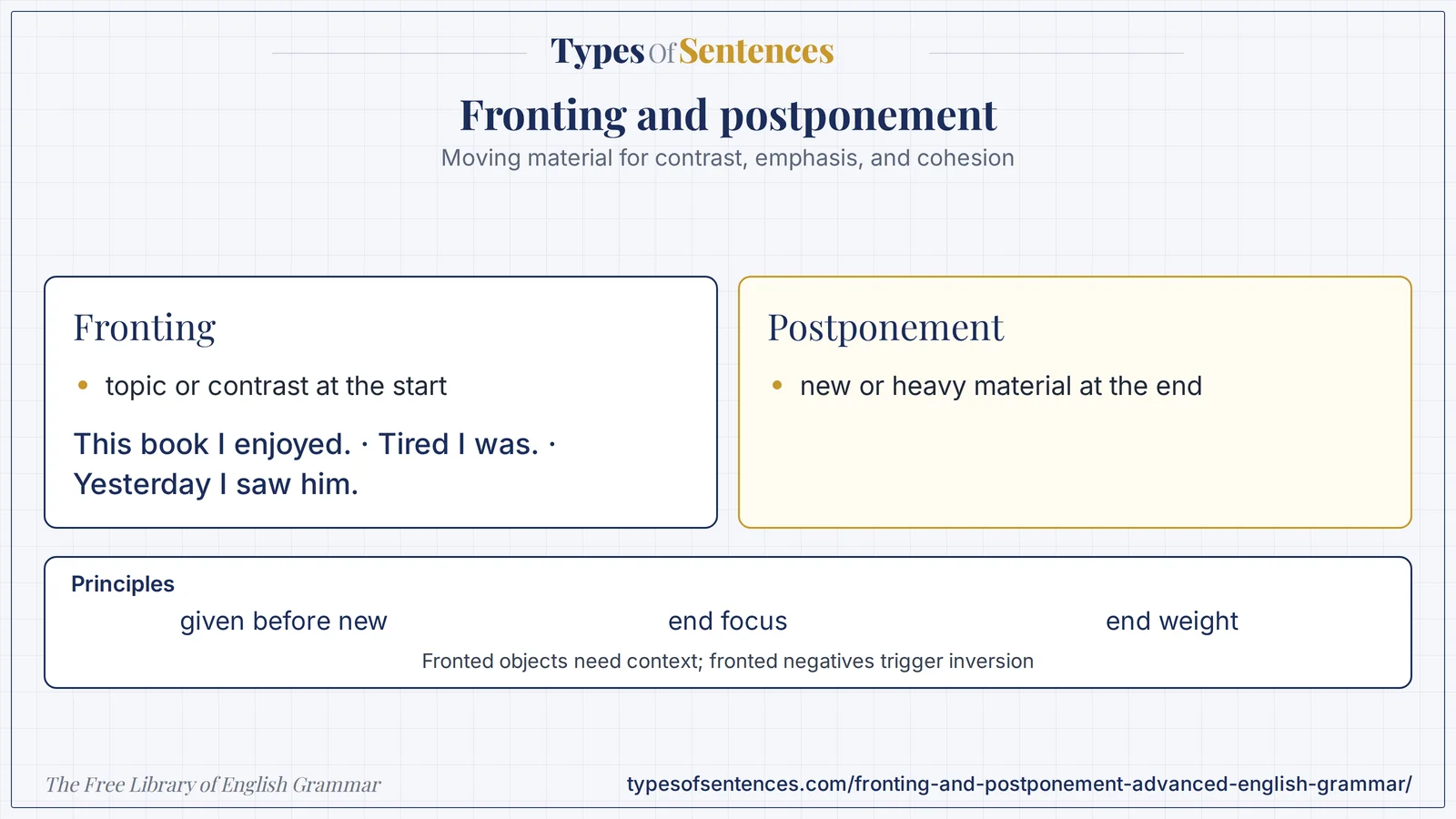
Summary: Fronting places an object, a predicate, or an adverbial at the start of a clause for contrast, emphasis, or cohesion (This book I enjoyed; Tired I was; Yesterday I saw him). Postponement moves a long, heavy, or new element to the end: extraposition of a clause subject (It is clear that he lied), heavy noun phrase shift (I gave to Mary the book that John had recommended), and extraposed modifiers. The motivations are information structure (given before new), end focus, and end weight.
- Fronting: topic or contrast at the start.
- Postponement: new or heavy material at the end.
- Principles: given before new; end focus; end weight.
- Fronted objects need context; fronted negatives trigger inversion.
What You’ll Learn
- 1. Fronting and Postponement: Word Order and Emphasis
- 2. Object Fronting (Topicalization)
- 3. Predicate Fronting
- 4. Adverbial Fronting
- 5. Postponement: Moving Elements to the End
- 6. Extraposition with It
- 7. Heavy Noun Phrase Shift
- 8. Information Structure: Given and New, Theme and Rheme
- 9. Dislocation and Topic Markers
- 10. Constraints and Cautions
- 11. Style: Using Word Order Deliberately
- 12. Common Errors with Fronting and Postponement
- 13. Exercises
- 14. Test Your Knowledge
- 15. Frequently Asked Questions
- 16. Conclusion
1. Fronting and Postponement: Word Order and Emphasis
The basic order of an English clause is subject, verb, object, and adverbials. Because English has little case marking, word order shows who did what to whom, so changes of order are limited. Where they occur, they are motivated by the flow of information in the text.
| Process | What moves | Example | Effect |
|---|---|---|---|
| fronting (topicalization) | object | This book I really enjoyed. | contrast or link to the previous sentence |
| predicate fronting | complement or verb phrase | Tired I was, but happy. Win they did. | emphasis; literary |
| adverbial fronting | time, place, manner, clause | Yesterday I saw him. In Paris we met. | scene-setting, cohesion |
| extraposition | a clause subject (or object) to the end | It is clear that he lied. | end weight; readability |
| heavy NP shift | a long noun phrase to the end | I gave to Mary the book that John had recommended. | end weight |
| dislocation | a topic to the left or right edge | My brother, he lives in Delhi. | informal topic marking |
| inversion | verb or auxiliary before subject | Never have I seen it. On the hill stood a castle. | emphasis; see the chapter on inversion |
Three principles of information structure explain most of these choices: given before new (old information early, new information late), end focus (the most important information at the end), and end weight (longer or heavier elements later). They are treated in the chapter on information structure.
2. Object Fronting (Topicalization)
| Basic order | Fronted object | Context |
|---|---|---|
| I really enjoyed this book. | This book I really enjoyed. | contrast: This book (but not that one) |
| I cannot accept that. | That I cannot accept. | a clear rejection |
| I like beans, but I hate peas. | Beans I like, but peas I hate. | contrast between two items |
| I don’t believe what he said. | What he said I don’t believe. | a clause as the fronted object |
| I never understood such things. | Such things I never understood. | generalizing |
| She told me that story twice. | That story she told me twice. | topic already in the context |
| Fronted | Effect | Register |
|---|---|---|
| a demonstrative object (This, That) | links the sentence to the previous one | neutral to formal |
| a clause (What he said) | weighty emphasis | formal, rhetorical |
| an object with a quantifier (Nothing, Not a word) | emphasis, often with inversion | literary |
| a contrasting pair | sets two items against each other | spoken and written |
| a generic noun phrase (Beans) | informal topic | spoken |
3. Predicate Fronting
| Basic order | Fronted predicate | Notes |
|---|---|---|
| I was tired, but happy. | Tired I was, but happy. | adjective complement fronted; literary |
| He could not sleep. | Sleep he could not. | a verb fronted with its auxiliary stranded; archaic or poetic |
| She said she would win, and she won. | She said she would win, and win she did. | VP fronting with do |
| Although she was rich, she was unhappy. | Rich though she was, she was unhappy. / Rich as she was, … | concessive fronting |
| However hard she tried, she failed. | Hard as she tried, she failed. Try as she might, she failed. | concessive |
| Be that as it may, … | (formula) | fixed expression |
| Come what may, … | (formula) | fixed expression |
| It is strange, though it may seem. | Strange though it may seem, … | concessive |
Predicate fronting is mostly literary or formal. The most common examples are the concessive patterns with though or as (Young as he was, he understood) and the fixed phrases Be that as it may, Come what may, and Try as I might. In ordinary prose they give a rhythmic, formal effect. See also the concessive clauses in the chapter on advanced adverbial clauses.
4. Adverbial Fronting
| Type | Example | Comma? |
|---|---|---|
| time (short) | Yesterday I saw him. Later we went home. | usually no comma, or an optional one |
| time (longer) | In the summer of 2020, we moved to Delhi. | comma after a long phrase |
| place | In Paris we met. At the back of the room, a man was sleeping. | comma after a long phrase |
| manner | Slowly she opened the door. With great care, he lifted the box. | comma for a longer phrase |
| frequency | Often she walked alone. | — |
| sentence adverb | Fortunately, nobody was hurt. Unfortunately, it failed. | comma |
| condition or reason clause | If it rains, we stay. Because the road was closed, we turned back. | comma after a fronted clause |
| linking adverb | However, it failed. In addition, it was costly. | comma |
A fronted adverbial often does two jobs: it sets the scene or the time frame for the sentence, and it links back to the previous sentence. In 2020, the company moved to Delhi. A year later, it opened a second office. A long sequence of such openings gives a chronological framework to a text. This is why adverbial fronting is a main feature of narrative and academic writing.
| Fronting with and without inversion | Example | Rule |
|---|---|---|
| neutral adverbial | Yesterday I saw him. (no inversion) | subject-verb order |
| negative or restrictive adverbial | Never have I seen it. Only then did I realize. | inversion required |
| locative with intransitive verb | In the corner sat an old man. | inversion with a noun-phrase subject |
| locative with pronoun subject | In the corner he sat. | no inversion with a pronoun |
5. Postponement: Moving Elements to the End
Postponement is the opposite of fronting. A heavy or new element is moved to the end of the clause, where the reader can absorb it last. The three main kinds are extraposition, heavy noun phrase shift, and extraposed modifiers.
| Kind | Basic order | Postponed order | Principle |
|---|---|---|---|
| extraposition of a clause subject | That he is guilty is clear. | It is clear that he is guilty. | end weight |
| extraposition of an infinitive subject | To learn Greek is hard. | It is hard to learn Greek. | end weight |
| extraposition of a clause object | I find that he lied odd. | I find it odd that he lied. | end weight |
| heavy NP shift | I gave the book that John had recommended to Mary. | I gave to Mary the book that John had recommended. | end weight |
| extraposed relative clause | A man who wanted to see you came in. | A man came in who wanted to see you. | end weight; new information last |
| extraposed prepositional phrase | Several books about grammar were published last year. | Several books were published last year about grammar. | end focus |
| particle shift | She took off her coat. | She took her coat off. | either order; pronouns require the second |
| ditransitive alternation | She gave Mary the book. | She gave the book to Mary. | new or heavy last |
Extraposition of clauses is treated in the chapter on nominal clauses, and the related dummy-it sentences in the chapter on cleft sentences. This chapter concentrates on how postponement interacts with the other word-order choices.
6. Extraposition with It
| Pattern | Example | Notes |
|---|---|---|
| it + be + adjective + clause | It is clear that he lied. It is likely that she will win. | the most common |
| it + be + noun + clause | It is a pity that you left. It is a fact that prices rose. | — |
| it + verb + object + clause | It surprised me that she left. It bothers her that he is late. | verbs of feeling |
| it + be + adjective + infinitive | It is easy to make mistakes. It is important to be on time. | — |
| it + passive + clause | It is said that prices will rise. It was decided that we should wait. | impersonal passive |
| it + seem/appear/happen + clause | It seems that she is tired. It happens that I know him. | raising alternatives: She seems to be tired |
| object extraposition | I find it odd that he left. I take it that you agree. We consider it unlikely that she will come. | it as dummy object |
7. Heavy Noun Phrase Shift
| Neutral order | Shifted order | Effect |
|---|---|---|
| I gave the book to Mary. | — | short object: no shift needed |
| I gave the book that John had recommended to Mary. | I gave to Mary the book that John had recommended. | the long object goes last |
| He put the books he had brought on the table. | He put on the table the books that he had brought. | — |
| She explained the rules to me. | (not *She explained me the rules) | explain allows only the prepositional frame |
| They elected as chair the woman who had organized the campaign. | (shifted) | formal and a little literary |
| She took off her coat. | She took her coat off. | particle shift; for a pronoun: She took it off |
| Test | Result |
|---|---|
| the direct object is much longer than the indirect object or the prepositional phrase | shift the long phrase to the end |
| the object is a pronoun | no shift: I gave it to Mary |
| the shifted order creates ambiguity | keep the basic order |
| formal writing | sometimes uses it to avoid awkward length |
Heavy NP shift is more common in writing than in speech, where speakers tend to break a long noun phrase into two clauses: I gave Mary the book. John had recommended it. The length of noun phrases and their postmodifiers is treated in the chapter on complex noun phrases.
8. Information Structure: Given and New, Theme and Rheme
| Principle | Meaning | Example |
|---|---|---|
| given before new | old information first, new information last | A man arrived. The man (given) wanted a room (new). |
| end focus | the most important information at the end | She gave the report to the director. |
| end weight | longer elements later | I told her that the meeting had been canceled because of the strike. |
| theme (topic) | what the sentence is about, at the start | This book I really enjoyed. |
| rheme (comment) | what is said about the theme | This book I really enjoyed. |
| Choice | Version A | Version B | Why |
|---|---|---|---|
| active or passive | The committee approved the plan. | The plan was approved by the committee. | A puts the committee first (new news about the committee); B puts the plan first (given) and the agent last (focus) |
| order of objects | She gave Mary the book. | She gave the book to Mary. | the last element is the focus: Mary in A, the book in B |
| fronting | I found the conclusions unconvincing. | The conclusions I found unconvincing. | B links back to a previous mention of the report |
| extraposition | That she left surprised us. | It surprised us that she left. | B moves the heavy clause to the end |
The discussion of the topic is developed in the chapter on information structure, and the study of how sentences link in a text in the chapter on cohesion and coherence. The point for this chapter is that fronting and postponement are not arbitrary: they bring the order of the words into line with the order of the information.
9. Dislocation and Topic Markers
| Type | Example | Notes |
|---|---|---|
| left dislocation | My brother, he lives in Delhi. That book, I haven’t read it. | the topic is stated first and repeated by a pronoun; spoken |
| right dislocation (tag) | He lives in Delhi, my brother. It’s a good book, that one. | an afterthought that clarifies the pronoun |
| topic markers | As for Tom, I don’t know him. As to the budget, we will decide later. Regarding the report, it is late. | formal and neutral |
| speaking of | Speaking of Tom, have you seen him? | conversation |
| when it comes to | When it comes to grammar, she is an expert. | — |
Dislocation differs from fronting because a pronoun in the clause takes the place of the dislocated noun phrase (My brother, he lives in Delhi), while a fronted object leaves a gap (This book I enjoyed). Left dislocation is typical of speech and informal writing; the topic markers as for, as to, and regarding are acceptable in writing to change or introduce a topic.
10. Constraints and Cautions
| Constraint | Example | Comment |
|---|---|---|
| fronting needs context | ?This book I really enjoyed. (out of the blue) | supply a context or contrast |
| not every element can be fronted | *Enjoyed I this book. | verbs alone and subjects cannot be fronted this way |
| pronoun objects are rarely fronted | ?Him I saw. | possible only for contrast |
| double fronting is rare | ?Yesterday this book I read. | avoid more than one fronted element |
| postponement can create garden-paths | I gave to Mary the book. (fine) / I put on the table that I had bought in Paris the vase. | keep the shift clear |
| ambiguity of a postposed modifier | A man came in with a hat who wanted to see you. (the hat or the man?) | check attachment |
- Front for a reason. Fronting without contrast or cohesion sounds mannered.
- Postpone for readability. Move long or new material to the end, not short pronouns.
- Check the attachment of postposed modifiers. A relative clause moved to the end must still be clearly linked to its noun.
- Do not mix registers. Predicate fronting and heavy NP shift sound formal or literary.
11. Style: Using Word Order Deliberately
| Original | Revised | Strategy |
|---|---|---|
| I found the conclusions in the report unconvincing, and the methods, too. | The conclusions in the report I found unconvincing, and the methods, too. | front to link to the previous mention |
| That the plan would fail was obvious to all of the people who had studied the budget. | It was obvious to all of the people who had studied the budget that the plan would fail. | extraposition (heavy clause last) |
| The company opened an office in Delhi in 2020. | In 2020, the company opened an office in Delhi. | fronted time frame |
| She told the committee the results of the survey that had been conducted last spring. | She told the committee about the results of the survey that had been conducted last spring. | keep the order and add a preposition for clarity |
| The reason was a lack of funds that ended the project. | What ended the project was a lack of funds. | wh-cleft; see the chapter on cleft sentences |
Skilled writers choose word order to fit the paragraph. A fronted adverbial gives a frame; a fronted object links back; an extraposed clause relieves a heavy subject; a postponed modifier puts new information at the end. Overuse of any one device is a weakness. See the chapter on sentence variety for variation in sentence openings.
12. Common Errors with Fronting and Postponement
| Error | Correction | Rule |
|---|---|---|
| Yesterday saw I him. | Yesterday I saw him. | no inversion after a neutral adverbial |
| Never I have seen it. | Never have I seen it. | inversion after a fronted negative |
| That I cannot accept. | That I cannot accept. (a complete fronted object) | correct only with a contrastive context |
| I gave to her it. | I gave it to her. | a pronoun object does not shift |
| She took off it. | She took it off. | a pronoun object precedes the particle |
| It is clear that he is guilty is. | It is clear that he is guilty. | one clause |
| That he is guilty is clear it. | It is clear that he is guilty. | no double subject |
| Is that he left surprising? | Is it surprising that he left? | extraposition in a question |
| In the corner an old man sat. (literary) | In the corner sat an old man. | inversion with a locative and a noun-phrase subject |
| This book, I enjoyed it. | This book I enjoyed. / This book, I enjoyed it. (informal dislocation) | fronting vs dislocation |
| The man came in who wanted to see you with a hat. | A man with a hat came in who wanted to see you. | attachment of a postposed modifier |
| She explained me the rules. | She explained the rules to me. | explain takes the prepositional frame |
Edit: Yesterday saw I him, never I have seen such a thing, he took off it, that he is guilty is clear it, and a man came in who wanted to see you with a hat, but she explained me the rules.
- Yesterday saw I him: Yesterday I saw him.
- never I have seen: never have I seen.
- took off it: took it off.
- that he is guilty is clear it: It is clear that he is guilty.
- who wanted to see you with a hat: a man with a hat came in who wanted to see you.
- explained me the rules: explained the rules to me.
- Result: Yesterday I saw him; never have I seen such a thing; he took it off. It is clear that he is guilty. A man with a hat came in who wanted to see you, but she explained the rules to me. (A better edit would split this into separate sentences.)
Recap in 12 seconds
Watch the lesson build itself: Fronting puts an element first and postponement moves heavy or new material to the end, following given-before-new, end focus, and end weight. The video has no sound.
Exercises
Part A: Fronting (Exercises 1–7)
Exercise 1: Front the object: I really enjoyed this book.
Show Answer
Answer: This book I really enjoyed.
Exercise 2: Front the object: I cannot accept that.
Show Answer
Answer: That I cannot accept.
Exercise 3: Front the object to contrast: I like beans, but I hate peas.
Show Answer
Answer: Beans I like, but peas I hate.
Exercise 4: Front the adverbial: I saw him yesterday.
Show Answer
Answer: Yesterday I saw him.
Exercise 5: Front the adverbial: We met in Paris.
Show Answer
Answer: In Paris we met.
Exercise 6: Front the predicate (concessive): Although she was rich, she was unhappy.
Show Answer
Answer: Rich though she was, she was unhappy.
Exercise 7: Edit: Yesterday saw I him.
Show Answer
Answer: Yesterday I saw him.
Part B: Postponement (Exercises 8–14)
Exercise 8: Extrapose: That he is guilty is clear.
Show Answer
Answer: It is clear that he is guilty.
Exercise 9: Extrapose: To learn Greek is hard.
Show Answer
Answer: It is hard to learn Greek.
Exercise 10: Extrapose the object clause: I find that he lied odd.
Show Answer
Answer: I find it odd that he lied.
Exercise 11: Shift the heavy object: I gave the book that John had recommended to Mary.
Show Answer
Answer: I gave to Mary the book that John had recommended.
Exercise 12: Edit: She took off it.
Show Answer
Answer: She took it off.
Exercise 13: Edit: I gave to her it.
Show Answer
Answer: I gave it to her.
Exercise 14: Edit: Is that he left surprising?
Show Answer
Answer: Is it surprising that he left?
Part C: Inversion with Fronting (Exercises 15–19)
Exercise 15: Front with inversion: I have never seen it.
Show Answer
Answer: Never have I seen it.
Exercise 16: Front with inversion: An old man sat in the corner.
Show Answer
Answer: In the corner sat an old man.
Exercise 17: Front with a pronoun subject: He sat in the corner.
Show Answer
Answer: In the corner he sat. (no inversion)
Exercise 18: Is there inversion after a neutral fronted adverbial: Yesterday I saw him?
Show Answer
Answer: No.
Exercise 19: Edit: Never I have seen it.
Show Answer
Answer: Never have I seen it.
Part D: Information Structure (Exercises 20–25)
Exercise 20: What does “given before new” mean?
Show Answer
Answer: Old information comes first; new information comes last.
Exercise 21: What does “end weight” mean?
Show Answer
Answer: Longer elements go later in the clause.
Exercise 22: Which version puts the focus on Mary: She gave Mary the book or She gave the book to Mary?
Show Answer
Answer: She gave the book to Mary (the last element is the focus).
Exercise 23: Name a topic marker.
Show Answer
Answer: as for (or as to, regarding).
Exercise 24: Dislocation or fronting: My brother, he lives in Delhi.
Show Answer
Answer: Left dislocation (a pronoun repeats the topic).
Exercise 25: Name the register of left dislocation.
Show Answer
Answer: Spoken and informal.
Part E: Style and Errors (Exercises 26–30)
Exercise 26: Add a frame: The company opened an office in Delhi. (2020)
Show Answer
Answer: In 2020, the company opened an office in Delhi.
Exercise 27: Edit: She explained me the rules.
Show Answer
Answer: She explained the rules to me.
Exercise 28: Edit: That he is guilty is clear it.
Show Answer
Answer: It is clear that he is guilty.
Exercise 29: Why is object fronting odd out of the blue?
Show Answer
Answer: It needs a given or contrastive context.
Exercise 30: Name a risk of postponing a relative clause.
Show Answer
Answer: Unclear attachment to its noun.
Test Your Knowledge
Ready to check what you learned? Answer all 10 questions, then submit. You need 80% (8 of 10) to pass. Your answers are not stored.
View correct answers and explanations
Question 1: What is fronting?
✓ Correct Answer: A – moving an element to the start of a clause
Fronting moves an element to the front.
Question 2: What is postponement?
✓ Correct Answer: C – moving an element to the end
Postponement moves a heavy or new element to the end.
Question 3: Which is object fronting?
✓ Correct Answer: D – This book I really enjoyed.
The object is placed first.
Question 4: Which is correct?
✓ Correct Answer: B – Yesterday I saw him.
No inversion after a neutral adverbial.
Question 5: Which is extraposition?
✓ Correct Answer: C – It is clear that he is guilty.
The clause is moved to the end with it.
Question 6: Which is correct?
✓ Correct Answer: D – She took it off.
A pronoun precedes the particle.
Question 7: What is “end weight”?
✓ Correct Answer: C – longer elements later
Heavy elements go at the end.
Question 8: Which is left dislocation?
✓ Correct Answer: A – My brother, he lives in Delhi.
A pronoun repeats the fronted topic.
Question 9: Which is correct?
✓ Correct Answer: B – She explained the rules to me.
Explain takes the prepositional frame.
Question 10: Which is correct?
✓ Correct Answer: B – Never have I seen it.
Inversion after a fronted negative.
Frequently Asked Questions
What is fronting and postponement?
Fronting moves an element to the start of a clause (This book I enjoyed); postponement moves an element to the end (It is clear that he lied). Both vary the basic word order for emphasis and information flow.
What does word order and emphasis mean here?
Word order and emphasis are linked: placing an element first or last gives it a different weight. Fronting gives contrast or a link to the previous sentence, and the end of a clause gives the focus.
What is fronting grammar?
Fronting grammar is the study of the elements that can be moved to the front (objects, predicates, adverbials), the contexts that make it natural, and the effect on emphasis and cohesion.
What is postponement grammar?
Postponement grammar is the study of the elements moved to the end: extraposed clauses, heavy noun phrases, and postposed modifiers, usually to follow the principles of end weight and end focus.
What is word order variation?
Word order variation is the use of different orders of the same elements for different effects: fronting, postponement, inversion, dislocation, and the choice between active and passive.
What is heavy noun phrase shift?
Heavy noun phrase shift is the movement of a long object to the end of the clause: I gave to Mary the book that John had recommended. It follows the principle of end weight.
Why does fronted object order need a context?
Because it signals that the object is given or contrastive. Without such a context, This book I really enjoyed sounds odd.
Conclusion
You now have a deep study of fronting and postponement: the fronting of objects, predicates, and adverbials, extraposition, heavy noun phrase shift, dislocation, and the principles of information structure, with the cautions and the common errors. You can use word order variation with expert control.
When you edit, ask what each sentence is about and what is new, and arrange the words to match. Next, you will study coordination and subordination at the advanced level.
- Huddleston, Rodney, and Geoffrey K. Pullum. The Cambridge Grammar of the English Language. Cambridge University Press, 2002.: the reference analysis of information packaging, fronting, and extraposition.
- Quirk, Randolph, et al. A Comprehensive Grammar of the English Language. Longman, 1985.: the classic treatment of end focus, end weight, and the order of elements.
- Biber, Douglas, et al. Longman Grammar of Spoken and Written English. Longman, 1999.: corpus evidence on fronted adverbials and dislocation.
- Halliday, M. A. K., and Christian M. I. M. Matthiessen. Halliday’s Introduction to Functional Grammar. 4th ed. Routledge, 2014.: the theory of theme and rheme.
- Merriam-Webster Dictionary: topicalization: the dictionary entry.
Last reviewed: October 29, 2026. How it was made: drafted with AI assistance, then checked with automated tests (structure, links, answer keys, spelling) and against the sources above. A person has not yet read this chapter line by line. Found a mistake? Report it.