Complex verb phrases are verb groups with several auxiliaries before the main verb, such as should have been working or might have been being watched. English allows up to four auxiliaries in a single verb phrase, and in each case the form of every auxiliary decides the form of the one that follows. These advanced verb phrases look intimidating, but they are built by a small number of rules that apply without exception.
You will study the order of the auxiliaries (modal, perfect, progressive, passive), the meaning of combinations such as the modal perfect and the modal perfect progressive, the passive progressive (is being done), the perfect progressive in all tenses, how negation, questions, and tags work with long verb phrases, how the semi-modals fit in, and a method for breaking down any verb phrase. This verb phrase structure advanced readers need is the basis of expert verb phrases. Thirty editing exercises and a quiz follow.
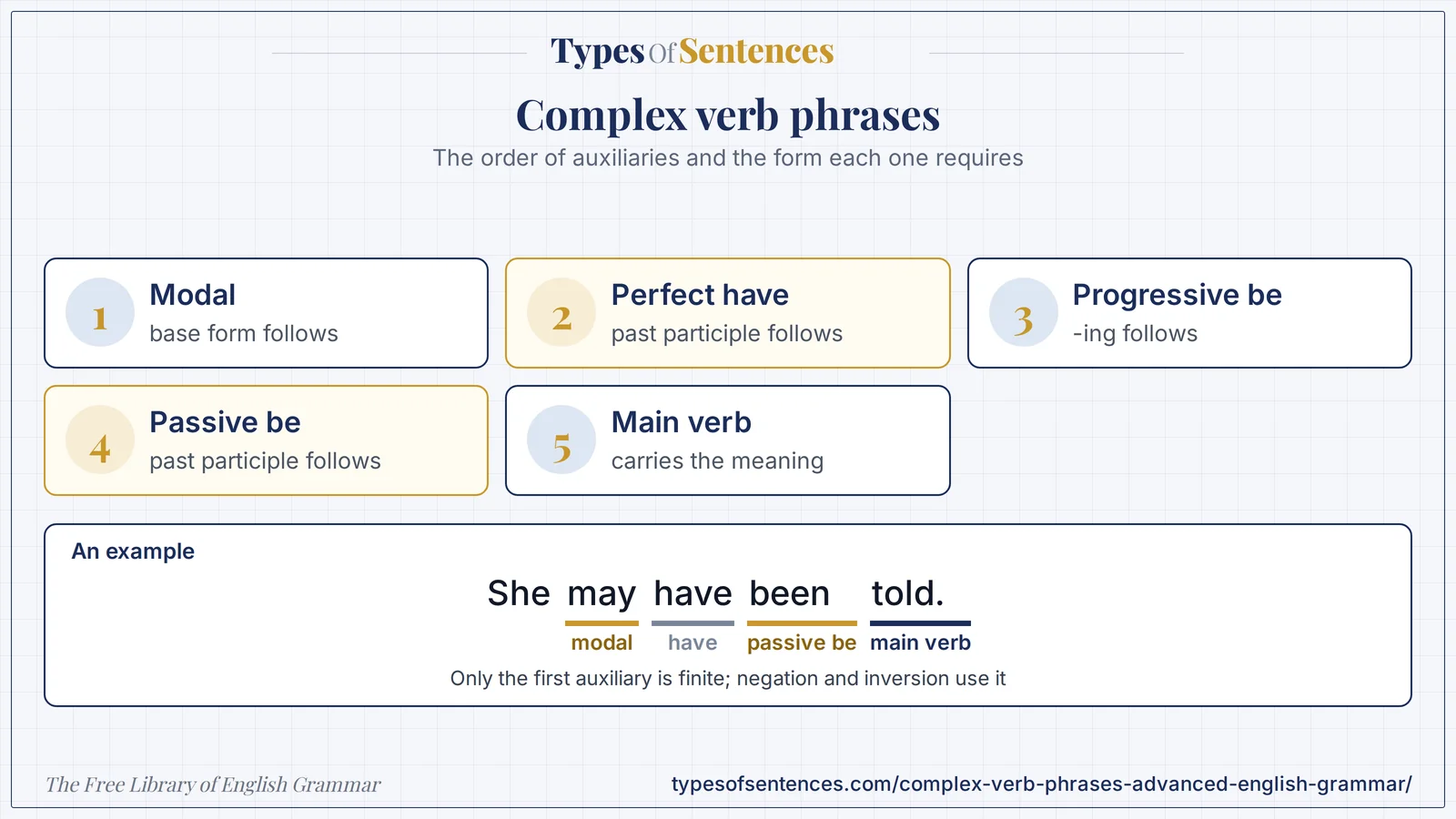
A verb phrase is the main verb together with its auxiliaries. Each auxiliary adds one meaning: the modal adds attitude (possibility, obligation), have adds completion, be adds duration or progress, and the passive be turns the subject into the receiver.
Why it matters: The auxiliaries always come in the same order, and each one forces a particular form on the next word. Once you know the pattern, even a four-auxiliary phrase can be built and read in seconds.
Summary: The order is: modal, perfect have, progressive be, passive be, main verb. A modal is followed by the base form, have by the past participle, progressive be by the -ing form, and passive be by the past participle. Only the first word is finite. Negation follows the first auxiliary; questions invert it. Phrases with three or four auxiliaries are rare in speech and are usually rewritten in writing.
- Order: modal → have → be (progressive) → be (passive) → main verb.
- Forms: base after a modal; -en after have; -ing after be; -en after passive be.
- Only the first auxiliary is finite and shows tense and agreement.
- Negation and inversion use the first auxiliary only.
What You’ll Learn
- 1. Complex Verb Phrases: The Structure and Order of Auxiliaries
- 2. Advanced Verb Phrases: Multiple Auxiliaries
- 3. Modal + Perfect + Progressive
- 4. The Passive Progressive
- 5. Perfect Progressive Forms in All Tenses
- 6. Negation, Questions, and Tags with Long Verb Phrases
- 7. Semi-Modals in Complex Verb Phrases
- 8. Analyzing Any Verb Phrase
- 9. Coordinating Verb Phrases and Sharing Auxiliaries
- 10. Style: Choosing the Simplest Form
- 11. Common Errors with Complex Verb Phrases
- 12. Exercises
- 13. Test Your Knowledge
- 14. Frequently Asked Questions
- 15. Conclusion
1. Complex Verb Phrases: The Structure and Order of Auxiliaries
A verb phrase consists of one or more auxiliaries followed by a main verb. The auxiliaries occupy four slots, always in the same order. The chapter on advanced verb concepts introduced the NICE properties and the types of auxiliary.
| Slot | Auxiliary | Form of the next word | Contributes |
|---|---|---|---|
| 1 | modal (can, could, may, might, will, would, shall, should, must) | base form | possibility, obligation, prediction, and so on |
| 2 | perfect have | past participle (-en) | completion; relevance to a later time |
| 3 | progressive be | -ing participle | an action in progress or temporary |
| 4 | passive be | past participle (-en) | the subject receives the action |
| 5 | main verb | — | the lexical meaning |
| Verb phrase | Slots filled | Number of auxiliaries |
|---|---|---|
| writes | main only | 0 |
| will write | 1 + 5 | 1 |
| has written | 2 + 5 | 1 |
| is writing | 3 + 5 | 1 |
| was written | 4 + 5 | 1 |
| will have written | 1 + 2 + 5 | 2 |
| has been writing | 2 + 3 + 5 | 2 |
| might be writing | 1 + 3 + 5 | 2 |
| is being written | 3 + 4 + 5 | 2 |
| should have been written | 1 + 2 + 4 + 5 | 3 |
| might have been writing | 1 + 2 + 3 + 5 | 3 |
| might have been being written | 1 + 2 + 3 + 4 + 5 | 4 |
2. Advanced Verb Phrases: Multiple Auxiliaries
To build or to read a verb phrase, work from the left, checking the form after each auxiliary. Take the longest possible phrase: The suspect might have been being watched.
| Word | Role | Form it requires next |
|---|---|---|
| might | modal (slot 1) | base form: have |
| have | perfect (slot 2) | past participle: been |
| been | progressive be in its -en form (slot 3) | -ing form: being |
| being | passive be in its -ing form (slot 4) | past participle: watched |
| watched | main verb, -en form (slot 5) | — |
| Number of auxiliaries | Example | Frequency |
|---|---|---|
| 0 | She writes. She wrote. | very common |
| 1 | She will write. She has written. She is writing. It was written. | very common |
| 2 | She will have written. She has been writing. It is being written. It must be written. | common |
| 3 | She might have been writing. It should have been written. It will have been done. | less common; mostly writing |
| 4 | It might have been being written. | very rare; usually rewritten |
Phrases with four auxiliaries are grammatical but almost never occur, because the passive progressive in a perfect form is awkward. Writers rewrite them: The suspect might have been under surveillance or Someone might have been watching the suspect. A good rule is to use the simplest form that carries the meaning. The twelve tenses are examined in the chapter on tense and aspect.
3. Modal + Perfect + Progressive
| Combination | Pattern | Examples | Meaning |
|---|---|---|---|
| modal + progressive | modal + be + -ing | She will be working. He must be sleeping. They might be waiting. | future in progress; a present deduction about an action in progress |
| modal + perfect | modal + have + -en | She must have left. He should have called. They could have won. | a past deduction, obligation, or possibility |
| modal + perfect + progressive | modal + have been + -ing | She must have been working. He might have been waiting. You should have been listening. | a past action in progress |
| future perfect progressive | will have been + -ing | By June she will have been working here for ten years. | duration up to a future point |
| counterfactual | would have + -en; would have been + -ing | If I had known, I would have come. I would have been sleeping. | an unreal past |
| Modal perfect | Meaning | Example |
|---|---|---|
| must have + -en | logical deduction about the past | She must have missed the train. |
| can’t / couldn’t have + -en | a negative deduction | He can’t have taken it. |
| may / might / could have + -en | a possibility about the past | She may have forgotten. |
| should / ought to have + -en | a past duty not done, or an expectation | You should have called. |
| needn’t have + -en | an unnecessary action that was done | I needn’t have gone. |
| would have + -en | a past result of an unreal condition | I would have helped. |
| could have + -en | an unrealized past possibility | You could have been killed. |
The meaning of the whole phrase is the sum of its parts. In She must have been working, must adds a conclusion, have places it in the past, and been working says the activity was in progress. The meanings of the modals are examined in the chapter on modality.
4. The Passive Progressive
The passive progressive combines progressive be and passive be: be being + past participle. It describes an action that is in progress while the subject receives it.
| Tense | Form | Example |
|---|---|---|
| present | am/is/are being + -en | The house is being painted. The reports are being reviewed. |
| past | was/were being + -en | The bridge was being built. Several options were being discussed. |
| future | will be being + -en (rare) | The report will be being written by then. (usually avoided) |
| present perfect | has/have been being + -en (rare) | The room has been being cleaned. (usually avoided) |
| modal | must be being + -en (rare) | It must be being repaired. |
| infinitive | to be being + -en (rare) | It seems to be being done. |
| Avoid | Use instead |
|---|---|
| The report will be being written. | The report will be written. / Someone will be writing the report. |
| The room has been being cleaned. | The room has been cleaned. / Someone has been cleaning the room. |
| The suspect might have been being watched. | Someone might have been watching the suspect. |
| It is being done. (agent needed) | Maria is doing it. |
Beyond the present and past, the passive progressive is felt to be heavy, and writers choose another structure: an active verb with a general subject (Someone is painting the house) or the simple passive (The house will be painted). The passive is studied in the chapter on voice.
5. Perfect Progressive Forms in All Tenses
| Tense | Form | Example |
|---|---|---|
| present perfect progressive | has/have been + -ing | She has been working since morning. |
| past perfect progressive | had been + -ing | She had been working for hours when he came. |
| future perfect progressive | will have been + -ing | By June she will have been working here for ten years. |
| modal perfect progressive | modal + have been + -ing | She must have been working. |
| infinitive | to have been + -ing | She seems to have been working. |
| -ing form | having been + -ing | Having been working all night, she was tired. |
| Perfect simple | Perfect progressive | Difference |
|---|---|---|
| I have painted the fence. | I have been painting the fence. | simple: the result (it is done); progressive: the activity (it may continue) |
| She has read the book. | She has been reading the book. | completion versus activity |
| They have lived here for ten years. | They have been living here for ten years. | similar; progressive suggests temporary or continuing |
| I have known her for years. | (not possible: *have been knowing) | a stative verb takes no progressive |
The perfect progressive emphasizes duration and often explains a present result: You are covered in paint! — I have been painting. It is used with for and since (for two hours, since Monday). Stative verbs do not take it. The distinctions are discussed further in the chapter on tense and aspect.
6. Negation, Questions, and Tags with Long Verb Phrases
| Operation | Rule | Example |
|---|---|---|
| negation | not or n’t after the first auxiliary | She might not have been working. She mightn’t have been working. (rare) |
| negation with have | after the first auxiliary | She has not been working. She hasn’t been working. |
| question (inversion) | the first auxiliary moves before the subject | Might she have been working? Has she been working? Was it being repaired? |
| question with a wh-word | wh-word + inverted first auxiliary | Why might she have been working? |
| tag question | repeat the first auxiliary with the opposite polarity | She might have been working, mightn’t she? She has been working, hasn’t she? |
| short answer | repeat the first auxiliary (and optionally more) | Might she have been working? — She might. / She might have. |
| emphatic | stress the first auxiliary | She HAS been working. |
| adverbs (medial position) | after the first auxiliary | She has always been working. She must definitely have been working. She may never have been told. |
All these operations use only the first auxiliary, which is why that auxiliary is the finite one. The NICE properties (negation, inversion, code, and emphasis) are explained in the chapter on advanced verb concepts and the structure of negation in the chapter on negation. Do-support appears only when there is no auxiliary: She does not work, but She has not worked.
| Negative modal perfect | Meaning | Notes |
|---|---|---|
| can’t / couldn’t have + -en | it is impossible that she did | negative deduction |
| may not have + -en | it is possible that she did not | not the same as can’t have |
| must not have + -en | (rare) it is certain that she did not | American usage often prefers can’t have |
| shouldn’t have + -en | she was wrong to do it | criticism |
| needn’t have + -en | it was unnecessary, but she did it | unnecessary action |
7. Semi-Modals in Complex Verb Phrases
The semi-modals (be going to, have to, be able to, used to, had better, would rather, ought to, be supposed to) fill the gaps in the modal system, because two modals cannot be combined in standard English (*might could, *will must).
| Combination | Example | Notes |
|---|---|---|
| modal + semi-modal | She will have to leave. He might be able to help. | the semi-modal supplies the second modal meaning |
| semi-modal + perfect | She ought to have called. You had better have finished. | ought to have; had better have |
| be going to + progressive | She is going to be working late. | future in progress |
| be going to + passive | The bridge is going to be built. | future passive |
| used to + be + -ing | She used to be working there. | past state |
| would rather + perfect | I would rather have gone. | past preference |
| have to in the perfect | She has had to leave. | obligation with a perfect |
| Impossible (double modal) | Possible |
|---|---|
| *She might could go. | She might be able to go. |
| *He will must leave. | He will have to leave. |
| *You should can do it. | You should be able to do it. |
| *They may can win. | They may be able to win. |
Double modals such as might could and used to could occur in some regional and dialect varieties, especially in the American South and in parts of Britain. They are not part of Standard English, but they are regular and rule-governed within those dialects.
8. Analyzing Any Verb Phrase
- Find the main verb: the last word of the phrase.
- Find the first word: it is the finite verb, carrying tense and agreement.
- Check the form of each word: base form after a modal, -en after have, -ing after be, -en after passive be.
- Label each auxiliary as modal, perfect, progressive, or passive, by the form that follows it.
- Read the meaning by combining the labels.
| Verb phrase | Analysis | Meaning |
|---|---|---|
| should have been working | should (modal) + have (perfect) + been (progressive, -en form) + working (main, -ing) | a past duty to be working |
| will have been written | will (modal) + have (perfect) + been (passive, -en form) + written (main, -en) | future perfect passive |
| is being built | is (progressive) + being (passive, -ing form) + built (main) | passive progressive |
| might have been being watched | might (modal) + have (perfect) + been (progressive) + being (passive) + watched (main) | four auxiliaries |
| had been told | had (perfect) + been (passive) + told (main) | past perfect passive |
| could not have been done | could (modal) + not + have (perfect) + been (passive) + done (main) | negative modal perfect passive |
Analyze: The report must have been being reviewed when the fire alarm sounded.
- Finite verb: must (a modal, slot 1).
- have (perfect, slot 2) → followed by been (-en).
- been (progressive be, slot 3) → followed by being (-ing).
- being (passive be, slot 4) → followed by reviewed (-en).
- reviewed (main verb).
- Meaning: a past deduction about an action that was in progress and that the report received. (It is grammatical but heavy; a writer would say Someone must have been reviewing the report when the alarm sounded.)
9. Coordinating Verb Phrases and Sharing Auxiliaries
Two main verbs can share auxiliaries, which avoids repeating them. The shared auxiliary must be in the right form for both main verbs.
| Sharing | Example | Notes |
|---|---|---|
| one auxiliary, two main verbs | She has written and sent the letters. | both are past participles |
| two auxiliaries shared | She might have been working and studying. | been + -ing for both |
| different auxiliaries | She has written the letters and will send them tomorrow. | each verb has its own |
| mismatch (error) | *She has written and sending the letters. | the second verb needs the same form |
| mismatch (error) | *He has gone and done it. (acceptable idiom) | a fixed expression |
A verb that needs a different form must repeat its own auxiliary: She has worked there for years and is happy, not *She has worked and happy. When the first auxiliary differs in form for the second verb, repeat it, as in He is working and she has finished. Ellipsis of auxiliaries is treated in the chapter on ellipsis.
10. Style: Choosing the Simplest Form
- Prefer simple forms. She worked all night is clearer than She had been working all night, unless the earlier time matters.
- Avoid more than two auxiliaries in one verb phrase unless the meaning requires them.
- Use the active voice where the doer is known: Maria is reviewing the report instead of The report is being reviewed by Maria.
- Rewrite four-auxiliary phrases. No reader benefits from might have been being watched.
- Check the main verb’s form after each auxiliary. Most errors are a wrong form: might have went, has been work, will be worked.
| Heavy | Lighter |
|---|---|
| The proposal would have been being considered if the committee had been meeting. | The committee would have been considering the proposal if it had been meeting. |
| It might have been being done. | Someone might have been doing it. |
| The results will have been being analyzed by then. | By then, researchers will have been analyzing the results. |
11. Common Errors with Complex Verb Phrases
| Error | Correction | Rule |
|---|---|---|
| She might have went. | She might have gone. | -en after have |
| She has been work. | She has been working. | -ing after be |
| The house is being paint. | The house is being painted. | -en after passive be |
| She will can go. | She will be able to go. | no double modals |
| I should of called. | I should have called. | have, not of |
| He had have gone. | He had gone. | one perfect auxiliary |
| She has been knowing him. | She has known him. | stative verb |
| It is been done. | It has been done. | perfect have before been |
| It was be done. | It was done. | no extra be |
| Might have she been working? | Might she have been working? | only the first auxiliary inverts |
| She didn’t had been working. | She hadn’t been working. | no do with an auxiliary |
| He may have to been gone. | He may have gone. | no to in the auxiliary chain |
Edit: The reports might have been being wrote when she will can arrive, and she should of been work, but she has been knowing that it is been done.
- been being wrote: been being written (and simplify).
- when she will can arrive: when she is able to arrive, or when she arrives.
- should of been work: should have been working.
- has been knowing: stative: has known.
- it is been done: it has been done.
- Result: The reports might have been written when she arrives, and she should have been working, but she has known that it has been done. (A better edit would rewrite the sentence completely.)
Recap in 12 seconds
Watch the lesson build itself: The order is modal, have, progressive be, passive be, main verb, and only the first auxiliary is finite. The video has no sound.
Exercises
Part A: Order and Forms (Exercises 1–8)
Exercise 1: Order the auxiliaries: been, might, working, have
Show Answer
Answer: might have been working.
Exercise 2: Name the form after a modal:
Show Answer
Answer: The base form.
Exercise 3: Name the form after have:
Show Answer
Answer: The past participle (-en).
Exercise 4: Name the form after progressive be:
Show Answer
Answer: The -ing form.
Exercise 5: Edit: She might have went.
Show Answer
Answer: She might have gone.
Exercise 6: Edit: She has been work.
Show Answer
Answer: She has been working.
Exercise 7: Edit: The house is being paint.
Show Answer
Answer: The house is being painted.
Exercise 8: Which word is finite in should have been written?
Show Answer
Answer: should.
Part B: Counting and Analysis (Exercises 9–14)
Exercise 9: Count the auxiliaries: will have written
Show Answer
Answer: Two.
Exercise 10: Count the auxiliaries: should have been written
Show Answer
Answer: Three.
Exercise 11: Count the auxiliaries: might have been being written
Show Answer
Answer: Four.
Exercise 12: Label: been in has been writing
Show Answer
Answer: Progressive be (-en form).
Exercise 13: Label: being in is being built
Show Answer
Answer: Passive be (-ing form).
Exercise 14: Name the construction: The bridge was being built.
Show Answer
Answer: Passive progressive.
Part C: Meaning of Combinations (Exercises 15–20)
Exercise 15: Meaning: She must have left.
Show Answer
Answer: A logical deduction about the past.
Exercise 16: Meaning: You should have called.
Show Answer
Answer: A past duty not done.
Exercise 17: Meaning: I needn’t have gone.
Show Answer
Answer: The going was unnecessary but happened.
Exercise 18: Meaning: She must have been working.
Show Answer
Answer: A past deduction about an action in progress.
Exercise 19: Meaning: By June she will have been working here for ten years.
Show Answer
Answer: Duration up to a future point.
Exercise 20: Contrast: I have painted the fence. and I have been painting the fence.
Show Answer
Answer: Result (done) versus activity (maybe continuing).
Part D: Negation, Questions, Semi-Modals (Exercises 21–26)
Exercise 21: Make negative: She might have been working.
Show Answer
Answer: She might not have been working.
Exercise 22: Make a question: She might have been working.
Show Answer
Answer: Might she have been working?
Exercise 23: Add a tag: She has been working, ___?
Show Answer
Answer: hasn’t she.
Exercise 24: Edit: She will can go.
Show Answer
Answer: She will be able to go.
Exercise 25: Edit: He will must leave.
Show Answer
Answer: He will have to leave.
Exercise 26: Edit: Might have she been working?
Show Answer
Answer: Might she have been working?
Part E: Style and Errors (Exercises 27–30)
Exercise 27: Rewrite: The suspect might have been being watched.
Show Answer
Answer: Someone might have been watching the suspect.
Exercise 28: Edit: I should of called.
Show Answer
Answer: I should have called.
Exercise 29: Edit: She has been knowing him.
Show Answer
Answer: She has known him.
Exercise 30: Edit: It is been done.
Show Answer
Answer: It has been done.
Test Your Knowledge
Ready to check what you learned? Answer all 10 questions, then submit. You need 80% (8 of 10) to pass. Your answers are not stored.
View correct answers and explanations
Question 1: What is the order of auxiliaries?
✓ Correct Answer: D – modal, perfect, progressive, passive
Modal, perfect, progressive, passive.
Question 2: Which form follows a modal?
✓ Correct Answer: C – base form
A modal takes the base form.
Question 3: Which form follows perfect have?
✓ Correct Answer: C – -en
Have takes the past participle.
Question 4: Which is correct?
✓ Correct Answer: A – She might have gone.
Past participle after have.
Question 5: Which is the passive progressive?
✓ Correct Answer: B – was being built
Be being plus a past participle.
Question 6: Which is correct?
✓ Correct Answer: D – She will be able to go.
No double modals.
Question 7: Which is the question form?
✓ Correct Answer: B – Might she have been working?
Only the first auxiliary inverts.
Question 8: How many auxiliaries are in should have been written?
✓ Correct Answer: C – Three
Should, have, and been.
Question 9: Which verb cannot take the progressive?
✓ Correct Answer: B – know
Know is stative.
Question 10: Which meaning has must have been working?
✓ Correct Answer: A – a past deduction about an action in progress
Modal plus perfect plus progressive.
Frequently Asked Questions
What are complex verb phrases?
Complex verb phrases are verb groups with two, three, or four auxiliaries before the main verb, such as should have been working, in the fixed order of modal, perfect, progressive, and passive.
What are advanced verb phrases?
Advanced verb phrases are verb phrases studied in depth: multiple auxiliaries, modal perfect and progressive forms, the passive progressive, the perfect progressive in all tenses, and their negation, questions, and tags.
What is verb phrase complexity?
Verb phrase complexity is the number of auxiliaries and the combination of meanings in a verb phrase. The most complex phrases have a modal, perfect, progressive, and passive element, but they are rare.
What is verb phrase structure advanced learners should master?
The verb phrase structure advanced learners should master is the order modal, perfect, progressive, passive, main verb, with the form rule that each auxiliary fixes the form of the next word.
What are expert verb phrases?
Expert verb phrases are verb phrases built and read with full control: correct order and forms, clear meaning, and a choice of the simplest form that carries the meaning.
How many auxiliaries can a verb phrase have?
In principle up to four (might have been being watched), but phrases with more than two are uncommon, and phrases with four are almost always rewritten.
Why can I not say “will can”?
Because only one modal is allowed in a verb phrase and it must come first. Use a semi-modal to supply the second meaning: will be able to.
Conclusion
You now have a deep study of the verb phrase: the order of auxiliaries and the form that each requires, multiple auxiliaries, modal perfect and progressive combinations, the passive progressive, the perfect progressive in all tenses, negation, questions, and tags, semi-modals, and a method for analysis. You can build and read complex verb phrases with expert control and avoid the usual errors.
When a verb phrase seems hard, work from the left and check the form after each auxiliary. Next, you will study complement clauses.
- Huddleston, Rodney, and Geoffrey K. Pullum. The Cambridge Grammar of the English Language. Cambridge University Press, 2002.: the reference analysis of the verb phrase, auxiliaries, and the order of dependents.
- Quirk, Randolph, et al. A Comprehensive Grammar of the English Language. Longman, 1985.: the classic treatment of verb-phrase structure and the auxiliary order.
- Biber, Douglas, et al. Longman Grammar of Spoken and Written English. Longman, 1999.: corpus evidence on the frequency of complex verb phrases.
- Garner, Bryan A. Garner’s Modern English Usage, 5th ed. Oxford University Press, 2022.: usage guidance on modals and perfect forms.
- Merriam-Webster Dictionary: auxiliary verb: the dictionary definition.
Last reviewed: October 29, 2026. How it was made: drafted with AI assistance, then checked with automated tests (structure, links, answer keys, spelling) and against the sources above. A person has not yet read this chapter line by line. Found a mistake? Report it.