Cleft sentences split one clause into two parts so that one element stands out. The plain sentence Maria wrote the report can become It was Maria who wrote the report or What Maria wrote was the report. The word cleft means “split”, and the two parts are a main clause with be and a dependent clause that contains the rest of the information. These cleft structures are the main grammatical tool for emphasis in English.
You will study the it-clefts (It was Maria who wrote it), the wh-clefts or pseudo-clefts (What I need is time), the reversed wh-clefts (Time is what I need), and all-clefts (All I want is peace), what each pattern can and cannot focus on, how tense, agreement, negation, and questions work in clefts, the difference between emphasis sentences and ordinary extraposition, the discourse functions that clefts serve, and the common errors. Thirty editing exercises and a quiz follow.
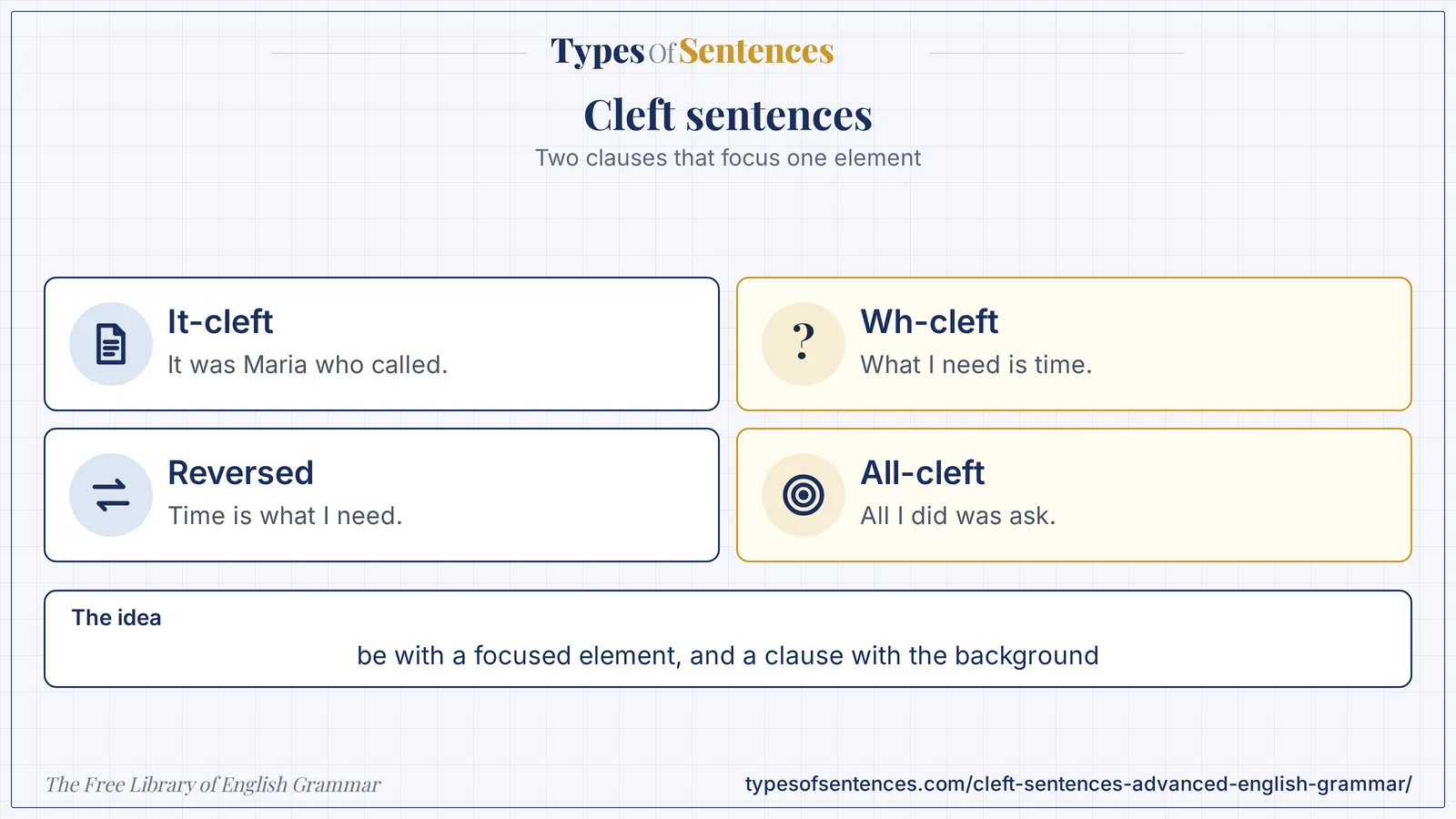
In a cleft sentence, the speaker singles out one piece of information and puts it in a special position. The rest of the sentence becomes background that both speaker and listener are assumed to know.
Why it matters: It was Maria who called presents “someone called” as known and “Maria” as the news. This makes clefts ideal for correcting, contrasting, and highlighting.
Summary: A cleft sentence has two clauses: be with a focused element, and a clause with the background. The it-cleft has the form It + be + focus + that/who-clause (It was Maria who called). The wh-cleft has the form wh-clause + be + focus (What I need is time); reversing it puts the focus first (Time is what I need). The all-cleft uses all for the wh-word (All I want is peace). The background clause is presupposed; the focus is the new or contrasted information.
- It-cleft: It was Maria who called.
- Wh-cleft: What I need is time.
- Reversed: Time is what I need.
- All-cleft: All I did was ask.
What You’ll Learn
- 1. Cleft Sentences: Splitting for Emphasis
- 2. It-Clefts: It Was … That …
- 3. Negation and Questions in It-Clefts
- 4. It-Clefts vs. Extraposition and Other Look-Alikes
- 5. Wh-Clefts (Pseudo-Clefts)
- 6. Reversed Wh-Clefts
- 7. All-Clefts and Other Variants
- 8. What Each Cleft Can and Cannot Focus
- 9. Discourse Functions: Why Writers and Speakers Use Clefts
- 10. Other Cleft-Like Patterns
- 11. Common Errors with Cleft Sentences
- 12. Exercises
- 13. Test Your Knowledge
- 14. Frequently Asked Questions
- 15. Conclusion
1. Cleft Sentences: Splitting for Emphasis
A cleft sentence is built from a simple sentence by splitting its content into a focus and a background. The focus is the highlighted element; the background is the rest, presented as already known.
| Plain sentence | Cleft form | Type | Focus |
|---|---|---|---|
| Maria wrote the report. | It was Maria who wrote the report. | it-cleft | Maria |
| Maria wrote the report. | It was the report that Maria wrote. | it-cleft | the report |
| I need time. | What I need is time. | wh-cleft (pseudo-cleft) | time |
| I need time. | Time is what I need. | reversed wh-cleft | time |
| I want peace. | All I want is peace. | all-cleft | peace |
| She laughed. | What she did was laugh. | wh-cleft with an action | laugh |
What a cleft shows is the speaker’s view of what is new and what is given. In It was Maria who wrote the report, the speaker takes it for granted that someone wrote the report and says that the someone was Maria. A cleft is therefore natural when you correct (No, it was Maria, not Tom), when you contrast (It is the cost that worries me), or when you want to answer an implied question. The use of focus in the sentence as a whole is treated in the chapters on emphasis and focus and information structure.
2. It-Clefts: It Was … That …
The it-cleft has the form it + be + focus + relative-type clause. The clause begins with that, who, which, or nothing, and gives the background.
| Focus | Example | Background clause |
|---|---|---|
| subject (person) | It was Maria who wrote the report. | who wrote the report |
| subject (thing) | It is the cost that worries me. | that worries me |
| direct object | It was the report that Maria wrote. It was Tom (whom/that) I saw. | that Maria wrote |
| adverbial (place) | It was in Paris that we met. | that we met |
| adverbial (time) | It was last year that she left. It was only then that I understood. | that she left |
| adverbial (reason) | It was because she was ill that she left. | that she left |
| adverbial (manner) | It was by working hard that she passed. | that she passed |
| prepositional object | It was to Tom that I spoke. | that I spoke |
| Feature | Rule | Example |
|---|---|---|
| relative word for persons | who or that | It was Maria who/that called. |
| relative word for things | that (or which in formal usage) | It was the report that she wrote. |
| relative word after an adverbial focus | that only | It was in Paris that we met. (not where in formal writing) |
| omission of the relative word | possible when the focus is the object or an adverbial | It was Tom I saw. It was Paris we visited. |
| tense | be may be present or past; the background clause is usually in the same tense or a logical one | It is the cost that worries me. It was the cost that worried me. |
| agreement | the verb in the background clause agrees with the focus when it is the subject | It is I who am responsible. (formal) / It is me who is responsible. (informal) / It is the students who are late. |
3. Negation and Questions in It-Clefts
| Operation | Example | Note |
|---|---|---|
| negation of the focus | It wasn’t Tom who called. It wasn’t until noon that she left. | the negation applies to the cleft as a whole |
| correction | It wasn’t Tom who called; it was Maria. | a typical use |
| not … until focus | It was not until noon that she left. | a common emphatic pattern |
| yes/no question | Was it Tom who called? | inversion of be |
| wh-question | Who was it that called? What was it that she said? Where was it that you met? | the wh-word, be, it, that |
| tag | It was Tom who called, wasn’t it? | — |
| only and just focus | It was only then that he understood. It is just the cost that bothers me. | intensifying |
Cleft questions are common in speech: What is it that you want? is more insistent than What do you want? The presupposition remains: someone wants something, and the question asks for its identity.
4. It-Clefts vs. Extraposition and Other Look-Alikes
Many sentences begin with It is … that, and not all of them are clefts. Extraposition (It is clear that she is right) and the dummy it of weather and time are different structures.
| Sentence | Type | Test |
|---|---|---|
| It was Maria who called. | it-cleft | can be paraphrased by Maria called; the clause is a relative clause |
| It is clear that she is right. | extraposition | paraphrase: That she is right is clear; that is a conjunction |
| It is raining. | dummy it | no paraphrase |
| It was a good idea that she left. | not a cleft | that-clause content, not a background |
| It is the students who are late. | it-cleft | Students are late is implied |
| It is important that she attend. | extraposition | paraphrase with the clause as subject |
A good test: in a cleft, the clause after that can be removed and the sentence It was Maria still makes sense as an answer to Who called?; in an extraposed sentence, It is clear alone does not answer a question about identity. Extraposition is treated in the chapter on nominal clauses.
5. Wh-Clefts (Pseudo-Clefts)
A wh-cleft begins with a clause introduced by what (or another wh-word), followed by be and the focus. The first part is a nominal relative clause, and the focus is what that clause names.
| Focus | Example | Notes |
|---|---|---|
| noun phrase | What I need is time. What she wants is a rest. | the most common |
| to-infinitive or bare infinitive (an action) | What she did was (to) laugh. What I want to do is (to) leave. | the verb after be is often the bare form; to is optional |
| that-clause | What happened was (that) he left. What I mean is that she is wrong. | a clause as the focus |
| -ing form | What she enjoys is walking. What I hate is waiting. | a gerund |
| adjective or adverb (rare) | What matters is how you feel. | a wh-clause as the focus |
| specific wh-nouns | The thing I need is time. The reason he left was that he was tired. The place where we met was Paris. The person who called was Tom. | a noun and a relative clause in place of what |
| Rule | Example |
|---|---|
| verb of the first clause | a form of do if the focus is an action: What she did was laugh. |
| tense agreement | The tense of be usually matches the first clause: What I needed was time. What I need is time. |
| agreement | The first clause is singular: What I need is books (the plural complement does not change the verb). |
| punctuation | no comma before is or was |
| verb forms after do | What he did was (to) leave early. (not left) |
Wh-clefts are called pseudo-clefts in the older tradition because the first clause looks like a relative clause with a free relative. The name “cleft” is used in the same way for both types, and the terminology varies between grammars. The structure is part of the system of nominal relative clauses discussed in the chapter on nominal clauses.
6. Reversed Wh-Clefts
Reversing the wh-cleft puts the focus first and the wh-clause last: Time is what I need. This is common in conversation and in writing that is close to speech.
| Wh-cleft | Reversed wh-cleft | Notes |
|---|---|---|
| What I need is time. | Time is what I need. | the focus comes first |
| What she did was laugh. | To laugh is what she did. / Laugh is what she did. (rare) | less common with actions |
| The place where we met was Paris. | Paris was the place where we met. | — |
| What matters is how you feel. | How you feel is what matters. | — |
| What I want to say is thanks. | Thanks is what I want to say. | — |
| This/that + be + wh-clause | Example |
|---|---|
| That is what I said. | That is what I meant. |
| This is where we came in. | This is how it works. |
| That’s why she left. | That’s when it happened. |
| That’s what I thought. | That’s who I was talking about. |
The pattern with this or that in the first position, called a th-cleft, links the cleft to the previous sentence. It is very common in speech: She never called. That is why I was angry.
7. All-Clefts and Other Variants
| Pattern | Example | Notes |
|---|---|---|
| all + clause + be + focus | All I want is peace. All he did was smile. All I ask is that you listen. | all means “the only thing” |
| the only thing | The only thing I want is peace. | a longer equivalent |
| the one thing, one thing | One thing I know is that she is honest. | — |
| something, everything, anything | Everything I need is here. Something you should know is that it is closed. | — |
| the thing that | The thing that worries me is the cost. | plain relative |
| negative | The one thing I don’t want is trouble. | — |
All in the all-cleft carries a sense of limitation, “nothing more than”: All he did was smile means that he only smiled. The verb after was in an all-cleft with do is the bare form (All he did was smile), and to is optional (All he did was to smile).
8. What Each Cleft Can and Cannot Focus
| Element | It-cleft | Wh-cleft |
|---|---|---|
| subject noun phrase | It was Maria who called. ✓ | The person who called was Maria. ✓ (What is not used for persons.) |
| object noun phrase | It was the report that she wrote. ✓ | What she wrote was the report. ✓ |
| adverbial of place | It was in Paris that we met. ✓ | Where we met was Paris. / The place where we met was Paris. ✓ |
| adverbial of time | It was last year that she left. ✓ | When she left was last year. (awkward) |
| adverbial of reason | It was because she was ill that she left. ✓ | The reason she left was that she was ill. ✓ |
| verb or predicate | *It was laugh that she did. ✗ | What she did was laugh. ✓ |
| whole clause | ✗ | What happened was that she left. ✓ |
| adjective complement | ✗ (rare) | What she is is tired. (rare) |
The choice between the two types depends on the element to be focused: use an it-cleft for noun phrases and adverbials, and a wh-cleft for actions and whole events. Both may be used for objects and some adverbials.
9. Discourse Functions: Why Writers and Speakers Use Clefts
| Function | Example | Explanation |
|---|---|---|
| correct or contrast | No, it was Maria who called, not Tom. | the focus replaces a wrong value |
| answer an implied question | Who called? — It was Maria. | the cleft fits the question |
| introduce a topic | What we need to discuss is the budget. | a wh-cleft prepares the reader |
| create suspense | What happened next was a shock. | the focus is delayed |
| highlight a cause or reason | It was the lack of funds that ended the project. | the cause is the news |
| signal a conclusion | All it takes is a little patience. | minimization |
| explain | That’s why I came. This is how it works. | links to previous text |
| To emphasize “Tom” in Tom broke the window | Example | Effect |
|---|---|---|
| intonation (spoken) | TOM broke the window. | contrast in speech |
| it-cleft | It was Tom who broke the window. | strong emphasis and a correction |
| passive with agent | The window was broken by Tom. | focus on the agent at the end |
| fronting | Tom, I think, broke it. (Tom, not Mary) | topicalization |
| wh-cleft | The person who broke the window was Tom. | neutral, formal |
| as for | As for Tom, he broke the window. | topic shift |
A cleft is not neutral: it adds emphasis, which can sound heavy if overused. Use clefts where the focus is genuinely contrastive or where the reader needs a signal about what is new. The relation of clefts to word-order variation is treated in the chapter on fronting and postponement.
10. Other Cleft-Like Patterns
| Pattern | Example | Notes |
|---|---|---|
| not … until cleft | It was not until noon that she left. Not until noon did she leave. | the latter is an inverted form |
| it … that with a reason | It was because of the rain that we stayed. | focus on the reason |
| it is not that … it is that | It’s not that I’m angry; it’s that I’m tired. | a correction pattern |
| there-cleft (existential) | There’s a man who wants to see you. | existential sentence with a relative clause |
| inferential | It’s that she is tired. (explanation) | not a focus structure |
| if-cleft (conditional) | If it’s help you want, ask Maria. | — |
| negation with only | It’s only Tom I trust. | — |
Some grammars treat the it-cleft, the pseudo-cleft, and similar structures as special cases of copular sentences with a “specificational” meaning, in which the focus specifies the value of a variable (the person who called = Maria). The terminology is more complex than the practical rule: use a cleft when you need to specify and emphasize one element.
11. Common Errors with Cleft Sentences
| Error | Correction | Rule |
|---|---|---|
| It was Maria who she wrote the report. | It was Maria who wrote the report. | no resumptive pronoun |
| It is the students who is late. | It is the students who are late. | agreement with the focus |
| It was laugh that she did. | What she did was laugh. | a verb cannot be the focus of an it-cleft |
| What I need it is time. | What I need is time. | no pronoun after the wh-clause |
| What I need are books. | What I need is books. (or: The things I need are books.) | the wh-clause is singular in strict agreement |
| What she did was to left. | What she did was leave. | bare or to infinitive |
| It was in Paris where we met. | It was in Paris that we met. | that in formal writing |
| It was last year when she left. | It was last year that she left. | that in formal writing |
| It is a good idea that he left. (as cleft) | It is a good thing that he left. | not a cleft |
| It’s me who am responsible. | It’s me who is responsible. / It is I who am responsible. | agreement and register |
| All I want it is peace. | All I want is peace. | no extra pronoun |
| It was because of she was ill that she left. | It was because she was ill that she left. | because + clause |
Edit: It was Maria who she wrote the report, and it is the students who is late, but what I need it is time, and it was in Paris where we met last year when it was because of she was ill that all she did was to left.
- who she wrote: who wrote.
- the students who is late: who are late.
- what I need it is: what I need is.
- in Paris where we met: in Paris that we met.
- last year when: last year that (or It was last year that … in a separate cleft).
- because of she was ill: because she was ill.
- to left: to leave / leave.
- Result: It was Maria who wrote the report, and it is the students who are late, but what I need is time. It was in Paris that we met last year, and because she was ill, all she did was leave. (A better edit would reduce the number of clefts.)
Recap in 12 seconds
Watch the lesson build itself: Cleft sentences are it-clefts, wh-clefts, reversed clefts, and all-clefts. The video has no sound.
Exercises
Part A: Recognizing Clefts (Exercises 1–7)
Exercise 1: Name the type: It was Maria who called.
Show Answer
Answer: It-cleft.
Exercise 2: Name the type: What I need is time.
Show Answer
Answer: Wh-cleft (pseudo-cleft).
Exercise 3: Name the type: Time is what I need.
Show Answer
Answer: Reversed wh-cleft.
Exercise 4: Name the type: All I want is peace.
Show Answer
Answer: All-cleft.
Exercise 5: Find the focus: It was in Paris that we met.
Show Answer
Answer: in Paris.
Exercise 6: Find the focus: What she did was laugh.
Show Answer
Answer: laugh.
Exercise 7: Cleft or extraposition: It is clear that she is right.
Show Answer
Answer: Extraposition.
Part B: Forming Clefts (Exercises 8–14)
Exercise 8: Make an it-cleft focusing on Maria: Maria wrote the report.
Show Answer
Answer: It was Maria who wrote the report.
Exercise 9: Make an it-cleft focusing on the report: Maria wrote the report.
Show Answer
Answer: It was the report that Maria wrote.
Exercise 10: Make a wh-cleft: I need time.
Show Answer
Answer: What I need is time.
Exercise 11: Make a wh-cleft with an action: She laughed.
Show Answer
Answer: What she did was laugh.
Exercise 12: Reverse: What I need is time.
Show Answer
Answer: Time is what I need.
Exercise 13: Make an all-cleft: I only want peace.
Show Answer
Answer: All I want is peace.
Exercise 14: Make an it-cleft with an adverbial: We met in Paris.
Show Answer
Answer: It was in Paris that we met.
Part C: Negation, Questions, Agreement (Exercises 15–20)
Exercise 15: Make negative with correction: It was Tom who called. (Maria)
Show Answer
Answer: It wasn’t Tom who called; it was Maria.
Exercise 16: Make a question: It was Tom who called.
Show Answer
Answer: Was it Tom who called?
Exercise 17: Make a wh-question: It was this that she said.
Show Answer
Answer: What was it that she said?
Exercise 18: Choose: It is the students who (is/are) late.
Show Answer
Answer: are.
Exercise 19: Choose (formal): It is I who (am/is) responsible.
Show Answer
Answer: am.
Exercise 20: Add until: It was ___ noon that she left. (not)
Show Answer
Answer: not until.
Part D: Discourse and Style (Exercises 21–25)
Exercise 21: Name a use of clefts.
Show Answer
Answer: Correcting, contrasting, or highlighting new information.
Exercise 22: Which cleft focuses on an action: it-cleft or wh-cleft?
Show Answer
Answer: Wh-cleft.
Exercise 23: Which element cannot be the focus of an it-cleft?
Show Answer
Answer: A verb.
Exercise 24: Give a th-cleft with why.
Show Answer
Answer: That’s why she left.
Exercise 25: Why avoid overusing clefts?
Show Answer
Answer: They add emphasis, which sounds heavy if repeated.
Part E: Errors (Exercises 26–30)
Exercise 26: Edit: It was Maria who she wrote the report.
Show Answer
Answer: It was Maria who wrote the report.
Exercise 27: Edit: What I need it is time.
Show Answer
Answer: What I need is time.
Exercise 28: Edit: It was laugh that she did.
Show Answer
Answer: What she did was laugh.
Exercise 29: Edit: It was in Paris where we met. (formal)
Show Answer
Answer: It was in Paris that we met.
Exercise 30: Edit: What she did was to left.
Show Answer
Answer: What she did was leave.
Test Your Knowledge
Ready to check what you learned? Answer all 10 questions, then submit. You need 80% (8 of 10) to pass. Your answers are not stored.
View correct answers and explanations
Question 1: What does “cleft” mean?
✓ Correct Answer: A – split
A cleft sentence is split in two.
Question 2: Which is an it-cleft?
✓ Correct Answer: C – It was Maria who called.
It + be + focus + clause.
Question 3: Which is a wh-cleft?
✓ Correct Answer: D – What I need is time.
A wh-clause + be + focus.
Question 4: Which cannot be the focus of an it-cleft?
✓ Correct Answer: B – a verb
A verb needs a wh-cleft.
Question 5: Which is correct?
✓ Correct Answer: C – It was Maria who wrote the report.
No resumptive pronoun.
Question 6: Which is correct?
✓ Correct Answer: D – It is the students who are late.
The verb agrees with the focus.
Question 7: What is the function of a cleft?
✓ Correct Answer: C – to focus on one element
Clefts highlight one element.
Question 8: Which is an all-cleft?
✓ Correct Answer: A – All I want is peace.
All I want is peace.
Question 9: Which is a reversed wh-cleft?
✓ Correct Answer: B – Time is what I need.
Focus first.
Question 10: Which is NOT a cleft?
✓ Correct Answer: A – It is clear that she is right.
This is extraposition.
Frequently Asked Questions
What are cleft sentences?
Cleft sentences split one clause into two parts to focus on one element: It was Maria who called, What I need is time, All I want is peace.
What are it-clefts?
It-clefts have the form It + be + focus + that/who-clause, as in It was Maria who wrote the report. They can focus on noun phrases and adverbials, but not on verbs.
What are wh-clefts?
Wh-clefts, also called pseudo-clefts, begin with a wh-clause and end with the focus after be: What she did was laugh. They can focus on actions and whole clauses.
What are cleft structures used for?
Cleft structures are used to correct, contrast, answer an implied question, introduce a topic, or highlight new information. They present the background as known and the focus as new.
What are emphasis sentences?
Emphasis sentences are sentences that highlight a part of their meaning. Clefts are one kind; others use stress, fronting, the passive, or intensifiers.
What is the difference between a cleft and extraposition?
A cleft singles out an element and has a relative-type clause (It was Maria who called). Extraposition moves a clause to the end with it as a placeholder (It is clear that she is right).
Can I use that after an adverbial focus?
Yes, and in formal writing it is preferred: It was in Paris that we met. In speech, where and when are common but are considered informal.
Conclusion
You now have a deep study of cleft sentences: it-clefts, wh-clefts, reversed wh-clefts, all-clefts, what each can focus, agreement, negation, and questions, the contrast with extraposition, the discourse functions of clefts, and the common errors. You can use cleft structures with expert control.
When you want to emphasize one element, choose the cleft that fits it, and do not overuse it. Next, you will study inversion.
- Huddleston, Rodney, and Geoffrey K. Pullum. The Cambridge Grammar of the English Language. Cambridge University Press, 2002.: the reference analysis of clefts and pseudo-clefts.
- Quirk, Randolph, et al. A Comprehensive Grammar of the English Language. Longman, 1985.: the classic treatment of cleft sentences and focus.
- Biber, Douglas, et al. Longman Grammar of Spoken and Written English. Longman, 1999.: corpus evidence on clefts in speech and writing.
- Garner, Bryan A. Garner’s Modern English Usage, 5th ed. Oxford University Press, 2022.: usage guidance on emphatic constructions.
- Merriam-Webster Dictionary: cleft: the dictionary entry.
Last reviewed: October 29, 2026. How it was made: drafted with AI assistance, then checked with automated tests (structure, links, answer keys, spelling) and against the sources above. A person has not yet read this chapter line by line. Found a mistake? Report it.