Information structure is the way a sentence is arranged to show what the speaker is talking about, what the hearer already knows, and what is new or important. The same facts can be packaged in many ways: Maria called the manager, The manager was called by Maria, It was Maria who called the manager, The manager Maria called. Each choice puts the emphasis in a different place and fits a different context, and a writer who understands the choices can make a text easy to follow.
You will study the main notions of information structure and their different names: theme rheme pairs (the starting point and the rest), the topic comment division (what the sentence is about and what is said), given and new information (known and unknown), and focus (the highlighted part). You will also see the types of themes (topical, interpersonal, and textual) and the difference between marked and unmarked themes, the constructions of information packaging, the differences between genres, and a practical method for revising a text with the information structure in mind. These are the tools of focus grammar and of the given new information principle that explain many choices of word order. Thirty editing exercises and a quiz follow.
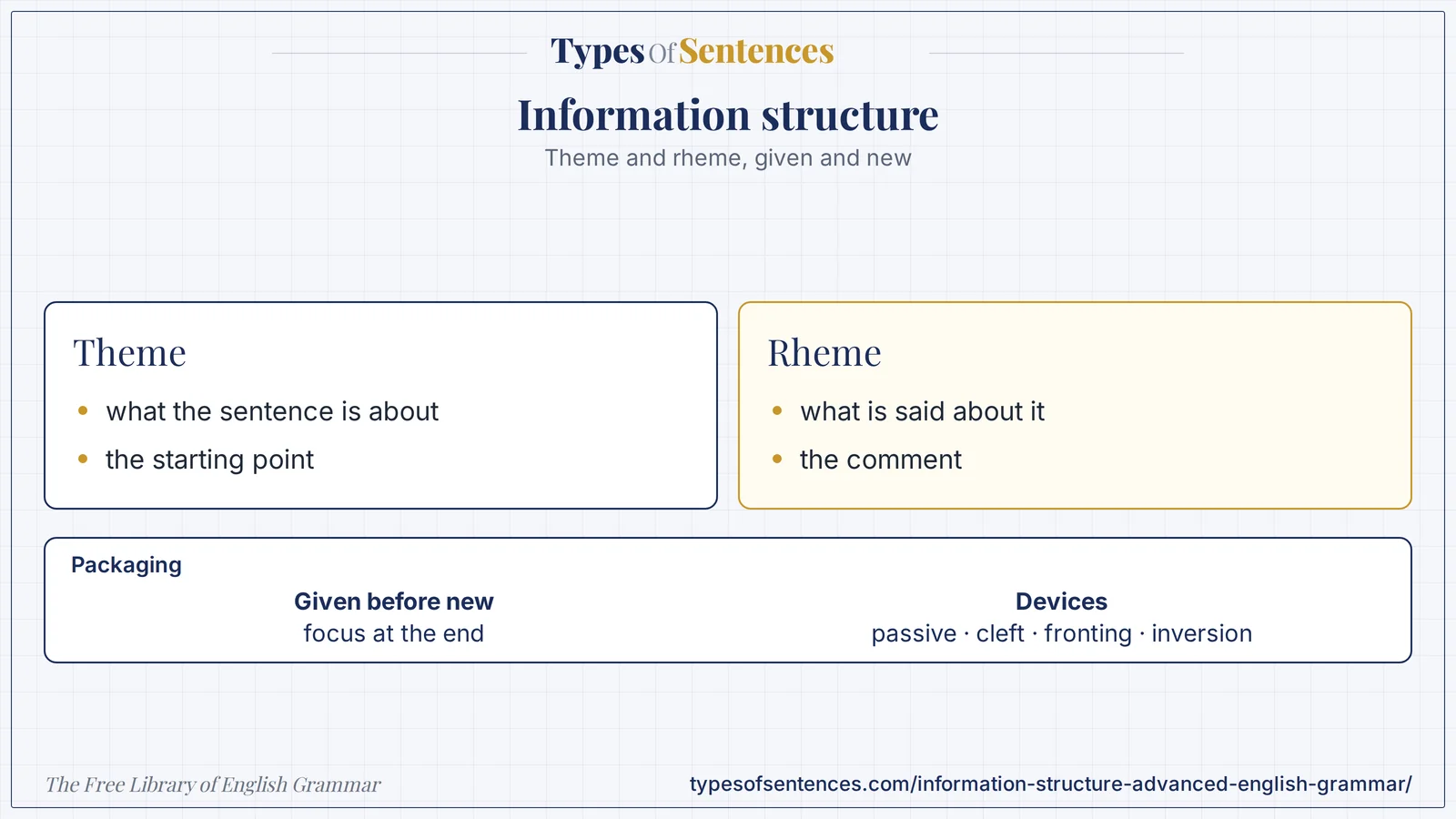
A sentence does two jobs at once: it states a fact, and it presents that fact in a way that fits the conversation. The presentation depends on what the listener already knows and what the speaker wants to stress.
Why it matters: English handles this mainly by word order, stress, and a small set of constructions. The principle behind them is simple: start with what is familiar, and end with what is new and important.
Summary: Information structure divides a sentence into parts according to their communicative role. Theme (or topic) is the starting point, what the sentence is about; rheme (or comment) is what is said about it. Given information is known or inferable from the context; new information is not. Focus is the part that the speaker presents as most important, marked by stress, position, or a construction such as a cleft. English prefers given before new (information flow), the most important element last (end focus), and heavy elements last (end weight). Passives, clefts, fronting, inversion, extraposition, and existential sentences are ways of repackaging the same content.
- Theme = what about; rheme = what you say.
- Given before new; focus at the end.
- Marked themes and constructions put an element in a special position.
- Packaging devices: passive, cleft, fronting, inversion, extraposition, existential there.
What You’ll Learn
- 1. Information Structure: Packaging the Same Content
- 2. Theme and Rheme
- 3. Topic and Comment
- 4. Given and New Information
- 5. Focus: Highlighting Information
- 6. Thematic Structure: Types of Themes and Marked Themes
- 7. Information Packaging: Constructions and Their Functions
- 8. Information Structure in Different Genres
- 9. Revising with Information Structure in Mind
- 10. Common Problems with Information Structure
- 11. Exercises
- 12. Test Your Knowledge
- 13. Frequently Asked Questions
- 14. Conclusion
1. Information Structure: Packaging the Same Content
| Version | Packaging | Suited to the question |
|---|---|---|
| Maria called the manager. | neutral active; Maria is the theme | What did Maria do? |
| The manager was called by Maria. | passive; the manager is the theme, Maria the new agent | What happened to the manager? |
| It was Maria who called the manager. | it-cleft; Maria in focus | Who called the manager? |
| What Maria did was call the manager. | wh-cleft; the action in focus | What did Maria do? |
| The manager Maria called. | fronted object; the manager a topic | What about the manager? |
| As for the manager, Maria called him. | topic marker | — |
| Term | Source | Meaning |
|---|---|---|
| theme / rheme | Prague School; Halliday | the starting point of the clause / the rest of the message |
| topic / comment | Hockett; Lambrecht; many others | what the sentence is about / what is said about it |
| given / new | Halliday; Chafe | information recoverable from the context / not recoverable |
| focus / background | Jackendoff; Lambrecht | the highlighted part / the remainder |
| presupposition | — | what is taken for granted |
| information packaging | Huddleston and Pullum | the general term for the choices of structure |
The terminology varies between traditions, and the notions overlap. In this chapter, theme means the first element of the clause, topic means the “aboutness” of the sentence, given means recoverable information, and focus means the most prominent new information. The related processes of fronting and postponement are treated in the chapter on fronting and postponement.
2. Theme and Rheme
In the Hallidayan analysis, the theme of a clause is its first element up to and including the first participant, process, or circumstance: it is the point of departure, “what the message is concerned with”. The rheme is the remainder of the clause: what is said about the theme.
| Clause | Theme | Rheme |
|---|---|---|
| Maria / called the manager. | Maria | called the manager |
| Yesterday / Maria called the manager. | Yesterday | Maria called the manager |
| The manager / was called by Maria. | The manager | was called by Maria |
| What / did Maria do? | What | did Maria do |
| Call / the manager. (imperative) | Call | the manager |
| Because it rained, / we stayed home. | Because it rained | we stayed home |
| Typical theme | Example | Status |
|---|---|---|
| subject of a declarative | Maria called. | unmarked |
| wh-word in a wh-question | Where did she go? | unmarked |
| finite auxiliary in a yes/no question | Did she go? | unmarked |
| verb in an imperative | Call the manager. | unmarked |
| adverbial | Yesterday she called. | marked |
| complement (object) | The manager she called. | marked |
| predicate | Tired I was. | marked (rare) |
The notion of theme is sometimes confused with that of topic or with given information. It is not the same: a theme is simply the starting point, and a theme can be new (A man came in) or given (The man sat down). The theme is the part of the sentence that anchors it in the text, and the way in which the themes of consecutive sentences relate is called thematic progression, described in the previous chapter.
3. Topic and Comment
The topic of a sentence is what it is about; the comment is what is said about the topic. In many sentences, the subject is the topic (Maria called the manager), but not always.
| Construction | Example | Topic |
|---|---|---|
| subject topic (default) | Maria called the manager. | Maria |
| as for, regarding, as to | As for the manager, Maria called him. | the manager |
| speaking of, when it comes to | Speaking of the manager, did you call him? | the manager |
| fronted object | The manager Maria called. | the manager |
| left dislocation | The manager, Maria called him. | the manager |
| passive | The manager was called. | the manager |
| about | About the budget, we have not decided. | the budget |
| topic in a question | What about the budget? | the budget |
| Test for a topic | Example |
|---|---|
| it answers What about X? | What about the manager? — Maria called him. |
| it can be introduced by as for X | As for the manager, … |
| it is usually definite, given, or generic | the manager, Maria, dogs |
| it is usually not new information | *As for a manager, … |
English does not mark topics with a special particle, as Japanese does with wa, but uses word order and the topic markers in the table. Topic-prominent languages such as Chinese and Japanese often place the topic first, and speakers of such languages may produce sentences like This book, I read it last week in English; the pattern exists in English as left dislocation, but is informal.
4. Given and New Information
| Given (old) information | New information |
|---|---|
| already mentioned in the text | introduced for the first time |
| present in the situation | not present |
| inferable from the context (a bridging link) | not inferable |
| usually expressed by pronouns, definite noun phrases, and unstressed words | usually expressed by indefinite noun phrases, full lexical words, and stressed words |
| comes early in the sentence | comes late |
| Example | Given | New |
|---|---|---|
| A man arrived. The man wanted a room. | the man | a room |
| I bought a car. The engine is noisy. | the engine (bridging) | noisy |
| Who broke the window? — Tom broke it. | broke the window | Tom |
| I saw Tom yesterday. I saw him at the station. | him | at the station |
| Stress and information | Example | Meaning |
|---|---|---|
| new information is stressed | I saw TOM. | Tom is the new information |
| given information is unstressed (deaccented) | I SAW him. | the answer is about seeing; him is given |
| contrastive stress | I saw TOM, not Mary. | — |
The preference for given before new is a tendency of English, and it underlies the choice of the passive (The window was broken by Tom when the window is known and Tom is new), the order of objects, and the use of cleft sentences. The classification of degrees of givenness is more detailed in the work of Ellen Prince, who distinguishes brand-new, inferrable, and evoked entities. The question-and-answer test is a useful tool: the answer to What did Tom break? has the window as its new information, and so it takes the stress.
5. Focus: Highlighting Information
| Kind of focus | Example | Question it answers |
|---|---|---|
| broad focus (the whole clause is new) | The WINDOW broke. | What happened? |
| narrow (information) focus | Tom broke the WINDOW. | What did Tom break? |
| contrastive focus | TOM broke the window, not Mary. | — |
| focus on the verb | He didn’t BREAK it; he CRACKED it. | — |
| focus on the polarity | He DID break it. | — |
| Device for marking focus | Example | Notes |
|---|---|---|
| nuclear stress (spoken) | TOM did it. | prosody |
| end position | The study found a link between SLEEP and MEMORY. | end focus |
| it-cleft | It was Tom who broke the window. | — |
| wh-cleft | What Tom broke was the window. | — |
| passive with agent | The window was broken by TOM. | — |
| existential there | There is a PROBLEM. | — |
| inversion | On the hill stood a CASTLE. | — |
| focus particles | Only Tom came. Even Tom came. Tom also came. Just Tom came. | scope depends on position |
| negation | Not Tom but Maria broke it. | — |
| fronting | THAT I cannot accept. | — |
| Focus particle | Example | Ambiguity |
|---|---|---|
| only | Only Tom introduced Bill to Sue. | nobody else introduced Bill |
| only | Tom only introduced Bill to Sue. | he did nothing more, or he introduced no one else |
| only | Tom introduced only Bill to Sue. | no one but Bill |
| even | Even Tom knew. | surprising |
| also | Tom also called. | in addition to someone else, or in addition to other acts |
Focus particles such as only, even, and also attach to the focused element, and their position affects the meaning. In writing, place only immediately before the element that it modifies. The cleft constructions are described in the chapter on cleft sentences. The role of intonation in speech, which is the main way to mark focus in English, cannot be shown in writing, and that is why writers use structures to do the work.
6. Thematic Structure: Types of Themes and Marked Themes
| Type of theme | Function | Example |
|---|---|---|
| topical (experiential) | the participant, process, or circumstance that begins the message | Maria called. Yesterday she called. |
| interpersonal | the speaker’s attitude or the interaction: modal adjuncts, vocatives, finite verbs in questions | Perhaps, Maria, you should leave. Did she call? |
| textual | links to the previous text: conjunctions, conjuncts, relatives | But, however, and, which |
- But | perhaps | Maria | should leave. textual + interpersonal + topical theme (a multiple theme); rheme: should leave
- However, | in 2020 | the company | moved. textual + marked topical themes
- Because it rained, | we stayed. the whole clause is the theme
| Marked themes | Example | Effect |
|---|---|---|
| adverbial of time | In 2020, the company moved to Delhi. | frames the sentence in time |
| adverbial of place | At the back of the room, a man was sleeping. | frames in space |
| adverbial clause | If you agree, we will start. | sets a condition |
| object | That book I enjoyed. | contrast or link |
| complement | Tired I was. | literary |
| there and it (dummy) | There is a problem. It is clear that … | neutral placeholders |
A text in which every sentence begins with a marked theme sounds mannered; a text in which every sentence begins with the subject can sound monotonous. Variation is a matter of style, treated in a later chapter.
7. Information Packaging: Constructions and Their Functions
| Construction | Example | What it does |
|---|---|---|
| passive | The plan was approved. | makes the patient the theme; may omit the agent |
| active vs passive choice | The committee approved the plan. / The plan was approved by the committee. | orders given and new |
| it-cleft | It was Maria who called. | focuses an element |
| wh-cleft | What I need is time. | focuses the predicate or an object |
| existential there | There is a problem. | introduces a new topic |
| extraposition | It is clear that he lied. | moves a heavy clause to the end |
| fronting | This book I enjoyed. | a contrastive topic |
| inversion | On the hill stood a castle. | places a new subject at the end |
| dislocation | My brother, he lives in Delhi. | establishes a topic |
| heavy NP shift | I gave to Mary the book that John had recommended. | end weight |
| object order (dative) | She gave Mary the book / the book to Mary. | end focus on the new item |
| pronoun + stress | I SAW him. | given pronoun, new verb |
These constructions are treated in the chapters on voice, inversion, and existential there, and in those on cleft sentences and fronting. They are different ways of reaching the same goal: to make the sentence fit the context, so that the reader processes the message smoothly. The choice is a part of the grammar that is made by the writer, not by the rules of syntax alone.
8. Information Structure in Different Genres
| Genre | Typical packaging | Example |
|---|---|---|
| academic writing | nominalized themes; heavy noun phrases; passives; given-new chains; “it is … that” | The increase in prices led to a decline in demand. This decline … |
| news | new event first (the lead); the agent often fronted; headlines drop the given | Police have arrested a man. The man, 34, was … |
| conversation | topic-comment, dislocation, fragments, deaccented pronouns | That car, I don’t like it. Tom? He’s late. |
| instructions | imperative themes; order of steps | Open the box. Remove the cover. |
| fiction | marked themes for effect; free indirect speech; inversion for scene setting | In the corner sat an old man. |
| legal | heavy themes; passive; conditionals up front | Where the tenant fails to pay, the landlord may … |
| advertising | focus and fronting for emphasis | Never again will you worry about price. |
Each genre has its own conventions of information flow. Academic prose often places the “given” information in a long nominalization at the start and the new claim at the end. News puts the most important new event first, in the lead. Conversation uses prosody to do much of the work that written genres do with structure.
9. Revising with Information Structure in Mind
- Identify the theme of each sentence (the first few words).
- Check that each theme is known (mentioned before or inferable) or deliberately new.
- Check that the new information is at the end, in the focus position.
- Check the weight: long elements go late, short ones early.
- Consider the construction that fits: the passive, an extraposition, a cleft.
- Check the focus particles (only, even) for scope.
- Read aloud to hear where the stress falls.
| Before | After | Change |
|---|---|---|
| A link between sleep and memory was found by the study. | The study found a link between sleep and memory. | known first; new last |
| That the committee would reject the proposal surprised everyone. | It surprised everyone that the committee would reject the proposal. | extraposition for end weight |
| Several advances were made by researchers. Faster computers were developed by them. | Researchers made several advances. They developed faster computers. | topic continuity (constant theme) |
| I only wanted a coffee. | I wanted only a coffee. | focus particle placed before its target |
| A very old and heavy wooden chest was in the corner of the room. | In the corner of the room was a very old and heavy wooden chest. | inversion puts the new, heavy subject last |
10. Common Problems with Information Structure
| Problem | Example | Fix |
|---|---|---|
| new information as the theme with no context | A manager Maria called. | The manager Maria called. / Maria called a manager. |
| given information at the end | A man arrived. Wanted a room, the man. | A man arrived. He wanted a room. |
| heavy subject | That the committee, after months of debate, would reject the proposal surprised everyone. | It surprised everyone that the committee … |
| misplaced only | I only saw Tom. (meaning: nobody else) | I saw only Tom. |
| fronting without context | This book I really enjoyed. (out of the blue) | add a context or use the neutral order |
| a dangling topic | As for Tom, the car was blue. | As for Tom, his car was blue. |
| a topic with no link | Regarding the budget, the weather was cold. | Regarding the budget, we have not decided. |
| overuse of clefts | It was Maria who called, it was Tom who left, it was … | use a neutral order for most sentences |
| unmotivated passive | The report was written by me. | I wrote the report. |
| inconsistent themes | Maria woke. The coffee was cold. Birds sang. | Maria woke. She made coffee. She listened to the birds. |
Edit: A link between sleep and memory was found by the study, and a manager Maria called, and I only saw Tom (nobody else), and as for Tom, the car was blue, and the report was written by me.
- A link … was found by the study: The study found a link between sleep and memory.
- a manager Maria called: Maria called a manager.
- I only saw Tom (nobody else): I saw only Tom.
- as for Tom, the car was blue: as for Tom, his car was blue.
- the report was written by me: I wrote the report.
- Result: The study found a link between sleep and memory, and Maria called a manager, and I saw only Tom, and as for Tom, his car was blue, and I wrote the report.
Recap in 12 seconds
Watch the lesson build itself: A sentence divides into theme and rheme and given and new information, with devices that repackage it. The video has no sound.
Exercises
Part A: Terms (Exercises 1–6)
Exercise 1: Define theme.
Show Answer
Answer: The starting point of the clause (what it is about).
Exercise 2: Define rheme.
Show Answer
Answer: What is said about the theme (the rest of the clause).
Exercise 3: Define given information.
Show Answer
Answer: Information already known or recoverable from the context.
Exercise 4: Define focus.
Show Answer
Answer: The most prominent new information.
Exercise 5: Give the theme: Yesterday Maria called the manager.
Show Answer
Answer: Yesterday.
Exercise 6: Give the theme: The manager was called by Maria.
Show Answer
Answer: The manager.
Part B: Topic and Given-New (Exercises 7–12)
Exercise 7: Name the topic marker: As for the manager, Maria called him.
Show Answer
Answer: As for.
Exercise 8: Which is more likely to be new: a man or the man?
Show Answer
Answer: a man.
Exercise 9: Which has the stress: I saw TOM or I SAW him? (answer to Who did you see?)
Show Answer
Answer: I saw TOM.
Exercise 10: Name the order preferred in English.
Show Answer
Answer: Given before new.
Exercise 11: Name the device: My brother, he lives in Delhi.
Show Answer
Answer: Left dislocation (informal topic).
Exercise 12: Explain the question-answer test.
Show Answer
Answer: The answer to a question is the new information, and takes the stress.
Part C: Focus (Exercises 13–19)
Exercise 13: Name the device: It was Tom who broke it.
Show Answer
Answer: It-cleft.
Exercise 14: Name the device: What Tom broke was the window.
Show Answer
Answer: Wh-cleft.
Exercise 15: Place only to focus on Tom: Tom came.
Show Answer
Answer: Only Tom came.
Exercise 16: Fix the scope: I only saw Tom. (nobody else)
Show Answer
Answer: I saw only Tom.
Exercise 17: Name the focus: TOM broke the window, not Mary.
Show Answer
Answer: Contrastive focus.
Exercise 18: Name the focus: What happened? — The WINDOW broke.
Show Answer
Answer: Broad focus.
Exercise 19: Which device marks focus in speech?
Show Answer
Answer: Nuclear stress (intonation).
Part D: Themes and Packaging (Exercises 20–25)
Exercise 20: Name the theme types: But perhaps Maria should leave.
Show Answer
Answer: Textual (But) + interpersonal (perhaps) + topical (Maria).
Exercise 21: Marked or unmarked: Yesterday she called.
Show Answer
Answer: Marked.
Exercise 22: Marked or unmarked: Maria called.
Show Answer
Answer: Unmarked.
Exercise 23: Extrapose: That he lied is clear.
Show Answer
Answer: It is clear that he lied.
Exercise 24: Revise: A link was found by the study.
Show Answer
Answer: The study found a link.
Exercise 25: Name the construction that introduces a new topic: There is a problem.
Show Answer
Answer: Existential there.
Part E: Genres and Errors (Exercises 26–30)
Exercise 26: Which genre puts the new event first?
Show Answer
Answer: News (the lead).
Exercise 27: Which genre uses imperative themes?
Show Answer
Answer: Instructions.
Exercise 28: Fix: As for Tom, the car was blue.
Show Answer
Answer: As for Tom, his car was blue.
Exercise 29: Fix: The report was written by me.
Show Answer
Answer: I wrote the report.
Exercise 30: Give the first step in revising with information structure.
Show Answer
Answer: Identify the theme of each sentence.
Test Your Knowledge
Ready to check what you learned? Answer all 10 questions, then submit. You need 80% (8 of 10) to pass. Your answers are not stored.
View correct answers and explanations
Question 1: What is the theme?
✓ Correct Answer: A – the starting point of the clause
Theme = starting point.
Question 2: What is the rheme?
✓ Correct Answer: C – what is said about the theme
Rheme = the rest.
Question 3: Which is given information?
✓ Correct Answer: D – the man (mentioned before)
The man was mentioned.
Question 4: Which marks focus in speech?
✓ Correct Answer: A – intonation (stress)
Nuclear stress.
Question 5: Which is a cleft?
✓ Correct Answer: C – It was Tom who broke it.
It + be + focus + clause.
Question 6: Which is correct for “nobody else”?
✓ Correct Answer: B – I saw only Tom.
Only before its target.
Question 7: Which is a marked theme?
✓ Correct Answer: C – Yesterday Maria called.
An adverbial in first position.
Question 8: Which is extraposition?
✓ Correct Answer: B – It is clear that he lied.
The clause moves to the end.
Question 9: Which is a topic marker?
✓ Correct Answer: D – as for
As for introduces a topic.
Question 10: Which is better information flow?
✓ Correct Answer: B – The study found a link.
Known first, new last.
Frequently Asked Questions
What is information structure?
Information structure is the way that a sentence is arranged to show what it is about, what is known, and what is new or important, by word order, stress, and constructions such as the passive and the cleft.
What are theme and rheme?
The theme is the starting point of a clause (what it is about), and the rheme is the rest (what is said about it). The pair is the basis of the theme rheme analysis of Halliday and the Prague School.
What are topic and comment?
The topic comment division separates what the sentence is about from what is said about it. The topic is often the subject but can be marked by as for, fronting, or dislocation.
What is given new information?
Given new information is the distinction between information that the hearer already has (given) and information that is new. English prefers given information early and new information late.
What is focus grammar?
Focus grammar is the study of how the most prominent information is marked: by stress, by position at the end of the clause, by clefts and other constructions, and by focus particles such as only.
What is information packaging?
Information packaging is the choice of how to present the same content: active or passive, cleft or plain, fronted or not. It fits the sentence to the context.
How do I use information structure to improve my writing?
Start each sentence with something the reader knows, put the new and important information last, put long elements late, use the passive or a cleft when it helps, and check the scope of focus particles.
Conclusion
You now have a deep study of information structure: theme and rheme, topic and comment, given and new information, focus, types of themes, the constructions of information packaging, genre differences, and practical revision. You can arrange sentences so that the reader follows the message with ease.
When you revise, ask of each sentence what it is about and what is new. Next, you will study discourse analysis.
- Halliday, M. A. K., and Christian M. I. M. Matthiessen. Halliday’s Introduction to Functional Grammar. 4th ed. Routledge, 2014.: the theory of theme and rheme and of given and new.
- Huddleston, Rodney, and Geoffrey K. Pullum. The Cambridge Grammar of the English Language. Cambridge University Press, 2002.: the chapter on information packaging.
- Lambrecht, Knud. Information Structure and Sentence Form. Cambridge University Press, 1994.: topic, focus, and presupposition.
- Prince, Ellen F. “Toward a Taxonomy of Given-New Information.” In Radical Pragmatics, edited by Peter Cole. Academic Press, 1981.: degrees of givenness.
- Merriam-Webster Dictionary: topic: the dictionary entry.
Last reviewed: October 29, 2026. How it was made: drafted with AI assistance, then checked with automated tests (structure, links, answer keys, spelling) and against the sources above. A person has not yet read this chapter line by line. Found a mistake? Report it.