Existential there is the there of There is a problem. It does not mean “in that place”; it simply states that something exists, and it fills the subject position so that the new information can come after the verb. These existential sentences are among the most common structures in English, and yet they raise questions that the Intermediate level never asks: what is the subject, why does the verb agree with the noun after it, why can you not say There is the book on the table, and what do writers gain by using there is at all?
You will study the structure of there constructions, the definiteness effect, agreement of there is and there are, existential sentences with verbs other than be, all tenses and modal verbs, non-finite forms such as I expect there to be, negation, questions, and tags, the difference from locative there and from dummy it, and the stylistic uses that make dummy there a useful tool and sometimes a weak one. Thirty editing exercises and a quiz follow.
In There is a book on the table, the word there is a placeholder. It lets the sentence begin without saying anything, so that the real news, a book, arrives later in the sentence where it can be noticed.
Why it matters: The forms there is, there are, and there’s all work this way. English likes to put new information late. Existential there is the standard way to introduce a new thing as the topic of a sentence without making it the grammatical subject at the start.
Summary: Existential there + a form of be + a noun phrase states that something exists (There is a problem). The noun phrase is normally indefinite (a, some, no, numerals). The verb agrees formally with that noun phrase (There are two problems), although speech often uses There’s with a plural. Verbs other than be occur in formal and literary style (There remains one question). There behaves like a subject in questions, tags, and raising (Is there?, There seems to be) but is not locative and has no stress.
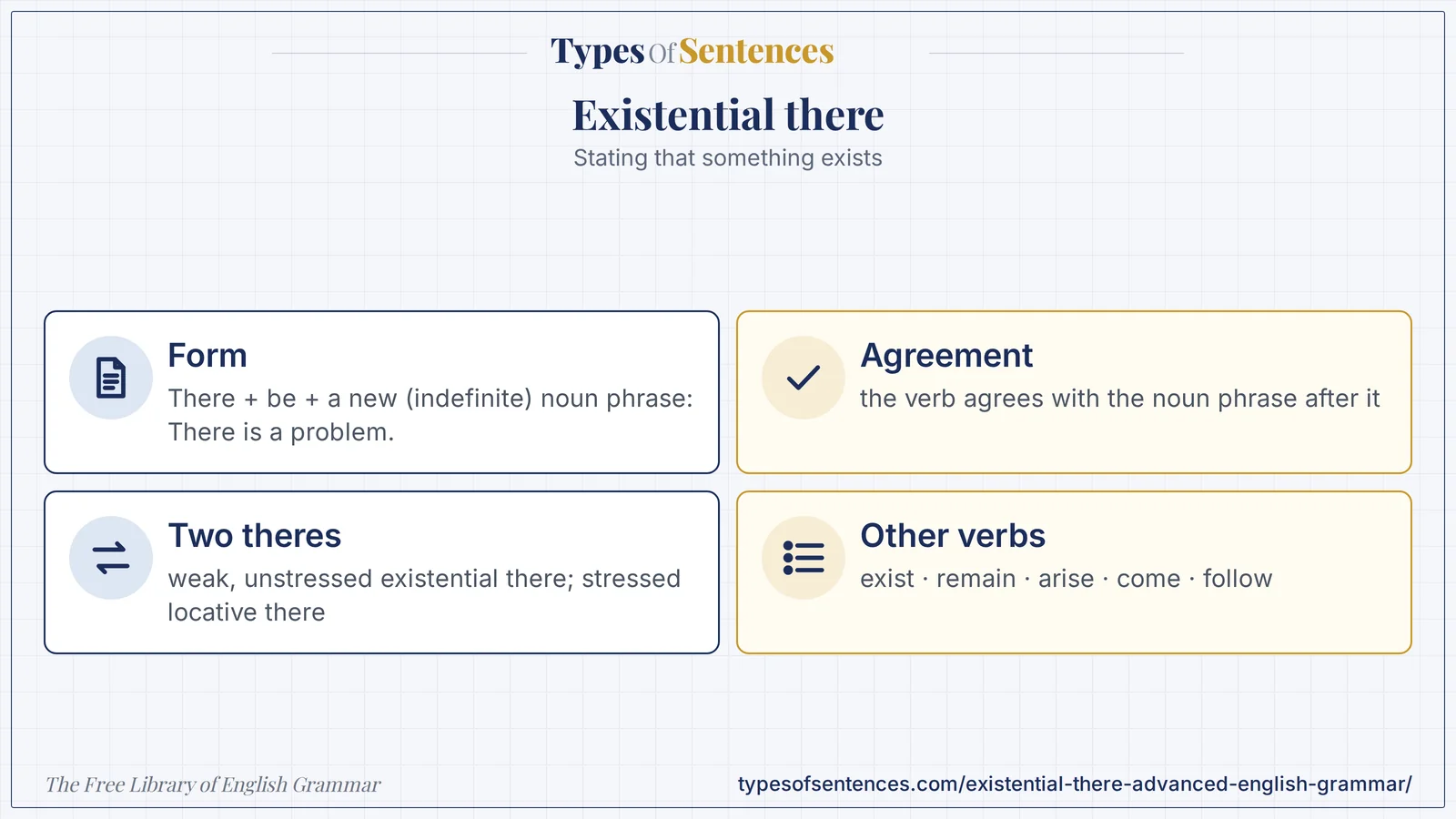
- There + be + new (indefinite) noun phrase.
- Agreement with the noun phrase after the verb.
- Weak, unstressed there; locative there is stressed.
- Other verbs: exist, remain, arise, come, follow.
What You’ll Learn
- 1. Existential There: What Is Existential There?
- 2. Structure: There + Be + Noun Phrase
- 3. The Definiteness Effect
- 4. Agreement: There Is and There Are
- 5. Existential Sentences with Verbs Other Than Be
- 6. There Constructions in All Tenses and with Modals
- 7. Existential There vs. Locative There
- 8. Stylistic Uses: There Constructions in Writing
- 9. Negation, Questions, and Tags
- 10. Existential Sentences in Other Structures
- 11. Common Errors with There Constructions
- 12. Exercises
- 13. Test Your Knowledge
- 14. Frequently Asked Questions
- 15. Conclusion
1. Existential There: What Is Existential There?
Existential there is a pronoun-like word with no meaning of its own. It appears in the subject position of a clause whose verb is usually be, and it introduces a noun phrase that states what exists or is present. The grammar of these there constructions differs from that of ordinary subject-verb sentences.
| Sentence | What there is | Notes |
|---|---|---|
| There is a problem. | existential (dummy) there | weak, unstressed; no place meaning |
| The problem is there. | locative there (an adverb) | stressed; means “in that place” |
| There he goes! | locative there | a deictic exclamation; stressed |
| It is raining. | dummy it | a different empty subject; see the chapter on advanced pronoun concepts |
| It is clear that she is right. | anticipatory it | extraposition; see nominal clauses |
The test is that existential there cannot be questioned with where? and cannot be replaced by here. There is a book on the table does not answer Where is a book?; the place, if mentioned, is on the table. Compare The book is there (answering Where is the book?), in which there is stressed and can be replaced by here.
| Property | Existential there | Locative there |
|---|---|---|
| meaning | none | in that place |
| stress | unstressed (/ðər/) | stressed (/ðɛər/) |
| can be replaced by here | no | yes |
| answers where? | no | yes |
| grammatical function | subject-like | adverbial |
| example | There are three cats. | The cats are there. |
2. Structure: There + Be + Noun Phrase
| Part | Role | Example |
|---|---|---|
| there | dummy subject | There is a problem. |
| be | verb (finite) | There is a problem. |
| noun phrase | the “notional” (logical) subject; new information | There is a problem. |
| coda (optional) | a locative, temporal, or other phrase | There is a problem with the plan. There was a storm last night. |
The noun phrase after the verb carries the information, and the verb agrees with it in number (There is a problem, There are problems). The word there behaves like a subject in several tests, which is why grammarians call it a “subject” in some analyses.
| Subject-like behavior | Example |
|---|---|
| inversion in questions | Is there a problem? What is there to do? |
| tag questions | There is a problem, isn’t there? |
| subject-raising | There seems to be a problem. There appears to be a delay. |
| exceptional case marking | I expect there to be a problem. We want there to be peace. |
| negation and contraction | There isn’t a problem. There’s no problem. |
| gerund and absolute | I dislike there being so many rules. There being no objection, we proceeded. |
Some analyses treat the noun phrase as the subject, since the verb agrees with it. The traditional view and the formal view differ; in either case, it is useful to think of there as a placeholder subject and the noun phrase as the thing that the sentence is really about. The chapters on complex verb phrases and information structure return to related questions.
3. The Definiteness Effect
The noun phrase in an existential sentence is normally indefinite, because the sentence introduces something new. A definite noun phrase (with the, this, my, a name) is odd, since it refers to something already known.
| Acceptable (indefinite) | Unacceptable or odd (definite) |
|---|---|
| There is a book on the table. | *There is the book on the table. |
| There are some students in the hall. | *There are the students in the hall. |
| There is no milk. | *There is my milk. |
| There were three people. | *There were all the people. |
| There is a man at the door. | *There is John at the door. (unless a list or a reminder) |
| There are many reasons. | *There are most of the reasons. |
| Is there anyone here? | *Is there everyone here? |
| Allowed with there | Not allowed |
|---|---|
| a, an, some, any, no | the, this, that, these, those |
| numerals (three, twenty) | possessives (my, their) |
| many, few, several, a lot of, enough | all, most, every, each, both (as determiners) |
| another, other, different, same (some) | proper names and pronouns |
The restriction has exceptions. In a list reading, a definite noun phrase is possible: What is there to eat? — Well, there’s the cheese, the leftover rice, and the fruit. A reminder or a presentational use can also be definite: There is the problem of cost. There is also the question of who pays. These are used to add items to a list or to introduce a point that the reader may not yet have considered.
4. Agreement: There Is and There Are
| Pattern | Formal agreement | Informal usage |
|---|---|---|
| singular noun phrase | There is a problem. | There’s a problem. |
| plural noun phrase | There are two problems. | There’s two problems. (common in speech) |
| uncountable noun | There is some milk. | There’s some milk. |
| coordinated noun phrases | There are a pen and two books. / There is a pen and two books. | agrees with the first or nearer noun phrase in speech |
| a lot of, plenty of + noun | There are a lot of people. There is a lot of money. | agrees with the noun after of |
| collective noun | There is a team of five. There are a team of five. (rare) | usually singular in American English |
| a number of / the number of | There are a number of problems. There is a growing number of … | a number of plural; the number of singular |
| Contraction | Use | Note |
|---|---|---|
| there’s | there is, there has | the usual spoken form |
| there’re | there are | rare in writing |
| there’ll | there will | There’ll be rain |
| there’d | there would, there had | There’d been a mistake |
| there isn’t / there aren’t | negative | There aren’t any; There’s no |
5. Existential Sentences with Verbs Other Than Be
In formal and literary style, there can be followed by verbs of existence, appearance, or position. The verb agrees with the following noun phrase.
| Verb | Example | Register |
|---|---|---|
| exist | There exists a solution to this problem. | formal, academic |
| remain | There remains one question. There remain several problems. | formal |
| arise | There arose a dispute over the contract. | formal, literary |
| come | There came a knock at the door. | literary |
| follow | There followed a long silence. | literary |
| live | Once upon a time there lived a king. | narrative |
| stand, lie, sit | There stood a house on the hill. There lay a letter on the floor. | literary |
| occur, happen, appear | There occurred an accident. There appears to be a problem. | formal |
| seem, appear, happen, tend, prove + to be | There seems to be a problem. There happens to be a shop nearby. | raising |
| used to be | There used to be a bridge here. | neutral |
The verbs of the first group state or imply existence, and the verb stands before the noun phrase because the noun phrase is new. In everyday speech, there is and there are are far more common; the other verbs are used for effect in fiction and in formal prose.
6. There Constructions in All Tenses and with Modals
| Form | Example |
|---|---|
| present simple | There is a problem. There are problems. |
| past simple | There was a problem. There were problems. |
| future | There will be a meeting. There is going to be a storm. |
| present perfect | There has been a delay. There have been complaints. |
| past perfect | There had been a mistake. |
| future perfect | There will have been enough time by then. |
| modal | There might be a problem. There should be time. There must be a reason. There can’t be a mistake. |
| modal perfect | There must have been a mistake. There could have been an accident. There should have been more time. |
| used to | There used to be a bridge here. |
| semi-modals | There has to be a way. There ought to be a law. There happens to be a shop. |
| progressive (rare) | There is a man waiting at the door. (a reduced relative) / There were people arriving. (more natural) |
| passive existential (rare) | There was built a church in the town. (formal, literary) |
Note that the progressive of be itself is rare with existential there: *There is being a problem is not used. Instead, a participle can modify the noun phrase: There is a man waiting (= who is waiting), There are children playing in the garden. This pattern is common and natural. The order and forms of the auxiliaries are in the chapter on complex verb phrases.
| Non-finite form | Example |
|---|---|
| to-infinitive after raising verbs | There seems to be a problem. There appears to have been a mistake. |
| to-infinitive after expect, want, believe | I expect there to be a delay. They want there to be peace. |
| for there to be | It is unusual for there to be so much snow. For there to be peace, both sides must agree. |
| -ing form | I dislike there being so many rules. There being no objection, the motion passed. |
| perfect | There having been a problem, we canceled it. (formal) |
7. Existential There vs. Locative There
| Existential (new information) | Locative (a place) | Difference |
|---|---|---|
| There is a book on the table. | The book is there. | the first introduces a book; the second says where it is |
| There are three students in the room. | The students are there. | — |
| There is a man at the door. | He is there. / There he is! | a pronoun subject stays before the verb in There he is |
| There was a storm. | Over there was a storm. (rare) | — |
Locative there at the start of a sentence causes inversion when the subject is a noun phrase, but not when it is a pronoun: There goes the bus! but There it goes!; Here comes the bride but Here she comes. This is a feature of the deictic construction, described in the chapter on inversion. A useful test: if you can pronounce there with stress and point to a place, it is locative.
| Sentence | Analysis |
|---|---|
| There is a café there. | the first there is existential (unstressed), the second is locative (stressed) |
| There are many people here. | existential there, with locative here |
| Is there a station near here? | existential there in a question |
| There! I told you so. | an interjection |
8. Stylistic Uses: There Constructions in Writing
Writers use there is and there are for four main purposes.
| Purpose | Example | Why it works |
|---|---|---|
| introduce a new topic | There is a growing body of evidence that sleep affects memory. | the new topic arrives at the end of the sentence |
| state that something exists or is the case | There is no evidence that the drug works. | a clear existential statement |
| open a narrative or description | There was once a village by the sea. There was a long silence. | a familiar opening |
| list or add a point | There is also the question of cost. There are three reasons. | presents items in turn |
| avoid a heavy subject | There is a chance that she will win. (instead of That she will win is a chance.) | extraposition for readability |
But there is and there are can also weaken a sentence. They add words, delay the real subject, and avoid a stronger verb. This is why many style guides advise using them with care.
| Weak (existential overuse) | Stronger (verb restored) |
|---|---|
| There are many students who prefer online classes. | Many students prefer online classes. |
| There is a need for more research. | More research is needed. / We need more research. |
| There is a possibility that it will rain. | It may rain. |
| There were five people who attended the meeting. | Five people attended the meeting. |
| There is a growing concern among parents. | Parents are increasingly concerned. |
- Keep there is when you introduce something new or when no better subject exists (There is no way to know).
- Delete it when a strong verb is available: Many students prefer beats There are many students who prefer.
- Avoid piling up there is … that clauses in the same paragraph. Vary the openings. See the chapter on sentence variety.
- In very formal writing, There is may be preferred to It is when stating a fact; in informal writing, contractions (There’s) are normal.
9. Negation, Questions, and Tags
| Operation | Example | Note |
|---|---|---|
| negation with not | There is not a problem. There isn’t a problem. | any is common after a negative |
| negation with no | There is no problem. | the same meaning |
| negation with any | There isn’t any milk. = There is no milk. | not … any and no are equivalent |
| yes/no question | Is there a problem? Are there any questions? | inversion of be |
| wh-question | What is there to do? How many are there? Where is there a café? | the wh-word precedes |
| wh-question about the noun phrase | What is on the table? (there omitted when the noun phrase is the questioned subject) | What is there on the table? also possible |
| tag question | There is a problem, isn’t there? There aren’t any problems, are there? | the tag uses there as the subject |
| short answer | Is there a problem? — Yes, there is. / No, there isn’t. | there is repeated |
| with hardly, scarcely | There is hardly any time. There is scarcely a person here. | near-negatives; see the chapter on negation |
Notice that the short answer must repeat there: Is there a problem? — Yes, there is, not Yes, it is. The structure of negation is treated in the chapter on negation.
10. Existential Sentences in Other Structures
| Structure | Example | Notes |
|---|---|---|
| relative clause with a gap | all there was to see; the biggest storm there had ever been; everything there is to know | there remains in the relative clause |
| reduced relative after the noun phrase | There is a man waiting. There was a letter lying on the floor. | participle phrases |
| infinitive after the noun phrase | There is nothing to do. There is a lot to learn. There was no one to ask. | purpose or possibility |
| adjective after something, nothing | There is something wrong. There is nothing new. | postpositive adjectives |
| no + gerund | There is no point in waiting. There is no use crying. There is no denying it. | fixed patterns |
| there is + that-clause (appositive) | There is a chance that she will win. There is evidence that it works. | content clauses |
| it-cleft vs there | It is Maria who called. (cleft) / There is someone who called. (existential) | see the chapter on cleft sentences |
The relative-clause structures are idiomatic: It was the best meal there had ever been and That is all there is to it. In them, there is the subject of the relative clause, and there is no relative pronoun. The related cleft structures are treated in the next chapter.
11. Common Errors with There Constructions
| Error | Correction | Rule |
|---|---|---|
| There is two problems. | There are two problems. | agree with the noun phrase (formal) |
| There are a problem. | There is a problem. | singular noun phrase |
| There is the book on the table. | The book is on the table. / There is a book on the table. | definiteness effect |
| It is a problem with the plan. | There is a problem with the plan. | existence uses there, not it |
| There has a problem. | There is a problem. | be, not have |
| In the room has a table. | There is a table in the room. | Chinese-style: a missing there is |
| There are many students who they like it. | There are many students who like it. / Many students like it. | no resumptive pronoun |
| Is exist a problem? | Is there a problem? | question form |
| Yes, it is. (to Is there a problem?) | Yes, there is. | repeat there |
| There is no way of knowing it. | There is no way of knowing. | no extra object pronoun |
| Their are many reasons. | There are many reasons. | there not their |
| There’s many reasons. (formal) | There are many reasons. | formal agreement |
Edit: It is a problem with the plan, because in the report has many mistakes, and there is the mistakes that nobody noticed, so there is two choices, and there are a need for another meeting, isn’t it?
- It is a problem: existence: There is a problem.
- in the report has many mistakes: there are many mistakes in the report.
- there is the mistakes that nobody noticed: a definite plural: there are mistakes that nobody noticed.
- there is two choices: there are two choices.
- there are a need: there is a need (or better: we need).
- isn’t it: tag with there: isn’t there.
- Result: There is a problem with the plan, because there are many mistakes in the report, and there are mistakes that nobody noticed, so there are two choices, and there is a need for another meeting, isn’t there? (A better edit would split this into shorter sentences.)
Recap in 12 seconds
Watch the lesson build itself: Existential there with a form of be introduces a new noun phrase, and the verb agrees with that noun phrase. The video has no sound.
Exercises
Part A: Structure and Types of There (Exercises 1–7)
Exercise 1: Existential or locative: There is a book on the table.
Show Answer
Answer: Existential.
Exercise 2: Existential or locative: The book is there.
Show Answer
Answer: Locative.
Exercise 3: Which can be replaced by here: existential or locative there?
Show Answer
Answer: Locative.
Exercise 4: Which is stressed: existential or locative there?
Show Answer
Answer: Locative.
Exercise 5: Name the notional subject: There is a problem.
Show Answer
Answer: a problem.
Exercise 6: Add a tag: There is a problem, ___?
Show Answer
Answer: isn’t there.
Exercise 7: Name the construction: I expect there to be a problem.
Show Answer
Answer: Exceptional case marking with there.
Part B: Definiteness and Agreement (Exercises 8–14)
Exercise 8: Edit: There is the book on the table.
Show Answer
Answer: There is a book on the table.
Exercise 9: Edit: There is two problems.
Show Answer
Answer: There are two problems.
Exercise 10: Edit: There are a problem.
Show Answer
Answer: There is a problem.
Exercise 11: Choose (formal): There (is/are) a pen and two books.
Show Answer
Answer: is (agree with the first).
Exercise 12: Choose: There (is/are) a number of problems.
Show Answer
Answer: are.
Exercise 13: Choose: There (is/are) a lot of money.
Show Answer
Answer: is.
Exercise 14: Name a case where a definite noun phrase is allowed.
Show Answer
Answer: A list reading (there’s the cheese, the rice …).
Part C: Verbs, Tenses, Modals (Exercises 15–21)
Exercise 15: Name a verb other than be in an existential sentence.
Show Answer
Answer: exist (also remain, arise, come, follow).
Exercise 16: Put into the past: There is a meeting.
Show Answer
Answer: There was a meeting.
Exercise 17: Put into the present perfect: There is a delay.
Show Answer
Answer: There has been a delay.
Exercise 18: Add a modal of deduction: There is a mistake. (past)
Show Answer
Answer: There must have been a mistake.
Exercise 19: Fill in: It is unusual ___ there to be so much snow.
Show Answer
Answer: for.
Exercise 20: Edit: There has a problem.
Show Answer
Answer: There is a problem.
Exercise 21: Edit: Their are many reasons.
Show Answer
Answer: There are many reasons.
Part D: Questions, Negation, Style (Exercises 22–27)
Exercise 22: Make a question: There is a problem.
Show Answer
Answer: Is there a problem?
Exercise 23: Short answer: Is there a problem? (yes)
Show Answer
Answer: Yes, there is.
Exercise 24: Make negative with any: There is some milk.
Show Answer
Answer: There isn’t any milk.
Exercise 25: Strengthen: There are many students who prefer online classes.
Show Answer
Answer: Many students prefer online classes.
Exercise 26: Strengthen: There is a need for more research.
Show Answer
Answer: We need more research.
Exercise 27: Edit: It is a problem with the plan.
Show Answer
Answer: There is a problem with the plan.
Part E: Other Structures and Errors (Exercises 28–30)
Exercise 28: Complete: That is all ___ is to it.
Show Answer
Answer: there.
Exercise 29: Edit: In the room has a table.
Show Answer
Answer: There is a table in the room.
Exercise 30: Edit: There are many students who they like it.
Show Answer
Answer: There are many students who like it.
Test Your Knowledge
Ready to check what you learned? Answer all 10 questions, then submit. You need 80% (8 of 10) to pass. Your answers are not stored.
View correct answers and explanations
Question 1: What does existential there mean?
✓ Correct Answer: A – it has no meaning of its own; it states existence
It is a dummy subject.
Question 2: Which is correct?
✓ Correct Answer: C – There are two problems.
Agree with the noun phrase.
Question 3: Which is odd?
✓ Correct Answer: D – There is the book on the table.
The definiteness effect.
Question 4: Which is the tag question?
✓ Correct Answer: B – There is a problem, isn’t there?
The tag repeats there.
Question 5: Which is correct?
✓ Correct Answer: C – Is there a problem? — Yes, there is.
Repeat there.
Question 6: Which uses a verb other than be?
✓ Correct Answer: B – There exists a solution.
Exist is formal.
Question 7: Which is stressed?
✓ Correct Answer: D – locative there
Locative there is stressed.
Question 8: Which is correct?
✓ Correct Answer: C – There are a lot of people.
Agree with the noun after of.
Question 9: Which is stronger style?
✓ Correct Answer: A – Many students prefer online classes.
Restore the verb.
Question 10: Which is correct?
✓ Correct Answer: B – There is a problem with the plan.
Existence uses there.
Frequently Asked Questions
What is existential there?
Existential there is the there of There is a problem. It is the there of there is, there are sentences: it has no place meaning; it fills the subject position and introduces a new noun phrase that states what exists.
What is the difference between there is and there are?
There is goes with a singular or uncountable noun phrase (There is a problem, There is some milk), and There are with a plural one (There are two problems). In speech, There’s is often used with a plural, but formal writing keeps the agreement.
What is dummy there?
Dummy there is another name for existential there: a placeholder subject with no meaning. It differs from locative there, which is stressed and means “in that place”.
What are existential sentences?
Existential sentences state that something exists or is present, usually with there + be + an indefinite noun phrase: There is a book on the table. They are used to introduce new information.
What are there constructions?
There constructions are sentences that use dummy there, including There is/are, other existential verbs (There exists), non-finite forms (I expect there to be), and idioms (There is no point in waiting).
Why can’t I say “There is the book on the table”?
Because the noun phrase in an existential sentence is normally indefinite: it introduces something new. A definite noun phrase is possible only in a list or a reminder (there’s the cheese, the rice).
When should I avoid there is?
Avoid it when a strong verb is available: Many students prefer online classes is better than There are many students who prefer online classes.
Conclusion
You now have a deep study of existential there: its structure, the definiteness effect, agreement, other verbs than be, all tenses and modals, non-finite forms, the contrast with locative there, negation, questions, and tags, and its style uses. You can use existential sentences with expert control and avoid the usual errors.
When you edit, ask whether each there is introduces something new, or whether a stronger verb would do. Next, you will study cleft sentences.
- Huddleston, Rodney, and Geoffrey K. Pullum. The Cambridge Grammar of the English Language. Cambridge University Press, 2002.: the reference analysis of existential clauses and the definiteness restriction.
- Quirk, Randolph, et al. A Comprehensive Grammar of the English Language. Longman, 1985.: the classic treatment of existential sentences.
- Biber, Douglas, et al. Longman Grammar of Spoken and Written English. Longman, 1999.: corpus evidence on there + be and agreement.
- Garner, Bryan A. Garner’s Modern English Usage, 5th ed. Oxford University Press, 2022.: usage guidance on there is with plural nouns.
- Merriam-Webster Dictionary: there: the dictionary entry.
Last reviewed: October 29, 2026. How it was made: drafted with AI assistance, then checked with automated tests (structure, links, answer keys, spelling) and against the sources above. A person has not yet read this chapter line by line. Found a mistake? Report it.