Hedging is the use of language to soften a claim, to show that the speaker is not fully certain, or to avoid committing too firmly. The drug reduces symptoms is a flat claim; The drug may reduce symptoms, The drug appears to reduce symptoms, and The drug seems, in most cases, to reduce symptoms are hedged versions that differ in how much the writer commits. Hedging language is not a weakness of style. In science, law, and everyday conversation it is a way of being accurate, polite, and persuasive at the same time.
You will study what hedges are and the functions that they serve, the reasons for hedging, the main hedging devices (modal verbs, lexical verbs, adverbs, adjectives, nouns, approximators, and phrases), the patterns of academic hedging, the balance between hedges and boosters, hedging in speech and in workplace writing, cultural differences in the expectation of directness, the grammar of tentative language, and the faults of over-hedging, vagueness, and weasel words. The skill is that of softening statements with precision and not by habit. Thirty editing exercises and a quiz follow.
To hedge is to hold back a little. A hedge tells the reader how sure you are, how far a claim extends, or how gently you want to put it. A good hedge is accurate: it matches your real level of certainty.
Why it matters: Hedging is a skill because both too little and too much cause trouble. Without hedges, a writer overclaims and sounds arrogant or wrong; with too many, a writer sounds evasive and the claim disappears.
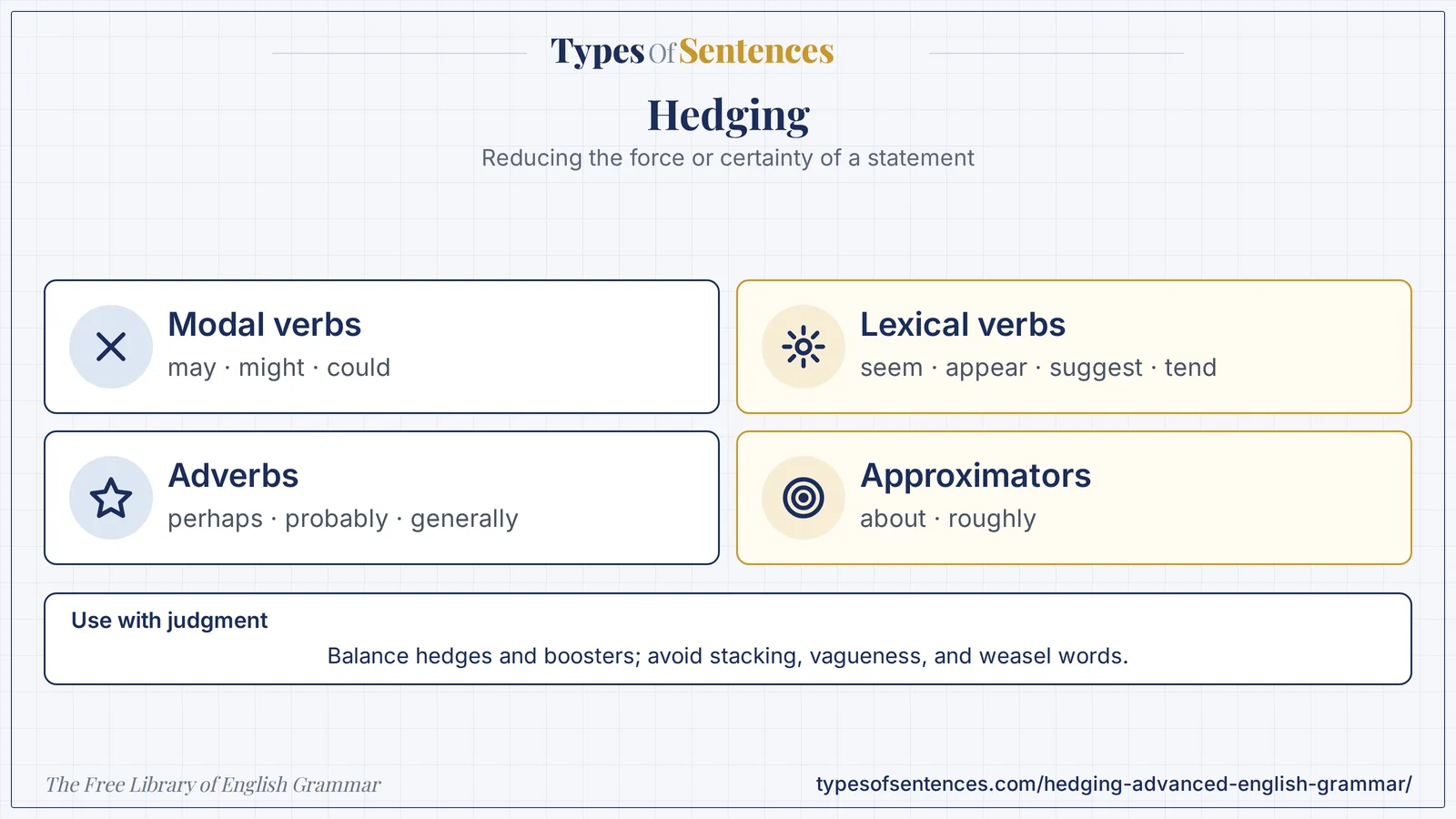
Summary: A hedge is a word or construction that reduces the force or the certainty of a statement: modal verbs (may, might, could), lexical verbs (seem, appear, suggest, tend), adverbs (perhaps, probably, generally), approximators (about, roughly), and phrases (it is possible that, to some extent). Hedges serve accuracy (the writer is not fully sure), politeness (the writer avoids imposing), and the norms of a community (academic writers negotiate claims). Boosters (clearly, definitely) do the opposite. Over-hedging, stacked hedges, and unattributed weasel words weaken a text.
- Hedge = reduce commitment: may, appear, perhaps, about.
- Functions: accuracy, politeness, and community norms.
- Balance hedges and boosters; match the strength to the evidence.
- Avoid stacking, vagueness, and weasel words.
What You’ll Learn
- 1. Hedging: What Is Hedging?
- 2. Why Hedge?
- 3. Hedging Devices
- 4. Hedging in Academic Writing
- 5. Boosting vs. Hedging
- 6. Hedging in Speech and Workplace Writing
- 7. Cultural Differences in Hedging
- 8. The Grammar of Tentative Language
- 9. Over-Hedging, Vagueness, and Weasel Words
- 10. Common Errors with Hedging
- 11. Exercises
- 12. Test Your Knowledge
- 13. Frequently Asked Questions
- 14. Conclusion
1. Hedging: What Is Hedging?
The term was brought into linguistics by George Lakoff in 1972, for words that make things “fuzzier”, such as sort of and technically. Later work, notably by Ken Hyland on academic writing, treats hedges as devices by which a writer withholds full commitment to a statement or presents it with caution.
| Unhedged | Hedged | Effect |
|---|---|---|
| The drug reduces symptoms. | The drug may reduce symptoms. | possibility |
| Smoking causes cancer. | Smoking is strongly associated with cancer. (a weaker causal claim) | a changed claim |
| The policy failed. | The policy appears to have failed. | a tentative judgment |
| It will rain. | It will probably rain. | degree of certainty |
| The sample is 200. | The sample is about 200. | an approximation |
| You are wrong. | I think you may be mistaken. | politeness |
| This proves the theory. | This supports the theory. | weaker evidence word |
| Two functions (Hyland) | Meaning | Example |
|---|---|---|
| content-oriented (accuracy) | makes the claim as exact as the evidence allows | The effect is approximately 5 percent. The results suggest a link. |
| reader-oriented (interpersonal) | shows respect for the reader and opens room for disagreement | It might be argued that the plan is unwise. |
| protecting the writer | limits the risk of being proved wrong | To the best of our knowledge, this is the first study. |
Hedging is related to modality, treated in the chapter on modality, but is wider: it includes adverbs, verbs, and whole phrases as well as modal verbs. It is related to vagueness, which is treated in the chapter on vagueness and precision, but is not the same: a hedge is precise about the degree of certainty.
2. Why Hedge?
| Reason | Explanation | Example |
|---|---|---|
| accuracy | most knowledge claims are probable, not certain, and a hedge says so | The data suggest that sleep affects memory. |
| politeness and face | avoids imposition or direct disagreement | I’m not sure, but I think the figure may be wrong. |
| academic convention | a claim must be acceptable to the community, so writers negotiate it | These findings may indicate a general pattern. |
| protection | reduces the risk of being refuted | This is likely to be the case. |
| caution about generalizing | a claim may not apply to every case | In most cases, …; Generally, … |
| avoiding overstatement | prevents exaggeration | The treatment may help some patients. |
| tact in criticism | softens an evaluation | This section could be clearer. |
| uncertainty (honest) | the writer does not know | It is not clear whether … |
In science, hedging is a mark of the careful reporting of evidence: one study rarely proves anything, and a strong claim requires strong evidence. In law and medicine, hedged language reflects the real uncertainty of outcomes (may cause drowsiness). In everyday talk, hedging is a way of being gentle and of keeping the conversation open. The pragmatic basis of such softening is treated in the previous chapter, on pragmatics.
3. Hedging Devices
| Type | Devices | Examples |
|---|---|---|
| modal verbs | may, might, could, can, would, should (and will as a booster) | This may be due to chance. It could be that the sample was small. |
| lexical (epistemic) verbs | seem, appear, suggest, indicate, tend, assume, estimate, believe, think, propose, imply, speculate, argue, claim | The results appear to support the hypothesis. The data suggest that … |
| adverbs of probability | perhaps, possibly, probably, presumably, apparently, arguably, conceivably, likely, supposedly | Prices will probably rise. |
| adverbs of degree and frequency | somewhat, relatively, fairly, rather, partly, largely, mainly, generally, usually, often, sometimes, typically | The effect is relatively small. |
| adjectives | possible, probable, likely, unlikely, potential, apparent, tentative, plausible | a possible explanation; a likely cause |
| nouns | possibility, probability, suggestion, assumption, tendency, indication, estimate, impression | There is a possibility that the data are flawed. |
| approximators | about, around, approximately, roughly, nearly, almost, in the region of, some, several, a few | about 40 percent; some 200 people |
| phrases and clauses | it is possible that; it appears that; it seems that; there is some evidence that; to some extent; in some cases; as far as we know; to the best of our knowledge; in general; on the whole | To some extent, this is true. |
| impersonal and passive | it is thought that; it has been suggested that; it is generally believed that | It has been suggested that the policy failed. |
| conditionals | if, unless, assuming that; provided that | If the model is correct, prices will fall. |
| negation | not necessarily; not entirely; not always; hardly | This is not necessarily true. |
| first-person stance | I think; I believe; I suspect; we would argue; in my view; it seems to me | In my view, the evidence is weak. |
| informal hedges | sort of, kind of, a bit, I guess, maybe, like, you know, or something | It’s kind of expensive. |
| tag and question forms | …, isn’t it?; Would you agree? | The plan is risky, isn’t it? |
| Strength of commitment | Wording | Example |
|---|---|---|
| strong (booster) | certainly, definitely, clearly, proves, must, will | This clearly proves the point. |
| fairly strong | is likely to, probably, indicates, should | This indicates a link. |
| moderate | may, suggests, seems to, appears to, tends to | This suggests a link. |
| weak | might, could, possibly, it is conceivable that | This might possibly be related. |
| very weak (speculation) | one could speculate that, it is not impossible that | One could speculate that … |
Verbs that report others’ claims (claim, argue, suggest) are hedges when the writer does not endorse the claim, as described in the chapter on advanced reported speech. The conditional forms that make a claim depend on a condition are in the chapter on advanced conditionals.
4. Hedging in Academic Writing
| Move | Hedged pattern | Example |
|---|---|---|
| reporting results | The results suggest / indicate / are consistent with … | The results are consistent with the hypothesis. |
| interpreting findings | These findings may / could indicate …; This appears to be due to … | This appears to be due to differences in sample size. |
| offering explanations | One possible explanation is that …; It is likely that … | One possible explanation is that the survey was short. |
| generalizing | tend to; generally; in most cases; typically | Students tend to prefer short tasks. |
| stating limitations | The study is limited by …; Caution is needed … | Caution is needed in generalizing the results. |
| predicting | is likely to; may well; could lead to | The policy is likely to reduce costs. |
| suggesting further research | Further research is needed to determine whether … | — |
| criticizing sources | Smith’s argument may overlook …; It could be argued that … | — |
| introducing a claim | It is argued that …; I would suggest that … | — |
| Unhedged claim | Hedged claim | Over-hedged claim |
|---|---|---|
| Social media causes depression. | Social media use is associated with depression, and may contribute to it. | It might possibly seem that social media may perhaps be associated with some depression. |
| The data prove that prices fall. | The data suggest that prices tend to fall. | The data seem to somewhat tend to suggest that prices may possibly fall. |
| This method is better. | This method appears to be more accurate in most cases. | This method may possibly be somewhat better in some cases, perhaps. |
| The study shows that sleep matters. | The study indicates that sleep may matter. | The study seems to possibly suggest that sleep might matter somewhat. |
- Hedge claims and interpretations, not facts and methods. The samples were heated to 100 degrees needs no hedge; This suggests a link does.
- Choose the right verb of evidence. Show and prove are strong; suggest, indicate, and be consistent with are weaker. Match the verb to the strength of the evidence.
- One hedge per claim is usually enough. This may suggest is a double hedge, and is acceptable; This might possibly suggest is too much.
- Disciplines differ. Research articles in the humanities and social sciences usually contain more hedging than those in the physical sciences, according to corpus studies.
- Check the conventions of the journal and the field. The chapter on academic writing introduces them.
5. Boosting vs. Hedging
| Boosters (strengthen) | Hedges (weaken) |
|---|---|
| clearly, obviously, definitely, certainly, undoubtedly, of course | perhaps, possibly, probably, apparently, arguably |
| it is clear that, it is certain that, there is no doubt that | it is possible that, it seems that, there is some evidence that |
| show, demonstrate, prove, establish, confirm | suggest, indicate, imply, appear |
| always, never, all, every, must, will | sometimes, often, some, may, could |
| in fact, indeed, actually, really | in some cases, to some extent, roughly |
| Function of boosters | Example | Caution |
|---|---|---|
| show confidence | The results clearly show a decline. | overclaiming if the evidence is weak |
| build solidarity with the reader | As we all know, …; Of course, … | may sound presumptuous |
| mark a conclusion | It is therefore certain that … | — |
| emphasize | Indeed, this is the most important factor. | — |
| reject an alternative | There is no doubt that the model is wrong. | — |
Hyland describes the writer’s stance as the balance between hedges and boosters, together with attitude markers (surprisingly, importantly) and self-mention (I, we). Both are needed: a text full of hedges seems timid, and a text full of boosters seems dogmatic. The right mix depends on the evidence, the genre, and the readers. A booster can also be a hedge in disguise: Clearly, further research is needed uses a booster to soften a limitation. The emphasis devices of grammar are treated in the next chapter, on emphasis and focus.
6. Hedging in Speech and Workplace Writing
| Function | Hedge | Example |
|---|---|---|
| softening a request | I was wondering if; would you mind; just | I just wanted to ask if you could review this. |
| softening disagreement | I’m not sure, but; I see what you mean, but; I may be wrong, but | I may be wrong, but I think the figure is too high. |
| softening criticism | a bit; slightly; could be improved | The report could be a bit clearer. |
| approximating | about, around, roughly, or so | It takes about an hour or so. |
| expressing uncertainty | I guess; I suppose; maybe; probably; I think | I guess it will be ready tomorrow. |
| informal vagueness | sort of; kind of; like; you know | It’s kind of complicated. |
| checking agreement | …, right?; …, don’t you think? | This is the best option, don’t you think? |
| saving face | if I may say so; with respect | With respect, I disagree. |
| making suggestions | It might be worth …; Perhaps we could …; One option would be … | It might be worth checking the figures. |
| Direct | Hedged (workplace email) |
|---|---|
| Send me the data today. | Could you send me the data today, if possible? |
| The plan won’t work. | I’m not sure the plan will work, because … |
| You made an error. | There may be an error on page 3; could you check? |
| We must change the schedule. | It might be worth looking at the schedule. |
| I disagree. | I see your point, but I wonder whether … |
In conversation, hedges are very frequent, and many are used without thought. The research on whether women or men hedge more is mixed, and much depends on the situation and the role. A hedge that softens a request is polite; but in an emergency or a set of instructions, hedging can be dangerous, and the direct imperative is right. The politeness strategies are described in the chapter on pragmatics.
7. Cultural Differences in Hedging
Expectations of directness vary between communities and between genres. Some communication styles favor explicit, direct statements; others favor indirect, context-dependent expression. The anthropologist Edward Hall called these “low-context” and “high-context” styles. Such labels are generalizations and should be used with care: there is wide variation within any country or group, and between individuals.
| Observation (general, to be treated with care) | Implication for writers |
|---|---|
| Anglo-American academic writing is often described as hedge-heavy compared with some other academic traditions | a writer trained elsewhere may seem too confident to English-language reviewers |
| writers working in a second language may under-hedge (sound over-confident) or over-hedge | study published articles in your field to see the norms |
| in some traditions a confident, authoritative tone is a mark of expertise; in others, caution is a mark of respect | adjust to the audience |
| hedges in speech differ (some varieties use more softeners) | observe local norms |
| translation can change the force of a hedge | check the equivalent in the target language |
- Do not copy hedges mechanically. Use them where you really have doubt.
- Learn the hedges of your field from a corpus or from the journals you read.
- Treat cultural generalizations as tendencies, not rules.
- If in doubt about the readers’ expectation, choose moderate hedging and clear, specific claims.
8. The Grammar of Tentative Language
| Structure | Example | Notes |
|---|---|---|
| modal + base | This may be true. | present possibility |
| modal + perfect | This may have been caused by the delay. | possibility in the past |
| modal + progressive | She might be waiting. | — |
| seem / appear + to-infinitive | The effect seems to be small. The policy appears to have failed. | raising verbs |
| it seems / appears that + clause | It appears that the sample was biased. | extraposition |
| would as hedge | I would say that it is risky. That would explain it. | remote, tentative |
| tend to | Students tend to avoid long tasks. | generalization |
| be likely / unlikely to | The change is likely to help. | — |
| passive reporting | It is thought that …; The disease is believed to have started in Asia. | impersonal |
| conditional | If the model is correct, … | dependent claim |
| approximator + number | about 40 percent | — |
| negation | not necessarily; not entirely | — |
| Position of adverb hedges | Example |
|---|---|
| before the main verb | This probably reflects a wider trend. |
| after the first auxiliary | This may possibly reflect … (too much); This will probably reflect … |
| sentence-initial | Perhaps the sample was too small. Apparently, the data were lost. |
| sentence-final (informal) | It’s expensive, I guess. |
The structures use the grammar that is described in the chapters on complement clauses (raising verbs and extraposition) and modality. A hedge has a scope: in This may possibly reflect a trend, may and possibly both apply to the whole clause, which is why combining them adds nothing.
9. Over-Hedging, Vagueness, and Weasel Words
| Problem | Example | Fix |
|---|---|---|
| stacked hedges | It may possibly seem that the results could perhaps suggest a link. | The results suggest a link. |
| hedging a fact | It seems that the experiment was done in May. | The experiment was done in May. |
| hedging everything (no thesis) | Perhaps, in some cases, it might be argued that … | State a clear claim and hedge only what is uncertain. |
| unattributed weasel words | Some say that …; Studies show that …; Experts believe … | Smith (2020) shows that … |
| vague quantifiers | many people; a lot of; various reasons | Of 200 respondents, 140 … |
| a hedge that hides responsibility | Mistakes may have been made. | We made mistakes. |
| hedging in instructions | You might want to press the red button. (emergency) | Press the red button. |
| hedge as a booster in disguise | Clearly, perhaps … | one or the other |
| hedging in law (ambiguous) | The tenant should pay. | The tenant must pay. (if obligatory) |
| an inaccurate hedge | The evidence suggests … (when the evidence is overwhelming) | The evidence shows … |
- Is the hedge accurate? Does it match your real certainty?
- Is the claim clear? A hedged claim should still be specific.
- One hedge is usually enough.
- Is the source named? Replace “some say” with a citation.
- Is it a fact? Remove hedges from facts and methods.
- Is a direct statement better? In instructions and warnings, yes.
10. Common Errors with Hedging
| Error | Correction | Rule |
|---|---|---|
| The results may possibly perhaps suggest … | The results may suggest … | stacked hedges |
| It seems that water boils at 100 degrees. | Water boils at 100 degrees. | do not hedge facts |
| Studies show that sleep matters. | Smith (2020) shows that sleep matters. | weasel words |
| The data prove that … | The data suggest that … | weak evidence |
| This is an absolutely perhaps possible explanation. | This is a possible explanation. | mixed booster and hedge |
| Some people think the plan may be rather somewhat risky. | The plan may be risky. | too many softeners |
| It will perhaps rain. | It will probably rain. / It may rain. | word order and strength |
| The drug might cure cancer. (a headline claim) | The drug may help some patients. | overclaiming and accuracy |
| This may not be necessarily true. | This is not necessarily true. | double hedge |
| I think that I am maybe right. | I think I am right. | one hedge |
| We can possibly conclude that … | We can conclude that … / We may conclude that … | one hedge |
| It is said that the experts say … | Jones (2019) says … | impersonal chain |
Edit: It might possibly seem that the data perhaps may prove that water boils at about 100 degrees, and studies show that sleep matters, and some people think the plan is somewhat risky.
- might possibly seem … perhaps may: stacked hedges: use one.
- prove: too strong for hedged evidence: suggest.
- water boils at about 100 degrees: a fact: no hedge: Water boils at 100 degrees (at sea level).
- studies show: Smith (2020) shows that …
- some people think: A survey found that 60 percent of respondents think …
- Result: The data suggest a link. Water boils at 100 degrees at sea level. Smith (2020) shows that sleep matters. In a survey, 60 percent of respondents thought the plan was risky. (the figures are invented for the example)
Recap in 12 seconds
Watch the lesson build itself: Hedges reduce commitment through modals, lexical verbs, adverbs, and approximators. The video has no sound.
Exercises
Part A: Recognizing Hedges (Exercises 1–7)
Exercise 1: Define hedging.
Show Answer
Answer: Using language to soften a claim or show less than full commitment.
Exercise 2: Name two functions of hedging.
Show Answer
Answer: Accuracy and politeness (also: community norms, protection).
Exercise 3: Find the hedge: The drug may reduce symptoms.
Show Answer
Answer: may.
Exercise 4: Find the hedge: The results appear to support the hypothesis.
Show Answer
Answer: appear to.
Exercise 5: Find the hedge: It will probably rain.
Show Answer
Answer: probably.
Exercise 6: Find the hedge: about 200 people
Show Answer
Answer: about (an approximator).
Exercise 7: Who introduced the term hedge into linguistics?
Show Answer
Answer: George Lakoff (1972).
Part B: Hedging Claims (Exercises 8–14)
Exercise 8: Hedge: The drug reduces symptoms.
Show Answer
Answer: The drug may reduce symptoms.
Exercise 9: Hedge: The policy failed.
Show Answer
Answer: The policy appears to have failed.
Exercise 10: Replace the strong verb: The data prove that …
Show Answer
Answer: The data suggest that …
Exercise 11: Hedge a generalization: Students avoid long tasks.
Show Answer
Answer: Students tend to avoid long tasks.
Exercise 12: Hedge a prediction: Prices will fall.
Show Answer
Answer: Prices are likely to fall.
Exercise 13: Approximate: The sample is 200.
Show Answer
Answer: The sample is about 200.
Exercise 14: Soften a criticism: This is wrong.
Show Answer
Answer: This may need revision.
Part C: Boosters and Strength (Exercises 15–19)
Exercise 15: Booster or hedge: clearly
Show Answer
Answer: Booster.
Exercise 16: Booster or hedge: arguably
Show Answer
Answer: Hedge.
Exercise 17: Strongest verb: suggest, show, or indicate?
Show Answer
Answer: show.
Exercise 18: Weakest: may, might, or will?
Show Answer
Answer: might.
Exercise 19: Name the balance of hedges and boosters.
Show Answer
Answer: Stance.
Part D: Speech and Culture (Exercises 20–24)
Exercise 20: Soften: Send me the data today.
Show Answer
Answer: Could you send me the data today, if possible?
Exercise 21: Soften: You made an error.
Show Answer
Answer: There may be an error; could you check?
Exercise 22: Name an informal hedge.
Show Answer
Answer: sort of, kind of, I guess.
Exercise 23: Is hedging always appropriate?
Show Answer
Answer: No (not in emergencies, instructions, or facts).
Exercise 24: Are cultural generalizations about hedging fixed rules?
Show Answer
Answer: No (tendencies, with wide variation).
Part E: Over-Hedging and Errors (Exercises 25–30)
Exercise 25: Fix: The results may possibly perhaps suggest a link.
Show Answer
Answer: The results may suggest a link.
Exercise 26: Fix: It seems that water boils at 100 degrees.
Show Answer
Answer: Water boils at 100 degrees.
Exercise 27: Fix: Studies show that sleep matters.
Show Answer
Answer: Smith (2020) shows that sleep matters.
Exercise 28: Fix: This may not be necessarily true.
Show Answer
Answer: This is not necessarily true.
Exercise 29: Name two problems of over-hedging.
Show Answer
Answer: Vagueness and a weak thesis.
Exercise 30: What is a weasel word?
Show Answer
Answer: A vague, unattributed word (some say, experts believe).
Test Your Knowledge
Ready to check what you learned? Answer all 10 questions, then submit. You need 80% (8 of 10) to pass. Your answers are not stored.
View correct answers and explanations
Question 1: What is a hedge?
✓ Correct Answer: A – a word that reduces the force or certainty of a claim
A hedge softens commitment.
Question 2: Which is a hedge?
✓ Correct Answer: B – may
May expresses possibility.
Question 3: Which is a booster?
✓ Correct Answer: C – clearly
Clearly strengthens.
Question 4: Which verb is weakest?
✓ Correct Answer: C – suggest
Suggest is tentative.
Question 5: Which is over-hedged?
✓ Correct Answer: B – The results may possibly perhaps suggest a link.
Stacked hedges.
Question 6: Which should not be hedged?
✓ Correct Answer: D – a fact
Hedge claims, not facts.
Question 7: Which is a weasel phrase?
✓ Correct Answer: C – Studies show that …
Unattributed.
Question 8: Which is an approximator?
✓ Correct Answer: D – about
About 200.
Question 9: Which is correct?
✓ Correct Answer: B – This is not necessarily true.
One hedge.
Question 10: Who introduced the term hedge into linguistics?
✓ Correct Answer: A – Lakoff
George Lakoff, in 1972.
Frequently Asked Questions
What is hedging?
Hedging is the use of words and structures that soften a claim or show less than full commitment, such as may, appear to, probably, and to some extent.
What is hedging language?
Hedging language is the set of devices used to hedge: modal verbs, epistemic verbs, adverbs, approximators, phrases, and impersonal and conditional structures.
What is academic hedging?
Academic hedging is the careful use of hedges in research writing to match claims to evidence and to negotiate them with the community: The results suggest that …
What does softening statements mean?
Softening statements means making them gentler or less certain, for accuracy or politeness: I’m not sure, but I think the figure may be wrong.
What is tentative language?
Tentative language is language that expresses caution or uncertainty: hedges, approximators, and phrases such as it seems that and one possible explanation is.
What is the difference between a hedge and a booster?
A hedge reduces the force of a claim (may, perhaps); a booster increases it (clearly, definitely). Writers balance both.
When should I not hedge?
Do not hedge facts and methods, instructions and warnings, or claims that the evidence fully supports; and avoid stacking several hedges in one claim.
Conclusion
You now have a deep study of hedging: what hedges are and why they are used, the full range of hedging devices, hedging in academic writing, boosters and stance, hedging in speech and at work, cultural differences, the grammar of tentative language, and the faults of over-hedging and weasel words. You can soften statements with precision.
When you hedge, ask what you really know and say exactly that. Next, you will study emphasis and focus.
- Lakoff, George. “Hedges: A Study in Meaning Criteria and the Logic of Fuzzy Concepts.” Journal of Philosophical Logic 2 (1973): 458–508.: the early study of hedges.
- Hyland, Ken. Hedging in Scientific Research Articles. John Benjamins, 1998.: the standard study of hedging in academic writing.
- Hyland, Ken. “Stance and Engagement: A Model of Interaction in Academic Discourse.” Discourse Studies 7 (2005): 173–192.: hedges, boosters, and stance.
- Brown, Penelope, and Stephen C. Levinson. Politeness: Some Universals in Language Usage. Cambridge University Press, 1987.: politeness and hedging.
- Merriam-Webster Dictionary: hedge: the dictionary entry.
Last reviewed: October 29, 2026. How it was made: drafted with AI assistance, then checked with automated tests (structure, links, answer keys, spelling) and against the sources above. A person has not yet read this chapter line by line. Found a mistake? Report it.