This intermediate grammar review part 2 is the intermediate final review. It brings together the second half of the Intermediate level, Chapters 35 to 68: verb tenses, modal verbs, voice and reported speech, conditionals, gerunds, infinitives and participles, punctuation and capitalization, the writing-skills chapters, and the common errors. Together with Part 1, it completes your review of the whole level.
This intermediate review part two has five jobs: a comprehensive review of the previous chapters, 30 practice exercises, a self-assessment for intermediate mastery, a summary of key concepts, and a guide to moving on to Advanced grammar. Use it to find out what you remember and what you should read again before you advance.
This is the last stop before the Advanced level. A final review checks that the foundations are firm, because the Advanced chapters assume that you can handle tenses, modals, clauses, and punctuation without effort.
Why it matters: If you find gaps, go back to the chapter and repeat its exercises. It is better to fill a gap now than to meet it again in a harder form later.
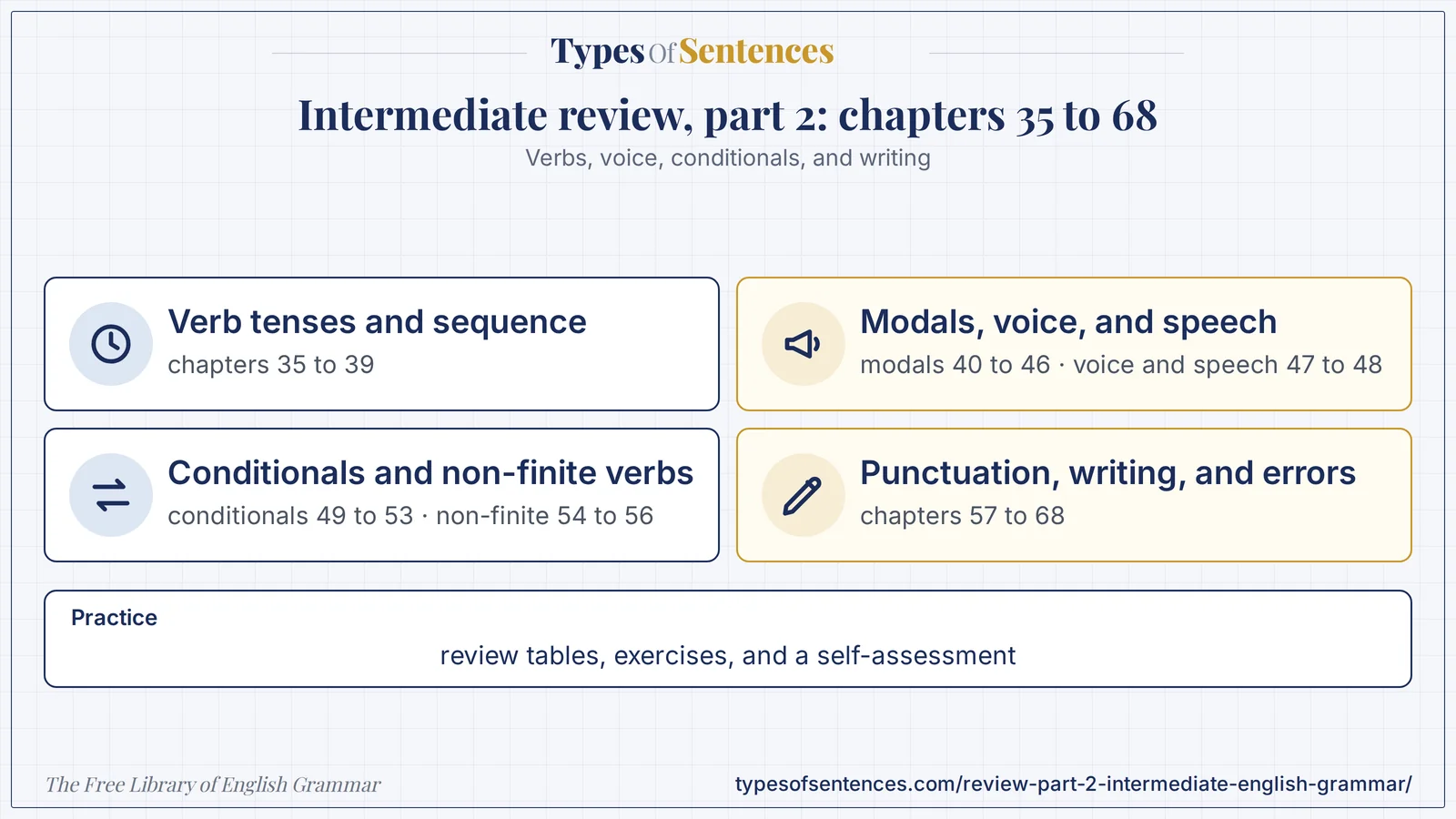
Summary: Chapters 35 to 68 cover the twelve tenses and their uses, the modal verbs by function, the active and passive voice, reported speech, the four conditional types, the three non-finite forms (gerund, infinitive, participle), punctuation and capitalization, the main kinds of writing, and the common errors. This chapter reviews them with tables, 30 exercises, a self-assessment, and a guide to the Advanced level.
- Verb tenses and sequence (35 to 39).
- Modal verbs (40 to 46) and voice and speech (47 to 48).
- Conditionals (49 to 53) and non-finite verbs (54 to 56).
- Punctuation, writing, and errors (57 to 68).
What You’ll Learn
- 1. Intermediate Grammar Review Part 2: What It Covers
- 2. Comprehensive Review of Previous Chapters
- I. Verb tenses (Chapters 35 to 39)
- II. Modal verbs (Chapters 40 to 46)
- III. Voice and reported speech (Chapters 47 to 48)
- IV. Conditionals (Chapters 49 to 53)
- V. Gerunds, infinitives, and participles (Chapters 54 to 56)
- VI. Punctuation and capitalization (Chapters 57 to 58)
- VII. Writing skills (Chapters 59 to 67)
- VIII. Common errors (Chapter 68)
- 3. Key Concepts Summary
- 4. Intermediate Final Review: Practice Exercises
- 5. Self-Assessment: Intermediate Mastery
- 6. Moving to Advanced Grammar
- 7. Exercises
- 8. Test Your Knowledge
- 9. Frequently Asked Questions
- 10. Conclusion
1. Intermediate Grammar Review Part 2: What It Covers
Review Part 2 covers Chapters 35 to 68, in eight groups. For each group, ask: Can I explain it? Can I use it? Can I find it in a sentence or paragraph?
| Group | Chapters | Topics |
|---|---|---|
| Verb tenses | 35 to 39 | the twelve tenses; present, past, and future tenses; tense consistency and sequence |
| Modal verbs | 40 to 46 | ability, permission, possibility, obligation, deduction, and other uses |
| Voice and speech | 47 to 48 | active and passive voice; reported speech |
| Conditionals | 49 to 53 | the four types, mixed conditionals, and other patterns |
| Non-finite verbs | 54 to 56 | gerunds, infinitives, participles |
| Punctuation | 57 to 58 | the marks; capitalization |
| Writing skills | 59 to 67 | paragraphs, essays, cohesion, description, narrative, exposition, persuasion, functional grammar, word formation |
| Common errors | 68 | the most frequent mistakes and a proofreading method |
Part 1, the previous chapter, covered Chapters 1 to 34. If you have not done it, do it first.
2. Comprehensive Review of Previous Chapters
I. Verb tenses (Chapters 35 to 39)
The twelve tenses combine three times (past, present, future) with four aspects (simple, continuous, perfect, perfect continuous). The overview is in the chapter on verb tenses.
| Tense | Form | Example |
|---|---|---|
| present simple | base / -s | She works here. |
| present continuous | am/is/are + -ing | She is working now. |
| present perfect | have/has + past participle | She has worked here for years. |
| present perfect continuous | have/has been + -ing | She has been working all day. |
| past simple | -ed / irregular | She worked yesterday. |
| past continuous | was/were + -ing | She was working when I called. |
| past perfect | had + past participle | She had worked before I came. |
| future simple | will + base | She will work tomorrow. |
| future continuous | will be + -ing | She will be working at noon. |
| future perfect | will have + past participle | She will have finished by six. |
- Use the present simple (not will) in time and conditional clauses: When I arrive, I will call.
- Use the present perfect for a period up to now, and the past simple for a finished time: I have lived here for ten years. I lived there in 2010.
- Keep one time frame in a passage unless the meaning changes. Use the past perfect for events before the main past events.
II. Modal verbs (Chapters 40 to 46)
Modals are followed by the base form and have no -s. See the chapter on modal verbs for the full set.
| Function | Modals | Example |
|---|---|---|
| ability | can, could, be able to | She can swim. |
| permission | can, could, may | May I come in? |
| possibility | may, might, could | It may rain. |
| obligation | must, have to, should | You must register. |
| prohibition / no necessity | mustn’t / don’t have to | You mustn’t smoke. You don’t have to come. |
| deduction | must, can’t | She must be at home. |
| requests and offers | could, would, shall | Shall I help? |
| past forms | must have, should have, could have | She must have left. |
III. Voice and reported speech (Chapters 47 to 48)
| Topic | Rule | Example |
|---|---|---|
| passive | be + past participle in the tense of the active verb | The report was written by Maria. |
| when to use it | the doer is unknown, unimportant, or obvious | My bike was stolen. |
| reported statement | backshift when the reporting verb is past; change pronouns and time words | She said that she was tired. |
| reported question | statement order; if/whether | He asked where I lived. |
| reported command | told/asked + object + (not) to + base | She told me to leave. |
IV. Conditionals (Chapters 49 to 53)
The four types are described in the chapter on conditional sentences. Never use will or would in the if clause for the future or a hypothesis.
| Type | Form | Meaning | Example |
|---|---|---|---|
| zero | if + present, present | general truth | If you heat ice, it melts. |
| first | if + present, will + base | likely future | If it rains, we will stay. |
| second | if + past, would + base | unreal present or future | If I had money, I would travel. |
| third | if + past perfect, would have + past participle | unreal past | If I had known, I would have called. |
| mixed | if + past perfect, would + base | past condition, present result | If I had studied, I would be a doctor now. |
- Unless means if not: Unless you hurry, you will miss it (not unless you don’t hurry).
- In case gives a precaution; provided that and as long as mean only if.
- Use were in formal If I were you.
V. Gerunds, infinitives, and participles (Chapters 54 to 56)
| Form | Function | Example |
|---|---|---|
| gerund (-ing as a noun) | subject, object, after prepositions | Swimming is fun. She enjoys reading. good at drawing |
| infinitive (to + base) | noun, adjective, adverb of purpose; after many verbs | She wants to leave. a place to rest. She studied to pass. |
| bare infinitive | after modals, let, make, and perception verbs | She can swim. He made them wait. |
| present participle (-ing) | adjective, continuous tenses | a running tap; She is running. |
| past participle (-ed) | adjective, perfect tenses, passive | a broken window; She has broken it. |
Remember the test for to: if a noun can follow, it is a preposition and a gerund follows (look forward to seeing). The structure is covered in the chapter on gerunds, and -ing and -ed adjectives follow the rule that -ing describes the cause and -ed describes the one who feels.
VI. Punctuation and capitalization (Chapters 57 to 58)
| Mark or rule | Use | Example |
|---|---|---|
| comma | series, introductory elements, before a conjunction joining clauses, nonessential phrases | When it rained, we left, and she stayed. |
| semicolon | joins related independent clauses | It rained; we stayed. |
| colon | introduces after a complete clause | You need three things: a pen, paper, and time. |
| apostrophe | possession and contractions; its and it’s | the dog’s bowl; it’s late |
| quotation marks | speech and short titles; periods and commas inside (American) | She said, “I am ready.” |
| capital letters | sentence starts, I, proper nouns, titles before names, days, months | Dr. Rao; Monday; the South |
| not capitalized | seasons, most directions, school subjects (except languages) | winter; drive south; biology |
The details are in the chapter on punctuation marks. Read your writing aloud to hear where a mark is needed.
VII. Writing skills (Chapters 59 to 67)
| Skill | Key idea |
|---|---|
| paragraph | one idea: topic sentence, support, conclusion; unity and coherence (see paragraph writing) |
| essay | introduction with a thesis, body paragraphs, conclusion |
| cohesion | reference, substitution, ellipsis, linkers connect sentences |
| descriptive writing | sensory details; show, don’t tell |
| narrative writing | plot, character, setting, point of view, dialogue, conflict |
| expository writing | explain objectively with evidence |
| persuasive writing | claim, evidence, counterargument, call to action |
| functional grammar | choose forms by function and politeness |
| word formation | prefixes, suffixes, conversion, compounding, roots |
VIII. Common errors (Chapter 68)
The most frequent errors are in agreement, pronoun case, tenses, adjective and adverb confusion, double negatives, misplaced modifiers, fragments and run-ons, confusable words, apostrophes, commas, and prepositions. The best habit is to proofread aloud, with an error log of your own most common mistakes.
3. Key Concepts Summary
| Concept | Remember |
|---|---|
| Present perfect | a period up to now, or a past action with a present result |
| Past perfect | an earlier past event before another past event |
| Backshift | the tenses shift back in reported speech after a past reporting verb |
| Modal verb | followed by the base form; no -s; no -ing |
| Must have + past participle | a logical conclusion about the past |
| Should have + past participle | advice or regret about the past |
| Passive voice | be + past participle; the receiver is the subject |
| Zero conditional | a general truth |
| Third conditional | the unreal past: if + past perfect, would have + past participle |
| Gerund | the -ing form as a noun; after prepositions |
| Infinitive | to + base; after many verbs and adjectives |
| Participle | -ing or -ed form used as an adjective or in a verb phrase |
| Dangling modifier | a phrase that does not modify the right noun |
| Cohesion | links between sentences |
| Thesis | one clear claim that the essay develops |
4. Intermediate Final Review: Practice Exercises
The 30 review exercises below cover Chapters 35 to 68. Try each one before you open the answer. If you miss a question, the answer names the topic to study again.
5. Self-Assessment: Intermediate Mastery
This self-assessment has two parts. First, check the I can statements. Then, take the quiz at the end and use its score.
| I can… | Chapters |
|---|---|
| form and use the twelve tenses and keep the tense consistent | 35 to 39 |
| use modals for ability, permission, possibility, obligation, deduction, requests, and offers | 40 to 46 |
| change a sentence from active to passive and use passive in all tenses | 47 |
| report statements, questions, and commands | 48 |
| form and use the zero, first, second, and third conditionals | 49 to 53 |
| use gerunds, infinitives, and participles correctly | 54 to 56 |
| punctuate and capitalize a text correctly | 57, 58 |
| plan and write a paragraph, an essay, and a description or story | 59 to 67 |
| recognize and fix the most common grammar errors | 68 |
| Score on the 10-question quiz | What to do |
|---|---|
| 9 or 10 | Excellent. You have intermediate mastery. Go on to the Advanced level. |
| 7 or 8 | Good. Review the topics you missed, then go on. |
| 5 or 6 | Reread the chapters for the missed topics, then retake the quiz. |
| 4 or fewer | Go back through Chapters 35 to 56 slowly, then try again. |
This is a self-check, not an official test. Different learners need different amounts of review, and a low score means you have found what to study, not that you have failed.
6. Moving to Advanced Grammar
The Advanced level of this course has 106 chapters. It deepens the topics you have studied and adds new ones: the grammar of tense and aspect, modality and voice, non-finite constructions, complementation and information structure, style, discourse, and the history and variation of English.
| You are ready if you can… | If not, review |
|---|---|
| explain any of the twelve tenses and when to use it | Chapters 35 to 39 |
| use modals for different functions without hesitation | Chapters 40 to 46 |
| identify clauses and phrases in a long sentence | Part 1: Chapters 12 to 24 |
| write a clear paragraph and essay with good punctuation | Chapters 57 to 60 |
| spot and fix common errors in your own writing | Chapter 68 |
- Start with the Advanced overview. It maps the course and shows how the chapters connect.
- Study in order, a chapter at a time. Advanced chapters build on each other.
- Keep your error log from Chapter 68 and check it as you write.
- Read widely. Notice grammar in newspapers, books, and speeches.
- Use the reference grammars named in the sources when you want more detail.
Recap in 12 seconds
Watch the lesson build itself: Part 2 of the Intermediate review covers chapters 35 to 68. The video has no sound.
Exercises
Part A: Tenses (Exercises 1–6)
Exercise 1: Choose: I (live/have lived) here for ten years.
Show Answer
Answer: have lived. (Chapter 36)
Exercise 2: Choose: I (lived/have lived) there in 2010.
Show Answer
Answer: lived. (Chapter 37)
Exercise 3: Fix it: When I will arrive, I will call.
Show Answer
Answer: When I arrive, I will call. (Chapter 38)
Exercise 4: Name the tense: She had worked before I came.
Show Answer
Answer: Past perfect. (Chapter 37)
Exercise 5: Name the tense: She will have finished by six.
Show Answer
Answer: Future perfect. (Chapter 38)
Exercise 6: Fix it: She walks in and sat down.
Show Answer
Answer: She walked in and sat down. (Chapter 39)
Part B: Modals (Exercises 7–12)
Exercise 7: Choose: The lights are on. She (must/can’t) be at home.
Show Answer
Answer: must. (Chapter 45)
Exercise 8: Choose: You (mustn’t/don’t have to) smoke here. (forbidden)
Show Answer
Answer: mustn’t. (Chapter 44)
Exercise 9: Choose: May I come in? is a request for:
Show Answer
Answer: Permission. (Chapter 42)
Exercise 10: Fix it: She can to swim.
Show Answer
Answer: She can swim. (Chapter 40)
Exercise 11: Past advice not followed: You should go.
Show Answer
Answer: You should have gone. (Chapter 44)
Exercise 12: Fix it: I should of called.
Show Answer
Answer: I should have called. (Chapter 44)
Part C: Voice and Reported Speech (Exercises 13–17)
Exercise 13: Passive: Maria wrote the report.
Show Answer
Answer: The report was written by Maria. (Chapter 47)
Exercise 14: Passive: They are building a bridge.
Show Answer
Answer: A bridge is being built. (Chapter 47)
Exercise 15: Report: She said, “I am tired.”
Show Answer
Answer: She said that she was tired. (Chapter 48)
Exercise 16: Report: “Where do you live?” he asked.
Show Answer
Answer: He asked where I lived. (Chapter 48)
Exercise 17: Report: “Close the door.”
Show Answer
Answer: He told me to close the door. (Chapter 48)
Part D: Conditionals (Exercises 18–22)
Exercise 18: Complete: If it (rain), we will stay.
Show Answer
Answer: rains. (Chapter 50)
Exercise 19: Complete: If I (have) money, I would travel.
Show Answer
Answer: had. (Chapter 51)
Exercise 20: Complete: If I had known, I (call).
Show Answer
Answer: would have called. (Chapter 52)
Exercise 21: Fix it: Unless you don’t hurry, you will miss it.
Show Answer
Answer: Unless you hurry, you will miss it. (Chapter 53)
Exercise 22: Choose: Take an umbrella (if/in case) it rains. (a precaution)
Show Answer
Answer: in case. (Chapter 53)
Part E: Non-Finite Verbs (Exercises 23–26)
Exercise 23: Choose: I look forward to (see/seeing) you.
Show Answer
Answer: seeing. (Chapter 54)
Exercise 24: Choose: She wants (to swim/swimming).
Show Answer
Answer: to swim. (Chapter 55)
Exercise 25: Choose: The film is (boring/bored).
Show Answer
Answer: boring. (Chapter 56)
Exercise 26: Fix it: She made him to wait.
Show Answer
Answer: She made him wait. (Chapter 55)
Part F: Punctuation, Writing, Errors (Exercises 27–30)
Exercise 27: Punctuate: When the bell rang we left
Show Answer
Answer: When the bell rang, we left. (Chapter 57)
Exercise 28: Capitalize: we visited lake superior in the north.
Show Answer
Answer: We visited Lake Superior in the north. (Chapter 58)
Exercise 29: What is a thesis?
Show Answer
Answer: One clear claim that the essay develops. (Chapter 60)
Exercise 30: Fix it: Me and Tom goes home yesterday.
Show Answer
Answer: Tom and I went home yesterday. (Chapter 68)
Test Your Knowledge
Ready to check what you learned? Answer all 10 questions, then submit. You need 80% (8 of 10) to pass. Your answers are not stored.
View correct answers and explanations
Question 1: Which tense is used for a period up to now?
✓ Correct Answer: B – Present perfect
Present perfect links the past to now.
Question 2: Which modal expresses a strong deduction?
✓ Correct Answer: C – must
Must expresses a strong deduction.
Question 3: Which is the passive of They make cars?
✓ Correct Answer: A – Cars are made.
Be + past participle.
Question 4: What is the reported form of “I will call”?
✓ Correct Answer: B – She said she would call.
Will becomes would.
Question 5: Which is the third conditional?
✓ Correct Answer: D – If I had known, I would have called.
If + past perfect, would have + past participle.
Question 6: Which means “if not”?
✓ Correct Answer: C – unless
Unless means if not.
Question 7: Which is correct?
✓ Correct Answer: C – I look forward to seeing you.
To is a preposition.
Question 8: Which is an -ed adjective for a person who feels?
✓ Correct Answer: D – bored
Bored describes the person who feels.
Question 9: Which is correct?
✓ Correct Answer: B – It was late, so we left.
A comma and a conjunction join clauses.
Question 10: What does a thesis do?
✓ Correct Answer: A – States the main claim of an essay
A thesis states the main claim.
Frequently Asked Questions
What is intermediate grammar review part 2?
Intermediate grammar review part 2 is a review of Chapters 35 to 68 of the Intermediate level: tenses, modals, voice and reported speech, conditionals, non-finite verbs, punctuation, writing skills, and common errors.
What is the intermediate final review?
The intermediate final review is the last chapter of the Intermediate level. With Part 1, it checks your knowledge of the whole level before you move on to Advanced grammar.
What does intermediate review part two cover?
It covers the second half of the Intermediate level in eight groups: tenses, modals, voice and speech, conditionals, non-finite verbs, punctuation, writing skills, and common errors.
How do I know if I have intermediate mastery?
You have intermediate mastery if you can explain and use the main grammar of the level without stopping to think: the tenses, modals, voice, conditionals, and non-finite forms, and if you score 9 or 10 on the quiz.
When should I move on to Advanced?
Move on when you score 7 or more on both review quizzes and can complete most of the exercises without hesitation. If you are unsure, review the topics you missed first.
What does the final review include?
A final review of this kind includes a summary of each topic group, a table of key concepts, 30 exercises with explained answers, a self-assessment, a 10-question quiz, and a guide to the Advanced level.
What should I do if my score is low?
Go back to the chapters for the topics you missed, redo their exercises, and retake the quiz. A low score tells you where to study next.
Conclusion
This intermediate grammar review part 2 summarized Chapters 35 to 68, gave you key concepts, 30 review exercises, and a self-assessment, and showed you how to move on. With Part 1, it completes the Intermediate level.
Fix any weak spots now. When you are ready, the Advanced level begins with an overview of the whole course.
- Purdue Online Writing Lab: Grammar: reference sections for every grammar topic reviewed here.
- Quirk, Randolph, et al. A Comprehensive Grammar of the English Language. Longman, 1985.: reference grammar for verbs, clauses, and sentences.
- Huddleston, Rodney, and Geoffrey K. Pullum. The Cambridge Grammar of the English Language. Cambridge University Press, 2002.: reference for the verb phrase and clause structure.
Last reviewed: October 29, 2026. How it was made: drafted with AI assistance, then checked with automated tests (structure, links, answer keys, spelling) and against the sources above. A person has not yet read this chapter line by line. Found a mistake? Report it.