Readability is the ease with which a reader can read and understand a text. It is not a property of the text alone: it depends on the words and sentences, on the organization and the layout, and also on the reader, who brings knowledge, motivation, and language skill. A text that is perfectly readable for a specialist may be unreadable for a beginner, and the reverse. The writer’s task is to make the text as easy as the reader needs it to be, without losing accuracy. Doing this is not “dumbing down”; it is respect for the reader’s time and attention.
This chapter explains what readability is and the factors that affect it. You will study sentence length and complexity, word choice, paragraph length and layout, the main readability formulas (Flesch Reading Ease, Flesch-Kincaid Grade Level, and Gunning Fog) with a worked calculation and a discussion of what they can and cannot tell you, and strategies for improving readability. You will also see how to balance simplicity and precision, how readability relates to accessible writing, and what the common errors are. Readable writing and clear writing are the goals; readability scores are only a guide. Thirty editing exercises and a quiz follow.
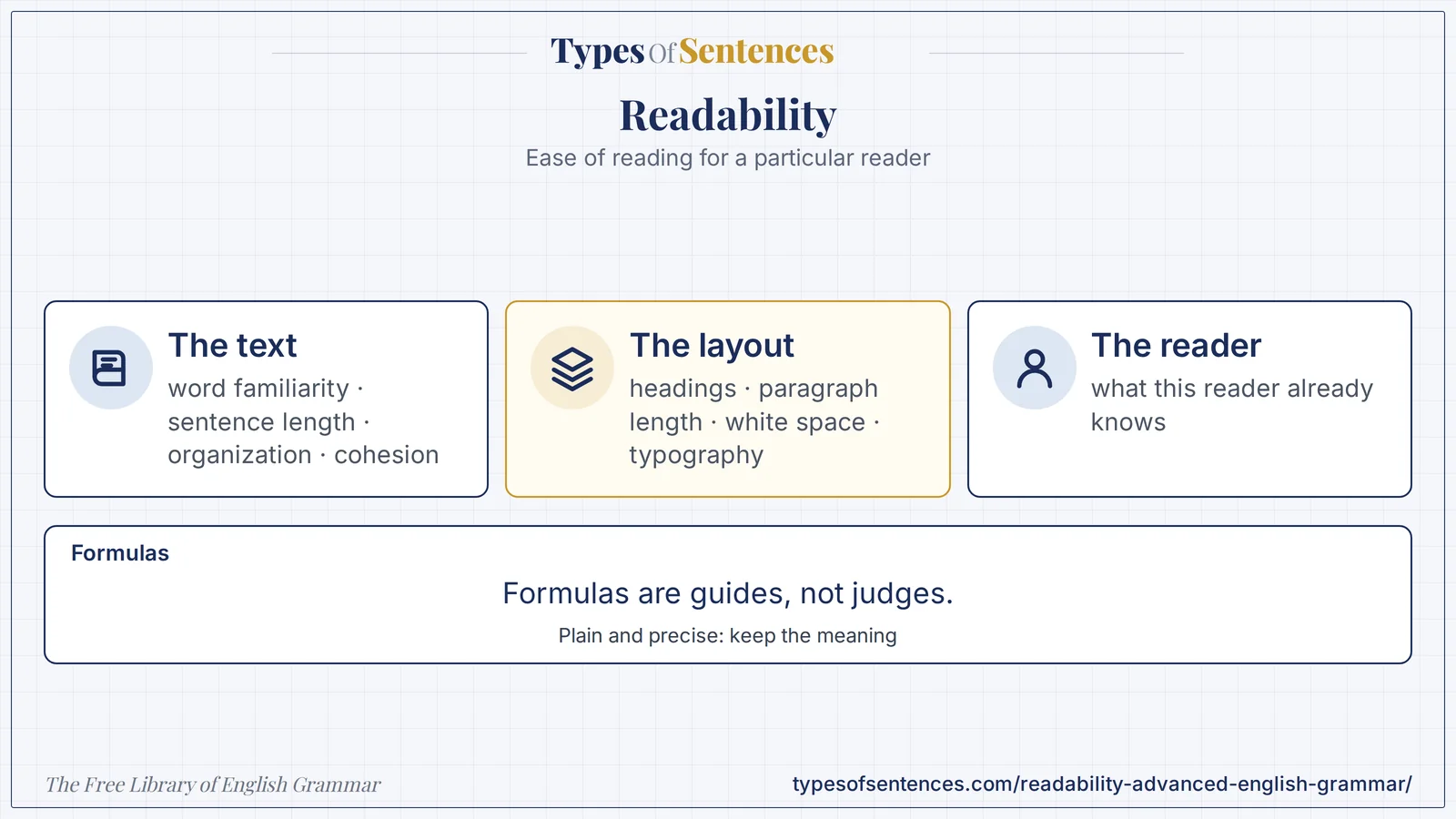
A readable text is one that a reader can understand without effort that is out of proportion to the task. Short, familiar words, clear sentences, short paragraphs, and a good layout all help. So does writing for the particular reader and not for an imaginary average one.
Why it matters: Readability scores can give you a rough number, but the final test is a real reader: can they understand it and do what they need to do?
Summary: Readability depends on the text (word familiarity, sentence length and complexity, organization, cohesion, density of ideas), the layout (headings, paragraph length, white space, typography), and the reader (prior knowledge, motivation, reading skill, language). Short, active sentences, familiar and concrete words, defined technical terms, and clear structure improve readability. Readability formulas combine measures such as average sentence length and word length (syllables or letters): the Flesch Reading Ease score = 206.835 − 1.015 × (words per sentence) − 84.6 × (syllables per word), and the Flesch-Kincaid Grade Level estimates a school grade. Such scores are rough guides: they ignore content, order, and cohesion, and they can be gamed. Improve readability by knowing the reader, cutting padding, shortening sentences where needed, using plain words, adding structure, and testing with readers. Simplicity must not cost accuracy.
- Readability = ease of reading for a particular reader.
- Sentence length, word choice, structure, and layout all matter.
- Formulas are guides, not judges.
- Plain and precise: keep the meaning.
What You’ll Learn
- 1. Readability: What Is It and What Affects It?
- 2. Sentence Length and Complexity
- 3. Word Choice: Simple vs Complex Words
- 4. Paragraph Length, White Space, and Layout
- 5. Readability Formulas: What They Measure and What They Do Not
- 6. Improving Readability: Strategies
- 7. Balance: Simplicity vs Precision
- 8. Readability and Accessible Writing
- 9. Readability in Different Kinds of Writing
- 10. Common Errors and a Worked Example
- 11. Exercises
- 12. Test Your Knowledge
- 13. Frequently Asked Questions
- 14. Conclusion
1. Readability: What Is It and What Affects It?
| Term | Meaning |
|---|---|
| readability | how easily a reader can read and understand a text |
| legibility | how easily the characters can be seen (type size, contrast, spacing) |
| comprehensibility | how well the content can be understood, given the reader’s knowledge |
| usability | whether the reader can use the text to do something |
| plain language | writing designed so that the reader can find, understand, and use the information the first time |
| Factor | Examples | Effect |
|---|---|---|
| words | familiar or rare, short or long, concrete or abstract, jargon, abbreviations | familiar, short, concrete words are easier |
| sentences | length, number of clauses, distance between subject and verb, nesting | short and simple structures are easier |
| organization | a clear order, headings, topic sentences, signposts | a clear structure helps |
| cohesion | links between sentences (see the chapter on cohesion) | clear links help |
| density of ideas | how many new ideas per sentence or paragraph | fewer new ideas per unit is easier |
| layout and typography | paragraph length, white space, lists, font, contrast | good layout helps scanning and reading |
| the reader’s knowledge | background, vocabulary, familiarity with the topic | known topics are easier |
| the reader’s motivation and purpose | interest; urgency; the task | motivated readers tolerate more difficulty |
| language skill | first or second language; reading skill | affects every other factor |
| context | screen or paper; noise; time | affects attention |
| Hard to read | Easier to read |
|---|---|
| In the event that employees are unable to attend the mandatory training session, which has been scheduled for the fifteenth of March, it is incumbent upon them to notify their immediate supervisors in writing prior to the commencement of the session, and failure to do so may result in the imposition of disciplinary measures. (54 words, one sentence) | Staff who cannot attend the training on 15 March must tell their supervisor in writing before the session starts. Staff who do not may face disciplinary action. (27 words, two sentences) |
The idea that texts can be measured for ease has been studied since the 1920s and 1930s, and the best-known formulas were developed in the mid-twentieth century by researchers such as Rudolf Flesch. They arose from work on how to make newspapers and public information easier to read. The plain-language movement, described in the chapter on legal writing, applies the same aim to official and legal documents.
2. Sentence Length and Complexity
| Average sentence length (words) | Difficulty (Flesch’s traditional scale) |
|---|---|
| 8 or fewer | very easy |
| 11 | easy |
| 14 | fairly easy |
| 17 | standard |
| 21 | fairly difficult |
| 25 | difficult |
| 29 or more | very difficult |
| Sentence (invented) | Words | Comment |
|---|---|---|
| The council approved the plan. | 5 | short and clear |
| Although the plan was popular with residents, the council delayed it for a year, because the cost estimates had risen and the funding was still unclear. | 26 | long but well organized: setup clause, main clause, reason |
| It failed. | 2 | very short: emphasis |
| Factor beyond word count | Why it matters | Example |
|---|---|---|
| distance between subject and verb | the reader must hold the subject in mind | The plan, which the council, after months of debate and several amendments, finally approved, failed. → After months of debate and several amendments, the council approved the plan. It failed. |
| nesting (a clause inside a clause) | center-embedded clauses are hard to process | The report the committee the council appointed wrote was long. → The council appointed a committee, which wrote a long report. |
| number of clauses | many subordinate clauses overload the reader | split into two or three sentences |
| passive and nominalization | hide the actor, add abstract nouns | The implementation of the policy was undertaken by the department. → The department implemented the policy. |
| negatives and double negatives | harder to process | not unlikely → likely |
| noun strings | — | the plan → the plan for housing in the city |
| ambiguity | makes the reader reread | — |
| garden-path sentences | mislead at first reading | The horse raced past the barn fell. (avoid) |
- Aim for a mixture of sentence lengths, with an average that suits the reader (about 15 to 20 words for general readers is a common guide). The chapter on sentence variety explains how to vary them.
- A long sentence is not a problem if it is well built: main clause visible, parallel items, signposts. A short sentence is not always easier: a string of short sentences can force the reader to supply the links.
- Put the subject near its verb, and put the main clause early.
- Break up a sentence that has several ideas.
- Use the active voice and verbs instead of nominalizations.
3. Word Choice: Simple vs Complex Words
| Complex or formal | Simpler | Note |
|---|---|---|
| utilize | use | same meaning |
| commence; initiate | begin; start | — |
| assistance | help | — |
| approximately | about | — |
| subsequently | later; then | — |
| demonstrate | show | — |
| sufficient | enough | — |
| terminate | end | — |
| endeavor | try | — |
| facilitate | help; make easier | — |
| in the vicinity of | near | — |
| remainder | rest | — |
| When to use the complex word | Example |
|---|---|
| a technical term that the reader needs | hypertension (with an explanation for a general reader) |
| a precise distinction that the plain word does not make | infer versus imply |
| a term that is standard in the field | defendant; denominator |
| a register that requires it | a legal clause |
| when the plain word would be vague or wrong | — |
| Aspect | Easier | Harder |
|---|---|---|
| word length (syllables) | few syllables | many syllables |
| familiarity | common words | rare words |
| concreteness | a tool | an instrument of implementation |
| origin | short Anglo-Saxon words (buy, help) | longer Latinate words (purchase, facilitate) |
| abbreviations | spelled out, then defined | unexplained acronyms |
| nominalizations | verbs | abstract nouns from verbs |
| figurative language | literal | idiom and metaphor (for second-language readers) |
- Prefer the plain word when it is exact. Use the technical word when it is needed, and define it.
- Define terms and abbreviations at first use.
- Avoid unneeded jargon, idioms, and slang for a general or international reader.
- Choose concrete words over abstract ones (see the previous chapters of this part, on diction).
- Keep one term for one idea. Changing words (plan, scheme, proposal) makes the reader wonder whether they are different things.
Some formulas and word lists (for example the Dale-Chall list of familiar words) use the familiarity of words as a measure of difficulty. A word that is short but rare may be harder than a longer common word, so syllable counts are only a rough proxy.
4. Paragraph Length, White Space, and Layout
| Feature | Guidance | Why |
|---|---|---|
| paragraph length | short to medium; one main idea; on screens, one to four sentences | long blocks discourage readers |
| white space | margins, spacing between paragraphs and lines | rests the eye and shows structure |
| headings and subheadings | descriptive; in order; frequent in long texts | allow scanning and navigation |
| lists | bullets for items; numbers for steps; parallel form | chunk information |
| tables | for comparison and look-up | show relations compactly |
| line length | about 45 to 75 characters per line is a common guide | very long lines make it hard to find the next line |
| font size and style | legible size; a clear typeface; avoid long stretches of italics or capitals | legibility |
| contrast | strong contrast between text and background | legibility and accessibility |
| alignment | left-aligned text with a ragged right edge is often easier than justified text with uneven spaces | even spacing |
| emphasis | use bold sparingly for key terms | too much emphasis dilutes it |
| line spacing | enough space between lines | — |
| screen versus print | shorter paragraphs and more headings on screens | readers scan on screens (see the chapter on writing for digital media) |
| images and captions | relevant, with captions and alt text | support understanding |
| Dense block | Chunked |
|---|---|
| A single paragraph of 300 words containing three separate points, a list of five items, and a table described in words. | Three short paragraphs, one per point; a bulleted list of five items; and a small table. A heading before each part. |
Layout is part of readability: a well-organized page can make difficult content easier, and a badly formatted page can make simple content hard. The principles of scannable writing for screens are developed in the chapter on writing for digital media.
5. Readability Formulas: What They Measure and What They Do Not
| Formula | What it uses | Formula (as commonly given) | Output |
|---|---|---|---|
| Flesch Reading Ease | average sentence length (ASL) and average syllables per word (ASW) | 206.835 − 1.015 × ASL − 84.6 × ASW | 0 to 100; higher = easier |
| Flesch-Kincaid Grade Level | ASL and ASW | 0.39 × ASL + 11.8 × ASW − 15.59 | a United States school grade level |
| Gunning Fog Index | ASL and the percentage of complex words (three or more syllables) | 0.4 × (ASL + 100 × complex words ÷ words) | a years-of-education estimate |
| SMOG | the number of polysyllabic words in a sample of sentences | 1.0430 × √(polysyllables × 30 ÷ sentences) + 3.1291 | a grade level |
| Coleman-Liau and Automated Readability Index | characters per word and words per sentence (no syllable counting) | — | a grade level |
| Dale-Chall | sentence length and the proportion of words not on a list of familiar words | — | a grade-level range |
| Flesch Reading Ease score | Difficulty | Typical level (United States) |
|---|---|---|
| 90 to 100 | very easy | about grade 5 |
| 80 to 90 | easy | grade 6 |
| 70 to 80 | fairly easy | grade 7 |
| 60 to 70 | plain English (standard) | grades 8 to 9 |
| 50 to 60 | fairly difficult | grades 10 to 12 |
| 30 to 50 | difficult | college |
| 0 to 30 | very difficult | college graduate |
| Worked calculation (invented sample: 100 words, 5 sentences, 140 syllables, 12 words of three or more syllables) | Result |
|---|---|
| ASL = 100 ÷ 5 | 20 words per sentence |
| ASW = 140 ÷ 100 | 1.4 syllables per word |
| Flesch Reading Ease = 206.835 − (1.015 × 20) − (84.6 × 1.4) = 206.835 − 20.3 − 118.44 | about 68.1 (plain English) |
| Flesch-Kincaid Grade = (0.39 × 20) + (11.8 × 1.4) − 15.59 = 7.8 + 16.52 − 15.59 | about 8.7 (between grades 8 and 9) |
| Gunning Fog = 0.4 × (20 + 100 × 12 ÷ 100) = 0.4 × 32 | 12.8 (about a twelfth-grade level) |
| Limitation | Explanation |
|---|---|
| they ignore content and meaning | a nonsense text of short words can score as easy |
| they ignore organization and cohesion | a jumbled text can score well |
| they ignore the reader’s knowledge | a technical text with short words may still be impossible for a beginner |
| syllables and sentence length are crude proxies | a long familiar word is easier than a short rare one |
| they can be gamed | breaking sentences into fragments or choosing short words raises the score and may reduce clarity |
| they depend on counting rules | different tools give different scores for the same text (abbreviations, numbers, lists, headings) |
| SMOG is designed for samples of 30 sentences | McLaughlin’s formula was calibrated on 30-sentence samples, so scores for a short text are unreliable |
| what counts as a complex word | Gunning’s complex words have three or more syllables, but proper names, familiar compounds, and words that only reach three syllables by adding a common suffix are usually excluded, so tools differ |
| they were designed for English prose | not for lists, poetry, code, or other languages |
| grade levels refer to school systems | the numbers vary by country and may not match the readers |
- Use scores as a diagnostic, to find long sentences and heavy words, not as a target to be reached by any means.
- Always test with real readers when it matters (a form, a medicine label, instructions).
- Compare versions of the same text with the same tool. The change in score is more informative than the absolute number.
- Know the audience. A grade level that suits the general public may be too low for specialists and too high for some readers.
- Check the reading level of important public information against the guidance of the relevant authority.
Many word processors include readability statistics. They report the counts of words, sentences, and syllables and the scores, and they are useful as a quick check. But the point of readability is the reader, and the formula is only a way of drawing attention to possible problems.
6. Improving Readability: Strategies
- Know your reader: knowledge, language, purpose, and situation.
- Put the main point first, and organize with headings and topic sentences.
- Cut padding and unneeded words (see the chapter on conciseness and wordiness).
- Shorten and simplify sentences where they are heavy: one main idea each, subject near verb, active voice.
- Use plain, familiar, concrete words; define the technical ones.
- Use lists and tables for items, steps, and comparisons.
- Link ideas clearly with transitions and repetition.
- Add examples that make abstract points concrete.
- Use a good layout: short paragraphs, white space, legible type.
- Test: read aloud, check with a tool, and ask a reader to explain the text in their own words.
| Technique | Before | After |
|---|---|---|
| active voice | The form must be completed by the applicant. | The applicant must complete the form. |
| verbs for nominalizations | We made a determination of eligibility. | We determined eligibility. |
| split | The fee, which is non-refundable, is due before registration, which opens on 1 March, and late payment incurs a penalty. | The fee is due before registration. Registration opens on 1 March. The fee is not refundable, and late payment incurs a penalty. |
| bullets for items | You need a passport, a photo, proof of address, and a signed form. | You need: • a passport • a photo • proof of address • a signed form |
| plain words | Utilize the aforementioned procedure. | Use this procedure. |
| positive | Applications not received by Friday will not be considered. | Send your application by Friday. |
| concrete | The system exhibits suboptimal performance. | The system is slow: it takes 12 seconds to load. |
| define terms | Hypertension is a risk. | Hypertension (high blood pressure) is a risk. |
| signposts | — | This guide has three parts: how to apply, how to pay, and what happens next. |
| examples | — | For example, if you applied on 1 March, … |
| Testing method | How it works |
|---|---|
| read aloud | stumbles show heavy sentences |
| readability tool | flags long sentences and rare words |
| user test (think-aloud) | a reader reads and speaks their thoughts |
| paraphrase test | a reader explains the text in their own words |
| comprehension questions | questions that check whether the key points were understood |
| cloze test | words removed at intervals; the reader fills in the blanks |
| usability test | a reader performs a task using the text |
| expert review | a plain-language editor checks the draft |
7. Balance: Simplicity vs Precision
| Mistake | Example | Better |
|---|---|---|
| oversimplifying (losing accuracy) | Aspirin is safe. | Aspirin is safe for most adults at the recommended dose, but it is not suitable for everyone, including children. |
| talking down to the reader | Now, let us all be good and read carefully. | Please read these instructions before you start. |
| dropping necessary qualifications | The drug cures cancer. | In some trials, the drug shrank tumors in some patients. |
| dropping necessary terms | using “bloodsugar thing” | blood sugar (glucose) |
| simplifying the language but not the structure | short words in a muddled order | organize first |
| over-chopping into fragments | Prices up. Costs up. Profits down. | Prices and costs rose, and profits fell. |
| over-explaining to experts | defining every term in an expert paper | assume the field’s vocabulary |
| Technique for balance | Example |
|---|---|
| layer the text | a plain summary first; details and technical terms below |
| define on first use | “Inflation (a general rise in prices) …” |
| use an example beside an abstract point | — |
| provide a glossary or links for technical terms | — |
| write the same content at two levels for two audiences | a lay summary and a technical report |
| keep precise terms where they matter and plain ones elsewhere | — |
Readable does not mean simple in content. A readable text on a complex subject can be rich in ideas; the aim is that the reader’s effort goes into understanding the ideas and not into decoding the prose. Precision and readability are not opposites: the discipline of precision (see the chapter on vagueness and precision) usually makes a text clearer too.
8. Readability and Accessible Writing
| Group or need | What helps |
|---|---|
| readers with low literacy or limited reading time | plain words; short sentences; headings; lists |
| second-language readers | plain structures; no idioms; defined terms; consistent vocabulary |
| readers with dyslexia | clear layout; left alignment; ample spacing; avoid dense text; allow readers to adjust the font and spacing |
| readers with low vision | strong contrast; resizable text; no text in images |
| readers who use screen readers | real headings; descriptive link text; alt text for images; captions |
| readers with cognitive disabilities | plain language; one idea at a time; clear instructions; consistent layout |
| readers under stress or in a hurry (a medicine label, a safety notice) | the most important information first; simple words; large type |
| readers on small screens | short paragraphs; large tap targets; front-loaded text |
| multilingual communities | provide translations where possible; use simple English as a base for translation |
Accessible writing makes information usable by as many readers as possible. Many of the practices of plain language also serve accessibility. Standards such as the Web Content Accessibility Guidelines address the technical side, and plain-language guidelines address the language side. The aim is the same: that a reader who needs the information can get it.
9. Readability in Different Kinds of Writing
| Genre | Reader | Readability practice |
|---|---|---|
| public information (health, finance, government) | the general public | plain words; short sentences; headings; a low reading level; testing |
| business writing | busy colleagues and customers | purpose first; short paragraphs; lists |
| technical documentation | users doing a task | one action per step; consistent terms; figures |
| legal documents | parties and the public | plain-language drafting; defined terms; lists |
| academic writing | specialists | dense but organized; signposts; defined terms; clear topic sentences |
| journalism | general readers | short sentences; inverted pyramid |
| web content | scanners | headings; lists; front-loading |
| education and textbooks | students | graded vocabulary; examples; summaries |
| fiction | general readers | readable prose is not necessarily simple prose; rhythm matters |
| children’s writing | children | controlled vocabulary; short sentences; repetition |
Each genre has its own idea of what is readable, and the standard is the reader. The principles in this chapter are guides, and the best test is always whether the people for whom the text is written can use it.
10. Common Errors and a Worked Example
| Error | Example | Fix |
|---|---|---|
| equating readability with a score | making the score the goal | use the score as a diagnostic |
| very long sentences | a 60-word sentence | split |
| gaming the formula with fragments | Prices up. Costs up. | write complete, connected sentences |
| jargon and abbreviations without definition | The NIC failed. | The network adapter (NIC) failed. |
| long, dense paragraphs | a 300-word block | chunk |
| passive and nominalizations | The implementation was undertaken. | We implemented it. |
| talking down | Let us try to understand this simple idea. | state the idea |
| over-simplification | losing a needed qualification | keep accuracy |
| poor layout | small type, long lines, low contrast | improve legibility |
| no headings in a long text | — | add descriptive headings |
| unclear structure | ideas in random order | organize |
| unexplained numbers | a rate of 12 with no unit | add the unit and the base |
| no testing | assuming that the text is clear | test with readers |
| ambiguous pronouns | It affected it. | name the nouns |
| inconsistent terms | plan … scheme … proposal | one term |
Edit (readability): In the event that employees are unable to attend the mandatory training session, which has been scheduled for the fifteenth of March, it is incumbent upon them to notify their immediate supervisors in writing prior to the commencement of the session, and failure to do so may result in the imposition of disciplinary measures.
- 54 words in one sentence; average sentence length 54, which is far above the “very difficult” threshold of 29.
- In the event that employees are unable to attend: padding: Staff who cannot attend.
- the mandatory training session, which has been scheduled for the fifteenth of March: relative clause and passive: the training on 15 March.
- it is incumbent upon them to notify their immediate supervisors in writing prior to the commencement of the session: nominalization and formal words: must tell their supervisor in writing before the session starts.
- failure to do so may result in the imposition of disciplinary measures: nominalizations: Staff who do not may face disciplinary action.
- Result: Staff who cannot attend the training on 15 March must tell their supervisor in writing before the session starts. Staff who do not may face disciplinary action. (27 words in two sentences; average sentence length 13.5; the policy is invented)
Recap in 12 seconds
Watch the lesson build itself: Readability depends on the text, the layout, and the reader. The video has no sound.
Exercises
Part A: What Is Readability? (Exercises 1–6)
Exercise 1: Define readability.
Show Answer
Answer: The ease with which a reader can read and understand a text.
Exercise 2: Name three factors that affect readability.
Show Answer
Answer: Words, sentences, organization, layout, the reader’s knowledge.
Exercise 3: Is readability a property of the text alone?
Show Answer
Answer: No; it depends on the reader too.
Exercise 4: Define legibility.
Show Answer
Answer: How easily the characters can be seen.
Exercise 5: What is plain language?
Show Answer
Answer: Writing that lets the reader find, understand, and use information the first time.
Exercise 6: Is readable writing “dumbed down”?
Show Answer
Answer: No.
Part B: Sentences and Words (Exercises 7–14)
Exercise 7: What average sentence length is “standard” on Flesch’s scale?
Show Answer
Answer: About 17 words.
Exercise 8: Name a factor beyond sentence length.
Show Answer
Answer: Distance between subject and verb, nesting, passive, nominalization.
Exercise 9: Simpler: utilize
Show Answer
Answer: use.
Exercise 10: Simpler: approximately
Show Answer
Answer: about.
Exercise 11: Simpler: assistance
Show Answer
Answer: help.
Exercise 12: Active: The form must be completed by the applicant.
Show Answer
Answer: The applicant must complete the form.
Exercise 13: When use the complex word?
Show Answer
Answer: When it is a needed technical term or the only exact word, and define it.
Exercise 14: Why keep one term for one idea?
Show Answer
Answer: Different terms may be read as different things.
Part C: Layout (Exercises 15–19)
Exercise 15: Name a feature of readable layout.
Show Answer
Answer: Short paragraphs, white space, headings, lists, legible type, contrast.
Exercise 16: Typical line length (guide):
Show Answer
Answer: About 45 to 75 characters.
Exercise 17: Why use headings?
Show Answer
Answer: They allow scanning and navigation.
Exercise 18: Why use bullets?
Show Answer
Answer: They chunk items.
Exercise 19: Should paragraphs on screens be long or short?
Show Answer
Answer: Short.
Part D: Formulas (Exercises 20–26)
Exercise 20: Flesch Reading Ease formula:
Show Answer
Answer: 206.835 − 1.015 × ASL − 84.6 × ASW.
Exercise 21: For 100 words, 5 sentences: ASL =
Show Answer
Answer: 20.
Exercise 22: For 140 syllables in 100 words: ASW =
Show Answer
Answer: 1.4.
Exercise 23: Does a higher Flesch Reading Ease score mean easier or harder?
Show Answer
Answer: Easier.
Exercise 24: Name a limitation of formulas.
Show Answer
Answer: They ignore content, organization, and the reader; they can be gamed.
Exercise 25: What does Gunning Fog count?
Show Answer
Answer: Sentence length and complex words (three or more syllables).
Exercise 26: How can you check real readability?
Show Answer
Answer: Test with readers.
Part E: Balance and Errors (Exercises 27–30)
Exercise 27: Name a risk of over-simplification.
Show Answer
Answer: Losing accuracy or a needed qualification.
Exercise 28: Name a way to balance simplicity and precision.
Show Answer
Answer: Layer the text; define terms; use examples.
Exercise 29: Fix: Prices up. Costs up. Profits down. (gaming the score)
Show Answer
Answer: Prices and costs rose, and profits fell.
Exercise 30: Name a group that benefits from plain, accessible text.
Show Answer
Answer: Second-language readers, readers with low literacy, screen-reader users, readers in a hurry.
Test Your Knowledge
Ready to check what you learned? Answer all 10 questions, then submit. You need 80% (8 of 10) to pass. Your answers are not stored.
View correct answers and explanations
Question 1: What is readability?
✓ Correct Answer: A – the ease with which a text can be read and understood
Ease of reading and understanding.
Question 2: What does a higher Flesch Reading Ease score mean?
✓ Correct Answer: B – easier text
Easier.
Question 3: Which is a factor of readability?
✓ Correct Answer: C – sentence length and word choice
Text features.
Question 4: Which is the simpler word?
✓ Correct Answer: D – use
Use.
Question 5: For 100 words and 5 sentences, ASL equals
✓ Correct Answer: C – 20
100 ÷ 5.
Question 6: Which is a limitation of readability formulas?
✓ Correct Answer: A – they ignore content and the reader
They are crude.
Question 7: Which is a good way to test readability?
✓ Correct Answer: D – ask a reader to explain the text
Test with readers.
Question 8: Which improves readability?
✓ Correct Answer: C – shorter paragraphs and headings
Chunking.
Question 9: Which is over-simplification?
✓ Correct Answer: B – The drug cures cancer. (omitting the qualification)
It loses accuracy.
Question 10: What is the main purpose of a readability score?
✓ Correct Answer: B – to diagnose possible problems
A diagnostic.
Frequently Asked Questions
What is readability?
Readability is the ease with which a reader can read and understand a text. Readability depends on the words, sentences, organization, and layout, and on the reader’s knowledge and skill.
What is readable writing?
Readable writing is writing that its intended readers can understand without undue effort: familiar words, clear sentences, good structure, and a helpful layout. Readable writing is not the same as simple content.
What are readability scores?
Readability scores are numbers calculated by formulas (such as Flesch Reading Ease and Flesch-Kincaid Grade Level) from sentence length and word length. Readability scores are rough guides and not final judgments.
What is clear writing?
Clear writing says exactly what the writer means in a way that the reader can follow without rereading. Clear writing is concise, specific, and well organized.
What is accessible writing?
Accessible writing is writing that as many readers as possible can use, including readers with low literacy, second-language readers, and readers with disabilities, through plain language, good structure, and accessible formats.
How do I improve readability?
Know the reader, put the main point first, cut padding, shorten heavy sentences, use plain and concrete words, define terms, use lists and headings, and test with readers.
What reading level should I aim for?
It depends on the readers. Many public documents aim for a level most adults can read easily, but specialists can handle more difficulty. The best target is the level that your readers need.
Conclusion
You now have a deep study of readability: its definition and the factors that affect it, sentence length and complexity, word choice, paragraph length and layout, readability formulas and their limits, strategies for improving readability, the balance between simplicity and precision, accessibility, and the common errors. You can make a text as easy to read as its readers need.
When you edit for readability, test with a real reader. Next, you will study grammar myths and controversies.
- Flesch, Rudolf. “A New Readability Yardstick.” Journal of Applied Psychology 32, no. 3 (1948): 221–233.: the Flesch Reading Ease formula.
- Kincaid, J. Peter, et al. Derivation of New Readability Formulas for Navy Enlisted Personnel. Naval Technical Training Command, 1975.: the Flesch-Kincaid Grade Level.
- DuBay, William H. The Principles of Readability. Impact Information, 2004.: an overview of readability research and formulas.
- Redish, Janice (Ginny). Letting Go of the Words. 2nd ed. Morgan Kaufmann, 2012.: readable content for real readers.
- Gunning, Robert. The Technique of Clear Writing. McGraw-Hill, 1952.: the Fog Index.
- McLaughlin, G. Harry. “SMOG Grading: A New Readability Formula.” Journal of Reading 12, no. 8 (1969): 639–646.: the SMOG formula.
- Merriam-Webster Dictionary: readability: the dictionary entry.
Last reviewed: October 29, 2026. How it was made: drafted with AI assistance, then checked with automated tests (structure, links, answer keys, spelling) and against the sources above. A person has not yet read this chapter line by line. Found a mistake? Report it.