The modals of ability express what a person or thing is able or unable to do: can for the present, could for the past, and be able to for all times and forms. They also distinguish a general ability (She could swim when she was five) from the success of a single event (She was able to swim across the lake yesterday). Choosing the right form depends on the tense and on whether the ability is general or specific.
This chapter covers the modals of ability one by one: can for present ability, could for past ability, be able to for every tense, cannot and couldn’t for inability, and managed to and succeeded in for specific achievements. You will compare can vs could, see other ways of expressing ability, and learn the common errors. Thirty exercises and a quiz follow.
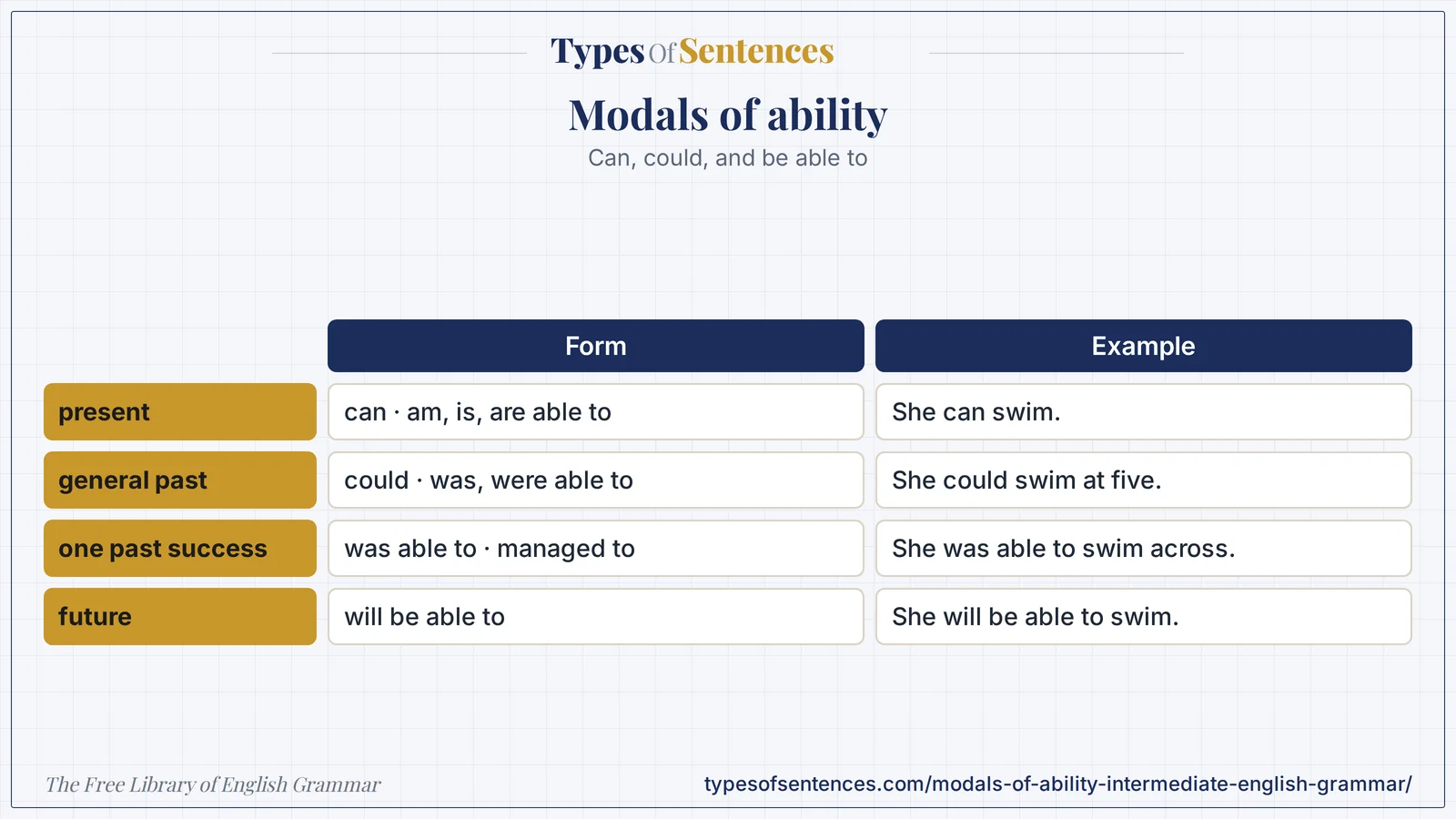
Ability is what you are capable of doing. English uses can now, could for a general past ability, and was able to or managed to when you succeeded at one particular thing.
Why it matters: The key question is whether the ability is general (you have the skill) or specific (you did it this once). The answer decides between could and was able to.
Summary: Can expresses present ability (She can swim); could expresses general past ability (She could swim at five); be able to works in all tenses (She will be able to swim). For one successful event in the past, use was able to or managed to, not could. Inability: cannot, couldn’t, be unable to.
- Present: can / am, is, are able to.
- General past: could / was, were able to.
- Specific past success: was able to, managed to, succeeded in + -ing.
- Future, perfect, and infinitive: only be able to.
What You’ll Learn
- 1. Modals of Ability: What Is Ability?
- 2. Can, Could: Ability in the Present
- 3. Could: Ability in the Past
- 4. Be Able To
- 5. Cannot / Can’t: Inability in the Present
- 6. Couldn’t: Inability in the Past
- 7. Managed To / Succeeded In
- 8. Can vs. Could
- 9. Other Ways of Expressing Ability
- 10. Common Errors with Modals of Ability
- 11. Exercises
- 12. Test Your Knowledge
- 13. Frequently Asked Questions
- 14. Conclusion
1. Modals of Ability: What Is Ability?
Ability is the power or skill to do something. The modals of ability tell whether the subject has that power. Two kinds of ability matter in English grammar.
| Kind | Meaning | Example |
|---|---|---|
| general ability | a skill or capacity that exists over time | She can swim. She could swim when she was five. |
| specific ability (an event) | the success or possibility on one occasion | She was able to swim across the lake yesterday. |
The modal verbs and their features are introduced in the previous chapter, on modal verbs. In every form below, the main verb after the modal is in the base form.
2. Can, Could: Ability in the Present
Can expresses present ability. It is used for skills, capacities, and what is possible now.
| Use | Example |
|---|---|
| skill | She can speak three languages. He can play the guitar. |
| capacity or power | This car can reach 200 miles per hour. |
| what the senses allow | I can see the mountains. I can hear music. (with verbs of perception) |
| understanding and remembering | I can understand you. I can’t remember his name. |
| opportunity (circumstance allows) | We can meet on Friday. |
| Form | Example |
|---|---|
| affirmative | I can swim. / She can swim. |
| negative | She cannot (can’t) swim. |
| question | Can she swim? / What can you do? |
| short answer | Yes, she can. / No, she can’t. |
3. Could: Ability in the Past
Could is used for a general ability in the past, a skill or capacity that existed over a period of time.
| Use | Example |
|---|---|
| general past ability | When I was five, I could swim. She could read at three. |
| past ability and inability (negative) | I couldn’t find my keys. He couldn’t sleep. |
| ability that did not continue | He could run fast when he was young. |
| hypothetical ability | If I could fly, I would visit every country. |
| unrealized ability in the past | I could have helped you. (but I did not) |
| General (could) | Specific (was able to / managed to) |
|---|---|
| As a child, she could swim well. | Yesterday, she was able to swim across the lake. |
| I could read when I was four. | I managed to finish the book in one night. |
| They couldn’t swim. | They couldn’t swim yesterday. (both fine in negatives) |
4. Be Able To
Be able to is the form that works in every tense and with other verb forms, where can has none. It is also a little more formal than can in the present.
| Tense or form | Example |
|---|---|
| present | She is able to swim. (= She can swim.) |
| past (specific success) | She was able to swim across the lake. |
| future | She will be able to swim next year. |
| present perfect | She has been able to swim since she was five. |
| past perfect | She had been able to swim before she moved. |
| infinitive | She wants to be able to swim. |
| gerund | I enjoy being able to swim every day. |
| after another modal | She might be able to help. You must be able to swim. |
| Form | Example |
|---|---|
| negative | She is not (isn’t) able to swim. / She was not able to swim. |
| question | Is she able to swim? / Will she be able to come? |
| inability | She is unable to swim. (formal) |
5. Cannot / Can’t: Inability in the Present
Cannot (or the contraction can’t) expresses present inability. The full form is written as one word, cannot, in standard writing; can not is used only for special emphasis.
| Use | Example |
|---|---|
| lack of skill | She cannot swim. I can’t drive. |
| lack of opportunity | We can’t come on Friday. I’m busy. |
| strong dislike or inability to bear (idiom) | I can’t stand noise. I can’t help laughing. |
| refusal | I can’t do that. |
| impossibility (deduction) | That can’t be true. (see the chapter on deduction) |
The negative of be able to is not be able to or be unable to: She is unable to attend (formal).
6. Couldn’t: Inability in the Past
| Use | Example |
|---|---|
| general or specific past inability | I couldn’t sleep last night. She couldn’t swim as a child. |
| inability in the past that continues | He couldn’t speak English when he arrived. |
| impossibility in the past (with have) | She couldn’t have known. (it was impossible) |
| refusal in the past | He couldn’t care less. |
Unlike the affirmative, couldn’t works for a single event: I couldn’t open the door yesterday is correct. I could open the door yesterday is not. In the negative form of the specific past, you may also use wasn’t able to (I wasn’t able to open the door), which is more formal.
7. Managed To / Succeeded In
Managed to and succeeded in (+ -ing) describe a specific achievement, often one that took effort or involved difficulty.
| Form | Example | Note |
|---|---|---|
| managed to + base verb | She managed to finish the report before the deadline. | success after effort |
| succeeded in + gerund | She succeeded in finishing the report. | more formal |
| was able to + base verb | She was able to finish the report. | neutral success |
| failed to + base verb | He failed to arrive on time. | the opposite |
- Use these forms only for the past: She managed to open the door yesterday.
- For a general ability, use could: She could open any lock (a skill).
- Do not use managed to in the negative to mean a lack of skill; use couldn’t or wasn’t able to: He couldn’t open the door.
8. Can vs. Could
| Can | Could | |
|---|---|---|
| time | present or future (arranged) | past |
| general ability | present: She can swim. | past: She could swim at five. |
| specific past success | no | no (use was able to / managed to) |
| hypothetical ability | no | yes: If I could swim, I would join. |
| request | informal: Can you help me? | more polite: Could you help me? |
| possibility | She can be rude. (a general trait) | It could rain. (a present possibility) |
| reported speech | — | She said she could swim. (backshift of can) |
Could is also the polite form of can in requests, and it expresses present possibility; these uses are studied in the chapters on permission and possibility. The reported-speech use is in the chapter on tense consistency and sequence (backshift: can becomes could).
9. Other Ways of Expressing Ability
| Expression | Example |
|---|---|
| know how to | She knows how to drive. |
| be capable of + -ing | The machine is capable of lifting 500 pounds. |
| be good at + -ing | He is good at solving problems. |
| have the ability to | She has the ability to learn quickly. |
| be unable to (formal inability) | He was unable to attend. |
| be skilled / talented / gifted | She is a talented painter. |
These expressions say more than can about the quality of the ability. She is good at math says that her ability is above average, while She can do math only says that she is able to.
10. Common Errors with Modals of Ability
| Error | Correction | Rule |
|---|---|---|
| I can to swim. | I can swim. | no to after a modal |
| She cans swim. | She can swim. | no -s on a modal |
| I will can help you. | I will be able to help you. | no double modals; use be able to |
| Yesterday I could find my keys. | Yesterday I was able to find my keys. | specific success in the past |
| I am able to swimming. | I am able to swim. | infinitive after able to |
| She can able to swim. | She is able to swim. / She can swim. | do not combine can and able |
| He could to swim. | He could swim. | base form after a modal |
| Do you can swim? | Can you swim? | no do with a modal |
| I am seeing a bird. | I can see a bird. | perception verbs take can |
Fix: When I was a child, I was able to swim, but yesterday I could finally cross the lake, and now I will can swim every day.
- A general past ability: could swim.
- A specific success: was able to cross (or managed to cross).
- Future: will be able to swim.
- Result: When I was a child, I could swim, but yesterday I was able to cross the lake at last, and now I will be able to swim every day.
Recap in 12 seconds
Watch the lesson build itself: Ability in the present, the general past, a single past success, and the future. The video has no sound.
Exercises
Part A: Can and Could (Exercises 1–6)
Exercise 1: Choose: She (can/could) swim now.
Show Answer
Answer: can.
Exercise 2: Choose: When I was five, I (can/could) swim.
Show Answer
Answer: could.
Exercise 3: Choose: I (can/could) see a bird. (present)
Show Answer
Answer: can (a perception verb).
Exercise 4: Fix it: I am seeing a bird.
Show Answer
Answer: I can see a bird.
Exercise 5: Make a question: She can swim.
Show Answer
Answer: Can she swim?
Exercise 6: Make negative: He can swim.
Show Answer
Answer: He cannot (can’t) swim.
Part B: General vs. Specific (Exercises 7–12)
Exercise 7: Choose: As a child, she (could/was able to) read well. (general)
Show Answer
Answer: could.
Exercise 8: Choose: Yesterday, she (could/was able to) finish the report. (specific)
Show Answer
Answer: was able to.
Exercise 9: Fix it: Yesterday I could find my keys.
Show Answer
Answer: Yesterday I was able to find my keys.
Exercise 10: Is I couldn’t find my keys yesterday correct?
Show Answer
Answer: Yes. The negative works for specific events.
Exercise 11: Rewrite with managed to: She finished the report with great effort.
Show Answer
Answer: She managed to finish the report.
Exercise 12: Rewrite with succeeded in: She finished the report.
Show Answer
Answer: She succeeded in finishing the report.
Part C: Be Able To (Exercises 13–18)
Exercise 13: Future: She can swim next year.
Show Answer
Answer: She will be able to swim next year.
Exercise 14: Present perfect: She can swim since she was five.
Show Answer
Answer: She has been able to swim since she was five.
Exercise 15: Complete: She wants ___ swim. (be able)
Show Answer
Answer: to be able to.
Exercise 16: Fix it: I will can help you.
Show Answer
Answer: I will be able to help you.
Exercise 17: Fix it: I am able to swimming.
Show Answer
Answer: I am able to swim.
Exercise 18: Fix it: She can able to swim.
Show Answer
Answer: She is able to swim. (or She can swim.)
Part D: Cannot and Couldn’t (Exercises 19–23)
Exercise 19: How is cannot usually written?
Show Answer
Answer: As one word.
Exercise 20: Complete: I ___ sleep last night. (inability)
Show Answer
Answer: couldn’t.
Exercise 21: Explain: She couldn’t have known.
Show Answer
Answer: It was impossible for her to know.
Exercise 22: Idiom: I can’t stand noise. means:
Show Answer
Answer: I strongly dislike noise.
Exercise 23: Formal form of He couldn’t attend.
Show Answer
Answer: He was unable to attend.
Part E: Can vs Could and Other Ways (Exercises 24–28)
Exercise 24: Which is more polite: Can you help me? or Could you help me?
Show Answer
Answer: Could you help me?
Exercise 25: Complete: If I ___ fly, I would visit every country.
Show Answer
Answer: could.
Exercise 26: Reported speech: “I can swim.” → She said she ___ swim.
Show Answer
Answer: could.
Exercise 27: Express with know how to: She can drive.
Show Answer
Answer: She knows how to drive.
Exercise 28: Express with be good at: He solves problems well.
Show Answer
Answer: He is good at solving problems.
Part F: Errors (Exercises 29–30)
Exercise 29: Fix it: I can to swim.
Show Answer
Answer: I can swim.
Exercise 30: Fix it: Do you can swim?
Show Answer
Answer: Can you swim?
Test Your Knowledge
Ready to check what you learned? Answer all 10 questions, then submit. You need 80% (8 of 10) to pass. Your answers are not stored.
View correct answers and explanations
Question 1: Which expresses present ability?
✓ Correct Answer: D – can
Can expresses present ability.
Question 2: Which expresses general past ability?
✓ Correct Answer: A – She could swim at five.
Could expresses general past ability.
Question 3: Which is correct for a specific past success?
✓ Correct Answer: C – I was able to find my keys yesterday.
Use was able to for one event.
Question 4: Which is correct?
✓ Correct Answer: B – I will be able to help you.
Use be able to for the future.
Question 5: Which is correct?
✓ Correct Answer: C – She can swim.
The base form follows a modal.
Question 6: Which is correct with perception verbs?
✓ Correct Answer: C – I can see a bird.
Use can with see, hear, and so on.
Question 7: Which works in the negative for a specific past event?
✓ Correct Answer: A – I couldn’t find my keys yesterday.
Couldn’t works for specific events in the negative.
Question 8: Which is more polite?
✓ Correct Answer: D – Could you help me?
Could is more polite.
Question 9: Which describes success after effort?
✓ Correct Answer: A – managed to
Managed to shows success after difficulty.
Question 10: Which is correct?
✓ Correct Answer: B – She is able to swim.
Do not combine can and able.
Frequently Asked Questions
What are the modals of ability?
The modals of ability are can (present), could (general past), and be able to (all tenses). Expressions such as managed to and succeeded in describe specific achievements.
What is the difference between can vs could?
Can is present ability; could is general past ability, hypothetical ability, or a polite request. For a single successful event in the past, use was able to, not could.
How do I use be able to?
Be able to works in every tense and form: She is able to swim, She will be able to swim, She has been able to swim, She wants to be able to swim.
What is expressing ability in the past?
Expressing ability in the past uses could for general ability (She could swim at five) and was able to or managed to for one event (She was able to cross the lake yesterday).
What are can, could ability examples?
She can speak three languages. He could run fast when he was young. I couldn’t find my keys. Can, could ability examples show present, past, and negative ability.
Why can I not say I will can?
A modal has no infinitive form, so it cannot follow will. Use be able to instead: I will be able to help you.
Is it cannot or can not?
Write cannot as one word in standard English. Can not as two words appears only when the writer wants to stress the not.
Conclusion
You now know the modals of ability: can for the present, could for general past ability, be able to for every tense and form, cannot and couldn’t for inability, and managed to for specific achievements. You can choose between general and specific ability and avoid the common errors.
Ask whether an ability is general or specific, and the choice becomes clear. Next, you will study modals of permission.
- Merriam-Webster Dictionary: can: the dictionary entry for the modal can.
- Purdue Online Writing Lab: Grammar: reference section on verbs.
- Quirk, Randolph, et al. A Comprehensive Grammar of the English Language. Longman, 1985.: modal meanings (ability, possibility, permission).
- Huddleston, Rodney, and Geoffrey K. Pullum. The Cambridge Grammar of the English Language. Cambridge University Press, 2002.: can and could, and the be able to periphrasis.
Last reviewed: October 29, 2026. How it was made: drafted with AI assistance, then checked with automated tests (structure, links, answer keys, spelling) and against the sources above. A person has not yet read this chapter line by line. Found a mistake? Report it.