Tone and voice in writing are what make a text sound like someone, speaking to someone, in a particular mood. Two writers can state the same facts and leave the reader with quite different impressions: one sounds warm, one cold; one confident, one doubtful; one like a friend, one like a form letter. The difference lies in tone and voice. They are not decoration added to content; they are part of what the text communicates, and a mismatch (a joking tone in a condolence, a stiff voice in a friendly newsletter) can undo the message.
This chapter distinguishes tone from voice, surveys the main types of tone, and shows how to create a consistent, authentic voice. You will study tone in different genres, how to adjust writing tone for the audience and the situation, how word choice and sentence structure convey tone, and how to repair common faults. The aim is control: to know the attitude you want to convey, to hear the voice you are using, and to make the grammar and vocabulary serve both. Authorial voice and voice in writing here mean the writer’s personality in prose; the grammatical voice (active and passive) is a separate subject, discussed elsewhere. Thirty editing exercises and a quiz follow.
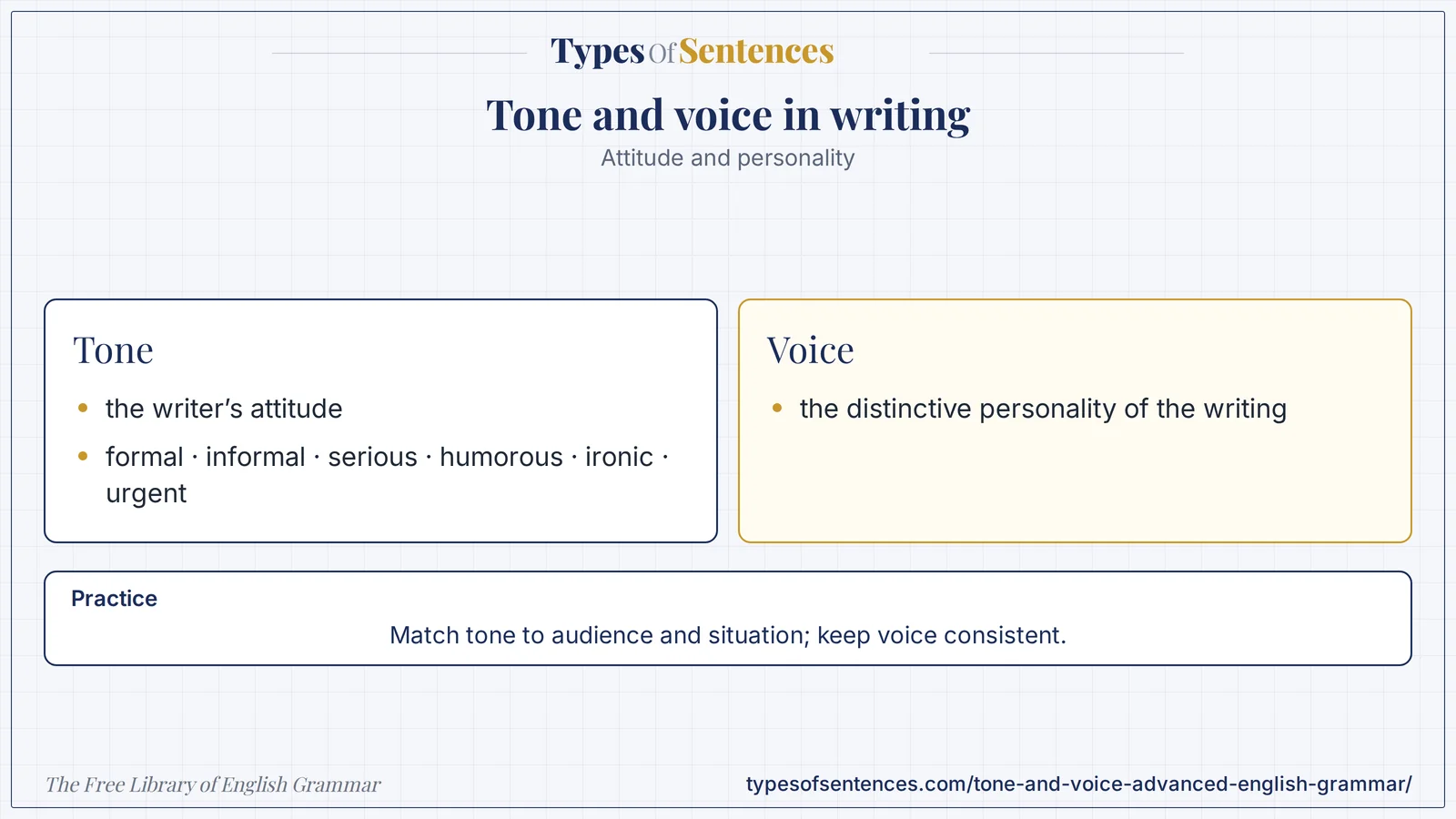
Tone is the attitude that a piece of writing shows toward its subject and its reader: serious, playful, respectful, angry, warm. Voice is the writer’s personality in the writing: the way they choose words, build sentences, and see things, which readers can recognize from piece to piece.
Why it matters: Tone changes with the occasion; voice stays recognizable. A writer who can be formal in a report and friendly in an email, and sound like the same person in both, has a voice and controls tone.
Summary: Tone is the writer’s attitude toward the subject and the audience (formal, informal, serious, humorous, optimistic, pessimistic, ironic, respectful, urgent). Voice is the distinctive personality of the writing, created by diction, sentence patterns, imagery, rhythm, point of view, and what the writer chooses to notice. Tone varies by genre, audience, and situation; voice should be consistent and authentic. Word choice (connotation, register, hedges and boosters, pronouns, modals, contractions) and sentence structure (length, voice, openings, punctuation) carry both. Common problems are tones that are too harsh, too casual, condescending, or inconsistent, and voices that are generic or borrowed.
- Tone = attitude; voice = personality.
- Match tone to audience and situation; keep voice consistent.
- Word choice and sentence structure carry tone and voice.
- Read aloud and ask: who is speaking, to whom, in what mood?
What You’ll Learn
- 1. Tone and Voice in Writing: Tone vs Voice
- 2. Types of Tone
- 3. Creating Voice: Consistency and Authenticity
- 4. Tone in Different Genres
- 5. Adjusting Tone for Audience and Situation
- 6. Word Choice and Tone
- 7. Sentence Structure and Voice
- 8. Common Problems of Tone and Voice, and How to Repair Them
- 9. Common Errors and a Worked Example
- 10. Exercises
- 11. Test Your Knowledge
- 12. Frequently Asked Questions
- 13. Conclusion
1. Tone and Voice in Writing: Tone vs Voice
| Feature | Tone | Voice |
|---|---|---|
| definition | the attitude toward the subject and the reader | the distinctive personality of the writer in the text |
| question it answers | How does the writer feel, and how do they address the reader? | Who is speaking? |
| varies? | yes, with each piece, audience, and situation | stays recognizable across pieces |
| created by | word choice, formality, emphasis, punctuation, the stance taken | diction, syntax, imagery, rhythm, humor, point of view, what is noticed |
| examples | formal, warm, ironic, urgent, sympathetic | plainspoken, lyrical, brisk, wry, scholarly |
| can be changed quickly? | yes | slowly; it develops over time |
| Related term | Meaning |
|---|---|
| mood | the feeling that the text creates in the reader (as distinct from the writer’s attitude) |
| style | the sum of a writer’s habitual choices (voice is its personal side) |
| register | the level of formality suited to a situation |
| persona | a voice adopted for a purpose (a narrator, a brand) |
| stance | the position taken (certain or doubtful, for or against) |
| point of view | the perspective (first, second, third person) |
| grammatical voice | active or passive: a different meaning of the word |
| One message in three tones | Tone |
|---|---|
| Your request has been declined. Further correspondence is not necessary. | cold and final |
| We are sorry that we cannot approve your request this time. Here is what you can do next. | warm and helpful |
| Sorry, no luck. Try again next month! | casual and light |
An organization may also have a “brand voice” (a constant personality) with a flexible “tone” that varies by situation: playful in a promotion, calm in an error message. The same principle applies to individual writers. For the choices that set tone, see the chapter on register and style.
2. Types of Tone
| Tone | Description | Example (about a delayed project) |
|---|---|---|
| formal | respectful, impersonal, full forms | The project has been delayed, and the committee has been informed. |
| informal | relaxed, conversational, contractions | The project’s late, and we’ve told the team. |
| neutral (objective) | plain, factual, without evaluation | The project is three weeks behind schedule. |
| serious | weighty, careful | The delay threatens the funding of the whole program. |
| humorous (playful) | light, amusing | The project is running late, but it is running. |
| optimistic | hopeful, positive | The delay is short, and the team is confident of a strong finish. |
| pessimistic | gloomy, expecting the worst | The delay is the first of many, and the deadline is already lost. |
| enthusiastic | energetic, excited | The delay gives us time to make this even better! |
| sarcastic | mocking, saying the opposite | Oh, wonderful, another delay. |
| ironic | a contrast between what is said and what is meant, often gently | The project to save time has taken longer than any other. |
| authoritative | confident, directive | The project will resume Monday. All staff must attend the meeting. |
| tentative | cautious, unsure | The project may be delayed, though it is still unclear. |
| respectful | courteous, regarding the reader | We appreciate your patience while we resolve the delay. |
| sympathetic (compassionate) | understanding another’s feelings | We understand how frustrating this delay is. |
| critical | finding fault | The delay was caused by poor planning. |
| defensive | justifying | The delay was not our fault; the supplier failed us. |
| urgent | pressing, immediate | Act now: every day of delay costs us money. |
| intimate | personal, close | Between us, I am worried about the schedule. |
| detached | distant, unemotional | The schedule was revised. |
| condescending | talking down | As you may not understand, projects sometimes take longer. |
| nostalgic | longing for the past | We once finished projects on time. |
| somber | grave, subdued | The delay is a heavy blow to us all. |
| wry | dryly humorous | The project has proved admirably consistent in its lateness. |
| assertive | firm but fair | The delay is not acceptable, and we need a revised schedule by Friday. |
| passive-aggressive | indirect hostility | I am sure you did your best, as always. |
| Cue to tone | What to look at |
|---|---|
| word choice | connotation, formality, intensity (delay versus catastrophe) |
| sentence structure | short and curt, long and careful, questions and exclamations |
| punctuation | exclamation marks, dashes, ellipses, capitals |
| what is included or omitted | details, praise, criticism, apologies |
| point of view | I, we, you, or an impersonal passive |
| figurative language and irony | metaphors, exaggeration, understatement |
| the relation implied between writer and reader | equal, superior, intimate, distant |
A tone is rarely pure: a text can be serious and warm, formal and optimistic. When you analyze tone, name it with two or three words and point to the evidence in the text. When you write, decide the tone you want before you begin, and check that the draft keeps it.
3. Creating Voice: Consistency and Authenticity
| Element of voice | What it includes | Example (two voices for one thought) |
|---|---|---|
| diction | the kinds of words: plain or elaborate, concrete or abstract, local or international | “The bus is always late.” / “The municipal bus service exhibits chronic unpunctuality.” |
| sentence patterns | short or long, simple or complex, fragments, questions | “Late. Again.” / “It is late, and it will no doubt be later tomorrow.” |
| imagery and figures | the images and comparisons that you favor | “The bus crept like a tired animal.” |
| rhythm | pacing and cadence | — |
| humor | the kind and the amount | dry, warm, absurd, none |
| point of view and person | I, we, you, third person | — |
| what you notice | the details that you select | a stranger’s shoes; the smell of the market |
| attitude to the reader | equal, teacher, friend, expert | — |
- Read your own writing aloud and mark the sentences that sound like you and those that sound like a form.
- Write as you speak to a friend, then edit. A voice grows from natural speech, tidied.
- Choose concrete, specific words that only you would choose.
- Read widely and notice how writers you admire build their voices. Imitate a passage (pastiche) to learn the technique, then write your own.
- Keep a consistent stance toward the reader and the subject within a text.
- Revise out generic phrases (in today’s fast-paced world, at the end of the day): they could appear in anyone’s writing, so they belong to no one’s.
- Be honest. A voice that pretends to be what the writer is not sounds false.
- Write a great deal. Voice is found by practice.
| Consistency | Authenticity |
|---|---|
| same level of formality and attitude through the text | sounds like a real person or a real organization |
| same person (I, we) and the same tense habits | honest about what the writer knows and feels |
| a recognizable manner from piece to piece | not copied from another writer or from a template |
| shifts only for a reason (a quotation, a different speaker) | allows the writer’s own humor, vocabulary, and rhythms |
In academic writing, voice is also the way that the writer’s own stance shows in the text: through the choice of reporting verbs, hedges and boosters, and sometimes I or we (see the chapter on academic writing). The grammatical term voice (active or passive) is separate, but the two overlap: a writer who always chooses the passive has a different authorial voice from one who chooses the active.
4. Tone in Different Genres
| Genre | Typical tone | Features | Pitfalls |
|---|---|---|---|
| academic writing | formal, objective, measured | hedging; impersonal or limited first person; precise terms | stiffness; overclaiming; excessive hedging |
| business writing | professional, courteous, direct | purpose first; polite requests; positive wording (see the chapter on business writing) | curtness; blame; jargon |
| technical writing | neutral, exact | imperatives; plain words | condescension; humor that distracts |
| legal writing | formal, precise, impersonal | defined terms; modals | pomposity; archaic words |
| scientific writing | objective, cautious | the passive in methods; hedged interpretations | exaggeration |
| journalism (news) | neutral, factual | attribution; short sentences | editorializing; loaded words |
| opinion and editorial | argumentative, committed | a clear stance; persuasive devices | overstatement; contempt |
| creative writing | varied: lyrical, wry, tense, tender | imagery; rhythm; voice (see the chapter on creative writing techniques) | cliché; inconsistency |
| digital and social media | conversational, concise, engaging | you; short sentences; brand voice | forced slang; insensitive humor |
| personal letter and email | warm, natural | personal detail; contractions | carelessness |
| condolence message | sympathetic, simple, sincere | few words; no clichés of fake comfort | humor; “at least” remarks |
| complaint | firm, courteous, factual | specific facts and a clear request | anger; sarcasm |
| apology | sincere, direct, accountable | naming the fault; the remedy | excuses; passive “mistakes were made” |
| cover letter | confident, respectful, enthusiastic | evidence of achievements | arrogance; clichés |
| speech | direct, rhythmic | repetition; parallelism; direct address | reading an essay aloud |
Every genre has an expected tone, and readers read departures as a message. A casual tone in a legal notice, or a pompous tone in a friendly invitation, signals that the writer has misjudged the occasion. For the conventions of professional genres, see the chapters on business, technical, legal, scientific, and journalistic writing.
5. Adjusting Tone for Audience and Situation
| Reader and situation | Tone to choose | Example (asking for a report) |
|---|---|---|
| a senior manager (formal) | respectful, concise, clear purpose | Could you send me the report by Friday? I need it for the board meeting. |
| a colleague (neutral) | friendly, direct | Can you send me the report by Friday? It’s for the board. |
| a close teammate (informal) | casual | Can you drop me the report before Friday? |
| a customer (service) | courteous, positive, helpful | We would be happy to send you the report. Could you confirm your email address? |
| a junior team member (supportive) | clear, encouraging | Please send me the report by Friday. Let me know if you need help with it. |
| a stranger (cold email) | polite, brief, formal | Dear Dr. Rao, I am writing to ask whether you could share your 2023 report. Thank you. |
| someone upset (apology) | calm, sympathetic, practical | We are sorry for the delay in sending the report. It is attached. |
| a child | simple, kind | Please give me your report today. |
| Factor | How it affects tone |
|---|---|
| relationship and power | the greater the distance or the difference in status, the more formal and indirect |
| size of the request | the larger the imposition, the more polite and indirect (see the chapter on pragmatics) |
| reader’s knowledge | explain terms to novices; do not talk down to experts |
| culture | norms of directness, hierarchy, and politeness differ across communities; check what your reader expects |
| emotional state of the reader | be gentler with an upset or grieving reader |
| medium | email and chat lack tone of voice, so tone must be shown in words |
| purpose | to inform, persuade, comfort, or instruct |
| occasion | a celebration, a complaint, a crisis |
| Tone pitfalls in written messages | Example | Revision |
|---|---|---|
| curtness | Send the file. | Could you send the file, please? |
| unintended anger | a message in capitals or with many exclamation marks | a calm sentence |
| sarcasm lost in text | Great job. | Thanks for the update; two numbers need correcting. |
| over-familiarity | Hey buddy! (to a client) | Dear Mr. Rao, |
| over-formality | Per my previous correspondence … (to a friend) | As I said in my last message, … |
| blame | You forgot to attach it. | The attachment seems to be missing. |
| false cheer | We are thrilled to inform you that your account is closed! | We are sorry to tell you that your account is closed. |
Politeness and the management of the reader’s face are discussed in the chapter on pragmatics. A useful test is to imagine the message read aloud by the reader, in the worst mood they might have. If it could sound hostile, change it.
6. Word Choice and Tone
| Choice | Effect on tone | Example |
|---|---|---|
| connotation | positive, neutral, or negative attitude | frugal / stingy |
| register | formal, neutral, informal | children / kids |
| intensity | strength of feeling | annoyed / furious |
| hedges | tentative, modest, polite | might, perhaps, I wonder whether |
| boosters | confident, emphatic | clearly, certainly, undoubtedly |
| pronouns | closeness or distance | we and you (close); impersonal (distant) |
| contractions | informal, friendly | don’t, we’ll |
| modal verbs | obligation or politeness | must (strong); could you (polite) |
| imperatives and requests | command or invitation | Send it. / Could you send it? |
| questions and exclamations | engagement, emotion | Why not?; What a day! |
| intensifiers (very, really) | emphasis (can sound informal or childish) | — |
| words of courtesy | respect | please, thank you, I would appreciate |
| figurative language | imagery, humor, irony | — |
| punctuation | exclamation marks (excitement), ellipses (hesitation), dashes (asides), capitals (shouting) | — |
| emoji (informal digital) | friendliness, softening | use only where the genre allows |
| Phrase | What it may convey | Safer alternative |
|---|---|---|
| Obviously, …; Clearly, … | condescension if the point is not obvious to the reader | delete, or explain |
| As I already said … | irritation | To recap, … |
| With all due respect, … | a polite phrase that often signals disagreement or disrespect | I see this differently: … |
| I’m sorry, but … | a half-apology before a refusal | Unfortunately, … |
| Just a quick question … | a softener, but “just” can sound dismissive or timid | I have a question: … |
| Per my last email … | a reproach | As I mentioned on Tuesday, … |
| Kindly do the needful. | stiff, vague; may confuse some readers | Please send the signed form by Friday. |
| To be honest, … | implies that other statements may not be honest | delete |
| No offense, but … | a signal that offense follows | — |
| Actually, … | can sound corrective | In fact, …; Another point is … |
The connotation of words is treated in the previous chapters of this part, on diction. Where a word does not fit the tone you want, change it: it is the quickest way to adjust a text. Be careful with hedges: too many make a writer sound unsure; too few can sound arrogant. The balance of the two is also a matter of tone.
7. Sentence Structure and Voice
| Idea: the project is late | Sentence form | Voice and tone |
|---|---|---|
| Late. | a one-word fragment | terse, dry |
| The project is late, and we are working on it. | a compound sentence with we | plain, accountable |
| Regrettably, the project has been delayed, and corrective measures are being implemented. | a passive with a nominalized frame | formal, impersonal, distant |
| Well, the project’s late. Not great, I know, but we’re on it. | fragments, contractions, a discourse marker | chatty, informal |
| The project is late, as it was always going to be, and we are, as always, hopeful. | a long sentence with asides | wry, reflective |
| The project is late. We apologize. Here is the new schedule. | short statements in sequence | direct, helpful |
| Structural choice | Effect on tone and voice |
|---|---|
| short sentences | brisk, urgent, confident, or curt |
| long, flowing sentences | reflective, careful, or elaborate |
| fragments | conversational, emphatic |
| active voice | direct, accountable (see the chapter on voice) |
| passive voice | impersonal, formal, can sound evasive |
| nominalization | abstract, formal, impersonal |
| questions | engaging, informal, or probing |
| inversion and fronting | formal, literary, emphatic |
| parallelism and repetition | rhetorical, rhythmic |
| sentence openers | the order of attention (see the chapter on sentence variety) |
| paragraph length | short = brisk, informal; long = careful, formal |
| direct address (you) | close, instructive |
| asides in dashes or parentheses | intimate, conversational |
Voice lives in the habits of sentence construction: whether a writer favors short statements or long periods, questions or assertions, plain verbs or abstract nouns. These choices are the grammar of style, discussed in the later chapters on stylistic grammar choices and on voice; the best way to learn your own habits is to read a piece aloud and count the patterns that recur.
8. Common Problems of Tone and Voice, and How to Repair Them
| Problem | Example | Repair |
|---|---|---|
| too harsh or blunt | Your report is wrong. Fix it. | The report has two errors on page 3. Could you correct them by Friday? |
| too casual for the occasion | Hey, so, about that contract thing … | Good morning. I am writing about the contract. |
| too stiff for the occasion | We regret to inform you of the unfortunate occurrence of a minor delay (to a friend) | Sorry, we’re running a bit late. |
| condescending | As you may not know, … | For reference, … |
| passive-aggressive | I’m sure you tried your best. | The figures need to be rechecked. |
| defensive | It’s not my fault. | Here is what happened. |
| over-effusive | We are absolutely delighted and thrilled and overjoyed!!! | We are pleased to announce … |
| inconsistent | a formal paragraph followed by slang | choose one tone |
| robotic or generic | Please be advised that your query has been received. | Thanks for your message. We’ll reply within two days. |
| evasive | Mistakes were made. | We made mistakes, and we have fixed them. |
| insincere | We value your feedback! (in a form reply) | a specific response to the feedback |
| sarcasm that fails | Nice work, as usual. | Thanks. Two things need to change: … |
| an unclear stance | The plan may be good or may not. | The plan is sound, but the budget is optimistic. |
| borrowed voice | imitating a style that does not fit | write in your own plain manner |
| humor at the wrong time | a joke in a complaint reply | a respectful tone |
- Reread as the reader. How does this sound, to someone who does not know you, on a bad day?
- Name the tone you want in two or three words before you write.
- Check the words that carry the attitude: adjectives, adverbs, verbs of speech, modals.
- Read aloud. If you would not say it to the reader’s face, rewrite it.
- When unsure, choose courtesy. A polite message is rarely a mistake.
- Wait before sending an angry message, and rewrite it when calm.
9. Common Errors and a Worked Example
| Error | Example | Fix |
|---|---|---|
| mixing registers | Dear Sir, hey, we gotta talk about the thing. | Dear Sir, I would like to discuss the contract. |
| confusing grammatical voice and authorial voice | using the passive to “sound academic” everywhere | choose active or passive by function |
| tone that contradicts the message | We are delighted to tell you your application failed. | We are sorry to tell you that your application was not successful. |
| unmarked irony | Great, another meeting. (in a formal report) | delete or state the point |
| too many exclamation marks | Thanks!!! Great!!! Amazing!!! | Thank you. |
| capitals for emphasis | PLEASE READ THIS NOW | Please read this today. |
| a voice that is all hedges | It might perhaps possibly be the case that … | The data suggest that … |
| cliché openers | In today’s fast-paced world, … | a specific opening |
| blame in the subject | You failed to pay. | Payment reminder: invoice 4521 |
| changing person without a reason | We recommend … The author believes … I think … | one person |
| unexplained jargon | — | explain or replace |
| using “voice” for “tone” without care | — | distinguish them |
| an artificial persona | a forced chirpy voice for a serious subject | match the subject |
| no personal voice at all (a form-letter style) | Please be advised that … | a direct, human sentence |
Edit: Hey Dr. Rao, OBVIOUSLY you failed to attach the report, as I already said, so kindly do the needful ASAP!!! With all due respect, mistakes were made by someone, but it is what it is, and I am thrilled to inform you that we will be closing your account!!!
- Hey Dr. Rao: too casual for a formal reader: Dear Dr. Rao,
- OBVIOUSLY you failed to attach the report, as I already said: blame and condescension, capitals: The attachment seems to be missing; could you send the report again?
- kindly do the needful ASAP!!!: vague, stiff, excessive: Please send it by 5 p.m. on Friday.
- With all due respect, mistakes were made by someone: evasive and a loaded phrase: We made an error in the invoice, and we have corrected it.
- it is what it is: a cliché that shrugs: delete.
- I am thrilled to inform you that we will be closing your account!!!: tone contradicts the message: We are sorry to tell you that we will be closing your account on 31 March.
- Result: Dear Dr. Rao, The attachment seems to be missing; could you send the report again by 5 p.m. on Friday? We made an error in the invoice, and we have corrected it. We are sorry to tell you that we will be closing your account on 31 March. Kind regards, Priya Rao (the names and details are invented)
Recap in 12 seconds
Watch the lesson build itself: Tone is the writer’s attitude and voice is the writing’s distinctive personality. The video has no sound.
Exercises
Part A: Tone vs Voice (Exercises 1–6)
Exercise 1: Define tone.
Show Answer
Answer: The attitude toward the subject and the reader.
Exercise 2: Define voice.
Show Answer
Answer: The distinctive personality of the writer in the text.
Exercise 3: Which varies more with the occasion: tone or voice?
Show Answer
Answer: Tone.
Exercise 4: What is mood?
Show Answer
Answer: The feeling the text creates in the reader.
Exercise 5: What is a brand voice?
Show Answer
Answer: A constant personality of an organization, with a flexible tone.
Exercise 6: Is grammatical voice the same as authorial voice?
Show Answer
Answer: No.
Part B: Types of Tone (Exercises 7–13)
Exercise 7: Name the tone: Oh, wonderful, another delay.
Show Answer
Answer: Sarcastic.
Exercise 8: Name the tone: We understand how frustrating this delay is.
Show Answer
Answer: Sympathetic.
Exercise 9: Name the tone: The project is three weeks behind schedule.
Show Answer
Answer: Neutral (objective).
Exercise 10: Name the tone: As you may not understand, …
Show Answer
Answer: Condescending.
Exercise 11: Name the tone: Act now: every day of delay costs us money.
Show Answer
Answer: Urgent.
Exercise 12: Name the tone: The delay gives us time to make this even better!
Show Answer
Answer: Enthusiastic (optimistic).
Exercise 13: Name a cue to tone.
Show Answer
Answer: Word choice, punctuation, sentence length, point of view.
Part C: Creating Voice and Genre (Exercises 14–19)
Exercise 14: Name two elements of voice.
Show Answer
Answer: Diction, sentence patterns, imagery, rhythm, point of view.
Exercise 15: Replace a generic phrase: in today’s fast-paced world
Show Answer
Answer: (delete; begin with a specific point).
Exercise 16: Which tone suits a condolence message?
Show Answer
Answer: Sympathetic, simple, sincere.
Exercise 17: Which tone suits an academic paper?
Show Answer
Answer: Formal, objective, measured.
Exercise 18: Which tone suits a complaint?
Show Answer
Answer: Firm, courteous, factual.
Exercise 19: Why read aloud?
Show Answer
Answer: To hear whether it sounds like you and fits the occasion.
Part D: Audience and Word Choice (Exercises 20–26)
Exercise 20: Make polite: Send the file.
Show Answer
Answer: Could you send the file, please?
Exercise 21: Remove blame: You forgot to attach it.
Show Answer
Answer: The attachment seems to be missing.
Exercise 22: Replace: Per my last email …
Show Answer
Answer: As I mentioned on Tuesday, …
Exercise 23: What may obviously convey?
Show Answer
Answer: Condescension.
Exercise 24: Name an informal feature.
Show Answer
Answer: Contractions, fragments, exclamation marks, discourse markers.
Exercise 25: Name a formal feature.
Show Answer
Answer: Full forms, passive, nominalization, impersonal constructions.
Exercise 26: What does a hedge do to tone?
Show Answer
Answer: Makes it tentative or polite.
Part E: Problems (Exercises 27–30)
Exercise 27: Repair: Your report is wrong. Fix it.
Show Answer
Answer: The report has two errors on page 3. Could you correct them by Friday?
Exercise 28: Repair: I’m sure you tried your best. (passive-aggressive)
Show Answer
Answer: The figures need to be rechecked.
Exercise 29: Repair: Mistakes were made.
Show Answer
Answer: We made mistakes, and we have fixed them.
Exercise 30: Repair: We are delighted to tell you your application failed.
Show Answer
Answer: We are sorry to tell you that your application was not successful.
Test Your Knowledge
Ready to check what you learned? Answer all 10 questions, then submit. You need 80% (8 of 10) to pass. Your answers are not stored.
View correct answers and explanations
Question 1: What is tone?
✓ Correct Answer: A – the writer’s attitude toward the subject and reader
Attitude.
Question 2: What is voice?
✓ Correct Answer: B – the distinctive personality in the writing
Personality.
Question 3: Which is a sarcastic tone?
✓ Correct Answer: C – Oh, wonderful, another delay.
Mocking.
Question 4: Which is most formal?
✓ Correct Answer: D – Regrettably, the project has been delayed.
Formal and impersonal.
Question 5: Which is more polite?
✓ Correct Answer: C – Could you send the file, please?
A courteous request.
Question 6: Which suits a condolence message?
✓ Correct Answer: A – sympathetic, simple words
Sincere and simple.
Question 7: Which may convey condescension?
✓ Correct Answer: D – Obviously, …
Obviously, in many contexts.
Question 8: Which is a tone that contradicts the message?
✓ Correct Answer: C – We are delighted to tell you your application failed.
Mismatch.
Question 9: Which helps you find your voice?
✓ Correct Answer: B – reading aloud and writing a great deal
Practice.
Question 10: Which is an element of voice?
✓ Correct Answer: B – sentence patterns
Sentence patterns.
Frequently Asked Questions
What are tone and voice in writing?
Tone is the writer’s attitude toward the subject and reader; voice is the writer’s distinctive personality in the text. Tone and voice in writing together make a text sound like someone speaking.
What is writing tone?
Writing tone is the attitude conveyed by a text, created by word choice, sentence structure, and punctuation: formal, informal, serious, humorous, sympathetic, urgent, and so on. Writing tone should suit the audience and occasion.
What is authorial voice?
Authorial voice is the writer’s recognizable personality in prose, formed by diction, sentence patterns, imagery, rhythm, and what the writer chooses to notice. Authorial voice develops with practice.
How do I control tone in writing?
Decide the attitude you want, choose words and structures that carry it, think about the reader and the situation, and read the text aloud. Tone in writing is easiest to change through word choice.
How do I develop voice in writing?
Read widely, write often, speak naturally on paper and then edit, use concrete and specific words, cut generic phrases, and stay consistent. Voice in writing grows by practice.
What is the difference between tone and register?
Register is the level of formality suited to a situation; tone is the attitude toward the subject and reader. A text can be formal in register and warm in tone.
How do I avoid a harsh tone in email?
Avoid blame and capitals, make requests polite, say what can be done, read the message as the reader would, and wait before sending an angry message.
Conclusion
You now have a deep study of tone and voice in writing: the distinction between them, the main types of tone, how to create a consistent and authentic voice, tone in different genres, adjusting tone for the audience, the roles of word choice and sentence structure, and the common problems. You can control how your writing sounds.
When you write, ask who is speaking, to whom, and in what mood. Next, you will study readability.
- Elbow, Peter. Vernacular Eloquence: What Speech Can Bring to Writing. Oxford University Press, 2012.: voice in writing and its relation to speech.
- Hyland, Ken. Metadiscourse: Exploring Interaction in Writing. Continuum, 2005.: stance and engagement in writing.
- Williams, Joseph M., and Joseph Bizup. Style: Lessons in Clarity and Grace. 12th ed. Pearson, 2017.: style and the reader.
- Brown, Penelope, and Stephen C. Levinson. Politeness: Some Universals in Language Usage. Cambridge University Press, 1987.: politeness and tone.
- Merriam-Webster Dictionary: tone: the dictionary entry.
Last reviewed: October 29, 2026. How it was made: drafted with AI assistance, then checked with automated tests (structure, links, answer keys, spelling) and against the sources above. A person has not yet read this chapter line by line. Found a mistake? Report it.