Register and style are about choosing the right language for the situation. The same message can be said as Could you let me know the outcome at your earliest convenience?, Can you tell me how it went?, or So? How’d it go?. All three are grammatical English, but each fits a different relationship, a different medium, and a different purpose. A writer who cannot move between them will sound either stiff or careless, and will be misread.
You will study the idea of language register and how it differs from dialect and genre, the levels of formality from frozen to intimate, Halliday’s three variables of field, tenor, and mode, the grammatical formal informal contrasts of English, the features of academic, professional, and literary registers, how registers are mixed and shifted, and a method of choosing register for any text. Register in English is a matter of grammar as well as vocabulary, and it is the foundation of the study of language variation. Thirty editing exercises and a quiz follow.
We do not speak or write in one way. We talk to a friend differently from the way we write to a bank, and we explain a result to a colleague differently from the way we present it in a journal. These differences of language according to use are called registers.
Why it matters: Registers differ in vocabulary, in grammar, and in tone. Knowing them lets you choose deliberately, so that your language fits your reader and your purpose.
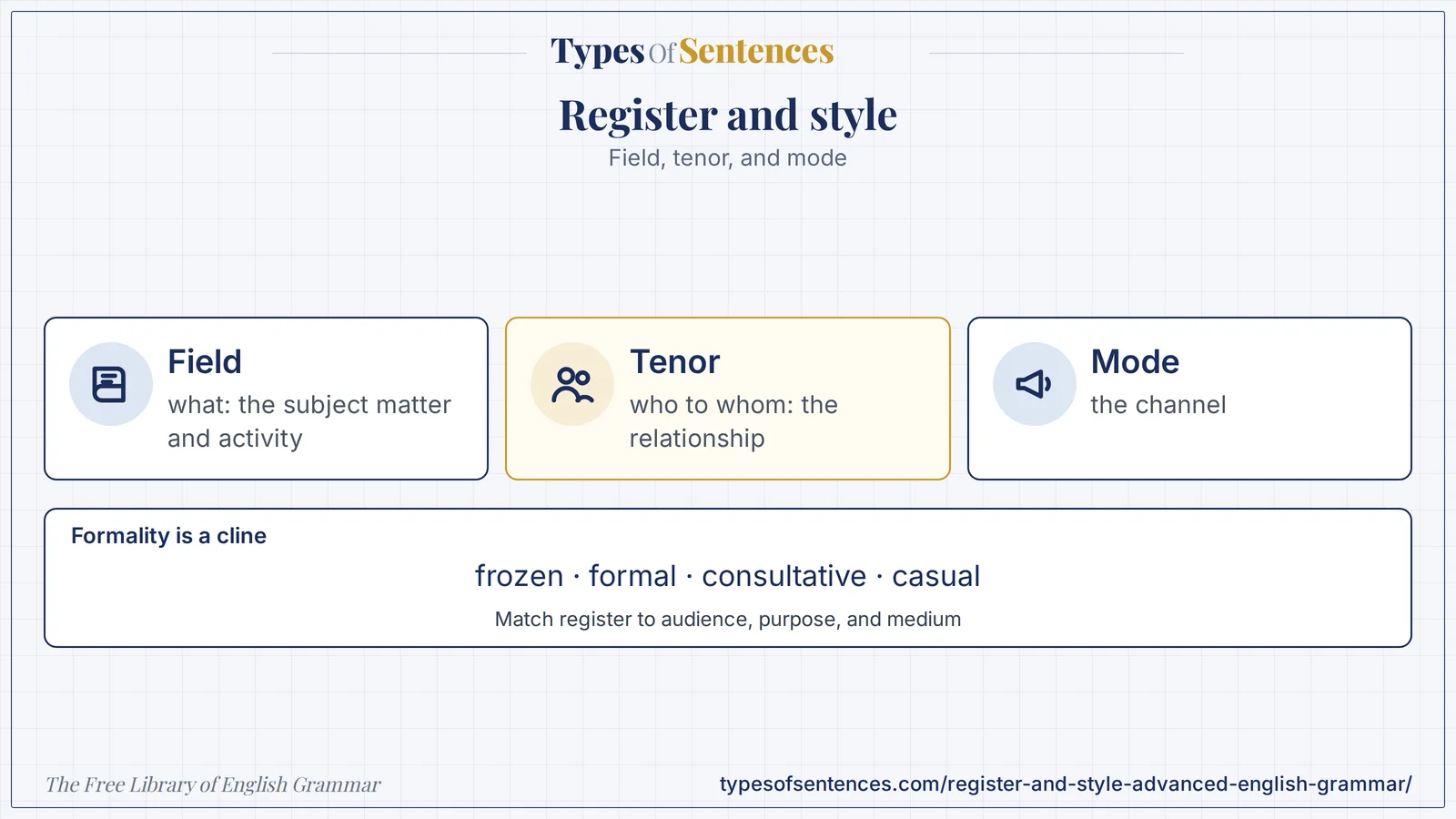
Summary: A register is a variety of language defined by its use: the context of situation. Halliday analyzes it by three variables: field (the subject matter and activity), tenor (the relationship between the participants), and mode (the channel and role of language, spoken or written). Formality is a cline from frozen to intimate. Formal English prefers longer words, nominalization, the passive, subordination, and full forms; informal English prefers short words, phrasal verbs, contractions, ellipsis, and active, personal constructions. Academic, professional, and literary writing each have typical grammatical choices. A good writer matches register to audience and purpose.
- Register = language variety by use; dialect = variety by user.
- Field (what), tenor (who to whom), mode (channel).
- Formality is a cline: frozen, formal, consultative, casual, intimate.
- Match register to audience, purpose, and medium.
What You’ll Learn
- 1. Register and Style: What Is Register?
- 2. Formality Levels: From Frozen to Intimate
- 3. Field, Tenor, and Mode
- 4. Formal vs. Informal Grammar
- 5. Academic Register
- 6. Professional Register: Business, Technical, and Legal
- 7. Literary Style: Grammar as Choice
- 8. Shifting, Mixing, and Mismatch
- 9. Language Variation: Register, Dialect, and World Englishes
- 10. Choosing a Register
- 11. Common Errors with Register and Style
- 12. Exercises
- 13. Test Your Knowledge
- 14. Frequently Asked Questions
- 15. Conclusion
1. Register and Style: What Is Register?
| Term | Meaning | Example |
|---|---|---|
| register | a variety of language associated with a use or situation | legal language; conversation with friends; a news report |
| dialect | a variety associated with a user: region, class, age, ethnicity | Scottish English; Indian English |
| style | the choices a writer or speaker makes within a register | plain style; ornate style |
| genre | a type of text with a recognized purpose and structure | a recipe; a lecture; a complaint letter |
| idiolect | the language of one individual | — |
| formality | the degree of seriousness or distance in language | from slang to legal formulas |
| Version | Register | Features |
|---|---|---|
| Could you let me know the outcome at your earliest convenience? | formal | polite modal, formal phrase, full forms |
| Can you tell me how it went? | neutral or consultative | plain words |
| How did it go? | informal | short, direct |
| So? How’d it go? | casual | contraction, fragment, discourse marker |
| Well?? | intimate | a single word, shared context |
A speaker uses a range of registers, and moving between them is called style-shifting or register-shifting. Dialect is “who you are”; register is “what you are doing”. The same speaker of Indian English, Scottish English, or Texan English will use a formal register in a job interview and a casual one with friends. The relation to discourse is treated in the previous chapter, on discourse analysis.
2. Formality Levels: From Frozen to Intimate
The linguist Martin Joos described five “styles” in The Five Clocks (1961). They are best seen as points on a cline from formal to informal.
| Level | Use | Features | Example |
|---|---|---|---|
| frozen (static) | fixed texts; ceremonies; legal and religious formulas | unchanging wording; archaic forms; long sentences | We the people of the United States, in order to form a more perfect union … |
| formal | speeches, official documents, academic writing; no feedback from the audience | full forms; complex sentences; Latinate vocabulary; passive; no contractions | The committee has resolved to postpone the meeting. |
| consultative | strangers, service encounters, professional talk; default in public | explicit information; some contractions; polite requests | Could I ask you a question about the schedule? |
| casual | friends and colleagues; informal talk | ellipsis; contractions; slang; phrasal verbs | Wanna grab lunch? Sounds good. |
| intimate | family and close friends; private | minimal language; shared reference; nicknames; non-verbal | Hey, you. Coffee? — Mm. |
Most people use the consultative and casual levels every day, and the formal level in writing. A text that uses a casual register with a formal audience, or the reverse, will seem inappropriate. Many modern descriptions treat formality as a continuous scale (a “formality dial”) with many points between the extremes, rather than as five fixed levels.
3. Field, Tenor, and Mode
Michael Halliday defined register by three variables of the context of situation, each of which affects a different part of the grammar.
| Variable | Meaning | Question | Affects |
|---|---|---|---|
| field | the subject matter and the social activity | What is going on? | vocabulary; the verbs and processes used |
| tenor | the relationship among the participants: power, distance, affect | Who is taking part? What is their relationship? | modality, mood, address forms, politeness |
| mode | the role of language and the channel: spoken or written, planned or spontaneous | What is the language doing? Through what channel? | cohesion, theme, density, ellipsis |
| Text | Field | Tenor | Mode |
|---|---|---|---|
| a doctor’s note: Patient presents with persistent cough; refer for chest radiograph. | medicine | expert to expert; formal | written; compressed; nominal |
| a text to a friend: cough still bad lol, going to the doc tmrw | health; everyday | friend to friend; casual | written but speech-like; abbreviations |
| a lecture: Now, when we look at the data, we see a pattern. | science | teacher to students; consultative | spoken (planned); markers; first person plural |
| a contract: The Tenant shall pay the rent monthly. | law | institutional; formal | written; fixed formulas |
Field, tenor, and mode together make up the register of a text. Changing the field changes the vocabulary; changing the tenor (writing to a superior instead of a friend) changes the politeness and modality; changing the mode (speech to writing) changes the density and the cohesion. For the grammar of the differences between speech and writing, see the chapter on discourse.
4. Formal vs. Informal Grammar
| Feature | Formal | Informal |
|---|---|---|
| contractions | do not, cannot, it is | don’t, can’t, it’s |
| verbs | Latinate single verbs: investigate, postpone, request, obtain | phrasal verbs: look into, put off, ask for, get |
| get and become | become; be (passive) | get (get tired, get fired) |
| pronoun case after be | It is I. It was she. | It’s me. It was her. |
| who and whom | To whom did you speak? Whom did you see? | Who did you speak to? Who did you see? |
| preposition stranding | the issue with which we are concerned | the issue we are concerned with |
| that / which relative | the report which was published | the report that was published / the report I read |
| subjunctive | If I were you; I suggest that he be present | If I was you; I suggest he is present |
| passive | The samples were analyzed. | We analyzed the samples. |
| nominalization | the implementation of the policy | putting the policy into practice |
| subordination | Although the plan was costly, it succeeded. | The plan was costly, but it worked. |
| inversion | Had I known, I would have come. Never have I seen it. | If I’d known, I’d have come. |
| conjunctions to start a sentence | However, … Therefore, … | But … So … |
| ellipsis and fragments | complete sentences | Sounds good. Want some? |
| pronouns | one, third person | you, I |
| shall / will; may / can | The tenant shall pay. May I leave? | I’ll pay. Can I leave? |
| quantifiers | many, a large number of, a great deal of | a lot of, lots of, loads of |
| vague words | approximately, and so on | around, and stuff, kind of |
| intensifiers | extremely, particularly | really, super, pretty |
| vocabulary | children, purchase, assist, commence | kids, buy, help, start |
| questions | May I ask whether …? | Can I ask if …? |
| negation | not any; no one | not … any; nobody |
| first names and titles | Dr. Rao; Ms. Gomez | Priya; Maria |
| sentence length | longer, with embedding | shorter, chained with and |
The contrasts are tendencies, not rules. A formal text may contain a plain word, and a good informal text may contain a careful clause. The point is consistency: the choices should fit together. The use of such contrasts to adjust tone is part of the topic of the chapter on diction.
5. Academic Register
| Feature | Example | Informal contrast |
|---|---|---|
| formal vocabulary | The results indicate a significant increase. | The results show a big jump. |
| nominalization | The rapid growth of urban populations | Urban populations grew fast. |
| complex noun phrases | a federal student loan repayment plan | a plan for paying back student loans |
| passive (especially in methods) | The samples were heated to 100 degrees. | We heated the samples. |
| hedging | The data suggest that the effect may be small. | The effect is small. |
| impersonal constructions | It is argued that … | I think that … |
| precise terms | approximately 40 percent | about half |
| no contractions | does not, cannot | doesn’t, can’t |
| explicit cohesion | Moreover, However, Therefore | And, But, So |
| avoids vague words and slang | many, several, a number of | a lot of, loads of, stuff |
| avoids phrasal verbs | investigate, conduct, determine | look into, carry out, find out |
| citations and attribution | Smith (2020) argues that … | Smith says … |
Academic writing is not simply “big words”. The best academic writers use plain, precise language, with the technical terms that the field requires, and many style guides now accept I and we where the writer’s role is clear. The register varies by discipline: scientific writing is more impersonal, and humanities writing more discursive. The introduction to academic writing is in the chapter on academic writing, and the hedging devices in the chapter on hedging.
6. Professional Register: Business, Technical, and Legal
| Register | Typical grammar and style | Example |
|---|---|---|
| business writing | active voice; short sentences; polite requests; clear action | Please send the report by Friday. We will review it on Monday. |
| email (formal) | full greeting; polite modals; formal closing | Dear Dr. Rao, I would be grateful if you could … Yours sincerely, |
| email (neutral) | first name; plain words | Hi Maria, Could you send the file? Thanks, Priya |
| email (informal) | casual greeting; contractions | Hey, can you send it over? Cheers |
| technical writing | imperatives for steps; numbered lists; precise terms; consistent terminology | 1. Press the power button. 2. Wait for the green light. |
| technical description | passive; present tense | The device is powered by a battery. |
| legal writing | shall, hereinafter, long conditional sentences; the plain-language movement favors simpler forms | The Tenant shall pay the rent on the first day of each month. |
| journalism | active; lead with the news; short paragraphs | Police arrested a man on Monday. |
| marketing | second person; imperatives; fragments; vivid words | Imagine a faster way. Try it free. |
| Email element | Formal | Neutral | Informal |
|---|---|---|---|
| greeting | Dear Dr. Rao, | Hi Priya, | Hey, |
| request | I would be grateful if you could … | Could you …? | Can you …? |
| closing | Yours sincerely, / Yours faithfully, | Best regards, / Kind regards, | Cheers, / Thanks, |
| apology | I apologize for the inconvenience. | Sorry for the delay. | Sorry about that! |
Professional registers are shaped by the aims of the writer. Business writing values clarity and courtesy; technical writing values exact instructions; legal writing values precision and has been criticized for needless complexity. The politeness strategies in requests are discussed in the chapter on discourse, and the tone of a text in a later chapter.
7. Literary Style: Grammar as Choice
| Choice | Example (invented) | Effect |
|---|---|---|
| short sentences or fragments | He ran. Fast. Nothing. | speed; tension |
| long, cumulative sentences | She walked down the road, past the shuttered shops, past the old school, past the field where, as a child, she had … | flow; immersion |
| parataxis (coordination) | The sun set and the wind rose and the shutters banged. | a simple, rhythmic effect |
| hypotaxis (subordination) | Although the sun had set, the wind, which rose at dusk, made the shutters bang. | complex relations; control |
| inversion and fronting | Down the street came the rain. | scene-setting; emphasis |
| repetition (anaphora) | We will go on. We will not stop. We will win. | rhetorical force |
| asyndeton and polysyndeton | She came, she saw, she left. / She wept and laughed and sang. | speed / accumulation |
| tense shifts | She walks in. Last year she had walked out. | immediacy; time |
| free indirect speech | Tomorrow was Monday. Would she never be free? | the character’s voice |
| point of view (person) | I saw … / She saw … / You see … | intimacy; distance |
| dialect and register in dialogue | “I ain’t seen him,” said the old man. | character; setting |
| fragmented lists | Rain. Mud. The smell of wet wool. | imagery |
In stylistics, writers’ choices are described as foregrounding: a deviation from the usual pattern (in grammar, in the sound or the meaning) that draws attention to itself. A fragment in a novel, a long sentence in a speech, and an inverted clause in a poem are all choices that create effects. In literary writing, “rules” are resources: a skilled writer may break one on purpose. The study of such effects is in the chapter on grammar in literature.
8. Shifting, Mixing, and Mismatch
| Mismatch | Example | Fix |
|---|---|---|
| formal greeting + casual body | Dear Sir, hey, whats up with the invoice? | Dear Sir, I am writing about the invoice. |
| slang in an academic paper | The results were kinda wild. | The results were unexpected. |
| over-formal in speech | Would you be so kind as to pass me that item? | Can you pass me that? |
| pompous vocabulary | We will utilize the facility to commence the proceedings. | We will use the room to start the meeting. |
| hypercorrection | Between you and I; Whom is calling? | Between you and me; Who is calling? |
| contractions in a legal text | The tenant shan’t pay. | The tenant shall not pay. |
| texting forms in a report | u r late, pls reply asap | You are late. Please reply as soon as possible. |
| inconsistent address | You should check … One must also … | You should check … You must also … |
| mixing fragments and long legal sentences | Done. The party of the first part … | choose one |
Some mixing is deliberate: humor often comes from putting a formal word in a casual setting (I shall be consuming a sandwich), and advertising and journalism borrow the informal register to sound friendly. Fairclough called this tendency in public language the “conversationalization” of discourse. But mixing without purpose is a fault. The test is whether the reader will think that the writer knows the audience.
9. Language Variation: Register, Dialect, and World Englishes
| Dimension | Type of variation | Example |
|---|---|---|
| user-based | regional dialect | Scottish English; Indian English; Texan English |
| user-based | social dialect (sociolect) | class, age, gender, ethnicity |
| user-based | standard versus non-standard | Standard English; regional forms |
| use-based | register | legal; academic; conversational |
| use-based | genre | recipe; lecture |
| time | historical variation | Middle English; Shakespeare’s English |
English is a world language with many national and regional varieties. The linguist Braj Kachru described the “circles” of English: the inner circle (where it is the first language, such as the United States and the United Kingdom), the outer circle (where it is an institutional second language, such as India, Nigeria, and Singapore), and the expanding circle (where it is a foreign language). Each variety has its own standard and its own registers. The differences between British and American usage are treated in the chapter on British vs. American English.
10. Choosing a Register
- Know your audience: who will read or hear it, and how well do you know them?
- Know your purpose: to inform, to persuade, to request, to entertain?
- Know the medium: email, report, article, speech, text message?
- Know the conventions of the genre and the field: look at models.
- Choose the level of formality and keep it consistent.
- Adjust vocabulary, grammar, and tone to match: contractions, voice, nominalization, address.
- Revise for mismatches: read aloud and check for words that do not fit.
| Message | Formal register | Informal register |
|---|---|---|
| request | I would appreciate it if you could send the data. | Can you send me the data? |
| refusal | I regret that I am unable to attend. | Sorry, I can’t make it. |
| thanks | Thank you for your assistance. | Thanks for your help! |
| opinion | It is my view that the policy is flawed. | I think the policy’s a mess. |
| news | The company has announced a reduction in staff. | The company’s cutting jobs. |
11. Common Errors with Register and Style
| Error | Correction | Rule |
|---|---|---|
| The results were kinda wild. (academic) | The results were unexpected. | slang in an academic text |
| We gotta submit it. (report) | We must submit it. | informal contractions in a report |
| Dear Sir, hey, I need the file. | Dear Sir, I need the file. | mismatched register |
| It was a big thing to do the study. (academic) | The study was significant. | vague words |
| Between you and I. | Between you and me. | hypercorrection |
| We will utilize the room. | We will use the room. | pompous vocabulary |
| Whom is calling? | Who is calling? | hypercorrection of whom |
| alot, gonna, u r (writing) | a lot, going to, you are | spelling of informal forms |
| I wanna go. (formal letter) | I would like to go. | informal in a formal context |
| The tenant shall not pay, don’t he? (legal) | The tenant shall not pay. | no tags in legal writing |
| Thou art late. (modern text, not archaic) | You are late. | archaic form |
| Cheers, Dr. Rao (formal) | Yours sincerely, Dr. Rao | closing mismatch |
Edit (to a formal register): Hey Prof, it’s kinda urgent, u gotta look at this data asap, the results are wild, and we wanna publish soon, cheers.
- Hey Prof: Dear Professor Rao,
- kinda urgent: somewhat urgent.
- u gotta look at this data asap: I would be grateful if you could review these data as soon as possible.
- the results are wild: the results are unexpected.
- we wanna publish soon: we intend to submit them for publication soon.
- cheers: Yours sincerely,
- Result: Dear Professor Rao, This is somewhat urgent. I would be grateful if you could review these data as soon as possible, as the results are unexpected and we intend to submit them for publication soon. Yours sincerely,
Recap in 12 seconds
Watch the lesson build itself: A register is a variety defined by use and analyzed by field, tenor, and mode; formality is a cline. The video has no sound.
Exercises
Part A: Terms (Exercises 1–6)
Exercise 1: Define register.
Show Answer
Answer: A variety of language defined by its use or situation.
Exercise 2: Define dialect.
Show Answer
Answer: A variety of language associated with its users (region, class, and so on).
Exercise 3: Define genre.
Show Answer
Answer: A type of text with a recognized purpose and structure.
Exercise 4: Name Halliday’s three variables.
Show Answer
Answer: Field, tenor, and mode.
Exercise 5: Which variable concerns the relationship among participants?
Show Answer
Answer: Tenor.
Exercise 6: Which variable concerns spoken versus written?
Show Answer
Answer: Mode.
Part B: Levels of Formality (Exercises 7–12)
Exercise 7: Name the five levels of Joos.
Show Answer
Answer: Frozen, formal, consultative, casual, intimate.
Exercise 8: Name the level: Wanna grab lunch?
Show Answer
Answer: Casual.
Exercise 9: Name the level: The committee has resolved to postpone the meeting.
Show Answer
Answer: Formal.
Exercise 10: Name the level: Could I ask you a question?
Show Answer
Answer: Consultative.
Exercise 11: Name the level: We the people … (a fixed text)
Show Answer
Answer: Frozen.
Exercise 12: Is formality a set of boxes or a cline?
Show Answer
Answer: A cline (a continuous scale).
Part C: Formal and Informal Grammar (Exercises 13–20)
Exercise 13: Formal equivalent of look into:
Show Answer
Answer: investigate.
Exercise 14: Formal equivalent of put off:
Show Answer
Answer: postpone.
Exercise 15: Formal equivalent of kids:
Show Answer
Answer: children.
Exercise 16: Formal equivalent of It’s me.:
Show Answer
Answer: It is I.
Exercise 17: Formal equivalent of Who did you speak to?:
Show Answer
Answer: To whom did you speak?
Exercise 18: Formal equivalent of We analyzed the samples. (passive):
Show Answer
Answer: The samples were analyzed.
Exercise 19: Formal equivalent of If I’d known, I’d have come.:
Show Answer
Answer: Had I known, I would have come.
Exercise 20: Formal equivalent of a lot of:
Show Answer
Answer: many / a great deal of.
Part D: Academic, Professional, Literary (Exercises 21–26)
Exercise 21: Academic version: The results show a big jump.
Show Answer
Answer: The results indicate a significant increase.
Exercise 22: Name a feature of academic register.
Show Answer
Answer: Nominalization, hedging, formal vocabulary, citations.
Exercise 23: Business version: I would be grateful if you could send the report. (plain)
Show Answer
Answer: Please send the report.
Exercise 24: Technical writing uses which form for steps?
Show Answer
Answer: The imperative (numbered).
Exercise 25: Name a literary device: She came, she saw, she left.
Show Answer
Answer: Asyndeton.
Exercise 26: Name the effect of short fragments in fiction.
Show Answer
Answer: Speed or tension.
Part E: Mismatch and Choosing (Exercises 27–30)
Exercise 27: Fix: Between you and I.
Show Answer
Answer: Between you and me.
Exercise 28: Fix: We will utilize the room.
Show Answer
Answer: We will use the room.
Exercise 29: Fix: The results were kinda wild. (academic)
Show Answer
Answer: The results were unexpected.
Exercise 30: Give the first step in choosing a register.
Show Answer
Answer: Know your audience.
Test Your Knowledge
Ready to check what you learned? Answer all 10 questions, then submit. You need 80% (8 of 10) to pass. Your answers are not stored.
View correct answers and explanations
Question 1: What is register?
✓ Correct Answer: A – a variety of language defined by its use
Register depends on use.
Question 2: Which is a user-based variety?
✓ Correct Answer: C – dialect
Dialect depends on the user.
Question 3: Which variable concerns the relationship among participants?
✓ Correct Answer: B – tenor
Tenor.
Question 4: Which is more formal?
✓ Correct Answer: D – investigate
Investigate is Latinate.
Question 5: Which is more formal?
✓ Correct Answer: C – It is I.
The subject form after be.
Question 6: Which is more formal?
✓ Correct Answer: D – children
Children.
Question 7: Which is a mismatch?
✓ Correct Answer: B – Dear Sir, hey, whats up with the invoice?
A formal greeting with casual text.
Question 8: Which is hypercorrection?
✓ Correct Answer: C – Between you and I.
I is overcorrected.
Question 9: Which is a feature of academic register?
✓ Correct Answer: A – nominalization
Nominalization is typical.
Question 10: Which is an email closing for a formal letter?
✓ Correct Answer: B – Yours sincerely,
Formal closing.
Frequently Asked Questions
What are register and style?
Register is a variety of language defined by its use (formal, academic, casual); style is the set of choices a writer or speaker makes within a register. Together they fit language to the situation.
What is language register?
Language register is the variety of language that a situation calls for, defined by field (subject), tenor (relationship), and mode (channel). A formal letter and a text message use different registers.
What is register in English?
Register in English is the use of different grammar, vocabulary, and tone according to the context: contractions and phrasal verbs in casual speech, nominalization and the passive in academic writing.
What is the difference between formal and informal English?
Formal informal contrasts include full forms versus contractions, Latinate verbs versus phrasal verbs, the passive and nominalization versus active constructions, and complete sentences versus fragments.
What is language variation?
Language variation is the difference in language between users (dialects) and uses (registers). Language variation includes regional, social, historical, and situational differences.
What are field, tenor, and mode?
They are Halliday’s three variables of register: field (what is going on), tenor (who the participants are and how they relate), and mode (the channel and role of the language).
How do I choose the right register?
Know your audience, purpose, and medium, check the conventions of the genre, choose a level of formality, keep it consistent, and revise for mismatches.
Conclusion
You now have a deep study of register and style: what register is, levels of formality, field, tenor, and mode, the grammar of formal and informal English, academic, professional, and literary registers, mixing and mismatch, language variation, and a method of choosing. You can adapt your language to any situation.
When you write, ask who is reading and what they expect. This chapter ends Part 4; next, you begin Part 5, on lexical sophistication, with collocation.
- Halliday, M. A. K., and Christian M. I. M. Matthiessen. Halliday’s Introduction to Functional Grammar. 4th ed. Routledge, 2014.: field, tenor, and mode.
- Joos, Martin. The Five Clocks. Harcourt, Brace and World, 1961.: the five levels of formality.
- Biber, Douglas, and Susan Conrad. Register, Genre, and Style. 2nd ed. Cambridge University Press, 2019.: the corpus study of register variation.
- Kachru, Braj B. “Standards, Codification and Sociolinguistic Realism: The English Language in the Outer Circle.” In English in the World, edited by Randolph Quirk and H. G. Widdowson. Cambridge University Press, 1985.: the three circles of English.
- Merriam-Webster Dictionary: register: the dictionary entry.
Last reviewed: October 29, 2026. How it was made: drafted with AI assistance, then checked with automated tests (structure, links, answer keys, spelling) and against the sources above. A person has not yet read this chapter line by line. Found a mistake? Report it.