Discourse analysis studies language beyond the sentence: how connected stretches of speech or writing are organized, how they work in their social context, and how speakers and writers do things with words. A grammar that stops at the sentence cannot explain why Well, anyway, as I was saying is natural in conversation, why Can you pass the salt? is a request and not a question, or why Some of the students passed suggests that others failed. These are questions of discourse grammar and of language in context.
You will study what discourse is and the main approaches to it, the grammatical differences between spoken and written discourse, discourse markers (well, now, anyway, so), turn-taking and adjacency pairs, politeness strategies and the idea of face, speech acts and performatives, conversational implicature and Grice’s maxims, the structure of narratives, and a method of text analysis that brings these discourse features together. Thirty editing exercises and a quiz follow.
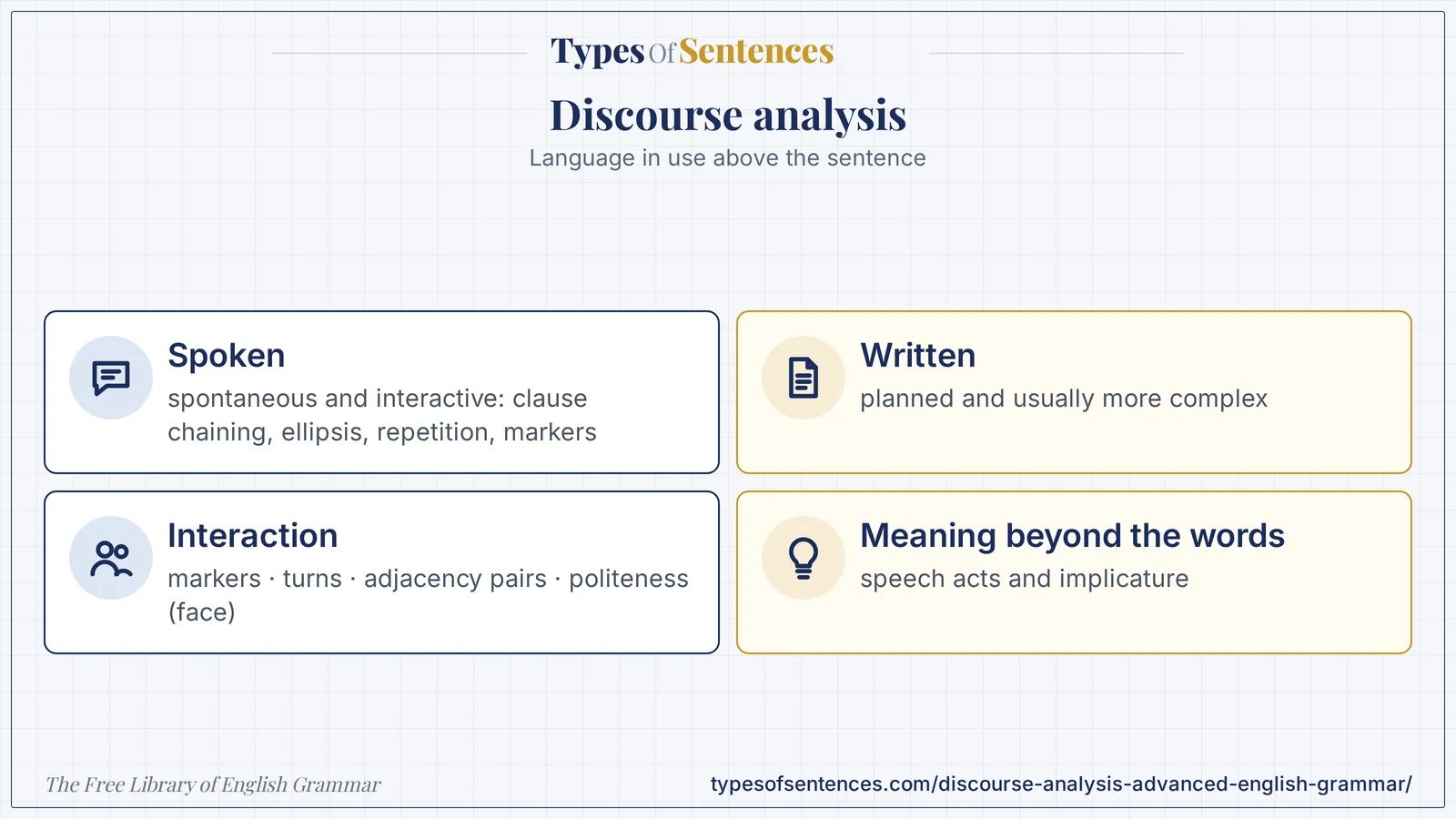
When people talk or write, they do not produce isolated sentences. They produce turns in a conversation, paragraphs in an essay, and whole texts that have a purpose and a shape. Discourse analysis asks how these larger units are built and what the speakers are doing with them.
Why it matters: Grammar supplies the building blocks, but the way they are used depends on the situation, the relationship between the participants, and the purpose. That is why the same sentence can be a question, a request, or a complaint.
Summary: Discourse is language in use above the level of the sentence. Spoken discourse is spontaneous and interactive and uses clause chaining, ellipsis, repetition, and discourse markers; written discourse is planned and uses nominalization and subordination. Conversation is organized into turns and adjacency pairs, with preferred and dispreferred responses. Politeness protects face, and is expressed by indirectness, modals, and hedges. Utterances are speech acts (assertions, directives, commissives, expressives, declarations), and their meaning often goes beyond the words through conversational implicature governed by Grice’s cooperative principle.
- Discourse = language in action above the sentence.
- Spoken versus written: planning, interaction, complexity.
- Markers, turns, adjacency pairs, politeness (face).
- Speech acts and implicature: meaning beyond the words.
What You’ll Learn
- 1. Discourse Analysis: What Is Discourse?
- 2. Spoken vs. Written Discourse
- 3. Discourse Markers
- 4. Turn-Taking and Adjacency Pairs
- 5. Politeness Strategies and Face
- 6. Speech Acts
- 7. Conversational Implicature and Grice’s Maxims
- 8. Discourse Structure: Narrative and Genre
- 9. Doing a Discourse Analysis
- 10. Common Problems with Discourse and Pragmatics
- 11. Exercises
- 12. Test Your Knowledge
- 13. Frequently Asked Questions
- 14. Conclusion
1. Discourse Analysis: What Is Discourse?
The word discourse is used in several senses. In linguistics it usually means language in use above the level of the sentence: connected speech or writing that has a communicative purpose. A text is the product (a written or transcribed piece of language); discourse is the process and the context in which the text is produced and interpreted; a genre is a type of text with a recognized purpose and structure (a recipe, a lecture, a complaint).
| Approach | Focus | Associated names |
|---|---|---|
| text linguistics | cohesion, coherence, textuality | Halliday and Hasan; de Beaugrande and Dressler |
| conversation analysis | turn-taking, adjacency pairs, repair | Sacks, Schegloff, and Jefferson |
| speech act theory | what utterances do | Austin; Searle |
| pragmatics | meaning in context; implicature | Grice; Levinson |
| politeness theory | face and indirectness | Brown and Levinson; Leech |
| genre analysis | structure and purpose of text types | Swales; Martin |
| critical discourse analysis | language, power, and ideology | Fairclough; van Dijk |
| interactional sociolinguistics | how context shapes interpretation | Gumperz; Tannen |
The levels of analysis build on each other: the sentence, the utterance (a sentence as used on an occasion), the turn, the exchange, and the whole text. The earlier chapters on reference and deixis and cohesion and coherence dealt with how sentences connect in a text; this chapter adds how people act and interact with discourse.
2. Spoken vs. Written Discourse
| Feature | Spoken discourse | Written discourse |
|---|---|---|
| planning | spontaneous; produced in real time | planned and revised |
| channel | sound; intonation and gesture | visual; punctuation and layout |
| permanence | fleeting | permanent and re-readable |
| interaction | shared time and place; immediate feedback | no immediate feedback; the reader is absent |
| context | shared; much deixis and ellipsis | explicit; context must be put into words |
| sentences | units are utterances, clauses, and fragments | sentences and paragraphs |
| complexity | clause chaining with and, so, but; “grammatical intricacy” | subordination and long noun phrases; “lexical density” |
| vocabulary | general words, vague language (stuff, sort of) | precise, abstract, Latinate words |
| repetition and repair | false starts, repetitions, reformulations | edited out |
| markers | well, you know, I mean, fillers | however, moreover, signposting |
| tags and questions | frequent | rare except for rhetorical effect |
| nominalization | rare | frequent |
| Spoken (invented example) | Written equivalent |
|---|---|
| So we went out and, you know, it was raining, and we got soaked, and then, well, we came home. | We went out in the rain, were soaked, and returned home. |
| I mean, the thing is, nobody really, like, knew what to do. | Nobody knew what to do. |
| It was, um, quite, quite expensive, sort of. | It was expensive. |
The differences are in degree: a lecture can be written, an email can be spoken, and texting and chat have features of both. Halliday observed that writing has a higher lexical density (more content words per clause) while speech has more grammatical intricacy (more clauses linked together). The grammar of speech is therefore different from the grammar of writing, and the rules for written sentences should not be applied to transcripts. Register differences are treated in the next chapter.
3. Discourse Markers
| Function | Markers | Example |
|---|---|---|
| open or change topic | now, so, okay, by the way, anyway, speaking of | Now, let’s turn to the budget. |
| close a topic or the conversation | anyway, okay, well, right, so | Anyway, I should go. |
| take or hold the turn | well, so, and, but, you know | Well, I think it’s a mistake. |
| mark a response or agreement | yeah, right, okay, sure, exactly, I see | Right, I see what you mean. |
| hedge or soften | sort of, kind of, I think, you know, like, maybe | It’s sort of late. |
| repair or reformulate | I mean, that is, or rather, in other words | It’s hot, I mean, it’s boiling. |
| signal surprise or new information | oh, really, wow, ah | Oh, I didn’t know that. |
| attract attention | look, listen, hey, you see | Look, it’s not that simple. |
| fillers (planning time) | um, er, uh | It was, um, about ten. |
| mark an aside | by the way, incidentally | By the way, have you seen Tom? |
Discourse markers are words and phrases that signal how an utterance relates to the surrounding discourse. They are syntactically loose: they are set off by commas or pauses and can usually be omitted without changing the truth of the sentence. They are not “mistakes” or “empty fillers”: they organize the conversation and manage the relationship between speakers. Some markers have stigma in certain contexts (like, you know), but studies show that they have regular functions. The written equivalents are the cohesive conjuncts, treated in the previous chapters.
4. Turn-Taking and Adjacency Pairs
| Concept | Meaning | Example |
|---|---|---|
| turn | a stretch of talk by one speaker | — |
| transition relevance place (TRP) | a point where a change of speaker is possible | the end of a clause or a question |
| adjacency pair | two turns by different speakers, where the first calls for the second | question–answer; greeting–greeting; request–grant; offer–acceptance; complaint–apology; summons–answer |
| preferred response | the expected, straightforward second part (usually immediate and short) | acceptance of an invitation |
| dispreferred response | the less expected second part (usually delayed, softened, with reasons) | refusal: Well … I’d love to, but I have a meeting. |
| backchannel | short responses showing attention | mm, uh-huh, yeah, right |
| overlap and interruption | speech at the same time | — |
| repair | correcting a problem in speaking or hearing | I mean …; Sorry, what? |
| pre-closing | a sign that the conversation is near its end | Okay. Well. So. |
| opening | how a conversation begins | Hello? / Hi, it’s Maria. |
| Invented exchange | Analysis |
|---|---|
| A: Are you free tonight? B: Well … I have a meeting. A: Oh, no problem. B: Sorry about that. | a pre-sequence (Are you free?), a dispreferred second part (delay well, a reason), acceptance, and an apology |
| A: Could you pass the salt? B: Here you are. A: Thanks. | request–grant–thanks |
| A: Nice day. B: Isn’t it? | assertion–agreement (a tag) |
Turn-taking works by rules that speakers follow without noticing: the current speaker may select the next; if not, another may self-select at a TRP; otherwise the current speaker may continue. Gaps and overlaps are small because speakers anticipate the end of a turn. Norms of silence, overlap, and directness vary across cultures and varieties of English. The question forms that start many adjacency pairs are described in the chapter on advanced question formation.
5. Politeness Strategies and Face
Politeness theory, developed by Penelope Brown and Stephen Levinson, builds on Erving Goffman’s idea of face: the public self-image that every person wants to protect. Positive face is the wish to be liked and approved; negative face is the wish to act freely without imposition. Many acts (requests, orders, criticism, disagreement) threaten face and are called face-threatening acts.
| Strategy | Example (request to open a window) | Features |
|---|---|---|
| bald on-record | Open the window. | direct imperative; no softening; used among intimates or in emergencies |
| positive politeness | Hey, mate, could you open the window? We both want some air. | shows solidarity, appeals to common ground |
| negative politeness | I’m sorry to bother you, but could you possibly open the window? | indirect, hedged, apologetic, respects freedom |
| off-record | It’s awfully stuffy in here. | a hint; the hearer infers the request |
| do not do the act | (say nothing) | avoid the imposition |
| Factor | Effect on politeness |
|---|---|
| social distance (how well the speakers know each other) | more distance, more politeness |
| power (the relative status) | more power of the hearer, more politeness |
| ranking of the imposition (how big the request is) | larger imposition, more politeness |
| Grammatical means of politeness | Example |
|---|---|
| modal remoteness | Could you …? Would you mind …? |
| past tense and progressive | I was wondering if you could … |
| conditionals | If you could pass the salt, that would be great. |
| negative questions | Wouldn’t it be better to wait? |
| hedges | sort of, a bit, possibly, rather |
| tag questions | You’ll help me, won’t you? |
| passives and impersonal forms | It is requested that visitors sign in. |
| apologies and thanks | Sorry to bother you. Thanks so much. |
| in-group markers | mate, dear, folks |
| indirectness (speech acts) | Can you pass the salt? (a request as a question) |
Leech’s politeness principle offers another set of maxims (tact, generosity, approbation, modesty, agreement, sympathy). The theory is a general frame, and the choices vary across cultures, families, and settings; what counts as polite in one variety of English may seem too direct or too formal in another. The grammar of modals and conditionals that serves politeness is in the chapters on modality and conditionals.
6. Speech Acts
John Austin observed that saying something is also doing something: I promise to come is the act of promising; I name this ship is the act of naming. He distinguished three aspects of an utterance: the locutionary act (the words), the illocutionary act (what the speaker does with them: asking, warning, promising), and the perlocutionary effect (the result on the hearer: convincing, frightening). John Searle classified illocutionary acts.
| Class | Purpose | Examples | Sentence |
|---|---|---|---|
| representatives (assertives) | commit the speaker to the truth of a statement | state, claim, report, deny, predict | It is raining. I deny that. |
| directives | try to get the hearer to act | request, order, ask, advise, warn, invite | Close the door. Could you help me? |
| commissives | commit the speaker to a future act | promise, offer, threaten, vow, volunteer | I will call you. I’ll help. |
| expressives | express a psychological state | thank, apologize, congratulate, complain, welcome | Thank you. I’m sorry. Congratulations! |
| declarations | change the state of affairs by being said | I now pronounce you married. I resign. You’re fired. War is declared. | needs an institutional context |
| Test and feature | Example |
|---|---|
| performative verb + hereby | I hereby declare the meeting open. (works) / *I hereby run. (does not) |
| explicit performative | I promise to come. I warn you not to. |
| implicit performative | I’ll come. (a promise) |
| direct speech act (form matches function) | Close the door. (imperative = directive) |
| indirect speech act (form differs from function) | Can you close the door? (a question used as a directive) |
| felicity conditions (conditions for success) | a promise needs a future act that the hearer wants, and the speaker’s sincerity |
The three main sentence forms are normally linked to functions: declarative with assertion, interrogative with question, imperative with directive. But speakers often use one form for another function: Can you pass the salt? (a question in form, a request in function), It’s cold in here (a statement used to ask for the window to be closed). The grammar of these forms is in the chapter on questions, and the study of what speakers do with them is the subject of the chapter on pragmatics.
7. Conversational Implicature and Grice’s Maxims
Paul Grice argued that conversation is governed by a cooperative principle: make your contribution as is required, at the stage at which it occurs, by the accepted purpose of the talk. He expressed it in four maxims. When speakers appear to break a maxim, listeners assume that they are still cooperating, and infer an extra meaning, called an implicature.
| Maxim | Rule | Example of observing | Flouting and the implicature |
|---|---|---|---|
| quantity | be as informative as required; no more | A: How many children? B: Three. | B: Some students passed. (implies: not all) |
| quality | say only what you believe to be true | — | A storm outside: “Lovely weather!” (irony; the opposite) |
| relation (relevance) | be relevant | — | A: Are you coming? B: I have an exam. (implies: no) |
| manner | be clear and orderly; avoid ambiguity | — | A: How was the singer? B: She produced a series of sounds corresponding to the score. (implies: bad) |
| Type of implicature | Example | Implicature |
|---|---|---|
| scalar (quantity) | Some of the students passed. | not all of them passed |
| scalar | It’s warm. / It’s good. | not hot / not excellent |
| relevance | A: Do you like my dress? B: The color is lovely. | the speaker does not like the style |
| indirect request | It’s cold in here. | please close the window |
| irony and understatement | That’s not bad. (of a masterpiece) | it is excellent |
| conventional implicature | She is poor but honest. | there is a contrast between poor and honest (but) |
| Test | Meaning | Example |
|---|---|---|
| cancellability | an implicature can be canceled without contradiction | Some students passed; in fact, all did. |
| entailment (cannot be canceled) | Some students passed entails that at least one did | *Some students passed; in fact none did. |
| calculability | the hearer can work it out from the maxims | — |
Implicature explains why a sentence can mean more than it says. In writing, implicatures can mislead: Some of our products are safe suggests that others are not. Careful writers avoid implicatures that they do not intend. The relation between implicature and hedging is discussed in the chapter on hedging.
8. Discourse Structure: Narrative and Genre
| Element (Labov) | Function | Example (invented) |
|---|---|---|
| abstract | summarizes the point | You won’t believe what happened to me on the bus. |
| orientation | who, when, where | Last Tuesday I was on the 8:15 bus to work. |
| complicating action | the sequence of events | The bus stopped. A man got on. He sat next to me. |
| evaluation | why the story is worth telling | It was the strangest thing I’ve ever seen. |
| resolution | how it ended | He got off at the next stop. |
| coda | returns to the present | And that’s why I walk to work now. |
| Genre analysis (Swales: introductions to research articles) | Move | Example |
|---|---|---|
| Move 1 | establish a territory | Research on sleep has grown rapidly. |
| Move 2 | establish a niche (a gap) | However, little is known about … |
| Move 3 | occupy the niche | This paper examines … |
Texts of a given genre have a typical structure, and discourse analysis describes it in terms of stages or moves. A narrative has a typical shape, and the verbs in it follow it: the complicating action uses the past simple; the orientation uses the past progressive and the past perfect; the evaluation often uses the present. These tense choices are described in the chapter on tense and aspect.
9. Doing a Discourse Analysis
- Describe the context: who is speaking or writing, to whom, for what purpose, in which genre, with what relationship.
- Describe the structure: openings, stages, turns, closings.
- Look at cohesion and reference: how the parts connect, what the pronouns point to.
- Look at the markers and what they do.
- Look at the speech acts: what each utterance does, and whether the form matches the function.
- Look at politeness and face: where it is protected or threatened.
- Look for implicatures: where the meaning goes beyond the words.
- Describe the patterns and state the conclusion with care, based on the evidence.
| Invented dialogue | Observation |
|---|---|
| A: Have you got a minute? B: Sure. What’s up? A: It’s about the report. B: Oh, right. A: I think there might be an error in the figures. B: Okay, let’s have a look. | pre-sequence (a minute?); a hedged assertion (I think … might) for politeness; markers (Oh, right, okay); the indirect directive in the last turn: let’s have a look accepts a request that was never stated |
10. Common Problems with Discourse and Pragmatics
| Problem | Example | Better |
|---|---|---|
| treating speech as defective writing | counting “errors” in a transcript | analyze it by the grammar of speech |
| calling markers “fillers” | — | recognize their discourse functions |
| too direct a request (learner pragmatic transfer) | Give me water. | Could I have some water, please? |
| too formal in conversation | I would be most grateful if you could kindly … | Could you help me? |
| answering a negative question wrongly | Don’t you like it? — Yes. (meaning: no) | No, I don’t. / Yes, I do. |
| reading a hint as a question | A: It’s cold in here. B: Yes, it is. | B: Shall I close the window? |
| implicature you do not intend | Some of our products are safe. | All of our products are safe. |
| too many markers in writing | Well, so, you know, the results are, like, significant. | The results are significant. |
| ambiguous pronoun across turns | A: Tom and Bill came. B: Did he leave? (who?) | Did Tom leave? |
| an unclear speech act | I’ll see what I can do. (a promise or a refusal?) | I will help you. / I can’t help you. |
Edit (for a formal report): Well, so, you know, the results are, like, sort of significant, and give me the data, I mean, some of our products are safe.
- Well, so, you know: spoken markers: delete.
- like, sort of: hedges and fillers: delete.
- significant: The results are significant.
- give me the data: a bald directive: Please send me the data.
- I mean: delete.
- some of our products are safe: implicature: All of our products are safe. (if true)
- Result: The results are significant. Please send me the data. All of our products are safe.
Recap in 12 seconds
Watch the lesson build itself: Spoken and written discourse differ in planning and interaction, and discourse analysis studies markers, turns, politeness, speech acts, and implicature. The video has no sound.
Exercises
Part A: Discourse and Approaches (Exercises 1–6)
Exercise 1: Define discourse in linguistics.
Show Answer
Answer: Language in use above the level of the sentence.
Exercise 2: Who developed conversation analysis?
Show Answer
Answer: Sacks, Schegloff, and Jefferson.
Exercise 3: Who is associated with speech act theory?
Show Answer
Answer: Austin and Searle.
Exercise 4: Who is associated with politeness theory?
Show Answer
Answer: Brown and Levinson.
Exercise 5: Name the difference: text and genre.
Show Answer
Answer: A text is a product; a genre is a type of text with a recognized purpose.
Exercise 6: Name the level above the sentence used on an occasion.
Show Answer
Answer: The utterance.
Part B: Spoken and Written (Exercises 7–11)
Exercise 7: Which has higher lexical density: speech or writing?
Show Answer
Answer: Writing.
Exercise 8: Which has more grammatical intricacy: speech or writing?
Show Answer
Answer: Speech.
Exercise 9: Which uses nominalization more: speech or writing?
Show Answer
Answer: Writing.
Exercise 10: Convert to writing: I mean, the thing is, nobody really knew what to do.
Show Answer
Answer: Nobody knew what to do.
Exercise 11: Name a feature of speech: false starts and repetitions.
Show Answer
Answer: Repair and reformulation.
Part C: Markers and Turns (Exercises 12–18)
Exercise 12: Name the function of anyway in Anyway, I should go.
Show Answer
Answer: Closing a topic or the conversation.
Exercise 13: Name the function of I mean in It’s hot, I mean, it’s boiling.
Show Answer
Answer: Repair or reformulation.
Exercise 14: Name the function of Oh in Oh, I didn’t know that.
Show Answer
Answer: Signaling new information or surprise.
Exercise 15: Name the adjacency pair: Hello. — Hi.
Show Answer
Answer: Greeting–greeting.
Exercise 16: Is a refusal usually preferred or dispreferred?
Show Answer
Answer: Dispreferred.
Exercise 17: Name a feature of a dispreferred response.
Show Answer
Answer: Delay, softening, and reasons.
Exercise 18: Name a backchannel.
Show Answer
Answer: mm, uh-huh, yeah.
Part D: Politeness and Speech Acts (Exercises 19–25)
Exercise 19: Name the strategy: It’s awfully stuffy in here. (a request)
Show Answer
Answer: Off-record.
Exercise 20: Name the strategy: I’m sorry to bother you, but could you possibly …?
Show Answer
Answer: Negative politeness.
Exercise 21: Name the strategy: Open the window.
Show Answer
Answer: Bald on-record.
Exercise 22: Name the class: I promise to come.
Show Answer
Answer: Commissive.
Exercise 23: Name the class: Thank you.
Show Answer
Answer: Expressive.
Exercise 24: Name the class: Close the door.
Show Answer
Answer: Directive.
Exercise 25: Name the kind: Can you pass the salt?
Show Answer
Answer: An indirect speech act (a request).
Part E: Implicature and Analysis (Exercises 26–30)
Exercise 26: Give the implicature: Some of the students passed.
Show Answer
Answer: Not all of them passed.
Exercise 27: Which maxim is flouted: A: Are you coming? B: I have an exam.
Show Answer
Answer: Relation (relevance).
Exercise 28: Name the maxim: be as informative as required
Show Answer
Answer: Quantity.
Exercise 29: Can an implicature be canceled?
Show Answer
Answer: Yes.
Exercise 30: Name the first step of a discourse analysis.
Show Answer
Answer: Describe the context.
Test Your Knowledge
Ready to check what you learned? Answer all 10 questions, then submit. You need 80% (8 of 10) to pass. Your answers are not stored.
View correct answers and explanations
Question 1: What is discourse?
✓ Correct Answer: A – language in use above the sentence
Discourse is connected language in use.
Question 2: Which has higher lexical density?
✓ Correct Answer: B – writing
Written language is more lexically dense.
Question 3: Which is a discourse marker?
✓ Correct Answer: C – well
Well manages the conversation.
Question 4: Which is an adjacency pair?
✓ Correct Answer: D – question–answer
The first part calls for the second.
Question 5: Which is a dispreferred response to an invitation?
✓ Correct Answer: C – Well … I have a meeting.
A delayed, hedged refusal.
Question 6: Which is off-record politeness?
✓ Correct Answer: B – It’s stuffy in here.
A hint.
Question 7: Which class is I promise?
✓ Correct Answer: C – commissive
It commits the speaker.
Question 8: Which is an indirect speech act?
✓ Correct Answer: D – Can you close the door?
A question used as a request.
Question 9: Which maxim does Some passed concern?
✓ Correct Answer: A – quantity
Scalar implicature (quantity).
Question 10: Can an implicature be canceled?
✓ Correct Answer: B – yes
Implicatures are cancelable.
Frequently Asked Questions
What is discourse analysis?
Discourse analysis is the study of language beyond the sentence: how connected speech and writing are organized, how it works in context, and what speakers and writers do with it.
What is discourse grammar?
Discourse grammar is the study of the grammatical features that operate above the sentence: markers, ellipsis and reference across turns, information structure, and the grammar of speech and writing.
What is text analysis?
Text analysis is the examination of a text’s structure, cohesion, reference, speech acts, and context. Text analysis helps explain how a text achieves its purpose.
What does language in context mean?
Language in context means that the meaning of an utterance depends on who says it, to whom, where, when, and for what purpose, not only on its words and grammar.
What are discourse features?
Discourse features are the characteristics of connected language: markers, turn-taking, adjacency pairs, politeness, speech acts, implicature, and the typical stages of a genre.
What are discourse markers?
Discourse markers are words and phrases such as well, now, anyway, and you know that signal how an utterance relates to the discourse: opening, closing, hedging, repairing, or responding.
What is conversational implicature?
Conversational implicature is a meaning that a speaker conveys beyond the literal words, by relying on the hearer’s assumption that the speaker is cooperative (Grice): Some passed implies that not all did.
Conclusion
You now have a deep study of discourse analysis: what discourse is, spoken and written discourse, discourse markers, turn-taking, politeness, speech acts, implicature, narrative and genre structure, and a method of analysis. You can describe how texts and conversations work.
When you analyze or write a text, ask what the participants are doing with the language and what the context requires. Next, you will study register and style.
- Halliday, M. A. K., and Ruqaiya Hasan. Cohesion in English. Longman, 1976.: text linguistics and cohesion.
- Grice, H. P. “Logic and Conversation.” In Syntax and Semantics 3: Speech Acts, edited by Peter Cole and Jerry L. Morgan. Academic Press, 1975.: the cooperative principle and the maxims.
- Brown, Penelope, and Stephen C. Levinson. Politeness: Some Universals in Language Usage. Cambridge University Press, 1987.: politeness theory and face.
- Austin, J. L. How to Do Things with Words. Oxford University Press, 1962; Searle, John R. Speech Acts. Cambridge University Press, 1969.: speech act theory.
- Schiffrin, Deborah. Discourse Markers. Cambridge University Press, 1987.: the study of discourse markers.
Last reviewed: October 29, 2026. How it was made: drafted with AI assistance, then checked with automated tests (structure, links, answer keys, spelling) and against the sources above. A person has not yet read this chapter line by line. Found a mistake? Report it.