Academic writing is the writing that scholars and students produce in order to inform, argue, analyze, and report research. Its readers are experts or teachers who expect claims to be supported, sources to be acknowledged, and language to be precise. These expectations shape the style, the grammar, and the organization of academic texts: they are formal and objective, they use particular structures such as nominalization and the passive, they hedge their claims, and they follow a logical plan. Scholarly writing is not “difficult for its own sake”; most of its features have a reason, and good academic writers use plain language wherever they can.
This chapter introduces the main features of academic style and academic grammar, with examples of each: formal register and objective tone, nominalization, the passive voice, complex sentences and noun phrases, hedging, tense choice, organization, and the attribution of sources. It also describes the differences between disciplines, the writing process, and the common mistakes that weaken academic prose, from informal language to the overuse of the first person. The aim is a practical command of writing for academia. Later chapters in this part treat essays, argument, citation, research papers, and critical analysis in detail. Thirty editing exercises and a quiz follow.
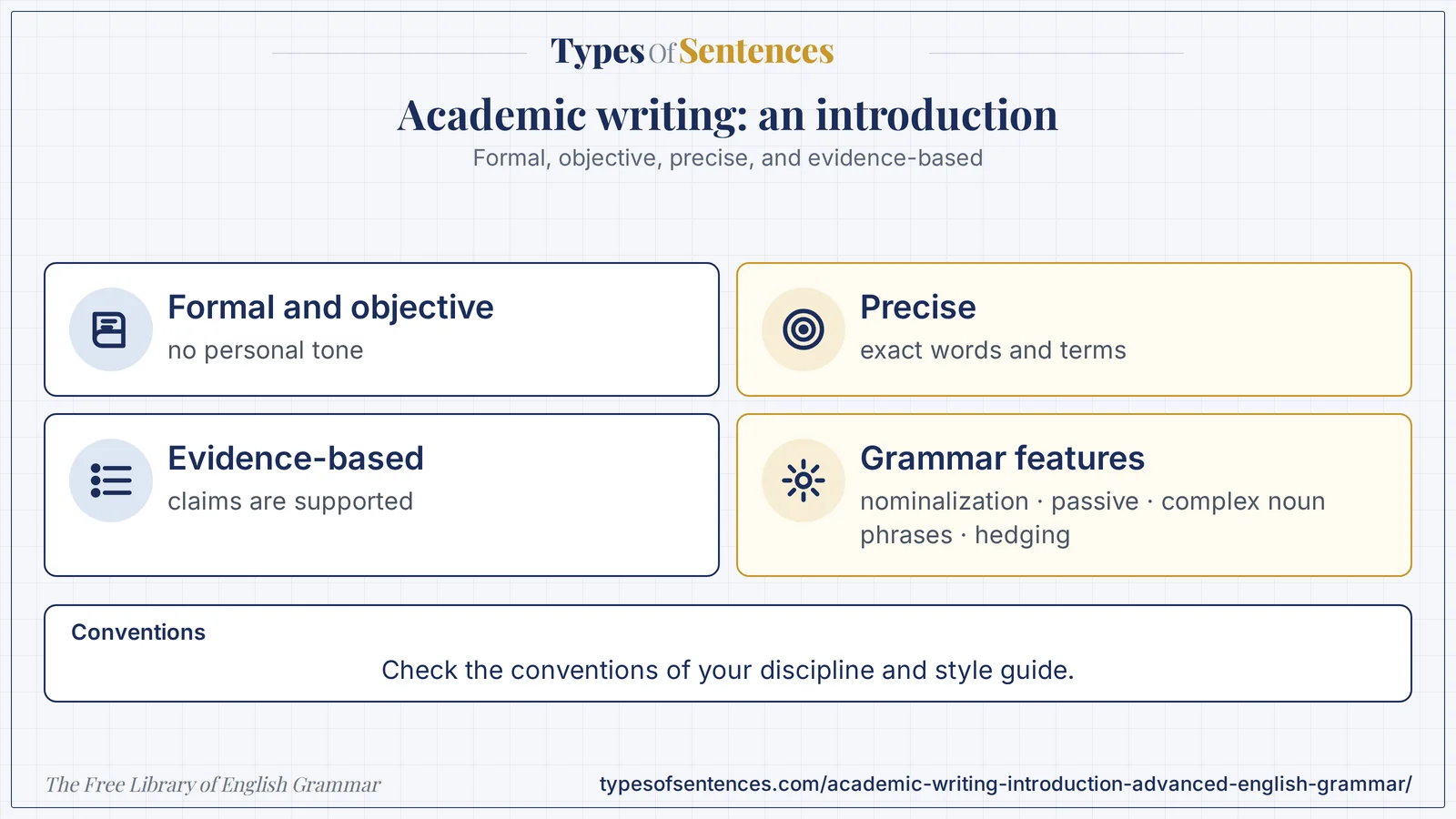
Academic writing has a job to do: to present an idea or a finding to a community of readers who will test it. For that reason it states claims clearly, supports them with evidence, admits limits, and shows where its ideas come from.
Why it matters: The style follows from the job. It avoids slang and emotion because they distract from the argument; it uses precise terms because a vague claim cannot be tested; and it is organized so that a reader can follow the reasoning from start to finish.
Summary: Academic writing is formal, objective, precise, and evidence-based. Its grammar favors nominalization (the investigation of), the passive where the agent is unimportant, complex noun phrases and subordination, hedged claims (suggests, may), explicit linking words, and present, past, and present perfect tenses for particular functions. It is organized by a thesis or research question, a logical sequence of paragraphs, and signposting, and it acknowledges sources by citation. Disciplines differ in format and in the acceptance of I and we. Common mistakes include informal language, vague words, overgeneralization, unsupported claims, and padding.
- Formal, objective, precise, evidence-based.
- Features: nominalization, passive, complex noun phrases, hedging.
- Organization: thesis, topic sentences, logical sequence, citation.
- Check the conventions of your discipline and style guide.
What You’ll Learn
- 1. Academic Writing: What Is It?
- 2. Academic Style: Formal Register and Objective Tone
- 3. Academic Grammar: Nominalization, Passive, and Complex Structures
- 4. Organization: Structure and Logical Progression
- 5. Using Sources: Attribution and Integrity
- 6. Differences Between Disciplines
- 7. The Process of Academic Writing
- 8. Academic English for Multilingual Writers
- 9. Common Mistakes in Academic Writing
- 10. Exercises
- 11. Test Your Knowledge
- 12. Frequently Asked Questions
- 13. Conclusion
1. Academic Writing: What Is It?
| Feature | Description | Example |
|---|---|---|
| purpose | to inform, argue, analyze, evaluate, or report research | This paper examines the effect of sleep on memory. |
| audience | teachers, experts, the scholarly community | — |
| evidence | claims are supported by data, sources, and reasoning | Smith (2020) found that … |
| formality | formal register; no slang or contractions | The results do not support the hypothesis. |
| objectivity | neutral tone; the argument, not the person, is in focus | The evidence suggests … |
| precision | exact terms, numbers, and scope | a 12 percent increase between 2019 and 2022 |
| caution | claims are hedged to match the evidence | may indicate; appears to |
| structure | a clear plan: thesis, sections, paragraphs | Introduction, Methods, Results, Discussion |
| acknowledgment of sources | citations and a reference list | (Smith, 2020) |
| cohesion | explicit links between ideas | However, …; Therefore, … |
| Genre | Purpose | Typical reader |
|---|---|---|
| essay | develop an argument or analysis | a teacher or examiner |
| research report or article | report an investigation | specialists in the field |
| literature review | survey and synthesize the sources on a topic | the research community |
| abstract | summarize a longer text | readers deciding whether to read it |
| thesis or dissertation | present extended original research | examiners |
| critical review | evaluate a text | the discipline |
| proposal | argue for a project | a committee or a funder |
| case study | analyze a particular case | students and practitioners |
Academic writing is not a single style: it varies by discipline, genre, and reader, and it is a skill that is learned, even by native speakers. The register choices are discussed in the chapter on register and style, and this chapter builds on them.
2. Academic Style: Formal Register and Objective Tone
| Informal | Academic | Feature |
|---|---|---|
| a lot of | many; a large number of; considerable | vague quantifier |
| kids | children | formal noun |
| get | obtain; receive; become | formal verb |
| look into | investigate | phrasal verb |
| find out | determine; establish | phrasal verb |
| show up | appear; attend | phrasal verb |
| big | substantial; significant; considerable | vague adjective |
| bad | inadequate; harmful; unfavorable | vague adjective |
| really important | crucial; essential | intensifier |
| sort of; kind of | somewhat; to some extent | hedge |
| stuff; things | materials; factors; issues (name them) | vague noun |
| and so on; etc. | (list the items or use such as) | vague tail |
| it’s; don’t; can’t | it is; do not; cannot | contraction |
| but; so; and (at the start) | However; Therefore; Moreover | conjunct |
| I think | This paper argues; The evidence suggests | personal opinion marker |
| you (generic) | one; readers; people | second person |
| a bit; a little | slightly; somewhat | informal degree |
| Feature of objective tone | Example | Avoid |
|---|---|---|
| neutral evaluation | The argument is incomplete. | The argument is stupid. |
| evidence-based claim | The data indicate a decline. | Everyone knows that prices fall. |
| balanced language | Some scholars argue …; others contend … | Obviously, X is wrong. |
| limited absolute words | Many students …; In most cases … | All students …; Always; Never |
| emotive language avoided | The policy has been criticized. | The policy is a disaster. |
| no personal anecdotes (usually) | Surveys show … | When I was a child, … |
| no rhetorical questions as a habit | This paper asks why prices rose. | Why do prices rise? Who knows? |
| no exclamations | The result is surprising. | What a surprise! |
The aim of formal register in academic writing is to keep the reader’s attention on the argument, and to signal membership in the scholarly community. It does not require long words: plain, precise vocabulary is preferred, and the choice of use over utilize is a good example. For vague words and the techniques of precision see the chapter on vagueness and precision.
3. Academic Grammar: Nominalization, Passive, and Complex Structures
| Feature | Example | Function |
|---|---|---|
| nominalization | The investigation of the causes … (from investigate) | turns processes into things; allows compact abstract subjects |
| passive voice | The samples were heated to 100 degrees. | focuses on the object or process; omits the agent |
| complex noun phrases | a federal student loan repayment plan | packs information |
| subordination | Although the results were clear, they were not conclusive. | shows logical relations |
| hedging | The data suggest that …; This may indicate … | matches claims to evidence |
| impersonal constructions | It is argued that …; It can be seen that … | objectivity |
| reporting verbs | Smith (2020) argues that … | attribution |
| conjuncts | However, …; Moreover, …; Therefore, … | cohesion |
| “this” + noun | This approach …; This finding … | summarizes the previous idea |
| definite generic reference | The teenager is a heavy user of … | a class in general |
| abstract subjects | This paper examines …; The study shows … | non-human agents |
| lexical density | many content words per clause | information per sentence |
| Nominalization (before → after) | Effect |
|---|---|
| The government decided to reduce taxes. → The government’s decision to reduce taxes … | compact; makes the decision the topic |
| Prices rose quickly, which worried investors. → The rapid rise in prices worried investors. | one clause instead of two |
| We analyzed the data carefully. → A careful analysis of the data … | formal and abstract |
| When researchers evaluate the model, they find errors. → The evaluation of the model reveals errors. | — |
- Use nominalization with care. It makes text compact and formal, but too much makes it heavy and hides the actor. See the chapter on voice for the passive and the chapter on complex noun phrases for long noun phrases.
- Choose the passive when the agent is unknown, unimportant, or obvious (methods sections, descriptions of processes). Many current style guides encourage the active voice and the first person where the writer’s role is clear (We analyzed the samples).
- Hedge claims, not facts. See the chapter on hedging.
- Use tenses for their functions: the present for what a source argues and for established facts (Smith argues); the past for a specific study or procedure (Smith found, We collected); the present perfect for a body of work (Researchers have shown).
- Keep sentences clear. A long sentence is acceptable if the structure is clear. Break it if the reader must re-read it.
| Convention | Example | Note |
|---|---|---|
| numbers | zero to nine in words, 10 and above in numerals (a common rule; style guides differ) | APA: five participants, 12 participants |
| abbreviations | define at first use: the World Health Organization (WHO) | — |
| Latin abbreviations | e.g. (for example), i.e. (that is), et al. (and others), cf. (compare) | in brackets mainly |
| punctuation | semicolon between long list items; colon to introduce a list or explanation | — |
| spelling | one variety (American or British), consistently | — |
| lists | parallel in form | — |
4. Organization: Structure and Logical Progression
| Level | Structure | Example |
|---|---|---|
| whole text | introduction (context, gap, thesis or aim) → body → conclusion | essay; research article (Introduction, Methods, Results, Discussion) |
| section | heading and a clear purpose | Literature Review |
| paragraph | topic sentence → support (evidence and explanation) → concluding or linking sentence | one main idea per paragraph |
| sentence | known → new; subordination for relations | — |
| signposting | tells the reader where the text is going | This section has three parts. First, … |
| transitions | link paragraphs and sections | In contrast, …; Building on this, … |
| Part of the paragraph | Function | Example |
|---|---|---|
| topic sentence | states the point | Sleep loss impairs memory. |
| evidence | data, source, or example | In a study of 200 students, those who slept less than six hours scored 15 percent lower (Lee, 2021). |
| explanation | shows why the evidence supports the point | This suggests that memory consolidation depends on sleep. |
| link | connects to the next point | However, the effect may differ by age. |
The details of essay structure are treated in the next chapter, and of the research paper in a later one. The coherence of a text depends on its organization as well as its links: see the chapter on cohesion and coherence. A reader of academic writing expects to know early what the thesis or aim is, and to be able to follow the path to the conclusion.
5. Using Sources: Attribution and Integrity
| Method | Example | Use |
|---|---|---|
| integral citation (author in the sentence) | Smith (2020) argues that sleep is vital. | focus on the author or the claim of the author |
| non-integral citation (author in brackets) | Sleep is vital (Smith, 2020). | focus on the idea |
| direct quotation | Smith (2020) calls sleep “the foundation of learning” (p. 12). | exact words are important; keep short |
| paraphrase | Smith (2020) holds that learning depends on sleep. | same idea in your words and structure |
| summary | Smith (2020) reviews 40 studies and concludes that sleep matters. | the main points, condensed |
| synthesis | Sleep matters (Smith, 2020; Lee, 2021), though effects differ by age (Rao, 2019). | several sources combined |
Every idea, finding, or phrase that is not your own must be acknowledged, and the acknowledgment must follow a style guide (APA, MLA, Chicago, or a discipline’s own). Copying or closely adapting another’s wording without a citation is plagiarism, even when it happens by accident. The grammar of attribution and the methods of quotation, paraphrase, and summary are treated in the chapter on citing sources.
6. Differences Between Disciplines
| Field | Typical features | Style guide (common) |
|---|---|---|
| humanities | argument and interpretation; sustained prose; the first person is often accepted; quotation of primary texts | MLA; Chicago (notes) |
| social sciences | empirical studies; defined terms; a mix of passive and active; APA format; clear sections | APA |
| natural sciences | IMRaD; the passive in methods; concise; figures, tables, and units | ACS, AMA, Vancouver, or journal style |
| engineering and technology | technical description; procedures; precise specifications; numbered lists | IEEE |
| business and management | case analysis; reports; executive summaries; practical recommendations | APA; Harvard |
| law | precedent; careful definitions; long, exact sentences | Bluebook; OSCOLA |
Fields differ in how much they hedge, in the use of the first person, in the format of citation, and in the order of the sections. Always check the guidelines of your instructor, department, or journal, and read some published examples. The registers of professional and technical writing are treated in later chapters of this part.
7. The Process of Academic Writing
- Understand the task: purpose, audience, length, genre, deadline, and criteria.
- Read and take notes with the source details for each note.
- Plan: state a thesis or aim, outline the sections and the order of ideas.
- Draft without stopping to polish; keep the plan beside you.
- Revise for content and structure: check each paragraph against the thesis; use a reverse outline.
- Edit for language: formality, precision, hedging, cohesion, grammar, and the consistency of terms.
- Check the citations against the reference list.
- Proofread for spelling, punctuation, and formatting; see the later chapter on editing and proofreading.
| Resource | Use |
|---|---|
| learner’s and academic dictionaries | check word meaning, patterns, collocations |
| a corpus or an academic phrase bank | see how experts write common moves |
| a style guide (APA, MLA, Chicago) | format and citation |
| feedback from a reader or a writing center | find gaps you cannot see |
| reading in your field | learn the genre and the vocabulary |
8. Academic English for Multilingual Writers
Academic English is a second language for everyone: no one is born knowing it. Writers who speak other languages at home bring strengths (broader perspective, awareness of language), and they meet some predictable challenges.
| Challenge | Example | Help |
|---|---|---|
| articles | *Research shows importance of sleep. | the chapter on articles |
| prepositions and collocations | *discuss about; *depend of | a collocation dictionary |
| hedging and directness | claims sound too strong or too weak for the reader | study hedges in published articles |
| sentence length and cohesion | long sentences without links | signposting and transitions |
| plural and uncountable nouns | *many informations, *researches | a learner’s dictionary |
| verb tense in citation | *Smith argued (in a general claim) | the tense conventions |
| register | informal words from speech | an academic word list |
| organization conventions | a different expected order | model texts |
The aim is not to sound like a native speaker, but to write clear, correct, appropriate academic English. Many successful scholars write in a second or third language. Varieties of English have their own conventions, and the main principle is consistency and clarity for the intended readers.
9. Common Mistakes in Academic Writing
| Problem | Example | Better |
|---|---|---|
| informal language | Kids nowadays get a lot of stuff from the internet. | Children today obtain a great deal of information online. |
| overuse of the first person | I think that I believe that I will argue … | This paper argues that … |
| overgeneralization | All students hate homework. Always … | Many students report dislike of homework. |
| unsupported claim | Social media is bad for you. | Social media use is associated with lower well-being (Lee, 2021). |
| vague opening | Since the dawn of time, people have used language. | Language use has been studied since the nineteenth century. |
| “in today’s society” | In today’s society, technology is important. | Digital technology now shapes most areas of work. |
| rhetorical questions | Is this fair? We will see. | This paper examines whether the policy is fair. |
| contractions | The results don’t support it. | The results do not support it. |
| wordiness | It is a fact that the results are important in nature. | The results are important. |
| unclear “this” | This shows that … | This result shows that … |
| “there is / there are” openings | There are many students who prefer … | Many students prefer … |
| inconsistent terms | policy … scheme … plan | policy … policy … |
| tense shifts | Smith argued … and shows … | Smith argues … and shows … |
| citation errors | (Smith 2020) in APA; missing page for a quotation | (Smith, 2020, p. 12) |
| fragments and comma splices | However the results were clear, they were not conclusive. | Although the results were clear, they were not conclusive. |
| padding and clichés | at the end of the day; needless to say | delete |
| false formality | utilize; commence; in order to (everywhere) | use; begin; to |
| plagiarism by patchwriting | copying a source with small word changes | paraphrase in your own structure and cite |
Edit: Since the dawn of time, kids have gotten a lot of stuff from books, and I think that all students hate homework, and the results don’t support it, and this shows it’s important, at the end of the day.
- Since the dawn of time: a cliché opening: delete.
- kids … gotten a lot of stuff: informal: children obtain a great deal of information.
- I think that all students hate homework: overgeneralization and opinion: Many students report dislike of homework (cite).
- don’t: do not.
- this shows it’s important: unclear “this” and contraction: This finding is important.
- at the end of the day: delete.
- Result: Children obtain a great deal of information from books. Many students report dislike of homework (Smith, 2020). The results do not support the claim. This finding is important.
Recap in 12 seconds
Watch the lesson build itself: Academic writing is formal, objective, precise, and evidence-based, with typical grammatical features. The video has no sound.
Exercises
Part A: Features (Exercises 1–6)
Exercise 1: Name three features of academic writing.
Show Answer
Answer: Formal, objective, precise, evidence-based, hedged, structured.
Exercise 2: Name two purposes of academic writing.
Show Answer
Answer: To inform, argue, analyze, evaluate, or report research.
Exercise 3: Who is the usual reader?
Show Answer
Answer: Teachers, experts, the scholarly community.
Exercise 4: Define an abstract.
Show Answer
Answer: A summary of a longer text.
Exercise 5: Name a genre of academic writing.
Show Answer
Answer: Essay, report, literature review, thesis, proposal.
Exercise 6: Is academic style the same in all disciplines?
Show Answer
Answer: No.
Part B: Style (Exercises 7–13)
Exercise 7: Formal for kids:
Show Answer
Answer: children.
Exercise 8: Formal for look into:
Show Answer
Answer: investigate.
Exercise 9: Formal for a lot of:
Show Answer
Answer: many / a large number of.
Exercise 10: Formal for don’t:
Show Answer
Answer: do not.
Exercise 11: Replace I think:
Show Answer
Answer: This paper argues / The evidence suggests.
Exercise 12: Replace All students hate homework.
Show Answer
Answer: Many students report dislike of homework.
Exercise 13: Replace bad:
Show Answer
Answer: harmful / inadequate / unfavorable.
Part C: Grammar (Exercises 14–20)
Exercise 14: Nominalize: The government decided to reduce taxes.
Show Answer
Answer: The government’s decision to reduce taxes …
Exercise 15: Nominalize: We analyzed the data.
Show Answer
Answer: The analysis of the data …
Exercise 16: Passive: We heated the samples.
Show Answer
Answer: The samples were heated.
Exercise 17: Which tense for what a source argues?
Show Answer
Answer: The present.
Exercise 18: Which tense for a specific past study?
Show Answer
Answer: The past.
Exercise 19: Which tense for a body of research?
Show Answer
Answer: The present perfect.
Exercise 20: Add a hedge: This proves the theory.
Show Answer
Answer: This supports the theory.
Part D: Organization and Sources (Exercises 21–26)
Exercise 21: Name the parts of a paragraph.
Show Answer
Answer: Topic sentence, evidence, explanation, link.
Exercise 22: Name the parts of IMRaD.
Show Answer
Answer: Introduction, Methods, Results, Discussion.
Exercise 23: Integral or non-integral: Smith (2020) argues …
Show Answer
Answer: Integral.
Exercise 24: Integral or non-integral: … (Smith, 2020).
Show Answer
Answer: Non-integral.
Exercise 25: Define plagiarism.
Show Answer
Answer: Using another’s words or ideas without acknowledgment.
Exercise 26: Name a style guide.
Show Answer
Answer: APA, MLA, or Chicago.
Part E: Mistakes (Exercises 27–30)
Exercise 27: Fix: Since the dawn of time, people have used language.
Show Answer
Answer: Language use has been studied since the nineteenth century.
Exercise 28: Fix: This shows that …
Show Answer
Answer: This result shows that …
Exercise 29: Fix: There are many students who prefer …
Show Answer
Answer: Many students prefer …
Exercise 30: Fix: The results don’t support it.
Show Answer
Answer: The results do not support it.
Test Your Knowledge
Ready to check what you learned? Answer all 10 questions, then submit. You need 80% (8 of 10) to pass. Your answers are not stored.
View correct answers and explanations
Question 1: Which is a feature of academic writing?
✓ Correct Answer: A – formal and objective
Formal and objective.
Question 2: Which is more formal?
✓ Correct Answer: B – children
Children.
Question 3: Which is the academic form of look into?
✓ Correct Answer: C – investigate
Investigate.
Question 4: Which avoids overgeneralization?
✓ Correct Answer: D – Many students report dislike of homework.
Many … report.
Question 5: Which tense reports what a source argues?
✓ Correct Answer: C – present
The academic present.
Question 6: Which is nominalization?
✓ Correct Answer: A – The investigation of the causes
A noun from a verb.
Question 7: Which is a hedge?
✓ Correct Answer: D – may indicate
May indicate.
Question 8: Which is integral citation?
✓ Correct Answer: C – Smith (2020) argues that sleep is vital.
Author in the sentence.
Question 9: Which is plagiarism?
✓ Correct Answer: B – copying a source with small changes and no citation
No acknowledgment.
Question 10: What does IMRaD stand for?
✓ Correct Answer: B – Introduction, Methods, Results, Discussion
The standard structure.
Frequently Asked Questions
What is academic writing?
Academic writing is formal, objective, evidence-based writing for a scholarly audience: essays, reports, articles, and theses that inform, argue, analyze, or report research.
What is scholarly writing?
Scholarly writing is another name for academic writing: writing produced for and by scholars, with citations, precise terms, and a logical structure. Scholarly writing is judged by the quality of its argument and evidence.
What is academic style?
Academic style is the set of language choices typical of academic writing: formal register, objective tone, precise vocabulary, hedging, nominalization, and explicit cohesion.
What is academic grammar?
Academic grammar is the set of grammatical structures that are frequent in academic texts: nominalization, the passive, complex noun phrases, subordination, hedged statements, and conjuncts.
What does writing for academia require?
Writing for academia requires a clear thesis, evidence, precise language, an organized structure, correct citation, and awareness of the conventions of your discipline.
Should I use I in academic writing?
It depends on the discipline and the guide. Many current guides accept I and we where the writer’s role is clear, and others prefer impersonal constructions. Follow the guide for your field.
How do I avoid the common mistakes?
Avoid informal and vague language, overgeneralization, and unsupported claims; use precise terms; hedge claims; cite sources; and edit for wordiness and clarity.
Conclusion
You now have an introduction to academic writing: its purposes and readers, academic style, academic grammar, organization, the use of sources, differences between disciplines, the writing process, the needs of multilingual writers, and the common mistakes. You can write in a formal, objective, and precise way.
When you write an academic text, ask who the reader is and what evidence they will need. Next, you will study essay structure at the advanced level.
- Swales, John M., and Christine B. Feak. Academic Writing for Graduate Students. 3rd ed. University of Michigan Press, 2012.: moves and conventions of academic genres.
- Hyland, Ken. Academic Discourse: English in a Global Context. Continuum, 2009.: academic discourse and disciplinary variation.
- Biber, Douglas, et al. Longman Grammar of Spoken and Written English. Longman, 1999.: corpus evidence on the grammar of academic prose.
- American Psychological Association. Publication Manual of the American Psychological Association. 7th ed. APA, 2020.: writing and citation guidance.
- Merriam-Webster Dictionary: academic: the dictionary entry.
Last reviewed: October 29, 2026. How it was made: drafted with AI assistance, then checked with automated tests (structure, links, answer keys, spelling) and against the sources above. A person has not yet read this chapter line by line. Found a mistake? Report it.