Voice in English grammar is the system that lets a writer choose which participant to put first: the doer (The committee approved the plan) or the receiver (The plan was approved). At the Intermediate level you learned to form the passive with be and the past participle. The advanced questions are different: why most passives have no agent, when deleting the agent is honest and when it is evasive, how the get-passive differs, what a bare passive such as The car needs washing is, how prepositional verbs form passives (He was looked after), and how to choose voice in a given genre.
You will study advanced passive voice and its passive constructions: agent deletion strategies, the get-passive, the bare passive, complex passives with modals and perfect forms, passives of prepositional and phrasal verbs, double passives (He is believed to have been seen), and the use of voice in academic, journalistic, legal, and literary writing. The chapter also gives a method of voice choice. Thirty editing exercises and a quiz follow.
Voice is a choice about emphasis. The active voice names the doer first; the passive names the receiver first and may leave the doer out. Neither is better in general. The right voice depends on what the sentence is about, who or what matters in the context, and what kind of text it is.
Why it matters: Most passives in real English have no agent at all, so a large part of the grammar of voice is the grammar of the missing doer: why it is omitted, and what the reader loses or gains.
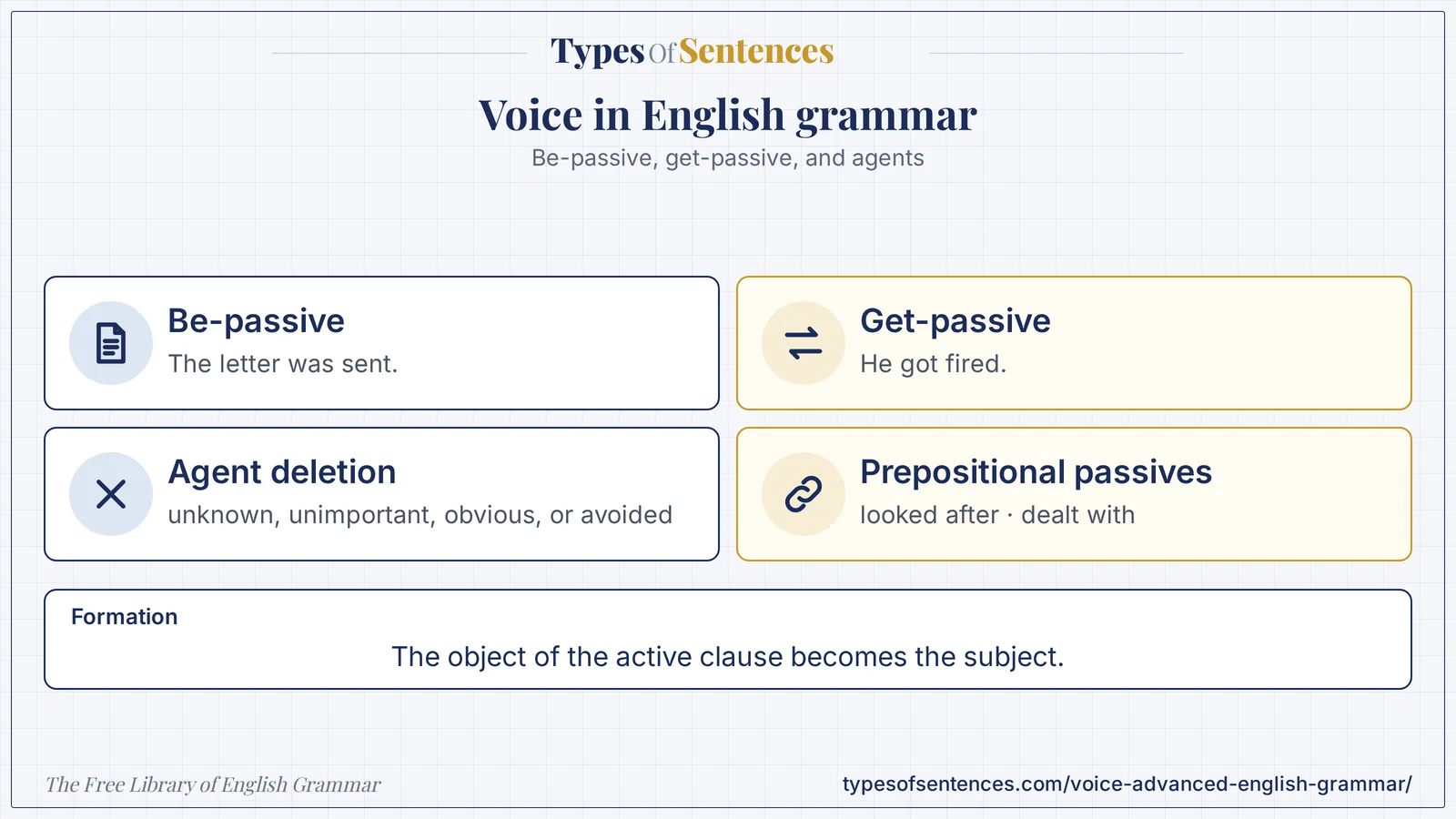
Summary: The passive is formed with be (or get) and the past participle; the object of the active clause becomes the subject and the subject may be expressed in a by-phrase or deleted. Most passives are agentless. The get-passive is informal and often implies a change of state or an adversative outcome. The bare passive uses an -ing form after need, want, or deserve. Prepositional verbs form passives with a stranded preposition (He was looked after), and verbs of saying and thinking form double passives (He is said to have been arrested). Choose voice by focus, information flow, agent importance, and genre.
- Be-passive and get-passive; bare passive with -ing.
- Agent deletion: unknown, unimportant, obvious, or avoided.
- Prepositional passives: looked after, dealt with, talked about.
- Double passives: is thought to have been; choose voice by focus and genre.
What You’ll Learn
- 1. Voice in English Grammar: Active, Passive, and Related Constructions
- 2. Advanced Passive Voice: Agentless Passives and Agent Deletion
- 3. The Get-Passive
- 4. The Bare Passive: Needs Washing
- 5. Complex Passives: Modals, Perfect, and Progressive Forms
- 6. Passives with Prepositional and Phrasal Verbs
- 7. Double Passives and Raising Passives
- 8. Voice in Different Genres
- 9. Choosing Voice: A Method
- 10. Common Errors with Voice
- 11. Exercises
- 12. Test Your Knowledge
- 13. Frequently Asked Questions
- 14. Conclusion
1. Voice in English Grammar: Active, Passive, and Related Constructions
The active voice has the doer as subject; the passive voice makes the receiver (the “patient”) the subject. English has several passive-like constructions that differ in form and meaning.
| Construction | Form | Example | Notes |
|---|---|---|---|
| active | subject = doer | The committee approved the plan. | the default |
| be-passive | be + past participle | The plan was approved (by the committee). | the standard passive |
| get-passive | get + past participle | He got fired. The window got broken. | informal; adversative or change of state |
| bare passive | need/want/deserve + -ing | The car needs washing. This idea bears repeating. | passive meaning with an -ing form |
| stative (adjectival) passive | be + participle as adjective | The door is closed. The shop is open. | a state, not an event |
| middle construction | active verb with patient subject | This book sells well. The fabric washes easily. | an inherent property |
| ergative (inchoative) | active intransitive verb | The door opened. The ice melted. | no agent implied |
| causative | have/get + object + participle | I had my car repaired. She got her hair cut. | someone does it for the subject |
Only a transitive verb (or a prepositional verb) normally forms a passive, so intransitive verbs do not: *The accident was happened. The verb patterns that allow a passive are treated in the chapter on advanced verb concepts. The different constructions in the table are not interchangeable; each is a way of presenting the event.
2. Advanced Passive Voice: Agentless Passives and Agent Deletion
In real texts, most passive clauses have no by-phrase. Corpus studies show that the large majority are agentless, which means that the passive is mainly a device for omitting the agent. The reasons for omission fall into several groups.
| Reason for deleting the agent | Example | Comment |
|---|---|---|
| the agent is unknown | My bike was stolen. | the writer does not know who did it |
| the agent is unimportant | The bridge was built in 1990. | the event matters, not the builder |
| the agent is obvious or recoverable | The thief was arrested. (by the police) | the police are understood |
| the agent is a general or generic agent | English is spoken all over the world. | “people” is understood |
| the process matters (science, instructions) | The samples were heated to 100 degrees. | objectivity; the experimenter is irrelevant |
| topic continuity | The government introduced a tax. The tax was widely criticized. | the patient is the topic |
| avoiding blame or responsibility | Mistakes were made. The decision was taken. | evasive when the agent is known and relevant |
| Strategy for omitting the agent | Example | Effect |
|---|---|---|
| agentless passive | The files were deleted. | no doer named |
| impersonal it + passive | It is said that prices will rise. | the source is generic |
| nominalization | The deletion of the files caused delays. | the action as a thing |
| middle or intransitive verb | The files vanished. | no agent at all |
| inanimate subject | The data suggest that … | the evidence acts |
| existential there | There were errors in the report. | the errors exist; no one made them |
| generic they, one, you | They say it will rain. | vague agent |
3. The Get-Passive
| Feature | Be-passive | Get-passive |
|---|---|---|
| example | He was fired. | He got fired. |
| register | all registers | informal; rare in formal writing |
| meaning | an event or a state (The window was broken is ambiguous) | an event or a change of state (not a state) |
| typical subjects | any patient | often a person affected, with an adversative or benefactive sense: He got fired. She got promoted. |
| agent | common in the by-phrase | rare: ?He got fired by his boss |
| verbs | any transitive verb | verbs of change, events, and things that happen to people: fired, hurt, caught, promoted, stuck |
| not used with | — | most stative verbs: *He got known by everyone; *She got loved by him |
| Use of get + participle | Example | Notes |
|---|---|---|
| true passive | He got fired. The car got stolen. | an affected subject |
| reflexive-like (adjectival) | get dressed, get married, get lost, get used to | the subject does it to himself or herself |
| causative | I got my hair cut. She got the car repaired. | the subject arranges it |
| progressive | He is getting fired. The room is getting cleaned. | a process |
The get-passive often signals that the subject is involved or affected. The window got broken may suggest that something unfortunate happened to it, whereas The window was broken is neutral. The get-passive is a feature of speech, and in formal writing it is replaced by the be-passive.
4. The Bare Passive: Needs Washing
| Pattern | Example | Equivalent |
|---|---|---|
| need + -ing | The car needs washing. The shirt needs ironing. | The car needs to be washed. |
| want + -ing (British, dated) | The room wants cleaning. | The room needs to be cleaned. |
| deserve + -ing | This idea deserves discussing. | …deserves to be discussed. |
| require + -ing | The report requires revising. | …requires revision. |
| bear + -ing | This point bears repeating. | …is worth repeating. |
| be worth + -ing | The film is worth seeing. | …is worth being seen. (not used) |
| adjective + to-infinitive (active form, passive meaning) | The book is easy to read. The water is fit to drink. | …easy to be read. (not used) |
In the bare passive, the -ing form has a passive meaning even though its form is active. The subject is the receiver of the action: The car needs washing means that someone must wash it. A similar effect occurs with adjectives such as easy and hard followed by an infinitive (The book is easy to read), which is called “tough movement”. The non-finite forms are examined in the chapter on non-finite verbs.
5. Complex Passives: Modals, Perfect, and Progressive Forms
| Form | Example | Notes |
|---|---|---|
| modal + passive | The work must be finished. The window can be opened. | modal + be + -en |
| modal + perfect passive | The report should have been sent. The letter may have been lost. | modal + have been + -en |
| passive progressive | The house is being painted. The bridge was being built. | be being + -en |
| perfect passive | The task has been completed. They had been warned. | have been + -en |
| passive infinitive | She wants to be promoted. The work needs to be done. | to be + -en |
| perfect passive infinitive | He seems to have been forgotten. | to have been + -en |
| passive gerund | I hate being told what to do. She remembers having been taken to the zoo. | being/having been + -en |
| be to be + -en (formal) | The meeting is to be held on Friday. The plan is to be revised. | arrangement |
| causative passive | The car is going to be repaired. I had it repaired. | — |
| long chain (rare) | The suspect might have been being watched. | usually rewritten |
The order of the auxiliaries in the passive is the same as in the chapter on complex verb phrases: modal, perfect, progressive, passive. A chain with four elements is grammatical but almost never used. In writing, prefer the simplest form that carries the meaning, or rewrite with an active verb and a general subject (Someone might have been watching the suspect).
6. Passives with Prepositional and Phrasal Verbs
| Verb type | Active | Passive | Notes |
|---|---|---|---|
| prepositional verb | Someone looked after him. | He was looked after. | the preposition stays after the verb |
| prepositional verb | They dealt with the matter. | The matter was dealt with. | — |
| prepositional verb | She laughed at him. | He was laughed at. | — |
| prepositional verb | Everyone talked about the plan. | The plan was talked about. | — |
| prepositional verb | Someone had slept in the bed. | The bed had been slept in. | the object is “affected” |
| phrasal verb | They turned down the offer. | The offer was turned down. | the particle stays |
| phrasal verb | They put off the meeting. | The meeting was put off. | — |
| phrasal-prepositional verb | They did away with the rule. | The rule was done away with. | possible, but awkward |
| not usually passivized | She ran into a friend. / She looked at the picture. | ?A friend was run into. / The picture was looked at. | possible only with strong affectedness |
7. Double Passives and Raising Passives
Verbs of saying, thinking, and believing form passives with an infinitive, which can itself be passive or perfect. These are used mostly in news and academic writing.
| Pattern | Example | Active equivalent |
|---|---|---|
| it + passive + that-clause | It is believed that he was seen. It is said that she left. | People believe that someone saw him. |
| subject + passive + to-infinitive | He is believed to be innocent. She is said to be rich. | People believe him to be innocent. |
| subject + passive + perfect infinitive | He is said to have left. They are reported to have won. | — |
| subject + passive + perfect passive infinitive | He is believed to have been seen. They are thought to have been arrested. | double passive |
| subject + passive + continuous infinitive | She is reported to be living abroad. | — |
| subject + be expected to + passive infinitive | The bill is expected to be passed next week. | — |
| Verbs that form this pattern | Examples |
|---|---|
| saying and reporting | say, report, announce, allege, claim, state, declare |
| thinking and believing | believe, think, consider, suppose, assume, understand, know, presume |
| expecting and finding | expect, find, prove, show, estimate |
The passive-plus-infinitive pattern is a way of reporting a claim without naming the source (He is said to have been involved). It is common in journalism, but writers who use it should be able to say who says so: the pattern can disguise a lack of evidence. In academic writing, the pattern allows the writer to attribute a claim without a name: The disease is thought to have originated in Asia. The reporting structures are examined in the next chapter, on advanced reported speech.
8. Voice in Different Genres
| Genre | Tendency | Example | Comment |
|---|---|---|---|
| scientific and academic (methods) | frequent passive | The samples were heated to 100 degrees. | objectivity; the actor is irrelevant |
| academic (argument, introduction) | mixed, with more active than in the past | We argue that … This paper examines … | many style guides now accept we and I |
| journalism | active; passive for unknown agents and victims | Police arrested a man. A man was arrested at six. | headlines: Man arrested |
| legal writing | frequent passive | The tenant shall be notified. | formality; impersonal rules |
| technical instructions | imperative; passive for descriptions | Press the button. The device is powered by a battery. | — |
| business writing | active preferred | We approved the plan. | clarity and responsibility |
| literary writing | a choice for focus and effect | The door was opened by a stranger. | the passive can create suspense |
| conversation | mainly active; get-passive | He got fired. | — |
Many writers know George Orwell’s rule from “Politics and the English Language”: never use the passive where you can use the active. The advice is useful against vague writing, but it is too strong: the passive is a legitimate tool when the agent is unknown or unimportant, when topic continuity is needed, and in the genres above. Studies of good writing find the passive in all of them. The aim is to choose it, not to avoid it.
9. Choosing Voice: A Method
- What is the sentence about? The topic (given information) usually becomes the subject; see the chapter on information structure.
- Does the reader need the agent? If yes, use the active or the passive with by.
- Is the agent known and responsible? If the reader needs to know who is responsible, name the agent.
- What follows from the previous sentence? The end of one sentence often introduces the subject of the next.
- What is the genre? Check the conventions for science, journalism, law, or business.
- Is the passive clear? If it is awkward, long, or vague, use the active.
- Is it consistent? Avoid shifting voice for no reason in one passage.
| Original | Revised | Reason |
|---|---|---|
| The committee approved the plan. The plan was criticized by the press. | The committee approved the plan. The press criticized it. | active throughout when the agents matter |
| The tax was introduced by the government. It was widely criticized. | The government introduced a tax. The tax was widely criticized. | topic continuity: the tax becomes the topic |
| It was decided that the project would be canceled. | The board decided to cancel the project. | a responsible agent |
| Errors were found in the report. | The auditor found errors in the report. | agent is relevant |
| The solution was heated to 100 degrees. | We heated the solution to 100 degrees. (APA allows) | acceptable in many journals |
10. Common Errors with Voice
| Error | Correction | Rule |
|---|---|---|
| The accident was happened. | The accident happened. | intransitive verbs have no passive |
| He was wrote by Tom. | He was written by Tom. | participle (the sentence is also unclear) |
| The book was wrote by Tom. | The book was written by Tom. | past participle |
| The car needs to wash. | The car needs washing. / The car needs to be washed. | bare passive |
| He got fired by his boss. | He was fired by his boss. / He got fired. | get-passive rarely takes an agent |
| He got known by everyone. | He became known to everyone. / He was known to everyone. | no get-passive with a state |
| The matter was dealt. | The matter was dealt with. | strand the preposition |
| He was looked. | He was looked at. | prepositional verb |
| It is said that he to have left. | He is said to have left. / It is said that he left. | one construction |
| The solution was heated by me to 100 degrees. | I heated the solution to 100 degrees. | agent is the writer |
| Mistakes were made by me. | I made mistakes. | agent is the subject |
| The report was been written. | The report has been written. | perfect auxiliary |
Edit: The accident was happened, and the book was wrote by Tom, so the car needs to wash, and he got fired by his boss, but the matter was dealt, and it is said that he to have left, and mistakes were made by me.
- was happened: happened.
- was wrote: was written.
- needs to wash: needs washing.
- got fired by his boss: was fired by his boss (or got fired).
- was dealt: was dealt with.
- it is said that he to have left: he is said to have left.
- mistakes were made by me: I made mistakes.
- Result: The accident happened, and the book was written by Tom, so the car needs washing, and he was fired by his boss, but the matter was dealt with, and he is said to have left, and I made mistakes.
Recap in 12 seconds
Watch the lesson build itself: The passive uses be or get and the past participle; the agent is often deleted. The video has no sound.
Exercises
Part A: Forms (Exercises 1–7)
Exercise 1: Name the construction: He got fired.
Show Answer
Answer: Get-passive.
Exercise 2: Name the construction: The car needs washing.
Show Answer
Answer: Bare passive.
Exercise 3: Name the construction: The door opened.
Show Answer
Answer: Ergative (inchoative) active.
Exercise 4: Name the construction: This book sells well.
Show Answer
Answer: Middle construction.
Exercise 5: Name the construction: I had my car repaired.
Show Answer
Answer: Causative.
Exercise 6: Edit: The accident was happened.
Show Answer
Answer: The accident happened.
Exercise 7: Edit: The car needs to wash.
Show Answer
Answer: The car needs washing.
Part B: Agent Deletion (Exercises 8–13)
Exercise 8: Give a reason for deleting the agent: My bike was stolen.
Show Answer
Answer: The agent is unknown.
Exercise 9: Give a reason: The samples were heated to 100 degrees.
Show Answer
Answer: Objectivity; the actor is irrelevant.
Exercise 10: Make the agent explicit: Mistakes were made. (by the company)
Show Answer
Answer: The company made mistakes.
Exercise 11: Name a strategy: It is said that prices will rise.
Show Answer
Answer: Impersonal it + passive.
Exercise 12: Name a strategy: The data suggest that …
Show Answer
Answer: An inanimate subject.
Exercise 13: When should the agent be kept?
Show Answer
Answer: When it is new, focal, heavy, contrastive, or a matter of responsibility.
Part C: Get-Passive and Bare Passive (Exercises 14–19)
Exercise 14: Which is informal: He was fired or He got fired?
Show Answer
Answer: He got fired.
Exercise 15: Edit: He got known by everyone.
Show Answer
Answer: He was known to everyone.
Exercise 16: Rewrite as a bare passive: The shirt needs to be ironed.
Show Answer
Answer: The shirt needs ironing.
Exercise 17: Rewrite: This idea bears being repeated.
Show Answer
Answer: This idea bears repeating.
Exercise 18: Name the construction: The book is easy to read.
Show Answer
Answer: Tough movement (active infinitive, passive meaning).
Exercise 19: Name the construction: She got dressed.
Show Answer
Answer: Reflexive-like get + participle.
Part D: Complex and Prepositional Passives (Exercises 20–26)
Exercise 20: Passive: Someone looked after him.
Show Answer
Answer: He was looked after.
Exercise 21: Passive: They dealt with the matter.
Show Answer
Answer: The matter was dealt with.
Exercise 22: Passive: They turned down the offer.
Show Answer
Answer: The offer was turned down.
Exercise 23: Edit: The matter was dealt.
Show Answer
Answer: The matter was dealt with.
Exercise 24: Name the form: The report should have been sent.
Show Answer
Answer: Modal perfect passive.
Exercise 25: Name the form: The house is being painted.
Show Answer
Answer: Passive progressive.
Exercise 26: Name the form: He is believed to have been seen.
Show Answer
Answer: A double passive (raising passive).
Part E: Genres and Choice (Exercises 27–30)
Exercise 27: Which genre uses the passive frequently in methods sections?
Show Answer
Answer: Scientific writing.
Exercise 28: Which voice is preferred in business writing?
Show Answer
Answer: Active.
Exercise 29: Revise for topic continuity: The tax was introduced by the government. It was widely criticized.
Show Answer
Answer: The government introduced a tax. The tax was widely criticized.
Exercise 30: Is Orwell’s rule against the passive absolute?
Show Answer
Answer: No. The passive is legitimate when the agent is unknown or unimportant.
Test Your Knowledge
Ready to check what you learned? Answer all 10 questions, then submit. You need 80% (8 of 10) to pass. Your answers are not stored.
View correct answers and explanations
Question 1: What is the passive voice?
✓ Correct Answer: A – the receiver is the subject
The patient becomes the subject.
Question 2: Which is the get-passive?
✓ Correct Answer: B – He got fired.
Get + past participle.
Question 3: Which is the bare passive?
✓ Correct Answer: C – The car needs washing.
Need + -ing has a passive meaning.
Question 4: Which is correct?
✓ Correct Answer: D – The accident happened.
Intransitive verbs have no passive.
Question 5: Which is correct?
✓ Correct Answer: C – The matter was dealt with.
Strand the preposition.
Question 6: Which is a double passive?
✓ Correct Answer: D – He is believed to have been seen.
Passive + perfect passive infinitive.
Question 7: Why are most passives agentless?
✓ Correct Answer: C – the agent is unknown, unimportant, or obvious
The agent is often omitted.
Question 8: Which is more informal?
✓ Correct Answer: B – He got fired.
Get-passives are informal.
Question 9: Which is a topic-continuity revision?
✓ Correct Answer: A – The government introduced a tax. The tax was criticized.
The tax becomes the topic.
Question 10: Which is correct?
✓ Correct Answer: B – He was known to everyone.
No get-passive with a state.
Frequently Asked Questions
What is voice in English grammar?
Voice in English grammar is the choice between the active voice (the doer is the subject) and the passive voice (the receiver is the subject), together with related constructions such as the get-passive and the bare passive.
What is advanced passive voice?
Advanced passive voice covers agent deletion, the get-passive, the bare passive, complex passives with modals and perfect forms, passives of prepositional verbs, and double passives.
What are passive constructions?
Passive constructions are the structures in which the receiver of an action is the subject: the be-passive, the get-passive, the bare passive, and passive infinitives and gerunds.
What is agent deletion?
Agent deletion is the omission of the doer in a passive sentence: My bike was stolen. It is used when the agent is unknown, unimportant, obvious, or when the writer wants to avoid naming it.
How do I do voice choice well?
For voice choice, decide what the sentence is about, whether the reader needs the agent, what comes from the previous sentence, and what the genre expects. Use the passive when it helps, and the active when the agent matters.
What is the difference between be and get passives?
The be-passive is general and may express a state or an event; the get-passive is informal and expresses an event or change of state, often adversative: He got fired.
Is the passive bad style?
No. Overuse can be vague, but the passive is legitimate in science, law, and many other contexts, and when the agent is unknown or unimportant.
Conclusion
You now have a deep study of voice: the active and passive constructions, agent deletion and its ethics, the get-passive, the bare passive, complex passives, prepositional and phrasal passives, double passives, voice in different genres, and a method of choice. You can use voice with expert control.
When you choose a voice, ask what the sentence is about and who matters. Next, you will study advanced reported speech.
- Huddleston, Rodney, and Geoffrey K. Pullum. The Cambridge Grammar of the English Language. Cambridge University Press, 2002.: the reference analysis of the passive, get-passives, and related constructions.
- Quirk, Randolph, et al. A Comprehensive Grammar of the English Language. Longman, 1985.: the classic treatment of the passive and its restrictions.
- Biber, Douglas, et al. Longman Grammar of Spoken and Written English. Longman, 1999.: corpus evidence on the frequency of passives and agentless passives.
- Orwell, George. “Politics and the English Language.” Horizon 13 (1946): 252–265.: the classic advice against the passive.
- Merriam-Webster Dictionary: passive voice: the dictionary definition.
Last reviewed: October 29, 2026. How it was made: drafted with AI assistance, then checked with automated tests (structure, links, answer keys, spelling) and against the sources above. A person has not yet read this chapter line by line. Found a mistake? Report it.