Title capitalization looks simple (capitalize the important words) until you have to decide whether with is important, whether is is a minor word, and what to do with Up in Giving Up on Perfection. The titles of books, articles, films, and headlines are the most visible lines of any text, so errors in them are the most visible errors, and the rules vary by style guide: the same title is capitalized differently in Chicago, APA, and AP style. Headlines add a second layer of grammar: they use the present tense for past events, omit articles and forms of be, and use commas in place of and.
This chapter sets out the grammar of titles and headlines. You will study capitalization in titles (title case and sentence case), the treatment of articles, the special grammar of headlines, punctuation in titles, quotation marks for short works and italics for long works, and the differences among APA, MLA, Chicago, and AP style. The rule behind title case is that major words are capitalized and minor words are not; the details of which words are minor are the source of the differences. Knowing title grammar and headline style lets a writer produce titles that are correct, consistent, and clear. Thirty exercises and a quiz follow.
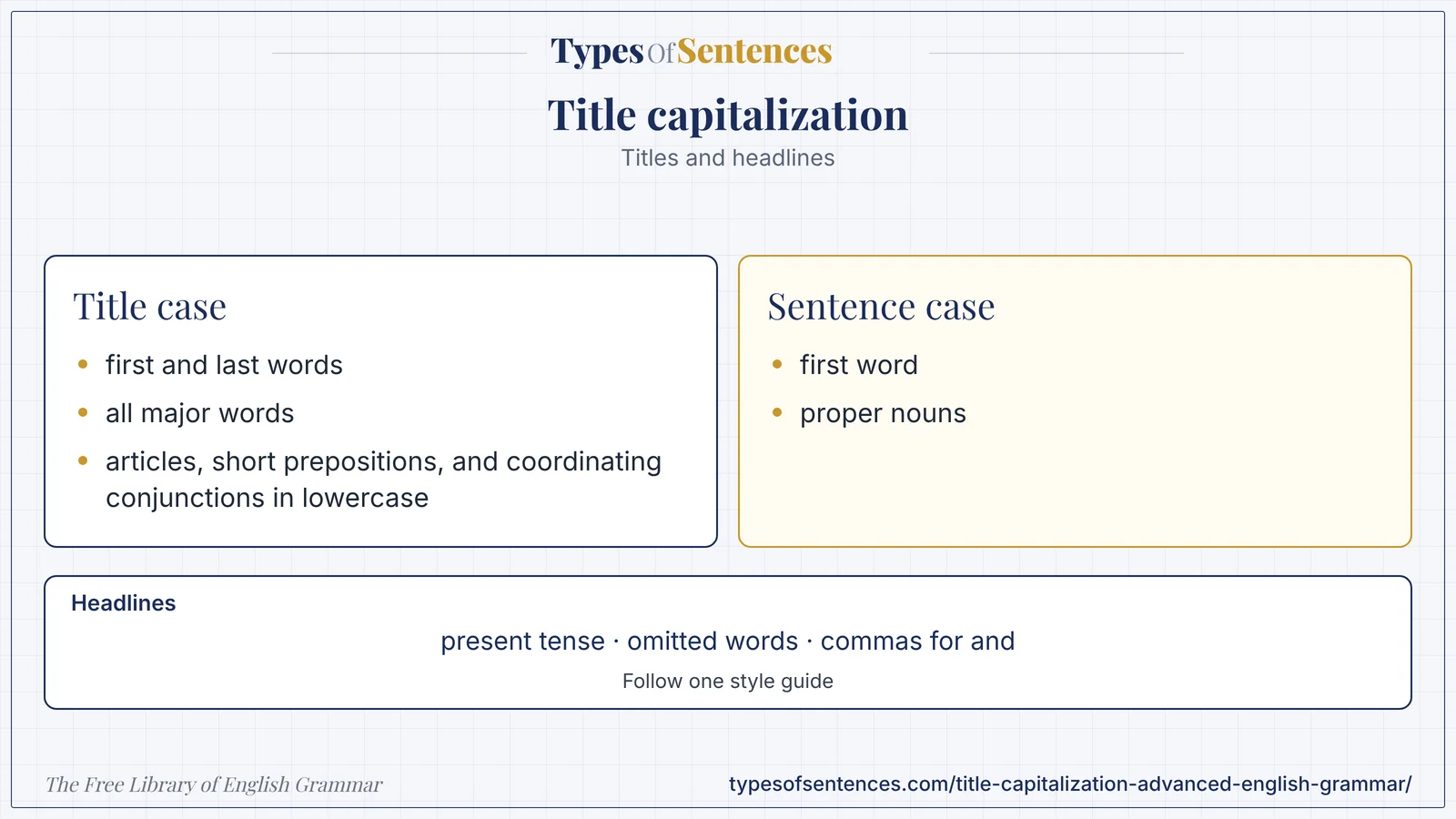
In title case, capitalize the first and last words and all the important words (nouns, verbs, adjectives, adverbs, pronouns); leave small words such as a, the, and, of, in in lowercase. In sentence case, capitalize only the first word and proper nouns.
Why it matters: Style guides differ on prepositions and conjunctions (is with small or not?), so use the guide that your publication requires, and apply it consistently.
Summary: Title case capitalizes the first and last words and all major words (nouns, pronouns, verbs including forms of be, adjectives, adverbs, and subordinating conjunctions), and lowercases articles, coordinating conjunctions, and prepositions; Chicago and MLA lowercase all prepositions, while APA and AP capitalize words of four or more letters. Sentence case capitalizes the first word, proper nouns, and the first word of a subtitle; AP and many British papers use sentence case for news headlines. Headline grammar uses the present tense for past events (Council Approves Plan), the infinitive for the future (Mayor to Sign Bill), omits articles and forms of be, uses commas for and, and avoids ambiguity. Titles take no final period; question marks and exclamation marks belong to the title. Long works take italics, short works take quotation marks. Consistency within a document is essential.
- Title case: first, last, and major words.
- Sentence case: first word and proper nouns.
- Headlines: present tense, omitted words, commas for and.
- Follow one style guide.
What You’ll Learn
- 1. Title Capitalization: Title Case and Sentence Case
- 2. Articles in Titles: When to Include or Omit
- 3. Headline Grammar: Present Tense, Omitted Words, and Commas for “And”
- 4. Punctuation in Titles: Ending and Internal Punctuation
- 5. Quotation Marks for Short Works and Italics for Long Works
- 6. Different Style Guides: APA, MLA, Chicago, and AP
- 7. Common Errors and a Worked Example
- 8. Exercises
- 9. Test Your Knowledge
- 10. Frequently Asked Questions
- 11. Conclusion
1. Title Capitalization: Title Case and Sentence Case
| Style | Rule | Example |
|---|---|---|
| title case (headline style) | capitalize the first and last words and all major words | How to Write a Clear Report |
| sentence case (sentence style) | capitalize the first word, proper nouns, and the first word of a subtitle | How to write a clear report |
| all capitals | a style for signs and display; avoid in running text | HOW TO WRITE A CLEAR REPORT |
| lowercase | a design choice in some brands and websites | how to write a clear report |
| small caps | used in some typography for headings | — |
| Part of speech | Title case | Example |
|---|---|---|
| first word | always capitalized | A Guide to Grammar |
| last word | always capitalized (even a preposition or particle) | What to Look Up |
| nouns, pronouns | capitalized | Grammar for Everyone; Who Moved My Cheese |
| verbs (including is, are, be) | capitalized | What Is a Clause? |
| adjectives and adverbs (including not) | capitalized | The Road Not Taken |
| subordinating conjunctions (if, because, although, when, that) | capitalized in most guides | When Grammar Matters |
| articles (a, an, the) | lowercase, except at the start (or after a colon) | Grammar in the Real World |
| coordinating conjunctions (and, but, for, or, nor, yet, so) | lowercase | Pride and Prejudice |
| prepositions | Chicago and MLA: lowercase of any length; APA and AP: capitalize four letters or more | see the table below |
| to in an infinitive | lowercase | How to Write |
| particles in phrasal verbs (up, out, off) | capitalized (they are adverbs) | Giving Up on Perfection |
| words after a colon | the first word of the subtitle is capitalized | Language: A Short Introduction |
| hyphenated compounds | capitalize the first element, and the rest if they are major words | Twentieth-Century Poetry; Self-Help Books |
| proper nouns | capitalized | Writing in India |
| acronyms and initialisms | keep their form | The NASA Story |
| numbers and symbols | as written | 10 Ways to Write Better |
| words after an em dash | the first word is capitalized (APA) | — |
| brand and special spellings | keep the brand’s form | the iPhone Guide |
| Title (as typed in lowercase) | Chicago and MLA | APA | AP (composition titles) |
|---|---|---|---|
| grammar for everyone: a guide to writing with confidence | Grammar for Everyone: A Guide to Writing with Confidence | Grammar for Everyone: A Guide to Writing With Confidence | Grammar for Everyone: A Guide to Writing With Confidence |
| how to learn from your mistakes | How to Learn from Your Mistakes | How to Learn From Your Mistakes | How to Learn From Your Mistakes |
| what is a clause? | What Is a Clause? | What Is a Clause? | What Is a Clause? |
| the road not taken | The Road Not Taken | The Road Not Taken | The Road Not Taken |
| writing between the lines | Writing between the Lines | Writing Between the Lines | Writing Between the Lines |
| life after death | Life after Death | Life After Death | Life After Death |
| writing through the night | Writing through the Night | Writing Through the Night | Writing Through the Night |
| the quick brown fox jumps over the lazy dog | The Quick Brown Fox Jumps over the Lazy Dog | The Quick Brown Fox Jumps Over the Lazy Dog | The Quick Brown Fox Jumps Over the Lazy Dog |
| giving up on perfection | Giving Up on Perfection | Giving Up on Perfection | Giving Up on Perfection |
| to be or not to be | To Be or Not to Be | To Be or Not to Be | To Be or Not to Be |
| nothing to fear but fear itself | Nothing to Fear but Fear Itself | Nothing to Fear but Fear Itself | Nothing to Fear but Fear Itself |
| five steps to better sentences and clearer paragraphs | Five Steps to Better Sentences and Clearer Paragraphs | Five Steps to Better Sentences and Clearer Paragraphs | Five Steps to Better Sentences and Clearer Paragraphs |
| language and the mind: how we learn to speak | Language and the Mind: How We Learn to Speak | Language and the Mind: How We Learn to Speak | Language and the Mind: How We Learn to Speak |
| twentieth-century poetry and the modern reader | Twentieth-Century Poetry and the Modern Reader | Twentieth-Century Poetry and the Modern Reader | Twentieth-Century Poetry and the Modern Reader |
| reading from left to right | Reading from Left to Right | Reading From Left to Right | Reading From Left to Right |
| a book about the people of india | A Book about the People of India | A Book About the People of India | A Book About the People of India |
| english grammar in use | English Grammar in Use | English Grammar in Use | English Grammar in Use |
| what to do when the writing stops | What to Do When the Writing Stops | What to Do When the Writing Stops | What to Do When the Writing Stops |
| why we sleep: unlocking the power of dreams | Why We Sleep: Unlocking the Power of Dreams | Why We Sleep: Unlocking the Power of Dreams | Why We Sleep: Unlocking the Power of Dreams |
The differences appear only where a preposition or a short conjunction has four or more letters (between, after, through, over, from, with): Chicago and MLA lowercase every preposition, while APA and AP capitalize those with four or more letters. A style guide for your publication decides; the table is a guide to the rules as I know them, and you should check the current edition of your guide. Automatic “title case” converters often follow a simplified rule and make mistakes, so check their output against your guide.
2. Articles in Titles: When to Include or Omit
| Situation | Rule | Example |
|---|---|---|
| article at the start of a title | capitalized, and part of the title | The Hindu (in some styles written without it in running text) |
| article in the middle of a title | lowercase in title case | Grammar in the Real World |
| article after a colon | capitalized (it begins the subtitle) | Grammar: A Short Introduction |
| article before a title in a sentence | follow the grammar of the sentence; omit it if the title’s own The would sound awkward | Joyce’s Ulysses; the Hindu |
| article dropped in running text before a newspaper’s name | Chicago omits or lowercases the before newspaper titles | the New York Times |
| article in a title used as a modifier | — | a Hamlet production |
| article alphabetization | ignore an initial A, An, The in alphabetical lists | The Hindu filed under H |
| articles in headlines | often omitted | Police seek suspect (not The police seek a suspect) |
| articles in website titles and page titles | style-dependent | — |
| articles in the titles of organizations | part of the official name | The Hindu Group (as the name is written) |
| articles in a book title cited in a list of works | include the initial article in the citation as published | — |
| a title beginning with a numeral or a symbol | no article issue | 1984 |
| an article before an acronym | by sound (an MBA) | An MBA for Everyone |
| an article before a proper noun in a title | as in the name | The Netherlands |
| articles in all-lowercase design styles | not capitalized by design | — |
The grammar of articles in titles is the grammar of articles elsewhere: they are function words and, in title case, are not capitalized unless they start the title or the subtitle. In running text, a writer may omit a title’s initial The where it does not read well, but in citations and bibliographies the title is given as published.
3. Headline Grammar: Present Tense, Omitted Words, and Commas for “And”
| Feature | Rule | Example |
|---|---|---|
| present tense for past events | headlines report completed events in the present tense | Council Approves Housing Plan |
| present tense for present events | — | Rain Floods Roads |
| infinitive for future events | to + verb | Mayor to Sign Bill Friday |
| future with will (less common) | — | Mayor Will Sign Bill (rare) |
| omission of articles | a, an, the are dropped | Police Seek Suspect in Robbery |
| omission of forms of be | is, are, was dropped | Prices Down 5%; Two Killed in Crash |
| past participle for the passive | be omitted | Man Rescued from Well |
| comma for and | a comma replaces and between two subjects | Cat, Dog Rescued from Fire |
| colon for said or says | attribution with a colon | Minister: Plan Will Go Ahead |
| semicolon for a period | two parts | Rain Stops; Floods Recede |
| single quotation marks | in AP and British headlines, single marks replace double | Mayor Calls Plan ‘a Disaster’ |
| numbers as figures | always figures in headlines | 5 Injured in Crash |
| abbreviations | limited and widely known | US, UN, UK; avoid others |
| short words (headlinese) | probe, seek, hit, mull, eye | Officials Probe Fire; avoid in formal writing |
| no end period | a headline has no final period | Plan Approved |
| questions | allowed, with a question mark | Will the Plan Work? |
| active voice preferred | the actor first | Council Rejects Plan (not Plan Rejected by Council) |
| a verb in every headline (usually) | a headline without a verb is a label | Plan Approved; Council Approves Plan |
| avoiding ambiguity | omitted words can cause a double meaning (“crash blossoms”) | Squad Helps Dog Bite Victim; Police Shoot Man with Knife |
| stacked nouns | avoid long strings | City Housing Policy Review Committee Report Delayed |
| specific verbs | strong verbs that fit the news | — |
| sentence case in AP and British papers | only the first word and proper nouns | Council approves housing plan |
| title case in magazines and many US papers | major words capitalized | Council Approves Housing Plan |
| numbers and symbols | $5M; 5%; & | style-dependent |
| web headlines | clear, front-loaded, with keywords, without clickbait | — |
| subheadings | the same style as the headline | — |
| headline length | short enough to fit one or two lines | about 6 to 12 words |
| capitalization of verbs in headlines | capitalize all verbs, even is | Plan Is Approved |
| quotation marks for speech | a short quoted phrase | Minister Calls Plan ‘Unworkable’ |
| headline in email subject lines | see the chapter on email | — |
| editorial headlines | may be a phrase or a sentence | — |
| Plain sentence | Headline | What changed |
|---|---|---|
| The council approved the housing plan on Tuesday. | Council Approves Housing Plan | article dropped; present tense |
| The mayor will sign the bill on Friday. | Mayor to Sign Bill Friday | infinitive for the future; on dropped |
| A cat and a dog were rescued from the fire. | Cat, Dog Rescued from Fire | comma for and; were and articles dropped |
| The minister said that the plan will go ahead. | Minister: Plan to Go Ahead | colon for said; infinitive |
| Prices have fallen by five percent. | Prices Down 5% | have fallen replaced by down; figure and symbol |
| The police are looking for a suspect. | Police Seek Suspect | present simple of a short verb |
| Two people were killed in a crash. | 2 Killed in Crash | figure; were dropped |
| The government has announced new rules for exams. | Government Announces New Exam Rules | present for present perfect; noun modifier |
| A new study says that grammar still matters. | Study: Grammar Still Matters | colon for says |
| The team won the match after a late goal. | Team Wins Match on Late Goal | present tense; after replaced by on |
| Students are protesting against fee increases. | Students Protest Fee Increases | present progressive replaced by the simple present |
| Heavy rain has closed schools in the city. | Heavy Rain Closes City Schools | present tense; noun modifier |
| Ambiguous headline (a “crash blossom”) | Readings | Repair |
|---|---|---|
| Squad Helps Dog Bite Victim | a squad helps a dog-bite victim; a squad helps a dog to bite a victim | Squad Helps Victim of Dog Bite |
| Police Shoot Man with Knife | the man had a knife; the police used a knife | Police Shoot Knife-Wielding Man |
| Red Tape Holds Up New Bridge | tape as an object; the red tape of bureaucracy (the intended meaning) | Bureaucracy Delays New Bridge |
| Kids Make Nutritious Snacks | kids prepare snacks; kids are made into snacks | Children Prepare Healthy Snacks |
| Eye Drops Off Shelf | a drop of eye medicine falls; eye drops are removed from the shelf | Eye Drops Removed from Shelves |
| Stolen Painting Found by Tree | painting found next to a tree; a tree found it | Stolen Painting Found Near Tree |
Headline style is a compressed grammar, with its own conventions, and a good headline is clear on a first reading. The ambiguity that omitted words can cause is discussed in the chapters on ambiguity in English and syntax and sentence processing, and the conventions of news headlines in the chapter on journalistic writing. Digital headlines have additional requirements, treated in the chapter on writing for digital media.
4. Punctuation in Titles: Ending and Internal Punctuation
| Question | Rule | Example |
|---|---|---|
| final period | a title does not end with a period | How to Write a Report |
| question mark | kept if part of the title | What Is a Clause? |
| exclamation mark | kept if part of the title | Help! |
| title ending with a question mark in a sentence | no extra period; a comma may follow | Have you read Who Moved My Cheese? |
| colon between title and subtitle | a colon, followed by a space | Grammar: A Short Introduction |
| subtitle capitalization | the first word of the subtitle is capitalized (title case) | Language: A Short Introduction |
| semicolon | rare | — |
| em dash | sometimes in a subtitle or a headline | — |
| commas | as in the original | Eats, Shoots and Leaves |
| hyphens | as in the original | Self-Help for Beginners |
| ampersand | as in the original | Pride & Prejudice (if published so) |
| ellipsis in a title | as in the original | — |
| quotation marks inside a title | single marks inside double; roman text inside an italic title | “The Meaning of ‘Grammar’” |
| a short work’s title inside a long work’s title | quotation marks inside italics | Reading “The Raven” Aloud |
| a long work’s title inside a short work’s title | italics inside quotation marks | “Rereading Hamlet” |
| an italic title inside an italic title | set in roman | Hamlet and the Art of Staging with Hamlet in roman for contrast |
| parentheses | as in the original | — |
| numbers | as in the original | Fahrenheit 451 |
| a title with a date | — | 1984 |
| possessive of a title | ’s added; the apostrophe is roman | Hamlet’s soliloquy |
| title followed by a comma or period in a sentence | the comma or period is roman and follows the title (outside the quotation marks in British style) | I read “The Raven,” and I read Emma. |
| title of a section in a document | no period; consistent style | Methods |
| table and figure titles | a label and a title; style-dependent | Table 3. Results by Year |
| slide titles | a short phrase or sentence; no period | — |
| abbreviations in titles | follow the form in the title | — |
5. Quotation Marks for Short Works and Italics for Long Works
| Work | Format | Example |
|---|---|---|
| book | italics | The Guide |
| article, essay, chapter, short story, poem, song, episode | quotation marks | “Why Grammar Matters” |
| newspaper, magazine, journal | italics | The Hindu |
| film, play, television series, album, painting | italics | Lagaan |
| website (the whole) | italics (style-dependent) | Wikipedia |
| web page or post | quotation marks | “How to Use Commas” |
| title of your own document (in a heading) | neither (set by the heading style) | — |
| unpublished work (a manuscript, a thesis) | quotation marks (or italics in some styles) | “A Study of Articles” |
| sacred texts and laws | roman | the Bible; the Companies Act |
| series title | roman or italics (style-dependent) | — |
The details of this distinction are covered in the chapter on typography and grammar; the point for title capitalization is that titles in quotation marks and titles in italics are capitalized by the same rules, and that the capitalization is part of the title’s form. A short work’s title, in quotation marks, follows the title-case rules of your style (“Politics and the English Language”), and a long work’s title, in italics, follows the same.
6. Different Style Guides: APA, MLA, Chicago, and AP
| Feature | Chicago | MLA | APA | AP |
|---|---|---|---|---|
| title case for titles in text | yes (headline style) | yes | yes (words of four letters or more capitalized) | yes (words of four letters or more capitalized) |
| prepositions | lowercase of any length | lowercase of any length | capitalize four letters or more; lowercase three or fewer | capitalize four letters or more; lowercase three or fewer |
| conjunctions | lowercase coordinating conjunctions; capitalize subordinating conjunctions | lowercase coordinating conjunctions | capitalize four letters or more | capitalize four letters or more |
| to in an infinitive | lowercase | lowercase | lowercase | lowercase |
| first word after a colon | capitalize | capitalize | capitalize | capitalize |
| reference-list titles of articles and books | headline style (bibliography) or sentence style (some author–date lists) | headline style | sentence case (only the first word, the first word of the subtitle, and proper nouns); journal titles in title case | — |
| news headlines | — | — | — | sentence case (first word and proper nouns) |
| article and chapter titles in text | quotation marks | quotation marks | title case in the text; no quotation marks in reference list | quotation marks |
| book titles | italics | italics | italics | quotation marks |
| website titles | roman or italics | italics | italics (whole site) or plain | roman or quotation marks |
| headings in a paper | headline style (levels 1 and 2) or sentence style | title case or sentence case, used consistently | level 1 to 3 in title case; levels 4 and 5 in title case | — |
| hyphenated compounds | capitalize the first element, and the second if it is a major word | capitalize the first element and following major words | capitalize both parts of a major hyphenated word | — |
| the Guardian and many British papers | — | — | — | sentence case for headlines |
| Practical advice | Why |
|---|---|
| use the guide your publication requires | editors check it |
| state the style in a style sheet | consistency |
| apply it to all titles in the document | mixed styles look careless |
| check titles in lists and citations | automated tools may reformat them |
| for web titles and page titles, choose one case and keep it | consistency and branding |
| when quoting a title, keep the form of the source for the title’s wording but apply your style to the capitalization (in many styles) | — |
| do not change the capitalization of a title that is a proper name with a special spelling | e. e. cummings or brand names |
| for page titles and SEO, clarity beats case | — |
| for user interfaces, sentence case is the current convention | Save as; Open file |
| use a checking tool, then check it | tools make mistakes |
7. Common Errors and a Worked Example
| Error | Example | Correction |
|---|---|---|
| lowercase is or are | *What is a Clause? | What Is a Clause? |
| capital on every small word | *A Guide To The Basics Of Grammar | A Guide to the Basics of Grammar |
| lowercase on a major word | *A guide to Writing Well | A Guide to Writing Well |
| lowercase last word | *What to Look up | What to Look Up |
| lowercase particle | *Giving up on Perfection | Giving Up on Perfection |
| lowercase first word after a colon | *Grammar: a Short Introduction | Grammar: A Short Introduction |
| final period | *How to Write a Report. | How to Write a Report |
| wrong format (quotation marks for a book) | *“Pride and Prejudice” (outside AP) | Pride and Prejudice |
| italics for a short work | *the poem The Raven | the poem “The Raven” |
| capital on to in an infinitive | *How To Write | How to Write |
| inconsistent style in one document | *Planning the Work / next steps / Final report | Planning the Work / Next Steps / Final Report |
| headline with a past tense for a past event | *Council Approved Plan (in a news headline) | Council Approves Plan |
| headline with and instead of a comma (a style choice) | — | Cat, Dog Rescued from Fire |
| headline with a period | *Council Approves Plan. | Council Approves Plan |
| ambiguous headline | Squad Helps Dog Bite Victim | Squad Helps Victim of Dog Bite |
| figure spelled out in a headline | *Five Killed in Crash (AP) | 5 Killed in Crash |
| title case in a reference list (APA) | *Writing With Confidence: A Guide | Writing with confidence: A guide |
| sentence case in a book title in running text (APA, MLA) | *Writing with confidence | Writing With Confidence |
| changing a brand’s capitalization | *Iphone Guide | iPhone Guide |
| capitalizing every letter | *A GUIDE TO WRITING | A Guide to Writing |
Edit (Chicago headline style, for a list of titles): 1. what Is a clause? 2. A Guide To Writing With confidence. 3. “Pride and Prejudice” by Jane Austen. 4. giving up on Perfection. 5. How To Learn from your Mistakes. 6. Grammar: a short introduction. 7. Council Approved The Housing Plan. 8. Reading between The Lines.
- 1. what Is a clause?: What Is a Clause?
- 2. A Guide To Writing With confidence: A Guide to Writing with Confidence (Chicago lowercases to and with).
- 3. “Pride and Prejudice”: a book takes italics: Pride and Prejudice by Jane Austen.
- 4. giving up on Perfection: Giving Up on Perfection.
- 5. How To Learn from your Mistakes: How to Learn from Your Mistakes.
- 6. Grammar: a short introduction: Grammar: A Short Introduction.
- 7. Council Approved The Housing Plan (as a news headline): Council Approves Housing Plan (present tense; article dropped).
- 8. Reading between The Lines: Reading between the Lines.
- Note: in APA or AP style, number 2 would read A Guide to Writing With Confidence and number 8 Reading Between the Lines. (the titles are invented, apart from the classic books named)
Recap in 12 seconds
Watch the lesson build itself: Title case capitalizes the first and last words and all major words; sentence case capitalizes the first word and proper nouns. The video has no sound.
Exercises
Part A: Title Case and Sentence Case (Exercises 1–8)
Exercise 1: Define title case.
Show Answer
Answer: Capitalizing the first and last words and all major words.
Exercise 2: Define sentence case.
Show Answer
Answer: Capitalizing only the first word, proper nouns, and the first word of a subtitle.
Exercise 3: Title case: what is a clause?
Show Answer
Answer: What Is a Clause?
Exercise 4: Title case (Chicago): how to learn from your mistakes
Show Answer
Answer: How to Learn from Your Mistakes.
Exercise 5: Title case (APA): how to learn from your mistakes
Show Answer
Answer: How to Learn From Your Mistakes.
Exercise 6: Title case: giving up on perfection
Show Answer
Answer: Giving Up on Perfection.
Exercise 7: Title case: the road not taken
Show Answer
Answer: The Road Not Taken.
Exercise 8: Capitalize to in an infinitive?
Show Answer
Answer: No (How to Write).
Part B: Articles and Punctuation (Exercises 9–14)
Exercise 9: Capitalize the in the middle of a title?
Show Answer
Answer: No (Grammar in the Real World).
Exercise 10: Capitalize the first word after a colon?
Show Answer
Answer: Yes.
Exercise 11: Does a title take a final period?
Show Answer
Answer: No.
Exercise 12: Keep a question mark that is part of a title?
Show Answer
Answer: Yes.
Exercise 13: Correct: *Grammar: a Short Introduction
Show Answer
Answer: Grammar: A Short Introduction.
Exercise 14: How do you set a short work inside an italic title?
Show Answer
Answer: In quotation marks, within the italics.
Part C: Headline Grammar (Exercises 15–22)
Exercise 15: Headline: The council approved the plan.
Show Answer
Answer: Council Approves Plan.
Exercise 16: Headline: The mayor will sign the bill on Friday.
Show Answer
Answer: Mayor to Sign Bill Friday.
Exercise 17: Headline: A cat and a dog were rescued.
Show Answer
Answer: Cat, Dog Rescued.
Exercise 18: Headline: Prices have fallen by five percent.
Show Answer
Answer: Prices Down 5%.
Exercise 19: What tense do headlines use for past events?
Show Answer
Answer: The present.
Exercise 20: What replaces and between two subjects?
Show Answer
Answer: A comma.
Exercise 21: What replaces said in a headline?
Show Answer
Answer: A colon.
Exercise 22: Repair: Squad Helps Dog Bite Victim
Show Answer
Answer: Squad Helps Victim of Dog Bite.
Part D: Quotation Marks, Italics, and Style Guides (Exercises 23–28)
Exercise 23: Format: the film Lagaan.
Show Answer
Answer: Italics.
Exercise 24: Format: the song “Jana Gana Mana”.
Show Answer
Answer: Quotation marks.
Exercise 25: Which style uses sentence case for reference-list titles?
Show Answer
Answer: APA.
Exercise 26: Which style lowercases all prepositions in title case?
Show Answer
Answer: Chicago and MLA.
Exercise 27: Which style uses sentence case for news headlines?
Show Answer
Answer: AP (and many British papers).
Exercise 28: Does AP set book titles in italics?
Show Answer
Answer: No; AP uses quotation marks for most titles.
Part E: Editing (Exercises 29–30)
Exercise 29: Correct: *A Guide To The Basics Of Grammar
Show Answer
Answer: A Guide to the Basics of Grammar.
Exercise 30: Correct: *What to Look up
Show Answer
Answer: What to Look Up.
Test Your Knowledge
Ready to check what you learned? Answer all 10 questions, then submit. You need 80% (8 of 10) to pass. Your answers are not stored.
View correct answers and explanations
Question 1: In title case, which words are capitalized?
✓ Correct Answer: A – the first and last words and the major words
First, last, and major words.
Question 2: Sentence case capitalizes
✓ Correct Answer: B – the first word and proper nouns
First word and proper nouns.
Question 3: In Chicago and MLA title case, prepositions are
✓ Correct Answer: C – lowercase regardless of length
Lowercase.
Question 4: Which is correct in APA title case?
✓ Correct Answer: D – Writing With Confidence
Four-letter words are capitalized.
Question 5: A headline such as Council Approves Plan uses
✓ Correct Answer: C – the present tense for a past event
Present tense.
Question 6: What does Mayor to Sign Bill show?
✓ Correct Answer: A – the infinitive for a future event
Infinitive for the future.
Question 7: Which is the correct title case?
✓ Correct Answer: D – What Is a Clause?
Capitalize Is; lowercase a.
Question 8: A headline typically omits
✓ Correct Answer: C – articles and some forms of be
Articles and be.
Question 9: Short works such as articles, poems, and songs are set in
✓ Correct Answer: B – quotation marks
Quotation marks.
Question 10: Which style uses sentence case for reference-list titles of articles?
✓ Correct Answer: B – APA
APA.
Frequently Asked Questions
What is title capitalization?
Title capitalization is the set of rules for which words in a title are capitalized: in title case, the first and last words and all major words; in sentence case, only the first word and proper nouns. Title capitalization varies by style guide.
What are titles and headlines?
Titles are the names of works (books, articles, films); headlines are the titles of news stories and articles. Titles and headlines follow different conventions of grammar and capitalization.
What is title grammar?
Title grammar covers capitalization, articles, punctuation, and the use of italics or quotation marks in titles. Title grammar depends on the style guide.
What is headline grammar?
Headline grammar is the compressed grammar of headlines: the present tense for past events, the infinitive for the future, omitted articles and forms of be, commas for and. Headline grammar saves space but must avoid ambiguity.
What is headline style?
Headline style can mean the capitalization style (title case) or the compressed grammar of news headlines. Headline style differs between AP (sentence case) and Chicago (title case).
Should with be capitalized in a title?
In Chicago and MLA, no (prepositions are lowercase). In APA and AP, yes, because it has four letters.
Which style guide should I follow?
The one required by your publication, institution, or instructor, applied consistently to all titles in the document.
Conclusion
You now have a guide to title capitalization: title case and sentence case, articles, headline grammar, punctuation in titles, quotation marks and italics, the differences among style guides, and the common errors. You can capitalize and punctuate titles and headlines correctly.
When you write a title, ask which style governs and what the reader needs to see first. Next, you will begin Part 11 with grammar in email and digital communication.
- The Chicago Manual of Style. University of Chicago Press. (check the current edition): headline-style and sentence-style capitalization.
- Publication Manual of the American Psychological Association. 7th ed. American Psychological Association, 2020.: title case and sentence case in APA.
- MLA Handbook. 9th ed. Modern Language Association, 2021.: capitalization of titles.
- The Associated Press Stylebook. Associated Press. (updated regularly): composition titles and headlines.
- Merriam-Webster Dictionary: headline: the dictionary entry.
Last reviewed: October 29, 2026. How it was made: drafted with AI assistance, then checked with automated tests (structure, links, answer keys, spelling) and against the sources above. A person has not yet read this chapter line by line. Found a mistake? Report it.