Complex sentence architecture is the study of how long and elaborate sentences are put together, and how to build them so that they stay clear. The word complex is often used as if it meant confusing, but the two are different. A complex sentence is one that has several parts arranged in a structure, as a building has rooms arranged in a plan; a confusing sentence is one whose plan the reader cannot see. Some of the best sentences in English are very complex, and some of the worst are short. What separates them is architecture: the order of the parts, the signals that mark the joins, and the way that each unit is closed before the next is opened.
This chapter describes the levels of complexity, from the simple sentence to multiple embedding, and then looks at the structures that decide how easy a complex sentence is to read: center embedding (hard), right-branching (easy), and left-branching (compact but demanding). It treats three classical shapes of the complex sentence, the periodic, the cumulative, and the balanced, and gives a method for building complex sentences step by step. The aim is advanced sentence structure that serves the reader: complex syntax that is under control, and sentence complexity that is chosen and not accidental. Thirty editing exercises and a quiz follow.
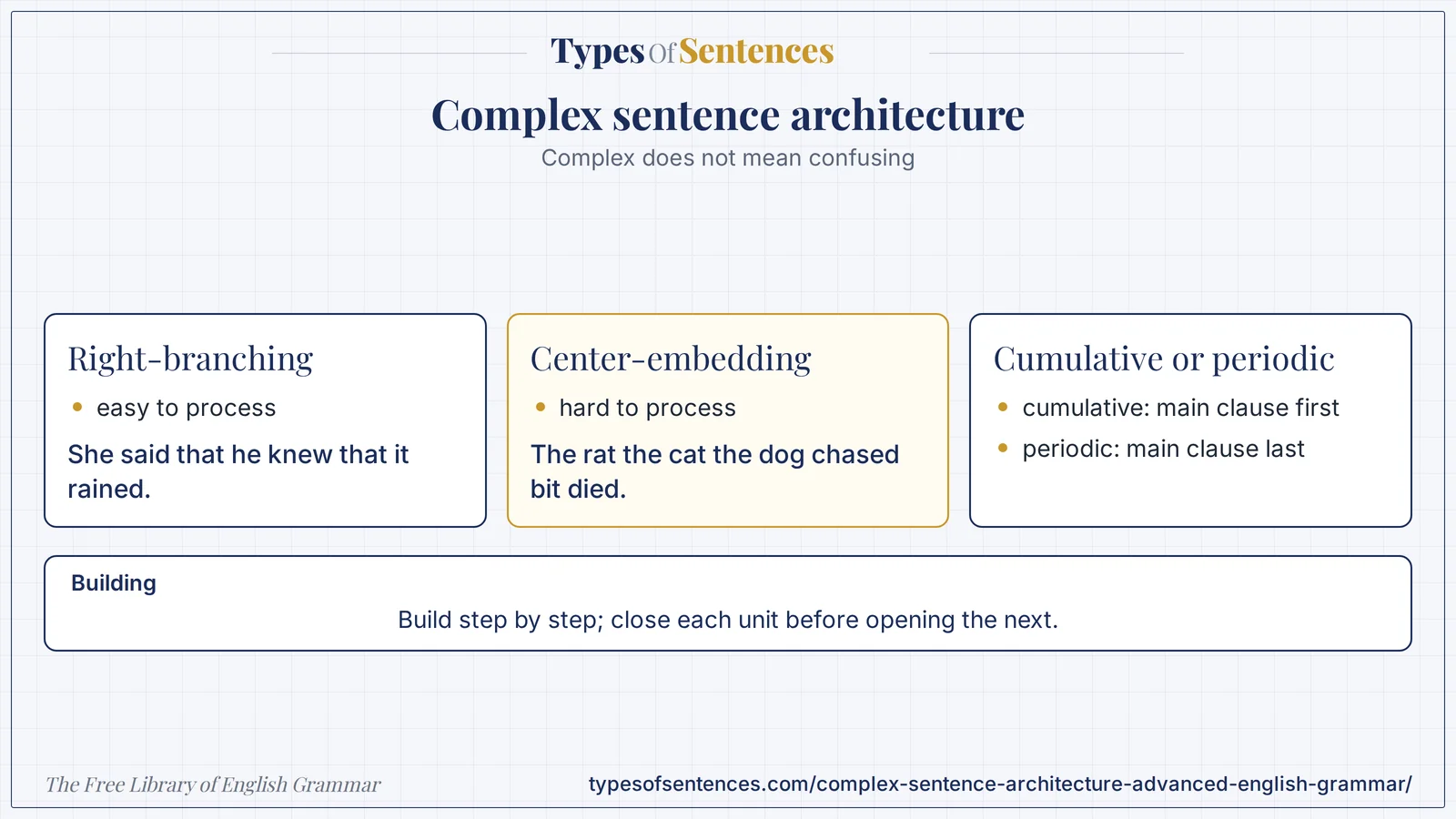
A complex sentence is a sentence with several parts, and the skill is in the order of the parts. If each part is finished before the next begins, or if the parts are added one after another at the end, the reader can follow a long sentence easily. If one part is stuffed into the middle of another, the reader has to hold unfinished business in mind, and the sentence becomes hard.
Why it matters: A writer can choose among three shapes: put the point first and add detail (cumulative), build suspense and put the point last (periodic), or set two ideas side by side in matching form (balanced).
Summary: Complexity can be measured by the number of clauses, the depth of embedding, the distance between related words, and the complexity of noun phrases. English strongly prefers right-branching structures, in which new clauses and phrases are added at the end, because they are easy to process. Center embedding (a clause inside the subject–verb span) is hard and should be avoided beyond one level. Left-branching structures, such as long noun compounds and stacked premodifiers, are compact but demanding. The cumulative sentence states its main clause first and adds free modifiers; the periodic sentence withholds the main clause until the end for suspense and emphasis; the balanced sentence sets matching structures in parallel or antithesis. Complex sentences are built by starting with a base clause and adding modifiers, coordination, and subordination step by step, with clear punctuation and signals.
- Complex does not mean confusing.
- Right-branching is easy; center-embedding is hard.
- Cumulative: main clause first; periodic: main clause last; balanced: parallel.
- Build step by step; close each unit before opening the next.
What You’ll Learn
- 1. Complex Sentence Architecture: Levels of Complexity
- 2. Multiple Embeddings: Clauses Within Clauses
- 3. Center Embedding: Processing Difficulty
- 4. Right-Branching vs Left-Branching: The English Preference
- 5. Periodic Sentences: The Main Clause Last
- 6. Cumulative Sentences: The Main Clause First
- 7. Balanced Sentences: Parallelism and Antithesis
- 8. Building Complex Sentences: A Step-by-Step Method
- 9. Complexity in Different Kinds of Writing
- 10. Common Faults in Complex Sentences
- 11. Exercises
- 12. Test Your Knowledge
- 13. Frequently Asked Questions
- 14. Conclusion
1. Complex Sentence Architecture: Levels of Complexity
| Level | Sentence (invented) | Words | Clauses | Structure |
|---|---|---|---|---|
| 1 simple | The council approved the plan. | 5 | 1 | one independent clause |
| 2 compound | The council approved the plan, and the mayor signed it. | 10 | 2 | two independent clauses (coordination) |
| 3 complex | When the council approved the plan, the mayor signed it. | 10 | 2 | one independent and one dependent clause (subordination) |
| 4 compound-complex | When the council approved the plan, the mayor signed it, and the work began. | 14 | 3 | two independent clauses and one dependent clause |
| 5 with non-finite and relative clauses | After approving the plan, which the residents had demanded for years, the council asked the mayor to sign it before the work began. | 23 | 5 | one main clause; a relative clause and an adverbial clause; two non-finite clauses |
| 6 multiple embedding | The mayor said that the council, which had approved the plan after the residents had demanded it for years, believed that the work would begin before the rains came. | 29 | 6 | clauses embedded up to three levels deep |
| 7 center-embedded (hard) | The plan the council the residents elected approved was signed. | 10 | 3 | two center-embeddings: hard to read despite the short length |
| Dimension of complexity | What it measures | Example |
|---|---|---|
| sentence length | words per sentence | 5 versus 29 words |
| clausal complexity | clauses per sentence; the T-unit (a main clause with its dependent clauses; Hunt, 1965) | levels 1 to 6 above |
| coordination | clauses joined by and, but, or | level 2 |
| subordination | dependent clauses (adverbial, relative, nominal) | level 3 |
| embedding depth | how many clauses lie inside other clauses | level 6: depth three |
| phrasal complexity | long noun phrases with modifiers (typical of academic prose) | the rapid expansion of urban housing in coastal regions |
| dependency distance | words between a word and its head | see the chapter on sentence processing |
| non-finite clauses | -ing, -ed, and to clauses | After approving the plan … |
| information density | how much content per word | — |
| Kind of complexity | Typical register | Example |
|---|---|---|
| clausal (many clauses, subordination) | speech and narrative | He said he thought she knew he would come. |
| phrasal (long noun phrases, few clauses) | academic and news writing | the rapid expansion of urban housing |
| coordinate (many ands) | informal speech, children’s prose, rhetoric | and … and … and |
| mixed | literary and legal prose | — |
Complexity is not a measure of quality. A simple sentence is often the best choice, and a very complex sentence can be a masterpiece or a mess. The first task is to see the structure: to be able to say what the main clause is, what each other clause is attached to, and how deep the embedding goes. The classification of sentence structures is described in the chapters on coordination and subordination and on the intermediate sentence types, and the subordinate clauses are described in the chapters on nominal clauses, adverbial clauses, and complement clauses.
2. Multiple Embeddings: Clauses Within Clauses
| Embedded unit | Where it sits | Example (embedded clause in brackets) |
|---|---|---|
| relative clause | after a noun | The report [that the committee wrote] was long. |
| nominal (complement) clause | as subject, object, or complement | She said [that the vote would be late]. |
| adverbial clause | modifies a clause | The meeting began [after the chairman arrived]. |
| non-finite clause | a participle or infinitive | [Having read the report], she left. / He wanted [to leave]. |
| appositive clause | explains a noun | The fact [that the plan failed] surprised us. |
| noun-phrase modifier | inside a noun phrase | the proposal [to extend the hours] |
| parenthetical | interrupts the clause | The plan, [as you know], failed. |
| Pattern | Example with bracketing | Depth |
|---|---|---|
| right-branching chain | She said [that he thought [that they believed [that it would rain]]]. | three levels, all at the end |
| relative within relative (right-branching) | This is the dog [that chased the cat [that ate the rat [that lived in the house]]]. | three levels, all at the end |
| adverbial within nominal | He claimed [that the work would begin [before the rains came]]. | two levels |
| relative within adverbial within main | The mayor resigned [after the council, [which had approved the plan], rejected his budget]. | two levels |
| center-embedded (hard) | The plan [the council [the residents elected] approved] was signed. | two center levels |
| mixed | The idea [that the committee [which the council appointed] would finish early] was optimistic. | two levels: one is center-embedded |
- Count the levels. Up to two levels of right-branching embedding are usually easy; three or more require clear signals.
- Use the same type of embedding in a chain only where the repetition helps. A chain of that-clauses can feel like a nursery rhyme.
- Identify what each clause modifies. A reader needs to know which noun a relative clause belongs to.
- Use punctuation to mark non-restrictive clauses (commas) and to separate long units (semicolons).
- Keep subject and verb together where possible (see the previous chapter, on syntax and sentence processing).
3. Center Embedding: Processing Difficulty
| Sentence | Structure | Difficulty |
|---|---|---|
| This is the malt that the rat ate. | one relative clause at the end | easy |
| This is the malt that the rat that the cat killed ate. | a clause inside the relative clause | hard |
| The rat the cat killed ate the malt. | a relative clause inside the subject (center) | moderate |
| The rat the cat the dog chased killed ate the malt. | two clauses inside the subject | very hard (Miller and Chomsky, 1963) |
| The report the committee the council appointed wrote was long. | two center embeddings | very hard |
| The lawyer the banker hired quit. | one center embedding | manageable |
| A man who a woman who a child saw met left. | two center embeddings with who | very hard |
| The fact that the plan the committee proposed failed surprised us. | an appositive clause containing a center-embedded relative | hard |
| Why center embedding is hard | Explanation |
|---|---|
| unfinished subjects pile up | three subjects must be held until three verbs arrive |
| verbs are far from their subjects | the matching of subject and verb requires memory |
| similar noun phrases interfere | the cat, the dog, and the rat are alike in memory |
| no signals help | relative pronouns may be omitted |
| grammar allows it | the limit is memory, not grammar (see the previous chapter) |
| Technique to remove center embedding | Before | After |
|---|---|---|
| convert to right-branching | The rat the cat the dog chased killed ate the malt. | The dog chased the cat that killed the rat that ate the malt. |
| use the passive | The report the committee wrote was long. | The report written by the committee was long. |
| split into sentences | The report the committee the council appointed wrote was long. | The council appointed a committee. It wrote a long report. |
| replace the embedded clause with a phrase | The plan the residents elected the council to approve … | The plan approved by the council the residents elected … |
| use a relative pronoun and commas | The man whom the woman whom the child saw met left. | The child saw a woman. The woman met a man. The man left. |
| move the clause to the end | The idea that the project, which was late, would fail … | The idea that the project would fail, since it was late, … |
Center embedding occurs naturally in a single level (The report the committee wrote), and is common in speech, but more than one level is rare in natural writing. Legal and technical text sometimes contains it, and editing for readers means finding and removing it. The general principle is that a unit should be closed before another is opened, a principle that the cumulative sentence follows by design.
4. Right-Branching vs Left-Branching: The English Preference
| Feature | Right-branching | Left-branching |
|---|---|---|
| definition | dependents follow the head; new material is added at the end | dependents precede the head; material accumulates before the word it modifies |
| English tendency | strongly preferred in clause structure | used in noun phrases (premodification) |
| verb phrases | verb before object (read the book) | — |
| prepositional phrases | preposition before noun (in the house) | — |
| relative clauses | after the noun (the man who came) | — |
| noun phrases | — | the university student housing policy committee |
| processing | easy: each constituent closes in turn | harder: the reader holds modifiers until the head appears |
| contrast with other languages | Japanese, Korean, Turkish are mostly left-branching (head-final) | — |
| Left-branching device in English | Example | Effect |
|---|---|---|
| noun compounds | climate change adaptation policy | compact, but hard to parse if long |
| participial premodifiers | a recently approved, long-delayed project | dense information before the noun |
| compound adjectives | a hard-to-find book, a never-to-be-forgotten day | packing a phrase before a noun |
| possessive chains | my friend’s sister’s husband’s car | hard after two links |
| adverbial openers | Despite the cost, and although it was late, … | delay of the main clause |
| stacked adjectives | a big old red wooden barn | natural order, but long |
| long subjects | The rapid expansion of urban housing in coastal regions during the last decade … | a heavy subject before the verb |
| Version | Sentence | Branching |
|---|---|---|
| right-branching | We hired a consultant who reviewed the plan that the council had approved after the residents had complained. | additional clauses at the end |
| left-branching (noun-phrase compression) | We hired a plan-review consultant after the residents’ complaint-prompted council approval. | long premodifier chains: harder |
| mixed (balanced) | After the residents complained, the council approved the plan, and we hired a consultant to review it. | closed units in a clear sequence |
Because English is mostly right-branching, a writer who needs to add information can usually do so at the end of a clause, with a relative clause, a participial phrase, an appositive, or an adverbial. This is the principle of the cumulative sentence, discussed below. Left-branching compression is characteristic of academic and news prose, as described in the chapter on complex noun phrases, and in moderation it is efficient; in excess, it creates the noun-string problem.
5. Periodic Sentences: The Main Clause Last
| Feature | Periodic sentence | Example |
|---|---|---|
| definition | a sentence in which the main clause (or its predicate) is delayed until the end, so that the sense is incomplete until the last words | Despite the doubts of her colleagues, the opposition of the board, and the weight of precedent, she decided to proceed. |
| effect | suspense, emphasis, a sense of climax and completeness | — |
| register | formal, rhetorical, literary; speeches and essays | — |
| structure | opening subordinate clauses, phrases, or parallel elements, then the subject and verb | When the last guest had gone, when the lamps had been put out, when the house at last was quiet, she sat down and wept. |
| contrast | the loose (cumulative) sentence, which states the main clause first | She sat down and wept when the last guest had gone. |
| Periodic sentence (original) | What is delayed | Effect |
|---|---|---|
| Whatever their differences, whatever their grievances, and whatever the cost, the two sides agreed to talk. | the main clause the two sides agreed to talk | a long anticipation resolved |
| If the evidence is sound and the reasoning is clear, then the conclusion must stand. | the main clause the conclusion must stand | logical suspense |
| After years of argument, after a dozen failed votes, and after the departure of its chairman, the committee finally met. | the main clause the committee finally met | a build to an event |
| Not by force, not by money, not by fear, but by patience did the town survive. | the predicate the town survive (with inversion) | balance and suspense |
| That a plan so carefully drafted, so widely praised, and so long awaited should fail is astonishing. | the predicate is astonishing | a heavy subject clause delaying the verb |
| To the surprise of everyone in the room, including the chairman himself, the motion passed. | the main clause the motion passed | a surprise at the end |
- Decide the point you want to emphasize, and make it the main clause.
- Gather the preliminary material (conditions, contrasts, circumstances).
- Place the preliminary material first, usually in parallel form.
- Keep each unit short enough to be remembered; two or three parallel units are usually enough.
- Put the main clause last, in a short, strong form.
- Read it aloud. If the reader loses the thread, make the sentence cumulative.
- Use periodic sentences sparingly. A whole paragraph of them is tiring.
- Do not delay the main clause beyond the reader’s memory.
- Use punctuation (commas, dashes) to mark the joins.
- Choose them for climax and emphasis, not for decoration.
6. Cumulative Sentences: The Main Clause First
The rhetorician Francis Christensen, in A Generative Rhetoric of the Sentence (1963), described the cumulative sentence as the characteristic form of modern prose: a base clause followed by “free modifiers” that add detail, each at a lower level of generality. The sentence moves forward by adding, and the reader can close each unit as it ends.
| Level | Element | Example (original) |
|---|---|---|
| 1 | base clause | The old man walked down the road, |
| 2 | free modifier (participial phrase) | carrying a basket of mangoes, |
| 3 | absolute phrase (a noun with a participle) | his shirt soaked with sweat, |
| 3 | appositive | a stick in one hand, a transistor radio in the other, |
| 4 | adjective phrase | tired but cheerful, |
| 4 | relative clause | which played a song he did not know. |
| Free modifier | Pattern | Example |
|---|---|---|
| participial phrase | verb + -ing or -ed + object | She stood at the window, watching the rain. |
| absolute phrase | noun + participle | She stood at the window, her hands folded. |
| appositive | a noun phrase renaming a noun | The village, a cluster of tin roofs, lay below. |
| adjective phrase | adjectives (with complements) after the noun | The road, long and empty, ran east. |
| relative clause (non-restrictive) | which/who + clause | The road, which the rains had washed out, ran east. |
| prepositional phrase | preposition + noun | He sat on the steps, in the last light. |
| adverbial clause | as, while, because | The bus pulled out, as the light failed. |
| infinitive phrase | to + verb | He lingered, to hear the last of the song. |
| Simple sentences | Cumulative sentence |
|---|---|
| The boy ran. He ran across the yard. He held a kite. The kite was red. The wind was strong. | The boy ran across the yard, holding a red kite, the wind pulling it, strong and steady, toward the trees. |
| The team won. The crowd cheered. The players wept. | The team won, the crowd cheering, the players weeping on the field. |
| She opened the box. Inside was a letter. It was addressed to her mother. | She opened the box and found a letter, yellowed and brittle, addressed to her mother. |
- Start with a clear base clause that states the point.
- Add free modifiers that give detail, image, and circumstance, moving from the general to the specific.
- Use commas to set off each free modifier.
- Keep the base clause close to the front so that the reader has the main idea.
- Avoid dangling modifiers. A participial modifier should modify the subject of the base clause.
- Stop before the sentence becomes a list. Three or four modifiers are usually enough.
The cumulative sentence is the natural form of right-branching English and is characteristic of narrative, description, and clear exposition. Its relation to creative technique is described in the chapter on creative writing techniques. A writer who can build a cumulative sentence can add detail without losing the reader.
7. Balanced Sentences: Parallelism and Antithesis
| Type | Structure | Example (public-domain or original) |
|---|---|---|
| balanced (parallel) | two or more clauses or phrases of the same form and length | She came early, and she stayed late. |
| antithesis | balanced parts that express opposed ideas | To err is human; to forgive, divine. (Alexander Pope, 1711) |
| isocolon | parts of equal length and rhythm | Easy to learn, easy to use. |
| chiasmus | parallel in reverse order (AB–BA) | Do not live to eat; eat to live. |
| correlative balance | not only … but also, either … or, the more … the more | The more we study, the more we know. |
| tricolon | three parallel parts | safer, stronger, and smarter |
| balanced complex sentence | dependent clauses of matching form around a main clause | When the plan succeeds, we celebrate; when it fails, we learn. |
| periodic balance | parallel clauses before the main clause | If we begin early, if we plan well, and if we persist, we will finish. |
| Plain | Balanced |
|---|---|
| The plan has good points and it has bad points, and it is expensive, and it is quick. | The plan is quick but expensive, practical but risky. |
| We should plan the work and then we should do the work, and after that we should check the work. | We should plan the work, do the work, and check the work. |
| Some people like cities and some people like the country. | Some prefer the city; others, the country. |
- Use parallel form for ideas of equal weight (see the earlier chapter on parallel structure).
- Match length as well as form in the parts of a balanced sentence.
- Place the contrasted terms at corresponding positions (to err … to forgive).
- Do not force symmetry on ideas that are not symmetrical.
- Do not overuse. A text of balanced sentences sounds like a speech or an aphorism.
Balanced sentences are the main instruments of the rhetoric of contrast and emphasis; they are treated further in the chapter on rhetoric and grammar. They combine well with the periodic and cumulative forms, as in When the plan succeeds, we celebrate; when it fails, we learn.
8. Building Complex Sentences: A Step-by-Step Method
| Step | Operation | Result |
|---|---|---|
| 1 base clause | state the main point | The council approved the plan. |
| 2 add time | a subordinate or prepositional phrase | The council approved the plan on Tuesday. |
| 3 add reason | an adverbial clause | The council approved the plan on Tuesday because the residents had demanded it. |
| 4 add concession | a contrasting clause | Although the cost was high, the council approved the plan on Tuesday because the residents had demanded it. |
| 5 add a free modifier | a participial phrase after the base | …, ending a three-year dispute. |
| 6 add a relative clause | information about a noun | …, the plan, which the mayor had drafted, … |
| 7 check the order | main idea clear; units closed in turn | — |
| 8 punctuate and read aloud | commas and semicolons mark joins | Although the cost was high, the council approved the plan on Tuesday, ending a three-year dispute that had divided the town. |
| Question at each step | Why |
|---|---|
| What is the main idea? | it must be in the main clause |
| What does the new material modify? | avoid dangling and ambiguous attachment |
| Is the relationship coordinate or subordinate? | choose and or a subordinator |
| Where does the new material go: before (periodic) or after (cumulative)? | suspense or ease |
| Can the reader close each unit? | avoid center-embedding |
| Is it parallel where it should be? | balance and clarity |
| Is the punctuation clear? | commas, semicolons, dashes, colons |
| Is the sentence too long for its job? | split if so |
| Punctuation in complex sentences | Use | Example |
|---|---|---|
| comma | after an introductory element; around non-restrictive material; between coordinated clauses with a conjunction | When the vote ended, the chairman, who was tired, left. |
| semicolon | between related independent clauses; between long items in a series | The plan failed; the cost was too high. |
| colon | to introduce an explanation or a list | The plan had one flaw: the cost. |
| dash | to set off an interruption or a summary | The plan—costly, slow, and unpopular—failed. |
| parentheses | for incidental information | The plan (as drafted) failed. |
| no punctuation | between a subject and its verb | — |
The method is a form of sentence combining, in which short sentences are joined by coordination, subordination, and modification (see the chapter on sentence variety). The test of a well-built sentence is that the reader can state its main idea after one reading, and can say what each other part adds.
9. Complexity in Different Kinds of Writing
| Genre | Typical complexity | Notes |
|---|---|---|
| academic prose | phrasal complexity (long noun phrases), nominalization; some embedded clauses | dense, with signposting; see the chapter on academic writing |
| legal prose | long sentences with conditions and exceptions; center embedding appears | lists and defined terms help (see the chapter on legal writing) |
| technical writing | short and medium sentences; limited embedding | consistency |
| news writing | short to medium; one main idea; some phrasal compression | the inverted pyramid |
| fiction and literary prose | a wide range: very short to very long; cumulative and periodic sentences | style and voice |
| speech and rhetoric | balanced, periodic, and parallel sentences; shorter units for the ear | — |
| conversation | clausal complexity (many short clauses linked), few long noun phrases | — |
| child-directed and plain-language writing | short, simple, right-branching sentences | — |
Each genre has its own norms of complexity, and the writer’s task is to meet them. Academic readers expect compact phrases; speech needs units that a listener can follow; legal text needs precision and sometimes length. A long sentence may be exactly right if its architecture is clear.
10. Common Faults in Complex Sentences
| Fault | Example | Repair |
|---|---|---|
| run-on or comma splice in a long sentence | The plan failed, the cost was too high, the council canceled it. | The plan failed because the cost was too high, and the council canceled it. |
| stringy sentence (too many ands and whichs) | The council approved the plan, and the mayor signed it, and the work began, which the residents welcomed, and which … | After the council approved the plan and the mayor signed it, the work began, to the residents’ delight. |
| center embedding | The plan the council the residents elected approved was signed. | The council the residents elected approved the plan, and it was signed. |
| lost subject (a mixed construction) | Although the plan was approved, but it failed. | Although the plan was approved, it failed. |
| dangling modifier | Having approved the plan, the work began. | Having approved the plan, the council began the work. |
| ambiguous attachment | She told him that she would leave in the morning. | She told him in the morning that she would leave. / She told him that she would leave in the morning (either reading). |
| faulty parallelism | He wanted to leave, to rest, and a vacation. | He wanted to leave, to rest, and to take a vacation. |
| excessive subordination | Because the plan, which was drafted by the committee that was appointed by the council that the residents elected, failed … | The residents elected a council, which appointed a committee that drafted the plan. Because the plan failed, … |
| main clause buried | Although … although … although …, we proceed. | Put the main clause earlier or split. |
| inconsistent tense in a long sentence | The mayor said that the plan was approved and will be signed. | The mayor said that the plan had been approved and would be signed. |
| a long noun string before the verb | The university student housing policy review committee report was published. | The committee’s report on university student housing policy was published. |
| unclear pronoun reference | The committee told the council that it had failed. | The committee told the council, “You have failed.” |
| a missing connective | The plan failed. The cost was high. The council acted. | The plan failed because the cost was high, so the council acted. |
| overlong periodic build | a periodic sentence of six parallel clauses before the main clause | shorten to two or three |
Edit: The plan the council the residents elected approved, which was signed by the mayor who, after the vote, which was close, which the opposition lost, was pleased, and the work began, and because the cost was high, and although the residents were pleased, but the opposition complained, having approved the plan, the work began, and so on.
- The plan the council the residents elected approved: center-embedded: The residents elected the council, which approved the plan.
- which was signed by the mayor who, after the vote, which was close, which the opposition lost, was pleased: nested relatives: The mayor signed it, pleased by a close vote that the opposition lost.
- and the work began, and because the cost was high, and although …, but the opposition complained: stringy, with a double connector (although … but): Although the cost was high and the opposition complained, the work began.
- having approved the plan, the work began: dangling: Having approved the plan, the council saw the work begin.
- and so on: a vague tail: delete.
- Result: The residents elected the council, which approved the plan. The mayor signed it, pleased by a close vote that the opposition lost. Although the cost was high and the opposition complained, the work began. (Having approved the plan, the council watched it start.) (the passage is invented)
Recap in 12 seconds
Watch the lesson build itself: Right-branching structures are easy and center-embedding is hard; cumulative sentences put the main clause first and periodic sentences last. The video has no sound.
Exercises
Part A: Levels (Exercises 1–6)
Exercise 1: Classify: The council approved the plan.
Show Answer
Answer: Simple.
Exercise 2: Classify: The council approved the plan, and the mayor signed it.
Show Answer
Answer: Compound.
Exercise 3: Classify: When the council approved the plan, the mayor signed it.
Show Answer
Answer: Complex.
Exercise 4: Classify: When the council approved the plan, the mayor signed it, and the work began.
Show Answer
Answer: Compound-complex.
Exercise 5: What is a T-unit?
Show Answer
Answer: A main clause with its dependent clauses.
Exercise 6: Name a dimension of complexity besides length.
Show Answer
Answer: Embedding depth, clauses per sentence, phrasal complexity.
Part B: Embedding and Center Embedding (Exercises 7–13)
Exercise 7: Bracket the embedded clause: She said that the vote would be late.
Show Answer
Answer: She said [that the vote would be late].
Exercise 8: Name two types of embedded clause.
Show Answer
Answer: Relative, nominal, adverbial, non-finite, appositive.
Exercise 9: Why is center embedding hard?
Show Answer
Answer: Several subjects must be held until their verbs arrive.
Exercise 10: Convert to right-branching: The rat the cat killed ate the malt.
Show Answer
Answer: The cat killed the rat that ate the malt.
Exercise 11: Convert with the passive: The report the committee wrote was long.
Show Answer
Answer: The report written by the committee was long.
Exercise 12: How many levels of right-branching are usually easy?
Show Answer
Answer: Up to two.
Exercise 13: Who tested center embedding in 1963?
Show Answer
Answer: Miller and Chomsky.
Part C: Branching and Sentence Shapes (Exercises 14–20)
Exercise 14: Is English mainly right-branching or left-branching?
Show Answer
Answer: Right-branching.
Exercise 15: Name a left-branching device in English.
Show Answer
Answer: Noun compounds; premodifiers; possessive chains.
Exercise 16: Define a periodic sentence.
Show Answer
Answer: The main clause is delayed until the end.
Exercise 17: Define a cumulative sentence.
Show Answer
Answer: The main clause comes first, with free modifiers added.
Exercise 18: Who described the cumulative sentence (1963)?
Show Answer
Answer: Francis Christensen.
Exercise 19: Name a free modifier.
Show Answer
Answer: A participial phrase, an absolute phrase, an appositive, an adjective phrase.
Exercise 20: Define antithesis.
Show Answer
Answer: Balanced parts expressing opposed ideas.
Part D: Building (Exercises 21–26)
Exercise 21: What is step 1 of building a complex sentence?
Show Answer
Answer: State the base clause (the main point).
Exercise 22: Add a reason: The council approved the plan. (the residents demanded it)
Show Answer
Answer: The council approved the plan because the residents demanded it.
Exercise 23: Add a free modifier: The team won. (the crowd cheering)
Show Answer
Answer: The team won, the crowd cheering.
Exercise 24: Which punctuation separates related independent clauses?
Show Answer
Answer: A semicolon.
Exercise 25: Which punctuation introduces an explanation?
Show Answer
Answer: A colon.
Exercise 26: Should there be a comma between a subject and its verb?
Show Answer
Answer: No.
Part E: Faults (Exercises 27–30)
Exercise 27: Repair the dangling modifier: Having approved the plan, the work began.
Show Answer
Answer: Having approved the plan, the council began the work.
Exercise 28: Repair: Although the plan was approved, but it failed.
Show Answer
Answer: Although the plan was approved, it failed.
Exercise 29: Repair the comma splice: The plan failed, the cost was high.
Show Answer
Answer: The plan failed because the cost was high.
Exercise 30: Name a way to reduce a stringy sentence.
Show Answer
Answer: Subordinate, combine, or split.
Test Your Knowledge
Ready to check what you learned? Answer all 10 questions, then submit. You need 80% (8 of 10) to pass. Your answers are not stored.
View correct answers and explanations
Question 1: What does “complex” mean in complex sentence architecture?
✓ Correct Answer: A – a sentence with several parts arranged in a structure
Several parts in a plan.
Question 2: Which is a compound sentence?
✓ Correct Answer: B – The council approved the plan, and the mayor signed it.
Two independent clauses.
Question 3: Which structure is hardest to process?
✓ Correct Answer: C – center-embedding
Center-embedding.
Question 4: Which is the main branching direction of English clause structure?
✓ Correct Answer: D – right
Right-branching.
Question 5: A periodic sentence
✓ Correct Answer: C – delays the main clause until the end
Main clause last.
Question 6: A cumulative sentence
✓ Correct Answer: A – states the main clause first and adds modifiers
Main clause first.
Question 7: Which is a balanced sentence?
✓ Correct Answer: D – To err is human; to forgive, divine.
Antithesis.
Question 8: Which fixes a dangling modifier?
✓ Correct Answer: C – make the subject of the main clause the doer
Match the subject.
Question 9: Which is a free modifier?
✓ Correct Answer: B – a participial phrase after the base clause
Free modifiers add detail.
Question 10: What is the best way to check a long sentence?
✓ Correct Answer: B – read it aloud and state its main idea
Read aloud.
Frequently Asked Questions
What is complex sentence architecture?
Complex sentence architecture is the structure of long, elaborate sentences: how clauses and phrases are arranged, embedded, and ordered so that the sentence stays clear. Complex sentence architecture depends on order and signals.
What is complex syntax?
Complex syntax is syntax with several clauses, embedded structures, and long phrases. Complex syntax is not the same as confusion; it is a matter of how well the parts are arranged.
What is sentence complexity?
Sentence complexity is the degree to which a sentence has several clauses, depth of embedding, and long phrases. Sentence complexity can be measured by clauses per sentence, embedding depth, and phrase length.
What is advanced sentence structure?
Advanced sentence structure includes multiple embedding, the periodic, cumulative, and balanced sentence shapes, and control of branching so that long sentences are readable.
How do I build complex sentences?
Start with a base clause, add time, reason, concession, and free modifiers step by step, check what each part modifies, keep the main idea clear, punctuate the joins, and read aloud. Building complex sentences is a matter of adding units that the reader can close.
Why is center embedding difficult?
Because several subjects must be held in memory until their verbs arrive. Convert center embedding to right-branching, split the sentence, or use the passive.
When should I use a periodic sentence?
When you want suspense or emphasis and the preliminary material is short and parallel. Use periodic sentences sparingly.
Conclusion
You now have a study of complex sentence architecture: levels of complexity, multiple embedding, center embedding, right- and left-branching, periodic, cumulative, and balanced sentences, a building method, and the common faults. You can build long sentences that remain clear.
When you write a long sentence, state its main idea and check that each unit can be closed. Next, you will study ambiguity in English.
- Christensen, Francis. “A Generative Rhetoric of the Sentence.” College Composition and Communication 14, no. 3 (1963): 155–161.: the cumulative sentence and free modifiers.
- Miller, George A., and Noam Chomsky. “Finitary Models of Language Users.” In Handbook of Mathematical Psychology, Vol. 2. Wiley, 1963.: center-embedding and processing limits.
- Hunt, Kellogg W. Grammatical Structures Written at Three Grade Levels. National Council of Teachers of English, 1965.: the T-unit.
- Biber, Douglas, et al. Longman Grammar of Spoken and Written English. Longman, 1999.: clausal and phrasal complexity by register.
- Merriam-Webster Dictionary: architecture: the dictionary entry.
Last reviewed: October 29, 2026. How it was made: drafted with AI assistance, then checked with automated tests (structure, links, answer keys, spelling) and against the sources above. A person has not yet read this chapter line by line. Found a mistake? Report it.