Citing sources means acknowledging the work of others and showing the reader where your information comes from. It is the practice that separates scholarship from assertion: a claim that rests on a named, checkable source can be evaluated, while a claim that rests on studies show cannot. Citation and attribution also protect the writer from plagiarism and build the writer’s credibility. But they are a matter of language as well as of format. A writer has to decide whether to quote, paraphrase, or summarize; to introduce each source with a phrase that fits the sentence; and to combine several sources into one argument.
You will study why and what to cite, the main citation styles, the grammar of attribution (According to Smith (2020), Smith (2020) argues that, (Smith, 2020)), the rules for integrating quotes, the technique of paraphrasing and its pitfalls (patchwriting), summary, signal phrases and the choice of reporting verbs, the synthesis of multiple sources, and the common errors. All the sources in the examples (Smith, Lee, Rao, and others) are invented for illustration. Thirty editing exercises and a quiz follow.
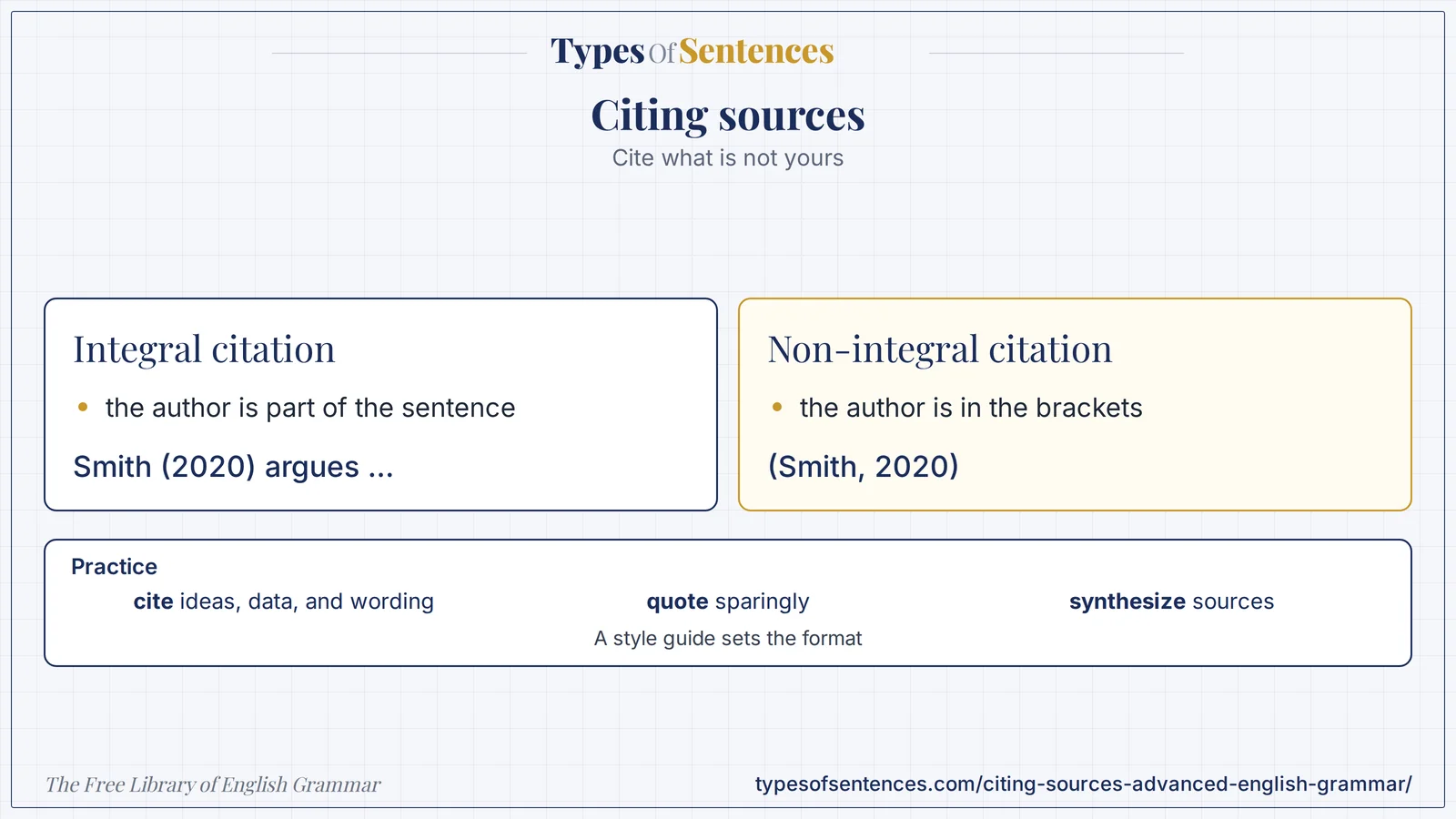
When you use another person’s idea, finding, or words, you must say so. The reader can then trust what you say, check it, and read further. Not to say so, even by accident, is plagiarism.
Why it matters: There are three ways to use a source: quote it (exact words, in quotation marks), paraphrase it (the idea in your own words and structure), or summarize it (the main points, shortened). All three need a citation.
Summary: Cite every idea, finding, data set, or wording that is not your own and not common knowledge. A style guide (APA, MLA, Chicago, or a numeric system) sets the format of in-text citations and the reference list. Attribution is integral (the author is part of the sentence: Smith (2020) argues that …) or non-integral (the author is in brackets: … (Smith, 2020)). Quote only when the exact wording matters, and integrate the quotation grammatically. Paraphrase by changing the structure and the words while keeping the meaning, and still cite. Summarize to condense. Signal phrases with varied reporting verbs introduce sources, and synthesis combines several sources into an argument. Plagiarism includes copying with small changes (patchwriting).
- Cite ideas, data, and wording that are not yours.
- Integral: Smith (2020) argues …; non-integral: (Smith, 2020).
- Quote sparingly; paraphrase and summarize in your own words; always cite.
- Synthesize sources; do not just list them.
What You’ll Learn
- 1. Citing Sources: Why and What to Cite
- 2. Citation Styles: APA, MLA, Chicago, and Numeric Systems
- 3. Methods of Attribution: Integral and Non-Integral Citation
- 4. Direct Quotation: When to Quote and How to Integrate
- 5. Paraphrasing: Using Your Own Words and Structure
- 6. Summary: Condensing Main Ideas
- 7. Signal Phrases and Reporting Verbs
- 8. Synthesis: Combining Multiple Sources
- 9. Common Citation Errors
- 10. Exercises
- 11. Test Your Knowledge
- 12. Frequently Asked Questions
- 13. Conclusion
1. Citing Sources: Why and What to Cite
| Reason | Explanation |
|---|---|
| academic integrity | gives credit to those whose ideas and work you use |
| credibility | shows that your claims rest on reliable evidence |
| verification | lets the reader check and follow up the source |
| participation in a conversation | shows how your work relates to the work of others |
| avoiding plagiarism | protects you from the charge of using another’s work as your own |
| Cite | No citation needed |
|---|---|
| direct quotations (in quotation marks) | your own ideas, findings, and analysis |
| paraphrases and summaries of another’s ideas | common knowledge (facts widely known and undisputed, such as Delhi is the capital of India) |
| data, statistics, figures, tables, and images from a source | facts that appear in many general sources and are not in dispute |
| definitions and terms coined by a source | — |
| another writer’s argument, structure, or distinctive phrasing | — |
| your own earlier work (self-citation) | — |
| Kind of plagiarism | Example | Fix |
|---|---|---|
| verbatim copying without quotation marks | copying a sentence and citing it | put it in quotation marks, or paraphrase |
| patchwriting (mosaic plagiarism) | changing a few words of a source sentence | restructure fully, in your own words, and cite |
| paraphrase without a citation | your own words, another’s idea | cite |
| misattribution | crediting the wrong source | check every citation |
| fabrication | inventing a source or a quotation | never; use only real sources |
| self-plagiarism | reusing your own earlier work without saying so | cite or ask permission |
Plagiarism is not the same as copyright infringement: plagiarism is a failure of acknowledgment and is judged by the standards of the academic community, while copyright is a legal matter of permission. Conventions of intellectual property differ between communities, but in English-language scholarship the standard is clear. Rules about the use of AI writing tools differ between institutions and journals; follow the policy that applies to your work, and acknowledge any permitted use as the policy requires.
2. Citation Styles: APA, MLA, Chicago, and Numeric Systems
| System | In-text form | Reference list | Typical fields |
|---|---|---|---|
| APA (7th edition): author–date | (Smith, 2020, p. 12); Smith (2020) | References | psychology, education, social sciences, business |
| MLA (9th edition): author–page | (Smith 12); Smith argues … | Works Cited | literature, languages, humanities |
| Chicago: notes and bibliography | a numbered footnote or endnote | Bibliography | history, arts, some humanities |
| Chicago: author–date | (Smith 2020, 12) | Reference List | sciences and social sciences |
| Harvard (variants) | (Smith 2020, p. 12) | Reference list | business, social sciences (varies by institution) |
| numeric (IEEE, Vancouver) | [1]; (1) | numbered list in order of citation | engineering; medicine |
| Source type | APA 7 reference (invented sample) | MLA 9 works cited (invented sample) |
|---|---|---|
| journal article | Smith, A. B., & Lee, C. (2020). Sleep and memory in adolescents. Journal of Learning Studies, 12(3), 45–67. https://doi.org/10.0000/xxxx | Smith, Anna B., and Chen Lee. “Sleep and Memory in Adolescents.” Journal of Learning Studies, vol. 12, no. 3, 2020, pp. 45–67. |
| book | Rao, D. (2019). Teaching in the digital age. Example Press. | Rao, Dev. Teaching in the Digital Age. Example Press, 2019. |
| web page | Lee, C. (2021, March 5). Start times and attendance. Example Institute. https://www.example.org/report | Lee, Chen. “Start Times and Attendance.” Example Institute, 5 Mar. 2021, www.example.org/report. |
| Feature | APA 7 | MLA 9 |
|---|---|---|
| two authors in text | (Smith & Lee, 2020) | (Smith and Lee 12) |
| three or more authors | (Smith et al., 2020) | (Smith et al. 12) |
| no date or page | (Smith, n.d.) | (Smith) |
| page number with a quotation | (Smith, 2020, p. 12) | (Smith 12) |
| secondary source | (Smith, 2020, as cited in Lee, 2021) | (qtd. in Lee 15) |
| group author | (World Health Organization, 2020) | (World Health Organization 4) |
| sentence case or title case for titles | sentence case for article titles | title case |
The details of these styles are specific and change between editions, so always check the current manual or the guide that your institution recommends. The principle is the same in every style: each source cited in the text must appear in the reference list, and the reverse. Reference-management software (such as Zotero, Mendeley, or EndNote) can store sources and format citations, but you must still check the output. All the sample references above are invented.
3. Methods of Attribution: Integral and Non-Integral Citation
| Method | Pattern | Example (invented source) |
|---|---|---|
| integral (author in the sentence), reporting verb | Author (year) + reporting verb + that-clause | Smith (2020) argues that sleep is vital. |
| integral, according to | According to Author (year), clause | According to Smith (2020), sleep is vital. |
| integral, possessive | Author’s (year) study + verb | Smith’s (2020) study shows that sleep is vital. |
| non-integral (author in brackets) | claim (Author, year) | Sleep is vital (Smith, 2020). |
| non-integral, with a verb | Research shows that … (Author, year) | Research shows that sleep is vital (Smith, 2020). |
| impersonal passive | It has been argued that … (Author, year) | It has been argued that sleep is vital (Smith, 2020). |
| multiple sources | claim (Author, year; Author, year) | Sleep is vital (Lee, 2021; Smith, 2020). |
| page-specific | claim (Author, year, p. 12) | … (Smith, 2020, p. 12). |
| secondary source | Author (year, as cited in Author2, year) | Smith (2020, as cited in Lee, 2021) argues … |
| Choose | When | Effect |
|---|---|---|
| integral | the author or the author’s claim is the focus (a debate, a key theorist) | foregrounds the person |
| non-integral | the idea or the evidence is the focus | foregrounds the claim |
| both in one text | — | variety and emphasis |
- Place the citation at the end of the sentence or clause where the source ends, before the period: … (Smith, 2020).
- Use the surname only in APA after the first mention (not Dr. Smith, not Anna Smith); MLA gives the full name at first mention and then the surname.
- Order multiple citations as the style requires (APA: alphabetical order within the brackets).
- Distinguish the source’s claim from your own. A paragraph full of citations with no voice of your own is a list. Use your own topic sentence and comment.
- Tense: the present for what a source argues (Smith argues), the past for a specific study (Smith found), the present perfect for a body of work (Researchers have shown); some styles (such as APA in a literature review) prefer the past or present perfect. See the chapter on academic writing.
4. Direct Quotation: When to Quote and How to Integrate
| Quote when | Do not quote when |
|---|---|
| the exact wording is the point of your analysis | you can explain the idea more clearly in your own words |
| the wording is distinctive, authoritative, or beautifully put | the source states an ordinary fact |
| you wish to show that a source says something precisely (especially in a disagreement) | you would be using the quotation to avoid explaining |
| a definition is important | the quotation is long and only part of it is relevant |
| Way of integrating | Pattern | Example (invented quotation) |
|---|---|---|
| introduce with a signal phrase and a comma | Author (year) + verb, “quotation” (p. x). | Smith (2020) observes, “Sleep is the foundation of learning” (p. 12). |
| introduce with a colon (a complete sentence before it) | A complete clause: “quotation” (Author, year, p. x). | Smith’s conclusion is clear: “Sleep is the foundation of learning” (2020, p. 12). |
| integrate with that | Author (year) says that “quotation” (p. x). | Smith (2020) argues that sleep is “the foundation of learning” (p. 12). |
| blend a phrase into your own sentence | your sentence with a short quoted phrase | Sleep, in Smith’s (2020) phrase, is “the foundation of learning” (p. 12). |
| block quotation | a long quotation set off without quotation marks (APA: 40 words or more; MLA: more than four lines) | — |
| ellipsis and brackets | use … to omit and [ ] to add words | “Sleep […] is the foundation”; “[Teenagers] need more sleep” |
| Rule | Example |
|---|---|
| keep the quotation accurate, word for word | — |
| the quotation must fit your sentence grammatically | Smith (2020) argues that teenagers “need more sleep than adults” (p. 12). (not argues that “Teenagers need …” unless the grammar fits) |
| commas and periods go inside the quotation marks in American style; the citation follows, then the period | … “the foundation of learning” (p. 12). |
| use [sic] for an error in the original | “their is a problem [sic]” |
| say if you add emphasis | (emphasis added) |
| use a single quotation mark for a quotation inside a quotation (American) | “She called it ‘the best of times,’” Smith writes. |
| explain every quotation | a quotation is evidence; it needs comment |
| Problem | Example | Fix |
|---|---|---|
| dropped quotation (no introduction) | Sleep matters. “Sleep is the foundation of learning.” (Smith, 2020) | introduce it: Smith (2020) notes that … |
| quotation that does not fit the sentence | Smith says that “teenagers needs more sleep.” | Smith says that teenagers “need more sleep.” |
| over-quotation | a paragraph that is mostly quotation | paraphrase most of it |
| quotation as a substitute for analysis | a quotation with no comment | add your explanation |
The grammar of the integrated quotation depends on the structures treated in the chapters on advanced reported speech and on non-finite verbs (Smith, writing in 2020, argues). A quotation is also evidence for the claim that you make about it, and must be explained in your own words.
5. Paraphrasing: Using Your Own Words and Structure
A paraphrase restates a passage in your own words and structure, keeping the meaning but changing the form. It is cited like a quotation, because the idea is not yours. A good paraphrase is about as long as the original, and shows that you understand the source.
| Original (invented passage) | Unacceptable (patchwriting) | Acceptable paraphrase |
|---|---|---|
| “Teenagers who sleep fewer than six hours a night perform significantly worse on memory tasks than those who sleep eight hours.” | Teenagers who sleep less than six hours each night perform significantly worse on memory tasks than teenagers who sleep eight hours. (Smith, 2020) | Memory test scores are markedly lower among adolescents who get under six hours of sleep than among those who get eight (Smith, 2020). |
| “The rapid growth of urban populations has placed pressure on public services.” | The fast growth of city populations has put pressure on public services. (Rao, 2019) | As cities have expanded quickly, public services have come under strain (Rao, 2019). |
| Technique | Before | After |
|---|---|---|
| change the structure of the sentence | Because sleep is lost, memory declines. | Memory declines as sleep is lost. |
| change the word class | The decline of memory | Memory declines |
| active ↔ passive | Researchers measured sleep. | Sleep was measured. |
| combine or split sentences | two short sentences → one, or one long → two | — |
| replace phrases with equivalents (not just single words) | a large number of → many | — |
| reorder the information | begin with the result instead of the cause | — |
| use a different grammatical frame | It is clear that … → X clearly … | — |
| keep technical terms that cannot be changed | sleep deprivation | keep the term and put it in your sentence |
- Read and understand the passage until you can explain it without looking.
- Put the source away and write the idea from memory, in your own structure.
- Compare with the original: is the meaning the same? Are the words and structure different? Have you kept any phrases that must be in quotation marks?
- Cite the source (and the page if the style asks).
- Check for patchwriting: if you only changed a few words, start again.
- Changing a few words is not paraphrasing. Swapping synonyms in the same structure is patchwriting.
- Paraphrase the idea, not the phrases. Technical terms and proper names may stay.
- Keep the meaning accurate; do not make a claim stronger or weaker than the source (see the chapter on hedging).
- A paraphrase still needs a citation.
6. Summary: Condensing Main Ideas
| Feature | Summary | Paraphrase | Quotation |
|---|---|---|---|
| length | much shorter than the original | about the same as the original | exact words, usually short |
| content | the main points only | all the ideas of a passage | exact wording |
| words | your own | your own | the source’s |
| quotation marks | no | no | yes |
| citation | yes | yes | yes (with page where required) |
| use | background and overview | a specific idea or detail | exact wording is the point |
| Step in summarizing | Task |
|---|---|
| 1 | read the whole source and identify its purpose and main claim |
| 2 | identify the main points (headings and topic sentences help) |
| 3 | write the points in your own words, shorter, in a neutral tone |
| 4 | keep the proportions: the main points get the space they have in the source |
| 5 | cite; add no opinion of your own |
| 6 | check against the original |
| Summary frames (invented source) | Example |
|---|---|
| one-sentence summary | Smith (2020) reviews 40 studies and concludes that adolescent sleep loss impairs memory. |
| two-sentence summary | Smith (2020) reviews 40 studies of adolescent sleep. She finds consistent evidence that sleep loss impairs memory, though the size of the effect varies with age. |
| summary with a stance verb | Rao (2019) outlines a framework for digital teaching, arguing that tools matter less than planning. |
| summary of a section | In the second section, the author compares three school systems. |
Summaries are used in introductions and literature reviews, where the writer needs to place the work of others briefly. A summary should be neutral: the writer’s evaluation comes after it, in a separate sentence. An annotated bibliography combines a citation with a short summary and an evaluation of each source.
7. Signal Phrases and Reporting Verbs
| Function | Reporting verbs | Example |
|---|---|---|
| neutral reporting | states, notes, reports, describes, observes, explains, mentions, points out | Lee (2021) reports that attendance rose. |
| argument | argues, claims, maintains, contends, asserts, holds, proposes, insists | Smith (2020) contends that start times matter. |
| evidence and findings | shows, demonstrates, finds, reveals, establishes, confirms, indicates | Rao (2019) demonstrates that planning matters. |
| tentative suggestion | suggests, implies, speculates, hypothesizes, proposes | Lee (2021) suggests that the effect is small. |
| agreement | agrees, concurs, supports, endorses, echoes | Rao (2019) agrees with Smith. |
| disagreement and challenge | disputes, challenges, questions, rejects, disagrees, contradicts, objects | Rao (2019) disputes this view. |
| doubt (the writer’s distance) | claims, alleges, purports, asserts (with a following evaluation) | Brown (2018) claims, without evidence, that … |
| evaluation | criticizes, praises, overlooks, ignores, fails to | Smith (2020) overlooks the role of cost. |
| Signal phrase pattern | Example |
|---|---|
| Author (year) + verb + that | Smith (2020) argues that … |
| According to Author (year), … | According to Lee (2021), … |
| As Author (year) notes, … | As Rao (2019) notes, … |
| In the words of Author (year), … | In Smith’s (2020) words, … |
| Author (year), writing about X, observes that … | Lee (2021), writing about attendance, observes that … |
| Following Author (year), … | Following Smith (2020), this paper defines … |
| Author (year) is concerned with … | — |
| The study by Author (year) found … | The study by Lee (2021) found … |
| For Author (year), … | For Rao (2019), planning is central. |
| Contrary to Author (year), … | Contrary to Smith (2020), … |
- Choose the verb for meaning and stance. Says is neutral and weak; claims suggests doubt; demonstrates suggests that the writer accepts the finding. The same point is made in the chapter on reported speech.
- Vary the verbs, but do not vary them at the cost of accuracy.
- Punctuate correctly: a comma after an introductory phrase (According to Smith (2020), …) and no comma before that.
- Keep a consistent tense for the same function.
- Do not start every sentence with a signal phrase. Vary with non-integral citations.
8. Synthesis: Combining Multiple Sources
Synthesis is the combining of ideas from several sources into your own argument: finding the patterns, agreements, disagreements, and gaps among them. A synthesis is organized by ideas, not by sources.
| Pattern | Language | Example (invented sources) |
|---|---|---|
| agreement (consensus) | Several studies (…); Both X and Y; consistent with | Several studies found that later starts raise attendance (Lee, 2021; Rao, 2019; Smith, 2020). |
| disagreement (contrast) | Whereas X …, Y …; In contrast; However | Whereas Smith (2020) attributes the effect to sleep, Rao (2019) attributes it to routine. |
| building (extension) | X extends; building on; further | Building on Smith’s (2020) findings, Lee (2021) examined … |
| cause and context | because; given that; as a result | — |
| gap in the literature | However, few studies have examined …; little is known about … | However, few studies have examined rural schools. |
| qualification | although; to some extent; only in … | — |
| chronology (development of the field) | Early work (…) focused on …; Later studies (…) | Early work focused on sleep duration (Smith, 2020); later studies examined quality (Lee, 2021). |
| Step in building a synthesis | Task |
|---|---|
| 1 | read each source and note its claim, evidence, and method |
| 2 | make a matrix: sources down the side, themes across the top |
| 3 | find agreements, disagreements, and gaps |
| 4 | decide your point: what do the sources show together? |
| 5 | write paragraphs organized by theme, each with your topic sentence |
| 6 | cite each source where used; add your own analysis |
| Listing (weak) | Synthesis (strong) |
|---|---|
| Smith (2020) says sleep matters. Lee (2021) says attendance rises. Rao (2019) says routine matters. | Sleep matters for attendance (Smith, 2020; Lee, 2021), but Rao (2019) argues that routine may be the cause, which suggests that sleep and routine need separate testing. |
The grammar of synthesis uses the contrast and concession structures from the chapters on coordination and subordination, the cohesive devices of the chapter on cohesion and coherence (especially for linking sources), and hedged verbs for the writer’s own interpretation.
9. Common Citation Errors
| Error | Example | Fix |
|---|---|---|
| missing citation | Sleep loss harms memory. | Sleep loss harms memory (Smith, 2020). |
| quotation without quotation marks | Sleep is the foundation of learning. (Smith, 2020) | “Sleep is the foundation of learning” (Smith, 2020, p. 12). |
| patchwriting | changing a few words of the source | restructure and cite |
| mismatch between text and list | (Lee, 2021) in the text but not in the reference list | add the entry |
| wrong format | (Smith 2020) in APA; (Smith, 12) in MLA | (Smith, 2020); (Smith 12) |
| “studies show” with no source | Studies show that … | Lee (2021) shows that … |
| secondary source cited as primary | citing Smith when you read Lee’s account of Smith | Smith (2020, as cited in Lee, 2021) |
| over-quoting | long quotations with little comment | paraphrase and comment |
| quotation not integrated | a sentence dropped into the text | introduce with a signal phrase |
| citation placed after the period | … learning. (Smith, 2020) | … learning (Smith, 2020). |
| “et al.” misuse | (Smith et al., 2020) for two authors in APA | (Smith & Lee, 2020) |
| fabricated or unchecked reference | a source that does not exist | use only sources you have read and can find |
| misrepresenting the source | making a claim stronger than the source | keep the meaning accurate |
| plagiarism of data or images | a figure used without a source | cite and permit |
| inconsistent style | APA in text and MLA in the list | one style |
Edit (APA): Studies show that sleep matters. Sleep is the foundation of learning. (Smith 2020). Teenagers who sleep less than six hours each night perform significantly worse on memory tasks, and Lee says that attendance rises, and Smith et al. wrote with Lee.
- Studies show: Smith (2020) shows that sleep matters.
- Sleep is the foundation of learning. (Smith 2020).: a quotation without marks and the wrong format: “Sleep is the foundation of learning” (Smith, 2020, p. 12).
- Teenagers who sleep less than six hours … significantly worse: copied: Adolescents who sleep under six hours score markedly lower on memory tests (Smith, 2020).
- Lee says: a weak verb and no year: Lee (2021) reports that attendance rises.
- Smith et al. wrote with Lee: wrong for two authors: Smith and Lee (2020) (in APA brackets: Smith & Lee, 2020).
- Result: Smith (2020) shows that sleep matters; in her words, sleep is “the foundation of learning” (p. 12). Adolescents who sleep under six hours score markedly lower on memory tests (Smith, 2020), and Lee (2021) reports that attendance rises. (all sources and quotations are invented)
Recap in 12 seconds
Watch the lesson build itself: Cite ideas, data, and wording that are not yours, in the format a style guide sets. The video has no sound.
Exercises
Part A: Why and What to Cite (Exercises 1–6)
Exercise 1: Give two reasons for citing.
Show Answer
Answer: Integrity, credibility, verification, avoiding plagiarism.
Exercise 2: Does common knowledge need a citation?
Show Answer
Answer: No.
Exercise 3: Does a paraphrase need a citation?
Show Answer
Answer: Yes.
Exercise 4: Define patchwriting.
Show Answer
Answer: Changing a few words of a source sentence without restructuring.
Exercise 5: Name a citation style.
Show Answer
Answer: APA, MLA, Chicago, Harvard, or a numeric style.
Exercise 6: Is plagiarism the same as copyright infringement?
Show Answer
Answer: No.
Part B: Attribution (Exercises 7–13)
Exercise 7: Integral or non-integral: Smith (2020) argues that …
Show Answer
Answer: Integral.
Exercise 8: Integral or non-integral: … (Smith, 2020).
Show Answer
Answer: Non-integral.
Exercise 9: APA for three or more authors:
Show Answer
Answer: (Smith et al., 2020).
Exercise 10: APA for two authors:
Show Answer
Answer: (Smith & Lee, 2020).
Exercise 11: Where does the citation go relative to the period?
Show Answer
Answer: Before the period.
Exercise 12: Name a secondary-source form (APA):
Show Answer
Answer: (Smith, 2020, as cited in Lee, 2021).
Exercise 13: Edit: Studies show that sleep matters.
Show Answer
Answer: Smith (2020) shows that sleep matters.
Part C: Quotation and Paraphrase (Exercises 14–20)
Exercise 14: When should you quote?
Show Answer
Answer: When the exact wording matters.
Exercise 15: Edit: Smith says that “teenagers needs more sleep.”
Show Answer
Answer: Smith says that teenagers “need more sleep.”
Exercise 16: What marks a long quotation in APA?
Show Answer
Answer: A block (40 words or more), without quotation marks.
Exercise 17: Use ellipsis: omit very from “Sleep is very important.”
Show Answer
Answer: “Sleep is […] important.”
Exercise 18: Is changing a few words a paraphrase?
Show Answer
Answer: No (patchwriting).
Exercise 19: Name a paraphrase technique.
Show Answer
Answer: Change the structure, the word class, active/passive, or the order.
Exercise 20: Should a paraphrase be about the same length as the original?
Show Answer
Answer: Yes, roughly.
Part D: Summary, Signal Phrases, Synthesis (Exercises 21–26)
Exercise 21: How does a summary differ from a paraphrase?
Show Answer
Answer: A summary is much shorter and gives only the main points.
Exercise 22: Name a neutral reporting verb.
Show Answer
Answer: states, notes, reports, describes.
Exercise 23: Name a verb that suggests doubt.
Show Answer
Answer: claims, alleges.
Exercise 24: Name a verb of disagreement.
Show Answer
Answer: disputes, challenges, rejects.
Exercise 25: What organizes a synthesis: sources or ideas?
Show Answer
Answer: Ideas.
Exercise 26: Name a synthesis tool.
Show Answer
Answer: A matrix of sources and themes.
Part E: Errors (Exercises 27–30)
Exercise 27: Fix: … learning. (Smith, 2020)
Show Answer
Answer: … learning (Smith, 2020).
Exercise 28: Fix: (Smith 2020) in APA.
Show Answer
Answer: (Smith, 2020).
Exercise 29: Fix: Lee says that attendance rises.
Show Answer
Answer: Lee (2021) reports that attendance rises.
Exercise 30: Name a rule for the reference list.
Show Answer
Answer: Every source cited in the text must appear in the list, and the reverse.
Test Your Knowledge
Ready to check what you learned? Answer all 10 questions, then submit. You need 80% (8 of 10) to pass. Your answers are not stored.
View correct answers and explanations
Question 1: Which needs a citation?
✓ Correct Answer: A – a paraphrase of another’s idea
Ideas of others need citation.
Question 2: Which is plagiarism?
✓ Correct Answer: B – changing a few words of a source and not citing
Patchwriting without citation.
Question 3: Which is a non-integral citation?
✓ Correct Answer: C – Sleep is vital (Smith, 2020).
The author is in brackets.
Question 4: Which is the APA form for three or more authors?
✓ Correct Answer: D – (Smith et al., 2020)
Et al.
Question 5: Where does the citation go?
✓ Correct Answer: C – before the period
Before the period.
Question 6: Which is a neutral reporting verb?
✓ Correct Answer: A – states
States is neutral.
Question 7: Which is a verb of disagreement?
✓ Correct Answer: D – disputes
Disputes.
Question 8: Which is the main way to avoid patchwriting?
✓ Correct Answer: C – restructure and use your own words
Restructure fully.
Question 9: Which is a synthesis?
✓ Correct Answer: B – a combination of sources organized by idea
Organized by ideas.
Question 10: Which must match the in-text citations?
✓ Correct Answer: B – the reference list
Every citation needs an entry.
Frequently Asked Questions
What is citing sources?
Citing sources is the practice of acknowledging the works that you use, by naming them in the text and listing them in a reference list, in a consistent style.
What are citation and attribution?
Citation is the formal reference to a source (the author, the year, and the details); attribution is the act of crediting an idea or a statement to its source within the text, for example with a signal phrase.
What is attribution grammar?
Attribution grammar is the set of structures used to credit sources: integral citations with reporting verbs, non-integral citations in brackets, impersonal passives, and signal phrases.
What does integrating quotes mean?
Integrating quotes means introducing each quotation with a signal phrase, making it fit the grammar of your sentence, citing it, and commenting on it, so that it supports your argument and is not left alone.
What is paraphrasing?
Paraphrasing is restating a passage in your own words and structure, keeping the meaning. A paraphrase must still be cited, and changing only a few words is not paraphrasing but patchwriting.
What is the difference between summarizing and paraphrasing?
A summary condenses the main points in a much shorter form; a paraphrase restates all the ideas of a passage at about the same length. Both need citations.
How do I avoid plagiarism?
Cite every idea, finding, or wording that is not your own; use quotation marks for exact words; paraphrase by restructuring, not by swapping words; keep notes with source details; and check the reference list.
Conclusion
You now have a deep study of citing sources: why and what to cite, the main citation styles, the grammar of attribution, quotation and its integration, paraphrasing, summary, signal phrases, synthesis, and the common errors. You can use sources accurately and honestly.
When you use a source, ask whether to quote, paraphrase, or summarize, and then credit it clearly. Next, you will study research writing.
- American Psychological Association. Publication Manual of the American Psychological Association. 7th ed. APA, 2020.: APA citation and reference format.
- Modern Language Association. MLA Handbook. 9th ed. MLA, 2021.: MLA format.
- University of Chicago Press. The Chicago Manual of Style. 17th ed. University of Chicago Press, 2017.: notes-bibliography and author-date styles.
- Swales, John M., and Christine B. Feak. Academic Writing for Graduate Students. 3rd ed. University of Michigan Press, 2012.: integrating sources in academic prose.
- Purdue Online Writing Lab: Research and Citation Resources: reference pages on citation styles.
Last reviewed: October 29, 2026. How it was made: drafted with AI assistance, then checked with automated tests (structure, links, answer keys, spelling) and against the sources above. A person has not yet read this chapter line by line. Found a mistake? Report it.