Vagueness and precision are the two ends of a scale of detail. I bought some stuff is vague; I bought three kilos of mangoes is precise. Many writers assume that vague language is simply bad, but it is a normal part of English: I’ll be there around six, She’s kind of tired, and and things like that are useful and natural. The skill lies in knowing when vagueness is the right choice and when only precise language will do. A contract, a recipe, a medical instruction, and a research claim cannot afford to be vague, while a casual chat or a polite request may need to be.
You will study vague language and its forms, approximators (about, around, roughly), general and specific words (dog and golden retriever, walk and stride), precise language in academic and professional writing, appropriate and inappropriate vagueness, techniques for increasing precision, the problem of false precision, and how to choose the level of detail for a purpose. The aim is to control specificity: to be as exact as the reader needs and no more. Thirty editing exercises and a quiz follow.
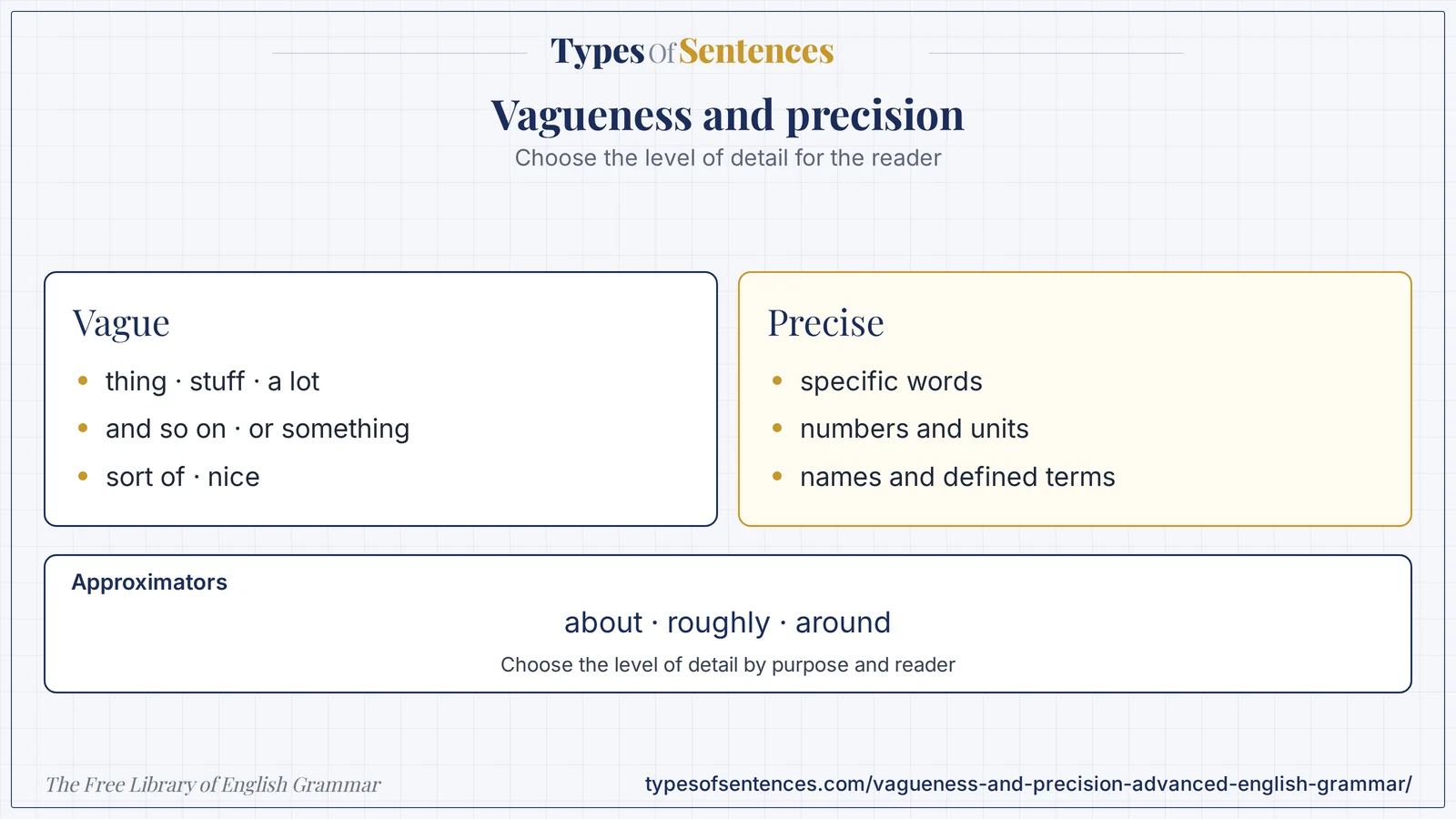
A vague statement leaves out detail; a precise one supplies it. Every sentence sits somewhere on this scale, and the right place depends on what the reader needs to do or understand.
Why it matters: Precision is not the same as length or technical vocabulary. It means choosing the specific word, the exact number, the named source, and the defined term, wherever they matter to the reader.
Summary: Vagueness is a lack of specific detail: general words (thing, stuff), vague quantifiers (a lot, some), vague category markers (and so on, or something), vague adjectives (nice, good), and hedges (sort of). Approximators (about, roughly) make a number deliberately imprecise. Precision is achieved by specific words (hyponyms), numbers and units, technical terms, named sources, and defined scope. Vagueness is appropriate in casual talk, in polite requests, when exact information is unknown or unneeded, and in some legal and creative writing; it is inappropriate in instructions, contracts, safety information, and academic claims. False precision (too many decimals) is also a fault.
- Vague: thing, stuff, a lot, and so on, sort of.
- Approximators: about, roughly, around.
- Precise: specific words, numbers, units, names, defined terms.
- Choose the level of detail by purpose and reader.
What You’ll Learn
- 1. Vagueness and Precision: What Are They?
- 2. Vague Language: Forms and Functions
- 3. Approximators: Making Numbers Deliberately Imprecise
- 4. General vs. Specific Words
- 5. Precision in Academic and Professional Writing
- 6. Appropriate Vagueness
- 7. Inappropriate Vagueness: When to Be Specific
- 8. Techniques for Increasing Precision
- 9. Choosing the Level of Precision
- 10. Common Errors with Vagueness and Precision
- 11. Exercises
- 12. Test Your Knowledge
- 13. Frequently Asked Questions
- 14. Conclusion
1. Vagueness and Precision: What Are They?
| Vague | More precise | Most precise |
|---|---|---|
| I bought some stuff. | I bought some fruit. | I bought three kilos of mangoes. |
| It happened a while ago. | It happened last year. | It happened in March 2024. |
| Many people came. | About 200 people came. | Exactly 213 people came. |
| The results were good. | The results were encouraging. | Accuracy rose from 82 to 91 percent. |
| He went somewhere. | He went to Delhi. | He took the 6 a.m. train to Delhi. |
| They have a big house. | They have a large house. | They have a five-bedroom house of 280 square meters. |
| Concept | Meaning | Example |
|---|---|---|
| vagueness | lack of specific detail; a fuzzy boundary | around, a lot, thing, soon |
| precision | specificity and exactness of detail | three kilos; 6 a.m.; defined term |
| accuracy | agreement with the truth (not the same as precision) | “Delhi is the capital of India” (accurate); “Delhi is exactly 123.456 km from X” (precise; may be inaccurate) |
| ambiguity | more than one possible meaning | I saw her duck |
| hedging | a deliberate reduction of commitment | may, appears to |
| generality | a broad category, not an error | The animals need food. |
Vagueness is different from ambiguity (two meanings; see the chapter on ambiguity in English) and from hedging (a stated lack of commitment; see the chapter on hedging): a vague statement may be perfectly clear but not specific enough. Precision is also different from accuracy: a precise statement can be wrong, and an accurate one can be vague. Linguists such as Joanna Channell have shown that vague language is frequent in everyday speech and is often used on purpose, as a feature of natural communication.
2. Vague Language: Forms and Functions
| Type | Examples | Sample sentence |
|---|---|---|
| general nouns | thing, stuff, something, someone, people, item, matter, issue, factor, aspect | There are a few things to discuss. I need some stuff for the trip. |
| general verbs | do, make, get, have, put, go, give, take | We need to get this done. |
| vague adjectives | nice, good, bad, great, interesting, big, small, fine, okay | It was a nice meeting. The results were interesting. |
| vague quantifiers | some, many, a lot (of), lots of, several, a few, plenty of, a number of, loads of | Many people disagree. A lot of students failed. |
| vague category markers (set markers) | and so on, and so forth, and stuff, and things like that, or something, or whatever, or so, etc., and the like, and all that | We bought rice, flour, and things like that. She’s a nurse or something. |
| hedges and softeners | sort of, kind of, like, you know, I guess, a bit | It’s kind of expensive. |
| vague time | soon, later, a while ago, recently, in a bit, at some point | I’ll call you later. It happened recently. |
| vague place | somewhere, around here, nearby, over there | It’s somewhere in the kitchen. |
| vague reference | it, this, that (with no clear antecedent) | This is a problem. |
| vague names | whatshisname, whatchamacallit, thingamajig | Pass me the thingamajig. |
| Function of vagueness | Example | Explanation |
|---|---|---|
| efficiency and shared knowledge | We had pizza and stuff. | the hearer can fill in the details |
| approximation (exact figures unknown or unneeded) | It takes about an hour or so. | — |
| politeness and face-saving | I was wondering if you could maybe look at this or something. | softens a request |
| solidarity (in-group talk) | We had a few drinks and things. | casual, friendly |
| avoiding commitment | We’ll see how things go. | — |
| protecting information | a friend of mine | privacy |
| signaling the general class | things like that | invites the hearer to complete the set |
| indirectness in disagreement | It’s sort of a different approach. | — |
Vague language is not a sign of poor vocabulary. Speakers who know exactly what they mean use it because it is enough, because it saves effort, or because it is friendlier. It is a feature of the grammar of speech, and the vague category markers (and stuff, or something) are common in conversation in many varieties of English. The question is only whether the vagueness is right for the occasion.
3. Approximators: Making Numbers Deliberately Imprecise
| Type | Examples | Sample |
|---|---|---|
| approximators of number (rounders) | about, around, approximately, roughly, some, nearly, almost, more or less, or so, in the region of, give or take, ballpark, -ish | about 40 people; around 200 rupees; some 5,000 words; 5-ish |
| limits (with numbers) | at least, at most, up to, over, under, more than, fewer than, no more than, no fewer than | at least ten; up to 50; more than 100 |
| ranges | between … and …; from … to …; …–… | between 10 and 20 people |
| approximators of degree (adaptors) | rather, fairly, somewhat, more or less, relatively, partly, sort of | somewhat tired |
| approximators of time | around noon, about six, six-ish, toward evening, shortly after | around 6 p.m. |
| approximators of category | a kind of, a sort of, a type of, something like | a sort of vegetable |
| sentence-final approximators | or so; or thereabouts | ten minutes or so |
| Precision of a figure | Example | Implication |
|---|---|---|
| round number | 100 people | probably an approximation |
| exact number | 103 people | probably counted |
| approximated exact number | approximately 103 people | contradictory: the exactness is lost |
| a range | between 95 and 110 people | an honest estimate |
| too many decimals | 38.4762 percent (from a sample of 20) | false precision |
| a lower or upper bound | at least 100 people | — |
Round numbers suggest an approximation, and exact figures suggest a count or a measurement. An approximator before a figure that is already exact is odd (approximately 103.2), and a figure with many decimals can claim more accuracy than the data allow. The rule is to give no more digits than the evidence supports (see the section on false precision).
4. General vs. Specific Words
| Level | Example 1 | Example 2 | Example 3 |
|---|---|---|---|
| general (superordinate) | animal | move | thing |
| basic | dog | walk | tool |
| specific (hyponym) | golden retriever | stride | screwdriver |
| very specific | a three-year-old golden retriever named Max | stride confidently across the platform | a Phillips-head screwdriver |
| General word | More specific words | Part of speech |
|---|---|---|
| walk | stroll, stride, amble, trudge, limp, march, pace | verb |
| say | whisper, shout, mutter, declare, murmur, state, insist | verb |
| look | glance, gaze, stare, peer, inspect | verb |
| get | obtain, receive, earn, buy, fetch, become, reach | verb |
| make | build, create, produce, cook, form, assemble | verb |
| go up | rise, climb, soar, increase, surge | verb |
| thing | tool, device, object, item, issue, factor | noun |
| problem | delay, defect, shortage, dispute, flaw | noun |
| people | residents, voters, customers, students, patients | noun |
| place | village, city, warehouse, clinic, market | noun |
| good | excellent, effective, reliable, valuable, skilled | adjective |
| bad | faulty, harmful, inadequate, poor, hazardous | adjective |
| big | enormous, extensive, considerable, vast | adjective |
| nice | pleasant, charming, kind, delicious, comfortable | adjective |
| interesting | fascinating, thought-provoking, surprising, original | adjective |
| quickly | swiftly, abruptly, at once, within minutes | adverb |
The difference between general and specific words is the relation of hyponymy, which is treated in the chapter on lexical relations. A specific word packs more information into one place: strode replaces walked quickly with long steps. Writers prefer specific words for vividness and concision, an advice that was summed up in the creative-writing rule “show, don’t tell”. The choice of the right word in a given context is discussed in the chapter on diction.
5. Precision in Academic and Professional Writing
| Vague | Precise | Strategy |
|---|---|---|
| Many studies show that sleep matters. | Of the 12 studies reviewed, 9 found that sleep improved memory (Smith, 2020; Lee, 2021). | number, source |
| Prices went up a lot. | Prices rose by 15 percent between 2020 and 2023. | number, units, time |
| The method is better. | The method is 12 percent more accurate than the baseline. | measure |
| This approach has some problems. | This approach has two problems: cost and scalability. | count and name |
| Recently, there has been interest in AI. | Since 2022, the number of papers on generative AI has tripled. | time, measure |
| The results were good. | The model correctly classified 91 percent of cases. | measure |
| Researchers found things that were important. | Researchers found three factors that affect yield: water, soil, and temperature. | specific terms |
| It is a big issue in society. | Unemployment affects 7 percent of the workforce. | data |
| Some people disagree. | Jones (2019) disagrees on two grounds. | source |
| The patient was given some medicine. | The patient was given 500 mg of paracetamol. | dose |
| The company did well. | Revenue grew 8 percent, to 4.2 billion rupees. | figures |
| We improved the process. | We reduced processing time from 10 to 4 minutes. | before and after |
- Use exact terminology. Use the standard technical term, define it at first use, and keep to it throughout.
- Quantify. Replace many, a lot, and some with numbers, percentages, or ranges where you have them.
- Name your sources. Replace studies show with the authors and the year; this avoids the weasel words that hedging writers warn against.
- Specify the scope: all, most, some; which group, which period, which place.
- Replace vague nouns (things, aspects, issues, factors) with the real nouns.
- Replace weak verbs and adjectives (got, nice, big) with specific ones.
- Combine precision and hedging when the evidence is uncertain: The data suggest that yields may rise by 5 to 10 percent.
Precision also means consistency: the same term for the same concept. A term that changes (policy, plan, scheme) suggests that the concept changes, as noted in the chapter on collocation and lexical relations. Wordiness and vagueness often go together: the chapter on conciseness and wordiness shows how to remove empty words while adding exact ones.
6. Appropriate Vagueness
| Context | Why vagueness is right | Example |
|---|---|---|
| casual conversation | shared knowledge; efficiency; solidarity | We had a few drinks and stuff. |
| polite requests and suggestions | softens the imposition | Maybe we could look at this at some point. |
| when the exact figure is unknown | honesty | It took about three hours. |
| when the exact figure is unneeded | economy | I’ll be there around six. |
| protecting privacy | discretion | A colleague mentioned it. |
| diplomacy | avoiding commitment (strategic ambiguity) | We will consider all options. |
| legal standards | flexible rules | reasonable care; substantial completion; as soon as practicable |
| an overview or an introduction | the general picture first | Several factors contribute. |
| creative writing | suggestion and mood | Something moved in the dark. |
| early drafts | work out the details later | — |
| headlines | brevity | Prices rise again |
Vagueness is a resource. A speaker who says around six is not being careless; the hearer does not need more. A request that says It would be great if you could look at this when you have a moment leaves the hearer room. Even in law, flexible terms such as reasonable are deliberate, because a precise rule cannot cover every case. The politeness function is treated in the chapter on pragmatics.
7. Inappropriate Vagueness: When to Be Specific
| Context | Vague (poor) | Specific (better) | Risk of vagueness |
|---|---|---|---|
| recipes and instructions | Cook until done. | Simmer for 20 minutes, until the rice is soft. | failed result |
| safety information | Keep away from heat. | Store below 30 degrees Celsius. | harm |
| medical advice | Take some tablets. | Take one 500 mg tablet twice a day after food. | overdose |
| contracts | The work will be done soon. | The work will be completed by 15 March. | dispute |
| emails and requests | Send it soon. | Please send it by Friday, 5 p.m. | delay |
| directions | It’s near the shop. | It’s 50 meters past the pharmacy, on the left. | getting lost |
| feedback | Good job. | The introduction clearly states the aim; the third paragraph needs evidence. | no help |
| reports | A lot of money was lost. | Losses were 1.2 million rupees. | no basis for action |
| news | Sources say … | According to the finance ministry’s statement on Monday, … | no accountability |
| job descriptions | Handle various tasks. | Prepare weekly reports; manage the supplier list. | confusion |
| academic claims | Some research shows … | Smith (2020) found … | unverifiable |
8. Techniques for Increasing Precision
| Technique | Before | After |
|---|---|---|
| answer who, what, when, where, how many | The meeting was moved. | The Monday sales meeting was moved to Wednesday at 3 p.m. |
| replace a general verb with a strong one | She went across the room. | She strode across the room. |
| replace a vague noun | There are many issues. | There are three problems: cost, time, and staffing. |
| add numbers and units | a long distance | 12 kilometers |
| name the source | Experts say … | The World Health Organization reports … |
| define a term | The model is robust. | The model is robust: its accuracy stays above 90 percent when 10 percent of the data are missing. |
| specify scope and time | Companies are investing. | Since 2022, Indian software companies have invested in … |
| add an example | The tools are useful. | The tools, such as a spell checker, are useful. |
| use a hyponym | a vehicle | a delivery van |
| use a technical term | the thing that holds the bones together | ligament |
| check the pronoun reference | This is important. | This result is important. |
| revise nominalizations | The occurrence of an increase … | Prices increased … |
- Read for vague words: thing, stuff, some, many, nice, good, etc.
- Ask for each one: what exactly? how many? who? when?
- Replace it with the specific word, number, or name.
- Decide whether the detail is needed. Not every sentence needs full precision.
- Read as a skeptical reader: could I check this? could I act on it?
- Keep the exact terms consistent through the text.
9. Choosing the Level of Precision
| Purpose and reader | Level of precision | Example |
|---|---|---|
| casual conversation | low; approximators | We’ll be there around six. |
| a business email | medium to high; dates and amounts | The report is due Friday at 5 p.m. |
| an academic argument | high; terms, numbers, citations | Of 150 participants, 62 percent … |
| instructions and safety | very high | Heat at 180 degrees Celsius for 25 minutes. |
| a contract | very high, with defined terms | “Delivery” means … |
| an overview or an introduction | general first, then specific | Several factors contribute; the three main ones are … |
| a news lead | specific who, what, when, where | Police arrested a man in Pune on Monday. |
| a poem or story | suggestive, with chosen concrete details | — |
| Fault | Example | Fix |
|---|---|---|
| too vague for the purpose | Heat until hot. | Heat to 80 degrees Celsius. |
| false precision (too many digits) | 38.4762 percent of 20 respondents | 38 percent (8 of 20) or 8 of 20 respondents |
| over-specific (burying the point) | At 3:14:07 p.m. on 12 March 2024, in room 305 of the east building … | On 12 March the committee met and … |
| approximating an exact count | approximately 20 of the 20 respondents | all 20 respondents |
| inconsistent precision | 5 people, 3.14159 hours, and about some money | — |
The right level of detail is guided by the maxim of quantity (be as informative as required, and no more), which is explained in the chapter on pragmatics. Providing too little detail frustrates the reader; providing too much, or false precision, hides the point and suggests an accuracy that the data do not have. The principle is to be as precise as the reader’s purpose and the available evidence allow.
10. Common Errors with Vagueness and Precision
| Error | Correction | Problem |
|---|---|---|
| approximately exactly 100 | exactly 100 / approximately 100 | contradiction |
| a lot of things | several factors / a number of problems | vague noun |
| and so on and so forth (in a formal report) | (list the items) | empty tail |
| etc. etc. | etc. (once) or complete the list | — |
| very exact | exact | intensifier with an absolute |
| studies show that … | Smith (2020) shows that … | weasel words |
| a number of people (when the number matters) | 47 people | vague quantity |
| soon / recently / in the past | by 15 March / in 2023 | vague time |
| The results are good. | The model correctly classified 91 percent of cases. | vague adjective |
| precise but wrong: 5.0000 meters (by eye) | about 5 meters | false precision |
| It is a very important thing. | It is a crucial factor. | vague noun and weak adjective |
| I am about 100% sure. | I am sure. / I am nearly certain. | approximator with an absolute |
| nice, good, bad (in an essay) | effective, reliable, flawed | vague adjectives |
| They did it. | The council approved the plan. | vague reference |
Edit: Studies show that a lot of things happened recently, approximately exactly 100 people were affected, and the results were good, and this is a very important thing, and so on and so forth, and I am about 100% sure.
- Studies show: Smith (2020) shows.
- a lot of things happened recently: three events occurred in 2023.
- approximately exactly 100: exactly 100 (if counted).
- the results were good: the model correctly classified 91 percent of cases.
- a very important thing: a crucial factor.
- and so on and so forth: delete or list the items.
- about 100% sure: nearly certain.
- Result: Smith (2020) shows that three events occurred in 2023, exactly 100 people were affected, and the model correctly classified 91 percent of cases. This is a crucial factor, and I am nearly certain. (the figures are invented for the example)
Recap in 12 seconds
Watch the lesson build itself: Vague language uses general words and hedges; precise language uses specific words, numbers, units, and names. The video has no sound.
Exercises
Part A: Vague or Precise (Exercises 1–7)
Exercise 1: Vague or precise: I bought some stuff.
Show Answer
Answer: Vague.
Exercise 2: Vague or precise: I bought three kilos of mangoes.
Show Answer
Answer: Precise.
Exercise 3: Name the type of vagueness: and things like that
Show Answer
Answer: A vague category marker.
Exercise 4: Name the type: a lot of
Show Answer
Answer: A vague quantifier.
Exercise 5: Name the type: sort of
Show Answer
Answer: A hedge or softener.
Exercise 6: Is precision the same as accuracy?
Show Answer
Answer: No.
Exercise 7: Is vague language always bad?
Show Answer
Answer: No (it is a normal resource).
Part B: Approximators (Exercises 8–13)
Exercise 8: Give an approximator for a number: 40 people
Show Answer
Answer: about / around / roughly / approximately 40 people.
Exercise 9: Give a lower limit: ten
Show Answer
Answer: at least ten.
Exercise 10: Give a range: 10 to 20 people
Show Answer
Answer: between 10 and 20 people.
Exercise 11: Edit: approximately exactly 100
Show Answer
Answer: exactly 100 (or approximately 100).
Exercise 12: Name a problem: 38.4762 percent of 20 respondents
Show Answer
Answer: False precision.
Exercise 13: Which suggests a count: 100 people or 103 people?
Show Answer
Answer: 103 people.
Part C: General and Specific (Exercises 14–20)
Exercise 14: Give a specific verb for walk (quickly with long steps):
Show Answer
Answer: stride.
Exercise 15: Give a specific verb for say (quietly):
Show Answer
Answer: whisper (murmur).
Exercise 16: Give a specific word for big:
Show Answer
Answer: enormous (vast).
Exercise 17: Give a specific word for thing: a tool that turns screws
Show Answer
Answer: screwdriver.
Exercise 18: Give a specific verb for get: receive money for work
Show Answer
Answer: earn.
Exercise 19: Name the relation between dog and golden retriever.
Show Answer
Answer: Hyponymy.
Exercise 20: Make specific: Prices went up a lot.
Show Answer
Answer: Prices rose by 15 percent between 2020 and 2023.
Part D: Appropriate or Inappropriate (Exercises 21–26)
Exercise 21: Appropriate or not: I’ll be there around six.
Show Answer
Answer: Appropriate.
Exercise 22: Appropriate or not: Take some tablets. (a prescription)
Show Answer
Answer: Inappropriate.
Exercise 23: Appropriate or not: Cook until done. (a recipe)
Show Answer
Answer: Inappropriate (give time and temperature).
Exercise 24: Appropriate or not: reasonable care (law)
Show Answer
Answer: Appropriate (a flexible standard).
Exercise 25: Make specific: Send it soon.
Show Answer
Answer: Please send it by Friday, 5 p.m.
Exercise 26: Replace the weasel words: Studies show that …
Show Answer
Answer: Smith (2020) shows that …
Part E: Techniques and Errors (Exercises 27–30)
Exercise 27: Edit: a lot of things
Show Answer
Answer: several factors (name them).
Exercise 28: Edit: I am about 100% sure.
Show Answer
Answer: I am nearly certain.
Exercise 29: Name a test for inappropriate vagueness.
Show Answer
Answer: What would the reader need in order to act or to check?
Exercise 30: Name a way to avoid false precision.
Show Answer
Answer: Give no more digits than the data support.
Test Your Knowledge
Ready to check what you learned? Answer all 10 questions, then submit. You need 80% (8 of 10) to pass. Your answers are not stored.
View correct answers and explanations
Question 1: What is vagueness?
✓ Correct Answer: A – lack of specific detail
Vagueness is a lack of specificity.
Question 2: Which is vague?
✓ Correct Answer: B – some stuff
Stuff is a general noun.
Question 3: Which is an approximator?
✓ Correct Answer: C – about
About 40.
Question 4: Which is more specific?
✓ Correct Answer: B – stride
Stride names the manner.
Question 5: Which is false precision?
✓ Correct Answer: D – 38.4762 percent of 20 respondents
Too many digits for the data.
Question 6: Which is a vague category marker?
✓ Correct Answer: C – and things like that
It leaves the set open.
Question 7: Which is a weasel phrase?
✓ Correct Answer: D – Studies show that …
Unattributed.
Question 8: Which needs high precision?
✓ Correct Answer: C – a medical dose
A dose must be exact.
Question 9: Which is correct?
✓ Correct Answer: B – exactly 100
Do not combine them.
Question 10: What is the test for inappropriate vagueness?
✓ Correct Answer: A – could the reader act on or check it?
The reader’s needs decide.
Frequently Asked Questions
What are vagueness and precision?
Vagueness is a lack of specific detail (some stuff, around six); precision is specific detail (three kilos of mangoes, 6 a.m.). They are the two ends of a scale of specificity.
What is vague language?
Vague language is language that is deliberately or naturally unspecific: general words, vague quantifiers, category markers (and so on), and softeners (sort of). It is normal and useful in speech.
What is precise language?
Precise language is language that gives exact detail: specific words, numbers and units, technical terms, named sources, and defined scope.
What is specificity?
Specificity is the degree of detail in a word or a statement. A hyponym (golden retriever) has more specificity than its superordinate (dog).
What is the difference in general vs specific words?
The difference in general vs specific words is the level of detail: a general word (move) covers many cases, and a specific word (stride) names a particular one. Specific words give more information.
When should I be vague?
In casual talk, in polite requests, when exact information is unknown or unneeded, in some legal standards, and in creative writing; not in instructions, contracts, safety information, or academic claims.
What is false precision?
False precision is the use of more exact figures than the data justify, such as 38.4762 percent from a sample of 20. It suggests an accuracy that does not exist.
Conclusion
You now have a deep study of vagueness and precision: what they are, the forms of vague language and their functions, approximators, general and specific words, precision in academic and professional writing, appropriate and inappropriate vagueness, techniques for precision, and the choice of the level of detail. You can control specificity for any purpose.
When you write, ask what the reader needs to know, and give that, no less and no more. This chapter ends Part 5; next, you begin Part 6, on professional and academic writing, with an introduction to academic writing.
- Channell, Joanna. Vague Language. Oxford University Press, 1994.: the standard study of vague language.
- Carter, Ronald, and Michael McCarthy. Cambridge Grammar of English. Cambridge University Press, 2006.: vague language in spoken English.
- Huddleston, Rodney, and Geoffrey K. Pullum. The Cambridge Grammar of the English Language. Cambridge University Press, 2002.: approximators and degree expressions.
- Garner, Bryan A. Garner’s Modern English Usage, 5th ed. Oxford University Press, 2022.: usage guidance on precision and vague words.
- Merriam-Webster Dictionary: vague: the dictionary entry.
Last reviewed: October 29, 2026. How it was made: drafted with AI assistance, then checked with automated tests (structure, links, answer keys, spelling) and against the sources above. A person has not yet read this chapter line by line. Found a mistake? Report it.