A comprehensive grammar review pulls everything you have studied into one place, so you can see how the parts fit together and find the gaps. This chapter is a full grammar review in six areas (parts of speech, sentence structure, the verb system, clauses and phrases, punctuation, and style and usage), followed by a self-assessment.
Think of it as a grammar overview you can return to. Each section gives the rules in compact form, with examples you can test yourself against, and points to the chapters that teach each idea in full. It ends with 30 exercises and a quiz that mix all the areas.
A review is not new material. It is a map: where each idea sits, how it connects to the others, and how well you can use it without looking anything up.
Why it matters: Grammar is easy to forget in pieces and easy to use as a whole. Reviewing the whole system at once shows you which rules you control, which you only recognize, and which you still avoid.
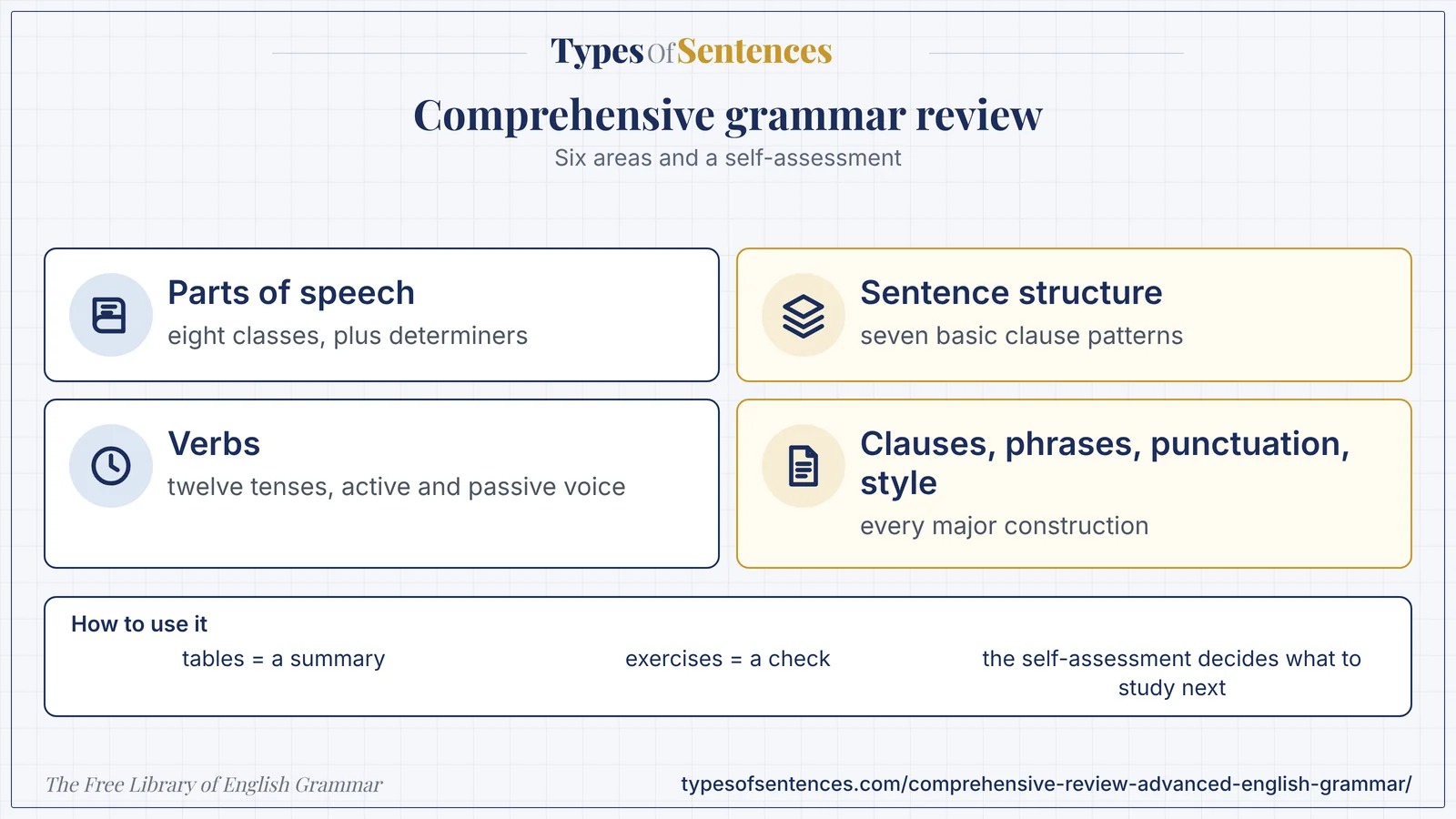
Summary: This comprehensive grammar review covers six areas and a self-assessment. Use the tables as a grammar summary, the exercises as a check, and the self-assessment to decide what to study next.
- Parts of speech: eight classes, plus determiners and the advanced ideas of gradability, conversion, and verb particles.
- Sentence structure: seven basic clause patterns; four types by function and four by structure.
- Verbs: twelve tenses, active and passive voice, three moods, modality, and the non-finite forms.
- Clauses, phrases, punctuation, style: every major clause and phrase type, the core punctuation rules, and the habits of clear, concise writing.
What You’ll Learn
- 1. Comprehensive Grammar Review: Parts of Speech
- 2. Sentence Structure: Complete Review
- 3. The Verb System: Complete Review
- 4. Clauses and Phrases: Complete Review
- 5. Punctuation: Complete Review
- 6. Style and Usage: Complete Review
- 7. Self-Assessment: Where Are You Now?
- 8. Exercises
- 9. Test Your Knowledge
- 10. Frequently Asked Questions
- 11. Conclusion
1. Comprehensive Grammar Review: Parts of Speech
Traditional grammar sorts words into eight classes by the job they do in a sentence. Modern grammars often add a ninth, determiner, for words such as the, this, my, and some. A word’s class depends on its use in the sentence, not on the word alone. The chapter on parts of speech teaches each class from the beginning.
| Class | Job | Example |
|---|---|---|
| Noun | names a person, place, thing, or idea | The teacher admired her courage. |
| Pronoun | replaces a noun | She said that everyone agreed. |
| Verb | expresses action or state | Birds fly; she is happy. |
| Adjective | describes a noun | a quiet street |
| Adverb | modifies a verb, adjective, or adverb | She quietly left; very slowly |
| Preposition | relates a noun to another word | the keys on the table |
| Conjunction | joins words, phrases, or clauses | tea and coffee; because it rained |
| Interjection | expresses sudden feeling | Wow, that was fast! |
| Determiner | introduces and specifies a noun | these three books; my keys |
I. The advanced ideas
- One word, several classes. Water is a noun in We need water and a verb in Please water the plants. This is called conversion.
- Gradable and non-gradable adjectives. You can say very cold but not very unique; ungradable adjectives such as dead and perfect resist degree words.
- Types of adverbs. Manner (slowly), place (here), time (soon), frequency (often), degree (quite), and sentence adverbs (fortunately).
- Phrasal and prepositional verbs. Look up a word (phrasal: the particle can move, look it up) versus look at a word (prepositional: look at it).
- Count and non-count nouns. Fewer cars but less traffic.
2. Sentence Structure: Complete Review
Every English clause follows one of seven basic patterns. The chapter on types of sentences shows how those patterns appear in statements, questions, commands, and exclamations.
| Pattern | Elements | Example |
|---|---|---|
| SV | subject + verb | Birds fly. |
| SVC | subject + verb + complement | She is a doctor. |
| SVA | subject + verb + adverbial | He lives in Ohio. |
| SVO | subject + verb + object | She wrote a book. |
| SVOO | subject + verb + indirect object + direct object | He gave her a gift. |
| SVOC | subject + verb + object + complement | They elected him president. |
| SVOA | subject + verb + object + adverbial | She put the keys on the table. |
I. Sentence types
| By function | Example | By structure | Example |
|---|---|---|---|
| Declarative | The store opens at nine. | Simple | Birds sing. |
| Interrogative | Does the store open at nine? | Compound | Birds sing, and bees buzz. |
| Imperative | Open the store at nine. | Complex | Birds sing when the sun rises. |
| Exclamatory | What a crowd there is! | Compound-complex | Birds sing when the sun rises, and bees buzz. |
3. The Verb System: Complete Review
The verb system has four parts: tense and aspect, voice, mood, and modality. The chapter on verb tenses teaches the twelve tenses in detail.
| Simple | Continuous | Perfect | Perfect continuous | |
|---|---|---|---|---|
| Present | she writes | she is writing | she has written | she has been writing |
| Past | she wrote | she was writing | she had written | she had been writing |
| Future | she will write | she will be writing | she will have written | she will have been writing |
- Voice. Active: The committee approved the plan. Passive (be + past participle): The plan was approved by the committee.
- Mood. Indicative states facts (He is on time); imperative gives commands (Be on time); subjunctive expresses wishes, demands, and unreal conditions (I suggest that he be on time; If I were you).
- Modality. Modal verbs express possibility (It may rain), logical conclusion (She must be tired), obligation (You must leave), ability (I can swim), and permission (You may go).
- Non-finite forms. Infinitive (to travel), gerund (traveling as a noun), present participle (a traveling salesman), past participle (traveled). They have no tense of their own.
- Agreement. The verb agrees with its subject: The list of items is long; Neither the manager nor the employees were ready (the verb agrees with the nearer subject).
4. Clauses and Phrases: Complete Review
A clause has a subject and a verb; a phrase does not. An independent clause can stand alone; a dependent clause cannot. The chapter on clauses introduces the difference, and the full grammar overview below shows the types side by side.
| Type | Job | Example |
|---|---|---|
| Noun clause | does a noun’s job | Whoever arrives first gets a seat. |
| Adjective (relative) clause | describes a noun | The book that I borrowed is overdue. |
| Adverb clause | shows time, reason, condition, contrast | When the bell rang, we left. |
| Noun phrase | head noun plus modifiers | the old house by the river |
| Verb phrase | main verb plus auxiliaries | has been waiting |
| Prepositional phrase | preposition plus object | in the garden |
| Participial phrase | participle plus modifiers | Walking home, she sang. |
| Gerund phrase | gerund as a noun | Reading novels relaxes me. |
| Infinitive phrase | infinitive plus modifiers | She wants to travel abroad. |
| Appositive phrase | renames a noun | Maya, my sister, is a pilot. |
| Absolute phrase | noun plus participle, modifies the clause | Her work done, she left. |
Coordination joins equal elements (and, but, or); subordination makes one element depend on another (because, although, who). Most advanced sentences combine both.
5. Punctuation: Complete Review
Punctuation marks the structure of a sentence for the reader. The chapter on punctuation marks covers every mark; this grammar summary lists the rules that cause the most errors.
| Mark | Core rule | Example |
|---|---|---|
| Period, question mark, exclamation mark | end a sentence | She left. Did she leave? She left! |
| Comma | after introductory elements; before and, but, or, so joining independent clauses; in a series; around non-restrictive material | After the meeting, we left, and she stayed. |
| Semicolon | joins closely related independent clauses, or separates items that contain commas | The test was hard; most students passed. |
| Colon | follows an independent clause to introduce a list or explanation | Bring three things: a pen, a pad, and a key. |
| Dash | sets off a break or an emphatic aside | She had one fear—failure. |
| Hyphen | joins compound modifiers before a noun | a well-known author |
| Apostrophe | shows possession or a contraction; its is possessive, it’s means it is | the company’s policy; it’s late |
| Quotation marks | enclose speech; in American style periods and commas go inside | She said, “I’m ready.” |
Two independent clauses cannot be joined by a comma alone. This error is called a comma splice; fix it with a conjunction, a semicolon, or a period.
6. Style and Usage: Complete Review
Style is the set of choices that make correct sentences clear and effective. These are the habits that matter most. The chapter on conciseness and wordiness develops the first one in depth.
- Be concise. Because it was raining, not due to the fact that it was raining.
- Keep ideas parallel. She enjoys hiking, swimming, and reading, not hiking, swimming, and to read.
- Prefer the active voice when the doer matters, and use the passive when the doer is unknown or unimportant.
- Avoid dangling modifiers. Walking down the street, I admired the trees, not Walking down the street, the trees were beautiful.
- Choose the right word. Fewer with count nouns and less with non-count nouns; affect (verb) and effect (noun).
- Match register to audience. Formal writing avoids contractions and slang; informal writing can use them.
That or which? American style guides, including The Chicago Manual of Style and the AP Stylebook, recommend that for restrictive clauses and which, with commas, for non-restrictive ones. British usage is less strict. When you are unsure, follow the style guide your reader expects.
7. Self-Assessment: Where Are You Now?
Use the checklist below as a full grammar review of your own skills. For each statement, decide whether you can do it correctly without looking anything up. Count the statements you can do in each group.
| Area | Can I do this without looking it up? |
|---|---|
| Parts of speech | Name the class of any word in a sentence; explain why one word can belong to two classes; tell a phrasal verb from a prepositional verb. |
| Sentence structure | Name the pattern of a clause (SV, SVO, and so on); label a sentence by function and by structure; fix a fragment and a run-on. |
| Verbs | Name and form all twelve tenses; change active to passive; choose the correct subjunctive form; make verbs agree with complex subjects. |
| Clauses and phrases | Label noun, adjective, and adverb clauses; name eight kinds of phrases; reduce a relative clause. |
| Punctuation | Punctuate compound and complex sentences; use semicolons and colons correctly; place quotation marks and apostrophes in American style. |
| Style | Cut a wordy sentence by a third without losing meaning; repair parallelism and dangling modifiers; choose between that and which. |
Score each area from 0 to 4. A score of 3 or 4 in an area means you can use it with confidence. A score of 0 to 2 marks the area to study next. This grammar summary is a map, so go back to the chapters on any area where you scored low, then retake this review in a month.
Pick the area where you scored lowest. Write one sentence that uses its main rule correctly, then check it against the chapter that teaches the rule.
Reveal answer
There is no single answer. If your sentence follows the rule from the chapter and you can explain why, you have shown you can use it; if you cannot explain it, reread the chapter section and try again with a new sentence.
Recap in 12 seconds
Watch the lesson build itself: The review covers six areas; use the tables as a summary, the exercises as a check, and the self-assessment to choose what to study next. The video has no sound.
Exercises
Part A: Parts of Speech (Exercises 1–5)
Exercise 1: In She quietly closed the door, what part of speech is quietly?
Show Answer
Answer: Adverb. It tells how she closed the door.
Exercise 2: What part of speech is that in I think that you are right?
Show Answer
Answer: Conjunction (subordinating). It joins the clause you are right to the verb think.
Exercise 3: Name the pronouns in Everyone brought their own lunch.
Show Answer
Answer: Everyone, their. Everyone is an indefinite pronoun; their is a possessive pronoun (or determiner).
Exercise 4: Is water a noun or a verb in Please water the plants?
Show Answer
Answer: Verb. It tells what someone should do.
Exercise 5: Name the determiners in These three students lost my keys.
Show Answer
Answer: These, three, my. Each introduces and specifies a noun.
Part B: Sentence Structure (Exercises 6–10)
Exercise 6: Name the pattern: She gave him a book.
Show Answer
Answer: SVOO (subject, verb, indirect object, direct object).
Exercise 7: Name the pattern: The committee elected her chair.
Show Answer
Answer: SVOC. Chair is the object complement.
Exercise 8: Name the structure: Although it rained, we played, and nobody complained.
Show Answer
Answer: Compound-complex. Two independent clauses and one dependent clause.
Exercise 9: Name the function: How wonderful this view is!
Show Answer
Answer: Exclamatory. It shows strong feeling and begins with How.
Exercise 10: Fix the fragment: Because the store was closed.
Show Answer
Answer: We went home because the store was closed. The dependent clause needs an independent clause.
Part C: The Verb System (Exercises 11–15)
Exercise 11: Name the tense: She had been waiting for an hour.
Show Answer
Answer: Past perfect continuous.
Exercise 12: Change to the passive: The committee approved the plan.
Show Answer
Answer: The plan was approved by the committee.
Exercise 13: Choose: If I (was/were) you, I would apply.
Show Answer
Answer: were. The subjunctive is used for an unreal condition.
Exercise 14: Epistemic or deontic? You must be joking.
Show Answer
Answer: Epistemic. Must expresses a logical conclusion, not an obligation.
Exercise 15: Choose: Neither the manager nor the employees (was/were) ready.
Show Answer
Answer: were. The verb agrees with the nearer subject, employees.
Part D: Clauses and Phrases (Exercises 16–20)
Exercise 16: Name the clause type: Whoever arrives first gets a seat.
Show Answer
Answer: Noun clause (the subject of gets).
Exercise 17: Find the relative clause: The book that I borrowed is overdue.
Show Answer
Answer: that I borrowed. It describes book.
Exercise 18: Name the phrase: Having finished the report, she left.
Show Answer
Answer: Participial phrase. It modifies she.
Exercise 19: Combine with an appositive: Maya is my sister. She is a pilot.
Show Answer
Answer: Maya, my sister, is a pilot.
Exercise 20: Gerund or participle? Swimming is fun.
Show Answer
Answer: Gerund. It names an activity and is the subject.
Part E: Punctuation (Exercises 21–25)
Exercise 21: Add the comma: After the meeting we went to lunch.
Show Answer
Answer: After the meeting, we went to lunch. Use a comma after an introductory phrase.
Exercise 22: Fix the comma splice: It was late, we left.
Show Answer
Answer: It was late, so we left. Or: It was late; we left.
Exercise 23: Choose: (Its/It’s) a good idea, and (its/it’s) cost is low.
Show Answer
Answer: It’s … its. The first means it is; the second is possessive.
Exercise 24: Join with a semicolon: The test was hard. Most students passed.
Show Answer
Answer: The test was hard; most students passed.
Exercise 25: Punctuate in American style: She said “I’m ready”
Show Answer
Answer: She said, “I’m ready.” A comma introduces the quotation and the period goes inside the marks.
Part F: Style and Usage (Exercises 26–30)
Exercise 26: Make parallel: She enjoys hiking, to swim, and biking.
Show Answer
Answer: She enjoys hiking, swimming, and biking.
Exercise 27: Fix the dangling modifier: Walking down the street, the trees were beautiful.
Show Answer
Answer: Walking down the street, I admired the trees. The participle needs a subject that can walk.
Exercise 28: Make concise: Due to the fact that it was raining, we stayed in.
Show Answer
Answer: Because it was raining, we stayed in.
Exercise 29: Choose in American style: The report (which/that) I wrote is due Friday.
Show Answer
Answer: that. The clause is restrictive.
Exercise 30: Choose: There are (fewer/less) cars today.
Show Answer
Answer: fewer. Cars is a count noun.
Test Your Knowledge
Ready to check what you learned? Answer all 10 questions, then submit. You need 80% (8 of 10) to pass. Your answers are not stored.
View correct answers and explanations
Question 1: How many parts of speech does traditional grammar list?
✓ Correct Answer: A – Eight
Traditional grammar lists eight: noun, pronoun, verb, adjective, adverb, preposition, conjunction, and interjection. Many modern grammars add determiners as a ninth class.
Question 2: Which pattern does They elected him president follow?
✓ Correct Answer: C – SVOC
President describes the object him, so it is an object complement and the pattern is SVOC. In SVOO the second object would be a direct object, not a description of the first.
Question 3: Which sentence is in the passive voice?
✓ Correct Answer: D – The plan was approved by the committee.
The passive uses a form of be with the past participle, and the subject receives the action. The other sentences are active.
Question 4: Which sentence uses the subjunctive correctly?
✓ Correct Answer: B – I suggest that he be on time.
After verbs of suggestion and demand, formal English uses the base form: that he be. The other forms use the indicative.
Question 5: What kind of clause is when the bell rang in When the bell rang, we left?
✓ Correct Answer: A – Adverb clause
It tells when we left, so it is an adverb clause. It cannot stand alone, so it is not independent.
Question 6: Which sentence is punctuated correctly?
✓ Correct Answer: D – When the meeting ended, we left.
A comma follows an introductory dependent clause. The other versions omit it or place commas where they do not belong.
Question 7: Which sentence fixes the comma splice in It was late, we left?
✓ Correct Answer: C – It was late, so we left.
Adding the conjunction so after the comma joins the two independent clauses correctly. Removing the comma leaves a run-on, and the other versions do not fix the problem.
Question 8: Which sentence is parallel?
✓ Correct Answer: B – She likes cooking, reading, and hiking.
All three items are gerunds, so the series is parallel. The other sentences mix gerunds with infinitives.
Question 9: Which sentence uses its correctly?
✓ Correct Answer: D – The company changed its policy.
Its without an apostrophe is the possessive, as in its policy. It’s means it is or it has.
Question 10: Which sentence contains a dangling modifier?
✓ Correct Answer: C – Walking down the street, the trees were beautiful.
The participle walking has no person to attach to, because the trees cannot walk. The other sentences attach the modifier to the subject that performs the action.
Frequently Asked Questions
What is a comprehensive grammar review?
A comprehensive grammar review revisits every major area of grammar in one place, from parts of speech to style, so you can check what you know and find gaps. It does not teach each topic from scratch; it summarizes the rules and points to the chapters that teach them in full.
How often should I review grammar?
Review regularly to maintain mastery. A short review every month works better than one long review a year, because the rules you use least are the first you forget. Use the self-assessment to pick the areas to revisit.
Is there a grammar overview I can use as a checklist?
Yes. The self-assessment in this chapter is a checklist for all grammar topics at this level: six areas, each with specific skills. Score yourself on each area and study the lowest first.
Do I need to memorize every grammar term?
No. The terms are a shared vocabulary for talking about language, but writing well depends on using the rules, not reciting the names. Learn the terms you need to look up a rule or discuss a sentence with an editor.
Which areas do writers get wrong most often?
Commas, subject-verb agreement, pronoun reference, parallel structure, and dangling modifiers cause most errors in edited writing. If you control those five, you have removed most of the mistakes readers notice.
How do I know when I am ready for the final assessment?
You are ready when you can score 3 or 4 in every area of the self-assessment and finish the 30 exercises here with few mistakes. The final assessment in the next chapter tests all grammar topics at once, so a solid full grammar review first will pay off.
Conclusion
A comprehensive grammar review shows the whole system at once: eight classes of words, seven clause patterns, twelve tenses, a dozen clause and phrase types, a handful of punctuation rules, and the habits of clear style. This grammar summary is meant to be reused, not read once.
Take the self-assessment, find your weakest area, and go back to the chapter that teaches it. When your scores are even, the final assessment will confirm what you know.
- Quirk, Randolph, et al. A Comprehensive Grammar of the English Language. Longman, 1985.: the seven basic clause patterns and the classification of sentence types.
- Huddleston, Rodney, and Geoffrey K. Pullum. The Cambridge Grammar of the English Language. Cambridge University Press, 2002.: reference for clause, phrase, and verb-system terminology.
- Garner, Bryan A. Garner’s Modern English Usage, 5th ed. Oxford University Press, 2022.: usage points on fewer and less, that and which, and dangling modifiers.
- The Chicago Manual of Style, 17th edition, chapter 5 (Grammar and Usage): American conventions for punctuation and usage.
Last reviewed: October 29, 2026. How it was made: drafted with AI assistance, then checked with automated tests (structure, links, answer keys, spelling) and against the sources above. A person has not yet read this chapter line by line. Found a mistake? Report it.