Grammar troubleshooting is the practice of finding what is wrong with a sentence that does not work, naming the cause, and fixing it. Every writer meets sentences that feel wrong without being sure why: a pronoun that sounds too formal or too casual, a verb that does not seem to agree with its subject, a list that limps, a word that might or might not be the right one. Some of these problems are caused by genuine rules, and some by half-remembered myths. The skill of solving grammar problems is to move from the feeling (something is wrong) to a diagnosis (what, exactly) and to a remedy that is correct and also natural.
This chapter gives a method and then applies it to the most persistent issues: the persistent problems of everyday writing, who and whom, less and fewer, lay and lie, that and which, the tricky cases of subject-verb agreement, and complex cases of parallel structure. For each, there is a rule, a test that settles doubtful cases, and examples. It is the chapter for those who have grammar questions and want grammar help they can use at the keyboard: a mixture of reference and drill. Distinctions that are genuine rules are marked as such, and those that are conventions or preferences are marked too, in line with the chapter on advanced grammar myths. Thirty exercises and a quiz follow.
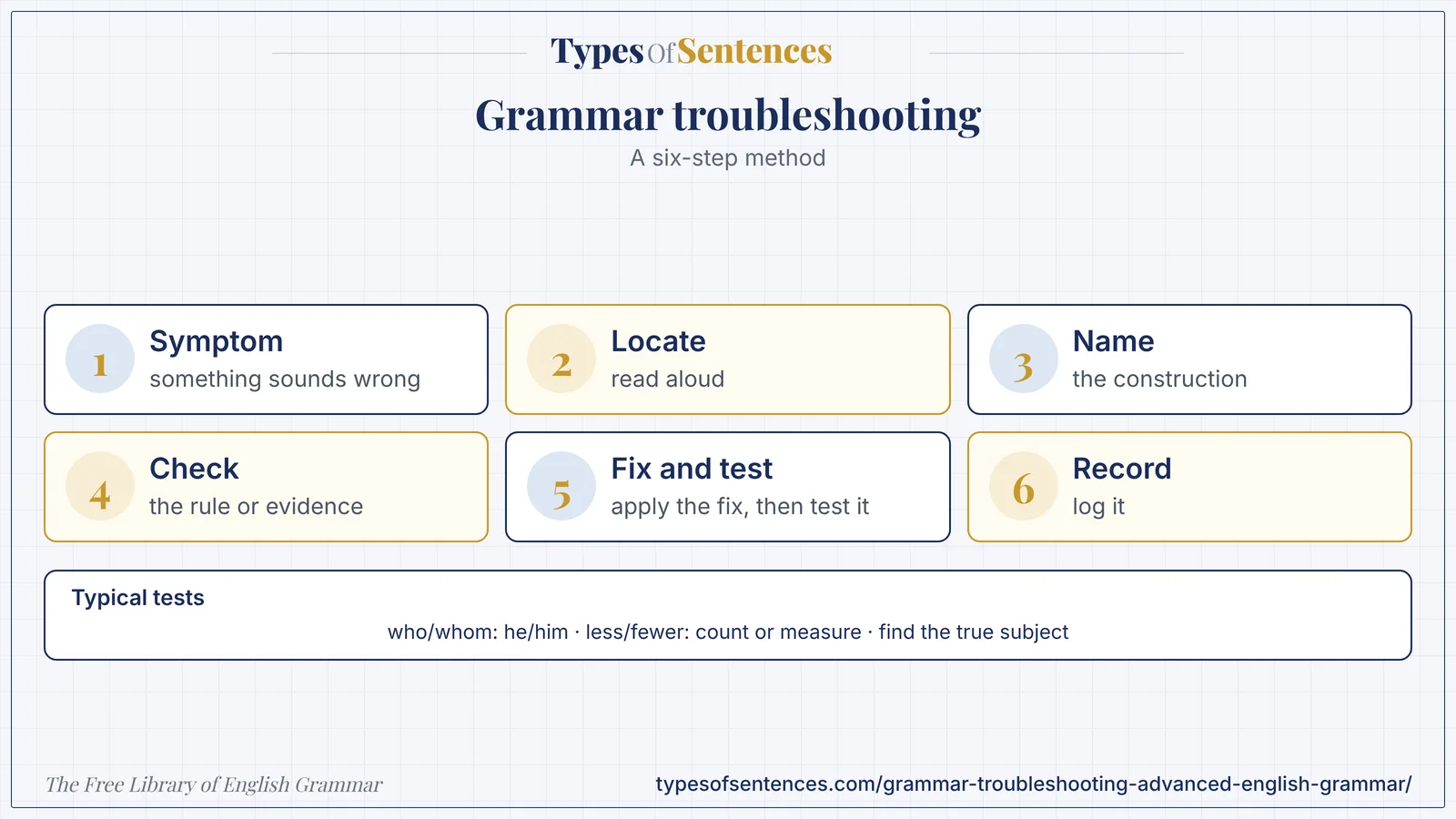
When a sentence feels wrong, do not guess. Read it aloud, find the part that bothers you, name what kind of construction it is (a pronoun, a verb and its subject, a list), check the rule, and test the fix.
Why it matters: Most persistent problems have a simple test: replace who/whom with he/him; count the nouns for less/fewer; ask whether lie/lay has an object; check for commas with that/which; find the real subject for agreement; check that the items in a list have the same form.
Summary: Troubleshooting uses a method: identify the symptom, locate it by reading aloud, name the construction, check the rule or the evidence, apply a fix, test the result, and record it. Typical tests: who/whom by substituting he/him; less/fewer by asking whether the noun is counted; lay/lie by asking whether there is an object (lay takes one; lie does not); that/which by asking whether the clause is restrictive (a nonrestrictive clause takes which and commas); agreement by finding the true subject and ignoring intervening phrases; parallelism by checking that items joined by a conjunction or a correlative pair have the same form. Many persistent problems are in fact conventions or myths, which should be distinguished from rules.
- Symptom → locate → name → check → fix → test.
- who/whom: he/him test; less/fewer: count or measure; lay/lie: object or not.
- that/which: commas; agreement: find the true subject.
- Parallelism: same form after the conjunction.
What You’ll Learn
- 1. Grammar Troubleshooting: A Method for Solving Grammar Problems
- 2. Who and Whom: When to Use Each
- 3. Less and Fewer: Count vs Non-Count
- 4. Lay and Lie: Transitive vs Intransitive
- 5. That and Which: Defining and Non-Defining Clauses in Detail
- 6. Subject-Verb Agreement: Tricky Cases and Complex Subjects
- 7. Parallel Structure: Complex Cases
- 8. Where to Find Help: A Troubleshooting Routine
- 9. Common Misunderstandings and a Worked Example
- 10. Exercises
- 11. Test Your Knowledge
- 12. Frequently Asked Questions
- 13. Conclusion
1. Grammar Troubleshooting: A Method for Solving Grammar Problems
| Step | Action | Example |
|---|---|---|
| 1 notice the symptom | something sounds or looks wrong | Between you and I, the plan is weak. |
| 2 locate it | read aloud; mark the part that bothers you | the pronoun after between |
| 3 name the construction | what kind of structure is it? | a pronoun as the object of a preposition |
| 4 recall or look up the rule | a reference, a corpus, a usage guide | after a preposition, the object form is used (me) |
| 5 apply a test | a substitution or a transformation | remove you and: between I is not possible |
| 6 fix | rewrite | Between you and me |
| 7 check that the fix is natural | read aloud again | — |
| 8 decide whether it is a rule or a convention | is it grammatical, a style guide point, or a myth? | this is a rule of case after a preposition |
| 9 record it | an error log or a style sheet | — |
| 10 learn the pattern | so that the problem does not recur | — |
| Useful general tests | How they work | Example |
|---|---|---|
| read aloud | the ear catches many problems | — |
| remove interrupting phrases | find the subject and verb | The list of items [on the table] is long. |
| substitute a pronoun | test case | He/him for who/whom |
| substitute a simpler sentence | check the core | Me went versus I went |
| split a compound | test each part alone | She gave it to him and me: gave it to me |
| reorder the sentence | find the subject | There are three reasons. → Three reasons are there. |
| check the antecedent | find what a pronoun refers to | — |
| replace with a synonym | test word choice | — |
| check a corpus or a usage dictionary | evidence of use | — |
| ask who is doing what | find actors and actions | — |
| expand contractions | test it’s and who’s | it is, who is |
| check each item in a list for form | test parallelism | — |
| change the tense | test consistency | — |
| look at the punctuation | commas show structure | — |
| ask whether a reader could misread it | test ambiguity | — |
| Persistent problem | Typical symptom or error | Cause | Fix |
|---|---|---|---|
| who and whom | Whom is calling? | overcorrection | Who is calling? |
| less and fewer | less people | confusing count and mass nouns | fewer people |
| lay and lie | I will lay down | confusing transitive and intransitive | I will lie down |
| that and which | The car, that I bought, | confusing restrictive and nonrestrictive | The car, which I bought, |
| agreement with a long subject | The cost of the repairs are high. | agreement with the nearer noun | The cost … is high. |
| agreement with there | There is three options. | the verb agrees with the first item or with there | There are three options. |
| agreement with a number of | A number of students is absent. | — | are absent |
| affect and effect | The weather effected my mood. | verb versus noun | affected |
| its and it’s | The dog wagged it’s tail. | apostrophe confusion | its |
| then and than | taller then me | homophone confusion | taller than me |
| whose and who’s | Who’s book is this? | — | Whose |
| lose and loose | I will loose my keys. | — | lose |
| advice and advise | I advice you. | noun versus verb | advise |
| farther and further | — | distance versus degree (a distinction many writers make) | farther (distance); further (degree) |
| principal and principle | the principle of the school | — | principal |
| imply and infer | I imply from your face that … | speaker versus listener | infer |
| comprise | is comprised of | disputed | comprises / is composed of |
| between and among | — | myth of a two/three rule | see the chapter on myths |
| I and me in compounds | Me and John went. | case in compound subjects | John and I went. |
| between you and I | — | hypercorrection | between you and me |
| myself as a polite substitute | contact myself | — | contact me |
| good and well | He plays good. | adjective for adverb | He plays well. |
| bad and badly | I feel badly. | — | I feel bad. (usual) |
| real and really | It was real good. | — | really good |
| like and as | Do like I do. | — | Do as I do. |
| since and because | — | ambiguity of time and reason | choose by meaning |
| comma splice | It rained, we stayed. | two sentences joined by a comma | a period, a semicolon, or a conjunction |
| run-on sentence | It rained we stayed. | no punctuation | — |
| fragment | Because it rained. | a dependent clause alone | — |
| dangling modifier | Walking home, the rain started. | the modifier has no subject | Walking home, I felt the rain start. |
| misplaced only | I only have two. | position | I have only two. |
| unclear this | This is a problem. | no noun | This delay is a problem. |
| pronoun agreement | A student should bring their book. | singular noun, plural pronoun | see the chapter on gender-inclusive language |
| pronoun reference | She told her she was late. | two antecedents | — |
| faulty comparison | Its price is lower than other stores. | comparing a price with stores | than other stores’ |
| double negative | I don’t know nothing. | nonstandard | I don’t know anything. |
| tense shift | She walked in and sees him. | — | saw |
| sequence of tenses | He said he is tired. | — | was tired (or keep present for a present fact) |
| subjunctive | If I was you | — | If I were you |
| apostrophe in a plural | CD’s | — | CDs |
| apostrophe omission | the dogs bone | — | the dog’s bone |
| missing comma after an introductory clause | When it rained we stayed. | — | When it rained, we stayed. |
| unneeded comma between subject and verb | The plan, was good. | — | The plan was good. |
| hyphen in compound modifiers | a well known author | — | a well-known author |
| missing articles | I bought book. | — | a book |
| wrong preposition | depend of | — | depend on |
| redundancy | added bonus | — | bonus |
| a versus an | an university | sound versus spelling | a university |
| few and a few | — | meaning differs | few (almost none); a few (some) |
| much and many | much books | mass versus count | many books |
| everyday and every day | I walk everyday. | adjective versus adverbial phrase | every day |
| alot | alot of people | not a word | a lot |
| could of | — | mishearing of could’ve | could have |
| irregardless | — | nonstandard | regardless |
| use to | I use to walk. | — | I used to walk. |
| for all intensive purposes | — | mishearing | for all intents and purposes |
| nip it in the butt | — | mishearing | nip it in the bud |
| take for granite | — | mishearing | take for granted |
| verbs after enjoy, avoid | enjoy to swim | — | enjoy swimming |
| verbs after want | want swimming | — | want to swim |
| look forward to + gerund | look forward to see | — | to seeing |
| suggest patterns | suggest me to go | — | suggest that I go |
| inverted questions in indirect speech | I wonder where is he. | — | where he is |
| uncountable nouns | informations | — | information |
The table is a quick reference; the sections that follow treat the six most persistent problems in depth. For the error analysis behind many of these problems, see the chapter on error analysis and correction; for the myths that are often mistaken for these rules, see the chapter on advanced grammar myths.
2. Who and Whom: When to Use Each
| Form | Function | Example |
|---|---|---|
| who | subject | Who called?; the man who called |
| whom | object (of a verb or a preposition) | Whom did you call?; to whom I spoke |
| whose | possessive | Whose book is this? |
| whoever | subject | Whoever calls is welcome. |
| whomever | object | Invite whomever you like. |
| who’s | contraction of who is or who has | Who’s coming? |
| The he/him test | Procedure | Example |
|---|---|---|
| 1 | rewrite the clause as a statement with he or him | Who/whom did you see? → You saw him. |
| 2 | if him fits, use whom; if he fits, use who | → whom |
| example | Who/whom wrote the report? | He wrote it. → who |
| example | The man who/whom I met was kind. | I met him. → whom |
| example | I do not know who/whom she asked. | She asked him. → whom |
| example | To who/whom did you speak? | after a preposition → whom |
| example | Who/whom do you think will win? | He will win → who (do you think is parenthetical) |
| example | Give it to whoever/whomever needs it. | whoever needs it is the object of to, but whoever is the subject of needs → whoever |
| Sentence | Correct form | Reason |
|---|---|---|
| Who/Whom is at the door? | Who | subject |
| Who/Whom did the committee select? | Whom (formal) or Who (informal) | object of select |
| For who/whom is this gift? | whom | object of for |
| Who/Whom are you talking to? | Whom (formal) or Who (informal) | object of to, stranded |
| the candidate who/whom they chose | whom (formal) or who (informal) or no pronoun | object |
| She is the person who/whom everyone admires. | whom (formal) or who (informal) | object of admires |
| He is the one who/whom I think is best. | who | I think is parenthetical; is best needs a subject |
| Ask who/whom the letter is for. | whom (formal) or who (informal) | object of for |
| whoever/whomever wins the prize | whoever | subject of wins |
| Send it to whoever/whomever you like. | whomever (formal) or whoever (informal) | object of like |
| Who/Whom shall I say is calling? | Who | is calling needs a subject |
| the artist whom/who the critics praised | whom (formal) | object |
| Who/Whom is it from? | Who or Whom | — |
| She, whom I admire, spoke. | whom | object of admire |
| He wondered who/whom had called. | who | subject of had called |
| He wondered who/whom she called. | whom (formal) or who (informal) | object of called |
| Who/Whom did you say was late? | Who | was late needs a subject |
| The woman to who/whom I wrote | whom | after a preposition |
| Who/Whom among us can say? | Who | subject |
| Who/Whom is the letter addressed to? | Who or Whom | — |
| Practical guidance | Advice |
|---|---|
| formal writing | use whom for objects, especially after a preposition |
| speech and informal writing | who is normal for objects not directly after a preposition |
| after a preposition | whom is required in formal English (to whom) |
| avoid hypercorrection | do not use whom for a subject: Whom is calling? is wrong |
| avoid the problem | rewrite: the man I met, the man that I met |
| the future of whom | it is retreating in speech; check your style guide for writing |
| than whom | a writer than whom none is better (fixed formal) |
3. Less and Fewer: Count vs Non-Count
| Rule | Example | Note |
|---|---|---|
| fewer with plural count nouns | fewer cars, fewer mistakes | the traditional rule |
| less with uncountable (mass) nouns | less traffic, less water | — |
| less with time, money, distance, weight, and amounts treated as a unit | less than ten minutes, less than ₹500, less than 5 miles, less than 3 kilograms | a quantity as a whole |
| fewer with units counted individually | fewer than five rupees (coins) | — |
| less with than and numbers in general | less than 100 words | common and accepted |
| fewer than with a count of people or things | fewer than 50 people | — |
| one fewer | one fewer problem | — |
| no fewer than | no fewer than ten | — |
| less as an adverb or preposition | She speaks less.; five less two | — |
| the history | the distinction was proposed by Robert Baker (1770); less with plurals is long attested | a preference that became a rule of editors |
| supermarket signs | ten items or fewer (strict) or ten items or less (common) | — |
| few and a few | few (hardly any); a few (some) | — |
| little and a little | little (hardly any); a little (some) | — |
| fewer with abstract plurals | fewer opportunities | — |
| less with a plural subject in a comparison | less than three of them | — |
| Sentence | Traditional choice | Reason |
|---|---|---|
| There are ___ students than last year. | fewer | students are counted |
| There is ___ noise than last year. | less | noise is uncountable |
| I have ___ time than I thought. | less | time as an amount |
| It takes ___ than ten minutes. | less | time as a unit |
| She made ___ errors than her brother. | fewer | errors are counted |
| ___ people came than expected. | fewer | people are counted |
| We need ___ than ₹500. | less | money as an amount |
| We have ___ coins than before. | fewer | coins are counted |
| There is ___ sugar in this. | less | uncountable |
| There are ___ sugars in this tea (types). | fewer | sugars as types |
| He lives ___ than a mile away. | less | distance as a unit |
| You will gain ___ weight. | less | uncountable |
| The team scored ___ goals. | fewer | goals are counted |
| The market has ___ stalls. | fewer | stalls are counted |
| There is ___ choice now. | less | choice as an uncountable noun |
| There are ___ choices now. | fewer | choices are counted |
| I eat ___ meat. | less | uncountable |
| I eat ___ eggs. | fewer | eggs are counted |
| Use ___ words. | fewer (or less, in the idiom less than 100 words) | — |
| She has ___ friends than I do. | fewer | friends are counted |
Informal English often uses less with plural nouns (less people), and style guides generally ask for fewer in formal writing. The distinction is a convention with a long history rather than a rule of the language, as the chapter on advanced grammar myths discusses, but it is a convention that many editors apply, so a writer should know it. A simple test: can you count them one by one? If so, use fewer.
4. Lay and Lie: Transitive vs Intransitive
| Verb | Meaning | Transitive? | Principal parts | Example |
|---|---|---|---|---|
| lie | recline; be located | no (no object) | lie, lay, lain, lying | I lie down every afternoon. I lay down yesterday. I have lain here for an hour. |
| lay | put or place something | yes (needs an object) | lay, laid, laid, laying | Lay the book on the table. She laid the book there. He has laid the foundation. |
| lie (tell an untruth) | — | no | lie, lied, lied, lying | He lied about his age. |
| sit and set | a parallel pair | sit intransitive; set transitive | sit, sat, sat; set, set, set | Sit down. Set the vase down. |
| rise and raise | another parallel pair | rise intransitive; raise transitive | rise, rose, risen; raise, raised, raised | The sun rises. Raise your hand. |
| hang | suspend | both | hang, hung, hung (things); hang, hanged, hanged (executions) | She hung the picture. |
| Test | Procedure | Example |
|---|---|---|
| object test | is there an object (a thing that receives the action)? if yes, use lay; if no, use lie | I will lay/lie the book down. → the book is the object → lay |
| “place” test | can you substitute place or put? then lay | Place the book → lay |
| “recline” test | can you substitute recline? then lie | I will recline → lie |
| past-tense confusion | lay is the present of one verb and the past of another | Yesterday I lay in bed (past of lie); Today I lay the plates (present of lay) |
| participle test | laid after have for placing; lain after have for reclining | I have laid the plates. I have lain in bed. |
| Sentence | Correct form | Reason |
|---|---|---|
| I want to ___ down. | lie | no object |
| Please ___ the baby in the crib. | lay | object: the baby |
| She ___ on the couch all day yesterday. | lay | past of lie |
| He ___ the keys on the table last night. | laid | past of lay; object: keys |
| The papers have been ___ on the desk. | laid | passive of lay |
| The dog has ___ there for hours. | lain | perfect of lie |
| She is ___ down. | lying | participle of lie |
| He is ___ the table. | laying | participle of lay; object: the table |
| The town ___ in the valley. | lies | — |
| Hens ___ eggs. | lay | object: eggs |
| The hen ___ an egg yesterday. | laid | — |
| The cat likes to ___ in the sun. | lie | — |
| ___ down, dog. | Lie | — |
| He ___ his head on the pillow. | lays | object: head |
| The book ___ open on the table. | lay (past) or lies (present) | no object |
| She ___ the plans before the board. | laid | object: plans |
| The treaty ___ the basis for peace. | laid | object |
| The wreck ___ on the sea floor for a century. | lay | — |
| He ___ to the police. | lied | tell an untruth |
| Let sleeping dogs ___. | lie | — |
The pair lay and lie is difficult because the past tense of lie is the same as the present tense of lay. In informal speech and some varieties the two are merged, and lay is used intransitively (I’m going to lay down); in standard written English the distinction is expected. The trick is to ask whether the verb has an object.
5. That and Which: Defining and Non-Defining Clauses in Detail
| Clause type | Test | Form | Example |
|---|---|---|---|
| restrictive (defining) | remove the clause: does the meaning of the noun change? (yes) | that (or which in some usage), no commas | The report that was late was approved. |
| nonrestrictive (non-defining) | removing the clause leaves the identification intact (no change) | which with commas | The report, which was late, was approved. |
| people | — | who (or that in restrictive clauses) | The man who called. |
| sentential relative | refers to a whole clause | which with a comma | He passed, which surprised us. |
| after a preposition | — | which (not that) | the house in which I live |
| zero relative | object of the clause | no pronoun | the report I read |
| after all, everything, something, nothing | — | that | everything that matters |
| after superlatives | — | that | the best film that I have seen |
| after the only, the same, the very | — | that | the only book that helped |
| proper names | — | nonrestrictive: which or who with commas | Pune, which is in Maharashtra, … |
| that never follows a comma in a relative clause | — | use which | *The car, that I bought, … |
| Sentence | Choice | Reason |
|---|---|---|
| The book ___ I bought is on the table. | that / which / (none) | restrictive |
| The book, ___ I bought yesterday, is on the table. | which | nonrestrictive |
| This is the house in ___ I was born. | which | preposition |
| This is the house ___ I was born in. | that / (none) | stranded preposition |
| Everything ___ you said is true. | that | after everything |
| He failed, ___ surprised everyone. | which | sentential |
| The students ___ passed were happy. | who / that | restrictive: only some |
| The students, ___ passed, were happy. | who | nonrestrictive: all |
| Dogs ___ bark rarely bite. | that / which | restrictive |
| My brother, ___ lives in Pune, is a doctor. | who | nonrestrictive |
| The only plan ___ works is this one. | that | after the only |
| Pune, ___ is warm, is popular. | which | nonrestrictive |
| The tea ___ you made is cold. | that / which / (none) | restrictive |
| The tea, ___ was hot, burned me. | which | nonrestrictive |
| A report ___ is late is useless. | that / which | restrictive |
| I read the report, ___ was long. | which | nonrestrictive |
| She is the person ___ called. | who / that | restrictive |
| This is the best tea ___ I have tasted. | that | after a superlative |
| Anything ___ helps is welcome. | that | after anything |
| The reasons, ___ I explained, are clear. | which | nonrestrictive |
The nonrestrictive rule (commas and which, never that) is a real rule. The restrictive preference for that is an American editorial convention, discussed in the chapter on advanced grammar myths. A writer should apply the rule always and the convention where the style guide requires it.
6. Subject-Verb Agreement: Tricky Cases and Complex Subjects
| Case | Rule | Example |
|---|---|---|
| intervening phrases | the verb agrees with the head noun, not the nearest noun | The cost of the repairs is high. |
| along with, as well as, together with | the verb agrees with the first subject | The manager, along with her team, is present. |
| subjects joined by and | plural verb | Tea and coffee are available. |
| and joining one thing | singular verb | Bread and butter is my breakfast. |
| each and every before singular nouns joined by and | singular | Each man and woman is invited. |
| subjects joined by or/nor | the verb agrees with the nearer subject | Neither the teacher nor the students were ready. |
| either … or, neither … nor | nearer subject | Either the students or the teacher is responsible. |
| not only … but also | nearer subject | Not only the plan but also the budget was approved. |
| inverted order: there is/are | the verb agrees with the following subject | There are three reasons. |
| here is/are | as above | Here are the keys. |
| collective nouns | American: usually singular; British: singular or plural by meaning | The committee is meeting. / The committee are divided. (British) |
| indefinite pronouns: each, everyone, someone, anybody, no one | singular | Everyone is here. |
| none | singular or plural (both standard) | None of them is/are late. |
| some, all, most, half, any | depends on the noun | Some of the water is gone. Some of the apples are gone. |
| a number of | plural | A number of students are absent. |
| the number of | singular | The number of students is growing. |
| a majority of | plural with plural nouns | A majority of members agree. |
| fractions and percentages | by the noun | Half of the cake is gone. Half of the cakes are gone. |
| amounts treated as a unit | singular | Ten rupees is not enough. |
| plural-looking singular nouns | news, mathematics, physics, measles | The news is good. |
| singular-looking plural nouns | police, people, cattle | The police are here. |
| data and media | both singular and plural uses occur; follow your guide | — |
| titles and names | singular | “The Raven” is a poem. |
| clauses as subjects | singular | What he said was true. |
| what clauses | agree with the complement in some cases | What we need is time. What we need are funds. |
| one of the … who | the verb agrees with the plural antecedent | She is one of the students who work hard. |
| the only one of the … who | singular | She is the only one of the students who works hard. |
| more than one | singular | More than one person was late. |
| a lot of, lots of | by the noun | — |
| either of, neither of | singular (formal); plural is common in speech | Neither of them is ready. |
| pronoun I and relative clauses | It is I who am responsible. | formal |
| who agreeing with its antecedent | I, who am late, apologize. | formal |
| gerund subjects | singular | Swimming is fun. |
| infinitive subjects | singular | To err is human. |
| subject and complement of different numbers | the verb agrees with the subject | The problem is the costs. |
| the rest of | by the noun | — |
| percent of | by the noun | Fifty percent of the staff are women. |
| couple | singular or plural by meaning | The couple is happy. / The couple are arguing. (British) |
| series, species | same form singular and plural | This series is new. These series are new. |
| compound subjects with or where one is plural | nearer subject | — |
| subject after a long modifier | find the head | — |
| all that | by the noun | — |
| ellipsed verbs | agree separately | She is tall, and they are short. |
| subjects with plus | singular (informal) | Two plus two is four. |
| names of organizations | singular (American) | Apple is … |
| each after the subject | the verb agrees with the subject | They each have a key. |
| which with a plural antecedent | plural | — |
| subject with a prepositional phrase of quantity | by the head noun | A box of chocolates is on the table. |
| Sentence | Correct verb | Reason |
|---|---|---|
| The list of items ___ long. (is/are) | is | head noun: list |
| The students, along with their teacher, ___ here. (is/are) | are | students (head) |
| The manager, along with the team, ___ here. (is/are) | is | manager (head) |
| Neither the plan nor the budgets ___ approved. (was/were) | were | nearer subject: budgets |
| Neither the budgets nor the plan ___ approved. (was/were) | was | nearer subject: plan |
| There ___ two problems. (is/are) | are | plural subject |
| There ___ a problem and a delay. (is/are) | is (formal) or are | first subject (traditional) |
| A number of people ___ late. (was/were) | were | plural |
| The number of people ___ small. (is/are) | is | singular |
| Everyone ___ their own opinion. (has/have) | has | singular |
| None of the cakes ___ left. (is/are) | are (or is) | — |
| The news ___ good. (is/are) | is | singular noun |
| Mathematics ___ difficult. (is/are) | is | singular |
| The police ___ here. (is/are) | are | plural |
| Ten kilometers ___ a long way. (is/are) | is | a distance as a unit |
| Either the manager or the clerks ___ responsible. (is/are) | are | nearer subject |
| What we need ___ more time. (is/are) | is | — |
| She is one of those people who ___ always late. (is/are) | are | the antecedent is people |
| More than one student ___ failed. (has/have) | has | singular |
| Each of the books ___ good. (is/are) | is | each is singular |
| Bread and butter ___ my favorite. (is/are) | is | one dish |
| The committee ___ divided. (is/are, British) | are | — |
| Half of the work ___ done. (is/are) | is | work is uncountable |
| Half of the students ___ present. (is/are) | are | students are plural |
| “The Hindu” ___ a newspaper. (is/are) | is | a title |
| Physics ___ my favorite subject. (is/are) | is | — |
| The cattle ___ in the field. (is/are) | are | plural |
| Two thousand rupees ___ a lot. (is/are) | is | an amount |
| Not only the teacher but also the students ___ happy. (was/were) | were | nearer subject |
| Here ___ the keys. (is/are) | are | plural |
| A series of events ___ unfolded. (has/have) | has | series is singular here |
| The rest of the cake ___ gone. (is/are) | is | uncountable |
| The rest of the cakes ___ gone. (is/are) | are | plural |
| The couple ___ married for ten years. (has/have) | have (British) or has (American) | — |
| A box of chocolates ___ on the table. (is/are) | is | head noun: box |
| Your friends and family ___ welcome. (is/are) | are | plural subject |
| The company and its employees ___ affected. (was/were) | were | plural subject |
| Having a lot of friends ___ nice. (is/are) | is | gerund subject |
| Neither of them ___ ready. (is/are) | is (formal) | — |
| Where ___ the keys? (is/are) | are | inverted |
7. Parallel Structure: Complex Cases
| Case | Problem | Correct |
|---|---|---|
| items in a series | She likes swimming, to hike, and cycling. | She likes swimming, hiking, and cycling. |
| correlative conjunctions | He is not only smart but also works hard. | He is not only smart but also hardworking. |
| either … or | She will either call me or send an email. | She will either call me or email me. |
| both … and | He is both a poet and writes plays. | He is both a poet and a playwright. |
| not … but | Not to complain but doing something. | Not complaining but acting. |
| comparisons | Living in a city is more expensive than to live in a village. | Living in a city is more expensive than living in a village. |
| verb phrases with different auxiliaries | She has finished and will present the report. | She has finished the report and will present it. |
| relative clauses | a man who is tall and with a beard | a man who is tall and has a beard |
| prepositional phrases | in the morning, at night, and during afternoons | in the morning, at night, and in the afternoon |
| lists after a colon | The job requires: experience, to be flexible, and a degree. | The job requires experience, flexibility, and a degree. |
| headings and bullets | Planning; How to do it; Checking | Planning; Doing; Checking |
| items with articles | the manager, assistant, and the clerk | the manager, the assistant, and the clerk |
| items with to | to read, to write, and speaking | to read, to write, and to speak |
| as well as | She teaches as well as writing. | She teaches as well as writes. |
| rather than | I would rather swim than to run. | I would rather swim than run. |
| than and as comparisons | as tall as him and as smart | as tall as he and as smart |
| objects of a verb | She likes tea and to read. | She likes tea and books. |
| noun clauses | He said that he was tired and he was going home. | He said that he was tired and that he was going home. |
| adjective and noun | a quick and efficiency | quick and efficient |
| long parallel items | — | repeat the introductory word to clarify |
| gerund and infinitive after the same verb | I like to swim and hiking. | I like to swim and to hike. / I like swimming and hiking. |
| parallel verbs in instructions | Open the file, saving it, and close it. | Open the file, save it, and close it. |
| parallel names and titles | Dr. Rao, Mrs. Nair | Dr. Rao, Dr. Nair |
| parallel adverbs | quickly and in a careful way | quickly and carefully |
| ellipsis in parallel structures | She wrote the report; he, the summary. | — |
| mixed noun and verb forms in a list of qualifications | Organized, a leader, and communicates well | Organized, decisive, and communicative |
| balanced sentences | The more we study, the more we know. | — |
| Test for parallelism | How |
|---|---|
| draw a line under each item | compare their forms |
| read the list with the lead-in for each item | She likes … swimming. She likes … to hike. (the second does not match) |
| check the word class | nouns with nouns, verbs with verbs |
| check the form of the verbs | all -ing, all to, all base |
| check correlatives | the same structure after each half |
| repeat the shared word | the manager, the assistant, and the clerk |
| revise by choosing a model form | use the first or the clearest item as the model |
| reorder | put the longest item last |
| test by deleting the conjunction | the items should stand alone in the same form |
| read aloud | faulty parallelism usually sounds uneven |
The principles of parallel structure are treated in the chapter on parallel structure; the cases above are those that cause difficulty even for good writers, especially the correlative conjunctions and the lists with mixed forms. Parallelism is both a rule of clarity and a source of rhythm.
8. Where to Find Help: A Troubleshooting Routine
- Write the sentence as it stands, and mark the part that troubles you.
- Name the construction (a pronoun, an agreement, a list, a modifier).
- Use a test (he/him; count or measure; object or not; commas; true subject; same form).
- Check a reference for doubtful cases: a learner’s grammar, a usage guide, a style guide, or a corpus (see the chapter on grammar resources).
- Rewrite the sentence to avoid the problem if the rule is awkward.
- Decide whether the issue is a rule, a convention, or a myth.
- Keep a log of the problems you meet, and review it.
- Ask someone if you are still unsure: a teacher, an editor, a writing center, or an online community with reliable answers.
| Source of grammar help | Strength | Caution |
|---|---|---|
| learner’s or reference grammar | reliable explanations | may not cover disputed points |
| usage guide | advice on disputed points | compare two |
| style guide | conventions for your field | not a grammar |
| dictionary | forms, patterns, and usage notes | — |
| corpus | real usage | requires interpretation |
| writing center (university) | personalized help and handouts | — |
| teacher or editor | feedback on your text | — |
| online Q&A communities | quick answers | quality varies; check the evidence |
| grammar checkers | a first pass | verify suggestions |
| AI chat tools | explanations and examples | may be wrong; check with a reference |
The sources of help are described in the chapter on grammar resources. The editing methods that apply when you are troubleshooting your own text are in the chapter on editing and proofreading.
9. Common Misunderstandings and a Worked Example
| Misunderstanding | Reality |
|---|---|
| Every grammar problem has one answer. | Some have several; some depend on register or style guide. |
| Whom must always be used for objects. | It is formal; who is normal in speech. |
| Less with plural nouns is always an error. | It is a convention of formal writing; in informal English it is common. |
| Lay and lie are the same. | They differ in transitivity and in their principal parts. |
| Which is always wrong in restrictive clauses. | It is accepted in much usage; that is the American editorial preference. |
| Agreement is always with the nearest noun. | It is with the head noun, except in or and nor structures. |
| Parallel structure is only about lists. | It also applies to comparisons, correlatives, and headings. |
| A grammar checker settles the matter. | Check the suggestion. |
| If it sounds right, it is right. | The ear can mislead; test. |
| If it sounds wrong, it is wrong. | The ear can be shaped by habit; check the evidence. |
Troubleshoot this paragraph (invented): Whom is responsible for the report, which was completed by less people than last year, whom were laying down their tools when the manager, along with the clerks, were told that the report which was late had lain on the desk, and that neither the plan nor the budgets was approved? The team is both hardworking and to be respected, and the number of problems are growing.
- Whom is responsible: who is the subject: Who is responsible.
- less people: counted: fewer people.
- whom were laying down their tools: the relative pronoun is the subject of were laying: who were laying down their tools; laying is correct here because the tools are the object (to lay down tools means to put them down).
- the manager, along with the clerks, were told: the head is manager: was told.
- the report which was late had lain on the desk: lain (past participle of lie) is correct; which is acceptable in a restrictive clause, but that is the American editorial preference.
- neither the plan nor the budgets was approved: nearer subject is plural: were approved.
- both hardworking and to be respected: not parallel: both hardworking and respected.
- the number of problems are growing: is growing.
- Result: Who is responsible for the report, which was completed by fewer people than last year, who were laying down their tools when the manager, along with the clerks, was told that the report that was late had lain on the desk, and that neither the plan nor the budgets were approved? The team is both hardworking and respected, and the number of problems is growing. (the paragraph is invented and deliberately full of errors; the reasoning for each fix is the point)
Recap in 12 seconds
Watch the lesson build itself: Troubleshooting runs from symptom to location, name, check, fix, test, and record. The video has no sound.
Exercises
Part A: Method and Who/Whom (Exercises 1–7)
Exercise 1: Name the first step of troubleshooting.
Show Answer
Answer: Notice the symptom and locate it by reading aloud.
Exercise 2: What is the he/him test?
Show Answer
Answer: Substitute he or him: he → who; him → whom.
Exercise 3: Who or whom: ___ called?
Show Answer
Answer: Who.
Exercise 4: Who or whom: To ___ did you speak?
Show Answer
Answer: Whom.
Exercise 5: Who or whom (formal): The man ___ I met was kind.
Show Answer
Answer: whom.
Exercise 6: Whoever or whomever: ___ wins the prize is lucky.
Show Answer
Answer: Whoever.
Exercise 7: Correct: *Whom is calling?
Show Answer
Answer: Who is calling?
Part B: Less/Fewer and Lay/Lie (Exercises 8–15)
Exercise 8: Less or fewer: ___ mistakes.
Show Answer
Answer: fewer.
Exercise 9: Less or fewer: ___ water.
Show Answer
Answer: less.
Exercise 10: Less or fewer: ___ than ten minutes.
Show Answer
Answer: less (time as a unit).
Exercise 11: Lay or lie: Please ___ the book on the table.
Show Answer
Answer: lay.
Exercise 12: Lay or lie: I want to ___ down.
Show Answer
Answer: lie.
Exercise 13: Past tense of lie (recline).
Show Answer
Answer: lay.
Exercise 14: Past participle of lay.
Show Answer
Answer: laid.
Exercise 15: Past tense of lie (tell an untruth).
Show Answer
Answer: lied.
Part C: That/Which (Exercises 16–20)
Exercise 16: Correct: *The car, that I bought, is red.
Show Answer
Answer: The car, which I bought, is red.
Exercise 17: What does a nonrestrictive clause do?
Show Answer
Answer: Adds extra information; takes commas and which.
Exercise 18: Restrictive or nonrestrictive: The students who passed were happy.
Show Answer
Answer: Restrictive (only some passed).
Exercise 19: Which after a preposition: the house in ___ I live.
Show Answer
Answer: which.
Exercise 20: Complete: Everything ___ you said is true.
Show Answer
Answer: that.
Part D: Agreement (Exercises 21–26)
Exercise 21: Choose: The list of items (is/are) long.
Show Answer
Answer: is.
Exercise 22: Choose: Neither the teacher nor the students (was/were) ready.
Show Answer
Answer: were.
Exercise 23: Choose: A number of students (is/are) absent.
Show Answer
Answer: are.
Exercise 24: Choose: The number of students (is/are) growing.
Show Answer
Answer: is.
Exercise 25: Choose: There (is/are) three reasons.
Show Answer
Answer: are.
Exercise 26: Choose: Everyone (has/have) a book.
Show Answer
Answer: has.
Part E: Parallelism (Exercises 27–30)
Exercise 27: Correct: *She likes swimming, to hike, and cycling.
Show Answer
Answer: She likes swimming, hiking, and cycling.
Exercise 28: Correct: *He is not only smart but also works hard.
Show Answer
Answer: He is not only smart but also hardworking.
Exercise 29: Correct: *I would rather swim than to run.
Show Answer
Answer: I would rather swim than run.
Exercise 30: Correct: *The job requires: experience, to be flexible, and a degree.
Show Answer
Answer: The job requires experience, flexibility, and a degree.
Test Your Knowledge
Ready to check what you learned? Answer all 10 questions, then submit. You need 80% (8 of 10) to pass. Your answers are not stored.
View correct answers and explanations
Question 1: Which pronoun follows a preposition as its object in formal English?
✓ Correct Answer: A – whom
Whom.
Question 2: Which is correct for countable nouns?
✓ Correct Answer: B – fewer books
Fewer.
Question 3: What are the principal parts of lie (recline)?
✓ Correct Answer: C – lie, lay, lain
Lie, lay, lain.
Question 4: Which is correct?
✓ Correct Answer: D – The report, which was late, was approved.
Nonrestrictive: which with commas.
Question 5: Which agrees?
✓ Correct Answer: C – A number of students are absent.
A number of: plural.
Question 6: Which is parallel?
✓ Correct Answer: A – She likes swimming, hiking, and cycling.
Same form.
Question 7: Neither the teacher nor the students ___ ready.
✓ Correct Answer: D – were
Nearer subject: students.
Question 8: Which is correct?
✓ Correct Answer: C – Lie down on the bed.
No object: lie.
Question 9: Not only the plan but also the budget ___ approved.
✓ Correct Answer: B – was
Nearer subject: budget.
Question 10: Which step comes first in troubleshooting?
✓ Correct Answer: B – identify the symptom and read aloud
Notice and locate.
Frequently Asked Questions
What is grammar troubleshooting?
Grammar troubleshooting is the method of diagnosing and fixing grammar problems: notice the symptom, locate it, name the construction, check the rule, apply a test, and fix. Grammar troubleshooting turns a vague feeling into a solution.
How do I go about solving grammar problems?
Use a method: read aloud, name the construction, apply a test (he/him, count or measure, object or not, commas, true subject, same form), check a reference, and record the result. Solving grammar problems gets easier with practice.
What are the most common grammar issues?
Who and whom, less and fewer, lay and lie, that and which, subject-verb agreement, parallel structure, apostrophes, commas, modifiers, and homophones. These grammar issues persist even among experienced writers.
How can I answer my own grammar questions?
Use tests, a learner’s grammar, a usage guide, a style guide, and a corpus. Grammar questions usually have an answer you can check in evidence.
Where can I get grammar help?
From reference books, dictionaries, writing centers, teachers, editors, corpora, and reliable online resources; check suggestions from tools. Grammar help is best combined with practice.
Is whom still necessary?
In formal writing, especially after prepositions, yes; in speech and informal writing who is normal for most objects.
Which agreement cases are hardest?
Subjects with intervening phrases, or and nor structures, a number of and the number of, collective nouns, and there is/are.
Conclusion
You now have a troubleshooting method and detailed guidance on the most persistent problems: who and whom, less and fewer, lay and lie, that and which, tricky agreement, and complex parallelism, with the persistent problems of everyday writing in one table. You can diagnose and fix most grammar problems with a test and a reference.
When something sounds wrong, do not guess: locate it, name it, test it, and check it. Next, you will study how to plan your own grammar self-study.
- Huddleston, Rodney, and Geoffrey K. Pullum. The Cambridge Grammar of the English Language. Cambridge University Press, 2002.: descriptions of relative clauses, agreement, and case.
- Garner, Bryan A. Garner’s Modern English Usage. 5th ed. Oxford University Press, 2022.: usage entries for the problems discussed.
- Merriam-Webster’s Dictionary of English Usage. Merriam-Webster, 1994.: evidence on disputed usage.
- Swan, Michael. Practical English Usage. 4th ed. Oxford University Press, 2016.: quick answers on agreement, quantifiers, and verbs.
- Merriam-Webster Dictionary: troubleshooting: the dictionary entry.
Last reviewed: October 29, 2026. How it was made: drafted with AI assistance, then checked with automated tests (structure, links, answer keys, spelling) and against the sources above. A person has not yet read this chapter line by line. Found a mistake? Report it.