Grammar self-study is the learning of grammar without a teacher: by reading, practicing, checking, and revising on your own schedule. Many people study this way, by choice or necessity, and many do it successfully; the self-taught learner, or grammar autodidact, has the advantage of choosing material that matters and the disadvantage of having to supply a plan, a standard, and feedback that a class would otherwise provide. The difference between a self-study learner who progresses and one who drifts is usually not talent but structure: clear goals, a regular routine, good materials, honest measurement, and some way of getting feedback.
This chapter is a guide to independent grammar learning. It explains how to create a study plan with goals and timelines, where to find resources (books, websites, tools, corpora), which practice strategies work, how to check your own progress (self-assessment), how to learn from authentic materials, where to find feedback when you are learning grammar alone, and how to stay motivated. The advice builds on the chapters on learning strategies and on grammar resources, and gives a practical framework that you can adapt: self-study grammar works best when the plan is simple enough to follow and flexible enough to change. Thirty exercises and a quiz follow.
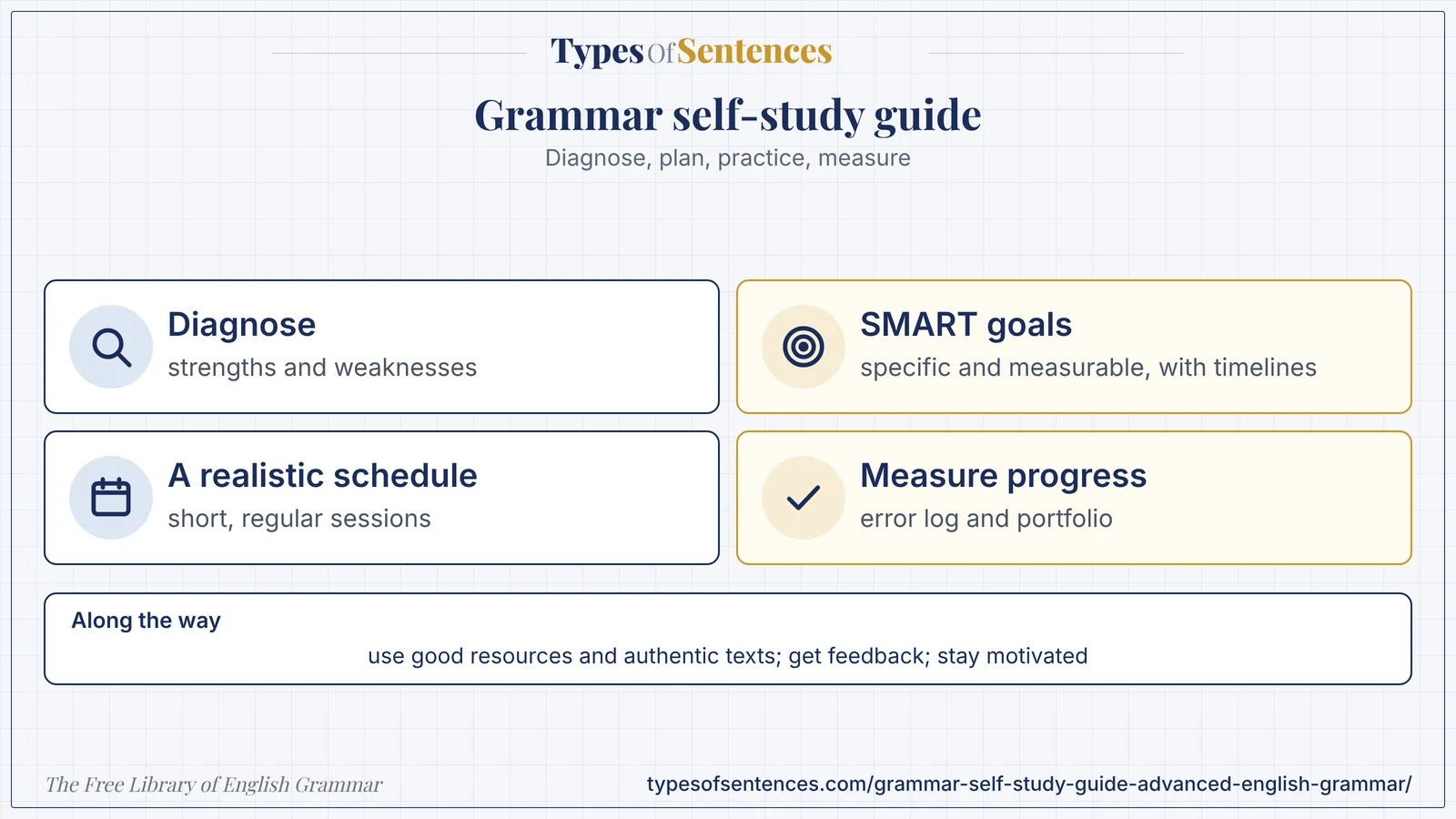
To study grammar on your own, you need five things: a goal, a plan, good materials, a way to check your progress, and some feedback from a person or a reliable source. Then you need to do a little regularly.
Why it matters: Do not try to learn everything. Choose what matters for your purposes (writing at work, an exam, academic papers), study it in small steps, use it in real writing, and review often.
Summary: Effective self-study begins with a diagnosis of strengths and weaknesses, then specific, measurable goals (SMART goals) with timelines, and a realistic weekly schedule of short, regular sessions mixing reading, study, practice, and writing. Resources include learner and reference grammars, usage and style guides, dictionaries, writing-center websites, corpora, and authentic texts. Practice strategies include noticing patterns, retrieval and spaced practice, sentence transformation, writing with feedback, and error logs. Self-assessment uses diagnostic tests, can-do checklists, rubrics, recorded work, and portfolios. Authentic materials (news, essays, speeches, subtitles, public-domain books) supply real grammar in context. Feedback comes from teachers, tutors, writing centers, peers, language exchange, editors, and, with caution, software and AI tools. Motivation is sustained by autonomy, competence, and relatedness, by if-then plans, and by visible progress.
- Diagnose, set SMART goals, plan short regular sessions.
- Use good resources and authentic texts.
- Measure progress; keep an error log and portfolio.
- Get feedback; stay motivated.
What You’ll Learn
- 1. Grammar Self-Study: Creating a Study Plan
- 2. Resources for Self-Study: Books, Websites, and Tools
- 3. Practice Strategies: Effective Exercises
- 4. Self-Assessment: Checking Your Progress
- 5. Using Authentic Materials: Learning From Real Texts
- 6. Getting Feedback: Finding Help When You Study Alone
- 7. Staying Motivated: Long-Term Commitment
- 8. Common Self-Study Mistakes and a Worked Plan
- 9. Exercises
- 10. Test Your Knowledge
- 11. Frequently Asked Questions
- 12. Conclusion
1. Grammar Self-Study: Creating a Study Plan
| Step | Action | Example |
|---|---|---|
| 1 decide your purpose | why are you studying grammar? | to write clearer work reports; to pass an exam; to publish articles |
| 2 diagnose | find strengths and weaknesses | a diagnostic test; a sample of your writing; the assessment chapter |
| 3 set goals | specific and measurable (SMART) | Reduce article errors in my emails from about 8 per page to 2 within three months |
| 4 choose materials | a grammar book, a usage guide, texts, a notebook | — |
| 5 build a schedule | a realistic weekly routine | 25 minutes a day, five days a week |
| 6 plan the content | order of topics | the weakest high-impact areas first |
| 7 include practice and review | new material and spaced review | one review day a week |
| 8 plan measurement | how you will check progress | a monthly error count; a monthly writing sample |
| 9 plan feedback | who will look at your work | a writing center; a friend; a tutor; an editor |
| 10 review and adjust | change the plan when needed | every month |
| 11 build the habit | tie study to a daily routine | after breakfast, before the news |
| 12 record | keep a study log | date, topic, minutes, one thing learned |
| SMART goal element | Meaning | Example |
|---|---|---|
| Specific | a clear target | Use the present perfect correctly in emails |
| Measurable | you can count or check it | fewer than three errors in ten emails |
| Achievable | within reach | a 50 percent reduction, not perfection |
| Relevant | matters for your purpose | emails are my main writing |
| Time-bound | a deadline | by 31 May |
| Timeline | Purpose | Typical content |
|---|---|---|
| one week | a start | diagnose; set up the notebook and the log; read two chapters |
| four weeks | a first cycle | study one topic area; write four pieces; review the log |
| twelve weeks | a substantial improvement | three topic areas; monthly writing samples; one round of outside feedback |
| six months | durable change | habits formed; a portfolio of revised work; a retest |
| one year | mastery in an area | a larger project (a thesis chapter, a blog, a report) as a test |
| ongoing | maintenance | reading, writing, and occasional review |
| Sample weekly schedule (about 30 minutes a day; invented) | Activity |
|---|---|
| Monday | read a short article; mark one pattern; add two sentences to the notebook |
| Tuesday | study a section of a grammar book on the week’s topic; do the exercises |
| Wednesday | write 150 words using the topic; mark the target forms |
| Thursday | review the error log; quick retrieval quiz on last week’s topic |
| Friday | revise Wednesday’s text; read it aloud |
| Saturday | longer reading or listening; note new patterns |
| Sunday | rest, or a 10-minute review of the notebook |
| Sample plans by purpose | Focus | Resources |
|---|---|---|
| workplace writing | clarity, tone, emails, reports | a plain-language guide; your organization’s style guide; the chapter on professional communication |
| exam preparation (for example C1 or C2 level exams, IELTS, TOEFL) | accuracy under time pressure; the exam’s formats | the exam body’s practice materials; timed tasks; the assessment chapter |
| academic writing | academic register, hedging, citation, structure | a university writing-center guide; articles in your field |
| editing and proofreading | error detection; style sheets | a style guide; practice editing real texts |
| teaching grammar | explanation; error analysis; pedagogy | a teacher’s grammar; observation; the chapters on teaching methods |
| creative writing | sentence variety, voice, dialogue | good prose; a writing group |
| non-native writer improving confidence | articles, prepositions, tense, word order | a learner’s grammar; an error log; a conversation partner |
| native writer polishing | usage, style, punctuation | a usage guide; a style guide; an editor |
A plan is a tool, not a contract. If a topic turns out to be harder or easier than expected, adjust the plan. The key is regular, short sessions: research on learning generally finds that spaced, repeated practice beats occasional long sessions, as the chapter on grammar learning strategies explains.
2. Resources for Self-Study: Books, Websites, and Tools
The resources named below are real and well established; availability, editions, and prices change, so check the current situation before you rely on them. Most of the grammars and guides are described in the chapter on grammar resources.
| Kind of resource | Examples | Use |
|---|---|---|
| learner’s grammars with exercises | English Grammar in Use (Murphy); Understanding and Using English Grammar (Azar and Hagen); Advanced Grammar in Use (Hewings) | explanation and practice |
| reference grammars | The Cambridge Grammar of the English Language; A Comprehensive Grammar of the English Language; Longman Grammar of Spoken and Written English | deep detail on a topic |
| usage guides | Garner’s Modern English Usage; Practical English Usage (Swan); Merriam-Webster’s Dictionary of English Usage | disputed points |
| style guides | The Chicago Manual of Style; APA; MLA; AP | conventions |
| learner’s dictionaries | Oxford, Cambridge, Longman, Collins COBUILD, Merriam-Webster learner’s dictionaries | patterns and examples |
| collocation and phrasal verb dictionaries | Oxford, Cambridge | word partnerships |
| writing-center websites | Purdue Online Writing Lab; university writing centers (for example UNC Chapel Hill, University of Toronto) | handouts and models |
| learner websites | British Council LearnEnglish; BBC Learning English; Khan Academy grammar | explanations and exercises |
| corpora and corpus tools | English-Corpora.org (COCA, BNC, and others); AntConc; Google Books Ngram Viewer | real usage |
| spaced repetition software | Anki and similar programs | review of rules and examples |
| grammar checkers | built-in and web tools | a first pass; verify suggestions |
| AI chat tools | explanations and practice sentences | check against references; they can make mistakes |
| podcasts and talks with transcripts | language and linguistics podcasts; public talks with transcripts | listening and reading together |
| public-domain books | Project Gutenberg; Standard Ebooks; Wikisource | free texts for reading and analysis |
| public-domain audiobooks | LibriVox | listening with the text |
| news sites and magazines | major newspapers and magazines in several varieties of English | current, real prose |
| language blogs and forums | linguists’ blogs; reliable Q&A communities | discussions of usage (check evidence) |
| MOOCs and online courses | university courses on grammar and writing | structured learning |
| library and interlibrary loan | reference grammars and style guides | free access to large works |
| apps for vocabulary and grammar | various | supplement, not substitute |
| writing tools | a word processor with a style sheet; a text editor | drafting and revising |
| dictation and speech tools | voice typing; recording apps | speaking and listening |
| a notebook or digital note system | — | the core of your self-study |
| spreadsheets | — | an error log |
| printable checklists | — | proofreading |
| a study timer | — | focus |
| a calendar | — | scheduling |
| a mentor or a study partner | — | feedback |
| How to choose a resource | Question |
|---|---|
| level | is it at the right level (a little challenging)? |
| purpose | does it match your goal? |
| authority | who wrote it? is it based on evidence? |
| currency | is the edition recent (for usage and style)? |
| variety | American, British, or other? does it match your needs? |
| practice | does it include exercises with answers? |
| clarity | are the explanations clear to you? |
| cost | is it free or affordable? can you borrow it? |
| format | print, digital, audio? |
| reviews | what do experts and teachers say? |
| sample | try a chapter before you commit |
| Free or low-cost starter kit | Content |
|---|---|
| one learner’s or reference grammar (library or secondhand) | core explanations |
| one learner’s dictionary (free online) | patterns and examples |
| one writing-center website | handouts and models |
| one usage guide (library) | disputed points |
| one corpus website | real examples |
| a notebook and a spreadsheet | record and log |
| a public-domain text each month | reading |
| a study partner or a tutor session now and then | feedback |
3. Practice Strategies: Effective Exercises
| Strategy | How to do it | Why it works |
|---|---|---|
| retrieval practice | close the book and write what you remember about a rule, then check | recalling strengthens memory |
| spaced repetition | review items after one day, one week, one month | prevents forgetting |
| interleaving | mix topics (tenses, articles, prepositions) in one session | improves discrimination |
| sentence transformation | active to passive; direct to reported; simple to complex | builds flexibility |
| sentence combining | join short sentences in several ways | builds range |
| imitation | copy the structure of a good sentence with new content | learns patterns |
| writing with a target | use a chosen structure at least five times in 150 words | moves from knowing to using |
| editing practice | correct a text with planted errors, then your own | builds error detection |
| error log and rewrite | record, correct, and write new examples | targets weaknesses |
| reading with a pen | mark a pattern throughout a text | noticing |
| dictation | write a short text from audio | links sound and form |
| shadowing | repeat speech immediately | automaticity |
| recording yourself | review speaking for errors | self-monitoring |
| timed writing | ten minutes without stopping | fluency |
| teach-back | explain a rule aloud or in writing without notes | tests understanding |
| flashcards with examples | a form and an example on each card | spaced review |
| corpus search | look up a doubtful phrase; read twenty lines | evidence |
| proofreading aloud | read your draft aloud | ear catches errors |
| translation comparison | translate a short text and compare with a published translation | contrast |
| summaries | summarize an article in one sentence, then in 100 words | concision and structure |
| rewrite for another audience | from formal to informal and back | register awareness |
| paragraph reconstruction | shuffle sentences and reorder them | cohesion |
| cloze practice from real texts | delete words and restore them | prediction |
| quizzes and tests | the assessment chapter; practice tests | checking |
| pattern collection | collect ten examples of a structure in real texts | generalizing |
| minimal pairs | compare since/for, who/whom | contrast |
| one-sentence daily journal | one grammatical sentence a day | habit |
| peer editing | trade drafts | feedback |
| reading aloud with expression | — | rhythm |
| copy-and-vary | copy a sentence then change one feature | awareness of options |
| sentence diagramming or bracketing | mark subject, verb, clauses | structure |
| grammar maps | a diagram of how structures relate | organization |
| mnemonics | a phrase for a rare rule | memory |
| practice under real conditions | write emails at work and then review them | transfer |
| rereading your old writing | spot your own patterns | reflection |
| using the “three-minute fix” | revise one paragraph for three minutes with one target | focus |
| reverse outlining | list the main point of each paragraph | structure |
| read two usage guides on one issue | compare | evaluation |
| write a short explanation for a beginner | — | consolidation |
| create your own quiz | write ten questions and answer them later | active learning |
| record your insights | a “what I learned today” line | metacognition |
| break the habit of copying from tools | draft first, check after | independence |
| practice at the edge of ability | slightly difficult tasks | growth |
| alternate focus | accuracy one day, fluency the next | balance |
| limit sessions to what you can do well | — | quality |
| finish with success | end with something you can do | motivation |
| Practice session template (30 minutes) | Minutes |
|---|---|
| warm-up: review the last session’s notes or flashcards | 5 |
| learn or notice: study one short section or read a text with a target | 8 |
| practice: exercises or sentence transformation | 8 |
| use: write or say something with the target | 7 |
| log: record one thing learned and any errors | 2 |
4. Self-Assessment: Checking Your Progress
| Method | What it shows | How often |
|---|---|---|
| diagnostic test (at the start) | strengths and weaknesses | once, then at intervals |
| the assessment chapter and practice tests | accuracy on a range of topics | quarterly |
| can-do checklists | what you can do in use (for example the Council of Europe’s self-assessment grid for levels) | quarterly |
| error count in a writing sample | errors per hundred words by category | monthly |
| error log trends | which errors have disappeared | monthly |
| rubric scoring of your own writing | accuracy, range, appropriateness, clarity | monthly |
| portfolio review | the growth of your writing | quarterly |
| recorded speech review | spoken errors | monthly |
| editing test on a planted-error text | error detection | monthly |
| timed writing | fluency under time pressure | monthly |
| teach-back | whether you can explain a rule | as needed |
| peer or teacher feedback | what you cannot see | monthly |
| comparing a draft with a revised version | revision skill | as needed |
| checking against a corpus | whether your usage matches current use | as needed |
| quizzes on flashcards | retention | weekly |
| reading speed and comprehension | whether harder texts are easier | quarterly |
| reflection notes | your own view of progress | weekly |
| goal check | whether you met your SMART goal | at the deadline |
| external tests or exams | a standard measure | as planned |
| mock editing job (edit a friend’s text) | applied skill | occasionally |
| response to real tasks (an email, a report) | transfer | ongoing |
| complaints or questions from readers | real effects | ongoing |
| number of corrections needed by an editor | — | ongoing |
| confidence rating before and after tasks | — | monthly |
| time to complete a task with the same quality | efficiency | monthly |
| self-rated rubric versus teacher rubric | calibration | occasionally |
| re-reading the earliest log entries | long-term change | yearly |
| “before and after” samples | vivid evidence | quarterly |
| skills matrix (a grid of topics and levels) | coverage | quarterly |
| audit of one genre (for example emails) | specific performance | monthly |
| readability checks (as a guide) | sentence and word length | monthly |
| accessibility checks on your documents | — | as needed |
| listening comprehension checks | — | monthly |
| vocabulary and collocation checks | — | monthly |
| proofreading speed and accuracy | — | monthly |
| style sheet compliance | — | per document |
| consistency checks | — | per document |
| a final retest at the end of a cycle | — | end of cycle |
| celebration of milestones | — | each milestone |
| Simple progress record (a table to keep) | Columns |
|---|---|
| date | — |
| topic studied | — |
| minutes | — |
| what I practiced | — |
| errors found (by category) | — |
| one thing I learned | — |
| next step | — |
The qualities of good tests and rubrics are described in the chapter on grammar testing and assessment; for your own checks, a simple rubric and a regular sample are enough.
| Interpreting results | Advice |
|---|---|
| progress is not linear | plateaus and dips are normal |
| errors may rise when you try new structures | that is a sign of learning |
| compare with your past self | not with others |
| look at trends over several samples | not one text |
| adjust the plan | — |
| celebrate small wins | — |
5. Using Authentic Materials: Learning From Real Texts
| Source of authentic text | What to notice | Task |
|---|---|---|
| news articles | tenses; reported speech; headlines; passives | mark and explain ten verbs |
| opinion essays and editorials | argument structure; hedging; rhetorical devices | list the connectors |
| long-form journalism | sentence variety; narrative tenses | count sentence lengths |
| speeches (public domain or in the public record) | repetition; parallelism; direct address | mark the devices |
| public-domain novels and stories | free indirect style; dialogue; periodic sentences | copy and vary two sentences |
| poems (public domain) | inversion; ellipsis; enjambment | paraphrase in prose |
| academic articles in your field | nominalization; hedging; citation; structure | write your own abstract |
| instructions and manuals | imperatives; sequence | rewrite one in plain language |
| business emails and reports | tone; structure | rewrite a poor email |
| legal and official text (a short extract) | long sentences; modals | simplify one clause |
| subtitles and scripts | spoken grammar | note the contractions and ellipses |
| podcasts with transcripts | discourse markers; questions | transcribe 60 seconds |
| interviews | questions; reported speech | report the interview |
| social media posts (carefully chosen) | informal grammar; hashtags | compare with a formal text |
| advertisements | fragments; imperatives; comparatives | analyze one |
| product descriptions | adjective order; compounds | write one |
| recipes | imperatives; sequence | rewrite as a paragraph |
| textbooks in other subjects | definitions; passives | define a term in your own words |
| encyclopedia entries | present perfect; passives; defined terms | summarize one |
| letters to the editor | argument; register | write a reply |
| reviews (books, films, products) | evaluation; contrast | write a review |
| obituaries and biographies | past tenses; sequence | — |
| travel writing | description; present tense; adjectives | write a short piece |
| science writing for general readers | explanation; analogy | — |
| technical documentation | consistency; terminology | — |
| forum answers (for example on usage) | evidence and reasoning | check the claims |
| the same news story in two newspapers | differences of style and voice | compare |
| the same story in British and American English | spelling and vocabulary differences | list them |
| a text translated from another language | how structures carry over | note awkward spots |
| letters and diaries (public domain) | older forms; informal style | — |
| your own old writing | your habits | revise it |
- Choose a text that you want to read and that is a little challenging.
- Read it once for meaning.
- Read it again with a pen and mark one grammar pattern (for example the past perfect).
- Ask why the writer used it in each place.
- Copy two or three sentences into your notebook.
- Write your own sentences with the pattern.
- Use the pattern in a piece of your own writing within three days.
- Review after a week.
| Free sources of authentic text (check the current availability and terms) | Note |
|---|---|
| Project Gutenberg, Standard Ebooks, Wikisource | public-domain books; older texts may use older grammar |
| LibriVox | public-domain audiobooks |
| national library and archive sites | speeches and documents |
| university open courseware and open-access journals | academic text |
| newspapers and magazines (some free articles) | current prose |
| government and international organization websites | plain-language documents and reports |
| TED-style talks with transcripts | spoken grammar |
| public-domain speeches | rhetoric |
| Wikipedia and Wikinews (check claims) | general prose |
| open-access textbooks | explanatory prose |
Learning from authentic texts is the method of the whole course: examples are real or realistic, and each pattern is seen in use. For the use of corpora as a source of authentic examples, see the chapter on corpus linguistics.
6. Getting Feedback: Finding Help When You Study Alone
| Source of feedback | What it offers | Cautions |
|---|---|---|
| a teacher or tutor | expert diagnosis and explanation | cost; choose someone with experience in your area |
| a university or public writing center | free or low-cost help with writing | booking times; scope of service |
| a language exchange partner | feedback on speaking and writing in return for help | quality varies; agree on a format |
| a study group or writing group | regular peer feedback and support | needs reliable members |
| an editor or proofreader | professional correction | cost; check that they explain changes |
| a colleague or a friend with strong writing | informal feedback | may not know the rules or may fix by taste |
| online communities with reliable moderation | answers to questions | check evidence; be wary of dogmatic answers |
| grammar checkers | instant flags for some errors | miss many errors; false alarms; verify |
| AI chat tools | instant explanations and rewrites | can be wrong or inconsistent; check with a reference; do not accept changes you do not understand |
| reference books and corpora | evidence for decisions | requires interpretation |
| your own recordings and rereading | self-feedback | blind spots remain |
| readers of your published writing | real responses | — |
| exam feedback | scores and comments | — |
| online courses with feedback | structured comments | — |
| pair editing with a classmate | mutual learning | — |
| mentors in your field | genre-specific advice | — |
| peer review on a blog or forum | — | quality varies |
| a style guide or your organization’s editor | conventions | — |
| automated style checkers | consistency checks | — |
| an accountability partner | — | not feedback on content but on routine |
| How to get useful feedback | Advice |
|---|---|
| ask a specific question | Is the tense consistent? rather than Is this good? |
| give context | audience, purpose, and what you want |
| ask for patterns, not only corrections | to learn the rule |
| ask for reasons | why is this wrong? |
| revise and show again | the learning is in the revision |
| thank and apply | — |
| compare sources of feedback | where they agree, act; where they disagree, check a reference |
| keep a record of corrections | add them to the error log |
| do not outsource all decisions | keep your own judgment |
| protect your privacy and your text | do not paste confidential material into public tools |
7. Staying Motivated: Long-Term Commitment
| Strategy | How it works | Example |
|---|---|---|
| autonomy, competence, relatedness (self-determination theory, Deci and Ryan) | people stay motivated when they choose their goals, feel capable, and feel connected | choose your own texts; track progress; join a group |
| if-then plans (implementation intentions, Gollwitzer) | link a cue to an action | If it is 7 a.m., I will study for 25 minutes. |
| small steps | reduce the start-up cost | open the notebook and write one sentence |
| visible progress | charts and logs | a streak calendar; an error graph |
| rewards | small and immediate | a coffee after the session |
| accountability | a partner or a group | weekly check-ins |
| variety | change activities | alternate reading, writing, listening |
| real purpose | use grammar for something you care about | write to a friend; blog; apply for a job |
| meaningful projects | a long-term project as a test | an article, a report, a story |
| celebrate milestones | mark progress | after finishing a topic |
| plan for obstacles | prepare for missed days | If I miss a day, I will do ten minutes the next day. |
| forgive lapses | return without guilt | — |
| connect with others | study groups, forums | — |
| read about language for pleasure | linguistics books and blogs | — |
| teach someone | explaining sustains interest | — |
| keep goals specific and flexible | revise when needed | — |
| avoid perfectionism | aim for improvement | — |
| rest | sleep and breaks aid memory | — |
| link to identity | I am a writer who revises | — |
| remember your “why” | write it on the first page of the notebook | — |
| use temptation bundling (pair study with a pleasure) | — | listen to a favorite podcast while taking notes |
| keep the environment ready | a clear desk; a ready notebook | — |
| set a minimum | at least five minutes a day | — |
| reflect monthly | what worked? | — |
| revisit your first sample | see progress | — |
| Common obstacle | Response |
|---|---|
| no time | shrink the session: ten minutes, daily |
| boredom | use texts you like; vary activities |
| plateau | change materials; ask for feedback; raise the challenge |
| loss of motivation | revisit goals; find a partner |
| fear of mistakes | treat errors as data; start with low-stakes writing |
| too many resources | choose one main resource |
| no feedback | find a writing center or a partner |
| confusing rules | look up the evidence; ask |
| perfectionism | set a good-enough standard |
| interruptions | schedule a fixed time; turn off alerts |
| forgetting | spaced review |
| doubt about progress | measure; compare samples |
8. Common Self-Study Mistakes and a Worked Plan
| Mistake | Better |
|---|---|
| no clear goal | define a purpose and SMART goals |
| studying only what is easy | include weak areas |
| collecting resources without using them | choose one and finish it |
| passive reading of rules | retrieval practice; writing |
| no review | spaced review |
| no feedback | schedule outside feedback |
| not measuring | keep a log and samples |
| studying in long, rare sessions | short, regular sessions |
| believing grammar myths | test rules against evidence |
| copying from tools without understanding | draft first; learn from corrections |
| giving up after a missed week | restart with a small session |
| neglecting speaking or listening | include all four skills |
| studying isolated sentences only | use real texts and tasks |
| comparing with others | compare with yourself |
| ignoring errors that you can’t explain | look them up or ask |
A 12-week plan (invented learner). Purpose: write clearer, more correct reports for work. Time: 30 minutes a day, five days a week.
- Week 1 (diagnose): collect three recent reports; mark errors; take the diagnostic questions in the assessment chapter; set two SMART goals (fewer than two article errors per page; no sentence over 35 words in the first draft).
- Weeks 2 to 4 (articles and sentence length): study the article rules; read one report a week and mark articles; write 150 words a day and check; split long sentences; keep an error log.
- Week 5 (review and feedback): ask a colleague to read one report; compare with your sample; adjust.
- Weeks 6 to 8 (voice and clarity): study the active and passive; rewrite five paragraphs; practice plain-language substitutions; read two model reports.
- Week 9 (test): write a new report; count errors; compare with week 1.
- Weeks 10 to 11 (punctuation and consistency): study the semicolon, colon, and numbers; make a style sheet for your reports.
- Week 12 (consolidate): write a final report; ask for feedback; update the portfolio; set the next goals.
- Result: a measured improvement, a style sheet, a portfolio, and a plan for the next quarter. (the learner and the plan are invented; adapt the plan to your own needs)
Recap in 12 seconds
Watch the lesson build itself: Effective self-study diagnoses weaknesses, sets SMART goals, schedules short regular sessions, and measures progress. The video has no sound.
Exercises
Part A: Planning (Exercises 1–7)
Exercise 1: Name the first step in a study plan.
Show Answer
Answer: Decide your purpose (and diagnose).
Exercise 2: What does SMART stand for?
Show Answer
Answer: Specific, Measurable, Achievable, Relevant, Time-bound.
Exercise 3: Write a SMART goal about articles.
Show Answer
Answer: Reduce article errors in my emails to fewer than two per page within three months.
Exercise 4: Why choose short, regular sessions?
Show Answer
Answer: Spaced practice beats occasional long sessions.
Exercise 5: Why plan review?
Show Answer
Answer: To prevent forgetting.
Exercise 6: Why record a study log?
Show Answer
Answer: To see progress and keep the habit.
Exercise 7: Name a timeline for a first cycle.
Show Answer
Answer: Four weeks.
Part B: Resources (Exercises 8–13)
Exercise 8: Name a learner’s grammar.
Show Answer
Answer: English Grammar in Use (Murphy).
Exercise 9: Name a corpus website.
Show Answer
Answer: English-Corpora.org.
Exercise 10: Name a source of public-domain books.
Show Answer
Answer: Project Gutenberg.
Exercise 11: Why be careful with AI tools?
Show Answer
Answer: They can be wrong; check with a reference.
Exercise 12: Name a question for choosing a resource.
Show Answer
Answer: Is it at the right level? Does it match my goal? Is it current?
Exercise 13: What is spaced repetition software?
Show Answer
Answer: Software such as Anki that schedules reviews at increasing intervals.
Part C: Practice and Assessment (Exercises 14–20)
Exercise 14: Define retrieval practice.
Show Answer
Answer: Recalling information from memory and then checking.
Exercise 15: Define interleaving.
Show Answer
Answer: Mixing topics in one session.
Exercise 16: Name an editing practice.
Show Answer
Answer: Correct a text with planted errors, then your own.
Exercise 17: What goes in an error log?
Show Answer
Answer: The error, the correction, the category, the rule, and a new example.
Exercise 18: Name a self-assessment method.
Show Answer
Answer: A diagnostic test, a rubric, can-do checklists, a portfolio.
Exercise 19: How often should you count errors in a writing sample?
Show Answer
Answer: Monthly.
Exercise 20: Is progress linear?
Show Answer
Answer: No; plateaus are normal.
Part D: Authentic Materials and Feedback (Exercises 21–26)
Exercise 21: Name the steps of learning from a real text.
Show Answer
Answer: Choose; read for meaning; mark a pattern; ask why; copy sentences; write your own; use; review.
Exercise 22: Name two kinds of authentic text.
Show Answer
Answer: News articles, essays, speeches, manuals, transcripts.
Exercise 23: Name a source of feedback.
Show Answer
Answer: A teacher, a writing center, a language partner, an editor.
Exercise 24: How should you ask for feedback?
Show Answer
Answer: Ask a specific question and give context.
Exercise 25: Why compare sources of feedback?
Show Answer
Answer: Where they agree, act; where they disagree, check a reference.
Exercise 26: Why protect your privacy with public tools?
Show Answer
Answer: Confidential text should not be pasted into public tools.
Part E: Motivation (Exercises 27–30)
Exercise 27: Name the three needs of self-determination theory.
Show Answer
Answer: Autonomy, competence, relatedness.
Exercise 28: What is an if-then plan?
Show Answer
Answer: A plan linking a cue to an action: If it is 7 a.m., I will study.
Exercise 29: Name a response to a plateau.
Show Answer
Answer: Change materials; get feedback; raise the challenge.
Exercise 30: Name a way to keep going after a missed day.
Show Answer
Answer: Restart with a short session without guilt.
Test Your Knowledge
Ready to check what you learned? Answer all 10 questions, then submit. You need 80% (8 of 10) to pass. Your answers are not stored.
View correct answers and explanations
Question 1: What does SMART stand for in goal-setting?
✓ Correct Answer: A – Specific, Measurable, Achievable, Relevant, Time-bound
The SMART criteria.
Question 2: Spaced repetition means
✓ Correct Answer: B – reviewing at increasing intervals
Increasing intervals.
Question 3: An error log is used to
✓ Correct Answer: C – find patterns and track progress
Patterns and progress.
Question 4: Which is authentic material?
✓ Correct Answer: D – a news article or speech written for real readers
Real texts.
Question 5: Which supports motivation (self-determination theory)?
✓ Correct Answer: C – autonomy, competence, and relatedness
The three needs.
Question 6: An implementation intention is
✓ Correct Answer: A – an if-then plan such as “If it is 7 a.m., I will study”
A cue-action plan.
Question 7: Why get outside feedback?
✓ Correct Answer: D – to catch errors you cannot see yourself
Blind spots.
Question 8: A good self-study session is
✓ Correct Answer: C – short, regular, and focused
Short, regular, focused.
Question 9: What is a diagnostic test for?
✓ Correct Answer: B – to find strengths and weaknesses
Strengths and weaknesses.
Question 10: A portfolio helps because it
✓ Correct Answer: B – shows progress over time
Shows progress.
Frequently Asked Questions
What is grammar self-study?
Grammar self-study is learning grammar independently, with your own plan, materials, practice, and checks. Grammar self-study works best with clear goals, regular sessions, and some outside feedback.
How do I go about independent grammar learning?
Diagnose your needs, set SMART goals, schedule short regular sessions, use a good reference and real texts, keep an error log, get feedback, and review your progress. Independent grammar learning needs structure.
What is self-study grammar practice?
Self-study grammar practice includes retrieval quizzes, sentence transformation, writing with a target structure, editing practice, and spaced review. Self-study grammar practice should include real writing.
What is a grammar autodidact?
A grammar autodidact is a self-taught learner of grammar. A grammar autodidact succeeds by supplying structure, standards, and feedback that a class would otherwise provide.
Is learning grammar alone possible?
Yes. Learning grammar alone is possible with good resources, a routine, honest measurement, and feedback from a teacher, a writing center, a partner, or reliable tools used with checking.
How much time should I study each day?
Short, regular sessions of 20 to 30 minutes are effective for many learners; consistency matters more than length.
Can I rely on AI tools for grammar help?
Use them as helpers, not authorities: they can explain and suggest, but they can be wrong, so check against a reference and learn from the correction.
Conclusion
You now have a guide to grammar self-study: how to plan, choose resources, practice effectively, assess your progress, learn from authentic texts, find feedback, and stay motivated. You can build a routine that keeps you improving after this course.
Study a little, regularly, with real texts and honest checks. Next, you will study grammar for academic success.
- Deci, Edward L., and Richard M. Ryan. Intrinsic Motivation and Self-Determination in Human Behavior. Plenum, 1985.: autonomy, competence, and relatedness.
- Gollwitzer, Peter M. “Implementation Intentions: Strong Effects of Simple Plans.” American Psychologist 54 (1999): 493–503.: if-then planning.
- Roediger, Henry L., and Jeffrey D. Karpicke. “Test-Enhanced Learning.” Psychological Science 17 (2006): 249–255.: retrieval practice.
- Council of Europe. Common European Framework of Reference for Languages. (online): can-do descriptors and self-assessment grids.
- Merriam-Webster Dictionary: autodidact: the dictionary entry.
Last reviewed: October 29, 2026. How it was made: drafted with AI assistance, then checked with automated tests (structure, links, answer keys, spelling) and against the sources above. A person has not yet read this chapter line by line. Found a mistake? Report it.