Grammar mastery is not the ability to recite rules. A person who can state the rule for the present perfect but cannot use it in a letter, or who can label every clause in a sentence but cannot write a clear paragraph, knows about grammar without having mastered it. Mastery is the point at which knowledge has become skill: the writer chooses the right structure without having to consult a rule, notices an error in a draft by sound and by sight, recognizes what a sentence is doing and why, and can explain the choice to someone else. It is the integration of everything that the earlier chapters set out, into judgment.
This chapter is about that integration. You will study what mastering grammar means (beyond rules to intuition), how to integrate reading, writing, listening, and speaking, how controlled knowledge becomes automatic, how grammar serves style, how to keep improving for life, how teaching others deepens expertise, and how to appreciate the beauty of grammar. The chapter treats grammar integration, expert grammar, and grammar proficiency as parts of one process: knowledge, practice, feedback, reflection, and use. It is not a summary of the course (the next review chapters do that) but a description of how the pieces come together. Mastery is intuitive grammar use, supported by awareness, and always open to learning. Thirty exercises and a quiz follow.
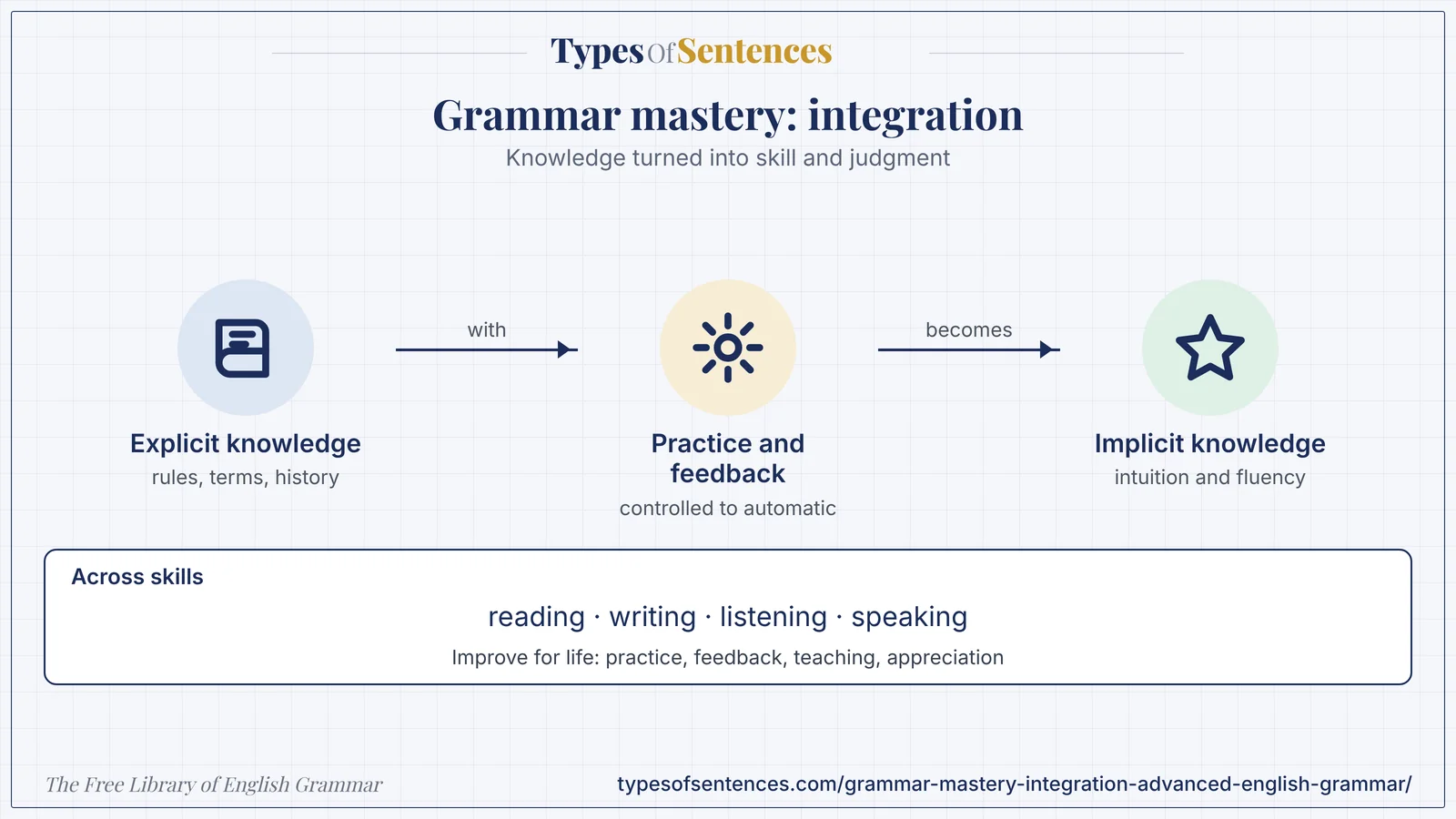
To master grammar is to be able to use it well without having to stop and think, and to be able to stop and think when it matters. You know the patterns so well that most choices feel natural; you also know the rules well enough to check a doubtful case, explain a choice, and teach someone else.
Why it matters: Mastery is built by using grammar in real tasks, getting feedback, reflecting, and repeating. It never ends, because language and your own goals keep changing.
Summary: Grammar mastery is the integration of explicit knowledge (rules, terms, history) with implicit knowledge (intuition, fluency) so that grammar is used accurately, flexibly, and appropriately. Skill acquisition moves from controlled processing (slow, deliberate, effortful) to automatic processing (fast, unconscious) through practice with feedback. Mastery integrates reading (noticing), writing (planning and revising), listening, and speaking, and requires judgment about style: choosing structures for their effect on a reader. Continuous improvement relies on deliberate practice, reading widely, a record of errors, feedback, and following change. Teaching others deepens understanding (the protégé effect). Appreciation of the structure and beauty of language sustains motivation. Models of expertise describe stages from novice to expert.
- Mastery = knowledge turned into skill and judgment.
- Controlled → automatic through practice and feedback.
- Integrate reading, writing, listening, speaking.
- Improve for life: practice, feedback, teaching, appreciation.
What You’ll Learn
- 1. Grammar Mastery: Beyond Rules to Intuition
- 2. Integrating All Skills: Reading, Writing, Listening, and Speaking
- 3. Automatic vs Controlled Processing: Moving to Automaticity
- 4. Stylistic Choices: Grammar for Effect
- 5. Continuous Improvement: Lifelong Learning
- 6. Teaching Others: Mastery Through Teaching
- 7. Grammar Appreciation: The Beauty of Language
- 8. Common Obstacles to Mastery and a Worked Self-Audit
- 9. Exercises
- 10. Test Your Knowledge
- 11. Frequently Asked Questions
- 12. Conclusion
1. Grammar Mastery: Beyond Rules to Intuition
| Dimension of mastery | What it means | Sign of mastery |
|---|---|---|
| knowledge of form | knowing how structures are built | choosing the correct verb form, article, or word order without effort |
| knowledge of meaning | knowing what a structure means | seeing the difference between I have lived here and I lived here |
| knowledge of use | knowing when and why a structure is used (Larsen-Freeman’s form, meaning, and use) | choosing the passive for focus and the active for directness |
| accuracy | producing standard forms | few errors, and the ability to self-correct |
| range | a wide repertoire of structures | varying sentence types and clause patterns |
| flexibility | changing structure for audience and purpose | rewriting a text for a different reader |
| speed and fluency | using grammar in real time | speaking and writing without long pauses |
| awareness (metalinguistic knowledge) | being able to name and explain patterns | explaining why a sentence is ambiguous |
| judgment | weighing rule, convention, and effect | deciding when to follow or break a convention |
| appropriateness | fitting the register and genre | formal in a report; informal in a chat |
| error detection | noticing problems in one’s own and others’ text | proofreading well |
| sensitivity to change and variety | knowing that usage varies and changes | respecting variation while meeting a reader’s expectations |
| independence | finding answers with references | using a corpus or a usage guide to settle a doubt |
| Kind of knowledge | Description | Example |
|---|---|---|
| explicit knowledge | conscious knowledge that can be stated | I know that since takes the present perfect. |
| implicit knowledge | intuitive knowledge used automatically; it can be hard to state | I say I have lived here since 2015 without thinking. |
| declarative knowledge | knowing that (facts about grammar) | the rule for the third conditional |
| procedural knowledge | knowing how (skill in use) | producing the third conditional in conversation |
| metalinguistic knowledge | knowledge about language | terms such as clause and subject |
| pragmatic knowledge | knowledge of use in context | choosing a polite request form |
| stylistic knowledge | knowledge of effects | using a fragment for emphasis |
| Stage (the Dreyfus model of skill acquisition, adapted) | Description in grammar | Typical behavior |
|---|---|---|
| novice | follows rules rigidly, one at a time | checks each rule and often misapplies it |
| advanced beginner | recognizes patterns in examples | uses common structures, with errors in new contexts |
| competent | chooses a plan and applies rules to it | writes correct, careful prose that can feel stiff |
| proficient | sees situations holistically and uses intuition | writes and speaks fluently; checks only doubtful points |
| expert | acts from intuition and can reflect and explain when needed | flexible, accurate, aware, and able to teach |
The Dreyfus model (Hubert and Stuart Dreyfus, 1980s) was developed for skills in general, and its application to language is an adaptation. The levels of language proficiency in the Common European Framework of Reference (C1 and C2) describe in more detail the kind of control of grammar that is expected of a highly proficient user: consistent accuracy and the ability to correct errors almost always. Mastery does not mean perfection: even expert writers make slips and consult references, and the mark of mastery is the ability to notice and repair them.
2. Integrating All Skills: Reading, Writing, Listening, and Speaking
| Skill | How grammar is used | How to integrate |
|---|---|---|
| reading | grammar guides the parsing of sentences and the recognition of structure and style | read with attention to how authors build sentences; mark patterns you want to use |
| writing | grammar is planned, applied, and revised | draft for meaning, then revise for structure, clarity, and correctness |
| listening | grammar supports understanding in real time, with intonation and context | listen for structure; transcribe short passages and analyze them |
| speaking | grammar is produced under time pressure | practice structures aloud; record and review |
| reading and writing | imitation and adaptation of structures | rewrite a passage in your own words and a different style |
| listening and speaking | repetition, shadowing, and response | repeat and vary what you hear |
| reading and speaking | using read material in discussion | summarize aloud what you read |
| listening and writing | dictation and note-taking | write a summary from a talk |
| all four | real tasks combine skills | prepare a presentation: read, write, speak, and answer questions |
| grammar and vocabulary | words and structures work together | learn verb patterns and collocations, not isolated words |
| grammar and punctuation | punctuation shows structure | punctuate a text and explain each mark |
| grammar and style | structure creates effect | revise a passage three ways: plain, formal, vivid |
| grammar and meaning | forms express meaning | analyze ambiguity and scope |
| grammar and context | use depends on situation | adapt one message to three audiences |
| grammar and culture | conventions differ across communities | compare varieties and registers |
| Integration task | What it uses | Result |
|---|---|---|
| summarize an article in 100 words | reading, selection, concision, paraphrase | a tight summary |
| rewrite a formal paragraph as an email | register, voice, punctuation | a suitable email |
| rewrite an email as a formal letter | register, structure | a formal letter |
| explain a rule to a younger reader | simplification, examples | a clear explanation |
| edit a paragraph with ten planted errors | error detection, terminology | a corrected text |
| analyze one page of a novel for sentence variety | reading, analysis | an evidence-based comment |
| write the same news story as a headline, a tweet, and a paragraph | concision, genre | three forms |
| transcribe 30 seconds of speech and punctuate it | listening, structure | a written version |
| present a two-minute talk without notes | speaking, planning | a spoken text |
| write instructions for a task and test them on someone | imperatives, sequence | usable instructions |
| translate a short text and discuss the problems | contrast, ambiguity | awareness of grammar differences |
| review a peer’s essay for grammar and clarity | feedback, terminology | useful feedback |
| write a paragraph, then restructure it using the passive, nominalization, and fronting | options | awareness of choice |
| turn a dense paragraph into plain language | plain language | a clear text |
| prepare a style sheet for a project | conventions | consistency |
| record yourself answering questions and review errors | speaking, self-monitoring | a list of patterns to fix |
| compare two usage guides on a disputed point | research, evaluation | a reasoned decision |
| use a corpus to settle a question of usage | evidence | a justified answer |
| write a short story paragraph with free indirect style | narrative grammar | creative control |
| revise a poem’s line breaks for syntax and sound | poetic grammar | awareness of form |
| proofread a text for punctuation and numbers | mechanics | a consistent text |
| draft an abstract for a paper | academic grammar | a concise abstract |
| write a persuasive paragraph using three devices | rhetorical grammar | a persuasive paragraph |
| simplify a legal clause without changing its meaning (then have it checked) | precision and plain language | a clearer clause |
| write for translation and test with a machine tool | clarity, ambiguity | a text that translates well |
| write an accessible web page with headings, links, and alt text | structure and plain language | an accessible page |
| teach a mini-lesson on a grammar point | explanation | a lesson plan |
| keep a language journal for a month | reflection | a record of progress |
| write a letter in two varieties of English | variety awareness | a comparison |
| debate a language-change question using evidence | reasoning | an argument |
Integration also means connecting the areas of grammar. A word class (a noun) forms a phrase (a noun phrase), which functions in a clause (as a subject), which combines in a sentence, which forms a paragraph and a text, which has a style and serves a purpose in a context. Mastery is seeing the same pattern at each level, as in the chapters on grammar and meaning and on stylistic grammar choices.
3. Automatic vs Controlled Processing: Moving to Automaticity
| Feature | Controlled processing | Automatic processing |
|---|---|---|
| speed | slow | fast |
| effort | high; needs attention | low; uses little attention |
| awareness | conscious | often unconscious |
| capacity | limited; interference when several tasks compete | large; can run alongside other tasks |
| typical at the stage | novice and early learning | proficient and expert |
| example in grammar | working out which tense to use by checking a rule | choosing the tense without thinking |
| research basis | Shiffrin and Schneider (1977) distinguished controlled and automatic processing; skill acquisition theory (DeKeyser and others) applies it to language learning | — |
| errors | rule errors; hesitation | slips; fossilized habits if wrong forms are automatized |
| how it changes | through practice and repetition with feedback | — |
| Step toward automaticity | Activity | Example |
|---|---|---|
| understand | learn the rule and see examples | study the second conditional |
| notice | find the pattern in real texts | underline conditionals in an article |
| practice with focus | controlled exercises | complete ten sentences |
| practice with meaning | tasks that need the form | talk about imaginary situations |
| practice under time pressure | timed or spoken tasks | answer five questions in two minutes |
| get feedback | correction, comparison with models | ask a partner to check |
| repeat at intervals | spaced practice | review after a day, a week, a month |
| use in real tasks | writing and speaking for a purpose | write a letter to a friend |
| monitor and fix | check for errors | keep an error log |
| reflect | ask what worked | a short note after each week |
| Exercise to build automaticity | How it works |
|---|---|
| substitution drills in context | change one element of a sentence quickly |
| transformation drills | active to passive, direct to reported |
| sentence combining | join short sentences in several ways |
| shadowing | repeat speech immediately |
| dictation | write what you hear |
| timed writing | write for ten minutes without stopping |
| freewriting with a grammar target | use a chosen structure at least five times |
| retelling a story using past tenses | — |
| describing a picture with prepositions of place | — |
| answering questions in full sentences, quickly | — |
| reading aloud with attention to phrases | — |
| recitation of memorable sentences | — |
| quick-fire error spotting | — |
| paired conversation with a target structure | — |
| chunk learning (learning phrases as wholes) | — |
| flashcards with example sentences | spaced repetition |
| recorded speech reviewed for errors | — |
| rewriting under a word limit | — |
| five-minute journal | daily |
| speed reading with a pen | — |
| games that require grammar (word order, tag questions) | — |
| peer dictation | — |
| gap-fill with a time limit | — |
| storytelling in turns | — |
| translation at sight | — |
| paraphrasing aloud | — |
| summary in one sentence | — |
| quick edits of one sentence a day | — |
| reading and restating | — |
| impromptu talks with a structure target | — |
| sentence stems | If I had …, I would … |
| say it three ways | — |
| mirror speaking (practice aloud alone) | — |
| mnemonics for rare rules | — |
| recall tests (write what you remember) | — |
| interleaved review of several rules | — |
| proofreading speed drills | — |
| reading a page of good prose each day and copying one sentence | — |
| pattern spotting in songs and poems (not copying them) | — |
Automatic habits are valuable only if they are correct. A wrong form that has been practiced until it is automatic (a fossilized error) is hard to unlearn, so feedback is essential at every stage. The practical strategies for learners are described in the chapter on grammar learning strategies.
4. Stylistic Choices: Grammar for Effect
| Choice | Plain version | Version with effect | Effect |
|---|---|---|---|
| sentence length | The plan failed. It cost too much. We stopped. | The plan failed because it cost too much, and we stopped before more was wasted. | flow versus staccato |
| voice | The council made a mistake. | A mistake was made. | directness versus distance |
| word order | I have never seen such courage. | Never have I seen such courage. | emphasis |
| fronting | I like this one. | This one I like. | contrast |
| cleft | Courage saved us. | It was courage that saved us. | focus |
| fragment | The room was empty and quiet. | The room. Empty. Quiet. | stress |
| parataxis and hypotaxis | She left because he was late. | He was late. She left. | implied relation |
| coordination | — | We worked, and we waited, and we hoped. | accumulation (polysyndeton) |
| asyndeton | We worked and waited and hoped. | We worked, we waited, we hoped. | speed |
| parallelism | She likes to swim, hiking, and cycling. | She likes swimming, hiking, and cycling. | rhythm and correctness |
| antithesis | We win or we learn. | We never lose; we win or we learn. | contrast |
| periodic sentence | She decided to proceed despite the doubts. | Despite the doubts of her colleagues and the weight of precedent, she decided to proceed. | suspense |
| cumulative sentence | The man walked tired. | The man walked down the road, tired and slow, his basket on his arm. | detail |
| nominalization | We decided to expand. | The decision to expand was made. | abstraction |
| verb style | The implementation of the plan led to a reduction of costs. | The plan reduced costs. | energy |
| hedging | This proves the theory. | This suggests the theory may hold. | caution |
| boosting | This may help. | This will help. | confidence |
| modality | You must go. | You might want to go. | politeness |
| tense | He walked in and sat down. | He walks in and sits down. | immediacy |
| person | One should check. | You should check. | closeness |
| pronoun choice | The company will refund you. | We will refund you. | accountability |
| questions | The plan is risky. | Is the plan risky? | engagement |
| rhetorical question | Nobody can object. | Who could object? | persuasion |
| imperative | You should read this. | Read this. | directness |
| inversion with negation | — | Not once did she complain. | solemnity |
| ellipsis | Some like tea and others like coffee. | Some like tea; others, coffee. | economy |
| apposition | Priya is our captain. She spoke. | Priya, our captain, spoke. | compression |
| relative clause | The book is old. I love it. | The book, which I love, is old. | subordination |
| participial phrase | He ran. He was laughing. | He ran, laughing. | simultaneity |
| absolute phrase | — | The work done, she left. | economy |
| conditional | If you come, we will start. | Come, and we will start. | invitation |
| concession | It is cheap. It is poor. | Although it is cheap, it is poor. | balance |
| emphasis by position | — | The strongest idea goes last. | end focus |
| repetition | — | Again and again and again. | intensity |
| sound patterns | — | safe and sound | memory |
| contraction | We are late. | We’re late. | informality |
| formal vocabulary | We will start. | We will commence. | formality |
| direct speech | She said she was tired. | “I’m tired,” she said. | vividness |
| free indirect style | She thought that she would go. | She would go, then. Why should she care? | voice |
| punctuation as rhythm | — | A comma slows; a dash cuts; a period stops. | pace |
| sentence openers | — | varying the first word | variety |
| lists and bullets | — | parallel items | scan |
| headings | — | questions or statements | navigation |
| register shifts | — | a formal word in a casual text for humor | irony |
| understatement | It was terrible. | It was not ideal. | irony |
| hyperbole | It was cold. | It was freezing. | vividness |
| metaphor | The meeting was long. | The meeting was an ocean. | image |
| personification | The wind was loud. | The wind complained. | image |
| accessibility choices | — | short sentences and headings | inclusion |
The table gives some of the many choices that expert writers make. Mastery of style is the ability to choose: not to use every device but to select the structure that serves the reader and the purpose. The principles are set out in the chapters on rhetoric and grammar and on stylistic grammar choices; the examples above are meant to be varied, not copied.
5. Continuous Improvement: Lifelong Learning
| Strategy | How to do it | Frequency |
|---|---|---|
| read widely | books, articles, and long-form journalism in different genres | daily |
| read as a writer | notice how sentences are built; copy a good one | weekly |
| write regularly | a journal, emails, essays, or blog posts | daily or weekly |
| revise your own writing | a second draft with attention to structure | each major text |
| keep an error log | record, correct, and review errors | weekly review |
| ask for feedback | a teacher, editor, or peer | monthly |
| use references | a usage guide, a learner’s grammar, a style guide, a corpus | as needed |
| read a usage guide chapter | one topic at a time | weekly |
| follow language news and research | blogs and journals by linguists | monthly |
| listen to varied English | podcasts, talks, news from different countries | weekly |
| study a new structure each month | from this course or a reference | monthly |
| learn another language | compare grammars | ongoing |
| join a writing or editing group | — | ongoing |
| teach or tutor | explain rules to others | ongoing |
| write for an audience | a blog, newsletter, or community page | ongoing |
| edit others’ work (with permission) | — | ongoing |
| review old texts | compare with new writing | yearly |
| keep a portfolio | best pieces and drafts | ongoing |
| set goals | one grammar goal per quarter | quarterly |
| test yourself | quizzes and the assessment chapter | quarterly |
| read the grammar of other genres | legal, scientific, technical, poetic | ongoing |
| use technology as a helper, not an authority | grammar tools, translation tools, and AI tools with checking | ongoing |
| attend a workshop or course | — | yearly |
| read style guides when they are updated | — | as published |
| keep a list of puzzling sentences | investigate each | ongoing |
| collect great sentences | a commonplace book | ongoing |
| analyze one paragraph a week | — | weekly |
| record and review speaking | — | monthly |
| practice proofreading | — | weekly |
| explore corpora | search a word and read the lines | monthly |
| check your assumptions about rules | test myths | ongoing |
| rest and review | sleep and spacing aid memory | ongoing |
| celebrate progress | note what you can now do | monthly |
| accept errors as information | — | ongoing |
| mentor a learner | — | ongoing |
| write in a second variety (for example British and American) | — | occasionally |
| summarize what you read in one sentence | — | daily |
| read aloud | to hear structure and rhythm | weekly |
| write by hand sometimes | slows thought; aids attention | occasionally |
| seek stretch tasks | harder genres, more formal registers | quarterly |
| stay curious | — | always |
| Deliberate practice (as described by Anders Ericsson and colleagues) | Application to grammar |
|---|---|
| a specific goal | improve the use of articles in business emails |
| full attention | practice without distraction |
| immediate feedback | a partner or checker reviews right away |
| repetition with refinement | rewrite the same sentences until natural |
| working at the edge of ability | tasks slightly beyond comfort |
| a mentor or model | compare with good examples |
| reflection | notes on what changed |
The research on expertise (Ericsson and colleagues, 1993) emphasizes the quality of practice, not only its quantity. Claims in the popular literature about the time needed for mastery are often exaggerated; there is no fixed number of hours for grammar. The sensible plan is regular practice with feedback, over years, with periodic checks of progress, as the chapter on grammar teaching methods describes for teachers and the chapter on self-study describes for independent learners.
6. Teaching Others: Mastery Through Teaching
Explaining something to another person is one of the best ways of finding out whether you understand it. Research on learning by teaching (for example Fiorella and Mayer, 2013) found that students who prepared to teach material and then explained it learned more than students who only studied it, a finding often called the protégé effect, though results depend on how the teaching is done.
| Concept to explain | A plain explanation (template) | Example |
|---|---|---|
| subject and predicate | The subject is who or what the sentence is about; the predicate says something about it. | The dog / barked. |
| verb | A verb is a word for an action or a state. | run, is |
| noun | A noun names a person, place, thing, or idea. | teacher, Pune, freedom |
| pronoun | A pronoun replaces a noun. | she, they |
| adjective | An adjective describes a noun. | red |
| adverb | An adverb tells how, when, where, or how much. | quickly |
| preposition | A preposition shows a relation of place, time, or direction. | in, on |
| conjunction | A conjunction joins words or clauses. | and, because |
| clause | A clause has a subject and a verb. | because it rained |
| phrase | A phrase is a group of words without a subject and verb together. | in the morning |
| independent clause | It can stand alone as a sentence. | She left. |
| dependent clause | It cannot stand alone. | when she left |
| active and passive | In the active the doer is the subject; in the passive the receiver is. | The cat chased the mouse. / The mouse was chased by the cat. |
| tense | Tense shows the time of an action. | walks, walked |
| aspect | Aspect shows how the action is viewed (complete, in progress). | has walked, is walking |
| present perfect | Use it for past events with a link to now. | I have lost my keys. |
| conditionals | They express conditions and results. | If it rains, we stay. |
| modal verbs | They express possibility, necessity, permission. | can, must |
| articles | A is for something new; the is for something known. | I saw a dog. The dog was big. |
| plural nouns | Add -s or -es; some are irregular. | cats, children |
| agreement | The verb matches its subject in number. | The dogs bark. |
| relative clauses | They give more information about a noun. | the man who called |
| reported speech | It tells what someone said, usually with a shifted tense. | She said she was tired. |
| comma | A comma separates parts of a sentence. | When it rained, we left. |
| semicolon | A semicolon joins two related sentences. | It rained; we left. |
| apostrophe | It shows possession or missing letters. | the dog’s bone; don’t |
| parallel structure | Similar ideas have the same form. | reading, writing, and speaking |
| ambiguity | A sentence is ambiguous if it has two meanings. | I saw the man with the telescope. |
| register | Register is the level of formality. | Dear Sir / Hi |
| collocation | Words that often go together. | make a decision |
| phrasal verb | A verb plus a particle with a special meaning. | give up |
| gerund | An -ing word used as a noun. | Swimming is fun. |
| infinitive | to + base verb. | to swim |
| participle | A verb form used as an adjective or in compound tenses. | broken, running |
| subjunctive | A form for wishes and requirements. | I wish I were … |
| imperative | A command form. | Close the door. |
| question tag | A short question at the end. | It’s late, isn’t it? |
| nominalization | Turning a verb into a noun. | decide → decision |
| ellipsis | Omitting words that can be understood. | She can swim and I can [swim] too. |
| cohesion | The links that connect sentences. | however, this |
| plain language | Writing that readers can understand at once. | — |
| grammar myths | Rules that are not supported by usage. | never end with a preposition |
- Explain in your own words, and give an example before the rule.
- Check your explanation against a reference; teaching a wrong rule is worse than not teaching.
- Use the learner’s examples.
- Invite questions; a question you cannot answer is a chance to learn.
- Teach in many forms: a short talk, a worksheet, a post, a video, a one-to-one session.
- Be honest about doubt. “Style guides differ on this” is a true and useful answer.
- Avoid shaming learners for errors.
7. Grammar Appreciation: The Beauty of Language
Grammar can be appreciated as one appreciates architecture: for its structure, its economy, its balance, and its surprises. Appreciation sustains the long effort of mastery, and it is a pleasure in its own right.
| What to appreciate | Example | Why it is beautiful |
|---|---|---|
| balance | To err is human; to forgive, divine. (Alexander Pope) | two clauses in perfect parallel, with a verb omitted |
| economy | Veni, vidi, vici. (in English: I came, I saw, I conquered) | three verbs, no conjunctions |
| rhythm and repetition | government of the people, by the people, for the people (Lincoln, 1863) | three prepositional phrases, one rhythm |
| a long sentence under control | a periodic sentence that holds its main verb until the end | suspense and release |
| a short sentence after long ones | Silence. | impact |
| unexpected word order | Never have I seen such courage. | emphasis |
| a pun | Time flies like an arrow; fruit flies like a banana. | two parses |
| a garden path | The horse raced past the barn fell. | a sentence that tricks the parser |
| a grammatical sentence with no sense | Colorless green ideas sleep furiously. (Noam Chomsky, 1957) | grammar and meaning are separate |
| a sentence made of one repeated word | Buffalo buffalo Buffalo buffalo buffalo buffalo Buffalo buffalo. | one word with three roles (a city, an animal, a verb) |
| a sentence with a long run of one word | that that is is that that is not is not | the same word in several functions |
| the economy of ellipsis | Some like tea; others, coffee. | a verb understood |
| conversion | to google, to table a motion | a noun becomes a verb without a change |
| an apposition | Priya, our captain, spoke. | a noun phrase renamed |
| a pun on grammar | Let’s eat, Grandma. / Let’s eat Grandma. | a comma saves a life |
| the subjunctive | If I were you | a surviving form |
| irregular verbs | go, went, gone | relics of older stages |
| borrowing | algebra, shampoo, pajamas | words from Arabic, Hindi, and other languages |
| the history in a word | they came from Old Norse | the story of contact |
| the sound of a sentence | a cadence that ends on a stressed syllable | music |
| the logic of grammar | agreement, concord | pattern |
| the flexibility of English | the same word as noun, verb, and adjective: light | economy |
| the survival of ancient forms | the plural children, feet | history in the grammar |
| the creativity of speakers | new words by old rules | — |
| the grammar of poetry | Because I could not stop for Death (Emily Dickinson) | a subordinate clause opening a poem |
| the grammar of a proverb | A stitch in time saves nine. | compression |
| the grammar of a headline | Council approves plan | a whole news item in three words |
| the grammar of a recipe | imperatives in sequence | clarity and rhythm |
| the grammar of instructions that save lives | Stop. Look. Listen. | plain commands |
| the grammar of laughter | a joke that depends on a structure | — |
| the grammar of translation | what survives and what changes | — |
| the grammar of a first language learned without being taught | children master the rules by age five or so | a marvel of acquisition |
| the same sentence in two varieties | I’ve got a flat / an apartment | variation without loss of meaning |
| the grammar of silence | ellipsis and the unsaid | — |
| sentence stress and meaning | I did not say she stole it (seven meanings by stress) | a single sentence, many meanings |
| the economy of the zero relative | the book I read | a word left out and understood |
| the infinite productivity of recursion | She said that he thought that they believed that … | an endless sentence from finite rules |
| agreement across distance | The key to the cabinets is lost. | the verb finds its true subject |
| pronoun resolution | The trophy would not fit in the suitcase because it was too big. | a reader resolves it by knowledge of the world |
| the grammar of the first line of a novel | Call me Ishmael. (Herman Melville) | an imperative and a name |
Some of the examples above are famous curiosities of the language (the sentence of Noam Chomsky, the Buffalo sentence, the garden path sentence), included because they show how the grammar works. The grammar of beauty and effect in literature and poetry is the subject of the chapters on grammar in literature and in poetry.
8. Common Obstacles to Mastery and a Worked Self-Audit
| Obstacle | Why it blocks progress | What to do |
|---|---|---|
| memorizing rules without using them | knowledge stays declarative | use rules in writing and speaking |
| practicing only what you can already do | no growth | choose tasks at the edge of ability |
| avoiding feedback | errors persist | seek feedback regularly |
| fear of mistakes | avoidance and silence | treat errors as information |
| relying on tools | dependence; errors accepted | use tools as checks, and learn from them |
| believing myths | wasted effort; stiff prose | test rules against evidence |
| perfectionism | stops publishing and speaking | aim for improvement, not perfection |
| isolation | no feedback | join a group; find a partner |
| ignoring register and audience | correct but inappropriate text | think about the reader |
| neglecting speaking and listening | imbalance | integrate all four skills |
| inconsistent practice | forgetting | short, regular sessions |
| no record of progress | no motivation | keep a portfolio and an error log |
| stopping at fluency | fossilization | keep working on accuracy and range |
| treating style as correctness | rigid rules | distinguish rule, convention, and choice |
| not reviewing | forgetting | spaced review |
A self-audit for one month (invented learner). Aim: improve clarity and accuracy in work reports.
- Collect a sample: three recent reports (about 1,500 words).
- Mark errors and weaknesses: articles (eight), long sentences over 35 words (six), passive without agent (nine), unclear this (five), inconsistent terms (three).
- Choose two priorities: long sentences and unclear this (highest effect on the reader).
- Plan practice: split every sentence over 30 words in weekly reports; replace this with this + noun; read a good report weekly and copy two sentences.
- Get feedback: ask a colleague to read one report and mark where they stumble.
- Review at month end: count again; compare; set the next goal (articles).
- Result: a measured improvement and a new target, not a claim of mastery. (the learner and the numbers are invented)
- Integration: the audit uses reading (a model), writing (revising), listening (feedback), and speaking (explaining changes to a colleague).
Recap in 12 seconds
Watch the lesson build itself: Mastery integrates explicit and implicit knowledge through practice and feedback across all four skills. The video has no sound.
Exercises
Part A: What Is Mastery? (Exercises 1–7)
Exercise 1: Define grammar mastery.
Show Answer
Answer: Using grammar accurately, flexibly, and appropriately, with intuition and awareness.
Exercise 2: Explicit or implicit: stating the rule for since.
Show Answer
Answer: Explicit.
Exercise 3: Explicit or implicit: producing I have lived here since 2015 without thinking.
Show Answer
Answer: Implicit.
Exercise 4: Name Larsen-Freeman’s three dimensions.
Show Answer
Answer: Form, meaning, use.
Exercise 5: What is declarative knowledge?
Show Answer
Answer: Knowing that (facts about grammar).
Exercise 6: What is procedural knowledge?
Show Answer
Answer: Knowing how (skill in use).
Exercise 7: Name the highest stage of the Dreyfus model.
Show Answer
Answer: Expert.
Part B: Integration (Exercises 8–13)
Exercise 8: Name the four language skills.
Show Answer
Answer: Reading, writing, listening, speaking.
Exercise 9: Give an integration task.
Show Answer
Answer: Rewrite a paragraph for a different audience; summarize an article.
Exercise 10: How does reading support writing?
Show Answer
Answer: By showing how authors build sentences, which you can notice and imitate.
Exercise 11: How does writing support speaking?
Show Answer
Answer: Planning and revising structures builds control you can use aloud.
Exercise 12: Why connect word classes to texts?
Show Answer
Answer: The same patterns appear at every level.
Exercise 13: Name a task that uses grammar and context.
Show Answer
Answer: Adapt one message to three audiences.
Part C: Automaticity (Exercises 14–19)
Exercise 14: Controlled or automatic: working out a tense by checking a rule.
Show Answer
Answer: Controlled.
Exercise 15: Controlled or automatic: choosing the tense without thinking.
Show Answer
Answer: Automatic.
Exercise 16: What builds automaticity?
Show Answer
Answer: Practice with feedback, over time.
Exercise 17: Who distinguished controlled and automatic processing (1977)?
Show Answer
Answer: Shiffrin and Schneider.
Exercise 18: Name an exercise for automaticity.
Show Answer
Answer: Shadowing, dictation, timed writing, sentence combining.
Exercise 19: Why is feedback essential?
Show Answer
Answer: Wrong forms practiced until automatic are hard to unlearn.
Part D: Style and Improvement (Exercises 20–25)
Exercise 20: What does grammar for effect mean?
Show Answer
Answer: Choosing structures for their impact on the reader.
Exercise 21: Give a choice for emphasis.
Show Answer
Answer: Fronting; a cleft; an inversion; a fragment.
Exercise 22: Name a strategy for lifelong improvement.
Show Answer
Answer: Read widely, write regularly, keep an error log, seek feedback.
Exercise 23: What is deliberate practice?
Show Answer
Answer: Practice with a specific goal, full attention, feedback, and reflection.
Exercise 24: Is there a fixed number of hours for mastery?
Show Answer
Answer: No.
Exercise 25: Why keep a portfolio?
Show Answer
Answer: To record progress and motivate.
Part E: Teaching and Appreciation (Exercises 26–30)
Exercise 26: What is the protégé effect?
Show Answer
Answer: Teaching or preparing to teach deepens the teacher’s own learning.
Exercise 27: Explain a clause in plain words.
Show Answer
Answer: A clause has a subject and a verb.
Exercise 28: Why check your explanation against a reference?
Show Answer
Answer: A wrong explanation misleads learners.
Exercise 29: Name a famous grammatical sentence with no sense.
Show Answer
Answer: Colorless green ideas sleep furiously.
Exercise 30: Name a benefit of grammar appreciation.
Show Answer
Answer: It sustains motivation and enjoyment.
Test Your Knowledge
Ready to check what you learned? Answer all 10 questions, then submit. You need 80% (8 of 10) to pass. Your answers are not stored.
View correct answers and explanations
Question 1: Which describes implicit knowledge?
✓ Correct Answer: A – intuitive knowledge used automatically
Intuitive and automatic.
Question 2: Controlled processing is
✓ Correct Answer: B – slow, deliberate, and effortful
Slow and effortful.
Question 3: What does automaticity come from?
✓ Correct Answer: C – repeated practice with feedback
Practice and feedback.
Question 4: The protégé effect suggests that
✓ Correct Answer: D – teaching others can deepen one’s own learning
Learning by teaching.
Question 5: What does grammar for effect mean?
✓ Correct Answer: C – choosing structures for their impact on the reader
Choosing for effect.
Question 6: Which is a sign of mastery?
✓ Correct Answer: A – flexibility: choosing among forms for the reader and purpose
Flexible choice.
Question 7: Who proposed form, meaning, and use as three dimensions?
✓ Correct Answer: D – Larsen-Freeman
Larsen-Freeman.
Question 8: A good integration task is
✓ Correct Answer: C – rewriting a paragraph for a different audience
Real, combined tasks.
Question 9: Lifelong improvement depends on
✓ Correct Answer: B – regular reading, writing, feedback, and reflection
Regular practice.
Question 10: Mastery means
✓ Correct Answer: B – using grammar intuitively and flexibly, with awareness
Intuition with awareness.
Frequently Asked Questions
What is grammar mastery?
Grammar mastery is the ability to use grammar accurately, flexibly, and appropriately, with intuition backed by awareness. Grammar mastery combines explicit knowledge of rules with implicit, automatic use.
How can I go about mastering grammar?
Learn the patterns, notice them in real texts, practice in real tasks with feedback, review at intervals, reflect, and teach others. Mastering grammar is a long process of deliberate practice.
What is grammar integration?
Grammar integration is the combining of knowledge across areas and skills (reading, writing, listening, speaking, style, and context) into coherent use. Grammar integration turns separate rules into skill.
What is expert grammar?
Expert grammar is grammar used with fluency, range, and judgment, including the ability to explain and to adapt to audience and purpose. Expert grammar is not perfection but control.
What is grammar proficiency?
Grammar proficiency is the level of control of grammar a person shows, described in frameworks such as the CEFR from basic to highly proficient. Grammar proficiency covers accuracy, range, and appropriateness.
Does mastery mean no errors?
No. Experts make slips and consult references; mastery is the ability to notice and repair errors.
Why teach to master grammar?
Explaining a rule forces you to understand it and shows what you do not yet know; it is one of the best ways to deepen learning.
Conclusion
You now have a view of grammar mastery as integration: knowledge becoming skill, the four skills working together, controlled processing becoming automatic, grammar serving style, learning continuing for life, teaching others, and the pleasure of the language. You can plan your own path of improvement.
Mastery is built by use, feedback, and reflection. Next, you will study grammar in professional communication.
- DeKeyser, Robert. “Skill Acquisition Theory.” In Theories in Second Language Acquisition, edited by Bill VanPatten and Jessica Williams. Routledge, 2007.: from controlled to automatic processing in language learning.
- Ericsson, K. Anders, Ralf T. Krampe, and Clemens Tesch-Römer. “The Role of Deliberate Practice in the Acquisition of Expert Performance.” Psychological Review 100 (1993): 363–406.: deliberate practice.
- Fiorella, Logan, and Richard E. Mayer. “The Relative Benefits of Learning by Teaching and Teaching Expectancy.” Contemporary Educational Psychology 38 (2013): 281–288.: learning by teaching.
- Larsen-Freeman, Diane. Teaching Language: From Grammar to Grammaring. Heinle, 2003.: form, meaning, and use.
- Merriam-Webster Dictionary: mastery: the dictionary entry.
Last reviewed: October 29, 2026. How it was made: drafted with AI assistance, then checked with automated tests (structure, links, answer keys, spelling) and against the sources above. A person has not yet read this chapter line by line. Found a mistake? Report it.