The grammar mastery assessment is a way to see where you stand. It is the final grammar test of the course: 200 questions that sample the grammar of the earlier chapters, from parts of speech to sentence structure, the verb system, and usage and style, each with an answer and an explanation. It is not an exam that you pass or fail, and its purpose is not to rank you; its purpose is to tell you which areas are secure and which need more work, so that you can decide what to study next. A grammar skills test of this kind is most useful when it is taken seriously, scored honestly, and followed by a review of every question you missed.
This chapter explains what the assessment tests, how to approach the final grammar exam, how to score it and read the result, how to learn from errors, and what to do next. The questions themselves are in the Exercises section, in four parts of fifty, and every answer opens at the click of a button. The mastery test covers the topics of the course in a sampling way, so a high score is a good sign but not a certificate, and a low score in one section is a guide, not a verdict. Mastery of grammar is a lifelong process, and the end of this course is, as the memory trick says, the beginning of it. A short quiz and a list of questions and answers follow.
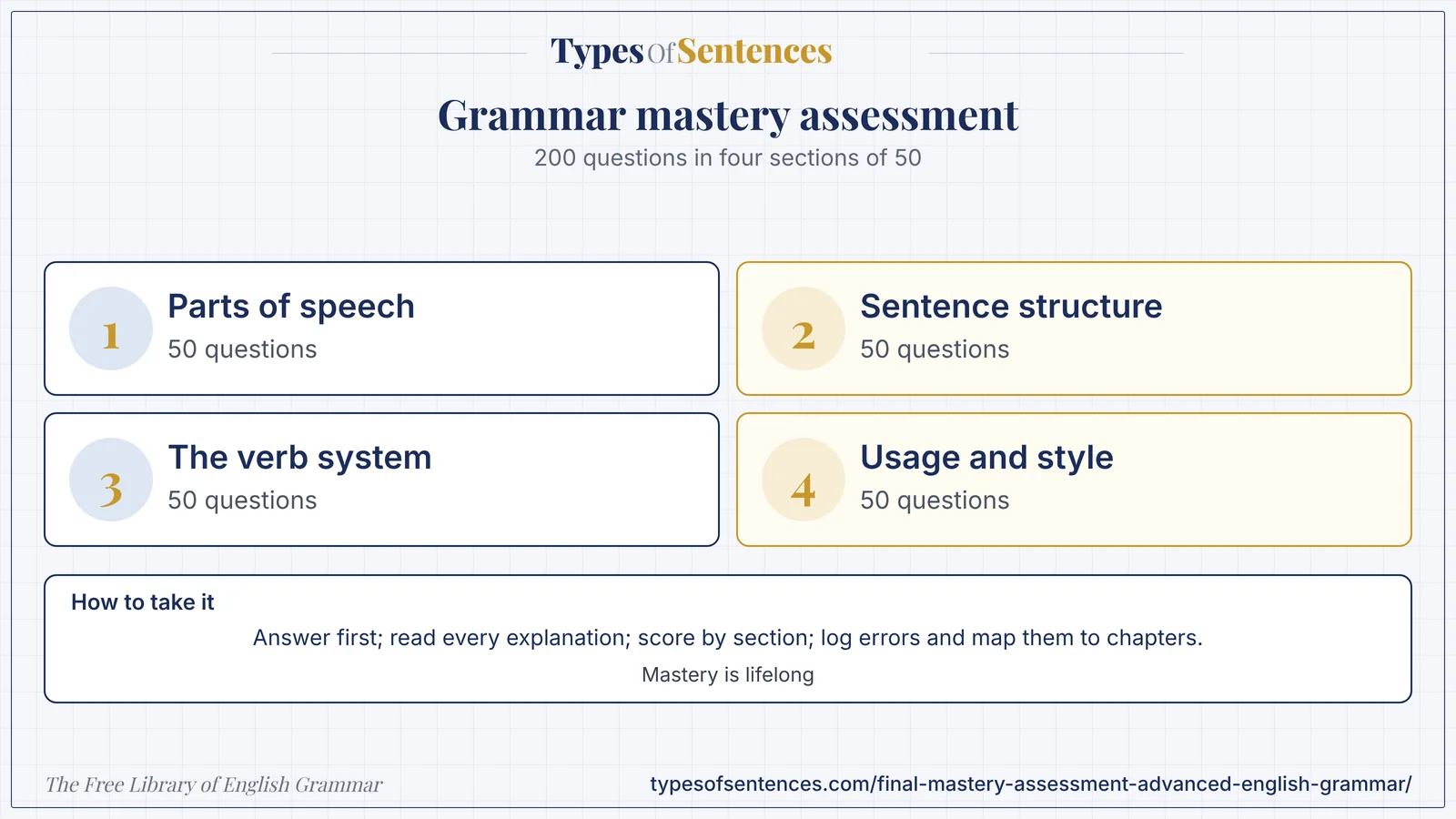
Take the test in four sittings, one section at a time, without looking up answers first. Write your own answer before you open the key. Then read every explanation, including those for the questions you got right, because the reasoning is the point.
Why it matters: Score each section separately, record every error in your log, and use the guide in this chapter to decide which chapters to review. Retake the test after some weeks of practice, to see what has changed.
Summary: The assessment has 200 questions in four sections of 50: parts of speech, sentence structure, the verb system, and usage and style. Question types include identification, completion, correction, transformation, and short explanation. Approach it in separate sittings, answer before looking, and treat the explanations as study material. Score each section: 45 or more of 50 indicates secure knowledge; 35 to 44 indicates good knowledge with gaps; below 35 indicates a need for review of that section. Record errors in an error log by topic, map each to the chapter that treats it, review, practice, and retest. Next steps include regular reading and writing, feedback, use of references, teaching others, and following change in the language. Completing the course is an achievement, and mastery continues beyond it.
- 200 questions, four sections of 50, answers with explanations.
- Answer first; read every explanation; score by section.
- Log errors; map them to chapters; review and retest.
- Mastery is lifelong.
What You’ll Learn
- 1. Grammar Mastery Assessment: Overview and How to Approach It
- 2. Structure of the Test: Sections, Topics, and Question Types
- 3. Scoring and Interpreting Your Results
- 4. Learning From Errors: The Answer Key and a Review Plan
- 5. Next Steps: Where to Go From Here
- 6. Celebrating Achievement: What Finishing the Course Means
- 7. Exercises
- 8. Test Your Knowledge
- 9. Frequently Asked Questions
- 10. Conclusion
1. Grammar Mastery Assessment: Overview and How to Approach It
| Question | Answer |
|---|---|
| What does it test? | recognition, knowledge, and use of grammar across the course: parts of speech, sentence structure, the verb system, usage, punctuation, and style |
| How many questions? | 200, in four sections of 50 |
| What question types? | identification, completion (choose or supply a form), correction, transformation, short explanation, true or false |
| How long does it take? | about 25 to 40 minutes per section for most people; allow time to read the explanations |
| Is it timed? | no; take your time on the first attempt, and use timing later if you want to test fluency |
| Is it graded? | no; you score yourself |
| What does it not test? | writing skill as a whole, speaking, or listening; it samples grammatical knowledge and judgment |
| Can I use references? | not on the first attempt; use them afterwards to study the answers |
| Can I retake it? | yes; after a period of review and practice |
| What is it for? | diagnosis and motivation |
| Guidelines for taking the assessment (more than thirty) | Why |
|---|---|
| take it in four separate sittings, one section at a time | fatigue lowers accuracy |
| choose a quiet time and place | focus |
| read each question completely before answering | many errors come from misreading |
| write your answer down before opening the answer toggle | committing to an answer makes the feedback useful |
| do not look anything up on the first attempt | you need an honest measure |
| do not guess wildly; mark a guess | guesses should be reviewed |
| if you are unsure, answer and put a question mark | — |
| use a separate sheet or file for your answers | you can retake the test later |
| do not rush | — |
| do not dwell on one question | move on and return |
| check the form that is asked for | a correction or a choice |
| for choice questions, test each option in the sentence | — |
| for correction questions, change only what is wrong | — |
| for transformation questions, keep the meaning | — |
| for classification questions, name the structure and the reason | — |
| for explanation questions, write one clear sentence | — |
| say the answer aloud when possible | the ear helps |
| note where a question depends on style or variety (American or British) | — |
| when an answer depends on a convention, remember that your guide may differ | — |
| after each section, score it before reading all the explanations | — |
| then read every explanation, including those for correct answers | you may have been right for the wrong reason |
| record each error in your log with the topic | — |
| look for patterns (articles, tenses, punctuation) | — |
| mark questions you got right by guessing | review them as errors |
| do not compare your score with others | compare with your later self |
| do not be discouraged by a low score in one section | it is information |
| do not stop at a high score | review the explanations anyway |
| plan the review before you close the page | — |
| set a date to retake the test | — |
| discuss difficult questions with a teacher or a partner | — |
| look up disputed points in a usage guide (see the chapter on grammar myths) | — |
| do not memorize the answers | the aim is to understand the reasoning |
| use the test again as a teaching tool | explain answers to someone else |
| keep a record of dates and scores | — |
| celebrate progress | — |
The assessment complements the shorter quiz at the end of every chapter and the comprehensive review in the previous chapter, which summarizes the topics of the course. If a section of the assessment shows that an area is weak, the review chapter and the relevant earlier chapters are the place to go.
2. Structure of the Test: Sections, Topics, and Question Types
| Section (exercises) | Topics sampled | Typical question types |
|---|---|---|
| Section 1: Parts of Speech (1–50) | nouns, pronouns, determiners, adjectives, adverbs, verbs, prepositions, conjunctions, interjections; countability; articles; word classes in context; word formation | identify the part of speech; choose a form; correct an error |
| Section 2: Sentence Structure (51–100) | sentence types; clauses and phrases; complements; fragments, run-ons, and comma splices; modifiers; parallelism; word order; inversion; ellipsis; ambiguity and processing | classify; identify; repair; transform |
| Section 3: The Verb System (101–150) | tenses and aspects; voice; mood; modals; conditionals; reported speech; agreement; gerunds and infinitives; phrasal verbs; sequence of tenses | complete with the correct form; transform; explain |
| Section 4: Usage and Style (151–200) | troublesome pairs; myths and conventions; punctuation; numbers; abbreviations; capitalization; register; plain language; hedging; inclusive language; citation; spelling varieties; language change | choose; correct; judge true or false; rewrite |
| Difficulty | Examples of question types | Where found |
|---|---|---|
| recognition | identify the part of speech or the clause | Sections 1 and 2 |
| selection | choose between two forms | all sections |
| production | supply a form | Sections 1 and 3 |
| correction | repair an error | all sections |
| transformation | rewrite as the passive, reported speech, or a cleft | Sections 2 and 3 |
| explanation | state why | all sections |
| judgment | true or false; myth or rule | Section 4 |
| application | rewrite for register or plain language | Section 4 |
| Question marked with | Meaning |
|---|---|
| (American) | the answer follows American usage; check your own variety |
| (formal) | the answer depends on formal register |
| (a widely accepted form) | a usage that is accepted but disputed in some guides |
| (or …) | another answer is acceptable |
Some answers depend on a convention (for example the American rule for commas inside quotation marks, or the AP rule on numbers). Where the answer depends on a convention, the question or the explanation says so. If your institution uses a different style guide, follow it, and treat the explanation as a prompt to check the guide.
3. Scoring and Interpreting Your Results
| Score in a section (out of 50) | Interpretation | Suggested action |
|---|---|---|
| 45 to 50 | secure knowledge in this area | review the few errors; move on to harder tasks in this area |
| 35 to 44 | good knowledge with some gaps | study the topics of the errors; practice |
| 25 to 34 | partial knowledge | review the chapters for this section; use the error log; retest in a month |
| below 25 | this area needs systematic review | start with the review chapter and the earlier chapters; use a learner’s grammar; get feedback |
| Total score (out of 200) | Interpretation (a rough guide) |
|---|---|
| 180 to 200 | very strong command of the topics sampled |
| 150 to 179 | strong command with some gaps |
| 110 to 149 | good foundation; targeted review will help |
| 70 to 109 | substantial areas to review; follow a study plan |
| below 70 | begin with the earlier review chapters; the test may be early for you |
| Points to remember when scoring | Why |
|---|---|
| score yourself strictly: a partly correct answer is not correct | — |
| count guesses that happened to be right as errors for review | — |
| an answer that is correct but for a different reason counts as an error in understanding | — |
| some questions have more than one acceptable answer; the explanation says so | — |
| a score is an estimate based on 200 items | it has error of measurement |
| a score reflects performance on this day | fatigue and distraction matter |
| the score does not measure writing ability as a whole | — |
| small differences between sections may not be meaningful | — |
| trends across retests matter more than a single score | — |
| the explanation is more valuable than the score | — |
The bands above are guides, not standards: they are not tied to an external test. The assessment samples the grammar of the course; it is not a certified examination and does not replace the exams or credentials that your studies or career may require. For the design of tests in general, and for the interpretation of scores, see the chapter on grammar testing and assessment.
4. Learning From Errors: The Answer Key and a Review Plan
- List every error by question number and topic.
- Read the explanation and write the rule in your own words.
- Check a reference for any answer that you do not understand (a learner’s grammar, a usage guide, or a corpus).
- Write two new sentences that apply the rule correctly.
- Group the errors by pattern: articles, tenses, agreement, punctuation, word choice, structure.
- Map each pattern to a chapter using the table below.
- Plan a review: two or three patterns at a time, with short daily sessions.
- Practice in real writing, not only in exercises.
- Retest the missed items after a few weeks.
- Record what changed.
| If you missed questions about … | Review | Notes |
|---|---|---|
| word classes, articles, pronouns, countability | the Basic and Intermediate chapters on parts of speech, and the comprehensive review | — |
| clauses, phrases, and sentence types | the Intermediate chapters on clauses and sentence structure, and the Advanced chapters on complex sentences | — |
| sentence boundaries and punctuation | the Basic and Intermediate punctuation chapters and the chapter on advanced punctuation | — |
| tenses, aspect, voice, mood, and modality | the Intermediate verb chapters and the Advanced chapters on tense and aspect and on voice | — |
| conditionals and reported speech | the Intermediate chapters on conditionals and reported speech | — |
| agreement, who/whom, less/fewer, lay/lie, that/which, parallelism | the chapter on grammar troubleshooting (Grammar Troubleshooting) | a drill-oriented chapter |
| myths and conventions | the chapter on advanced grammar myths (Advanced Grammar Myths) | distinguish rule, convention, and myth |
| register, plain language, hedging, and style | the Advanced chapters on stylistic grammar choices, plain language, and academic and professional writing | — |
| persistent errors of your own | the chapter on error analysis (Error Analysis and Correction) and your error log | — |
| numbers, abbreviations, titles, and typography | the Advanced chapters on mechanics | — |
| language change and variety | the Advanced chapters on language change and global Englishes | — |
| finding and checking answers | the chapter on grammar resources | — |
| Error log entry (template) | Example |
|---|---|
| question number | 73 |
| topic | parallelism with correlative conjunctions |
| my answer | He is not only smart but also works hard. |
| correct answer | He is not only smart but also hardworking. |
| rule in my words | the words after not only and but also must have the same form |
| new example of my own | She is not only a poet but also a painter. |
| review date | — |
The explanations in the answer toggles are short; for fuller treatment of any topic, use the chapter named in the table, and for strategies of studying from errors see the chapter on grammar self-study. The habit of turning every error into a pattern and every pattern into practice is one of the best habits that a writer can form.
5. Next Steps: Where to Go From Here
| Suggestion | Why |
|---|---|
| review the sections where you scored below 35 | targeted improvement |
| keep an error log from now on | patterns appear over time |
| read widely and regularly | grammar is learned from use |
| read as a writer: notice how sentences are built | imitation and noticing |
| write regularly and revise | practice with feedback |
| ask a teacher, an editor, or a writing group for feedback | blind spots |
| use references: a learner’s grammar, a usage guide, a style guide, a corpus | independence |
| follow one style guide for your field | consistency |
| read two usage guides on a disputed point | evidence |
| test every “rule” you meet against evidence | avoid myths |
| learn the genre conventions of your work or study | — |
| practice proofreading | a separate skill |
| practice editing others’ work (with permission) | — |
| teach someone a grammar point | learning by teaching |
| write explanations in your own words | — |
| join or start a reading or writing group | — |
| listen to varied English (podcasts, talks, news) | — |
| study the grammar of another language and compare | — |
| read about linguistics for pleasure | — |
| explore corpora and language data | — |
| follow language change (dictionary updates, usage notes, style guide revisions) | — |
| learn about varieties of English | — |
| practice speaking and presenting | — |
| write for real audiences: a blog, a newsletter, a report | — |
| keep a portfolio of your best work | — |
| set a goal each quarter | — |
| retake the assessment in two or three months | to measure progress |
| take an external test if you need a credential | — |
| use technology as a helper, with checking | — |
| keep your voice while you improve your control | — |
| stay curious | — |
| be patient with yourself | — |
| revisit the course chapters you found hardest | — |
| help others who are learning | — |
| enjoy the language | — |
| Time frame | Plan |
|---|---|
| this week | score the test; list errors; choose two patterns to work on |
| this month | study the two patterns; write 150 words a day using them; ask for feedback |
| next three months | follow a study plan; keep the log; retake the test |
| this year | a larger project in your own field; a portfolio; another round of feedback |
| for life | read, write, listen, notice, and keep learning |
6. Celebrating Achievement: What Finishing the Course Means
The complete course has 228 chapters: 52 Basic, 70 Intermediate, and 106 Advanced. If you have worked through them, or through the parts that matter to you, you have studied grammar more thoroughly than most people ever do, and that is worth recognizing. If you have come to this page directly, the chapters are there when you need them.
| What finishing the course gives you | What it does not give you |
|---|---|
| a broad map of English grammar, from words to texts | a guarantee that you will never make an error |
| a vocabulary for describing language | a certificate or formal credential |
| tools for solving grammar problems | the end of learning |
| a method for testing rules against evidence | a final authority on every disputed point |
| an understanding of style, register, and effect | a fixed style |
| habits for continued improvement | automatic fluency without practice |
| an appreciation of the language | — |
| Ways to mark your progress | Example |
|---|---|
| write down three things you can do now that you could not do before | I can explain the difference between the present perfect and the simple past. |
| reread a piece of your earlier writing | see the change |
| revise an old text with what you now know | — |
| share a grammar point with someone | — |
| plan your next challenge | a paper, a talk, a project |
| thank those who helped you | — |
Mastery is not a state that is reached once. A language changes, your needs change, and your own skills develop with use. The aim of the course is to give you the knowledge, the judgment, and the habits to keep learning for yourself, and the next step is yours: to read, to write, to listen, to notice, to ask, and to enjoy it. As the memory trick says, this is the beginning of lifelong mastery.
Recap in 12 seconds
Watch the lesson build itself: The assessment has 200 questions in four sections of 50, with explained answers and a plan for review and retesting. The video has no sound.
Exercises
Section 1: Parts of Speech (Exercises 1–50)
Exercise 1: Name the part of speech of light in Please light the candle.
Show Answer
Answer: Verb (transitive): it takes an object, the candle.
Exercise 2: Name the part of speech of light in a light jacket.
Show Answer
Answer: Adjective: it describes the noun.
Exercise 3: Choose: The committee (is/are) divided. (American usage)
Show Answer
Answer: is: American usage usually treats a collective noun as singular; British usage often accepts are when the members are meant.
Exercise 4: Which is uncountable: advice or suggestion?
Show Answer
Answer: advice: it takes some and a piece of, not a or a plural.
Exercise 5: Give the plural of criterion.
Show Answer
Answer: criteria: a plural from Greek.
Exercise 6: Give the plural of mother-in-law.
Show Answer
Answer: mothers-in-law: the plural goes on the head noun.
Exercise 7: Complete: Between you and ___, the plan is weak.
Show Answer
Answer: me: an object after the preposition between.
Exercise 8: Complete: She hurt ___. (she is the person hurt)
Show Answer
Answer: herself: a reflexive pronoun for the same person as the subject.
Exercise 9: Is the antecedent clear? The dog chased the cat until it tired.
Show Answer
Answer: No: it could be the dog or the cat; repeat the noun.
Exercise 10: Which relative pronouns fit: The book ___ I read was long.
Show Answer
Answer: that, which, or none: a restrictive clause allows a zero relative.
Exercise 11: Choose: He runs (quick/quickly).
Show Answer
Answer: quickly: an adverb modifies the verb.
Exercise 12: Choose: She plays the piano (good/well).
Show Answer
Answer: well: the adverb of good.
Exercise 13: Which is used for distance: farther or further?
Show Answer
Answer: farther (traditionally); further is used for degree or addition.
Exercise 14: Order the adjectives: a (wooden, big, old) table.
Show Answer
Answer: a big old wooden table: opinion, size, age, shape, color, origin, material.
Exercise 15: Choose: I need (a/some) information.
Show Answer
Answer: some: information is uncountable.
Exercise 16: Complete: She is interested ___ music.
Show Answer
Answer: in: adjective + preposition collocation.
Exercise 17: Complete: It depends ___ the weather.
Show Answer
Answer: on: verb + preposition collocation.
Exercise 18: What does look after mean?
Show Answer
Answer: take care of: a prepositional or phrasal verb with a fixed meaning.
Exercise 19: What kind of conjunction is although?
Show Answer
Answer: Subordinating: it introduces a dependent clause.
Exercise 20: Complete the correlative: either … ___.
Show Answer
Answer: or.
Exercise 21: What part of speech is Wow!?
Show Answer
Answer: Interjection.
Exercise 22: Choose: ___ hour (a/an).
Show Answer
Answer: an: the h is silent, so the sound is a vowel.
Exercise 23: Choose: ___ university (a/an).
Show Answer
Answer: a: it begins with the sound /j/.
Exercise 24: Choose: ___ moon (a/the).
Show Answer
Answer: the: a unique referent.
Exercise 25: Possessive for several dogs: the (dog’s/dogs’) bones.
Show Answer
Answer: dogs’: plural noun ending in s takes only an apostrophe.
Exercise 26: Choose: The book is (her’s/hers).
Show Answer
Answer: hers: possessive pronouns take no apostrophe.
Exercise 27: Identify the gerund: Swimming is fun.
Show Answer
Answer: Swimming: a verb form used as a noun (subject).
Exercise 28: What is broken in a broken window?
Show Answer
Answer: A past participle used as an adjective.
Exercise 29: Pronoun or determiner: This is mine. (This)
Show Answer
Answer: Pronoun: it stands alone as the subject.
Exercise 30: What does She has few friends mean?
Show Answer
Answer: She has hardly any friends: few is negative; a few is positive.
Exercise 31: Choose: How (much/many) books?
Show Answer
Answer: many: books is countable.
Exercise 32: What process makes to google from a brand name?
Show Answer
Answer: Conversion (a noun or name used as a verb).
Exercise 33: What kind of noun is bus stop?
Show Answer
Answer: A compound noun.
Exercise 34: Capitalize correctly: tuesday, april.
Show Answer
Answer: Tuesday, April: days and months are capitalized.
Exercise 35: What is Fortunately in Fortunately, he came?
Show Answer
Answer: A sentence adverb: it comments on the whole sentence.
Exercise 36: What does very modify in very tall?
Show Answer
Answer: The adjective tall.
Exercise 37: Is unique traditionally gradable?
Show Answer
Answer: No: it is usually treated as non-gradable (very unique is criticized).
Exercise 38: Choose: The dog wagged (its/it’s) tail.
Show Answer
Answer: its: possessive; it’s means it is.
Exercise 39: Complete: Everyone brought ___ book. (a widely accepted form)
Show Answer
Answer: their: singular they; some styles prefer rephrasing.
Exercise 40: What kind of numeral is twenty-first in the twenty-first century?
Show Answer
Answer: Ordinal.
Exercise 41: Identify the subject: What he said was true.
Show Answer
Answer: What he said: a noun clause.
Exercise 42: Identify the appositive: Priya, our captain, spoke.
Show Answer
Answer: our captain.
Exercise 43: Identify the infinitive: To err is human.
Show Answer
Answer: To err: the subject.
Exercise 44: Which modal expresses permission: can or may (formal)?
Show Answer
Answer: may.
Exercise 45: Identify the auxiliaries: She has been working.
Show Answer
Answer: has, been.
Exercise 46: Class of that: I know that he left.
Show Answer
Answer: Conjunction (complementizer) introducing a noun clause.
Exercise 47: Class of that: that book.
Show Answer
Answer: Determiner.
Exercise 48: Class of that: the book that I read.
Show Answer
Answer: Relative pronoun.
Exercise 49: Class of but: everyone but me.
Show Answer
Answer: Preposition (meaning except).
Exercise 50: Class of since: since 2015 and since he left.
Show Answer
Answer: Preposition before 2015; conjunction before a clause.
Section 2: Sentence Structure (Exercises 51–100)
Exercise 51: Classify: When the council met, it approved the plan.
Show Answer
Answer: Complex: one independent and one dependent clause.
Exercise 52: Classify: The council met, and it approved the plan.
Show Answer
Answer: Compound: two independent clauses.
Exercise 53: Classify: Although it rained, we went, and we enjoyed it.
Show Answer
Answer: Compound-complex.
Exercise 54: Classify: The council approved the plan.
Show Answer
Answer: Simple.
Exercise 55: Subject: In the garden stood an old oak.
Show Answer
Answer: an old oak: an inverted sentence.
Exercise 56: Subject: There are three reasons.
Show Answer
Answer: three reasons: there is a dummy subject.
Exercise 57: Direct object: She gave him a book.
Show Answer
Answer: a book (him is the indirect object).
Exercise 58: Subject complement: The soup smells delicious.
Show Answer
Answer: delicious.
Exercise 59: Object complement: They elected her president.
Show Answer
Answer: president.
Exercise 60: Fragment or sentence: Because it was late.
Show Answer
Answer: Fragment: a dependent clause alone.
Exercise 61: Repair the comma splice: It rained, we stayed.
Show Answer
Answer: It rained, so we stayed. (or a semicolon or period).
Exercise 62: Repair the run-on: I like tea she likes coffee.
Show Answer
Answer: I like tea; she likes coffee. (or a period).
Exercise 63: Fix the dangling modifier: Walking home, the rain started.
Show Answer
Answer: Walking home, I felt the rain start..
Exercise 64: Fix the misplaced modifier: She almost drove 200 miles.
Show Answer
Answer: She drove almost 200 miles..
Exercise 65: Name the clause: who called in the man who called.
Show Answer
Answer: Relative (adjective) clause.
Exercise 66: Name the clause: that he was late in I know that he was late.
Show Answer
Answer: Noun clause (the object of know).
Exercise 67: Name the clause: because it rained.
Show Answer
Answer: Adverbial clause of reason.
Exercise 68: Restrictive or nonrestrictive: My brother, who lives in Pune, is a doctor.
Show Answer
Answer: Nonrestrictive: the commas show it is extra information (one brother).
Exercise 69: Name the phrase: having finished the work.
Show Answer
Answer: Participial phrase.
Exercise 70: Name the phrase: to win the race in She wants to win the race.
Show Answer
Answer: Infinitive phrase (object of wants).
Exercise 71: Identify the absolute phrase: The work done, she left.
Show Answer
Answer: The work done: a noun with a participle, unconnected by a conjunction.
Exercise 72: Correct the parallelism: She likes swimming, to hike, and cycling.
Show Answer
Answer: She likes swimming, hiking, and cycling.
Exercise 73: Correct: He is not only smart but also works hard.
Show Answer
Answer: He is not only smart but also hardworking.
Exercise 74: Rewrite as a cleft: Courage saved us.
Show Answer
Answer: It was courage that saved us.
Exercise 75: Passive: The committee approved the plan.
Show Answer
Answer: The plan was approved by the committee.
Exercise 76: Sentence function: Close the door.
Show Answer
Answer: Imperative.
Exercise 77: Sentence function: What a beautiful day!
Show Answer
Answer: Exclamative.
Exercise 78: Correct the indirect question: Do you know where is the station?
Show Answer
Answer: Do you know where the station is? (statement order).
Exercise 79: Complete the tag: She is late, ___?
Show Answer
Answer: isn’t she.
Exercise 80: What is omitted: She can swim and I can too.
Show Answer
Answer: swim: a verb phrase ellipsis.
Exercise 81: What is there in There is a problem.?
Show Answer
Answer: A dummy (existential) subject.
Exercise 82: Rewrite with inversion: I have never seen such courage.
Show Answer
Answer: Never have I seen such courage.
Exercise 83: Punctuate: My friend a doctor called.
Show Answer
Answer: My friend, a doctor, called.
Exercise 84: List the coordinating conjunctions (FANBOYS).
Show Answer
Answer: for, and, nor, but, or, yet, so.
Exercise 85: Punctuate: The plan failed therefore the council canceled it.
Show Answer
Answer: The plan failed; therefore, the council canceled it.
Exercise 86: Punctuate: The plan failed however the cost was low.
Show Answer
Answer: The plan failed; however, the cost was low. (semicolon before, comma after).
Exercise 87: How many clauses: She said that he thought that it would rain.
Show Answer
Answer: Three (one main, two subordinate).
Exercise 88: Simplify the center embedding: The rat the cat killed ate the malt.
Show Answer
Answer: The cat killed the rat that ate the malt.
Exercise 89: What is the main clause: She left before he arrived.
Show Answer
Answer: She left.
Exercise 90: Give two readings of I saw the man with the telescope.
Show Answer
Answer: I used a telescope; the man had a telescope.
Exercise 91: Why is The horse raced past the barn fell hard?
Show Answer
Answer: A garden path: a reduced relative clause; fix: The horse that was raced past the barn fell.
Exercise 92: Identify the subject: That she left surprised us.
Show Answer
Answer: That she left (a noun clause).
Exercise 93: Name the conditional: If I had known, I would have come.
Show Answer
Answer: Third conditional (an unreal past).
Exercise 94: Type of clause: so that we could leave early.
Show Answer
Answer: Adverbial clause of purpose.
Exercise 95: Combine: The report was long. It was dull.
Show Answer
Answer: The report was long and dull. (or with a relative clause).
Exercise 96: Choose: The cost of the repairs (is/are) high.
Show Answer
Answer: is: the head noun is cost.
Exercise 97: Punctuate: When it rained we stayed.
Show Answer
Answer: When it rained, we stayed. (comma after the introductory clause).
Exercise 98: Correct: Although it rained; we went.
Show Answer
Answer: Although it rained, we went. (no semicolon before a dependent clause).
Exercise 99: Periodic or cumulative: Despite the doubts, despite the delay, she proceeded.
Show Answer
Answer: Periodic: the main clause comes last.
Exercise 100: Periodic or cumulative: She walked down the road, tired and slow.
Show Answer
Answer: Cumulative: the main clause comes first.
Section 3: The Verb System (Exercises 101–150)
Exercise 101: Past tense of lie (recline).
Show Answer
Answer: lay.
Exercise 102: Past participle of lay (place).
Show Answer
Answer: laid.
Exercise 103: Choose: I have lived here (since/for) 2015.
Show Answer
Answer: since: a point in time.
Exercise 104: Complete: I ___ him yesterday. (see)
Show Answer
Answer: saw: a finished time takes the simple past.
Exercise 105: Complete: When I arrived, the film ___. (start)
Show Answer
Answer: had started: past perfect for an earlier event.
Exercise 106: Complete: By 2030 she ___ the course. (finish)
Show Answer
Answer: will have finished: future perfect.
Exercise 107: Complete: I ___ him at five tomorrow. (meet, an arrangement)
Show Answer
Answer: am meeting.
Exercise 108: Correct: I am knowing the answer.
Show Answer
Answer: I know the answer. (a stative verb).
Exercise 109: Complete: If I ___ time, I would learn Spanish. (have)
Show Answer
Answer: had: second conditional.
Exercise 110: Complete: If I ___ known, I would have come.
Show Answer
Answer: had: third conditional (had known).
Exercise 111: Complete: If I had studied law, I ___ a lawyer now.
Show Answer
Answer: would be: a mixed conditional.
Exercise 112: Complete: If you heat ice, it ___. (melt)
Show Answer
Answer: melts: zero conditional.
Exercise 113: Complete: If I ___ you, I would go.
Show Answer
Answer: were: the subjunctive in a hypothetical.
Exercise 114: Complete: I insist that he ___ present.
Show Answer
Answer: be: the mandative subjunctive.
Exercise 115: Report: She said, “I am tired.”
Show Answer
Answer: She said (that) she was tired.
Exercise 116: Report: He asked, “Where do you live?”
Show Answer
Answer: He asked where I lived.
Exercise 117: Report: She told him, “Close the door.”
Show Answer
Answer: She told him to close the door.
Exercise 118: Passive: They are building a bridge.
Show Answer
Answer: A bridge is being built.
Exercise 119: Passive: Someone has stolen my bike.
Show Answer
Answer: My bike has been stolen.
Exercise 120: Complete: He ___ have left; his car is gone. (must/can’t)
Show Answer
Answer: must: a deduction about the past (must have left).
Exercise 121: Complete: You ___ stop at a red light. (must/might)
Show Answer
Answer: must: obligation.
Exercise 122: Complete: She ___ swim when she was five. (can/could)
Show Answer
Answer: could: past ability.
Exercise 123: Explain: You needn’t have come.
Show Answer
Answer: You came, but it was not necessary. (didn’t need to come does not say whether you came).
Exercise 124: Choose after enjoy: swimming or to swim?
Show Answer
Answer: swimming: enjoy takes a gerund.
Exercise 125: Choose after want: swimming or to swim?
Show Answer
Answer: to swim.
Exercise 126: Explain the difference: stop smoking and stop to smoke.
Show Answer
Answer: Quit the habit / pause in order to smoke.
Exercise 127: Explain: I remember locking the door and I remembered to lock the door.
Show Answer
Answer: Recall the past act / did not forget the task.
Exercise 128: Complete: I look forward to ___ you. (see)
Show Answer
Answer: seeing: to is a preposition.
Exercise 129: Complete: I am used to ___ up early. (get)
Show Answer
Answer: getting: be used to + gerund (accustomed).
Exercise 130: Place the pronoun: Pick up it / Pick it up.
Show Answer
Answer: Pick it up: a pronoun object goes between the verb and the particle.
Exercise 131: Choose: Neither the teacher nor the students (was/were) ready.
Show Answer
Answer: were: the nearer subject.
Exercise 132: Choose: Everyone (is/are) here.
Show Answer
Answer: is.
Exercise 133: Choose: The news (is/are) good.
Show Answer
Answer: is: a singular noun.
Exercise 134: Choose: A number of students (is/are) absent.
Show Answer
Answer: are.
Exercise 135: Correct: She walked in and sees him.
Show Answer
Answer: She walked in and saw him.
Exercise 136: Complete: He said that he ___ tired. (be)
Show Answer
Answer: was: backshift.
Exercise 137: Complete: I ___ when the phone rang. (cook)
Show Answer
Answer: was cooking: a background action.
Exercise 138: Complete: She ___ here since 2019. (work)
Show Answer
Answer: has been working.
Exercise 139: Complete: Look at those clouds! It ___ rain.
Show Answer
Answer: is going to: a prediction from present evidence.
Exercise 140: Complete: I will call you when I ___. (arrive)
Show Answer
Answer: arrive: the present for a future time clause.
Exercise 141: Complete: I wish I ___ fly. (can)
Show Answer
Answer: could.
Exercise 142: Complete: It’s time we ___. (go)
Show Answer
Answer: went: the past subjunctive.
Exercise 143: Complete: I would rather you ___ smoke. (not)
Show Answer
Answer: didn’t.
Exercise 144: Complete: He got ___. (promote)
Show Answer
Answer: promoted: the get-passive.
Exercise 145: Complete: I had my car ___. (repair)
Show Answer
Answer: repaired: the causative.
Exercise 146: Voice: The window was broken.
Show Answer
Answer: Passive (the agent is omitted).
Exercise 147: Name the form: has been waiting.
Show Answer
Answer: Present perfect progressive.
Exercise 148: Complete: She has ___ the report. (write)
Show Answer
Answer: written.
Exercise 149: Complete: Have you ever ___ to Paris? (be/go)
Show Answer
Answer: been: been means you went and came back.
Exercise 150: Mood: Please sit down.
Show Answer
Answer: Imperative.
Section 4: Usage and Style (Exercises 151–200)
Exercise 151: Complete: To ___ did you speak? (who/whom)
Show Answer
Answer: whom: object of a preposition.
Exercise 152: Complete: ___ mistakes (fewer/less)
Show Answer
Answer: fewer: countable.
Exercise 153: Complete: Please ___ the book on the table. (lay/lie)
Show Answer
Answer: lay: it has an object.
Exercise 154: Complete: The car, ___ I bought last year, is red. (that/which)
Show Answer
Answer: which: a nonrestrictive clause takes which and commas.
Exercise 155: True or false: split infinitives are ungrammatical.
Show Answer
Answer: False: they are grammatical and have been used since Middle English.
Exercise 156: True or false: a sentence may never end with a preposition.
Show Answer
Answer: False: a myth; stranding is idiomatic.
Exercise 157: True or false: the passive voice should never be used.
Show Answer
Answer: False: it has real uses (unknown actor, focus, processes).
Exercise 158: True or false: a sentence may not begin with however.
Show Answer
Answer: False: major guides allow it.
Exercise 159: Punctuate: The plan failed ___ the cost was too high.
Show Answer
Answer: semicolon (or a period).
Exercise 160: Punctuate: She bought three things ___ milk, eggs, and bread.
Show Answer
Answer: colon after a complete clause.
Exercise 161: Which mark for pages 10–20?
Show Answer
Answer: An en dash.
Exercise 162: Plural of CD.
Show Answer
Answer: CDs: no apostrophe.
Exercise 163: Possessive: the CEO ___ office.
Show Answer
Answer: ’s: the CEO’s office.
Exercise 164: Complete: It’s/Its in The dog wagged ___ tail.
Show Answer
Answer: its.
Exercise 165: American quotation style: She called it “fine”___ (comma).
Show Answer
Answer: She called it “fine,”: commas and periods go inside the closing quotation mark.
Exercise 166: Capitalize (Chicago title case): how to write a clear report.
Show Answer
Answer: How to Write a Clear Report.
Exercise 167: AP style: She has 5 apples.
Show Answer
Answer: five apples: AP spells out one through nine.
Exercise 168: Fix: 25 students passed. (sentence start)
Show Answer
Answer: Twenty-five students passed.
Exercise 169: Write unambiguously: 03/04/2024.
Show Answer
Answer: 4 March 2024 (or 2024-03-04).
Exercise 170: Complete: citrus fruits, ___ lemons and limes (e.g./i.e.)
Show Answer
Answer: e.g.: for example.
Exercise 171: Choose: ___ MBA (a/an).
Show Answer
Answer: an: it begins with the sound “em.”
Exercise 172: Plural of PhD.
Show Answer
Answer: PhDs.
Exercise 173: Hyphenate: a well known author.
Show Answer
Answer: a well-known author.
Exercise 174: More formal: look into or investigate?
Show Answer
Answer: investigate.
Exercise 175: Shorten: due to the fact that.
Show Answer
Answer: because.
Exercise 176: Plainer: utilize.
Show Answer
Answer: use.
Exercise 177: Shorten: in order to.
Show Answer
Answer: to.
Exercise 178: Remove the redundancy: added bonus.
Show Answer
Answer: bonus.
Exercise 179: Give two readings of Visiting relatives can be boring.
Show Answer
Answer: To visit relatives is boring; relatives who visit are boring.
Exercise 180: Hedge: This proves the theory.
Show Answer
Answer: This suggests that the theory may hold.
Exercise 181: Neutral for chairman.
Show Answer
Answer: chair.
Exercise 182: Rephrase to avoid a gendered pronoun: Each student should bring his book.
Show Answer
Answer: Students should bring their books. (or their book with singular they).
Exercise 183: Make parallel: The job requires experience, to be flexible, and a degree.
Show Answer
Answer: The job requires experience, flexibility, and a degree.
Exercise 184: Make polite: Send me the file.
Show Answer
Answer: Could you please send me the file?
Exercise 185: Improve the subject line: Hi.
Show Answer
Answer: A specific subject, such as “Request for Friday’s meeting agenda.”
Exercise 186: Headline: The council approved the plan.
Show Answer
Answer: Council approves plan: present tense, articles dropped.
Exercise 187: Add a signal phrase: Smith 2019 says that class size matters.
Show Answer
Answer: According to Smith (2019), class size matters.
Exercise 188: Is changing three words of a source a good paraphrase?
Show Answer
Answer: No: restructure and use your own words, and cite the source.
Exercise 189: American spelling of colour.
Show Answer
Answer: color.
Exercise 190: Complete: The weather ___ my mood. (affected/effected)
Show Answer
Answer: affected: the verb is affect.
Exercise 191: Complete: taller ___ me (then/than)
Show Answer
Answer: than.
Exercise 192: Complete: I ___ you to go. (advice/advise)
Show Answer
Answer: advise: the verb.
Exercise 193: Complete: the ___ of the school (principal/principle)
Show Answer
Answer: principal: the head.
Exercise 194: Correct: Me and John went.
Show Answer
Answer: John and I went.
Exercise 195: Complete: I will ___ my keys if I am careless. (lose/loose)
Show Answer
Answer: lose: the verb meaning to misplace; loose means not tight.
Exercise 196: Complete: I feel ___ about it. (bad/badly)
Show Answer
Answer: bad: a linking verb takes an adjective.
Exercise 197: Define a grammar myth.
Show Answer
Answer: A “rule” that is not supported by the evidence of usage and the description of reference grammars, such as the ban on split infinitives.
Exercise 198: Which tool shows real usage of a phrase?
Show Answer
Answer: A corpus.
Exercise 199: Name a documented trend in English grammar.
Show Answer
Answer: The decline of whom; singular they; colloquialization; the decline of some modals.
Exercise 200: What is a sign of grammar mastery?
Show Answer
Answer: Using grammar accurately and flexibly, with awareness, and being able to explain and adapt choices.
Test Your Knowledge
Ready to check what you learned? Answer all 10 questions, then submit. You need 80% (8 of 10) to pass. Your answers are not stored.
View correct answers and explanations
Question 1: How should you use this assessment?
✓ Correct Answer: A – as a diagnostic to find what to review
It is a diagnostic.
Question 2: What is a good response to a wrong answer?
✓ Correct Answer: B – record it, read the explanation, and review the topic
Learn from it.
Question 3: What does a score tell you?
✓ Correct Answer: C – your current performance on this sample of topics
Performance on a sample.
Question 4: Which is a good next step after the assessment?
✓ Correct Answer: D – plan a review of weak topics and keep practicing
Review and practice.
Question 5: Mastery is
✓ Correct Answer: C – a lifelong process
Lifelong.
Question 6: Which tool helps track recurring errors?
✓ Correct Answer: A – an error log
An error log.
Question 7: When is retaking the assessment most useful?
✓ Correct Answer: D – after review and practice, some weeks later
After review and practice.
Question 8: How many chapters does the full course have?
✓ Correct Answer: C – 228
52 Basic, 70 Intermediate, 106 Advanced.
Question 9: Why study the explanations?
✓ Correct Answer: B – to learn the reasoning behind each answer
The reasoning is the point.
Question 10: Which habit is best for the future?
✓ Correct Answer: B – regular reading, writing, feedback, and review
Regular practice and feedback.
Frequently Asked Questions
What is the grammar mastery assessment?
The grammar mastery assessment is a 200-question test of the grammar covered in the course, in four sections, with an answer and explanation for every question. The grammar mastery assessment is for diagnosis, not ranking.
What is the final grammar test?
The final grammar test is this assessment: the last chapter of the course, which samples parts of speech, sentence structure, the verb system, and usage and style. The final grammar test is self-scored.
What is a grammar skills test?
A grammar skills test measures knowledge and use of grammar through questions such as identification, correction, and transformation. A grammar skills test gives a snapshot, not a full picture of writing ability.
Is this a final grammar exam that I must pass?
No. This final grammar exam is a self-assessment with no pass mark and no certificate; the score bands are rough guides to help you plan your review.
What is the mastery test for?
The mastery test shows which areas are secure and which need work, and it motivates you to continue. The mastery test is most useful when followed by a review of every error.
How often should I retake the assessment?
After a period of review and practice, for example every two or three months, to see changes.
What should I do after I finish?
Record your errors, map them to chapters, review them, practice in real writing, get feedback, and keep reading and writing regularly.
Conclusion
You now have the final assessment of the course, with 200 questions, explanations, a way of scoring, a method for learning from errors, and a list of next steps. The assessment is a snapshot of the grammar of this course at one moment, and the habit of checking, correcting, and practicing is what lasts.
Mastery of grammar is lifelong. Thank you for studying with this course; the chapters will be here when you need them, and the next step is yours.
- Bachman, Lyle F., and Adrian S. Palmer. Language Testing in Practice. Oxford University Press, 1996.: principles of test design and interpretation.
- Purpura, James E. Assessing Grammar. Cambridge University Press, 2004.: the assessment of grammatical ability.
- Huddleston, Rodney, and Geoffrey K. Pullum. The Cambridge Grammar of the English Language. Cambridge University Press, 2002.: a reference for checking answers.
- Swan, Michael. Practical English Usage. 4th ed. Oxford University Press, 2016.: quick answers on usage.
- Merriam-Webster Dictionary: assessment: the dictionary entry.
Last reviewed: October 29, 2026. How it was made: drafted with AI assistance, then checked with automated tests (structure, links, answer keys, spelling) and against the sources above. A person has not yet read this chapter line by line. Found a mistake? Report it.