Grammar in advertising is grammar under commercial pressure. An advertisement has a few seconds, a few words, and a reader who did not ask to read it, so its writers bend the rules that serve long, careful writing: sentences become fragments, verbs become commands, adjectives become superlatives, and spelling and word class become toys. The result is a distinctive style that is sometimes called advertising language or marketing language, and that linguists have studied since Geoffrey Leech’s English in Advertising (1966). Knowing how the style works helps copywriters to produce it, and helps readers to see what is being done to them.
This chapter describes advertising grammar and the choices of copywriting grammar: concision and punch, intentional fragments, the imperative mood and the call to action, superlatives and the bending of comparison rules, wordplay, the grammar of slogans, and the persuasive grammar of the you-focus and the active voice. It also treats the limits that law and ethics place on claims, because the grammar of a claim (a comparison, a superlative, a qualifier) can make it misleading, and the differences among media. The examples are invented unless they are named as real slogans, and the chapter is about style, not about any product. Advertising style rewards impact over correctness, but the best copy knows exactly which rules it is breaking and why. Thirty exercises and a quiz follow.
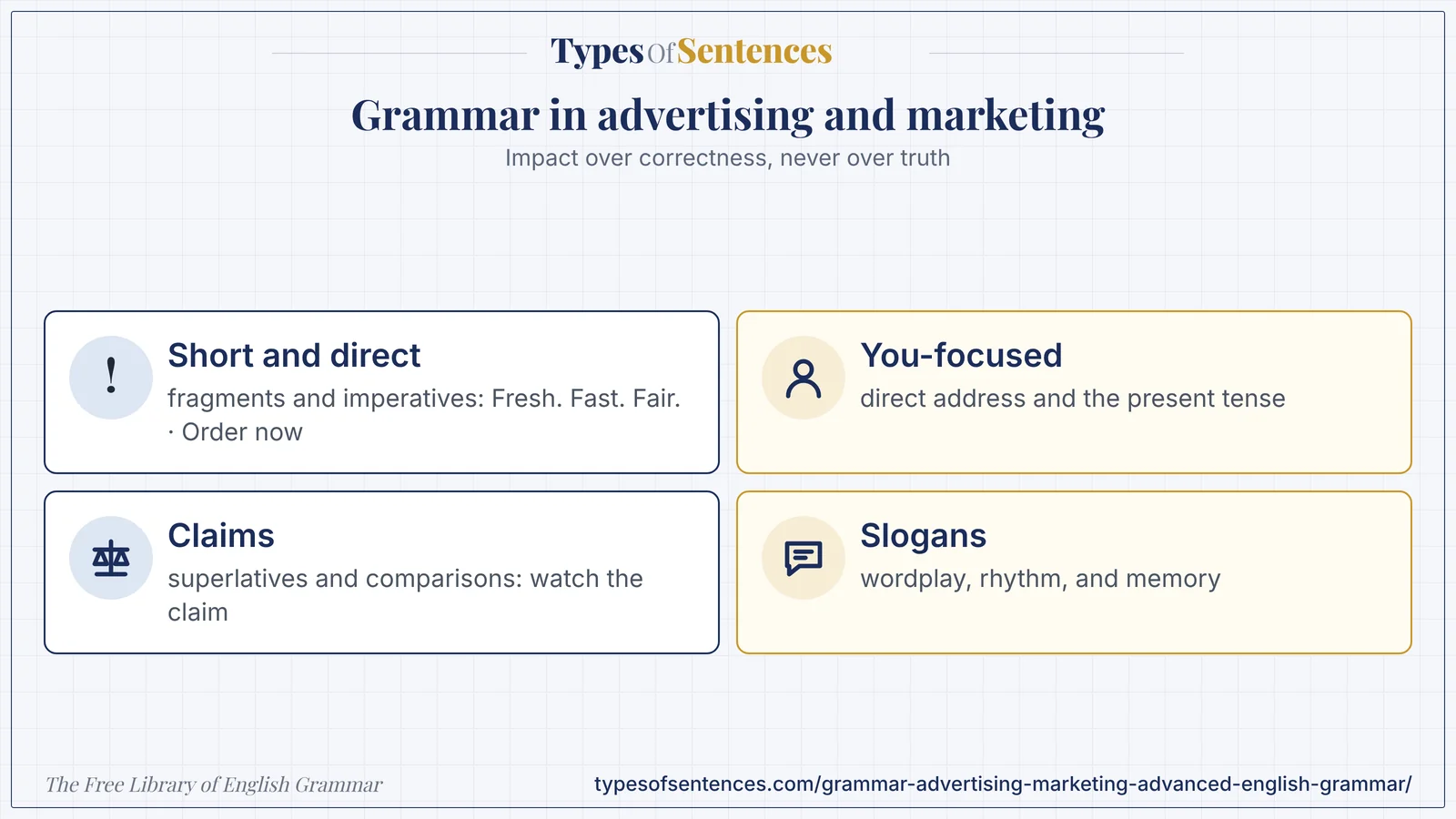
Advertisements use grammar differently from essays. They use short sentences and fragments, commands (Try it today), the word you, comparisons and superlatives, rhymes and puns. This is deliberate: it makes the message quick to read and easy to remember.
Why it matters: Breaking rules in an advertisement can work, but only if the copywriter knows the rule, and the result is clear, honest, and suited to the audience. A claim must be true even if the grammar is playful.
Summary: Advertising language is concise, direct, and often rule-breaking: it uses fragments (Fresh. Fast. Fair.), imperatives and calls to action (Order now), direct address with you, the present tense, simple vocabulary, parallelism, and rhythm. Superlatives and comparisons (the best, better) are common; incomplete comparatives (cleans better) invite the question than what?, and non-gradable words (unique, perfect) are intensified for effect. Wordplay includes puns, rhyme, alliteration, and unusual word class (Think different). Slogans are short, rhythmical, and memorable. Persuasive grammar focuses on the reader (the you-attitude), uses the active voice, and expresses benefits. Law and self-regulatory codes (the FTC in the United States, the ASA in the United Kingdom, the ASCI in India) require that claims be truthful and substantiated, and that conditions be disclosed. Style varies by medium.
- Short, direct, you-focused: fragments and imperatives.
- Superlatives and comparisons: watch the claim.
- Wordplay and slogans: rhythm and memory.
- Impact over correctness, but never over truth.
What You’ll Learn
- 1. Grammar in Advertising: Characteristics of Advertising Grammar
- 2. Sentence Fragments in Advertising: Intentional and Impactful
- 3. The Imperative Mood: Commands and Calls to Action
- 4. Superlatives and Comparisons: Rules Bent
- 5. Wordplay: Puns and Grammar Games
- 6. Slogans: Memorable Grammar
- 7. Persuasive Grammar: You-Focus, Active Voice, and Benefits
- 8. Claims, Law, and Ethics: Where Grammar Meets Responsibility
- 9. Grammar Across Media: Print, Broadcast, Digital, and Social
- 10. Common Errors and a Worked Example
- 11. Exercises
- 12. Test Your Knowledge
- 13. Frequently Asked Questions
- 14. Conclusion
1. Grammar in Advertising: Characteristics of Advertising Grammar
| Characteristic | Description | Example (invented) | Effect |
|---|---|---|---|
| concision | few words; headline and tagline | Fresh bread. Daily. | quick to read |
| direct address | the reader is you | Your morning starts here. | personal |
| imperatives | commands and invitations | Taste the difference. | action |
| fragments | phrases without a finite verb | Pure. Simple. Yours. | punch and rhythm |
| present tense | a permanent, immediate state | Our tea tastes of the hills. | immediacy |
| simple vocabulary | short, familiar words | Good food. Good price. | accessibility |
| coined words and compounds | new combinations | coolfresh; ready-to-go | novelty |
| unusual spelling | respelling for brand effect | Kwik Fix; Nite Out | memorability; also non-standard |
| parallelism | repeated structures | Eat well. Live well. Be well. | rhythm and memory |
| rhyme and alliteration | sound patterns | Pick a pack of pure pleasure. | memory |
| superlatives | best, finest, most | The finest cotton. | claim of quality |
| intensifiers | very, really, extra, ultra, super | ultra-soft | emphasis |
| adjective density | many adjectives before a noun | a rich, creamy, slow-cooked sauce | sensory appeal |
| noun phrases as sentences | — | A taste of home. | compactness |
| ellipsis | omitted words | Open daily. Closed never. | compactness; wit |
| questions | engage the reader | Tired of slow Wi-Fi? | a problem to solve |
| negative framing | — | No fuss. No waste. | relief |
| numbers and specifics | — | Ready in 5 minutes. | credibility |
| free and new | attention words | New. Free delivery. | attraction |
| conditionals | — | If it tastes good, you will return. | promise |
| modal verbs | can, will for promises | You can taste the difference. | confidence |
| loose, additive syntax | items added with and, plus | Fresh and local, plus fast delivery. | the sound of speech |
| borrowing | foreign words for prestige | a café, a boutique | status |
| personification | the product speaks or acts | The sauce says hello. | charm |
| comparative structures | — | Softer than ever. | improvement |
| contractions | informal tone | We’ve got you covered. | friendliness |
| elliptical comparisons | — | Better value. | compactness (see the section on comparisons) |
| code-mixing | local languages with English | a headline mixing English and a local language | local identity |
| implied meaning | what is not said | — | suggestion |
| brand voice | a consistent style | — | recognition |
| aural features (radio and TV) | repetition, rhythm, a jingle | — | listener memory |
| typographic emphasis | capitals, bold, color | SALE | — |
| calls to action | — | Call today. | response |
| legal tails | small print and qualifiers | Terms apply. | compliance |
| Source or study | Contribution |
|---|---|
| Geoffrey Leech, English in Advertising (1966) | an early linguistic study of the language of advertisements, noting features such as loose, minor-sentence structures and the vocabulary of persuasion |
| Guy Cook, The Discourse of Advertising (1992; 2nd ed. 2001) | advertising as discourse, including its relation to genre and context |
| Angela Goddard, The Language of Advertising (1998; 2nd ed. 2002) | an introduction to the analysis of advertising language |
| Greg Myers, Words in Ads (1994) | a study of how advertisements use language |
Advertising language borrows techniques that the chapter on rhetoric and grammar describes (parallelism, repetition, rhetorical questions, tricolon), and uses them at speed. The grammar of advertising is also the grammar of headlines and slogans: short, rhythmic, and complete in its effect even when incomplete in its syntax.
2. Sentence Fragments in Advertising: Intentional and Impactful
| Type of fragment | Example (invented) | Effect |
|---|---|---|
| noun phrase | A cup of calm. | an image |
| adjective phrase | Fresh. Local. Honest. | qualities in a list |
| prepositional phrase | Under a clear sky. | a scene |
| adverbial | Now open. | news |
| participial phrase | Delivering happiness since 1990. | a claim in progress |
| infinitive phrase | To you, from us. | a gift |
| verbless sentence | Simply delicious. | an evaluation |
| comparative phrase | Faster than ever. | improvement |
| single word | Hungry? | a hook |
| question fragment | Why wait? | a challenge |
| repetition | More. More. More. | emphasis |
| pair or triad | Fast. Fresh. Fun. | rhythm |
| elliptical contrast | Open daily. Closed never. | wit |
| fragment after a full sentence | We bake every morning. Every single one. | afterthought emphasis |
| fragment with a conjunction | And that’s a promise. | conversational tone |
| fragment with a dash | Tea—as it should be. | pause |
| label-style fragment | New arrival. | announcement |
| fragment with a number | 5 minutes. 5 ingredients. | specifics |
| fragment as a call to action | Join us. | imperative (a full sentence in form) |
| fragment as a slogan | Taste the difference. | imperative |
| fragment as a headline | Better mornings. | a promise |
| fragment as a subhead | For people who care. | audience |
| fragment as a sign-off | Made with love. | warmth |
| fragments in a sequence for pace | Wake. Brew. Smile. | a sequence |
| fragment after a colon | Today’s special: butter chicken. | — |
| fragment in a negation | Not just any tea. | contrast |
| fragment for a price | From ₹99. | — |
| fragment with a time | Tonight only. | urgency |
| fragment with a place | Right here in Bengaluru. | local |
| fragment as a response | Yes, really. | — |
| Use fragments when | Avoid fragments when |
|---|---|
| the text is a headline, a tagline, or a short list of benefits | the text is a legal or contractual statement that needs completeness |
| rhythm and emphasis matter | instructions must be exact |
| the brand voice is informal and quick | the audience is formal or the text is a formal letter |
| each fragment is clear on its own | the fragments are ambiguous |
| the sequence is parallel | the fragments are mixed without pattern |
| you can supply the missing words easily | a reader might misread the meaning |
| the medium is short (a banner, a billboard) | the message needs explanation |
Fragments are discussed as an error in the chapter on parallel structure (when parallelism fails) and as a technique in the chapters on style; in advertising they are a deliberate technique, and the writer should be able to turn each into a full sentence on request. The test of a good fragment is that the reader supplies the missing words without effort, and the fragments together make a pattern.
3. The Imperative Mood: Commands and Calls to Action
| Type | Example (invented) | Purpose |
|---|---|---|
| direct command | Buy now. | a sale |
| invitation | Come in and see. | welcome |
| softened command | Why not try it? | reduces pressure |
| inclusive command (let’s) | Let’s get started. | togetherness |
| negative command | Don’t miss out. | urgency (fear of missing out) |
| command with a benefit | Save 20% today. | value |
| command with a deadline | Order by Friday. | urgency |
| command with a question | Ready? Order now. | engagement |
| command to experience | Taste the difference. | sensory |
| command to discover | Discover your next favorite book. | curiosity |
| command to join | Join the club. | belonging |
| command to try | Try it free for 30 days. | low risk |
| command to learn | Learn more. | information |
| command to share | Share the joy. | social |
| command to act | Call today. | response |
| command to book | Book your seat. | — |
| command to visit | Visit our store. | — |
| command to download | Download the app. | — |
| command to subscribe | Subscribe for updates. | — |
| command to follow | Follow us. | — |
| command to save | Save the date. | — |
| command to imagine | Imagine a cleaner kitchen. | vision |
| command to choose | Choose your color. | agency |
| command to claim | Claim your offer. | — |
| command to start | Start your day right. | — |
| command to remember | Remember the name. | — |
| command to relax | Relax. We’ve got this. | — |
| command to enjoy | Enjoy every bite. | — |
| command to experience (a place) | Experience the hills. | — |
| command with please | Please try our new menu. | politeness |
| imperative in a button | Add to cart; Get started; Sign up | see the chapter on technology |
| imperative in an email subject line | Read this before Friday | see the chapter on email |
| imperative in a push notification | Check your balance. | — |
| imperative in a headline | Meet the new standard. | — |
| imperative in a slogan (real example) | Just do it (a widely discussed sports-brand slogan) | a three-word imperative |
| imperative in a public-service message | Wash your hands. | — |
| imperative as warning | Stop. Look. Listen. | — |
| imperative for education | Learn grammar. Love language. | — |
| imperative for charity | Give today. | — |
| imperative for a service | Book a repair. | — |
| Guideline for calls to action | Why |
|---|---|
| use a strong verb at the start | clarity and energy |
| say what happens next | Get your free sample, not Click here |
| limit to one main action | a clear path |
| make it specific | Reserve your table |
| add urgency honestly | a real deadline |
| reduce risk | Cancel anytime (if true) |
| match the reader’s stage | Learn more for early interest; Buy now for a ready buyer |
| keep it short | 2 to 5 words on buttons |
| avoid pressure that misleads | false scarcity can be a deceptive practice |
| test variants | small changes in wording affect results |
| use the active voice and the present tense | — |
| place it where the reader finishes reading | — |
4. Superlatives and Comparisons: Rules Bent
| Device | Example (invented) | Grammar and issue |
|---|---|---|
| superlative | the best coffee in town | the + superlative + a set; the set must be stated |
| superlative without a set | the finest quality | — |
| comparative with than | cheaper than last year | complete |
| incomplete comparative | Cleans better. Tastes fresher. | than what? The comparison is left open |
| comparative with ever | Better than ever. | — |
| absolute adjective intensified | the most perfect finish; so unique | perfect and unique are usually treated as non-gradable |
| -er and more | softer; more comfortable | regular |
| #1 and number one | the number one choice | a claim that requires evidence |
| world’s + superlative | the world’s best | a broad claim |
| -est with one of the | one of the finest | a safer claim |
| up to | Up to 50% off. | the maximum, not the typical |
| as low as | as low as ₹99 | the minimum, not the typical |
| from with a price | From ₹99. | the lowest price |
| more … than with a vague standard | more value | — |
| -er with a brand | Brand X washes whiter. | the standard of comparison missing |
| new and improved | — | what is new and what is improved? |
| extra, ultra, super, mega | ultra-fresh | intensifying prefixes |
| so … that | so soft that you’ll never go back | result clause |
| double comparatives (nonstandard) | more softer | avoid |
| least and less | the least expensive | a comparison of low degree |
| best-selling | best-selling brand | must be true for a defined market and period |
| #1 claims | — | need a source and a time period |
| no. 1 in a category | — | say which category |
| relative superlative (most) of a group | the most popular among students | — |
| the optional: best as a predicate adjective | This one is best. | — |
| hyperbole | the biggest sale ever | a boast; usually not read literally |
| puffery | the best coffee in the world | a subjective boast; in law often treated as not a factual claim, but rules differ |
| specific superlative | the tallest building in the state | a checkable fact |
| comparison with a competitor | cheaper than Brand Y | needs substantiation and fair comparison |
| comparison with the past | 50% faster than our last model | requires a stated basis |
| ranking | No. 3 in customer satisfaction (survey, 2024) | source and date |
| The question to ask of a comparison | Why |
|---|---|
| Compared with what? | an incomplete comparative may mislead |
| By how much? | vague amounts avoid commitment |
| Under what conditions? | up to and from hide the typical case |
| Who says so? | a source or a test |
| Is it checkable? | a claim of fact needs evidence |
| Is it a boast? | puffery is usually understood as opinion |
| Does it break a grammar rule in a way that changes the meaning? | whiter than white is a play on a non-gradable adjective |
Comparisons are a place where grammar and ethics meet: the grammar allows an incomplete comparative, but regulators and consumers may ask what the comparison is with. The advertising codes of the United States (Federal Trade Commission guidance), the United Kingdom (the CAP Code, enforced by the Advertising Standards Authority), and India (the Advertising Standards Council of India) all require that claims be capable of substantiation, and treat misleading comparisons as a problem. The writer should check the current code that applies.
5. Wordplay: Puns and Grammar Games
| Device | Example (invented unless named) | How it works |
|---|---|---|
| pun | Our bakery has a lot of dough-ability. | two meanings (dough and -ability) |
| pun on a common phrase | Berry good! | sound |
| double meaning | Our best seat in the house. | — |
| rhyme | Pick a pack of Pick-Me-Up. | sound |
| alliteration | Perfectly prepared, perfectly priced. | repeated consonants |
| assonance | Slow and low. | repeated vowels |
| repetition | Good, good, good. | — |
| antithesis | Small price. Big taste. | contrast |
| parallelism | Real food. Real fast. Real good. | repeated structure |
| coined word (blend) | brunchfast | — |
| word class conversion | Think different. (Apple, 1997) | an adjective in place of the adverb; widely discussed; it was a deliberate choice |
| noun as verb | Google it; Chill with us. | conversion |
| adjective as noun | The Fresh. | — |
| misspelling for effect | Kwik Mart. | respelling |
| rebus | I ♥ tea. | — |
| template (a fill-in-the-blank frame) | Got milk? is a widely copied frame: Got ___? | a recognizable template for imitation |
| missing letters | Nutrition: it’s in the bag. | — |
| homophone play | A tail of two kitties. | a pun on tale |
| allusion | — | a phrase from a well-known text |
| oxymoron | jumbo shrimp-style contradictions | — |
| hyperbole | — | — |
| personification | The tea wants to meet you. | — |
| grammar jokes | Let’s eat, Grandma! (punctuation pun) | — |
| pairing of sound and meaning | Crunchy crunch. | onomatopoeia |
| bilingual pun | a play on a local word | — |
| alphabetic play | A to Z of … | — |
| numbers play | Win-win. | — |
| reversal | Open daily. Closed never. | — |
- Check the pun for other meanings. An unintended second meaning can embarrass the brand (see the chapter on ambiguity).
- Check across languages and cultures. A pun rarely translates (see the chapter on translation).
- Do not sacrifice clarity. A clever line that leaves the reader puzzled fails.
- Know the rule you are breaking. Think different is memorable because readers know the standard form Think differently; the same line by a writer who did not know the rule would be an error.
- Do not infringe others’ trademarks or slogans.
6. Slogans: Memorable Grammar
| Structure | Example (invented) | Why it works |
|---|---|---|
| imperative | Taste the hills. | action and sensory image |
| imperative + object + adverbial | Start your day with a smile. | benefit |
| fragment | Fresh from the farm. | image |
| triad (tricolon) | Fast. Fresh. Fair. | rhythm |
| pair (balanced) | Small price. Big taste. | contrast |
| question | Who says healthy can’t taste great? | engagement |
| statement with you | You deserve better mornings. | you-focus |
| negative | No fuss. Just food. | relief |
| rhyme | Clean, keen, green. | sound |
| alliteration | Bright bites, daily delights. | sound |
| repetition | More taste, more time, more you. | rhythm |
| parallel clauses | Eat well; live well. | balance |
| conditional | Try it once; you’ll return. | promise |
| comparative | Better every day. | improvement |
| superlative | The finest tea in the hills. | claim |
| present tense claim | Our tea tastes like home. | immediacy |
| possessive | Your tea, your way. | ownership |
| pun | Brew-tiful days. | wit |
| personification | Tea that listens. | charm |
| metaphor | A hug in a cup. | image |
| simile | Smooth as silk. | comparison |
| place-based | From the hills of Coorg. | origin |
| time-based | Since 1950. | heritage |
| number-based | Five ingredients. One taste. | specificity |
| alphabetic | A to Z of taste. | completeness |
| two-word | Pure joy. | compactness |
| three-word | Just taste it. | memorability |
| four-word | Real tea. Real taste. | — |
| five-word | Where every cup tells a story. | — |
| six-word | Goodness from the hills to your cup. | — |
| seven-word | Because every morning deserves a good tea. | — |
| slogan with a brand name | Brand X: made to be shared. | association |
| slogan with a call to action | Try it today. | — |
| slogan with a promise | Satisfaction, or your money back. | guarantee (must be honored) |
| slogan with a pledge | We care. Always. | — |
| slogan with a benefit | Sleep better tonight. | benefit |
| slogan with a feature | Ready in five minutes. | feature |
| slogan with an identity | For people who love tea. | audience |
| slogan with an invitation | Come as you are. | — |
| slogan with a double meaning | Our best seat in the house. | — |
| slogan with an ellipsis | Good things come … | — |
| slogan with a colon | Tea: the way it should be. | — |
| slogan with a dash | Tea—naturally. | — |
| slogan with an exclamation | Fresh today! | — |
| slogan with an ampersand | Tea & Joy. | — |
| slogan with a hashtag | #TeaTime | see the chapter on social media |
| Criterion for a good slogan | Question |
|---|---|
| brevity | is it short (often 3 to 7 words)? |
| rhythm | does it have a beat or a pattern? |
| clarity | is the meaning clear at once? |
| distinctiveness | is it different from competitors’ slogans? |
| benefit or identity | does it say what the brand offers or is? |
| memorability | can it be repeated easily? |
| truthfulness | is it accurate and honest? |
| legal clearance | is it free of others’ rights? |
| cultural fit | does it work in the target languages and cultures? |
| durability | will it still work in five years? |
Real slogans (such as the imperative Just do it or the question template Got milk?) are discussed by linguists because of their structure; they are the property of their owners, and new slogans should be original. The memorable grammar of slogans is the grammar of rhetoric (see the chapter on emphasis and focus): short units, patterns of sound, and the strongest word last.
7. Persuasive Grammar: You-Focus, Active Voice, and Benefits
| Technique | Weak version | Stronger version |
|---|---|---|
| you-focus (the “you-attitude”) | We offer a range of services. | You get a range of services that fit your needs. |
| active voice | Your order will be delivered by our team. | We deliver your order. |
| benefit over feature | Our app has a 5-inch screen mode. | See more on a screen that fits your hand. |
| concrete detail | We provide good quality. | Hand-picked leaves, packed within a day. |
| verbs of action | The product is designed for … | This product lets you … |
| present tense | Our service will make your life easier. | Our service makes your life easier. |
| direct question | — | Need a place to rest? |
| short sentences | Because of the fact that … | Because … |
| positive framing | Do not forget to order. | Order today. |
| modals of promise | — | You can save time. |
| conditionals | — | If you order by noon, we deliver today. |
| specific numbers | Fast delivery. | Delivery in 24 hours. |
| social proof (with a source) | — | Rated 4.8 out of 5 by 2,000 customers (survey, 2024). |
| storytelling | — | Priya started the bakery in her kitchen. |
| sensory words | Good tea. | Warm, floral, and smooth. |
| rhetorical contrast | — | Not just a cup of tea, a moment of calm. |
| reader’s problem and solution | — | Tired of slow Wi-Fi? Get the plan that keeps up. |
| honest limits | — | Available in selected cities. |
| reading level | long and complex sentences | plain sentences (see the chapter on plain language) |
| parallel lists of benefits | — | Save time. Save money. Save effort. |
| ethical persuasion | false urgency | a real deadline |
| Feature-based copy | Benefit-based copy |
|---|---|
| Our blender has a 1,200-watt motor. | Make a smooth smoothie in seconds. |
| The mattress contains memory foam. | Wake up without a stiff back. |
| The course has 30 lessons. | Speak with confidence in 30 lessons. |
| The cafe has free Wi-Fi. | Work and sip in peace, online and relaxed. |
| The jacket is made of recycled fabric. | Stay warm and make less waste. |
Persuasive writing is treated at the intermediate level in the chapter on persuasive writing and at the advanced level in the chapter on rhetorical strategies. Advertising adds speed and the need to hold attention. The principle of writing for the reader rather than the writer is the same as the principle of clear writing in the chapter on rhetorical strategies.
8. Claims, Law, and Ethics: Where Grammar Meets Responsibility
| Issue | Grammar involved | Guidance |
|---|---|---|
| incomplete comparatives | cleans better | state the comparison or avoid the claim |
| superlatives | the best | keep to opinion (puffery) or support with evidence |
| qualifiers | up to, from, as low as | state the typical outcome as well |
| conditions and fine print | asterisks and terms apply | make conditions clear and near the claim |
| free offers | free | state what the customer must do or pay |
| testimonials | quotation and attribution | must be real and typical, or disclosed |
| endorsements and sponsored content | #ad, sponsored | disclose the relationship clearly |
| health and safety claims | modals and verbs of effect (cures, helps) | claims about health are often tightly regulated; use verified wording |
| environmental claims | green, eco-friendly | be specific and substantiated |
| price claims | was/now, save | the former price must be genuine |
| children and vulnerable audiences | imperatives and pressure | extra care is required by codes |
| comparison with competitors | comparative structures | be fair and verifiable |
| truth in the headline and the small print | — | they must not contradict each other |
| gendered and stereotyped language | — | see the chapter on gender-inclusive language |
| accessibility | plain language; readable type | see the chapter on plain language |
| local codes and laws | — | the Advertising Standards Council of India (ASCI) code, the UK CAP Code, and US Federal Trade Commission guidance are examples; check the current rules that apply |
This chapter is not legal advice. Advertising law differs by country and changes, and the rules on claims, endorsements, health products, and children’s advertising are detailed. A copywriter should know the code that applies, and should treat honesty as a condition of style: a memorable line that misleads is a liability.
9. Grammar Across Media: Print, Broadcast, Digital, and Social
| Medium | Typical grammar | Notes |
|---|---|---|
| print headline | short; present tense; fragments; imperatives | see the chapter on titles and headlines |
| print body copy | short paragraphs; direct address; benefits | — |
| billboard and outdoor | a handful of words; one idea; large type | read in seconds |
| radio | aural patterns: repetition, rhythm, simple syntax; a clear brand name; spoken calls to action | listeners cannot reread |
| television | short lines with images; slogan at the end | — |
| online banner | a few words and a button | — |
| search ads | a headline and description within character limits; the keyword in the headline | — |
| subject line and a call to action | see the chapter on email | |
| social media | platform-specific length and tone; hashtags | see the chapter on social media |
| packaging | a name, claim, and legal text | — |
| product descriptions | sensory adjectives; features and benefits | — |
| landing page | headline, subhead, benefits, call to action | — |
| video script | spoken grammar; short sentences | — |
| jingles and audio logos | rhyme and rhythm | — |
| direct mail | you-focused letter; a call to action; a postscript | — |
| press release | third person; news style | — |
| influencer posts | informal first person; disclosure | — |
| in-store signs | short; clear | — |
| customer service messages | neutral and helpful | — |
| multilingual campaigns | adapt, do not merely translate | see the chapter on translation |
10. Common Errors and a Worked Example
| Error | Example | Correction |
|---|---|---|
| greengrocer’s apostrophe | *Apple’s 50p a pound | Apples 50p a pound |
| unintended ambiguity | *Our guides are friendly, local people with a passion for the hills. | Our guides are friendly local people who love the hills. |
| dangling modifier | *Made with real fruit, you will love our jam. | Made with real fruit, our jam is one you will love. |
| incomplete comparison | *Cleans better. | Cleans better than the leading brand (if substantiated). |
| absolute adjectives intensified without intent | *the most unique gift | a unique gift |
| wrong word | *Your guaranteed to love it. | You’re guaranteed to love it. |
| its and it’s confusion | *It’s flavor is rich. | Its flavor is rich. |
| a missing verb in a body sentence (not a fragment on purpose) | *The best tea ever the hills. | The best tea ever grown in the hills. |
| inconsistent tense | *We bake daily and baked with love. | We bake daily with love. |
| a pun that fails | a pun that offends or confuses | test with readers |
| a mixed message | *Free delivery* (small print contradicts) | state the condition |
| overuse of exclamation marks | *Buy now!!! Save big!!! | Buy now. Save big. |
| ALL CAPS body text | *THE BEST TEA IN THE WORLD AND IT IS CHEAP. | The best tea, at a fair price. |
| a call to action with no clear action | *Click here | Reserve your table |
| mismatched register | a formal legal sentence in a casual slogan | one consistent voice |
| you-focus lost | *We are proud to announce our new range. | Meet a range made for you. |
| passive evasions | *Mistakes were made with your order. | We made a mistake with your order, and we’re fixing it. |
| jargon | *synergistic solutions | solutions that work together |
| a slogan that copies a famous one | — | create an original |
| unsubstantiated claim | *the cheapest in India | state a basis, or use opinion language |
Edit this copy (invented). Brief: a small-town tea brand wants an honest, lively ad. Draft: Hill Leaf Tea’s are the most unique tea’s in the world!!! Made with love, you’ll never want another tea. Our tea cleans your body better, and it is free* to try. We is proud to announce our new range of premium synergistic blends. Click here.
- Hill Leaf Tea’s … tea’s: apostrophes in plurals: Hill Leaf teas.
- the most unique … in the world!!!: an absolute adjective intensified, an unprovable claim, and exclamation marks: unique is non-gradable; use Teas grown on the hills of Coorg. (a checkable fact).
- Made with love, you’ll never want another tea: a dangling modifier (you was not made with love) and an absolute promise: Made with love, our tea is one you’ll want again.
- cleans your body better: an incomplete comparison and an unsubstantiated health claim: delete; if a health claim is needed it must be substantiated and may be regulated.
- free* to try: a hidden condition: Try a free sample (one per customer; terms apply). with the conditions stated beside the claim.
- We is proud to announce: agreement and a weak you-focus: Meet a range made for your morning.
- premium synergistic blends: jargon: four hand-blended teas.
- Click here: a vague action: Order your sample.
- Result: Hill Leaf teas. Grown on the hills of Coorg. Made with love; yours to try. Order your sample (one per customer; terms apply). (the brand and copy are invented)
- Notes: the revision uses fragments and an imperative on purpose, avoids unprovable claims, and puts the condition beside the offer.
Recap in 12 seconds
Watch the lesson build itself: Advertising language is short, direct, and you-focused; watch superlative claims and keep persuasion truthful. The video has no sound.
Exercises
Part A: Characteristics (Exercises 1–6)
Exercise 1: Name three features of advertising grammar.
Show Answer
Answer: Concision, direct address, fragments, imperatives, superlatives.
Exercise 2: Who wrote English in Advertising (1966)?
Show Answer
Answer: Geoffrey Leech.
Exercise 3: Why do advertisements use the present tense?
Show Answer
Answer: For immediacy and permanence.
Exercise 4: What is the you-attitude?
Show Answer
Answer: Focus on the reader’s needs and benefits.
Exercise 5: Name a rhythm device common in slogans.
Show Answer
Answer: Parallelism or tricolon.
Exercise 6: Why do copywriters use simple vocabulary?
Show Answer
Answer: Quick reading and wide understanding.
Part B: Fragments and Imperatives (Exercises 7–13)
Exercise 7: Fragment or sentence: Fresh. Fast. Fair.
Show Answer
Answer: Fragments (a tricolon).
Exercise 8: When should you avoid fragments?
Show Answer
Answer: In legal text, instructions, or formal letters.
Exercise 9: What is a call to action?
Show Answer
Answer: An imperative that tells the reader what to do next.
Exercise 10: Improve: Click here.
Show Answer
Answer: Reserve your table.
Exercise 11: Name a softened command.
Show Answer
Answer: Why not try it?
Exercise 12: Name a negative command in advertising.
Show Answer
Answer: Don’t miss out.
Exercise 13: How many main actions should a call to action have?
Show Answer
Answer: One.
Part C: Superlatives and Comparisons (Exercises 14–19)
Exercise 14: What is wrong with Cleans better.?
Show Answer
Answer: It is an incomplete comparison: better than what?
Exercise 15: What does up to 50% off mean?
Show Answer
Answer: The maximum discount, not the typical one.
Exercise 16: Why is most unique criticized?
Show Answer
Answer: Unique is usually treated as non-gradable.
Exercise 17: Define puffery.
Show Answer
Answer: A subjective boast that is not meant as a factual claim.
Exercise 18: Name a checkable superlative.
Show Answer
Answer: The tallest building in the state.
Exercise 19: What should a #1 claim have?
Show Answer
Answer: A source, a category, and a time period.
Part D: Wordplay and Slogans (Exercises 20–25)
Exercise 20: Define a pun.
Show Answer
Answer: Wordplay using two meanings or similar sounds.
Exercise 21: What device is Small price. Big taste.?
Show Answer
Answer: Antithesis.
Exercise 22: Name a common length for a slogan.
Show Answer
Answer: Three to seven words.
Exercise 23: What is notable about Think different?
Show Answer
Answer: An adjective used where the standard form is an adverb; a deliberate choice.
Exercise 24: Why check a pun in other languages?
Show Answer
Answer: It may not translate or may mean something else.
Exercise 25: Name a criterion for a good slogan.
Show Answer
Answer: Brevity, rhythm, clarity, distinctiveness, truthfulness.
Part E: Persuasion and Ethics (Exercises 26–30)
Exercise 26: Rewrite with a you-focus: We offer a range of services.
Show Answer
Answer: You get a range of services that fit your needs.
Exercise 27: Rewrite in the active voice: Your order will be delivered by our team.
Show Answer
Answer: We deliver your order.
Exercise 28: Feature to benefit: The mattress has memory foam.
Show Answer
Answer: Wake up without a stiff back.
Exercise 29: Name two things to disclose in advertising.
Show Answer
Answer: Conditions of an offer; a paid endorsement.
Exercise 30: Correct: *Apple’s 50p a pound.
Show Answer
Answer: Apples 50p a pound.
Test Your Knowledge
Ready to check what you learned? Answer all 10 questions, then submit. You need 80% (8 of 10) to pass. Your answers are not stored.
View correct answers and explanations
Question 1: Which structure is typical of advertising copy?
✓ Correct Answer: A – short fragments and imperatives
Fragments and imperatives.
Question 2: What is a call to action?
✓ Correct Answer: B – an imperative that tells the reader what to do next
An imperative that directs action.
Question 3: What is wrong with Brand X cleans better?
✓ Correct Answer: C – an incomplete comparison: better than what?
Than what?
Question 4: Which device is in Fresh. Fast. Fair.?
✓ Correct Answer: D – fragments in parallel (a tricolon)
Tricolon of fragments.
Question 5: A pun is
✓ Correct Answer: C – wordplay using two meanings or similar sounds
Wordplay.
Question 6: The you-attitude means
✓ Correct Answer: A – focusing on the reader’s benefits
Focus on the reader.
Question 7: Which is puffery?
✓ Correct Answer: D – a subjective boast such as “the best coffee in the world”
A boast.
Question 8: Why is most unique criticized?
✓ Correct Answer: C – unique is usually treated as non-gradable
Non-gradable.
Question 9: A greengrocer’s apostrophe is
✓ Correct Answer: B – an apostrophe wrongly used in a plural, as in apple’s
A misused apostrophe.
Question 10: Which is good practice for advertising claims?
✓ Correct Answer: B – make claims you can substantiate and disclose conditions
Substantiate and disclose.
Frequently Asked Questions
What is grammar in advertising?
Grammar in advertising is the distinctive use of grammar in advertisements: short sentences, fragments, imperatives, direct address, superlatives, and wordplay. Grammar in advertising is shaped by the need to be brief and memorable.
What is advertising grammar?
Advertising grammar is the set of grammatical features typical of advertising copy, often rule-breaking on purpose. Advertising grammar differs from the grammar of essays and reports.
What is marketing language?
Marketing language is the language used to promote products, services, and brands, including slogans, headlines, product descriptions, and calls to action. Marketing language is persuasive and audience-focused.
What is copywriting grammar?
Copywriting grammar is the grammar that copywriters use for effect: fragments, imperatives, the you-focus, and parallelism, with knowledge of the rules being bent. Copywriting grammar should not mislead.
What is advertising style?
Advertising style is the overall manner of advertisements: concise, direct, rhythmic, and persuasive. Advertising style varies by medium and brand voice.
Is it all right to break grammar rules in ads?
Yes, if it is deliberate, clear, and suited to the audience (fragments, imperatives, playful forms), but claims must remain true and the conditions of offers disclosed.
What makes a good slogan?
Brevity, rhythm, clarity, distinctiveness, a benefit or identity, truthfulness, and cultural fit; many use imperatives, parallelism, or contrast.
Conclusion
You now have a study of the grammar of advertising: its characteristics, fragments, imperatives, superlatives and comparisons, wordplay, slogans, persuasive grammar, the limits of claims, and the differences among media. You can write and analyze copy with attention to both effect and responsibility.
When you write or read an advertisement, ask what each grammatical choice is doing and whether the claim is true. Next, you will study grammar in social media.
- Leech, Geoffrey N. English in Advertising: A Linguistic Study of Advertising in Great Britain. Longman, 1966.: an early linguistic study of advertising language.
- Cook, Guy. The Discourse of Advertising. 2nd ed. Routledge, 2001.: advertising as discourse.
- Goddard, Angela. The Language of Advertising: Written Texts. 2nd ed. Routledge, 2002.: an introduction to the analysis of ad copy.
- Myers, Greg. Words in Ads. Edward Arnold, 1994.: how advertisements use language.
- Merriam-Webster Dictionary: advertising: the dictionary entry.
Last reviewed: October 29, 2026. How it was made: drafted with AI assistance, then checked with automated tests (structure, links, answer keys, spelling) and against the sources above. A person has not yet read this chapter line by line. Found a mistake? Report it.