Emphasis and focus are the means by which speakers and writers make one part of a message stand out. In speech the main tool is stress: I DID lock the door. In writing, where stress cannot be heard, the tools are grammatical: a cleft (It was the key that I lost), fronting (That I cannot accept), emphatic do (I do like it), an emphatic reflexive (I did it myself), repetition (very, very important), and intensifiers (absolutely, extremely, utterly). Each of these emphasis grammar devices has its own form, effect, and limits.
You will study the principal ways of creating emphasis, the role of stress and of typography, the focus structures reviewed from earlier chapters (clefts, fronting, and inversion), the grammar of emphatic do and of emphatic reflexive pronouns, repetition and parallelism, the intensifiers and their restrictions (very good but absolutely perfect), emphatic negatives and exclamations, and the style of emphasis: where to place it, how much to use, and how to avoid weakening it by overuse. These are the emphatic structures that help highlight information in every kind of text. Thirty editing exercises and a quiz follow.
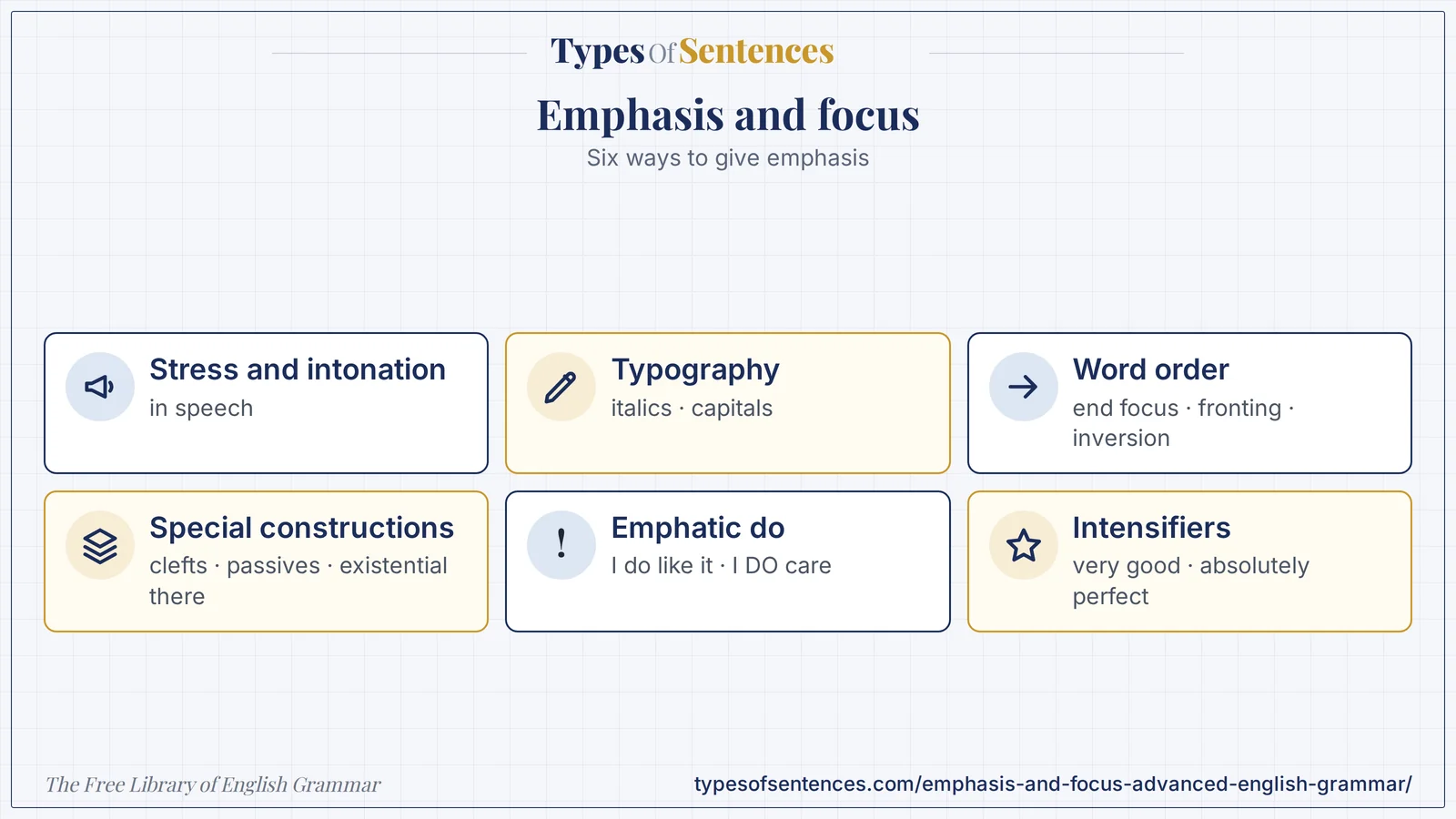
To emphasize is to give something extra weight. In English you can do it by stress, by position, by a special construction, by a strong word, or by saying something twice. All of them signal: “This is the important part.”
Why it matters: Emphasis works only by contrast. If everything is emphasized, nothing is. The best writers choose one or two devices and use them where the point matters.
Summary: Emphasis is created by prosody (stress and intonation), typography (italics, capitals), word order (end focus, fronting, inversion), special constructions (clefts, passives, existential there), emphatic do (I do like it), emphatic reflexives (I did it myself), repetition and parallelism, intensifiers (very, absolutely), emphatic negatives (not at all), and exclamations (What a day!). Intensifiers are limited by gradability: very good but absolutely perfect. Emphasis depends on contrast and fades with overuse.
- Spoken emphasis: stress; written: structure, typography, intensifiers.
- Focus structures: cleft, fronting, inversion, passive.
- Emphatic do and reflexives: I DO care; I did it myself.
- Intensifiers match the adjective: very good, absolutely perfect.
What You’ll Learn
- 1. Emphasis and Focus: Ways to Create Emphasis
- 2. Stress, Intonation, and Typography
- 3. Focus Structures: A Review
- 4. Do-Support for Emphasis
- 5. Reflexive Pronouns for Emphasis
- 6. Repetition and Parallelism
- 7. Intensifiers: Amplifiers and Downtoners
- 8. Emphatic Negatives, Exclamations, and Other Devices
- 9. Style: Where and How Much to Emphasize
- 10. Common Errors with Emphasis
- 11. Exercises
- 12. Test Your Knowledge
- 13. Frequently Asked Questions
- 14. Conclusion
1. Emphasis and Focus: Ways to Create Emphasis
| Means | Examples | Where used |
|---|---|---|
| stress and intonation | I DID lock the door. TOM broke it. | speech |
| typography | italics, bold, capitals, underlining, exclamation marks | writing |
| position (end focus) | The prize went to Maria. | all |
| fronting | This book I really enjoyed. Never have I seen it. | formal and literary |
| inversion | On the hill stood a castle. Not only did she win, … | formal and literary |
| cleft sentences | It was Maria who won. What I need is time. | all |
| passive with agent | The window was broken by Tom. | all |
| existential and extraposition | There is a problem. It is clear that he lied. | all |
| emphatic do | I do like it. Do be careful. | speech; informal writing |
| emphatic reflexives | I did it myself. The president himself came. | all |
| repetition and parallelism | very, very important; again and again | all |
| intensifiers | absolutely, extremely, utterly, totally | all |
| emphatic additives | indeed, in fact, actually, of course, really | all |
| focus particles | only, even, just, also | all |
| emphatic negatives | not at all; by no means; not a word | all |
| exclamations | What a day! How lovely! | speech and informal writing |
| strong lexical choice | enormous (for very big); exhausted (for very tired) | all |
| punctuation | a dash or colon before the key word: She had one fear: heights. | writing |
| Type of emphasis | Purpose | Example |
|---|---|---|
| contrastive | distinguish one item from others | TOM broke it, not Mary. |
| intensifying | strengthen a quality | absolutely wonderful |
| emotive | express feeling | What a day! |
| polarity (affirmation) | insist that something is true | I DO like it. |
| informational (focus) | mark the new, important information | The prize went to MARIA. |
Several of these devices are treated in detail elsewhere: the cleft sentence in the chapter on cleft sentences, fronting in the chapter on fronting and postponement, and inversion in the chapter on inversion. The theory of focus as a part of information structure is in the chapter on information structure. This chapter reviews them briefly and adds the devices that have not yet been treated: emphatic do, emphatic reflexives, repetition, and intensifiers.
2. Stress, Intonation, and Typography
In speech, the strongest tool of emphasis is the nuclear stress, a pitch movement on one syllable that marks the focus of the utterance. Moving the stress changes the meaning, as in the classic series of seven meanings for one sentence.
| Stressed word | Sentence | Implied meaning |
|---|---|---|
| I | I didn’t say he stole it. | someone else said it |
| didn’t | I didn’t say he stole it. | I did not say it |
| say | I didn’t say he stole it. | I implied it or wrote it |
| he | I didn’t say he stole it. | someone else stole it |
| stole | I didn’t say he stole it. | he did something else with it |
| it | I didn’t say he stole it. | he stole something else |
| Device in writing | Use | Caution |
|---|---|---|
| italics | stress a word in a sentence; titles; foreign words | sparingly: one per paragraph at most |
| bold | headings, key terms, warnings | not in running text for emphasis |
| capitals (ALL CAPS) | acronyms; very rarely a single word | whole sentences read as shouting |
| exclamation mark | strong feeling; informal writing | avoid in formal writing; never several in a row |
| underline | links (on the web) | not for emphasis online |
| dash or colon | introduce the key point | — |
| quotation marks (scare quotes) | distance or irony | not for emphasis |
| layout (a short paragraph or line) | isolate a key sentence | — |
In writing, italics are the closest equivalent of stress, but they should be used sparingly: a text with many italicized words loses its force. A better way to put the stress where you want it is to arrange the sentence so that the important word comes at the end, where the natural stress falls (end focus).
3. Focus Structures: A Review
| Version of Maria wrote the report | Device | What is emphasized |
|---|---|---|
| It was Maria who wrote the report. | it-cleft | Maria (the doer) |
| It was the report that Maria wrote. | it-cleft | the report |
| What Maria wrote was the report. | wh-cleft | the report |
| What Maria did was write the report. | wh-cleft | the action |
| The report was written by Maria. | passive with agent | Maria (at the end) |
| The report Maria wrote. (in context) | fronting | the report as topic |
| Maria did write the report. | emphatic do | the fact of writing |
| Maria wrote the report herself. | emphatic reflexive | that she did it without help |
| Goal | Best device |
|---|---|
| correct a mistaken belief about who or what | it-cleft |
| highlight an action or a whole event | wh-cleft |
| put a new item at the end | passive; end position; inversion |
| connect to the previous sentence while contrasting | fronting |
| insist on the truth of a statement | emphatic do; stress |
| stress that no one helped | emphatic reflexive |
Choose the device that fits the context. A cleft is a heavy device and sounds odd when used for a mild point; emphatic do is natural in a reply to a doubt (You don’t care. — I do care!); fronting needs a context that supports it. The negative fronting that triggers inversion (Never have I seen it) belongs to formal style.
4. Do-Support for Emphasis
| Pattern | Example | Meaning and use |
|---|---|---|
| do + base form (present) | I do like it. She does know the answer. | affirms in the face of doubt or denial |
| did + base form (past) | I did lock the door. He did say that. | — |
| emphatic imperative | Do come in. Do be careful. Do sit down. | polite insistence, welcome, or urgent advice |
| with be (no do) | I AM happy. She IS late. | stress on be; no do with be in statements |
| with other auxiliaries (stress only) | I CAN swim. She HAS finished. | stress on the auxiliary |
| negative emphatic | I do NOT like it. Don’t you DARE! | — |
| in a tag | He did say that, didn’t he? | — |
| in a reply (contradiction) | A: You don’t care. B: I DO care. | polarity focus |
| Neutral | Emphatic | Context |
|---|---|---|
| I like it. | I DO like it. | after someone says that you do not |
| She called. | She DID call. | after doubt that she called |
| Come in. | Do come in. | a warm invitation |
| I know the answer. | I DO know the answer. | after doubt |
| They arrived. | They DID arrive. | — |
5. Reflexive Pronouns for Emphasis
Reflexive pronouns (myself, yourself, himself, herself, itself, ourselves, yourselves, themselves) have two uses. In the reflexive use, the object is the same as the subject (She hurt herself). In the emphatic (or intensive) use, they add emphasis to a noun phrase and can be omitted without changing the grammar.
| Position | Example | Meaning |
|---|---|---|
| after the noun phrase | The president himself attended. I myself saw it. | the very person; surprising or important |
| at the end of the clause | I made it myself. She told me herself. | without help; in person |
| after the subject | She herself said so. | — |
| in a command | Do it yourself. | without help |
| with by | I did it by myself. She lives by herself. | alone or unaided |
| on one’s own; own | I did it on my own. my own house; of my own | — |
| very (emphatic adjective) | the very man; this very day; the very idea | exactly |
| Emphatic reflexive | Reflexive (not emphatic) | Test |
|---|---|---|
| The manager herself called. (can be removed) | The manager hurt herself. (cannot be removed) | if you can delete it, it is emphatic |
| I fixed it myself. | I taught myself to code. | — |
| Common problem | Example | Fix |
|---|---|---|
| myself as a polite form for me | Please contact John or myself. | Please contact John or me. |
| myself as a subject | John and myself will attend. | John and I will attend. |
| redundant doubling | He himself did it by himself. | He did it himself. |
| wrong form (hisself, themself in formal writing) | He did it hisself. | He did it himself. |
Emphatic reflexives are a mild but clear device: I did it myself stresses that I had no help, and The CEO himself called stresses that it was the top person. The use of myself where me or I is correct is a common error and is treated in the chapter on advanced pronoun concepts.
6. Repetition and Parallelism
| Device | Example | Effect |
|---|---|---|
| repeated intensifier | very, very important; really, really good | strong emphasis; informal |
| repeated word (epizeuxis) | Never, never, never give up. a long, long time | intensity |
| repeated adjective or adverb of degree | more and more difficult; bigger and bigger; again and again | increase or duration |
| the…the… comparative | The more she practiced, the better she became. | proportion |
| anaphora (repeated start) | We will go on. We will not stop. We will win. | rhetorical force |
| repeated structure (parallelism) | She came, she saw, she conquered. | rhythm; balance |
| tricolon (rule of three) | faster, cheaper, better | completeness |
| reduplication | bye-bye; so-so; hush-hush | informal |
| repetition of the topic noun | The plan is simple. The plan is cheap. The plan works. | emphasis and cohesion |
| polyptoton (same root) | a war to end all wars; the pot calling the kettle black | — |
Repetition adds weight because it makes the reader notice the point. It must be deliberate: He was very, very, very tired is stronger than He was very tired but sounds childish if overdone, and an unintended repetition of a word in a paragraph is a fault of style. Parallel structure, in which items of the same kind are given the same form, supports emphasis through rhythm; see the chapter on parallel structure.
7. Intensifiers: Amplifiers and Downtoners
| Class | Intensifiers | Examples |
|---|---|---|
| maximizers (completely) | absolutely, completely, totally, utterly, entirely, fully, perfectly, thoroughly, quite (with non-gradable) | absolutely perfect; completely different; utterly ridiculous |
| boosters (very) | very, really, extremely, highly, terribly, awfully, deeply, bitterly, incredibly, so, ever so | extremely tired; highly unlikely; deeply concerned; bitterly cold |
| approximators and downtoners | slightly, somewhat, fairly, rather, pretty, quite (British: fairly), a bit, a little, kind of, sort of, hardly, barely | a bit tired; fairly good; rather expensive |
| informal intensifiers | super, totally, so, mega, mad, crazy, well (British: well good) | super easy; so cool |
| emphatic phrases | on earth, in the world, the hell (rude), ever | What on earth are you doing? Why ever not? |
| Adjective type | Takes | Examples | Does not take |
|---|---|---|---|
| gradable (can be more or less) | very, extremely, rather, fairly, quite, too, so, a bit | very good; extremely tired; rather expensive | absolutely, completely (normally) |
| non-gradable (extreme or absolute) | absolutely, completely, utterly, totally, entirely, perfectly | absolutely perfect; completely impossible; utterly exhausted; totally unique | *very perfect; *very impossible |
| extreme (strong) adjectives | absolutely, utterly, really | absolutely fantastic; utterly terrible; really enormous | *very fantastic; *very terrible (used informally) |
| classifying adjectives | — | *very wooden; *very nuclear | — |
| Instead of … | Use … |
|---|---|
| very big | enormous, huge, vast |
| very small | tiny, minute |
| very tired | exhausted, worn out |
| very good | excellent, outstanding |
| very bad | terrible, awful, dreadful |
| very happy | delighted, overjoyed |
| very important | crucial, essential, vital |
| very interesting | fascinating, compelling |
| very hungry | starving, ravenous |
| very angry | furious, livid |
- Match the intensifier to the adjective. Very goes with gradable adjectives, and absolutely with extreme or absolute ones. Intensifiers are also collocations; see the chapter on collocation.
- Quite varies. In British English quite good often means “fairly good” (less than very), whereas in American English it often means “very good”. Quite with a non-gradable adjective means “completely” (quite impossible).
- Avoid overusing very and really. A stronger word is often better than very + a weak word.
- Literally means “in a literal sense”; its use as a general intensifier (I literally died) is common in informal speech but is disliked in formal writing.
- So and such intensify: so tired, such a long day; too means “more than is good”: too tired to work.
8. Emphatic Negatives, Exclamations, and Other Devices
| Device | Examples | Notes |
|---|---|---|
| emphatic negatives | not at all; not a bit; not in the least; by no means; not a word; nothing at all; never in my life | — |
| negative fronting | Not a word did she say. Never have I seen it. | inversion; formal |
| exclamative sentences | What a day! What a lovely surprise! How lovely! How well she sings! | what + noun; how + adjective or adverb |
| exclamation as a question | Isn’t it lovely! Wasn’t that a game! | negative question with falling tone |
| emphatic additives | indeed, in fact, actually, really, of course, certainly, after all, truly | Indeed, it was the best. In fact, it was perfect. |
| ever with wh-words | What ever happened to him? Why ever not? Who ever said that? | emphatic wh-questions |
| on earth, in the world | What on earth is that? Who in the world called? | — |
| such and so … that | It was such a good book that I read it twice. | result with emphasis |
| no less than, nothing less than | He won no less than five medals. It was nothing less than a miracle. | surprise at the amount |
| simply, just, quite | It is simply impossible. She is just wonderful. | — |
| comparatives with far, much, by far | far better; much too late; by far the best | emphatic comparison |
| emphasis by understatement | It was not a bad idea. | litotes (see the chapter on negation) |
The exclamative sentence is a formal type: What a day! and How lovely! use what and how in a fixed pattern and end with an exclamation mark. The emphatic additives often mark a shift to a stronger claim: It was good. In fact, it was the best I have seen.
9. Style: Where and How Much to Emphasize
| Principle | Example | Reason |
|---|---|---|
| put the important item at the end of the sentence (end focus) | The prize went to Maria. / not Maria got the prize. | the end is the natural place for stress |
| also use the beginning | Never again will I trust him. | the two positions are the strongest |
| use a short sentence for impact | The plan failed. Completely. | contrast with longer sentences |
| use one device at a time | a cleft or an intensifier, not both | overuse weakens emphasis |
| prefer a strong word to an intensifier | exhausted (not very tired) | precision |
| use understatement | It was not a bad result. | restraint is strong |
| signal the important point in academic writing | Importantly, …; Notably, …; In particular, … | signposting |
| use italics once, at the key term | The key concept is aspect. | — |
| isolate a key line | a short paragraph | visual emphasis |
| avoid several exclamation marks | Stop! | — |
| Device | Effect | Risk |
|---|---|---|
| intensifiers | strengthen a quality | overuse; empty words |
| clefts | focus and correction | heaviness |
| fronting and inversion | drama, formality | artificiality |
| repetition | force and rhythm | redundancy |
| italics and capitals | stress in writing | a shouting tone |
| exclamations | feeling | informality |
| emphatic do | affirmation | sounds defensive |
In the end, emphasis is a matter of proportion. A text in which every sentence is emphatic has no peaks. Decide the two or three points that matter most, and give them the strongest positions and devices, as discussed in the chapters on sentence variety and on rhetorical strategies.
10. Common Errors with Emphasis
| Error | Correction | Rule |
|---|---|---|
| very unique | unique | non-gradable |
| very perfect | perfect (or: nearly perfect) | non-gradable |
| She did went. | She did go. | base form after emphatic do |
| I do am happy. | I am happy. (stress am) | no do with be |
| Please contact myself. | Please contact me. | reflexive for me |
| John and myself will attend. | John and I will attend. | reflexive as a subject |
| He did it by hisself. | He did it by himself. | reflexive form |
| He himself did it by himself. | He did it himself. | redundant |
| It was so a good book. | It was such a good book. / It was so good. | so and such |
| extremely amazing (informal) | absolutely amazing | extreme adjective |
| The weather is totally nice. | The weather is really nice. | informal intensifier with gradable |
| !!!! and ALL CAPS in a formal letter | plain punctuation | style |
| I literally died. | I was exhausted. (formal) | overuse of literally |
| very very very important (in an academic paper) | crucial | overuse |
Edit: It was a very unique and very perfect event, and she did went and I do am happy, and please contact myself, and John and myself did it by hisself, and it was so a good book, and the weather is totally nice!!!!
- very unique: unique.
- very perfect: perfect (or: nearly perfect).
- did went: did go.
- I do am happy: I am happy.
- contact myself: contact me.
- John and myself … by hisself: John and I did it by ourselves (or ourselves).
- so a good book: such a good book.
- totally nice!!!!: really nice.
- Result: It was a unique and perfect event, and she did go and I am happy, and please contact me, and John and I did it by ourselves, and it was such a good book, and the weather is really nice.
Recap in 12 seconds
Watch the lesson build itself: Emphasis comes from prosody, typography, word order, special constructions, emphatic do, and intensifiers. The video has no sound.
Exercises
Part A: Ways of Emphasis (Exercises 1–6)
Exercise 1: Name three ways of creating emphasis in writing.
Show Answer
Answer: Word order, clefts, intensifiers, repetition, or typography.
Exercise 2: Which device is the main one in speech?
Show Answer
Answer: Stress and intonation.
Exercise 3: Name the principle: the important word at the end
Show Answer
Answer: End focus.
Exercise 4: Which typography is closest to stress?
Show Answer
Answer: Italics.
Exercise 5: Why avoid ALL CAPS?
Show Answer
Answer: It reads as shouting.
Exercise 6: Name the types of emphasis.
Show Answer
Answer: Contrastive, intensifying, emotive, polarity, informational.
Part B: Focus Structures (Exercises 7–11)
Exercise 7: Make an it-cleft focusing on Maria: Maria wrote the report.
Show Answer
Answer: It was Maria who wrote the report.
Exercise 8: Make a wh-cleft focusing on the action:
Show Answer
Answer: What Maria did was write the report.
Exercise 9: Use the passive to emphasize the agent:
Show Answer
Answer: The report was written by Maria.
Exercise 10: Front the adverbial negative: I have never seen it.
Show Answer
Answer: Never have I seen it.
Exercise 11: Which device corrects a belief about who did it?
Show Answer
Answer: An it-cleft.
Part C: Emphatic Do and Reflexives (Exercises 12–19)
Exercise 12: Make emphatic: I like it.
Show Answer
Answer: I do like it.
Exercise 13: Make emphatic: She called.
Show Answer
Answer: She did call.
Exercise 14: Edit: She did went.
Show Answer
Answer: She did go.
Exercise 15: Edit: I do am happy.
Show Answer
Answer: I am happy.
Exercise 16: Add an emphatic reflexive: I made it. (without help)
Show Answer
Answer: I made it myself.
Exercise 17: Add an emphatic reflexive: The president attended.
Show Answer
Answer: The president himself attended.
Exercise 18: Edit: Please contact myself.
Show Answer
Answer: Please contact me.
Exercise 19: Edit: He did it by hisself.
Show Answer
Answer: He did it by himself.
Part D: Intensifiers (Exercises 20–26)
Exercise 20: Choose: (very/absolutely) perfect
Show Answer
Answer: absolutely (or just perfect).
Exercise 21: Choose: (very/absolutely) good
Show Answer
Answer: very.
Exercise 22: Choose: (very/utterly) ridiculous
Show Answer
Answer: utterly.
Exercise 23: Edit: very unique
Show Answer
Answer: unique.
Exercise 24: Replace with a strong word: very tired
Show Answer
Answer: exhausted.
Exercise 25: Replace with a strong word: very big
Show Answer
Answer: enormous.
Exercise 26: What does quite good often mean in British English?
Show Answer
Answer: Fairly good.
Part E: Style and Errors (Exercises 27–30)
Exercise 27: Edit: It was so a good book.
Show Answer
Answer: It was such a good book.
Exercise 28: Edit: John and myself will attend.
Show Answer
Answer: John and I will attend.
Exercise 29: Name the risk of overusing emphasis.
Show Answer
Answer: It loses force.
Exercise 30: Name a strong alternative to very important.
Show Answer
Answer: crucial (vital, essential).
Test Your Knowledge
Ready to check what you learned? Answer all 10 questions, then submit. You need 80% (8 of 10) to pass. Your answers are not stored.
View correct answers and explanations
Question 1: Which is the main tool of emphasis in speech?
✓ Correct Answer: A – stress
Stress marks the focus.
Question 2: Which is correct?
✓ Correct Answer: B – unique
Unique is non-gradable.
Question 3: Which is correct?
✓ Correct Answer: C – She did go.
Base form after emphatic do.
Question 4: Which is correct?
✓ Correct Answer: D – I am happy.
No do with be.
Question 5: Which is correct?
✓ Correct Answer: C – Please contact me.
Me.
Question 6: Which is an emphatic reflexive?
✓ Correct Answer: A – I made it myself.
It can be removed.
Question 7: Which is correct?
✓ Correct Answer: C – absolutely perfect
Absolutely with a non-gradable adjective.
Question 8: Which is correct?
✓ Correct Answer: B – It was such a good book.
Such a.
Question 9: Which is a strong alternative to very tired?
✓ Correct Answer: B – exhausted
Exhausted.
Question 10: Which is an it-cleft?
✓ Correct Answer: D – It was Maria who won.
It + be + focus + clause.
Frequently Asked Questions
What are emphasis and focus?
Emphasis is the extra weight given to part of a message; focus is the part of the sentence presented as most important. They are created by stress, word order, constructions, and word choice.
What is emphasis grammar?
Emphasis grammar is the set of grammatical devices that create emphasis: clefts, fronting, inversion, emphatic do, emphatic reflexives, repetition, and intensifiers.
What are focus structures?
Focus structures are constructions that mark an element as the focus: it-clefts, wh-clefts, the passive with an agent, fronting, and inversion.
What does highlighting information mean?
Highlighting information means making a part of the message stand out, for example by placing it at the end of the sentence, by stress, or by a cleft sentence.
What are emphatic structures?
Emphatic structures are the special constructions used for emphasis: emphatic do (I do like it), emphatic reflexives (I did it myself), clefts, and exclamations.
What is emphatic do?
Emphatic do is the use of do, does, or did with the base form in a positive statement to stress the truth of the statement: I do like it.
How can I avoid overusing emphasis?
Choose one or two points to emphasize, use one device at a time, prefer a strong word to very + a weak one, and avoid italics, capitals, and exclamation marks in formal writing.
Conclusion
You now have a deep study of emphasis and focus: the ways of creating emphasis, stress and typography, a review of clefts, fronting, and inversion, emphatic do and reflexives, repetition and parallelism, intensifiers and their restrictions, emphatic negatives and exclamations, and style. You can make your points stand out with control.
When you want a point to stand out, choose the position and the device that fit it, and do not spoil it by overuse. Next, you will study vagueness and precision.
- Huddleston, Rodney, and Geoffrey K. Pullum. The Cambridge Grammar of the English Language. Cambridge University Press, 2002.: information packaging, intensifiers, and emphatic do.
- Quirk, Randolph, et al. A Comprehensive Grammar of the English Language. Longman, 1985.: emphasis, intensifiers, and focus.
- Biber, Douglas, et al. Longman Grammar of Spoken and Written English. Longman, 1999.: corpus evidence on intensifiers and emphasis.
- Halliday, M. A. K., and Christian M. I. M. Matthiessen. Halliday’s Introduction to Functional Grammar. 4th ed. Routledge, 2014.: information focus and prominence.
- Merriam-Webster Dictionary: emphasis: the dictionary entry.
Last reviewed: October 29, 2026. How it was made: drafted with AI assistance, then checked with automated tests (structure, links, answer keys, spelling) and against the sources above. A person has not yet read this chapter line by line. Found a mistake? Report it.