Rhetorical strategies are the choices that a writer makes to move a particular audience toward a conclusion. An argument is a claim supported by reasons and evidence; persuasion is the broader art of getting an audience to accept the claim, which also involves credibility, emotion, and the way that the message is shaped. The two are not opposites: a good persuasive text is built on a sound argument, and a good argument is presented with an understanding of its readers. These strategies are among the most important ones in academic, professional, and public writing.
You will study the rhetorical situation and the kinds of claims, logical argumentation (claims, evidence, and reasoning, with deduction and induction), types and tests of evidence, the three classical appeals (logos, ethos, pathos), the handling of counterarguments, logical fallacies and how to avoid them, persuasive language (word choice, sentence structure, and figures), the structure of persuasive texts, and the ethics of persuasion. The aim is advanced argumentation that is both logical and effective, using persuasion strategies honestly. Thirty editing exercises and a quiz follow.
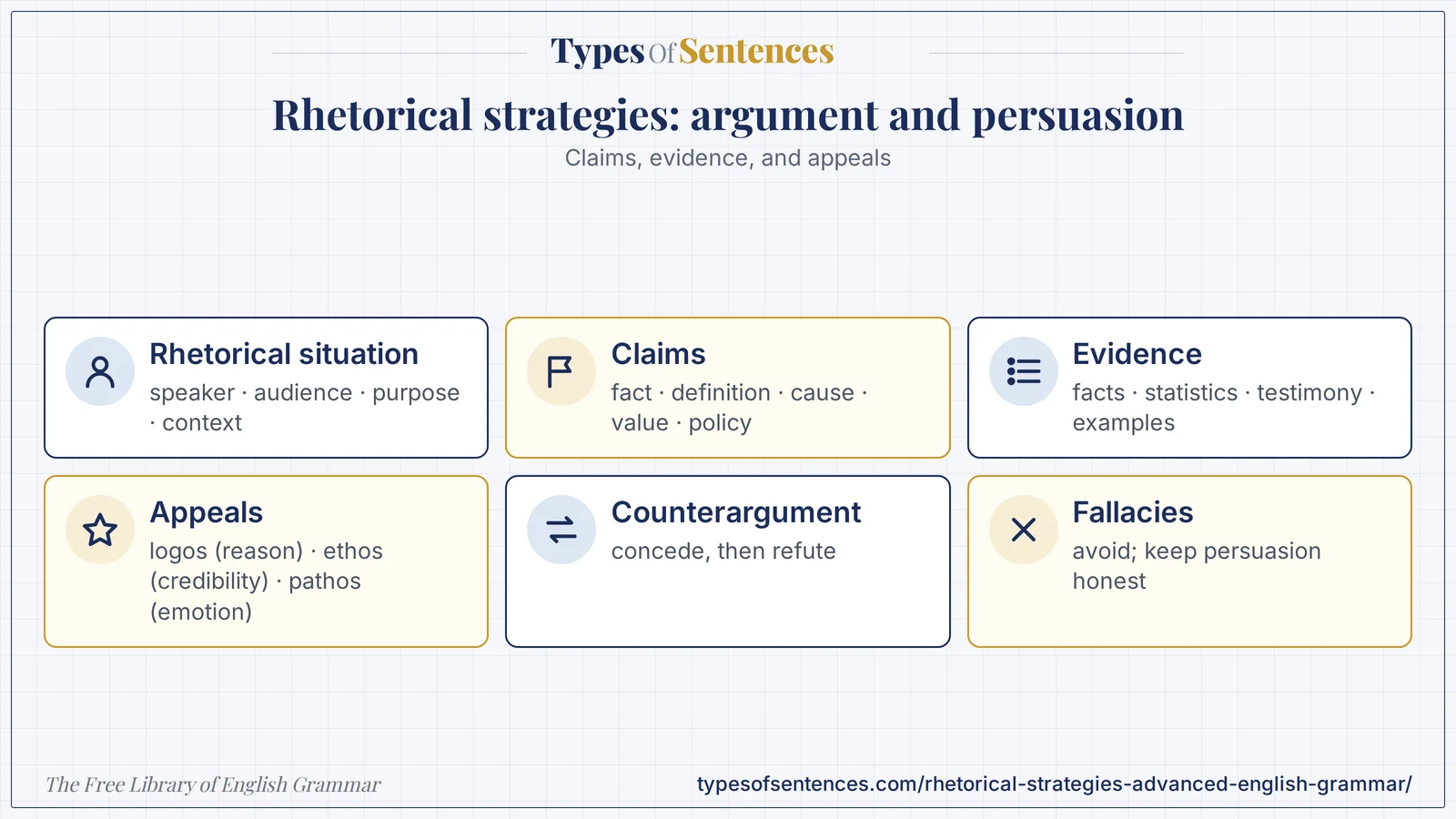
To argue is to give reasons for a claim. To persuade is to get someone to accept it. The first needs good reasons; the second also needs a speaker the audience trusts, a message that connects with what they care about, and language that carries the point.
Why it matters: A strong argument has three parts: a claim (what you say is true), evidence (the facts that support it), and reasoning (why the evidence supports the claim). Remove any one of them and the argument fails.
Summary: A rhetorical situation has a speaker, an audience, a purpose, and a context. An argument is built from claims (of fact, definition, cause, value, or policy), evidence (facts, statistics, testimony, examples), and reasoning that links them (deductive or inductive). Aristotle’s appeals are logos (reason), ethos (credibility), and pathos (emotion). A strong argument anticipates counterarguments and answers them by concession and refutation. Fallacies are common patterns of faulty reasoning (straw man, false dilemma, slippery slope). Persuasive language uses word choice, sentence structure, repetition, and figures with care. Persuasion should be honest: it respects the audience’s ability to judge.
- Strong argument = claim + evidence + reasoning.
- Appeals: logos (reason), ethos (credibility), pathos (emotion).
- Counterargument: concede, then refute.
- Avoid fallacies; keep persuasion honest.
What You’ll Learn
- 1. Rhetorical Strategies: The Rhetorical Situation and Kinds of Claims
- 2. Logical Argumentation: Claims, Evidence, and Reasoning
- 3. Types of Evidence and How to Test Them
- 4. The Rhetorical Appeals: Logos, Ethos, and Pathos
- 5. Addressing Counterarguments
- 6. Logical Fallacies and How to Avoid Them
- 7. Persuasive Language: Word Choice, Sentence Structure, and Figures
- 8. Structuring Persuasive Texts
- 9. Persuasion in Different Contexts
- 10. The Ethics of Persuasion
- 11. Common Problems in Argument and Persuasion
- 12. Exercises
- 13. Test Your Knowledge
- 14. Frequently Asked Questions
- 15. Conclusion
1. Rhetorical Strategies: The Rhetorical Situation and Kinds of Claims
Rhetoric is the study of effective communication, and since Aristotle it has been concerned with the ways in which a speaker can find the means of persuasion in a given situation. A rhetorical situation has four elements.
| Element | Question | Example (an editorial on school start times) |
|---|---|---|
| speaker (writer) | Who is speaking and with what authority? | a school psychologist |
| audience | Who is to be persuaded, and what do they already think? | parents and school boards, partly skeptical |
| purpose | What should the audience believe or do? | move the start time to 8:30 |
| context | What is the occasion, the medium, the timing? | a debate at a school board meeting |
| Kind of claim | Question | Example |
|---|---|---|
| claim of fact | Is it true? | Teenagers need more sleep than adults. |
| claim of definition | What is it? | Sleep deprivation is a public health problem. |
| claim of cause | What caused it? | Early start times cause sleep deprivation. |
| claim of value (evaluation) | Is it good or bad? | Early start times are harmful. |
| claim of policy (proposal) | What should be done? | Schools should start at 8:30 or later. |
| Audience | Strategy |
|---|---|
| supportive | reinforce; call to action |
| neutral or undecided | present evidence clearly; be fair |
| hostile | establish common ground; concede what can be conceded; use strong evidence |
| mixed or unknown | state the case in terms that most would accept |
The kinds of claim determine the kind of support they need: a claim of fact needs data, a claim of cause needs evidence of a mechanism and the exclusion of other causes, a claim of value needs criteria, and a claim of policy needs all of these, together with a plan. The question of structure is treated in the previous chapter, on essay structure.
2. Logical Argumentation: Claims, Evidence, and Reasoning
| Part | Meaning | Example |
|---|---|---|
| claim (conclusion) | what the writer wants accepted | Schools should start later. |
| evidence (premises, grounds) | the facts and reasons offered | Teenage sleep need is about nine hours; early start times reduce sleep by one hour (Rao, 2021). (a sample citation) |
| reasoning (warrant) | why the evidence supports the claim | Reduced sleep harms learning, so a policy that reduces sleep harms learning. |
| backing | support for the reasoning | research on sleep and memory |
| qualifier | the strength of the claim | in most cases; probably |
| rebuttal | conditions under which the claim fails | unless transport makes later start impossible |
| Type of reasoning | Pattern | Example | Test |
|---|---|---|---|
| deductive | general premise + specific premise → certain conclusion | All teenagers need nine hours of sleep. Maria is a teenager. So Maria needs nine hours. | valid (the form is right) and sound (the premises are true) |
| inductive (generalization) | many cases → a probable general claim | In 40 schools, later starts raised attendance; so later starts raise attendance. | strong or weak (sample size, representativeness) |
| causal | A caused B | The policy change preceded the rise in attendance. | correlation is not causation; rule out other causes |
| analogical | A is like B, so what holds of B holds of A | School start times are like work hours: both affect health. | how similar are the cases in relevant respects? |
| abductive (inference to the best explanation) | the best explanation of the evidence | Test scores rose when sleep rose; sleep is the likely cause. | compare alternative explanations |
| argument from authority | an expert says so | The American Academy of Pediatrics recommends … | is the authority relevant and unbiased? |
| Indicators | Words |
|---|---|
| premise (reason) indicators | because, since, for, as, given that, in view of the fact that, after all |
| conclusion indicators | therefore, so, thus, hence, consequently, it follows that, which shows that, accordingly |
Many arguments leave a premise unstated, an enthymeme: Teenagers are chronically tired, so schools should start later assumes that tiredness is caused by early starts and that later starts would help. Part of critical writing is to make the hidden assumptions visible and to check them. The analysis of arguments is treated in a later chapter, on critical analysis.
3. Types of Evidence and How to Test Them
| Type | Example | Strengths | Weaknesses |
|---|---|---|---|
| facts and data | Sleep need for teens is about nine hours. | verifiable | must be sourced |
| statistics | Attendance rose by 8 percent. | precise; compact | can mislead if the sample is biased or the comparison unfair |
| expert testimony | A pediatrician states … | authority | must be relevant and unbiased |
| examples and cases | In Seattle, later start times … | concrete; memorable | one case may not generalize |
| anecdotes | My daughter slept better … | vivid | not representative |
| experiments and studies | A randomized trial found … | strong for causes | may not apply to every setting |
| analogies | A school is like a factory. | explains by comparison | false if the cases differ |
| historical precedent | The same reform in 1990 … | shows consequences | conditions may differ |
| quotations from sources | A principle in a policy document | precise wording | needs interpretation |
| Test for evidence | Question |
|---|---|
| relevance | Does it bear on the claim? |
| sufficiency | Is there enough of it? |
| credibility of the source | Who produced it, and are they reliable and unbiased? |
| recency | Is it up to date? |
| representativeness | Does it apply to the whole group? |
| accuracy | Can it be verified? |
| balance | Does it include evidence on the other side? |
- Link every piece of evidence to the claim with explanation: claim, evidence, reasoning.
- Use statistics honestly: give the base, the source, and the comparison; do not cherry-pick favorable figures.
- Name the sources (see the chapter on hedging on weasel words, and the chapter on citing sources).
- Match the strength of the claim to the strength of the evidence: a single study justifies suggests, not proves.
4. The Rhetorical Appeals: Logos, Ethos, and Pathos
| Appeal | Meaning | How language creates it | Example |
|---|---|---|---|
| logos (reason) | the argument’s logic and evidence | claims, evidence, reasons, logical connectives, definitions, statistics | Because later starts raise sleep by one hour and sleep improves memory, later starts will improve learning. |
| ethos (credibility) | the speaker’s trustworthiness and authority | credentials, accuracy, fairness, concession, balanced tone, citation, shared values | As a school psychologist who has worked with teenagers for 20 years, I have seen … |
| pathos (emotion) | the audience’s feelings and values | vivid language, narrative, imagery, emotive words, appeal to shared values | Picture a fifteen-year-old, asleep at her desk at 8 a.m., unable to follow the lesson. |
| kairos (timing) | the right moment and occasion | reference to the occasion | At this week’s board meeting, the question is one of timing. |
| Ethos is built by | Examples |
|---|---|
| competence | knowledge shown by accurate detail and citation |
| character | honesty and fairness: conceding a point, acknowledging limits |
| goodwill | showing care for the audience’s interests: inclusive we |
| shared values | starting from common ground |
| consistent tone | a measured, respectful register |
| Grammar and word choice | Effect |
|---|---|
| inclusive we and our | builds solidarity (see the chapter on reference and deixis) |
| modal verbs of obligation (should, must) | express a policy claim; strong |
| hedges (may, appears to) | build credibility by honest caution |
| boosters (clearly, undoubtedly) | express confidence; risk overclaiming |
| rhetorical questions | engage the reader |
| concession clauses (although) | show fairness |
The best arguments use all three appeals in balance. An argument that is all logos can seem cold, one that is all pathos can seem manipulative, and one that relies on the speaker’s authority alone can seem arrogant. In academic writing, logos and ethos dominate, and pathos is used lightly, in an example or a framing sentence. In advertising and public speaking, pathos is often central.
5. Addressing Counterarguments
| Step | Task | Example (school start times) |
|---|---|---|
| 1 anticipate | think of the strongest objections | Later starts will disrupt bus schedules and after-school sports. |
| 2 acknowledge | state the objection fairly | Critics argue that later starts will force schools to end later and disrupt sports and jobs. |
| 3 concede (if fair) | grant what is true in it | It is true that schedules would need to change. |
| 4 refute or qualify | answer the objection with evidence or reasoning | But districts that changed schedules reported that sports adapted within a year (Lee, 2021). |
| 5 return to the thesis | show that the argument stands | So the cost of adjustment is small compared with the benefit to health. |
| Refutation strategy | Description | Example |
|---|---|---|
| deny the premise | the objection rests on a false claim | Later starts do not reduce after-school time; they only shift it. |
| challenge the evidence | the support is weak | The study had 12 participants. |
| show irrelevance | the objection does not touch the claim | The cost of buses is a logistical issue, not an educational one. |
| show that the objection is outweighed | the cost is small compared with the benefit | — |
| qualify the claim | accept part of the objection | Later starts work best where transport is flexible. |
| turn the argument | show the objection supports your claim | Because students are tired, they cannot play sports well. |
| offer a solution | remove the difficulty | a staggered schedule |
| Language of counterargument | Examples |
|---|---|
| introducing | Some argue that …; Critics may object that …; It might be objected that …; A common objection is … |
| conceding | Admittedly, …; It is true that …; Granted, …; Although … |
| refuting | However, …; Yet this overlooks …; This view fails to consider …; On closer examination, … |
| returning | Even so, …; Nevertheless, the main point stands: … |
Fairness is part of ethos: a writer who presents the opposing view in its strongest form (a “steel man”) is more persuasive than one who attacks a weak version of it (a “straw man”). The concessive structure is treated in the chapter on coordination and subordination. In a Rogerian argument, the writer first restates the other position until its holder would accept the description, finds common ground, and only then presents the case.
6. Logical Fallacies and How to Avoid Them
| Fallacy | Description | Example |
|---|---|---|
| ad hominem | attacks the person, not the argument | She is not a scientist, so her argument about sleep is worthless. |
| straw man | attacks a distorted version of the opponent’s view | They want students to sleep all day. |
| false dilemma (either/or) | offers only two options when more exist | Either we start at 7:30 or we give up on education. |
| slippery slope | claims, without evidence, that a small step leads to a disaster | If we change the start time, soon there will be no school at all. |
| hasty generalization | a conclusion from too few cases | Two students were late, so all students are lazy. |
| post hoc (false cause) | assumes that what follows is caused by what precedes | Attendance rose after the new principal arrived, so she caused it. |
| appeal to authority (irrelevant) | cites an authority outside their field | A famous actor says that sleep is unimportant. |
| bandwagon (appeal to popularity) | claims that something is true because many believe it | Everyone starts early, so it must be right. |
| appeal to tradition | claims that something is right because it has always been done | Schools have always started at 7:30. |
| appeal to novelty | claims that something is better because it is new | The new schedule is better because it is new. |
| appeal to emotion (as the only support) | replaces reasons with feelings | Think of the children! |
| circular reasoning (begging the question) | the conclusion is assumed in the premise | Early starts are bad because starting early is harmful. |
| red herring | introduces an irrelevant point | What about the cost of school lunches? |
| equivocation | uses a word in two senses | — |
| false analogy | compares cases that are not alike | A school is just like a factory. |
| tu quoque | “you do it too” | You also stay up late, so your argument is hollow. |
| loaded question | contains an unproved assumption | Have you stopped harming your students? |
| anecdotal fallacy | uses a personal story as proof | My cousin sleeps five hours and is fine. |
| no true Scotsman | redefines the group to protect a claim | No real teacher would support this. |
| composition and division | what is true of parts is true of the whole, or the reverse | — |
- Check each step. Ask whether the evidence supports the conclusion, not whether the conclusion seems right.
- Do not mistake a fallacy for a lie. People use fallacies without intending to deceive.
- Note that some forms are not always fallacies: citing an expert on a matter of their expertise is a legitimate argument from authority; a slippery slope with a documented mechanism is not a fallacy.
- The fallacy fallacy: a conclusion is not false only because a particular argument for it is fallacious; it may be true for other reasons.
- Use fallacy names with care in your own writing; show the faulty step instead.
7. Persuasive Language: Word Choice, Sentence Structure, and Figures
| Resource | Example | Effect |
|---|---|---|
| connotation (word choice) | thrifty / stingy; protest / riot; reform / tinkering | frames the topic |
| concrete detail | a fifteen-year-old asleep at her desk | vividness |
| repetition and parallelism | We need rest. We need focus. We need a later start. | rhythm and emphasis |
| tricolon (three parts) | safer, healthier, wiser | completeness |
| antithesis | Early starts save minutes and cost years. | contrast |
| periodic sentence (main clause last) | Although later starts cost money, and although they disrupt routines, they improve health. | builds to the point |
| short sentence for emphasis | The evidence is clear. | impact |
| rhetorical question | Can we afford to ignore it? | engagement |
| metaphor and analogy | a school day that begins in the dark | imagery |
| hyperbole and understatement | a mountain of evidence; not a trivial matter | emphasis |
| irony | A system designed for learning that keeps learners asleep | — |
| imperatives and direct address | Ask your board to act. | call to action |
| modality | must, should, need to | policy force |
| framing | sleep as a right; as a cost | how the issue is seen |
| Scheme (pattern of form) | Example | Trope (figure of meaning) | Example |
|---|---|---|---|
| anaphora | We want … We want … We want … | metaphor | a river of evidence |
| antithesis | Not less, but more. | simile | as clear as day |
| parallelism | to learn, to rest, to grow | hyperbole | a million reasons |
| chiasmus | Ask not what … but what … | irony | What a bright idea! |
| asyndeton | We came, we saw, we left. | understatement | a minor setback |
| polysyndeton | and … and … and … | personification | the data speak |
Persuasive language works by emphasis and framing, and it is treated further in the chapters on emphasis and focus (intensifiers and focus structures) and on rhetoric and grammar. Rhetorical questions are described in the chapter on advanced question formation. In academic writing, the figures are used sparingly; in speeches and editorials, they are central.
8. Structuring Persuasive Texts
| Model | Stages | Best for |
|---|---|---|
| classical arrangement | introduction (exordium) → statement of the case (narratio) → proof (confirmatio) → refutation (refutatio) → conclusion (peroratio) | formal arguments, speeches |
| Toulmin | claim → grounds → warrant → backing → qualifier → rebuttal | analytical arguments |
| Rogerian | restate the other view → common ground → your position → benefits to both | contested topics; hostile audiences |
| problem–solution | problem → causes → solution → feasibility → call to action | proposals and policy writing |
| Monroe’s motivated sequence | attention → need → satisfaction → visualization → action | speeches and sales |
| concession first | concede → refute → positive case | editorials |
| inverted (strongest first) | conclusion first, then support | busy readers; reports |
Decide the order by thinking about the audience. A hostile audience may need common ground before the claim; a busy audience may need the conclusion first; an audience that cares about the practicalities needs the plan. A call to action should be specific: not We must act, but The board should vote on 15 March to move the start time to 8:30.
9. Persuasion in Different Contexts
| Context | Norms | Language |
|---|---|---|
| academic argument | evidence and reasoning; restrained; hedged; fair to opponents; little pathos | The evidence suggests that …; Although …, … |
| op-ed or editorial | a clear stance; vivid; concise; personal voice allowed | We should; the case is clear |
| speech | rhythm; repetition; direct address; emotion | We will; we must; together |
| advertising | pathos and brevity; imperatives; claims that may be implied | Try it today. |
| business proposal | benefits, evidence, feasibility, a specific request | We recommend; the return will be |
| legal argument | precedent; precise language; formal | It is submitted that … |
| public health and campaigns | simple messages; repeated; call to action | Wash your hands. |
The same appeals work differently in each context, and the grammar of persuasion varies with it: hedged and impersonal in academic writing, direct and imperative in advertising. The reader’s tolerance for emotion and for strong claims varies by genre, as described in the chapter on pragmatics. Persuasion in a business setting is treated in a later chapter.
10. The Ethics of Persuasion
| Honest persuasion | Manipulation |
|---|---|
| gives accurate evidence | hides or distorts evidence |
| acknowledges opposing views and limits | ignores or caricatures opponents |
| appeals to emotions that are relevant to the issue | exploits fear or guilt to prevent thought |
| uses statistics fairly | cherry-picks or misleads with figures |
| claims what the evidence supports | overclaims; presupposes what is unproved (loaded questions) |
| respects the audience’s judgment | pressures or tricks the audience |
A persuasive writer has a responsibility to the audience: to be accurate, fair, and open about the basis of the claims. Persuasion that depends on deception works only until the audience discovers it, and damages the writer’s credibility. The pragmatics of implicature and presupposition (the chapter on pragmatics) show how a text can mislead without lying; an honest writer checks for such effects.
11. Common Problems in Argument and Persuasion
| Problem | Example | Fix |
|---|---|---|
| unsupported claim | Later starts are better. | Later starts improve attendance by 8 percent (Lee, 2021). |
| evidence without reasoning | a statistic dropped in with no comment | add the link: “This suggests …” |
| reliance on emotion alone | Think of the children! | add evidence and reasoning |
| overclaiming | Later starts will solve all problems. | Later starts are likely to improve attendance. |
| straw man | They want students to sleep all day. | They propose a start at 8:30. |
| ignoring a strong counterargument | one-sided essay | address the best objection |
| false dilemma | Either … or … | consider other options |
| hasty generalization | two cases → all | a larger sample, or qualify |
| circular reasoning | Early starts are bad because they are harmful. | give an independent reason |
| ad hominem | He is not an expert. | address his argument |
| loaded language in an academic argument | the disastrous, idiotic policy | the policy has been criticized as … |
| vague evidence | Studies show … | Lee (2021) found … |
| inconsistent register | a casual joke in a formal argument | keep the register |
| a weak call to action | We must do something. | The board should vote on … |
Edit: Everyone knows that later starts are better, and only a fool would disagree, and either we change the schedule or education will collapse, and studies show that students are happier, so think of the children!
- Everyone knows: bandwagon: replace with evidence: Lee (2021) found that attendance rose by 8 percent.
- only a fool would disagree: ad hominem: delete; address the objection: Critics argue that sports would suffer, but districts adapted within a year.
- either … or education will collapse: false dilemma: There are several options, of which a later start is the best supported.
- studies show: unattributed: name the source.
- students are happier: unsupported: reported higher well-being (Rao, 2021).
- think of the children: emotion only: Students who sleep more learn more.
- Result: Later starts raised attendance by 8 percent (Lee, 2021) and reported well-being (Rao, 2021). Critics argue that sports would suffer, but districts adapted within a year. Of the options, a later start is the best supported. (the citations and figures are invented for the example)
Recap in 12 seconds
Watch the lesson build itself: An argument builds claims with evidence and reasoning, uses logos, ethos, and pathos, and answers counterarguments. The video has no sound.
Exercises
Part A: Situation and Claims (Exercises 1–6)
Exercise 1: Name the four elements of a rhetorical situation.
Show Answer
Answer: Speaker, audience, purpose, context.
Exercise 2: Name the kind of claim: Schools should start later.
Show Answer
Answer: A claim of policy.
Exercise 3: Name the kind of claim: Teenagers need more sleep.
Show Answer
Answer: A claim of fact.
Exercise 4: Name the kind of claim: Early starts cause sleep loss.
Show Answer
Answer: A claim of cause.
Exercise 5: Name the kind of claim: Early starts are harmful.
Show Answer
Answer: A claim of value.
Exercise 6: Which strategy suits a hostile audience?
Show Answer
Answer: Common ground and fair concession (Rogerian).
Part B: Logic and Evidence (Exercises 7–13)
Exercise 7: Name the three parts of a strong argument.
Show Answer
Answer: Claim, evidence, reasoning.
Exercise 8: Deductive or inductive: In 40 schools later starts raised attendance, so …
Show Answer
Answer: Inductive.
Exercise 9: Define an enthymeme.
Show Answer
Answer: An argument with an unstated premise.
Exercise 10: Name a conclusion indicator.
Show Answer
Answer: therefore, thus, hence, consequently.
Exercise 11: Name a premise indicator.
Show Answer
Answer: because, since, given that.
Exercise 12: Name two tests for evidence.
Show Answer
Answer: Relevance, sufficiency, credibility, recency, representativeness.
Exercise 13: Why is an anecdote weak evidence?
Show Answer
Answer: It is not representative.
Part C: Appeals (Exercises 14–19)
Exercise 14: Name the appeal: reason and evidence
Show Answer
Answer: Logos.
Exercise 15: Name the appeal: credibility
Show Answer
Answer: Ethos.
Exercise 16: Name the appeal: emotion
Show Answer
Answer: Pathos.
Exercise 17: Name the appeal: As a psychologist with 20 years of experience …
Show Answer
Answer: Ethos.
Exercise 18: Name the appeal: Picture a fifteen-year-old asleep at her desk.
Show Answer
Answer: Pathos.
Exercise 19: Which appeals dominate academic writing?
Show Answer
Answer: Logos and ethos.
Part D: Counterarguments and Fallacies (Exercises 20–26)
Exercise 20: Name the steps of handling a counterargument.
Show Answer
Answer: Anticipate, acknowledge, concede, refute, return.
Exercise 21: Name the fallacy: They want students to sleep all day.
Show Answer
Answer: Straw man.
Exercise 22: Name the fallacy: Either we start at 7:30 or give up on education.
Show Answer
Answer: False dilemma.
Exercise 23: Name the fallacy: She is not a scientist, so she is wrong.
Show Answer
Answer: Ad hominem.
Exercise 24: Name the fallacy: Two students were late, so all are lazy.
Show Answer
Answer: Hasty generalization.
Exercise 25: Name the fallacy: Early starts are bad because starting early is harmful.
Show Answer
Answer: Circular reasoning.
Exercise 26: Name the fallacy: Attendance rose after she arrived, so she caused it.
Show Answer
Answer: Post hoc (false cause).
Part E: Language and Ethics (Exercises 27–30)
Exercise 27: Name the device: We need rest. We need focus.
Show Answer
Answer: Anaphora (parallelism).
Exercise 28: Name the device: Early starts save minutes and cost years.
Show Answer
Answer: Antithesis.
Exercise 29: Name a mark of honest persuasion.
Show Answer
Answer: Accurate evidence, fair treatment of opponents.
Exercise 30: Make specific: We must do something.
Show Answer
Answer: The board should vote on 15 March to move the start time.
Test Your Knowledge
Ready to check what you learned? Answer all 10 questions, then submit. You need 80% (8 of 10) to pass. Your answers are not stored.
View correct answers and explanations
Question 1: What are the three parts of a strong argument?
✓ Correct Answer: A – claim, evidence, reasoning
Claim, evidence, reasoning.
Question 2: Which appeal concerns credibility?
✓ Correct Answer: B – ethos
Ethos.
Question 3: Which appeal concerns emotion?
✓ Correct Answer: C – pathos
Pathos.
Question 4: Which is a straw man?
✓ Correct Answer: D – They want students to sleep all day.
A distorted version.
Question 5: Which is a false dilemma?
✓ Correct Answer: C – Either we start at 7:30 or education collapses.
Only two options.
Question 6: Which is circular reasoning?
✓ Correct Answer: A – Early starts are bad because starting early is harmful.
The conclusion is in the premise.
Question 7: Which is a hasty generalization?
✓ Correct Answer: D – A survey with 90 percent response.
Too few cases.
Question 8: Which is a counterargument move?
✓ Correct Answer: C – Some argue that … However, …
Acknowledge and refute.
Question 9: Which is a conclusion indicator?
✓ Correct Answer: B – therefore
Therefore marks a conclusion.
Question 10: What does honest persuasion do?
✓ Correct Answer: B – respects the audience’s judgment
It is accurate and fair.
Frequently Asked Questions
What are rhetorical strategies?
Rhetorical strategies are the choices a writer or speaker makes to persuade an audience: the kind of claim, the evidence, the appeals to reason, character, and emotion, the structure, and the language.
What is argument and persuasion?
An argument is a claim supported by reasons and evidence; persuasion is getting an audience to accept the claim. Argument and persuasion work together in good writing.
What is advanced argumentation?
Advanced argumentation is the use of sophisticated reasoning: distinguishing types of claims, testing evidence, anticipating and refuting counterarguments, avoiding fallacies, and arranging the argument for a particular audience.
What are persuasion strategies?
Persuasion strategies are techniques for influencing an audience: building ethos, using logos and pathos, framing, concession, repetition, and the structuring of the text.
What is a logical argument?
A logical argument is one in which the conclusion follows from the premises: deductively (necessarily) or inductively (probably). A logical argument also uses true, relevant evidence.
What are logical fallacies?
Logical fallacies are common patterns of faulty reasoning, such as the straw man, the false dilemma, the slippery slope, and circular reasoning. They make an argument unsound even when they sound convincing.
How do I handle a counterargument?
State the objection fairly, concede what is true in it, refute or qualify it with evidence or reasoning, and return to your thesis.
Conclusion
You now have a deep study of rhetorical strategies: the rhetorical situation and kinds of claims, logical argumentation, types and tests of evidence, the appeals, counterarguments, fallacies, persuasive language, structure, context, and ethics. You can build arguments that are sound and persuasive.
When you argue, ask what the audience believes, what evidence they will accept, and what objection they will raise. Next, you will study citing sources.
- Aristotle. Rhetoric. Translated by W. Rhys Roberts. Modern Library, 1954.: the classic account of ethos, pathos, and logos.
- Toulmin, Stephen E. The Uses of Argument. Updated ed. Cambridge University Press, 2003.: the model of claim, grounds, and warrant.
- Lunsford, Andrea A., John J. Ruszkiewicz, and Keith Walters. Everything’s an Argument. 8th ed. Bedford/St. Martin’s, 2019.: a modern textbook of argument.
- Corbett, Edward P. J., and Robert J. Connors. Classical Rhetoric for the Modern Student. 4th ed. Oxford University Press, 1999.: the classical arrangement and the figures.
- Merriam-Webster Dictionary: rhetoric: the dictionary entry.
Last reviewed: October 29, 2026. How it was made: drafted with AI assistance, then checked with automated tests (structure, links, answer keys, spelling) and against the sources above. A person has not yet read this chapter line by line. Found a mistake? Report it.