Plain language is writing that its readers can find what they need in, understand, and use. It is not a lowered standard of writing; it is a higher one, because it requires the writer to know exactly what is meant and to say it in the form that the reader can use at once. A tax notice, a medicine label, a bank form, a website, or a set of instructions fails if the people who must use it cannot understand it, whatever its grammar or its authority. Plain language is therefore the practical meeting point of grammar and accessibility: the grammar chosen (short sentences, active verbs, common words) decides whether the text can be read by people with different abilities, backgrounds, and circumstances.
This chapter shows how to write for everyone: what accessible writing is and who benefits, the principles of plain language and its techniques, the role of active voice and consistent grammar in reducing cognitive load, the avoidance of jargon, screen reader considerations, and writing for non-native speakers. It also touches on grammar and accessibility for readers with dyslexia and other cognitive differences, on writing for accessibility and inclusive writing practices more broadly, and on how to test a text. The aim is clear communication: writing that is understandable by all of its intended readers. Some of the standards mentioned (WCAG, ISO 24495-1) are described in outline, and the writer should consult the current versions. Thirty exercises and a quiz follow.
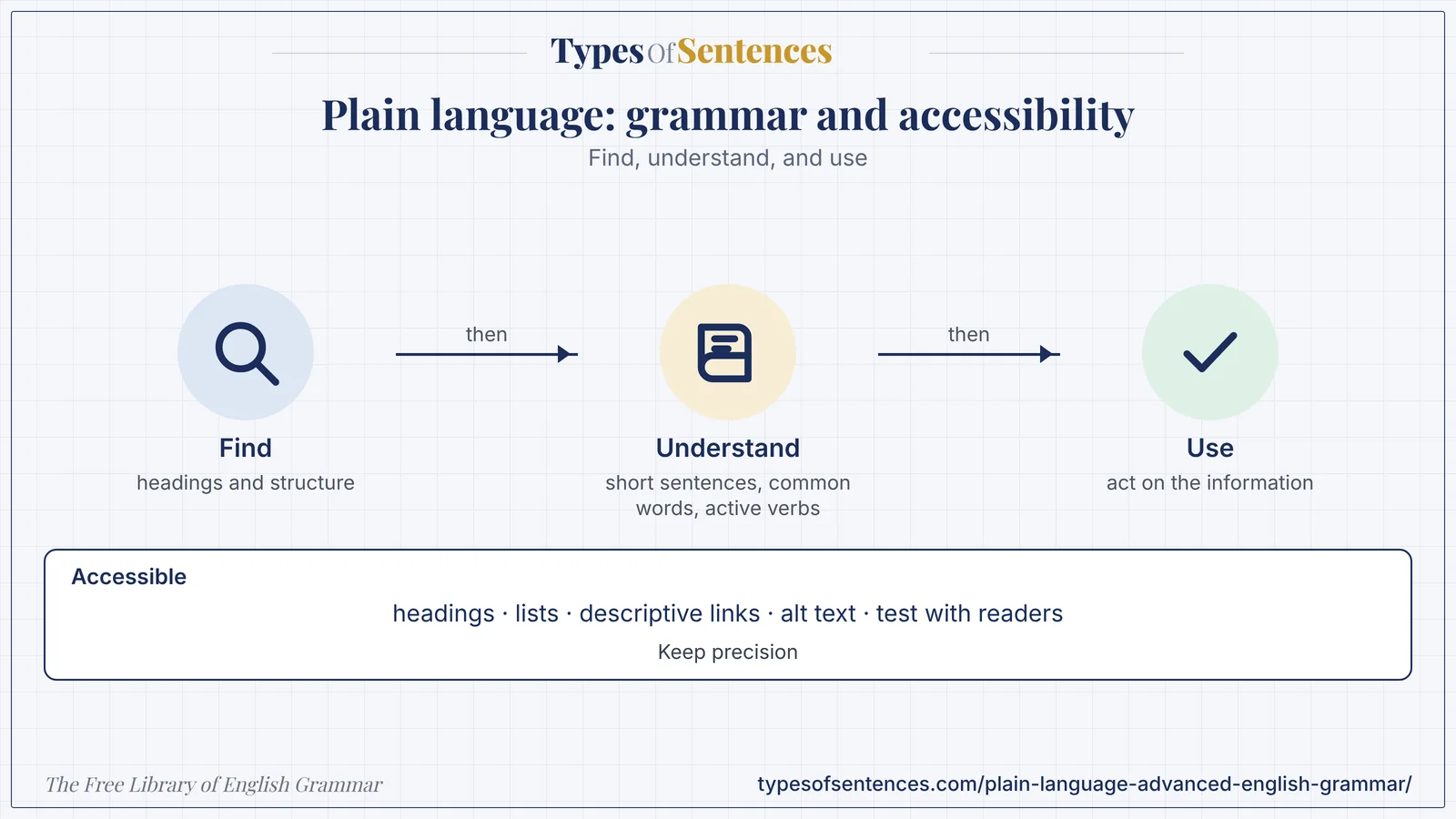
Write so that the person who needs your message can understand it the first time. Use short sentences, everyday words, and active verbs. Put the main point first. Explain or avoid specialist terms. Use headings and lists so that the reader can find things.
Why it matters: Accessible writing also means writing that works for people who use screen readers, who have dyslexia, who read English as an additional language, or who are reading under stress. What helps them usually helps everyone.
Summary: Plain language is writing that readers can find, understand, and use (ISO 24495-1, 2023). Techniques include short sentences (many guides recommend an average of about 15 to 20 words), common words (use for utilize), the active voice, personal pronouns (you), positive wording, logical order, headings, and lists. Consistent grammar and terminology reduce cognitive load. Jargon should be avoided or defined. Screen reader users need meaningful headings, descriptive link text, alt text for images, simple tables, expanded abbreviations, and a declared language. Non-native readers benefit from clear structure, consistent words, and the avoidance of idioms and long noun strings. Readers with dyslexia and other cognitive differences benefit from clear layout, short paragraphs, and plain wording. Texts should be tested with readers, and readability formulas used with care. Plain language is not simplistic: it keeps precision.
- Find, understand, use.
- Short sentences, common words, active verbs.
- Headings, lists, descriptive links, alt text.
- Test with readers; keep precision.
What You’ll Learn
- 1. Plain Language: What Is Accessible Writing?
- 2. Plain Language: Simple Sentences and Common Words
- 3. Active Voice for Clarity: Easier to Process
- 4. Consistent Grammar: Reducing Cognitive Load
- 5. Avoiding Jargon: Accessible to All
- 6. Screen Reader Considerations: Clear Structure and Meaningful Text
- 7. Non-Native Speakers: Accessible Grammar
- 8. Dyslexia, Cognitive Accessibility, and Easy Read
- 9. Testing and Process: How to Check That a Text Is Plain
- 10. Common Problems and a Worked Example
- 11. Exercises
- 12. Test Your Knowledge
- 13. Frequently Asked Questions
- 14. Conclusion
1. Plain Language: What Is Accessible Writing?
| Reader or situation | Typical need | What helps |
|---|---|---|
| readers with low vision or blindness (screen readers, magnifiers) | text that can be read aloud or enlarged in a logical order | headings, descriptive links, alt text, text that is not locked in images |
| readers who are deaf or hard of hearing | written equivalents of audio | captions, transcripts, plain wording (sign language may be the first language of some) |
| readers with dyslexia | text that is easy to decode and scan | short paragraphs, clear layout, plain words, left alignment |
| readers with attention, memory, or cognitive differences (including some neurodivergent readers) | low cognitive load | one idea per sentence, consistent terms, clear steps |
| readers with intellectual disability | very plain wording and visual support | Easy Read formats (short sentences, images) |
| readers with motor disabilities | navigation and form completion without a mouse | clear labels and instructions |
| readers who are non-native speakers of English | plain structure and common vocabulary | no idioms; consistent words; glossary |
| readers with low literacy or limited schooling | everyday words and short sentences | plain language; examples; spoken support |
| older readers | legible type and clear structure | larger text, plain words |
| readers under stress (illness, emergency, bereavement, debt) | information that is quick to take in | the main point first; short sentences |
| readers on mobile devices or with poor connections | short, scannable text | headings, short paragraphs |
| readers in a hurry | scannable text | headings, lists, bold lead-ins |
| readers using translation tools | text that translates well | plain structure (see the chapter on translation) |
| readers using voice assistants | text that sounds clear when spoken | short sentences; no symbols |
| Principle (WCAG: POUR) | Meaning | Writing implication |
|---|---|---|
| Perceivable | information can be perceived through at least one sense | text alternatives for images; captions; structure |
| Operable | users can navigate and use the content | descriptive headings and links; clear instructions |
| Understandable | content and operation are understandable | plain language; consistent wording; defined terms; the language declared |
| Robust | content works with different technologies | clean structure, real headings and lists |
| Standard or initiative | What it is (outline) | Note |
|---|---|---|
| Web Content Accessibility Guidelines (WCAG) | international guidelines by the World Wide Web Consortium; versions 2.1 (2018) and 2.2 (2023) are widely used | success criteria include text alternatives (1.1.1), language of the page (3.1.1), language of parts (3.1.2), link purpose (2.4.4), and, at the highest level, reading level (3.1.5), unusual words (3.1.3), and abbreviations (3.1.4) |
| ISO 24495-1:2023 | an international standard on plain language: governing principles and guidelines | readers should be able to find, understand, and use what they need |
| Plain Writing Act of 2010 (United States) | requires United States federal agencies to write clearly in documents for the public | the Federal Plain Language Guidelines |
| Plain English Campaign (UK, founded 1979) and the Crystal Mark | a campaign for plain English and a mark of approval for documents | — |
| Easy Read | a format for people with intellectual disabilities, using short sentences and images | guidelines by Inclusion Europe and others |
| W3C Cognitive and Learning Disabilities Accessibility guidance | guidance on writing for cognitive accessibility | — |
| national accessibility laws | laws such as the Rights of Persons with Disabilities Act, 2016 in India, and accessibility regulations elsewhere | check the law that applies |
| organizational style guides | internal plain language guides | — |
The World Health Organization has estimated that roughly one in six people worldwide lives with a significant disability; the exact figures vary by source and year. Accessibility is a matter of rights and law in many countries, and also of everyday courtesy: people read under many conditions. The practices below are also good clear writing, as discussed in the chapter on readability.
2. Plain Language: Simple Sentences and Common Words
| Guideline | Before | After |
|---|---|---|
| put the main point first | After reviewing the matter carefully and taking account of all the facts, we have decided that your application is approved. | We have approved your application. |
| use short sentences (average about 15 to 20 words) | The committee, which met on 4 March to consider the proposals that had been submitted during the preceding quarter, decided that no further action was required. | The committee met on 4 March. It reviewed last quarter’s proposals. No further action is needed. |
| one idea per sentence | You must submit the form, and if you are late you will pay a fee, but you may appeal. | You must submit the form by Friday. If you are late, you will pay a fee. You can appeal. |
| use common words | We will endeavor to commence the process. | We will try to start the process. |
| use you and we | Applicants are required to provide proof. | You must give us proof. |
| use the active voice | The form must be completed by the applicant. | Complete the form. |
| use positive wording | Do not submit after the deadline. | Submit before the deadline. |
| use verbs, not nouns | We will conduct an examination of the records. | We will examine the records. |
| avoid noun strings | student loan repayment option selection form | the form for choosing how to repay your student loan |
| avoid double negatives | You will not be ineligible unless … | You are eligible unless … |
| use lists for steps and conditions | To apply you need a photo, an ID, a form, and a fee. | To apply, you need a photo, an ID, a form, and the fee, each listed on its own line. |
| use headings in the reader’s words | Remittance Procedures | How to pay |
| use examples | — | For example, if you earn ₹5,00,000 a year, you pay … |
| define terms the first time | — | Your premium (the amount you pay each month) … |
| use consistent terms | — | always application, not application and request |
| put conditions before actions | — | If you are late, pay the fee. |
| avoid long sentences with many clauses | — | split |
| avoid unnecessary words | in the event that; with regard to | if; about |
| say what to do | — | Send the form to this address. |
| keep paragraphs short | — | two to four sentences |
| use numerals for numbers readers need | three hundred | 300 |
| write dates unambiguously | 03/04/2024 | 4 March 2024 |
| Complex word or phrase | Plainer | Complex word or phrase | Plainer |
|---|---|---|---|
| utilize | use | commence | start; begin |
| terminate | end | endeavor | try |
| assist | help | ascertain | find out |
| approximately | about | subsequent to | after |
| prior to | before | in the event that | if |
| with regard to | about | in order to | to |
| due to the fact that | because | at this point in time | now |
| a number of | several; some | the majority of | most |
| in excess of | more than | in close proximity to | near |
| provide | give | require | need |
| purchase | buy | additional | more; extra |
| sufficient | enough | indicate | show |
| demonstrate | show | facilitate | help; make easier |
| remainder | rest | inform | tell |
| obtain | get | request | ask |
| reside | live | attempt | try |
| necessitate | need | notwithstanding | despite |
| pursuant to | under | forthwith | at once |
| herewith | with this; enclosed | aforementioned | this; the |
| per annum | a year | regarding | about |
| reimburse | repay | remit | send; pay |
| modification | change | implement | carry out; start |
| numerous | many | optimal | best |
| assume | think; take on | accordingly | so |
| commencement | start | cessation | end |
| expedite | speed up | comprise | include |
| inquire | ask | methodology | method |
| nevertheless | but; still | consequently | so |
| elucidate | explain | peruse | read |
| ameliorate | improve | delineate | describe |
Plain language is not a matter of word lists alone: the structure of the text matters as much. A text that is organized by what the reader needs to know and do is plain even if it uses a technical word; a text of short words in a muddled order is not. The linguistic basis of the guidelines is the study of how readers process sentences, discussed in the chapter on conciseness and wordiness, and the readability formulas are treated in the chapter on readability.
3. Active Voice for Clarity: Easier to Process
| Passive or noun-heavy | Active and plain | Why |
|---|---|---|
| Your claim will be reviewed by our team. | We will review your claim. | the actor and the action come first |
| The form must be signed by both parties. | Both parties must sign the form. | — |
| A decision has been made to close the office. | We have decided to close the office. | the passive hides who decided |
| Payment is required upon receipt. | Pay when you receive the invoice. | a command with a clear subject |
| The application was rejected. | We rejected your application because … | a reason can be added |
| It is recommended that applicants apply early. | We recommend that you apply early. | — |
| Failure to comply may result in penalties. | If you do not comply, we may charge a penalty. | — |
| Reports must be submitted by the deadline. | Submit your report by the deadline. | — |
| The system will be restarted. | The system restarts. | — |
| Assistance will be provided to eligible applicants. | We will help eligible applicants. | — |
| Mistakes were made. | We made a mistake. | the passive can evade responsibility |
| The matter is under consideration. | We are considering the matter. | — |
| Your password was reset. | You reset your password. / We reset your password. | say who did it if the reader needs to know |
| Seats are reserved for senior citizens. | These seats are for senior citizens. | a place where the passive suits (see below) |
| The bridge was built in 1932. | — | the passive is natural when the actor is unknown or unimportant |
| The library will be closed on Monday. | The library is closed on Monday. | a simple state |
| The money was stolen. | — | the actor is unknown |
| It has been determined that … | We have determined that … | — |
| Appointments can be made online. | You can make an appointment online. | — |
| No refunds will be given after 30 days. | We do not give refunds after 30 days. | — |
| Passengers are advised to keep their tickets. | Keep your ticket. | an instruction in the imperative |
| Alcohol is prohibited. | Do not bring alcohol. | — |
| Fees are payable in advance. | Pay the fees in advance. | — |
| The rules were broken. | — | keep if the focus is on the rules |
| Complaints should be directed to the manager. | Send complaints to the manager. | — |
- Use the active voice by default. It names the actor, it is shorter, and readers process it more easily (see the chapter on syntax and sentence processing).
- Use the passive when the actor is unknown, unimportant, or when the focus is on the receiver (The bridge was built in 1932.).
- Do not use the passive to avoid responsibility. Readers need to know who is responsible for what.
- Use the imperative for instructions (Complete the form.).
- Check noun-heavy sentences (nominalizations) and turn them into verbs (We will examine …).
4. Consistent Grammar: Reducing Cognitive Load
| Consistency | Why it helps | Example |
|---|---|---|
| one term for one thing | the reader does not wonder whether two words mean different things | always application, never application and request and submission |
| one tense for one kind of statement | predictability | instructions in the imperative; descriptions in the present |
| parallel items in a list | the pattern is learned at once | Bring your ID. Bring your form. Bring the fee. |
| a standard pattern for similar information | readers know where to look | every step: verb + object + detail |
| the same order in similar sentences | — | who, what, when |
| consistent headings | — | questions or noun phrases throughout |
| consistent terms for system and user actions | select, click, press used the same way | — |
| consistent person | you throughout | not you in one place and the applicant in another |
| consistent warnings | a label and a pattern | Warning: … |
| consistent abbreviations | spell out at first use; use the same form | — |
| consistent labels in forms | the label matches the instruction | — |
| consistent language of the page | declare it | — |
Cognitive load is the mental effort that a text requires. Inconsistency adds to it: the reader has to work out whether a change of word or pattern signals a change of meaning. The research on reading and memory (for example on working memory, discussed in the chapter on syntax and sentence processing) supports the practice of consistency; the application to writing is simple: say the same thing the same way.
5. Avoiding Jargon: Accessible to All
| Jargon or legalese | Plain alternative | Note |
|---|---|---|
| The Party of the First Part | the company; the tenant | define who is meant |
| pursuant to | under | — |
| hereinafter | from now on; below | — |
| indemnify | protect against loss; repay | define if the legal term is needed |
| notwithstanding | despite | — |
| aforementioned | this; the | — |
| in lieu of | instead of | — |
| per diem | a day; daily | — |
| KPI | a measure of success (key performance indicator) | define on first use |
| SLA | the agreed service standard (service level agreement) | — |
| bandwidth (of a person) | time; capacity | — |
| leverage (verb) | use | — |
| synergy | working together | — |
| paradigm shift | a big change | — |
| stakeholder | a person or group affected | — |
| deliverable | what we will give you | — |
| onboarding | starting; getting set up | — |
| touch base | talk; contact | — |
| circle back | return to this | — |
| low-hanging fruit | easy wins | an idiom |
| move the needle | make a real difference | an idiom |
| going forward | from now on | — |
| at the end of the day | finally; in the end | — |
| ballpark figure | rough figure | — |
| actionable | something you can act on | — |
| robust | strong | — |
| holistic | whole | — |
| scalable | able to grow | — |
| solution (vague) | state what it is | — |
| optimize | improve | — |
| ideate | think of ideas | — |
| pain point | problem | — |
| value-add | benefit | — |
| bleeding edge | newest | — |
| mission-critical | essential | — |
| COB; EOD | close of business; end of day | define |
| ASAP | as soon as possible; by [date] | — |
| FYI | for your information | — |
| prima facie | at first sight | — |
| inter alia | among other things | — |
| mutatis mutandis | with the necessary changes | — |
| bona fide | genuine | — |
| force majeure | events outside our control | define |
| ultra vires | beyond legal power | — |
| sub judice | under court consideration | — |
| myocardial infarction | heart attack (explain both in a medical text) | — |
| hypertension | high blood pressure | — |
| contraindicated | should not be used | — |
| PRN (medical) | as needed | — |
| NPO | nothing by mouth | — |
| b.i.d. | twice a day | — |
| malware | harmful software | — |
| authenticate | prove who you are | — |
| latency | delay | — |
| cache | temporary storage | — |
- Know the reader’s vocabulary. A specialist term is fine for specialists.
- Define a necessary term at first use, in plain words, and use it consistently.
- Use a glossary for a long document.
- Replace buzzwords with specifics. Leverage synergies says nothing; work together does.
- Avoid idioms in texts for international readers.
- In legal and medical texts, keep the precise term, and add a plain explanation beside it.
- Test: would a reader outside the field understand the sentence?
6. Screen Reader Considerations: Clear Structure and Meaningful Text
A screen reader is software that reads on-screen text aloud, or outputs it as braille, for people who are blind or have low vision, and is also used by people with other reading difficulties. It reads in the order of the underlying structure of the page, so the structure of the text is as important as its wording. The advice below follows the general principles of WCAG; consult the current guidelines and test with the software your readers use.
| Element | Guidance | Example |
|---|---|---|
| headings | use real heading styles in order (one level 1, then levels 2 and 3); write headings that describe the section | How to apply rather than Section 3 |
| lists | use real list formatting (bullets or numbers), not typed symbols or dashes | — |
| link text | describe the destination; avoid click here, read more alone | Read the application guide. |
| repeated links | make each link text unique, or add context | — |
| alt text | a short description of the image’s meaning; empty alt for purely decorative images | Graph showing enrollment rising from 2020 to 2024. |
| images of text | avoid; use real text | — |
| tables | use simple tables with header cells; avoid merged cells; give a caption | — |
| abbreviations | spell out at first use; software may read an unfamiliar abbreviation as a word or letter by letter | World Health Organization (WHO) |
| acronyms and initialisms | — | NASA is read as a word; FBI letter by letter; unfamiliar ones are unpredictable |
| capital letters | avoid long stretches of capitals; some software reads capitalized words letter by letter | — |
| hashtags | use CamelCase so that each word is read | #GrammarMatters |
| emoji | screen readers read the names of emoji, so many in a row are tiresome; put them at the end and use few | — |
| symbols and special characters | avoid symbols as decoration (for example lines of asterisks); software may read each | — |
| numbers and dates | write clearly | 4 March 2024 |
| punctuation | punctuation affects pauses; use it normally | — |
| line breaks | do not break lines with manual returns inside a sentence | — |
| language declaration | mark the language of the page and of passages in other languages | — |
| foreign words | mark with the language tag if possible | — |
| sentence structure | short sentences with clear subjects; avoid long, nested clauses that are hard to hold in memory when heard | — |
| instructions | avoid relying on sensory cues (click the green button on the right) | Select Submit. |
| color | do not use color as the only means of conveying information | — |
| forms | labels attached to fields; clear error messages | — |
| error messages | say what is wrong and how to fix it | Enter a date in the format 4 March 2024. |
| pdf and documents | use tagged, structured documents; avoid scans of paper | — |
| video and audio | captions and transcripts | — |
| page title | a clear, unique title for each page | — |
| read order | the reading order matches the visual order | — |
| skip links | allow users to skip repeated blocks | — |
| text size | allow text to be resized | — |
| contrast | sufficient contrast (4.5:1 for body text under WCAG) | — |
| links that open new windows | tell users | — |
| read-aloud testing | listen to your text read aloud by software | — |
| write for listening | sentences that sound clear when heard | — |
| avoid decorative Unicode text | fancy fonts made from symbols may be unreadable | — |
| provide text equivalents for charts | a short summary or a data table | — |
| write meaningful button labels | Save changes; Send message | — |
The practice of writing for screen readers overlaps with the practice of writing for the web (see the chapter on writing for digital media) and with the structure of good technical writing (see the chapter on technical writing): clear headings, meaningful links, and consistent structure benefit all readers, and not only those who use assistive technology.
7. Non-Native Speakers: Accessible Grammar
| Feature that causes difficulty | Example | Accessible alternative |
|---|---|---|
| idioms | We’ll touch base next week. | We’ll talk next week. |
| phrasal verbs with several meanings | put off; put up with; come across | postpone; tolerate; find |
| long noun strings | customer service request tracking system | the system that tracks customer requests |
| multiple negatives | It is not uncommon not to receive … | Often you will not receive … |
| long sentences with embedded clauses | The report, which the committee that the council appointed wrote, … | The council appointed a committee. The committee wrote the report. |
| ambiguous pronouns | It affects it. | The change affects the budget. |
| unusual abbreviations | — | spell out |
| cultural references | a sports metaphor | a literal statement |
| slang | — | plain words |
| irony and sarcasm | — | a literal statement |
| inconsistent terms | form, document, paper for one thing | one term |
| conditional structures with inversion | Had you applied earlier, you would … | If you had applied earlier, you would … |
| fronted adverbials and inversion | Rarely does it happen. | It rarely happens. |
| passive and impersonal constructions | It is believed that … | We believe that … |
| contractions that are hard to parse | shouldn’t’ve | should not have |
| articles | — | keep correct; readers rely on them |
| tense variety | — | use the simple tenses where possible |
| homonyms | bank, light | choose clear contexts |
| complex tenses | will have been done | simple present or future |
| time expressions | next Thursday (ambiguous) | Thursday, 7 March |
| dates in numbers | 03/04/2024 | 4 March 2024 |
| units | — | state the unit and, if needed, the equivalent |
| currency | — | state the currency |
| titles and forms of address | — | explain unfamiliar forms |
| numbers | lakh and crore (for international readers) | also give million |
| local terms | — | define |
| references to local institutions | — | explain |
| long lists in a sentence | — | use a bulleted list |
| dense paragraphs | — | short paragraphs |
| unclear structure | — | use headings and signposts |
| machine translation | plain structure translates better | see the chapter on translation |
| bilingual glossary | — | provide when useful |
| dictionary-friendly wording | use base forms where possible | — |
Writing for non-native speakers is the same as writing for global audiences (see the chapters on global Englishes and on translation). A text that is accessible to people who read English as an additional language is usually also clear to native readers: plain sentence structure, consistent terms, and explanations of local or specialist terms.
8. Dyslexia, Cognitive Accessibility, and Easy Read
| Practice | Why | Note |
|---|---|---|
| short paragraphs and clear headings | scanning and orientation | widely recommended |
| left-aligned text | even spacing between words | avoid full justification |
| sans serif fonts at a comfortable size (such as 12 to 14 points in print, with generous line spacing) | legibility for many readers with dyslexia | recommended in guidance such as that of the British Dyslexia Association; the research evidence for particular fonts is mixed |
| avoid italics, long underlining, and long stretches of capitals | — | use bold sparingly for emphasis |
| clear contrast without glare | — | off-white backgrounds are often preferred, but needs differ |
| plain words and short sentences | decoding load | — |
| numbered steps | sequence | — |
| avoid time pressure | — | allow enough time in forms and tests |
| Easy Read: very short sentences, one idea each, with pictures | for people with an intellectual disability | guidelines exist; test with the people for whom it is written |
| plain wording in medical consent and legal forms | informed consent requires understanding | — |
9. Testing and Process: How to Check That a Text Is Plain
- Identify the readers and what they need to do with the text.
- Put the main point and the action first.
- Write in short sentences and common words, using the active voice.
- Use headings, lists, and descriptive links.
- Define or replace jargon.
- Check consistency of terms, tenses, and patterns.
- Read aloud (or use a screen reader) and mark where you stumble.
- Check readability scores as a guide, not as a goal (see the chapter on readability).
- Test with real readers: ask them to find an answer and to say what they would do; observe where they hesitate.
- Revise and test again.
| Test | What it shows |
|---|---|
| read aloud | awkward sentences and missing words |
| screen reader test | structure, links, alt text, reading order |
| readability formula (see the chapter on readability) | a rough measure of sentence length and word length; it does not measure clarity or accessibility on its own |
| user testing (task-based) | whether readers can find, understand, and use the text |
| comprehension questions | what readers took from the text |
| cloze test | how predictable the text is for readers |
| peer review by someone outside the field | jargon and gaps |
| accessibility checkers (software) | some technical problems; not all |
| feedback from readers after publication | real use |
| measures of outcomes (fewer calls, fewer errors, more completed forms) | whether the text works |
| Misconception | Reality |
|---|---|
| Plain language means dumbing down. | It means respecting the reader’s time and needs; it keeps precision. |
| Plain language is for children. | It is for all readers, including experts who are in a hurry. |
| Short words mean plain language. | Structure, order, and clarity matter more than word length alone. |
| A good readability score means a plain text. | Scores measure surface features; test with readers. |
| Legal and technical accuracy cannot be plain. | Precision and plain wording can coexist; many legal documents have been redrafted in plain language. |
| Accessible writing is only for people with disabilities. | It helps everyone. |
| Plain language makes writing boring. | It can be lively; it is clear first. |
| We have always written this way, so readers understand. | Test it. |
| Plain language is a one-time job. | Revise as readers and needs change. |
| Accessibility is the designer’s job alone. | Writers affect it through structure, links, and alt text. |
The relation of plain language to inclusion is also treated in the chapter on gender-inclusive language, and the evidence on grammar myths that sometimes block clear writing (for example, that the passive is always wrong) is in the chapter on advanced grammar myths.
10. Common Problems and a Worked Example
| Problem | Example | Better |
|---|---|---|
| long sentence with embedded clauses | Applicants who have submitted forms that were incomplete, unless they are notified, are deemed to have been refused. | If your form is incomplete, we will tell you. If we do not tell you, your application is refused. |
| passive without an actor | Mistakes were made in processing. | We made mistakes when we processed your form. |
| buzzwords | We leverage synergies. | We work together. |
| vague link text | Click here | Read the application guide |
| image without alt text | a chart with no alt | Chart: enrollment rose from 2020 to 2024. |
| abbreviations without definition | Submit the SLA RCA. | Submit the report on the cause of the problem. |
| idioms | Let’s touch base. | Let’s talk. |
| inconsistent terms | application / request / submission | application |
| unclear instruction | Please revert at the earliest. | Please reply by Friday. |
| all capitals | THE OFFICE IS CLOSED. | The office is closed. |
| dense paragraph | a 200-word block | headings, lists, short paragraphs |
| a heading that does not describe | Section 3 | How to apply |
| no main point first | a long preamble | the main point first |
| relying on color | Press the red button. | Press Stop (the red button). |
| placeholder-only labels in forms | — | a visible label |
| a long noun string | user account password reset request page | the page for requesting a new password |
| double negatives | You will not be ineligible … | You are eligible … |
| a list that is not parallel | — | parallel items |
| dates in numbers | 03/04/2024 | 4 March 2024 |
| unexplained legal term | The tenant shall indemnify the landlord. | The tenant will repay the landlord for any loss it causes (an indemnity). |
| fine print away from the claim | — | state the condition beside the claim |
| reading level far above the audience | — | rewrite and test |
| no summary | — | a short summary at the top |
| no contact for help | — | give a phone number and an address |
Rewrite this notice (invented) for the public: Notwithstanding the provisions of the aforementioned bye-law, residents who have failed to remit the stipulated levy prior to the expiry of the notified period shall be liable to penal interest, which shall be computed per annum on the outstanding amount, unless an exemption has been granted by the competent authority upon an application duly made.
- Identify the reader and the need: a resident who must know whether to pay, by when, what happens if late, and what to do.
- Main point first: Pay the water charge by 31 March. (the date and charge are invented placeholders).
- Say the consequence in plain words: If you pay late, you will pay interest on the amount you owe.
- Replace jargon: remit the stipulated levy → pay the charge; penal interest, computed per annum → interest each year (give the rate); competent authority → the municipal office.
- Say how to ask for an exemption: If you think you should not pay, apply to the municipal office before the deadline.
- Use headings and a list:
- Result: Pay your water charge by 31 March. If you pay late, you will pay interest on the amount you owe (the rate is __% a year). If you think you should not pay, apply to the municipal office before 31 March. Questions? Call __ or visit the office. (the notice is invented; the date, rate, and contacts are placeholders to be filled in from the real rules)
- Check: the sentences are short, the verbs are active, the terms are consistent, and the legal substance (the duty, the penalty, the exemption) is preserved; for a legal notice, a lawyer should confirm that the plain version states the rule accurately.
Recap in 12 seconds
Watch the lesson build itself: Plain language lets readers find, understand, and use what they read (ISO 24495-1, 2023). The video has no sound.
Exercises
Part A: What Is Accessible Writing? (Exercises 1–6)
Exercise 1: Define plain language.
Show Answer
Answer: Writing that readers can find, understand, and use.
Exercise 2: Name two groups who benefit from plain language.
Show Answer
Answer: Non-native readers, readers with dyslexia, readers under stress, screen reader users, everyone.
Exercise 3: What does POUR stand for?
Show Answer
Answer: Perceivable, Operable, Understandable, Robust.
Exercise 4: Name a plain language law or standard.
Show Answer
Answer: The Plain Writing Act of 2010 (US); ISO 24495-1.
Exercise 5: Is plain language dumbing down?
Show Answer
Answer: No.
Exercise 6: What is Easy Read?
Show Answer
Answer: A format with very short sentences and images for people with intellectual disabilities.
Part B: Plain Language Techniques (Exercises 7–14)
Exercise 7: Plain for utilize.
Show Answer
Answer: use.
Exercise 8: Plain for commence.
Show Answer
Answer: start.
Exercise 9: Plain for in the event that.
Show Answer
Answer: if.
Exercise 10: Plain for in order to.
Show Answer
Answer: to.
Exercise 11: Rewrite: The form must be completed by the applicant.
Show Answer
Answer: Complete the form.
Exercise 12: Rewrite: We will conduct an examination of the records.
Show Answer
Answer: We will examine the records.
Exercise 13: Rewrite: Do not submit after the deadline.
Show Answer
Answer: Submit before the deadline.
Exercise 14: What average sentence length do many plain language guides recommend?
Show Answer
Answer: About 15 to 20 words.
Part C: Active Voice, Consistency, and Jargon (Exercises 15–21)
Exercise 15: When is the passive appropriate?
Show Answer
Answer: When the actor is unknown or unimportant, or the focus is on the receiver.
Exercise 16: Rewrite: Mistakes were made.
Show Answer
Answer: We made a mistake.
Exercise 17: Why use one term for one thing?
Show Answer
Answer: It lowers cognitive load.
Exercise 18: Replace: stakeholder.
Show Answer
Answer: a person or group affected.
Exercise 19: Replace: going forward.
Show Answer
Answer: from now on.
Exercise 20: Replace: pursuant to.
Show Answer
Answer: under.
Exercise 21: What should you do with a necessary technical term?
Show Answer
Answer: Define it at first use and use it consistently.
Part D: Screen Readers and Non-Native Readers (Exercises 22–27)
Exercise 22: Why use real heading styles?
Show Answer
Answer: Screen readers use them to navigate and to read the structure.
Exercise 23: Improve the link text: click here.
Show Answer
Answer: Read the application guide.
Exercise 24: What does alt text do?
Show Answer
Answer: Describes an image for people who cannot see it.
Exercise 25: Why avoid idioms for international readers?
Show Answer
Answer: They may not know them; they do not translate.
Exercise 26: Rewrite: 03/04/2024.
Show Answer
Answer: 4 March 2024.
Exercise 27: Rewrite: #grammarmatters for accessibility.
Show Answer
Answer: #GrammarMatters.
Part E: Testing (Exercises 28–30)
Exercise 28: Name a way to test a text.
Show Answer
Answer: Read aloud; screen reader test; user testing; readability scores as a guide.
Exercise 29: Do readability scores prove a text is plain?
Show Answer
Answer: No; they measure surface features.
Exercise 30: Why test with real readers?
Show Answer
Answer: To see whether they can find, understand, and use the text.
Test Your Knowledge
Ready to check what you learned? Answer all 10 questions, then submit. You need 80% (8 of 10) to pass. Your answers are not stored.
View correct answers and explanations
Question 1: What is plain language?
✓ Correct Answer: A – writing that readers can find, understand, and use
Find, understand, use.
Question 2: Which is plainer?
✓ Correct Answer: B – use
Use.
Question 3: Why use descriptive link text?
✓ Correct Answer: C – screen reader users often hear a list of links out of context
Links are heard out of context.
Question 4: What does alt text provide?
✓ Correct Answer: D – a text description of an image for people who cannot see it
A description.
Question 5: Which sentence is in the active voice?
✓ Correct Answer: C – Submit the form.
The imperative is active.
Question 6: Which is a common average sentence length target in plain language guides?
✓ Correct Answer: A – about 15 to 20 words
About 15 to 20 words.
Question 7: What does POUR stand for?
✓ Correct Answer: D – Perceivable, Operable, Understandable, Robust
WCAG principles.
Question 8: Which helps non-native readers most?
✓ Correct Answer: C – clear structure and consistent words
Clear structure and consistency.
Question 9: Is plain language “dumbing down”?
✓ Correct Answer: B – no; it respects the reader’s time and needs and keeps precision
No.
Question 10: Which is a good way to test plain language?
✓ Correct Answer: B – user testing and reading aloud
Test with readers.
Frequently Asked Questions
What is plain language?
Plain language is writing that readers can find what they need in, understand, and use, with short sentences, common words, the active voice, and clear structure. Plain language is a standard of clear writing, not a lowering of standards.
What is grammar and accessibility?
Grammar and accessibility is the study of how grammatical choices (sentence length, voice, word choice, structure) affect whether people with different abilities and backgrounds can read a text. Grammar and accessibility meet in plain language.
How do I go about writing for accessibility?
Use clear structure with real headings, short sentences, common words, descriptive links, alt text for images, and defined terms, and test with readers. Writing for accessibility helps all readers.
What are inclusive writing practices?
Inclusive writing practices are habits that make texts usable and respectful for all readers: plain language, accessible structure, bias-free wording, and consideration of different abilities and backgrounds. Inclusive writing practices include the guidance in the chapter on gender-inclusive language.
What is clear communication?
Clear communication is communication in which the reader understands the message and can act on it. Clear communication needs the right words, structure, and tone for the reader.
Does plain language lose precision?
No. Good plain language keeps the necessary precision and defines technical terms; in legal and medical texts, a plain explanation can be added beside the precise term.
How do screen readers affect writing?
They read in the order of the structure, so real headings, lists, descriptive links, alt text, and expanded abbreviations matter as much as the wording.
Conclusion
You now have a guide to plain language and accessibility: who accessible writing serves, plain language techniques, active voice, consistent grammar, avoiding jargon, screen reader considerations, writing for non-native readers and cognitive accessibility, and testing. You can write and revise texts so that more people can use them.
When you write, ask who might struggle with the text, and what change would help them. Next, you will study grammar and translation.
- International Organization for Standardization. ISO 24495-1:2023, Plain language — Part 1: Governing principles and guidelines.: the international standard on plain language.
- World Wide Web Consortium. Web Content Accessibility Guidelines (WCAG) 2.1. 2018; WCAG 2.2, 2023.: accessibility guidelines for web content.
- Federal Plain Language Guidelines. plainlanguage.gov. (online): United States federal guidance on clear writing.
- Cutts, Martin. Oxford Guide to Plain English. 5th ed. Oxford University Press, 2020.: guidance on plain English.
- Merriam-Webster Dictionary: accessible: the dictionary entry.
Last reviewed: October 29, 2026. How it was made: drafted with AI assistance, then checked with automated tests (structure, links, answer keys, spelling) and against the sources above. A person has not yet read this chapter line by line. Found a mistake? Report it.