Rhetoric and grammar have been partners since antiquity. Rhetoric is the art of effective and persuasive language; grammar supplies the structures in which it works. Every rhetorical device is a grammatical pattern: anaphora is repetition at the start of clauses, asyndeton is the omission of conjunctions, antithesis is parallel structure with opposed content, a rhetorical question is an interrogative used to make a statement. To know the grammar behind a device is to be able to build it, to vary it, and to recognize it when someone uses it on you.
This chapter treats rhetorical grammar, sometimes called persuasive grammar or grammatical rhetoric, as a toolkit. You will study the classical distinction between schemes (patterns of form) and tropes (turns of meaning), then more than sixty rhetoric devices, each with its grammatical mechanism and an example; the use of sentence structure for effect (short for impact, long for detail); repetition for emphasis; questions for engagement; balance and rhythm; famous examples from speeches and literature (public-domain texts); the ethics of persuasive devices; and a method for using them. The chapter builds on the argument strategies of the earlier chapter on rhetorical strategies, and concentrates on the grammar. Thirty editing exercises and a quiz follow.
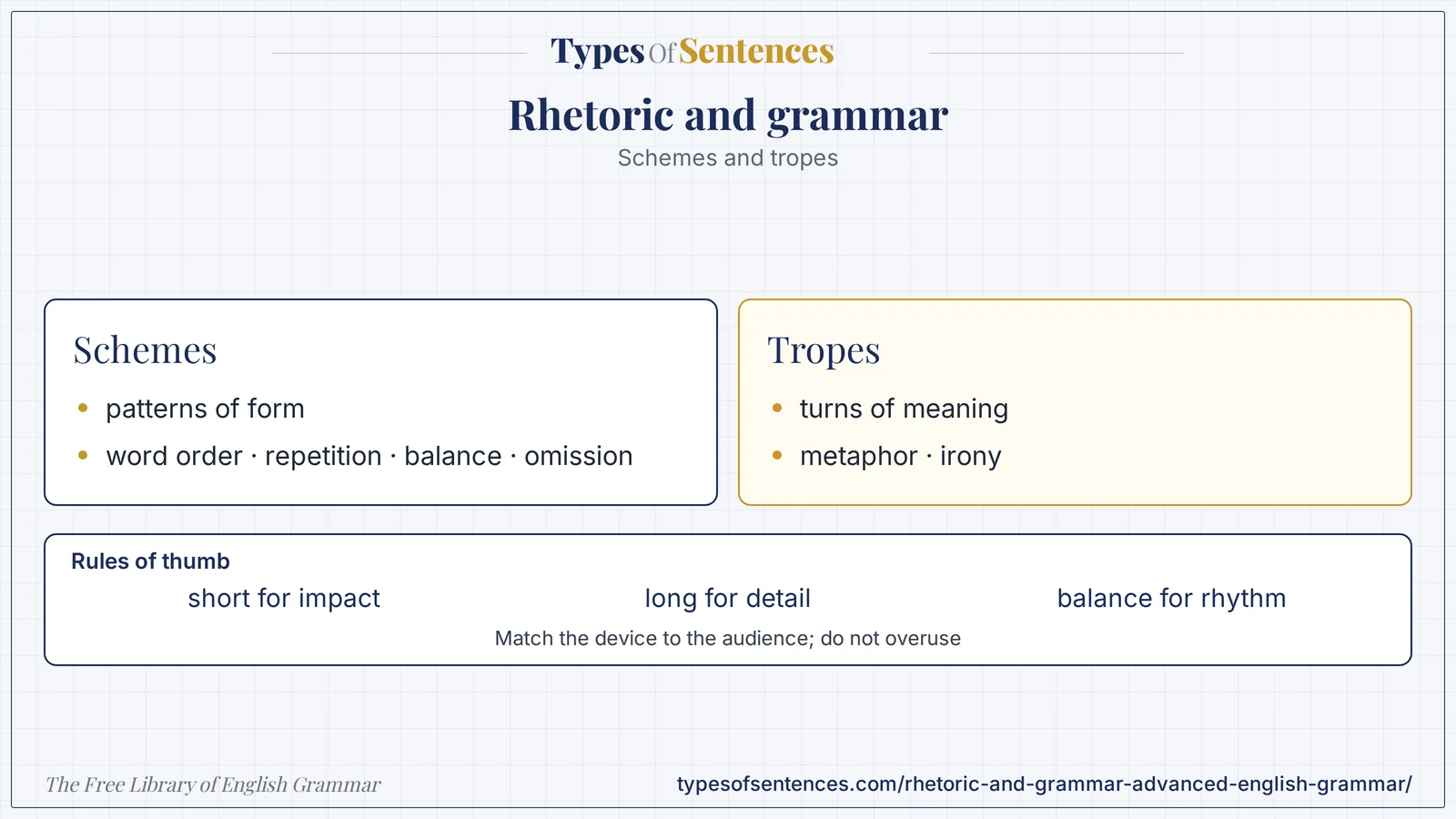
A rhetorical device is a way of arranging words so that they have more effect: a pattern that the ear notices and the memory keeps. Almost every device is made from ordinary grammar used in a deliberate way: a repeated opening, a missing conjunction, a balanced pair.
Why it matters: Knowing the devices lets you do three things: write with more force, read other people’s persuasion more critically, and avoid the clumsy use of devices that do not fit the occasion.
Summary: Classical rhetoric distinguishes schemes (patterns of word order, repetition, balance, and omission) from tropes (figures that change the meaning of words, such as metaphor and irony). Rhetorical grammar studies the grammatical form of the schemes: parallelism, antithesis, chiasmus, and tricolon (balance); anaphora, epistrophe, and polyptoton (repetition); asyndeton and ellipsis (omission); inversion, parenthesis, and the periodic sentence (order); and the rhetorical question. Short sentences give impact; long sentences give detail; repetition gives emphasis and memorability; balanced structures give rhythm and an air of reason. Devices should fit the audience, the occasion, and the ethics of honest persuasion, and they fail when overused or mismatched. Writers use them best by choosing a purpose, selecting a device, drafting, and testing the effect.
- Schemes = patterns of form; tropes = turns of meaning.
- Devices are grammar used on purpose.
- Short for impact, long for detail, balance for rhythm.
- Match the device to the audience; do not overuse.
What You’ll Learn
- 1. Rhetoric and Grammar: What Is Rhetorical Grammar?
- 2. Rhetoric Devices: More Than Sixty Schemes and Tropes
- 3. Sentence Structure for Effect: Short for Impact, Long for Detail
- 4. Repetition for Emphasis: Intentional Repetition
- 5. Questions for Engagement: Rhetorical Questions
- 6. Balance and Rhythm: Creating Flow
- 7. Famous Examples: Speeches and Literature
- 8. Ethics and the Misuse of Rhetorical Devices
- 9. Using Rhetorical Grammar in Your Writing
- 10. Common Errors and a Worked Example
- 11. Exercises
- 12. Test Your Knowledge
- 13. Frequently Asked Questions
- 14. Conclusion
1. Rhetoric and Grammar: What Is Rhetorical Grammar?
| Term | Meaning | Source or comment |
|---|---|---|
| rhetoric | the art of effective and persuasive speaking and writing | Aristotle, Rhetoric |
| rhetorical grammar | grammar studied and taught as a set of choices that create effects for readers | Martha Kolln, Rhetorical Grammar (1991) |
| the five canons of rhetoric | invention, arrangement, style, memory, delivery | Cicero and Quintilian |
| style (elocutio) | the choice of words and structures, including figures of speech | the canon in which grammar and rhetoric meet |
| scheme | a figure that changes the ordinary pattern or arrangement of words | anaphora, antithesis |
| trope | a figure that changes the ordinary meaning of words | metaphor, irony |
| figure of speech | a general term for schemes and tropes | — |
| kairos | the right moment for a message | — |
| decorum (appropriateness) | fitting style to subject, audience, and occasion | classical principle |
| Grammatical choice | Rhetorical effect | Example |
|---|---|---|
| short declarative sentence | impact, finality, emphasis | The plan failed. |
| long sentence with parallel clauses | build-up, thoroughness, momentum | We have listened, we have studied, and we have decided. |
| fragment | emphasis; a spoken tone | Not this time. |
| imperative | command, direct address, urgency | Stand up. Speak out. |
| rhetorical question | engagement; an assertion in disguise | Who could object? |
| inversion | formality, emphasis, drama | Never have I seen such courage. |
| passive voice | distance, authority, hiding or focusing the agent | It has been decided. |
| active voice | directness, responsibility | We decided. |
| first person plural we | solidarity, shared purpose | We must act. |
| second person you | direct address; involvement | You can help. |
| modal must, shall | obligation, resolve | We must act. |
| negation and contrast (not … but) | correction, emphasis | Not by chance, but by choice. |
| superlatives and absolutes | magnitude, confidence | the greatest challenge |
| conditional | reasoning, hypothetical persuasion | If we fail now, we fail forever. |
| present tense | immediacy | Today we begin. |
| future tense | promise, prophecy | We will build. |
| nominalization | abstraction, authority, impersonality | The pursuit of justice |
| verbs of action | energy, vividness | We rise, we march, we vote. |
| list of three | completeness and rhythm | safe, strong, and secure |
| coordination with and (polysyndeton) | accumulation, solemnity | and … and … and |
| omission of and (asyndeton) | speed, urgency | We came, we saw, we left. |
| subordination (concession) | fairness, reasoning | Although the road is long, we will finish. |
| apposition | definition, emphasis | Priya, our best teacher, … |
| direct speech | vividness, authority | “Enough,” she said. |
| hedges and boosters | caution or confidence | perhaps, undoubtedly |
| parenthetical aside | intimacy, irony | (and who could blame us?) |
The relationship between grammar and persuasion is the subject of the earlier chapter on rhetorical strategies, which treats claims, evidence, appeals, and fallacies. This chapter goes into the grammar of the figures. The foundations are in the classical rhetoric of Aristotle, Cicero, and Quintilian, and in the modern treatments of Edward Corbett and Robert Connors, which many of the terms below follow.
2. Rhetoric Devices: More Than Sixty Schemes and Tropes
The tables group the devices by their main mechanism. Examples are original unless a source is named; the public-domain lines are short.
| Scheme of balance | Definition | Grammatical mechanism | Example |
|---|---|---|---|
| parallelism | equal ideas in equal form | matching words, phrases, or clauses | She likes swimming, hiking, and cycling. |
| isocolon | parts of equal length | equal numbers of words or syllables | Easy to learn, easy to use. |
| antithesis | opposed ideas in parallel form | contrasting words in matching structures | To err is human; to forgive, divine. (Alexander Pope) |
| chiasmus | parallel structure in reverse order (AB–BA) | inverted repetition | Do not live to eat; eat to live. |
| tricolon | three parallel parts | a list of three | safer, stronger, and smarter |
| climax (gradatio) | parts in rising order of importance | parallel items of increasing force | a mistake, a failure, a disaster |
| anticlimax (bathos) | parts in falling order, often for humor | items that drop in importance | He lost his job, his house, and his umbrella. |
| balanced sentence | two clauses of matching shape | coordination | When we win, we celebrate; when we lose, we learn. |
| correlative balance | paired conjunctions | not only … but also; the more … the more | The more we read, the more we know. |
| periodic sentence | the main clause delayed to the end | subordinate material first | Despite the cost, despite the delay, she decided to proceed. |
| Scheme of repetition | Definition | Grammatical mechanism | Example |
|---|---|---|---|
| anaphora | repetition at the start of successive clauses | repeated opening words | We will plan. We will build. We will finish. |
| epistrophe (epiphora) | repetition at the end of successive clauses | repeated closing words | of the people, by the people, for the people (Abraham Lincoln, 1863) |
| symploce | anaphora and epistrophe combined | repeated opening and closing | When there is talk, we listen; when there is work, we listen. (invented) |
| anadiplosis | the last word of a clause begins the next | chain repetition | Fear leads to anger; anger leads to hate. |
| epanalepsis | a word begins and ends a clause | enclosing repetition | Nothing is more certain than uncertainty? Nothing. (invented) |
| polyptoton | repetition of a word in different forms | related inflections | We were slow to learn, and so slow to teach. (a pattern) |
| ploce | repetition of a word with a changed sense | same word, new meaning | A friend is a friend only when a friend is needed. |
| epizeuxis | immediate repetition of a word | adjacent repetition | Never, never, never |
| diacope | repetition separated by a word or two | interrupted repetition | Rain, rain, and more rain. |
| alliteration | repeated initial consonant sounds | sound pattern | safe and sound |
| assonance | repeated vowel sounds | sound pattern | mad as a hatter |
| consonance | repeated consonant sounds within or at the end | sound pattern | pitter-patter |
| polysyndeton | many conjunctions | repeated and | and the rain fell and the rivers rose and the roads vanished |
| refrain | a repeated line or phrase | recurring sentence | a slogan repeated at intervals |
| repetend and catchphrase | a memorable repeated unit | — | Yes, we can.-type slogans |
| Scheme of omission | Definition | Grammatical mechanism | Example |
|---|---|---|---|
| asyndeton | omission of conjunctions | commas replace and | I came, I saw, I conquered. (Caesar, in translation) |
| ellipsis | omission of words that can be supplied | gapping, pro-forms | Some like tea; others, coffee. |
| zeugma | one word governs two or more others in different senses | one verb with two objects | She lost her keys and her temper. |
| syllepsis | a zeugma with a clash in sense or grammar | — | He opened the door and his heart. |
| brachylogia | a series with no conjunctions and short elements | — | Eyes front. Heads up. Move. |
| aposiopesis | breaking off in the middle of a sentence | a dash or ellipsis | If you do that, I will— |
| paraprosdokian | an unexpected ending that forces a reinterpretation | a twist in the last clause | The plan was perfect until it met reality. |
| Scheme of word order and interruption | Definition | Grammatical mechanism | Example |
|---|---|---|---|
| anastrophe (inversion) | unusual word order | object or adverbial fronted | Strong is the temptation. |
| hyperbaton | displacement of words from natural order | a separated pair | Great was the fall of that house. |
| parenthesis | an interruption set off by punctuation | commas, dashes, parentheses | The plan—costly, slow, unpopular—failed. |
| apposition | a noun phrase renaming another | adjacent noun phrases | Priya, our captain, spoke. |
| anacoluthon | a break in grammatical sequence | an unfinished construction | The man who—well, never mind. |
| periodic sentence | the main clause is delayed | subordination first | see above |
| cumulative (loose) sentence | the main clause first, modifiers after | free modifiers | She walked in, tired and wet. |
| hypotaxis | subordination of clauses | dependent clauses | Because it rained, we stayed. |
| parataxis | coordination without subordination | clauses side by side | It rained. We stayed. |
| end-focus and climax | the strongest idea last | sentence ending | — |
| topicalization | an element fronted as the topic | fronting | This I believe. |
| cleft | focus by a pseudo-cleft or cleft | It is … that | It was courage that saved us. |
| Rhetorical questions and address | Definition | Grammatical mechanism | Example |
|---|---|---|---|
| rhetorical question (erotema) | a question asked for effect; no answer is expected | an interrogative functioning as a statement | Who could be against fairness? |
| hypophora | a question the speaker answers | question and answer | What did we learn? We learned to wait. |
| apostrophe | address to an absent person or thing | a vocative | O liberty, what crimes are committed in thy name. (paraphrase of a well-known line) |
| epiplexis | a reproachful question | — | Have you no shame? |
| anacoenosis | a question to the audience about common interest | — | Is it not in our interest to cooperate? |
| imperative address | a command to the audience | imperative | Look at the evidence. |
| direct address | you and the vocative | second person | Friends, Romans, countrymen, lend me your ears. (Shakespeare) |
| Trope (change of meaning) | Definition | Example |
|---|---|---|
| metaphor | an implied comparison | Time is a river. |
| simile | an explicit comparison with like or as | as quiet as snow |
| metonymy | a thing named by something associated with it | the crown for the monarchy |
| synecdoche | a part for the whole, or the whole for a part | hands for workers |
| irony | saying the opposite of what is meant | What lovely weather (in a storm) |
| hyperbole | exaggeration | a million reasons |
| litotes | understatement by denying the opposite | not bad for very good |
| meiosis | understatement | a slight delay for a long one |
| oxymoron | a contradiction in two words | deafening silence |
| paradox | a statement that seems contradictory but holds truth | Less is more. |
| personification | human qualities given to a thing | The wind complained. |
| euphemism | a soft term for a harsh one | passed away |
| dysphemism | a harsh term for a neutral one | — |
| periphrasis (circumlocution) | a roundabout phrase | the late lamented |
| pun (paronomasia) | play on a word with two meanings or similar sounds | I used to be a baker; I needed the dough. |
| allusion | an indirect reference to a text or event | — |
| antonomasia | a title or epithet for a name | the Iron Lady; a Scrooge |
| onomatopoeia | a word imitating a sound | buzz, thud |
| catachresis | a strained or mixed use of a word | — |
| rhetorical hedging | softening a claim for credibility | it would seem |
| understatement | minimizing for effect | — |
| analogy | an extended comparison | — |
| symbol and motif | recurring images | — |
| proverb and maxim | a short, memorable saying | A stitch in time saves nine. |
| definition (as a device) | defining a term to shape its meaning | Freedom is … |
These tables list more than sixty devices. Many occur together: the line from Lincoln’s address is both an epistrophe and a tricolon, and a periodic sentence may also be balanced. The names matter less than the mechanisms: if you can see that anaphora is a repeated opening, you can write it without knowing the word. The use of tropes in creative writing is discussed in the chapter on creative writing techniques.
3. Sentence Structure for Effect: Short for Impact, Long for Detail
| Structure | Effect | Example (original) |
|---|---|---|
| very short sentence | impact; a verdict; a pause | It failed. |
| short sentence after long ones | emphasis; a punchline | The committee debated for weeks, weighed every option, and consulted every expert. Nothing changed. |
| long cumulative sentence | richness, detail, flow | She walked through the market, past the spice stalls, the fruit sellers, the tea shops with their steaming kettles, and out into the quiet of the river road. |
| long periodic sentence | suspense and climax | After the years of argument, after the failed votes, and after the doubts of every colleague, they agreed. |
| series of short sentences | speed, urgency | We came. We saw. We left. |
| fragment | a thought, an emphasis | Silence. |
| sentence starting with a conjunction | a conversational voice | But we persisted. |
| question at the end | invitation to reflect | What would you do? |
| sentence ending on a strong word | end-weight and punch | It was not a defeat; it was a lesson. |
| inversion at the start | drama | Gone are the days. |
| sentence-initial negative adverb | formality, emphasis | Never before had we seen it. |
| subordinate clause first (concession) | fairness; building to the main point | Although we respect the objection, we cannot accept it. |
| subordinate clause last (reason) | explanation after the claim | We cannot accept it, because the evidence is against it. |
| mixed lengths in a paragraph | rhythm | see the chapter on sentence variety |
| long sentence broken at the end by a short one | release | — |
| Position in the sentence | What it does |
|---|---|
| beginning | sets the theme; known information; contrast with the previous |
| middle | carries the development |
| end | carries the new information and the stress: put the strongest idea here (the principle of end focus) |
Sentence length and shape are rhetorical choices, and the balance of short and long is treated in the chapters on complex sentence architecture and on sentence variety. The general principle is that a sentence ends where the voice falls: the final position is the most prominent, so the most important element belongs there.
4. Repetition for Emphasis: Intentional Repetition
| Purpose of repetition | Device | Example (original) |
|---|---|---|
| emphasis | epizeuxis, repeated key word | This matters. This matters a great deal. |
| rhythm and momentum | anaphora, parallelism | We will listen. We will learn. We will lead. |
| memorability | refrain, slogan, tricolon | Safe, strong, and ready. |
| cohesion | repetition of a key term across sentences | repeating justice through a speech |
| solemnity | polysyndeton | and the sea and the sky and the land were still |
| contrast | antithesis with repeated words | Not less, but more. |
| intensity | polyptoton | The more we gave, the more they asked, and the more asked of us, the less we had. |
| listener orientation | signposting (first … second … third) | — |
| irony | repeating an opponent’s words with a changed tone | — |
| ritual and tradition | liturgical or ceremonial repetition | — |
| Guideline | Why |
|---|---|
| repeat the word that carries the idea, not a filler | emphasis depends on content |
| vary the rest of the sentence | pure repetition becomes monotony |
| limit the number of repetitions (usually three) | the rule of three is rhythmically complete |
| place the repetition at the start or end | where the ear notices it |
| use repetition in speech more than in writing | listeners cannot reread |
| avoid accidental repetition | it looks like carelessness |
| keep it consistent with the register | academic prose uses little |
Repetition is the grammatical form of emphasis and the mark of oral style. It is related to the linguistic redundancy discussed in the previous chapter on redundancy and economy: the repetition that would be padding in an essay may be the heart of a speech. Both the wordiness of repetition without a function (see the chapter on parallel structure for the useful kind) and the force of repetition with a function are consequences of the same fact: repeated forms are noticed.
5. Questions for Engagement: Rhetorical Questions
| Kind | Function | Example |
|---|---|---|
| rhetorical question (erotema) | asserts what is obvious; invites agreement | Who among us would refuse? |
| hypophora | the speaker asks and answers | Why does it matter? Because lives depend on it. |
| question as a topic opener | introduces the subject of the paragraph | What causes inflation? |
| question as a transition | links sections | So what should we do? |
| question as a challenge | confronts the audience or an opponent | If not now, when? |
| question as irony | implies the opposite | Could the plan be any worse? |
| tag question | seeks agreement | It is a good plan, isn’t it? |
| series of questions | builds pressure | What did they know? When did they know it? Who told them? |
| question as a title | engages the reader | Is English Getting Worse? |
| leading question | suggests the answer | Surely you agree? |
| loaded question | contains a presupposition | Have you stopped wasting time? (see the chapter on pragmatics) |
- Use a rhetorical question to engage, not to dodge. If the audience could answer “No,” the question may backfire.
- Avoid a long series unless you want a drumbeat.
- Answer your own question (hypophora) when the audience needs the answer.
- In academic writing, ask questions to frame the topic, and answer them; avoid questions that only assert.
- Do not use loaded questions in an honest argument.
- In speech, pause after the question.
The grammar of questions is described in the chapter on advanced question formation, including the way that a question may perform other acts. The rhetorical question is a good example: its form is interrogative, its function is declarative.
6. Balance and Rhythm: Creating Flow
| Factor | How it creates rhythm | Example |
|---|---|---|
| parallel structure | repeated shape | We came, we saw, we left. |
| clause length | short–short–long, or equal parts | Easy to learn, easy to use. |
| stress and end-stress | the closing word carries the beat | — |
| the rule of three | a triad feels complete | safe, strong, and secure |
| rising and falling patterns | climax and anticlimax | — |
| punctuation as breath | comma, dash, semicolon mark pauses | — |
| sound patterns | alliteration, assonance | safe and sound |
| syntactic suspense | delaying the main clause | — |
| variation after repetition | a break in the pattern for emphasis | We will plan. We will build. And we will not stop. |
| conjunction choice | and slows; no conjunction speeds | — |
| Flat | Rhythmic |
|---|---|
| We want better schools and we want better hospitals and we want better roads. | We want better schools, better hospitals, better roads. |
| The policy has many benefits and some drawbacks. | The policy has real benefits and real costs. |
| The plan is a good one, and it is practical, and it will work. | The plan is good, practical, and sure to work. |
| This is a hard problem and it is not easy to solve. | The problem is hard; the solution, harder. |
Rhythm in prose is a matter of the ordering of stressed and unstressed syllables, of clause length, and of punctuation, all of which can be adjusted in revision. Reading aloud is the surest test. The attention to rhythm connects the study of rhetoric with the creative writing of the chapter on rhythm in fiction and the study of poetry in the next chapters.
7. Famous Examples: Speeches and Literature
The examples below are short passages from public-domain texts; the aim is to see the grammar at work.
| Passage (public domain) | Source | Device and grammar |
|---|---|---|
| government of the people, by the people, for the people | Abraham Lincoln, Gettysburg Address, 1863 | epistrophe (repeated the people) and tricolon; three parallel prepositional phrases |
| Friends, Romans, countrymen, lend me your ears | Shakespeare, Julius Caesar | a triple vocative (tricolon), then an imperative; direct address |
| It was the best of times, it was the worst of times | Charles Dickens, A Tale of Two Cities, 1859 | anaphora (it was the), antithesis, parallel clauses; asyndeton in the chain that follows |
| To err is human; to forgive, divine | Alexander Pope, An Essay on Criticism, 1711 | antithesis and parallelism, with ellipsis of is in the second clause |
| It is a truth universally acknowledged | Jane Austen, Pride and Prejudice, 1813 | a formal impersonal it is construction and a passive participle for irony and authority |
| No man is an island | John Donne, Meditation XVII, 1624 | metaphor in a simple, categorical negative sentence |
| To every thing there is a season | King James Bible, Ecclesiastes, 1611 | parallel structure and a fronted adverbial phrase; the whole passage is a chain of balanced clauses |
| Call me Ishmael. | Herman Melville, Moby-Dick, 1851 | an imperative with a short, direct opening; a rhetorical gesture of intimacy |
| I came, I saw, I conquered | attributed to Julius Caesar (Latin: veni, vidi, vici) | asyndeton, tricolon, parallelism |
- Read the passage aloud.
- Mark the repeated structures (repeated openings, repeated endings, parallel clauses).
- Identify the grammar (clause types, word order, omission).
- Name the device if you know it.
- Ask what the pattern does: emphasize, contrast, build, conclude?
- Ask what the passage would lose if the pattern were removed.
| Analysis (the Dickens line) | Observation |
|---|---|
| two clauses of equal length and shape | parallelism and isocolon |
| it was the best of times / it was the worst of times | antithesis: best versus worst |
| the repeated opening it was | anaphora |
| the clauses follow without a conjunction in the next lines of the paragraph | asyndeton |
| the effect | a balanced picture of an age of contradictions |
Further analysis of grammar in literary texts, including how novelists use sentence structure to characterize voice, is the subject of the chapters on grammar in literature and on grammar in poetry, and the general method of reading style is in the chapter on emphasis and focus for the grammar of focus.
8. Ethics and the Misuse of Rhetorical Devices
| Misuse | Example | Why it fails |
|---|---|---|
| device without substance | a speech full of triads and no argument | style cannot replace evidence |
| overuse | anaphora in every sentence | predictable, tiring, and suspicious |
| mismatch with the audience | a flourish in a technical report | the register is wrong |
| false balance | Safe or not, we will proceed. (balancing unlike things) | symmetry hides the argument |
| loaded questions and false dilemmas | Are you with us or against us? | manipulation |
| emotional appeal masking weak logic | — | see the chapter on rhetorical strategies |
| obscurity | heavy figures that hide the meaning | the audience cannot follow |
| euphemism that deceives | collateral damage | hides the facts |
| hyperbole that destroys credibility | the worst thing ever | exaggeration undermines trust |
| quoting out of context | — | distortion |
- Use devices to clarify and strengthen honest arguments, not to disguise weak ones.
- Be open about the basis of your claims.
- Respect your audience’s ability to judge.
- Fit the device to the audience and occasion (decorum).
- Read persuasion critically: when a statement sounds especially memorable, ask what it is asking you to accept.
9. Using Rhetorical Grammar in Your Writing
- State your purpose and your audience. What should they think, feel, or do?
- Find the key sentence in your draft: the one you most want remembered.
- Choose a device that fits: balance for contrast, repetition for emphasis, a question for engagement, a short sentence for impact.
- Build it in plain grammar: a parallel structure, a repeated opening, a periodic order.
- Place it well: at the opening, the turn, or the close.
- Check the rhythm by reading aloud.
- Cut devices that do not serve the point.
- Test it with a reader.
| Plain draft | With rhetorical grammar |
|---|---|
| The plan has costs and benefits, but we think the benefits matter more, so we support it. | The plan will cost money; it will save lives. We support it. |
| We have a problem and it is serious and it will not go away if we ignore it, so we should deal with it now. | The problem is serious. It will not go away. We must deal with it now. |
| The school needs money and teachers and books. | The school needs money, teachers, books. |
| People often think that this is impossible, but it is possible. | Impossible? Not at all. |
| We have worked hard and done a lot and now we are tired. | We worked. We built. Now we rest. |
| Context | Typical devices |
|---|---|
| speech | anaphora, tricolon, antithesis, rhetorical questions, repetition, direct address |
| persuasive essay or editorial | antithesis, rhetorical questions, periodic sentences, concession, hedging |
| academic writing | parallelism, hedging, signposting, restrained antithesis |
| advertising | short sentences, imperatives, puns, repetition, fragments |
| business writing | parallel lists, imperatives, clear contrast |
| fiction and poetry | the full range, with emphasis on sound and rhythm |
| digital writing | short sentences, direct address, questions, calls to action |
10. Common Errors and a Worked Example
| Error | Example | Repair |
|---|---|---|
| faulty parallelism in a device | We want better schools, to improve roads, and hospitals. | We want better schools, better roads, and better hospitals. |
| anaphora with a changed structure | We will build schools. Building roads we will do. And hospitals. | We will build schools. We will build roads. We will build hospitals. |
| antithesis with unlike terms | Safe or sorry, we will plan. | Better safe than sorry: we will plan. |
| overlong tricolon | safe, strong, secure, stable, sure | safe, strong, and secure |
| rhetorical question that invites a “no” | Who wants this plan? | Who could oppose a plan that saves lives? |
| mixed metaphors | We will nip this in the bud before it snowballs. | We will stop this before it grows. |
| asyndeton without parallelism | He came, saw that it was late, the end. | He came, he saw, he left. |
| cliché instead of a device | at the end of the day | a specific, fresh image |
| device in the wrong register | a flourish in a technical report | plain statement |
| redundant “device” (padding) | He was totally and utterly exhausted. | He was exhausted. |
| hyperbole that destroys credibility | the worst policy in history | a costly policy |
| overly long periodic sentence | a periodic sentence of eight clauses | two or three |
| pun that obscures the point | — | state the point |
| a fragment where a sentence is needed (in formal writing) | Because of the cost. | Because of the cost, we declined. |
| direct address in a formal report | You must see that … | It is clear that … |
Edit for a short persuasive speech: We want to build better schools and to be improving the roads, and hospitals, and we think that this is very important and everyone should be agreeing that it is the greatest thing ever in history, and who wants it not to happen, and we will be doing it and doing it and doing it totally and utterly.
- to build better schools and to be improving the roads, and hospitals: faulty parallelism: We will build better schools, better roads, and better hospitals.
- we think that this is very important: weak: delete or sharpen: This matters.
- everyone should be agreeing that it is the greatest thing ever in history: hyperbole and padding: Who could disagree? (a rhetorical question)
- who wants it not to happen: an awkward question: part of the previous question.
- we will be doing it and doing it and doing it totally and utterly: padding: use anaphora: We will plan. We will build. We will finish.
- Result: We will build better schools, better roads, and better hospitals. This matters. Who could disagree? We will plan. We will build. We will finish. (the speech is invented)
Recap in 12 seconds
Watch the lesson build itself: Schemes are patterns of form and tropes are turns of meaning; rhetorical devices are grammar used on purpose. The video has no sound.
Exercises
Part A: Basics (Exercises 1–6)
Exercise 1: Define rhetoric.
Show Answer
Answer: The art of effective and persuasive language.
Exercise 2: Define a scheme.
Show Answer
Answer: A figure that changes the ordinary pattern or arrangement of words.
Exercise 3: Define a trope.
Show Answer
Answer: A figure that changes the ordinary meaning of words.
Exercise 4: Name the five canons of rhetoric.
Show Answer
Answer: Invention, arrangement, style, memory, delivery.
Exercise 5: Who wrote Rhetorical Grammar (1991)?
Show Answer
Answer: Martha Kolln.
Exercise 6: What is decorum?
Show Answer
Answer: Fitting style to subject, audience, and occasion.
Part B: Devices (Exercises 7–14)
Exercise 7: Name the device: We will plan. We will build. We will finish.
Show Answer
Answer: Anaphora.
Exercise 8: Name the device: of the people, by the people, for the people
Show Answer
Answer: Epistrophe (with tricolon).
Exercise 9: Name the device: I came, I saw, I conquered.
Show Answer
Answer: Asyndeton (tricolon).
Exercise 10: Name the device: Do not live to eat; eat to live.
Show Answer
Answer: Chiasmus.
Exercise 11: Name the device: To err is human; to forgive, divine.
Show Answer
Answer: Antithesis (with ellipsis).
Exercise 12: Name the device: She lost her keys and her temper.
Show Answer
Answer: Zeugma.
Exercise 13: Name the device: Who could be against fairness?
Show Answer
Answer: Rhetorical question.
Exercise 14: Name the device: deafening silence
Show Answer
Answer: Oxymoron.
Part C: Structure and Repetition (Exercises 15–21)
Exercise 15: Which sentence length gives impact?
Show Answer
Answer: Short.
Exercise 16: Where does the strongest idea belong in a sentence?
Show Answer
Answer: At the end.
Exercise 17: Name a purpose of repetition.
Show Answer
Answer: Emphasis, rhythm, memorability, cohesion.
Exercise 18: How many repetitions are typical in a triad?
Show Answer
Answer: Three.
Exercise 19: What is polysyndeton?
Show Answer
Answer: Many conjunctions in a row.
Exercise 20: What is anadiplosis?
Show Answer
Answer: The last word of a clause begins the next.
Exercise 21: Why avoid accidental repetition?
Show Answer
Answer: It looks like carelessness.
Part D: Questions and Rhythm (Exercises 22–26)
Exercise 22: Define a rhetorical question.
Show Answer
Answer: A question asked for effect, with no answer expected.
Exercise 23: Define hypophora.
Show Answer
Answer: A question that the speaker answers.
Exercise 24: Give an example of anaphora with we will.
Show Answer
Answer: We will plan. We will build. We will finish.
Exercise 25: Why read aloud?
Show Answer
Answer: To test rhythm.
Exercise 26: Which gives speed: and or no conjunction?
Show Answer
Answer: No conjunction (asyndeton).
Part E: Ethics and Editing (Exercises 27–30)
Exercise 27: Name a misuse of rhetorical devices.
Show Answer
Answer: Overuse, mismatch with the audience, device without substance, loaded questions.
Exercise 28: Repair: We want better schools, to improve roads, and hospitals.
Show Answer
Answer: We want better schools, better roads, and better hospitals.
Exercise 29: Repair: He was totally and utterly exhausted.
Show Answer
Answer: He was exhausted.
Exercise 30: Name a rule for using devices honestly.
Show Answer
Answer: Use them to clarify and strengthen honest arguments, not to disguise weak ones.
Test Your Knowledge
Ready to check what you learned? Answer all 10 questions, then submit. You need 80% (8 of 10) to pass. Your answers are not stored.
View correct answers and explanations
Question 1: What is a scheme?
✓ Correct Answer: A – a pattern of word order or form
Pattern of form.
Question 2: Which device repeats a word at the beginning of successive clauses?
✓ Correct Answer: B – anaphora
Anaphora.
Question 3: Which device omits conjunctions?
✓ Correct Answer: C – asyndeton
Asyndeton.
Question 4: Which is a rhetorical question?
✓ Correct Answer: D – Who could be against fairness?
No answer expected.
Question 5: What is antithesis?
✓ Correct Answer: C – balanced contrasting ideas in parallel form
Contrast in parallel form.
Question 6: What does a tricolon give?
✓ Correct Answer: A – rhythm and a sense of completeness
Three parts feel complete.
Question 7: Which is a trope?
✓ Correct Answer: D – metaphor
Change of meaning.
Question 8: Which device reverses a pattern (AB–BA)?
✓ Correct Answer: C – chiasmus
Chiasmus.
Question 9: Who wrote Rhetoric, an early treatise on persuasion?
✓ Correct Answer: B – Aristotle
Aristotle.
Question 10: When is a rhetorical device a fault?
✓ Correct Answer: B – when it is overused or mismatched to the audience
Overuse or mismatch.
Frequently Asked Questions
What are rhetoric and grammar?
Rhetoric is the art of effective persuasion, and grammar supplies the structures in which it works. Rhetoric and grammar meet in the figures of speech, which are patterns of grammar used on purpose.
What is rhetorical grammar?
Rhetorical grammar is the study and use of grammatical choices for their effect on readers and listeners. Rhetorical grammar treats grammar as a set of options and not only as rules.
What is persuasive grammar?
Persuasive grammar is grammar used for persuasion: parallelism, repetition, questions, short and long sentences, and the choice of voice and person. Persuasive grammar should serve honest arguments.
What are rhetoric devices?
Rhetoric devices are techniques of language used for effect, such as anaphora, antithesis, asyndeton, rhetorical questions, metaphor, and irony. Rhetoric devices are either schemes (patterns of form) or tropes (changes of meaning).
What is grammatical rhetoric?
Grammatical rhetoric is another name for the rhetorical use of grammar: how the arrangement of words, clauses, and sentences creates emphasis, rhythm, and persuasion.
How many rhetorical devices are there?
Classical handbooks list hundreds. This chapter covers more than sixty of the most useful, with their grammatical mechanisms.
How do I use rhetorical devices well?
Decide your purpose and audience, choose a device that fits, build it in plain grammar, place it where it counts, read it aloud, and do not overuse it.
Conclusion
You now have a study of rhetoric and grammar: the distinction of schemes and tropes, more than sixty devices with their grammar, sentence structure for effect, repetition, rhetorical questions, balance and rhythm, famous examples, ethics, and a method for use. You can build persuasive sentences and read them critically.
When you want a sentence to persuade, ask which grammatical pattern gives it force, and whether the audience will accept it. Next, you will study stylistic grammar choices.
- Aristotle. Rhetoric. Translated by W. Rhys Roberts. Modern Library, 1954.: the classical treatise on persuasion and style.
- Corbett, Edward P. J., and Robert J. Connors. Classical Rhetoric for the Modern Student. 4th ed. Oxford University Press, 1999.: schemes and tropes.
- Kolln, Martha. Rhetorical Grammar: Grammatical Choices, Rhetorical Effects. Pearson, 1991.: grammar as rhetorical choice.
- Lanham, Richard A. A Handlist of Rhetorical Terms. 2nd ed. University of California Press, 1991.: a reference to the terms.
- Merriam-Webster Dictionary: rhetoric: the dictionary entry.
Last reviewed: October 29, 2026. How it was made: drafted with AI assistance, then checked with automated tests (structure, links, answer keys, spelling) and against the sources above. A person has not yet read this chapter line by line. Found a mistake? Report it.