Advanced adjective concepts go well beyond “a describing word”. An adjective can come before a noun, after a linking verb, or after the noun itself; some adjectives work in only one of those places; some change meaning with the position; and the same word can be an adjective, an adverb, or a noun. Complex adjectives, such as the president elect, afraid to ask, or a well-known, hard-working actor, show how much structure a simple word class can carry.
You will study adjective types and positions, the order of adjectives, the degrees of comparison and the limits of gradability (including the old argument over very unique), adjective complementation, participial adjectives, compound adjectives and hyphenation, and nominal adjectives such as the rich. These adjective complexities, and the usage that goes with them, are the basis of expert adjectives. Thirty editing exercises and a quiz close the chapter.
An adjective modifies a noun, but it also has a life of its own: it can take modifiers (very tired), complements (afraid of the dark), and comparison (taller, more careful). That makes an adjective phrase a small structure, not just a word.
Why it matters: Most errors with adjectives are about position, order, comparison, and hyphens. Each has a pattern that is easy to learn once you see it.
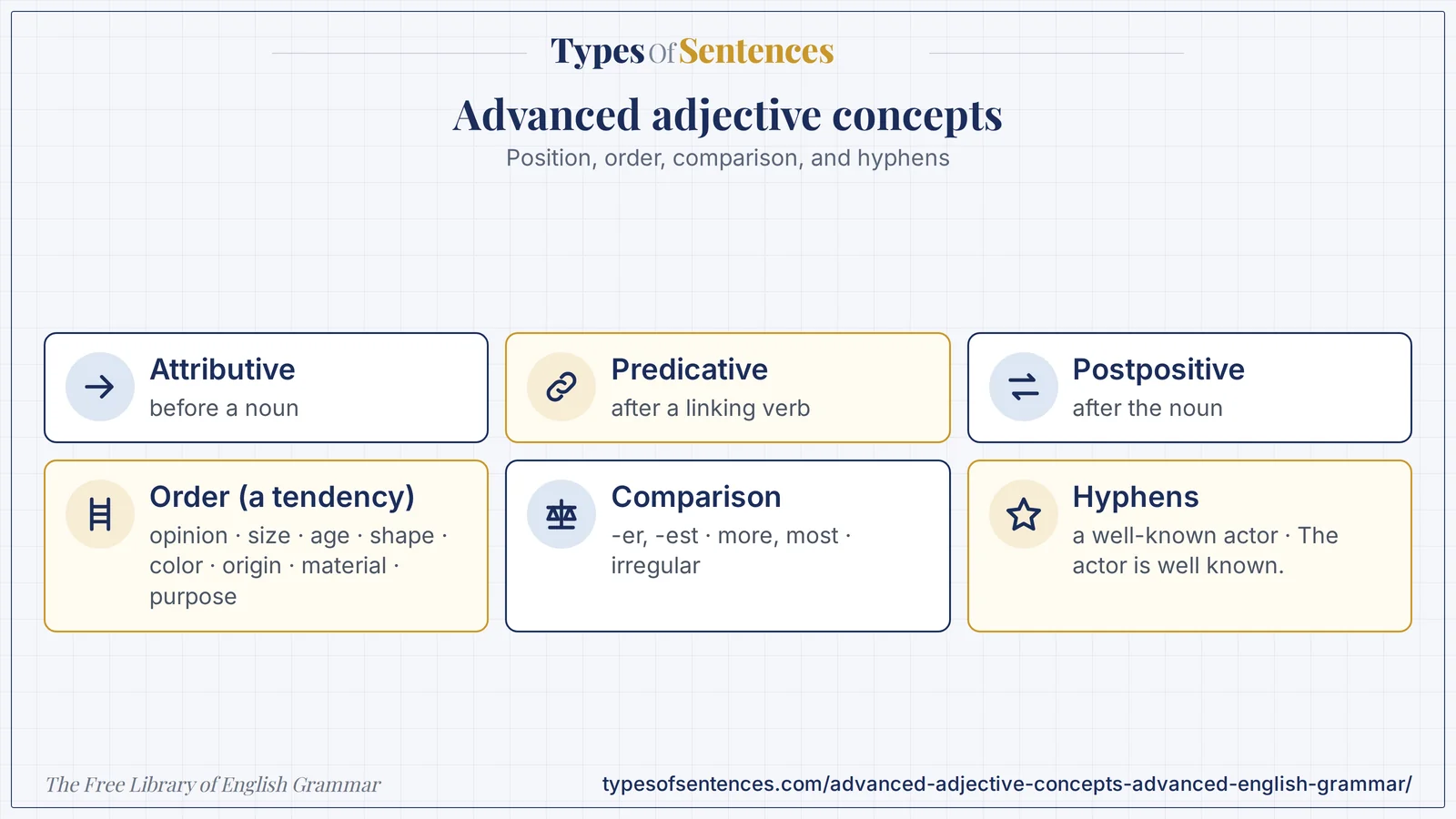
Summary: Adjectives are attributive (before a noun), predicative (after a linking verb), or postpositive (after the noun). A few occur in only one position (the main reason, afraid). Several adjectives in a row follow a loose order (opinion, size, age, shape, color, origin, material, purpose). Gradable adjectives take comparison and intensifiers; absolute ones (unique, dead) resist them. Adjectives take complements (proud of, eager to), form participial and compound adjectives, and can act as nouns (the rich).
- Position: attributive, predicative, postpositive.
- Order: OSASCOMP (a flexible tendency).
- Comparison: -er/-est or more/most; irregular forms.
- Hyphens: a well-known actor but The actor is well known.
What You’ll Learn
- 1. Advanced Adjective Concepts: Functions and Positions
- 2. Complex Adjectives: Adjectives That Occur in Only One Position
- 3. Postpositive Adjectives
- 4. Order of Adjectives
- 5. Degrees of Comparison and Gradability
- 6. Adjective Complementation
- 7. Participial Adjectives: -ing and -ed
- 8. Compound Adjectives and Hyphenation
- 9. Nominal Adjectives and Adjective–Adverb Boundaries
- 10. Confusable Adjectives
- 11. Common Errors with Adjectives
- 12. Exercises
- 13. Test Your Knowledge
- 14. Frequently Asked Questions
- 15. Conclusion
1. Advanced Adjective Concepts: Functions and Positions
An adjective phrase has an adjective as its head and may include modifiers and complements: very tired, afraid of the dark, easy to read, much taller than her brother. Adjectives are also distinguished from determiners (the, some, my), which specify a noun but do not describe it.
| Function | Position | Example |
|---|---|---|
| attributive | before the noun | a tired teacher; the main reason |
| predicative (subject complement) | after a linking verb | The teacher is tired. |
| predicative (object complement) | after the object | They found the exam difficult. It made her angry. |
| postpositive | after the noun | something nice; the people involved; the president elect |
| nominal (adjective as noun head) | after the | the rich, the unexpected |
| complement of a preposition (rare) | after a preposition | She came out of it unhurt. |
The test for an adjective is whether it can follow be or a similar linking verb, take very (if gradable), and form a comparative. The adjective–adverb boundary is treated in the next chapter, on advanced adverb concepts.
2. Complex Adjectives: Adjectives That Occur in Only One Position
| Position | Adjectives | Examples |
|---|---|---|
| attributive only | main, chief, principal, mere, sheer, utter, total, former, latter, only, very (the very man), elder, eventual, entire, maiden, upper, outer | the main reason (not *The reason is main); a mere child; the former president |
| predicative only | afraid, alive, alone, asleep, awake, aware, ashamed, glad, content, unable, ready, sorry, well (healthy), ill (often) | The child is asleep. (not *the asleep child); She is afraid. |
| both positions, same meaning | tired, happy, old, red, large | a tired teacher; The teacher is tired. |
| Adjective | Attributive (before the noun) | Predicative or postpositive |
|---|---|---|
| late | the late president (deceased) | The president is late. (not on time) |
| certain | a certain person (unnamed) | I am certain. (sure) |
| present | the present members (current) | the members present (in attendance) |
| responsible | a responsible person (reliable) | the person responsible (to blame) |
| concerned | the concerned parents (worried) | the parents concerned (affected) |
| involved | an involved story (complex) | the people involved (taking part) |
| proper | a proper meal (real) | the meal proper (itself) |
| old | an old friend (long-standing) | a friend who is old (aged) |
| poor | a poor man (unfortunate) | a man who is poor (without money) |
The pairs show that position can change meaning, a fact that matters for precision: the concerned parents and the parents concerned are not the same people. The adjectives that begin with a- (afraid, alive, asleep) come from old prepositional phrases and are predicative; the attributive forms use another word (a frightened child, a living creature, a sleeping baby).
3. Postpositive Adjectives
| Context | Example | Note |
|---|---|---|
| after indefinite pronouns | something nice, anyone interested, nothing new, somebody else, everything possible | always postpositive |
| fixed titles and legal terms | attorney general, secretary general, court martial, heir apparent, notary public, God Almighty, time immemorial | borrowed from French and Latin word order |
| after a noun, with a complement or modifiers | a man happy to help; a problem difficult to solve; a student proud of her work | the adjective phrase is too heavy to go before the noun |
| after the superlative with -able or -ible | the best seat available; every resource imaginable | a standard pattern |
| participles used as adjectives | the people involved; the money spent; the items listed | reduced relative clause |
| after measure phrases | a pole ten feet long; a child five years old | the measure phrase comes first |
The postpositive position keeps long adjective phrases readable. See the chapter on complex noun phrases for how these premodifiers and postmodifiers combine. In writing, avoid long premodifying strings: a happy-to-help, always-smiling, extremely well-qualified assistant is easier to read as an assistant who is happy to help, always smiling, and extremely well qualified.
4. Order of Adjectives
| Position | Category | Example |
|---|---|---|
| 1 | determiner and quantity | a, the, two, my |
| 2 | opinion | lovely, ugly, delicious |
| 3 | size | large, small, tiny |
| 4 | age | old, new, young |
| 5 | shape | round, square, long |
| 6 | color | red, blue, green |
| 7 | origin | Italian, Chinese |
| 8 | material | wooden, silk, marble |
| 9 | purpose (or type) | writing (desk), cooking (pot) |
- a lovely old Italian marble fountain opinion, age, origin, material
- two large round red balloons size, shape, color
- a small wooden writing desk size, material, purpose
- a beautiful long silk scarf opinion, size, material
The order is a strong tendency, not a law. It reflects how subjective or objective the adjective is: judgment words come early and classifying words, which are closest to the noun, come late (an economic crisis, a nuclear reactor). Native speakers rarely use more than three adjectives before a noun.
| Type | Test | Punctuation | Example |
|---|---|---|---|
| coordinate adjectives | you can reverse them or insert and | comma between | a tall, handsome man; a tall and handsome man |
| cumulative adjectives | they cannot be reversed or joined by and | no comma | a small wooden box (not *a wooden small box) |
| predicative series | after a linking verb | commas and a final and | The room was large, bright, and clean. |
5. Degrees of Comparison and Gradability
| Degree | Form | Example |
|---|---|---|
| positive (absolute) | the plain form | tall |
| comparative | -er or more + adjective | taller; more careful |
| superlative | -est or most + adjective | tallest; most careful |
| equative | as + adjective + as | as tall as |
| inferiority | less / least + adjective | less careful; least careful |
| Rule | Examples |
|---|---|
| one-syllable adjectives: -er / -est | tall, taller, tallest; large, larger, largest; big, bigger, biggest |
| two-syllable adjectives in -y: -ier / -iest | happy, happier, happiest |
| other two-syllable adjectives: either form, with a preference for more/most when in doubt | clever (cleverer, more clever), common (commoner, more common), polite (politer, more polite) |
| adjectives of three or more syllables: more / most | beautiful, more beautiful, most beautiful |
| participial and -ful, -less, -ous adjectives: more / most | more tired, most helpful |
| irregular | good, better, best; bad, worse, worst; far, farther or further; little, less, least; many/much, more, most; old, older/elder, oldest/eldest |
I. Non-gradable (absolute) adjectives
Some adjectives name a limit and do not naturally take comparison or intensifiers: unique, perfect, dead, empty, full, complete, final, impossible, equal, pregnant. Prescriptive guides have long objected to very unique and more perfect. In practice, speakers treat many of these adjectives as gradable when they mean “close to the limit” or “more nearly”.
| Adjective | Strict view | Common usage |
|---|---|---|
| unique | *very unique, *more unique | almost unique, truly unique; very unique is widely used |
| perfect | *more perfect | nearly perfect, more nearly perfect (as in the U.S. Constitution’s “more perfect Union”) |
| dead | *very dead | almost dead, completely dead |
| full | *very full | fairly full, quite full are both heard |
| equal | *more equal | more nearly equal; “more equal than others” is a famous literary play |
The objection to very unique is based on the idea that unique means “one of a kind”. Many dictionaries also give a sense of “unusual”, which is gradable. Some style guides advise against very unique in formal writing, and others accept it. If you write for an audience that is sensitive to the point, use unusual, remarkable, or almost unique. The chapter on grammar myths and controversies treats it as one of several debated points.
| Intensifier type | Used with | Examples |
|---|---|---|
| for gradable adjectives (scale) | very, extremely, really, so, too, quite, rather, fairly, pretty, somewhat, slightly, a bit | very tired, rather cold, slightly damp |
| for non-gradable and extreme adjectives (limit) | absolutely, completely, utterly, totally, entirely, simply, virtually | absolutely essential, utterly ridiculous, completely empty |
| extreme adjectives (gradable at the limit) | absolutely, really (not very) | absolutely terrible, really fantastic, *very terrible |
| postposed | enough | tall enough, good enough (the adjective comes first) |
6. Adjective Complementation
| Pattern | Examples | Notes |
|---|---|---|
| adjective + preposition + noun phrase | afraid of the dark, interested in art, good at math, proud of her work, responsible for the error, jealous of his friend, keen on football, similar to mine | the preposition is fixed by the adjective |
| adjective + to-infinitive | eager to learn, easy to use, ready to leave, likely to win, sorry to hear | the subject is the doer (eager) or the object (easy) |
| adjective + that-clause | sure that she knows, afraid that he is late, important that she attend | after important, essential, vital: the subjunctive in formal American English |
| adjective + wh-clause | unsure what to do, unclear whether it works | a reduced question |
| adjective + -ing (with busy, worth) | busy cooking, worth trying | special adjectives |
| Adjective | Preposition choices | Note |
|---|---|---|
| angry | at (something), with (someone), about | angry at the delay, angry with her |
| bored | with, by; of (British) | bored with the film |
| different | from (standard), than (American, with a clause), to (British) | different from the others; different than I expected |
| married | to | married to Tom |
| afraid | of; to + infinitive; that | afraid of heights; afraid to ask |
| aware | of | aware of the problem |
The tough-movement pattern is characteristic: The book is easy to read means that it is easy for someone to read the book. Compare She is eager to read (she does the reading). The choice of preposition after an adjective cannot be predicted from meaning and has to be learned as a collocation; see the chapter on collocation. Different from is the form recommended in formal writing; different than is common in American English when a clause follows (different than I expected).
7. Participial Adjectives: -ing and -ed
| -ing (the cause) | -ed (the one who feels or is affected) |
|---|---|
| The film is boring. | I am bored. |
| an interesting idea | I am interested in it. |
| a surprising result | We were surprised. |
| an exhausting day | an exhausted traveler |
| a frightening noise | a frightened child |
| a disappointing result | a disappointed fan |
The -ing participial adjective has an active meaning (it causes or does), and the -ed one has a passive or resulting meaning (it receives or has undergone). Participles are described at the Intermediate level in the chapter on participles. Many participles are fully adjectives: they take very (very tired), form a comparative (more interesting), and follow seem and become.
| Test | Adjective | Passive verb |
|---|---|---|
| very is possible | The door is very closed? (no) | The door was closed by the guard. |
| become/seem is possible | She seems tired. | — |
| an agent by-phrase is possible | — | The window was broken by a boy. |
| the state is the point | The shop is closed. (a state) | The shop was closed at six. (an event) |
The line between a participial adjective and a passive verb is a continuum. The context decides, and the participle is often both: the non-finite uses are in the chapter on non-finite verbs.
8. Compound Adjectives and Hyphenation
| Pattern | Examples |
|---|---|
| adjective + noun + -ed | blue-eyed, short-sighted, kind-hearted |
| noun + adjective | sugar-free, lifelong, world-famous, color-blind |
| noun + participle | man-made, hand-written, heart-broken, time-consuming |
| adverb + participle | well-known, newly built, highly paid, fast-growing |
| number + noun | a ten-year-old boy, a five-minute walk, a two-way street |
| phrase compounds | a never-to-be-forgotten day, an out-of-date map, a state-of-the-art system |
Style guides differ in detail: for instance, Chicago style is more sparing with hyphens and gives an extensive table of cases, and some publishers hyphenate more freely. When in doubt, hyphenate if the compound could be misread (a small-business owner versus a small business owner), and be consistent in a document.
9. Nominal Adjectives and Adjective–Adverb Boundaries
| Type | Example | Notes |
|---|---|---|
| plural people | the rich, the poor, the unemployed, the elderly, the wounded | plural verb: The rich are getting richer. |
| nationalities | the French, the Spanish, the Dutch, the English | plural; others (the Americans) are nouns |
| abstract or singular | the unexpected, the best, the beautiful, the inevitable | singular verb |
| specific person | the accused, the deceased | singular or plural by context |
Writers now often prefer person-first or neutral phrasing to nominal adjectives for groups of people (people with disabilities, unemployed workers), because the plain adjective can sound impersonal. Consult the style guide for your field.
| Word | Adjective | Adverb (flat form) | Different adverb |
|---|---|---|---|
| fast | a fast car | She runs fast. | — |
| hard | a hard test | She works hard. | hardly (barely) |
| late | a late train | He arrived late. | lately (recently) |
| high | a high wall | He jumped high. | highly (very) |
| early | an early bird | She left early. | — |
| wrong | a wrong answer | You guessed wrong. | wrongly (in error) |
10. Confusable Adjectives
| Pair | Meanings |
|---|---|
| economic / economical | economic: of the economy (economic growth); economical: thrifty (an economical car) |
| historic / historical | historic: important in history (a historic event); historical: of history (historical records) |
| classic / classical | classic: a model of its kind; classical: of ancient Greece and Rome, or traditional music |
| continual / continuous | continual: repeated; continuous: without a break |
| uninterested / disinterested | uninterested: not interested; disinterested: impartial (the traditional sense) |
| sensible / sensitive | sensible: practical; sensitive: easily affected |
| electric / electrical | electric: powered by electricity (an electric guitar); electrical: of electricity as a subject (electrical engineering) |
| -able / -ible | -able is productive (readable); -ible is from Latin (flexible, visible) |
Dictionaries record the distinctions, though real usage blurs some of them (disinterested is widely used for uninterested). In careful writing, keep the distinctions, since a reader who knows them will notice.
11. Common Errors with Adjectives
| Error | Correction | Rule |
|---|---|---|
| more taller | taller | one comparative marker |
| most easiest | easiest | one superlative marker |
| the asleep child | the sleeping child | predicative-only adjective |
| a wooden small box | a small wooden box | order of adjectives |
| a ten-years plan | a ten-year plan | singular noun in a compound |
| a highly-paid doctor | a highly paid doctor | no hyphen after -ly |
| She is very unique. | She is unique. / She is highly unusual. | absolute adjective |
| I feel badly. | I feel bad. | linking verb takes an adjective |
| She is the most tallest girl. | She is the tallest girl. | one superlative marker |
| The concerned parents are the parents who are involved (confusion) | The parents concerned are the parents who are affected. | position changes meaning |
| It is different to me. (American) | It is different from me. | preposition choice |
| a big red round ball | a big round red ball | order: size, shape, color |
Edit: The most unique, well-known actor is the late president’s very old friend, and the asleep child, who is the most tallest of the ten-years group, feels badly about a red round big ball.
- most unique: absolute: unusual (or unique).
- the late president’s very old friend: meaning check: the late president’s old friend (very is unnecessary).
- the asleep child: the sleeping child.
- the most tallest: the tallest.
- ten-years: ten-year.
- feels badly: feels bad.
- red round big ball: big round red ball.
- Result: The unusual, well-known actor is the late president’s old friend, and the sleeping child, who is the tallest of the ten-year group, feels bad about a big round red ball.
Recap in 12 seconds
Watch the lesson build itself: Adjectives are attributive, predicative, or postpositive, follow a loose order, and take hyphens before a noun. The video has no sound.
Exercises
Part A: Position (Exercises 1–6)
Exercise 1: Edit: the asleep child
Show Answer
Answer: the sleeping child.
Exercise 2: Edit: She is a mere. (attributive only)
Show Answer
Answer: She is a mere child. (a noun is needed)
Exercise 3: Name the position: something nice
Show Answer
Answer: Postpositive.
Exercise 4: Explain the difference: the concerned parents and the parents concerned.
Show Answer
Answer: The first: worried parents. The second: the parents affected.
Exercise 5: Explain the difference: the late president and The president is late.
Show Answer
Answer: Deceased versus not on time.
Exercise 6: Name a fixed phrase with a postpositive adjective.
Show Answer
Answer: attorney general (or court martial, heir apparent).
Part B: Order and Punctuation (Exercises 7–11)
Exercise 7: Order: a (wooden/small/box)
Show Answer
Answer: a small wooden box.
Exercise 8: Order: (red/big/round) balloons
Show Answer
Answer: big round red balloons.
Exercise 9: Order: a (marble/lovely/old/Italian) fountain
Show Answer
Answer: a lovely old Italian marble fountain.
Exercise 10: Punctuate: a tall handsome man (coordinate)
Show Answer
Answer: a tall, handsome man.
Exercise 11: Punctuate: a small wooden box (cumulative)
Show Answer
Answer: No comma.
Part C: Comparison and Gradability (Exercises 12–19)
Exercise 12: Edit: more taller
Show Answer
Answer: taller.
Exercise 13: Edit: most easiest
Show Answer
Answer: easiest.
Exercise 14: Comparative of good:
Show Answer
Answer: better.
Exercise 15: Comparative of happy:
Show Answer
Answer: happier.
Exercise 16: Choose (American, distance): We walked (farther/further).
Show Answer
Answer: farther.
Exercise 17: Name a non-gradable adjective.
Show Answer
Answer: unique (or dead, perfect, empty).
Exercise 18: Choose: It was (very/absolutely) terrible.
Show Answer
Answer: absolutely.
Exercise 19: Edit (formal): very unique
Show Answer
Answer: unique / highly unusual.
Part D: Complementation and Participles (Exercises 20–25)
Exercise 20: Complete: She is afraid ___ the dark.
Show Answer
Answer: of.
Exercise 21: Complete: He is good ___ math.
Show Answer
Answer: at.
Exercise 22: Choose: The film is (boring/bored).
Show Answer
Answer: boring.
Exercise 23: Choose: I am (interesting/interested) in art.
Show Answer
Answer: interested.
Exercise 24: Name the pattern: The book is easy to read.
Show Answer
Answer: Adjective + to-infinitive (tough movement).
Exercise 25: Complete (formal American): It is essential that she (arrive/arrives) on time.
Show Answer
Answer: arrive.
Part E: Compounds, Nominals, Confusables (Exercises 26–30)
Exercise 26: Edit: a ten-years plan
Show Answer
Answer: a ten-year plan.
Exercise 27: Edit: a highly-paid doctor
Show Answer
Answer: a highly paid doctor.
Exercise 28: Choose: the (economic/economical) crisis
Show Answer
Answer: economic.
Exercise 29: Choose: an (economic/economical) car
Show Answer
Answer: economical.
Exercise 30: Agreement: The rich (is/are) getting richer.
Show Answer
Answer: are.
Test Your Knowledge
Ready to check what you learned? Answer all 10 questions, then submit. You need 80% (8 of 10) to pass. Your answers are not stored.
View correct answers and explanations
Question 1: Which adjective is predicative only?
✓ Correct Answer: B – asleep
Asleep is predicative only.
Question 2: Which is the usual order?
✓ Correct Answer: C – a small wooden box
Size comes before material.
Question 3: Which is correct?
✓ Correct Answer: D – taller
One comparative marker.
Question 4: Which is an absolute adjective?
✓ Correct Answer: C – unique
Unique resists comparison.
Question 5: Which is correct?
✓ Correct Answer: B – a ten-year plan
The noun in the compound is singular.
Question 6: Which is correct?
✓ Correct Answer: C – a highly paid doctor
No hyphen after an -ly adverb.
Question 7: Which describes the cause of a feeling?
✓ Correct Answer: D – boring
The -ing adjective describes the cause.
Question 8: Which is a postpositive adjective?
✓ Correct Answer: A – something nice
It follows the pronoun.
Question 9: Which is correct (American, distance)?
✓ Correct Answer: A – We walked farther.
Farther for physical distance.
Question 10: Which adjective means “impartial”?
✓ Correct Answer: B – disinterested
Disinterested has the sense of impartial.
Frequently Asked Questions
What are advanced adjective concepts?
Advanced adjective concepts are the finer points of the adjective: its positions and functions, adjectives that occur in only one position, the order of adjectives, comparison and gradability, complementation, participial and compound adjectives, and nominal adjectives.
What are complex adjectives?
Complex adjectives are adjectives with more than a simple use: postpositive adjectives (the president elect), adjectives with complements (afraid of the dark), participial adjectives, and compound adjectives such as well-known.
What are adjective complexities that change meaning?
Some adjective complexities depend on position: the late president and The president is late, or the concerned parents and the parents concerned, mean different things.
What is advanced adjective usage in a series?
Advanced adjective usage in a series follows the order of opinion, size, age, shape, color, origin, material, and purpose, and uses commas only between coordinate adjectives: a lovely old Italian marble fountain.
What are expert adjectives?
Expert adjectives are adjectives used with full control: the right position, order, comparison, complement, and hyphenation, and the precise word instead of a pile of general ones.
Is “very unique” wrong?
Strict guides say yes, because unique means “one of a kind”. Many speakers use it to mean “very unusual”. In formal writing, choose unusual or almost unique if you want to avoid the objection.
When do I hyphenate a compound adjective?
Hyphenate it before a noun when it could be misread (a well-known author), usually not after the noun (The author is well known), and never after an -ly adverb (a highly paid doctor).
Conclusion
You now have a deep study of the adjective: its functions and positions, adjectives limited to one position, postpositive adjectives, the order of adjectives, comparison and gradability, complementation, participial and compound adjectives, nominal adjectives, and the confusable pairs. You can use adjectives with expert control and avoid the usual errors.
When you edit, replace a pile of general adjectives with one exact one, and check position, order, and hyphens. Next, you will study advanced adverb concepts.
- Huddleston, Rodney, and Geoffrey K. Pullum. The Cambridge Grammar of the English Language. Cambridge University Press, 2002.: the reference analysis of adjectives and adjective phrases.
- Quirk, Randolph, et al. A Comprehensive Grammar of the English Language. Longman, 1985.: the classic treatment of adjective classes, position, and order.
- Garner, Bryan A. Garner’s Modern English Usage, 5th ed. Oxford University Press, 2022.: usage guidance on absolute adjectives, farther and further, and confusable pairs.
- Biber, Douglas, et al. Longman Grammar of Spoken and Written English. Longman, 1999.: corpus evidence on adjective order and position.
- The Chicago Manual of Style, 17th edition, chapter 7 (Spelling, Distinctive Treatment of Words, and Compounds): American hyphenation conventions.
Last reviewed: October 29, 2026. How it was made: drafted with AI assistance, then checked with automated tests (structure, links, answer keys, spelling) and against the sources above. A person has not yet read this chapter line by line. Found a mistake? Report it.