Ambiguity in English is the property of a word, phrase, or sentence that allows more than one interpretation. It is a normal feature of language, not a defect, and most ambiguities pass unnoticed because the context decides at once: nobody hears I’ll meet you at the bank as an invitation to a river or a lender until the context is removed. But ambiguity becomes a problem when the context does not decide, or when the cost of misunderstanding is high: a contract, a set of instructions, an exam question, a headline. Then the writer must find the second reading before the reader does.
This chapter classifies the main types of ambiguity and shows how to find and remove them. You will study lexical ambiguity (one word, two meanings), structural ambiguity (one string, two grammatical analyses), scope ambiguity (All the students didn’t pass), and pronoun ambiguity (John told Bill he was wrong), as well as tests that separate ambiguity from vagueness, strategies for avoiding ambiguity, and the uses of ambiguity on purpose in humor, poetry, and diplomacy. Semantic ambiguity and the problem of unclear meaning are the central concerns of clear writing. Thirty editing exercises and a quiz follow.
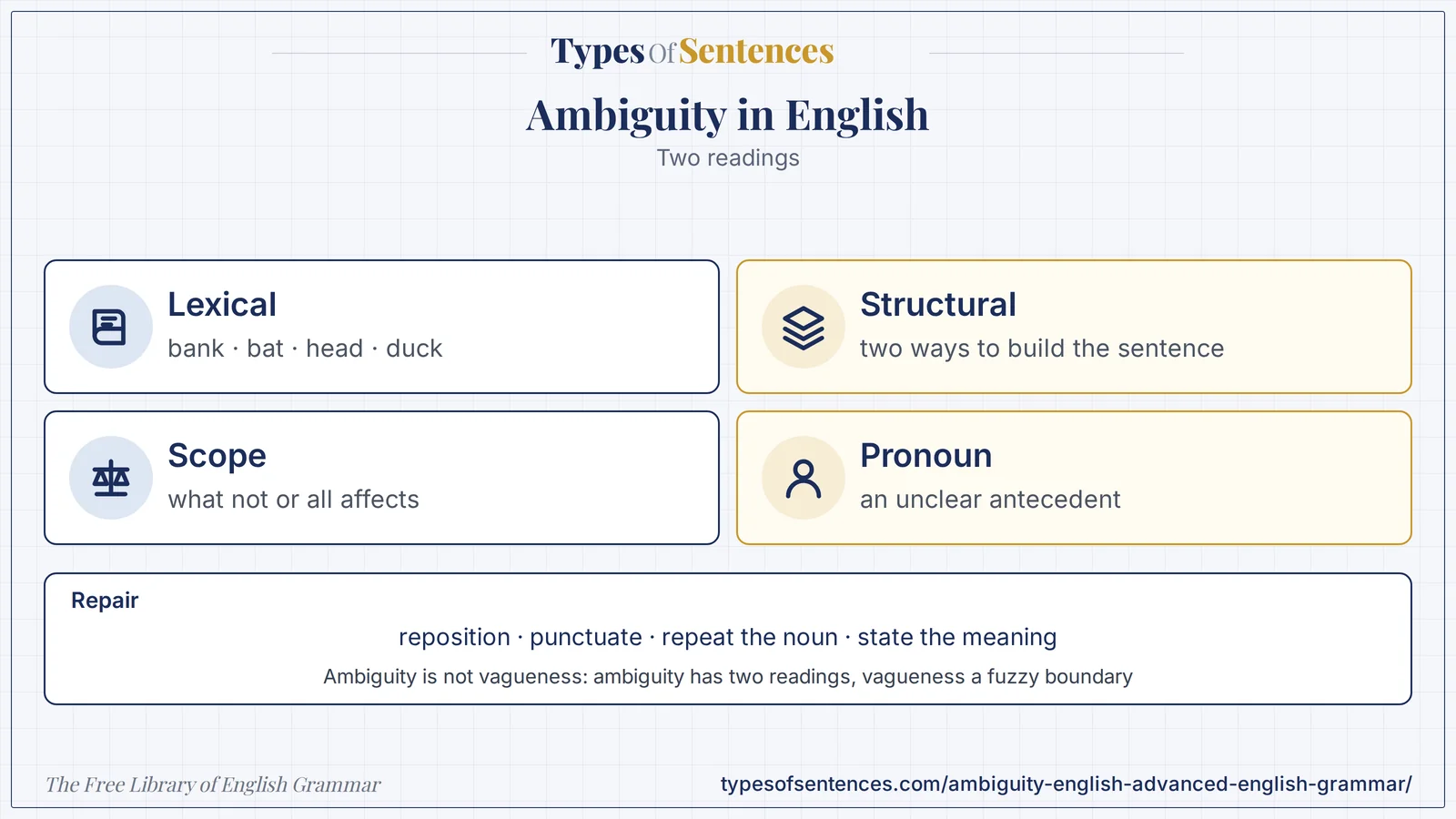
A sentence is ambiguous when a reader can reasonably understand it in two or more different ways. Sometimes a word has two meanings, sometimes the grammar can be read in two ways, sometimes a pronoun could refer to two people.
Why it matters: A careful writer reads each important sentence as a skeptical reader would, looking for the second meaning, and rewrites until only the intended meaning is left.
Summary: Lexical ambiguity arises when a word has more than one sense (homonyms such as bank and bat; related senses of polysemous words such as head; words that are nouns or verbs, such as duck). Structural ambiguity arises when words can be grouped in more than one way (I saw the man with the telescope; old men and women). Scope ambiguity arises when quantifiers, negation, or adverbs can apply to different parts (All the students didn’t pass). Pronoun ambiguity arises when a pronoun can refer to more than one antecedent. Ambiguity differs from vagueness (unclear boundaries) and generality (a broad term). Writers avoid ambiguity by repositioning modifiers, using punctuation and hyphens, repeating nouns instead of pronouns, making scope explicit, and testing sentences with readers. Intentional ambiguity serves puns, poetry, advertising, and diplomacy.
- Types: lexical, structural, scope, pronoun.
- Ambiguity ≠ vagueness: two readings versus fuzzy boundaries.
- Repair: reposition, punctuate, repeat the noun, state the scope.
- Ambiguity can be a tool: humor, poetry, diplomacy.
What You’ll Learn
- 1. Ambiguity in English: Types of Ambiguity
- 2. Lexical Ambiguity: Words with More Than One Meaning
- 3. Structural Ambiguity: Two Grammatical Analyses
- 4. Scope Ambiguity: What Is Affected?
- 5. Pronoun Ambiguity: Unclear Reference
- 6. Avoiding Ambiguity: Clarity Strategies
- 7. Intentional Ambiguity: Humor, Poetry, and Diplomacy
- 8. Ambiguity in Speech, Translation, and Language Technology
- 9. Common Ambiguities and a Worked Example
- 10. Exercises
- 11. Test Your Knowledge
- 12. Frequently Asked Questions
- 13. Conclusion
1. Ambiguity in English: Types of Ambiguity
| Type | Source | Example | Readings |
|---|---|---|---|
| lexical | a word with more than one meaning | He sat by the bank. | a river bank or a financial institution |
| part-of-speech (category) | a word that belongs to more than one class | I saw her duck. | her pet duck, or her lowering her head |
| structural (syntactic) | words can be grouped in more than one way | I saw the man with the telescope. | I used a telescope; or the man had one |
| scope | a quantifier, negation, or adverb can apply to different parts | All the students didn’t pass. | none passed; or not all passed |
| referential (pronoun) | a pronoun could refer to more than one antecedent | John told Bill he was wrong. | John was wrong; Bill was wrong |
| elliptical | a missing word can be supplied in more than one way | She likes him more than Mary. | more than Mary likes him; more than she likes Mary |
| phonological (spoken) | sounds can be divided in more than one way | ice cream / I scream | — |
| punctuation (written) | missing or misplaced punctuation | Let’s eat Grandma. | an invitation to eat; or an alarming proposal |
| pragmatic | an utterance can be a statement or an indirect request | Can you open the window? | a question about ability; or a request |
| semantic (general) | the meaning of a phrase is open between interpretations | The shooting of the hunters was terrible. | the hunters shot badly; or were shot |
| Contrast | Ambiguity | Vagueness | Generality |
|---|---|---|---|
| definition | two or more distinct readings | a fuzzy boundary; no sharp line | a term that covers many cases without difference |
| example | bank; I saw her duck | tall; soon; a few | teacher (of any gender); sibling |
| fix | choose a reading | give a number or a criterion | specify only if needed |
| test | the two readings give different truth values | borderline cases | — |
| Local versus global ambiguity | Meaning | Example |
|---|---|---|
| local (temporary) | ambiguous for part of a sentence, resolved by later words | While Anna dressed the baby spit up. (see the chapter on processing) |
| global (permanent) | remains after the whole sentence | I saw the man with the telescope. |
| Tests for ambiguity | How it works | Example |
|---|---|---|
| identity test (zeugma) | in an elliptical coordination, both parts must take the same sense | Priya went to the bank and so did Raj: both went to a lender, or both to a river, not one of each |
| contradiction test | one reading can be affirmed and the other denied without contradiction | I saw her duck, but I did not see her duck. (each sense true or false independently) |
| paraphrase test | each reading has a different paraphrase | — |
| translation test | the readings are expressed by different words in another language | bank in Hindi: kinara versus bank |
| truth-conditions test | the readings are true in different situations | — |
Ambiguity and the way that readers process it are related: the ambiguities that readers notice are mostly those that the processing strategies fail to resolve. The relationship is discussed in the chapter on syntax and sentence processing. For headlines, where ambiguity is common because of omitted words, see the chapter on journalistic writing.
2. Lexical Ambiguity: Words with More Than One Meaning
| Word | Senses | Kind |
|---|---|---|
| bank | the side of a river; a financial institution | homonymy (unrelated senses with different origins) |
| bat | a flying mammal; a stick for hitting a ball | homonymy |
| bark | the sound of a dog; the covering of a tree | homonymy |
| bear | the animal; to carry or endure | homonymy |
| match | a stick for fire; a contest; a pair that fits | homonymy and polysemy |
| light | not heavy; not dark; to ignite | homonymy and polysemy |
| spring | the season; a coil; a source of water; to jump | homonymy |
| pen | a writing tool; an enclosure for animals | homonymy |
| seal | the animal; a stamp; to close tightly | homonymy |
| rock | stone; to sway; a kind of music | homonymy and polysemy |
| bow | to bend; a weapon; a ribbon; the front of a ship | homonymy (with different pronunciations) |
| tear | a drop from the eye; to rip | homonymy (different pronunciations) |
| lead | to guide; the metal | homonymy (different pronunciations) |
| head | the top of the body; a leader; the top of a page; the source of a river | polysemy (related senses) |
| mouth | of a person; of a river; of a cave | polysemy |
| foot | of the body; of a mountain; a unit of length | polysemy |
| run | to move fast; to operate; to manage; a stretch | polysemy |
| paper | the material; a newspaper; an essay; a document | polysemy |
| book | a printed work; to reserve | polysemy |
| face | the front of the head; to confront | polysemy |
| table | furniture; a chart | polysemy |
| mean | to intend; stingy; average | homonymy |
| fair | just; light-colored; a festival; moderately good | homonymy and polysemy |
| fine | excellent; thin; a penalty | homonymy |
| right | correct; the opposite of left; a legal entitlement | polysemy |
| sound | noise; healthy; to seem; a strait | homonymy |
| can | able to; a metal container | homonymy |
| date | a calendar day; a social meeting; a fruit | homonymy |
| bank (of switches) | a row of similar things | polysemy |
| plant | a living thing; a factory; to put in the ground | homonymy and polysemy |
| novel | a book; new and unusual | homonymy |
| organ | part of the body; a musical instrument | homonymy |
| crane | a bird; a machine | homonymy |
| ring | a circle; a sound; a jewel; to call | homonymy and polysemy |
| scale | for weighing; of a fish; a range; to climb | homonymy |
| Concept | Meaning | Test |
|---|---|---|
| homonymy | unrelated meanings that share a form | separate dictionary entries; different origins (bank “side of a river” from Old Norse; bank “money” from Italian banca, “bench”) |
| polysemy | related meanings of one word | one dictionary entry with numbered senses; a metaphorical or metonymic link (head) |
| homophony | different words with the same sound | their/there, to/two/too |
| homography | different words with the same spelling | tear (drop) and tear (rip) |
| part-of-speech ambiguity | one form, several classes | duck (noun or verb), light (noun, adjective, verb) |
| contextual disambiguation | context selects the sense | river with bank; deposit with bank |
| collocation | typical word partners select senses | heavy rain versus heavy heart |
| word sense disambiguation | the task, in language technology, of choosing a sense automatically | — |
| Ambiguous sentence | Readings | Repair |
|---|---|---|
| The bat flew in the night. | the animal; (in cricket) the stick flew | The flying mammal swooped in the night. |
| She hurt her head. | her body; her mind (figuratively) | — |
| He was moved. | physically moved; emotionally moved | He was deeply touched. |
| The pitcher was empty. | a jug; a baseball player | The water jug was empty. |
| He is a hard man. | strict; difficult to move | He is a strict man. |
| They are cooking apples. | a type of apple; the act of cooking | They are cooking some apples. / They are cooking apples (for a pie). |
| She can fish. | she is able to; she puts fish in cans (a pun) | She is able to fish. |
| Keep the change. | coins returned; keep the alteration | Keep the coins. |
| We saw the sign. | a notice; a gesture; an omen | We saw the notice. |
The dictionary treats homonyms as separate entries and polysemous senses as sub-entries of one entry, though the boundary is not always sharp. This distinction is described in the chapter on lexical relations. For a writer, the practical question is whether the context will select the sense for the reader; if it might not, choose another word.
3. Structural Ambiguity: Two Grammatical Analyses
| Source | Sentence | Reading 1 (structure) | Reading 2 (structure) |
|---|---|---|---|
| prepositional phrase attachment | I saw the man with the telescope. | [saw [the man] [with the telescope]]: I used the telescope | [saw [the man with the telescope]]: the man had it |
| prepositional phrase attachment | She watched the boy on the hill with binoculars. | she used binoculars | the boy had binoculars |
| relative clause attachment | The daughter of the colonel who was on the balcony waved. | the colonel was on the balcony | the daughter was on the balcony |
| coordination scope | old men and women | [old [men and women]] | [[old men] and [women]] |
| coordination scope | pickled onions and eggs | [pickled [onions and eggs]] | [[pickled onions] and [eggs]] |
| noun compound | plastic bottle maker | [plastic bottle] maker: a maker of plastic bottles | plastic [bottle maker]: a bottle maker who is plastic |
| noun compound | French language teacher | a teacher of French | a language teacher who is French |
| gerund versus participle | Visiting relatives can be boring. | visiting (activity) | visiting (relatives who visit) |
| gerund versus participle | Flying planes can be dangerous. | to fly planes | planes that are flying |
| infinitive subject | The chicken is ready to eat. | ready to eat something | ready to be eaten |
| genitive | the shooting of the hunters | the hunters were the shooters | the hunters were shot |
| adverbial attachment | She told him to leave in the morning. | the leaving is in the morning | the telling is in the morning |
| adverbial attachment | He said that he would resign yesterday. | said yesterday | would resign yesterday |
| verb or noun | They fed her dog biscuits. | fed her dog some biscuits | fed her some dog biscuits |
| compound or phrase | I like cooking apples. | I like to cook apples | I like apples for cooking |
| ellipsis | She likes him more than Mary. | more than Mary likes him | more than she likes Mary |
| ellipsis | John loves his wife and so does Bill. | Bill loves John’s wife (strict) | Bill loves his own wife (sloppy) |
| modifier before a coordination | young boys and girls | young boys and young girls | young boys; girls of any age |
| negation and adverb | He didn’t leave early. | he left, but not early | he did not leave at all |
| nonrestrictive versus restrictive | My brother who lives in Pune is a doctor. | I have several brothers; the one in Pune | (with commas) I have one brother, and he lives in Pune |
| complement clause | I know a man who sold the house that I wanted. | the house that I wanted was sold | I wanted the man who sold it (rare) |
| appositive or list | I invited Priya, my cousin, Raj and Kumar. | four people (Priya, my cousin, Raj, and Kumar) | three people (Priya my cousin, Raj, and Kumar) |
| multiple modifiers | the American history teacher | a teacher of American history | a teacher of history who is American |
| sentence adverb | Clearly, he did not answer. | it is clear that he did not answer | he did not answer in a clear way (clearly as manner) |
| Technique to see the structure | How it works | Example |
|---|---|---|
| bracketing | mark the groupings with brackets | [old men] and [women] versus old [men and women] |
| tree diagram | show hierarchy graphically | — |
| paraphrase | express each reading in other words | — |
| movement test | a phrase that can move or be replaced by a pronoun is a constituent | The man with the telescope can be replaced by him |
| question test | ask what the phrase answers | With what did you see him? versus Which man? |
| insertion test | insert punctuation or words that force one reading | — |
Structural ambiguity differs from lexical ambiguity because the individual words are unambiguous: it is their arrangement that has two analyses. It differs from a garden path because the ambiguity is not resolved by the end of the sentence. The study of how the reader chooses between the analyses (often favoring attachment to the verb) is part of the chapter on syntax and sentence processing, and the study of the two readings’ meanings belongs to the chapter on grammar and meaning.
4. Scope Ambiguity: What Is Affected?
| Sentence | Reading 1 | Reading 2 | Repair |
|---|---|---|---|
| All the students didn’t pass. | None of the students passed. | Not all of the students passed. | Not all the students passed. / None of the students passed. |
| Every student read a book. | each student read some book (possibly different) | one particular book was read by every student | Each student read a (different) book. / Every student read the same book. |
| Someone must have left. | it is certain that somebody left | there is a particular person who must have left | — |
| I didn’t go because I was tired. | I did not go, and the reason was tiredness | I went, but not because I was tired | I stayed home because I was tired. / I went, though not because I was tired. |
| Two men carried three pianos. | a total of three pianos were carried by the pair | each man carried three pianos | — |
| Only Priya loves Raj. | nobody else loves Raj | Priya loves nobody else (in other positions of only) | Priya is the only person who loves Raj. |
| I always help my friends. | on every occasion, I help friends | all my friends are always helped (reading varies) | — |
| She almost won the race. | she came close to winning | she won, but with a margin that was small (unlikely) | She came close to winning the race. |
| He can’t have done it. | it is impossible that he did it | he is not able to do it (no obligation) | It is impossible that he did it. |
| He hasn’t seen many films. | he has seen few films | there are many films he has not seen | — |
| You may have tea or coffee and cake. | tea, or (coffee and cake) | (tea or coffee) and cake | You may have tea, or coffee and cake. |
| Most students like some teachers. | a majority like at least one teacher each | there are teachers whom most students like | — |
| Priya is looking for a book. | a particular book (specific) | any book (non-specific) | Priya is looking for a certain book. / for some book or other. |
| The company must hire a manager. | a specific manager is required | a manager of some kind is required | — |
| If you finish the work or leave early and call me … | if (finish or leave) and call me | if finish, or (leave and call me) | — |
| Factor | Effect on scope |
|---|---|
| order of quantifiers | the first quantifier often takes wider scope in a simple sentence |
| negation and quantifiers | not may negate the quantifier or the verb |
| modals | must, may interact with quantifiers and negation |
| only, also, even | the focus of the particle depends on stress or context |
| adverbs (always, often) | they quantify over occasions |
| coordinated phrases | and and or may group differently |
| intonation (speech) | stress can disambiguate |
| context | real-world knowledge selects the sensible reading |
Scope ambiguities are among the hardest to see in writing because the writer knows which reading is intended. They matter greatly in law, mathematics, regulations, and exams (Which of the following is not …?), and for negation in particular, see the chapter on negation in English. The repair is to state the scope explicitly or to choose a structure with only one reading.
5. Pronoun Ambiguity: Unclear Reference
| Sentence | Possible antecedents | Repair |
|---|---|---|
| John told Bill he was wrong. | John or Bill (or a third person) | John told Bill, “You are wrong.” / John told Bill that Bill was wrong. / John said that he himself was wrong. |
| When Maria met Susan, she was nervous. | Maria or Susan | When Maria met Susan, Maria was nervous. |
| The manager told the clerk that she would be promoted. | the manager or the clerk | The manager told the clerk, “You will be promoted.” |
| The councilmen refused the women a permit because they feared violence. | the councilmen (they feared) | — |
| The councilmen refused the women a permit because they advocated violence. | the women (they advocated) | — |
| The report criticized the proposal, but it was ignored. | the report or the proposal | The report criticized the proposal, but the proposal was ignored. |
| She put the cup on the plate and then broke it. | the cup or the plate | She put the cup on the plate and then broke the cup. |
| I told him that I would call him after he finished his work, which was good. | the work, or the whole situation (which referring to a clause) | I told him that I would call him after he finished his work. That was a good plan. |
| They say that it will rain. | who is they? | The forecast says that it will rain. |
| It was reported that it was closed. | what was closed? | The report said that the road was closed. |
| This is a problem. | what is this? | This delay is a problem. |
| Employees and managers should know that they are responsible. | employees, managers, or both | Employees and managers should know that each is responsible. |
| The doctor told the patient that he needed rest. | the doctor or the patient | The doctor told the patient, “You need rest.” |
| Tom visited Dan after he had graduated. | Tom or Dan | After Tom graduated, he visited Dan. |
| In the book, it says that … | what is it? | The book says that … |
| Source of pronoun ambiguity | Explanation |
|---|---|
| two or more eligible antecedents | of the same gender and number in the preceding clause |
| a distant antecedent | the pronoun is far from its noun |
| implicit antecedent | the pronoun has no noun (they for an unnamed group; it in it says) |
| this and that for a whole clause | the referent is unclear |
| which after a clause | — |
| pronoun in a subordinate clause that could refer to the subject or the object of the main clause | Winograd-type sentences resolved by plausibility rather than grammar (Winograd, 1972) |
| one, you, they used generically | — |
- Repeat the noun when two candidates are possible.
- Restructure so that the pronoun’s antecedent is the only candidate.
- Use direct speech to show whose words they are.
- Use a noun after this (this result, this decision).
- Do not use they or it without an antecedent.
- Keep pronouns close to their antecedents.
- Use a reflexive or a name to settle the reference (John said that he himself …).
The grammar of reference is discussed in the chapter on reference and deixis. Pronoun ambiguity is the most common ambiguity in business and academic writing, and it is also the easiest to repair.
6. Avoiding Ambiguity: Clarity Strategies
| Strategy | Ambiguous | Clear |
|---|---|---|
| move the modifier next to what it modifies | He saw a man in a car with a beard. | He saw a bearded man in a car. |
| place only and almost directly before the word they modify | She only kissed him. | She kissed only him. / She kissed him only (on the cheek). |
| use a hyphen to join a compound modifier | a small business owner | a small-business owner (the owner of a small business) / a small business-owner (a small owner) |
| use the hyphen to prevent misreading | man eating tiger | man-eating tiger |
| use the hyphen with a prefix where needed | He resigned the document. | He re-signed the document. / He resigned from the post. |
| use commas to mark restrictive and non-restrictive clauses | My brother who lives in Pune is a doctor. | My brother, who lives in Pune, is a doctor. (one brother) / My brother who lives in Pune is a doctor. (one of several) |
| use the serial comma | I thank my parents, Priya and Raj. | I thank my parents, Priya, and Raj. |
| repeat a word to show scope | old men and women | old men and old women / women and old men |
| state the scope of negation | All the students didn’t pass. | Not all the students passed. |
| avoid and/or | a manager and/or a clerk | a manager, a clerk, or both |
| use parallel structure | Employees who are over 50 and with 10 years of service | Employees who are over 50 and have 10 years of service |
| use active voice to show the agent | The man was seen with a telescope. | I saw the man through a telescope. |
| choose a less ambiguous word | The bank was steep. | The river bank was steep. |
| define a term at its first use | The Company shall pay a bank charge. | The Company shall pay a bank charge (defined in clause 3). |
| write numbers and dates unambiguously | 03/04/2024 | 4 March 2024 |
| rewrite ambiguous because clauses | I didn’t go because I was tired. | Because I was tired, I stayed home. |
| name the subject of a participle | Walking to school, the rain started. | As she walked to school, the rain started. |
| use the colon or dash for an apposition | I invited Priya, my cousin, Raj and Kumar. | I invited four people: Priya (my cousin), Raj, and Kumar. |
| replace the pronoun with the noun | The report criticized the proposal, but it was ignored. | The report criticized the proposal, but the proposal was ignored. |
| avoid or within a list of and | You may have tea or coffee and cake. | You may have (tea or coffee) and cake. |
| use quotation marks and tags for speech | He told her that he was wrong. | He told her, “I was wrong.” |
- Read the sentence as a skeptical reader who does not know what you mean.
- Look for the usual sources: modifiers, pronouns, coordination, negation, quantifiers, and words with two senses.
- Ask whether a second reading is plausible in the context. If it is, change the sentence.
- Choose the repair that keeps the meaning and does not create a new ambiguity.
- Test it by giving it to a reader and asking them to restate it.
- Pay extra attention where the cost of error is high: instructions, contracts, regulations, exams, safety notices.
| High-stakes genre | Ambiguity risks and cautions |
|---|---|
| legal documents | scope of and/or; pronouns; modifiers; punctuation (see the chapter on legal writing) |
| technical instructions | dangling modifiers; it; one meaning per word (see the chapter on technical writing) |
| exam questions | negation, scope, and quantifiers |
| medical and safety information | dose and timing; twice daily versus every other day |
| public notices and signs | No parking in the driveway (ambiguous?) |
| headlines | omitted words; compounds (see the chapter on journalistic writing) |
| contracts for services | by Friday (before or on?); within 30 days of (which date?) |
7. Intentional Ambiguity: Humor, Poetry, and Diplomacy
| Use | How ambiguity works | Example (original unless noted) |
|---|---|---|
| puns and jokes | a word or structure with two readings is used so that both are felt | I used to be a baker, but I could not make enough dough. (a pun on dough) |
| structural jokes | a sentence invites the wrong parse, then reveals the right one | Time flies like an arrow; fruit flies like a banana. |
| headlines | ambiguity as accident or as wit | Police Help Dog Bite Victim (an accidental “crash blossom”) |
| advertising | a slogan with a second meaning | Our bank is on your side. (the side of a river; of a person) |
| poetry | multiple meanings enrich the text; William Empson’s Seven Types of Ambiguity (1930) argued that ambiguity is a resource of poetic language | — |
| double entendre | a second, often risqué, meaning is available | — |
| riddles | the question is constructed to mislead | What has a mouth but never speaks? (a river) |
| diplomacy and negotiation | a formula that each side can read in its own way (sometimes called “constructive ambiguity”) | — |
| law and regulation | deliberate generality (reasonable care) that courts must apply | — |
| irony and understatement | the stated and the intended meanings differ | Not bad for excellent |
| literature | ambiguity of narrator, character, or event invites interpretation | — |
| politeness and indirectness | an utterance that can be taken as a hint or a statement | It’s cold in here. (a request to close the window) |
| euphemism | vagueness softens an unpleasant fact | passed away |
| Accidental ambiguity (a problem) | Intentional ambiguity (a tool) |
|---|---|
| unintended second meaning | both meanings are intended and noticed |
| arises from carelessness | arises from craft |
| costs the reader effort | rewards the reader’s attention |
| appears in instructions, contracts, notices | appears in jokes, poems, slogans |
| fix by rewriting | keep and shape |
A writer should be able to do both: to remove ambiguity where clarity is needed, and to use it where the text benefits. The difference is control. A writer who has learned to see second readings can avoid them in a manual and exploit them in a poem. Literary uses are discussed further in the chapters on grammar in literature and on grammar in poetry.
8. Ambiguity in Speech, Translation, and Language Technology
| Medium | How ambiguity is handled |
|---|---|
| speech | intonation, stress, pauses, and gesture disambiguate: I saw the man (pause) with the telescope |
| writing | punctuation, word choice, and structure must do the work |
| translation | a translator must choose a reading; ambiguity may not carry over |
| language technology | parsers and word-sense disambiguation systems choose among readings using frequencies, context, and models |
| second-language readers | may see fewer or different ambiguities, and may be misled by false friends |
| search engines and voice assistants | must resolve ambiguous queries (jaguar: car or animal) |
| legal drafting | requires one reading, using defined terms and structure |
| everyday conversation | repair strategies: “Do you mean …?” |
In conversation, the listener can ask what was meant; in writing, the reader cannot. This is why written language must be more explicit about structure and reference, and why clarity in writing is so often a matter of removing ambiguity in advance.
9. Common Ambiguities and a Worked Example
| Ambiguity | Example | Repair |
|---|---|---|
| misplaced modifier | She nearly drove 200 miles. | She drove nearly 200 miles. |
| dangling modifier | Walking down the street, the trees looked tall. | Walking down the street, I saw tall trees. |
| unclear pronoun | The dog chased the cat until it got tired. | The dog chased the cat until the cat got tired. |
| scope of negation | All employees must not smoke. | No employee may smoke. |
| scope of and/or | A manager and clerk or accountant | a manager and a clerk, or an accountant |
| homonym in a headline | Bank on the river rises | River bank rises |
| compound | a leather book cover | a leather-covered book / a cover for a book made of leather |
| elliptical comparison | The teacher likes Priya more than Raj. | The teacher likes Priya more than Raj does. / … more than she likes Raj. |
| time reference | The meeting is on Friday through Sunday. | The meeting runs from Friday to Sunday, inclusive. |
| quantity | twice weekly | two times a week / every two weeks |
| range | between 1 and 10 | from 1 to 10, inclusive |
| numeric date | 03/04/2024 | 4 March 2024 |
| restrictive clause | All students who cheated, failed. | All students failed; those who cheated failed because … |
| or inclusive or exclusive | You may take tea or coffee. | You may take tea or coffee, but not both. |
| elided subject | Priya met Raj and left. | Priya met Raj and then left. / Priya met Raj, and he left. |
| verb or noun | Police shoot man with knife. | Police shoot a man who had a knife. |
Edit: The bank near the river, which the manager told the clerk he should visit, was closed on Friday through Sunday, and all the staff didn’t attend because they were tired, and I saw her duck with binoculars, and old men and women could take tea or coffee and cake, and the report criticized the plan, but it was ignored.
- The bank near the river: lexical: The riverside bank branch (or define the branch).
- which the manager told the clerk he should visit: pronoun: which the manager told the clerk to visit.
- closed on Friday through Sunday: inclusive? closed from Friday to Sunday, inclusive.
- all the staff didn’t attend because they were tired: scope and reason: Not all staff attended; the tired ones stayed home.
- I saw her duck with binoculars: category and attachment: Using binoculars, I saw the duck that belongs to her.
- old men and women could take tea or coffee and cake: coordination scope: Elderly people could have tea, or coffee and cake.
- the report criticized the plan, but it was ignored: pronoun: the report criticized the plan, but the plan was ignored.
- Result: The riverside bank branch, which the manager told the clerk to visit, was closed from Friday to Sunday, inclusive. Not all staff attended. Using binoculars, I saw the duck that belongs to her. Elderly people could have tea, or coffee and cake. The report criticized the plan, but the plan was ignored. (the passage is invented)
Recap in 12 seconds
Watch the lesson build itself: Lexical, structural, scope, and pronoun ambiguity, and how to repair each. The video has no sound.
Exercises
Part A: Types (Exercises 1–7)
Exercise 1: Define ambiguity.
Show Answer
Answer: Allowing more than one interpretation.
Exercise 2: Name four types of ambiguity.
Show Answer
Answer: Lexical, structural, scope, pronoun.
Exercise 3: Is bank a case of lexical or structural ambiguity?
Show Answer
Answer: Lexical.
Exercise 4: Is I saw the man with the telescope lexical or structural?
Show Answer
Answer: Structural.
Exercise 5: Ambiguity or vagueness: tall
Show Answer
Answer: Vagueness.
Exercise 6: Ambiguity or vagueness: bat (animal or stick)
Show Answer
Answer: Ambiguity.
Exercise 7: Local or global: While Anna dressed the baby spit up.
Show Answer
Answer: Local (temporary).
Part B: Lexical and Structural (Exercises 8–14)
Exercise 8: Give two meanings of bat.
Show Answer
Answer: The flying mammal; the stick.
Exercise 9: Homonymy or polysemy: bank (river) and bank (money)
Show Answer
Answer: Homonymy.
Exercise 10: Homonymy or polysemy: head (body, leader)
Show Answer
Answer: Polysemy.
Exercise 11: Give two readings of old men and women.
Show Answer
Answer: Old men and old women; old men and women of any age.
Exercise 12: Give two readings of Flying planes can be dangerous.
Show Answer
Answer: To fly planes is dangerous; planes that are flying are dangerous.
Exercise 13: Give two readings of The chicken is ready to eat.
Show Answer
Answer: The chicken can eat; the chicken can be eaten.
Exercise 14: Repair: He saw a man in a car with a beard.
Show Answer
Answer: He saw a bearded man in a car.
Part C: Scope and Pronouns (Exercises 15–21)
Exercise 15: Give two readings of All the students didn’t pass.
Show Answer
Answer: None passed; not all passed.
Exercise 16: Repair: All the students didn’t pass. (meaning not all)
Show Answer
Answer: Not all the students passed.
Exercise 17: Give two readings of I didn’t go because I was tired.
Show Answer
Answer: I stayed because I was tired; I went, but not because I was tired.
Exercise 18: Repair: John told Bill he was wrong.
Show Answer
Answer: John told Bill, “You are wrong.”
Exercise 19: Repair: The report criticized the plan, but it was ignored.
Show Answer
Answer: …, but the plan was ignored.
Exercise 20: Repair: This is a problem. (clear referent)
Show Answer
Answer: This delay is a problem.
Exercise 21: Name a Winograd-type sentence.
Show Answer
Answer: The councilmen refused the women a permit because they feared violence.
Part D: Avoiding Ambiguity (Exercises 22–27)
Exercise 22: Hyphenate: man eating tiger
Show Answer
Answer: man-eating tiger.
Exercise 23: Place only: she kissed only him (not others). Rewrite: She only kissed him.
Show Answer
Answer: She kissed only him.
Exercise 24: Replace and/or: a manager and/or a clerk
Show Answer
Answer: a manager, a clerk, or both.
Exercise 25: Rewrite: 03/04/2024 (unambiguous)
Show Answer
Answer: 4 March 2024.
Exercise 26: Rewrite: Walking down the street, the trees looked tall.
Show Answer
Answer: Walking down the street, I saw tall trees.
Exercise 27: Name two high-stakes genres.
Show Answer
Answer: Legal documents, instructions, exam questions, safety information.
Part E: Intentional Ambiguity (Exercises 28–30)
Exercise 28: Name two uses of intentional ambiguity.
Show Answer
Answer: Puns, poetry, advertising, diplomacy.
Exercise 29: Who wrote Seven Types of Ambiguity (1930)?
Show Answer
Answer: William Empson.
Exercise 30: Name the difference between accidental and intentional ambiguity.
Show Answer
Answer: Control: the writer intends and shapes the second meaning.
Test Your Knowledge
Ready to check what you learned? Answer all 10 questions, then submit. You need 80% (8 of 10) to pass. Your answers are not stored.
View correct answers and explanations
Question 1: Which is lexical ambiguity?
✓ Correct Answer: A – The word bank has several meanings.
One word, two senses.
Question 2: Which is structural ambiguity?
✓ Correct Answer: B – I saw the man with the telescope.
Two groupings.
Question 3: Which is scope ambiguity?
✓ Correct Answer: C – All the students didn’t pass.
Negation and quantifier.
Question 4: Which has pronoun ambiguity?
✓ Correct Answer: D – John told Bill he was wrong.
Two antecedents.
Question 5: Which pair shows a hyphen removing ambiguity?
✓ Correct Answer: C – a man-eating tiger / a man eating tiger
The hyphen joins the compound.
Question 6: Which is a way to avoid pronoun ambiguity?
✓ Correct Answer: A – repeat the noun
Repeat the noun.
Question 7: Intentional ambiguity is common in
✓ Correct Answer: D – puns and poetry
Humor and poetry.
Question 8: What is the difference between ambiguity and vagueness?
✓ Correct Answer: C – ambiguity has distinct readings; vagueness has unclear boundaries
Distinct readings versus fuzzy boundaries.
Question 9: Who wrote Seven Types of Ambiguity (1930)?
✓ Correct Answer: B – William Empson
Empson.
Question 10: Which is a local, temporary ambiguity?
✓ Correct Answer: B – a garden path
Resolved by later words.
Frequently Asked Questions
What is ambiguity in English?
Ambiguity in English is the property of a word, phrase, or sentence that allows more than one interpretation. Ambiguity in English may be lexical, structural, scope, or referential.
What is structural ambiguity?
Structural ambiguity occurs when the same words can be grouped in more than one way, as in I saw the man with the telescope. Structural ambiguity is resolved by rewording or punctuation.
What is lexical ambiguity?
Lexical ambiguity occurs when a word has more than one meaning, as with bank or bat. Lexical ambiguity is usually resolved by context.
What is semantic ambiguity?
Semantic ambiguity is a general term for ambiguity of meaning, including the scope of quantifiers and negation, as in All the students didn’t pass. Semantic ambiguity can remain even when the grammar and words are clear.
How do I deal with unclear meaning?
Find the sources: modifiers, pronouns, coordination, negation, and words with two senses; read as a skeptical reader; rewrite so that only the intended meaning remains. Unclear meaning is the most common cause of misunderstanding in writing.
How is ambiguity different from vagueness?
An ambiguous expression has two or more distinct meanings; a vague one has a fuzzy boundary, such as tall or soon. They need different repairs.
Is ambiguity always bad?
No. It is a resource in jokes, poetry, advertising, and diplomacy, where both meanings are intended. It is a problem in instructions, contracts, and exams.
Conclusion
You now have a study of ambiguity in English: the types, lexical ambiguity, structural ambiguity, scope ambiguity, pronoun ambiguity, tests, strategies for avoiding ambiguity, and the use of ambiguity on purpose. You can find the second reading of a sentence and decide whether to remove it or use it.
When you revise, read each important sentence as a skeptical reader. Next, you will study redundancy and economy.
- Empson, William. Seven Types of Ambiguity. Chatto and Windus, 1930.: the classic study of ambiguity in poetry.
- Kess, Joseph F., and Ronald A. Hoppe. Ambiguity in Psycholinguistics. John Benjamins, 1981.: types of ambiguity and their processing.
- Winograd, Terry. Understanding Natural Language. Academic Press, 1972.: pronoun resolution examples.
- Cruse, D. Alan. Lexical Semantics. Cambridge University Press, 1986.: homonymy, polysemy, and tests for ambiguity.
- Merriam-Webster Dictionary: ambiguity: the dictionary entry.
Last reviewed: October 29, 2026. How it was made: drafted with AI assistance, then checked with automated tests (structure, links, answer keys, spelling) and against the sources above. A person has not yet read this chapter line by line. Found a mistake? Report it.