Negation in English seems easy: add not after the auxiliary. But the choices that an advanced writer faces are subtle. In He didn’t come because he was sick, does the negation apply to coming (he stayed and the reason was sickness) or to the reason (he came, but not because he was sick)? In I don’t think he will come, what exactly is negated? Why can you say I don’t know anything but not *I know anything? And why is I don’t know nothing wrong in Standard English and perfectly regular in many dialects?
This chapter studies advanced negation: how to negate a clause and how to test whether it is negated, the scope of negation and the ambiguities that it creates, negative words and near-negatives, transferred negation, double negatives and litotes, negative inversion, non-assertive forms, and the style of negative structures. The aim is control of complex negatives and of the negative structures of formal and informal writing. Thirty editing exercises and a quiz follow.
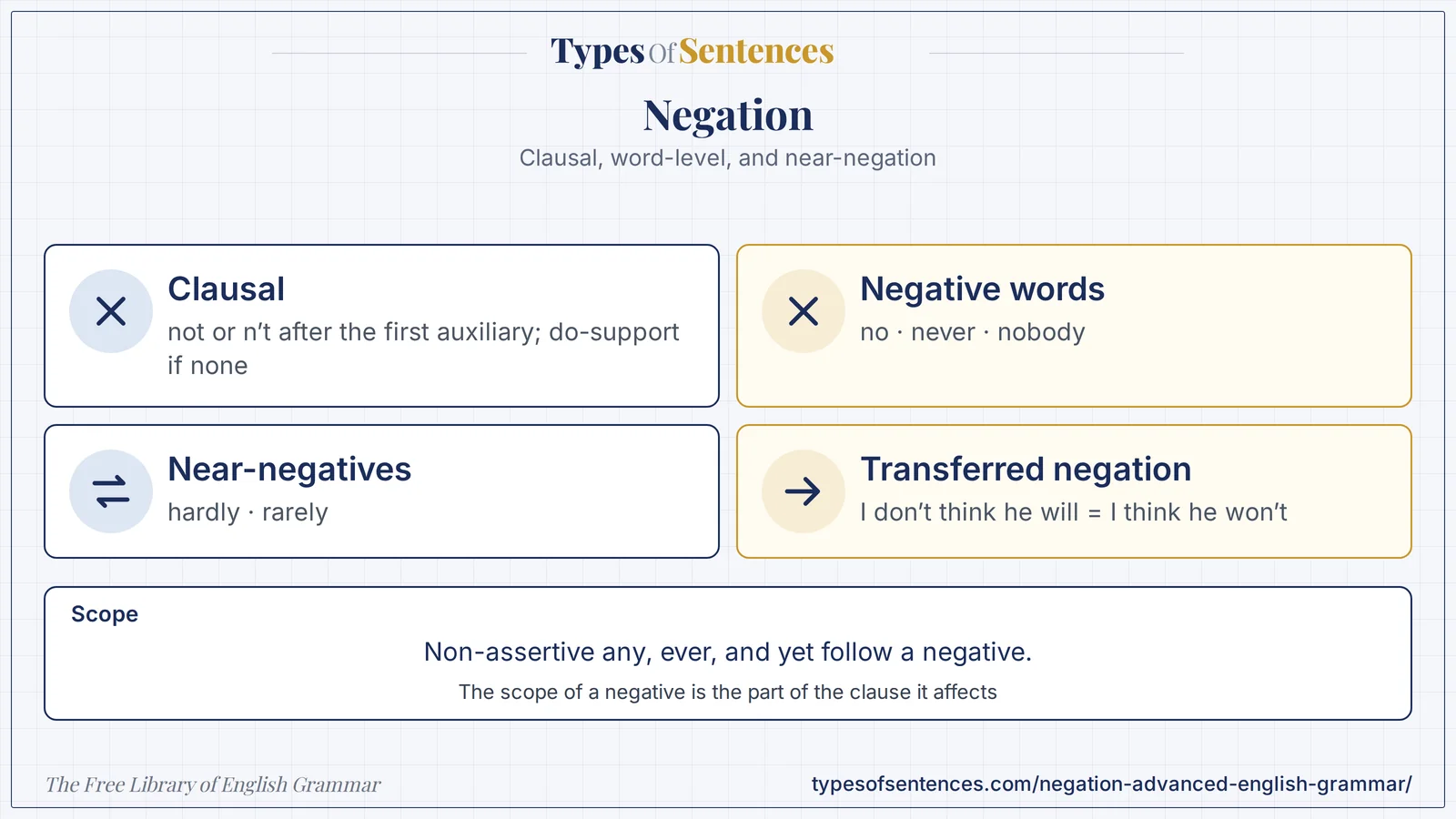
To negate a statement, you deny it: She is here becomes She is not here. But a negative word can affect different parts of a sentence, and the part that it affects is called its scope. Most problems with negation are problems of scope: it is not clear what has been denied.
Why it matters: The other main problem is word choice. English has words that appear only in negative or question contexts (any, ever, yet) and words that appear in positive contexts (some, already), and the choice between them is a grammatical choice.
Summary: A clause is negated by not/n’t after the first auxiliary (with do-support if there is none), by a negative word (no, never, nobody), or by a near-negative (hardly, rarely). The scope of a negative is the part of the sentence it affects, and it can be ambiguous (He didn’t come because he was sick). Transferred negation moves not from the subordinate clause to the main clause (I don’t think he will come). In Standard English, two negatives in one clause cancel (I don’t know nothing is nonstandard), but litotes (not uncommon) is a stylistic device. Non-assertive forms (any, ever, yet) occur in negative, interrogative, and conditional contexts.
- Clausal negation: not/n’t after the first auxiliary; do-support.
- Scope: what the negative affects; can be ambiguous.
- Transferred negation: I don’t think he will = I think he won’t.
- Non-assertive: any, ever, yet after negatives; assertive: some, already.
What You’ll Learn
- 1. Negation in English: Ways of Negating
- 2. Scope of Negation: What Negation Affects
- 3. Negative Words and Near-Negatives
- 4. Transferred Negation
- 5. Double Negatives and Litotes
- 6. Negative Inversion (Review)
- 7. Non-Assertive Forms: Any vs. Some, Ever vs. Always
- 8. Negation in Other Constructions
- 9. Style: Positive and Negative Formulations
- 10. Common Errors with Negation
- 11. Exercises
- 12. Test Your Knowledge
- 13. Frequently Asked Questions
- 14. Conclusion
1. Negation in English: Ways of Negating
| Means | Examples | Notes |
|---|---|---|
| not / n’t after the first auxiliary | She is not here. She hasn’t left. He can’t swim. | clausal negation |
| do-support (no auxiliary) | She does not work. They did not leave. | do + not + base form |
| negative determiners and pronouns | no, none, neither, nobody, no one, nothing, nowhere, never | I saw no one. Nothing happened. |
| negative adverbs | never, nowhere, no longer, not once | She never calls. |
| near-negatives | hardly, scarcely, barely, seldom, rarely, few, little | She hardly speaks. |
| negative affixes | un-, in-, im-, non-, dis-, a-, -less, mis- | unhappy, careless, nonexistent |
| implicit negative verbs and prepositions | fail, refuse, deny, doubt, prevent, avoid, without, instead of, too … to | She failed to arrive. He left without saying goodbye. |
| negative questions and tags | Isn’t it late? It’s late, isn’t it? | see the chapter on questions |
| Test for clausal negation | Positive | Negative |
|---|---|---|
| tag question polarity | She is happy, isn’t she? | She isn’t happy, is she? |
| either vs too | She is happy, and he is, too. | She isn’t happy, and he isn’t, either. |
| so vs neither | She is happy, and so is he. | She isn’t happy, and neither is he. |
| any allowed | *She saw anyone. | She didn’t see anyone. |
| inversion after a fronted negative | — | Never has she seen it. |
The rules for placing not with auxiliaries and modals are part of the NICE properties, described in the chapter on advanced verb concepts, and the interaction of negation with modals in the chapter on modality. A negative in a verb phrase always follows the first auxiliary: She might not have been working; see the chapter on complex verb phrases.
2. Scope of Negation: What Negation Affects
The scope of a negative is the part of the meaning that it denies. In many sentences the scope is obvious, but in others the same words allow two or more readings.
| Sentence | Reading A | Reading B |
|---|---|---|
| He didn’t come because he was sick. | He did not come, and the reason was sickness. | He came, but not because he was sick (another reason). |
| She didn’t marry him because he was rich. | She did not marry him; the reason: his wealth. | She married him, but not for his money. |
| I didn’t see someone. | There is a person I did not see. | (unnatural; use anyone for “nobody”) |
| All the students didn’t pass. | None of the students passed. | Not all of them passed (some did). |
| She doesn’t always win. | She sometimes loses (not always). | — |
| I don’t like all of them. | I like some, not all. | I like none of them (possible with stress). |
| He didn’t deliberately break it. | He broke it, but not on purpose. | He did not break it, and it was deliberate (odd). |
| They didn’t both come. | Only one came. | Neither came (less natural). |
| Strategy to avoid ambiguity | Example |
|---|---|
| use a comma to separate the reason | He didn’t come, because he was sick. (reading A) |
| rewrite to place the negative | He came, but not because he was sick. / The reason that he didn’t come was sickness. |
| use not all, none, no | Not all of the students passed. None of the students passed. |
| use it is not the case that | It is not the case that all students passed. |
| use a different quantifier | Some students did not pass. / No student passed. |
| stress in speech (the focus) | He didn’t come because he was SICK. (the reason is denied) |
| restructure with a cleft | It wasn’t because he was sick that he stayed away. |
Several general principles of scope help. A negative normally takes scope over what follows it in the clause (I didn’t see anyone: not [see anyone]), and a quantifier before a negative can take wide scope (Everyone didn’t come can mean that nobody came, although this reading is dispreferred in writing). Adverbs after not are within its scope (She doesn’t always win), while adverbs before it take wide scope (She always doesn’t win is not idiomatic). When the meaning matters, rewrite to remove the ambiguity.
3. Negative Words and Near-Negatives
| Word | Use | Example | Notes |
|---|---|---|---|
| no (determiner) | before a noun | There is no milk. She has no friends. | = not any |
| not any | with a verb negative | There isn’t any milk. | the same meaning; less emphatic |
| none | a pronoun, “not one”, “not any” | None of them came. None is left. | verb: none of them are (informal plural) or is (formal singular) |
| neither | of two; pronoun and determiner | Neither of them came. Neither answer is right. | neither of them are is common informally |
| nobody, no one | pronouns | Nobody called. No one knows. | singular verb |
| nothing | a pronoun | Nothing happened. I know nothing. | — |
| nowhere | an adverb | She went nowhere. Nowhere is safe. | — |
| never | an adverb of frequency | She never calls. | before the main verb, after be and the first auxiliary |
| no longer, not … any more | change | She no longer lives here. She doesn’t live here any more. | — |
| not a, not one, not a single | emphatic | Not a single person came. | — |
| nor | a second negative | He did not call; nor did he write. | inversion |
| hardly, scarcely, barely | almost not | She hardly speaks. He barely made it. | with any, ever: hardly anyone |
| seldom, rarely | not often | She rarely complains. | near-negative adverbs |
| few, little | small quantity (negative sense) | Few people came. There is little hope. | vs a few, a little (positive) |
4. Transferred Negation
In transferred negation (also called neg-raising), a negative is placed in the main clause even though it is understood to apply to the subordinate clause. I don’t think he will come is understood as I think he will not come.
| Transferred form | Understood meaning | Notes |
|---|---|---|
| I don’t think he’ll come. | I think he won’t come. | the usual way to express the negative opinion |
| I don’t believe she is guilty. | I believe she is not guilty. | — |
| I don’t suppose you know her. | I suppose you don’t know her. | polite |
| I don’t expect it will rain. | I expect it will not rain. | — |
| I don’t want you to go. | I want you not to go. | also with want |
| It doesn’t seem that he cares. | It seems that he doesn’t care. | with seem and appear |
| He isn’t likely to come. | He is unlikely to come. | with likely |
| I can’t believe she left. | I believe she didn’t leave (not quite): I find it surprising. | a different meaning |
| Verbs that allow transferred negation | Verbs that do not |
|---|---|
| think, believe, suppose, expect, imagine, feel, reckon, guess, seem, appear, want, wish, intend, plan | know, claim, say, hope, be sure, be certain, realize, regret (factive verbs) |
| I don’t think he left. (opinion) | I don’t know he left. (a different meaning: I am not aware) |
- The tag question follows the subordinate clause: I don’t think he’s coming, is he?
- The transferred negative is more polite and less direct than the subordinate negative: I don’t think it’s a good idea is softer than I think it’s a bad idea.
- With hope, the negative stays in the subordinate clause: I hope he won’t come (not *I don’t hope he will come).
- Think with so: I don’t think so is the usual negative of I think so (see the chapter on ellipsis and substitution).
5. Double Negatives and Litotes
| Type | Example | Status |
|---|---|---|
| negative concord (nonstandard) | I don’t know nothing. She never said nothing to nobody. | regular in many dialects and in older English; not Standard English |
| hypercorrect double negative (error) | I can’t hardly see it. I can’t help but laugh. (debated) | nonstandard or debated |
| logical double negative (canceling) | It is not unlikely that she will come. | Standard: two negatives make a weak positive |
| litotes | not bad, not uncommon, no small achievement, not without reason, I can’t say I disagree | a stylistic understatement |
| negative + negative affix | He is not unhappy. It is not impossible. | a weaker claim than He is happy |
| Nonstandard | Standard | Comment |
|---|---|---|
| I don’t know nothing. | I don’t know anything. / I know nothing. | one negative per clause |
| She never said nothing to nobody. | She never said anything to anybody. | — |
| I can’t hardly see it. | I can hardly see it. / I can’t see it. | hardly is a negative |
| He didn’t see no one. | He didn’t see anyone. / He saw no one. | — |
| I haven’t got no money. | I haven’t got any money. / I have no money. | — |
| Nobody never calls. | Nobody ever calls. / Nobody calls. | — |
In many languages (Spanish, Italian, French, Russian) and in Old and Middle English, several negative words in one clause reinforce each other; this is called negative concord, and it is not a mistake in those systems. In the eighteenth century, grammarians such as Robert Lowth argued that two negatives cancel each other, as in logic, and this rule became the basis of the prescription against double negatives in Standard English. Dialects such as African American English, Cockney, and many regional varieties kept negative concord, and it is a systematic and rule-governed feature of them. In formal writing, use one negative per clause.
Litotes, on the other hand, is deliberate. It is not uncommon is a restrained way of saying It is common, and He is no fool says that he is clever. Writers use it for understatement, politeness, and irony. Overuse produces a heavy style: It is not impossible that she may not be unwilling is confusing. The use of such devices to soften claims is also discussed in the chapter on hedging.
6. Negative Inversion (Review)
| Fronted negative | Example |
|---|---|
| never | Never have I seen such a sight. |
| rarely, seldom | Rarely does she complain. |
| hardly … when, no sooner … than | Hardly had he left when it rained. |
| not only | Not only did she win, but she also set a record. |
| not until | Not until noon did she leave. |
| under no circumstances, at no time | Under no circumstances should you open it. |
| nowhere, nothing | Nowhere have I seen such beauty. |
| little | Little did he know. |
| nor, neither | He did not call, nor did he write. |
A fronted negative or restrictive adverbial triggers subject-auxiliary inversion. The rules and the register of this construction are treated fully in the chapter on inversion, and the sentences above serve as a reminder that the negative word, not the auxiliary, determines the inversion.
7. Non-Assertive Forms: Any vs. Some, Ever vs. Always
| Positive (assertive) | Non-assertive (negative, question, conditional) | Negative |
|---|---|---|
| some, something, someone, somebody, somewhere | any, anything, anyone, anybody, anywhere | no, nothing, no one, nobody, nowhere |
| already | yet, any more, ever | never, no longer |
| still | any longer, yet | no longer |
| too, also | either | neither |
| sometimes, always, often | ever, at all, in the least | never |
| a lot of, much | much, a lot (in questions and negatives) | not much |
| somewhat, rather, quite | at all, in the least | not at all |
| I have some milk. | I don’t have any milk. Do you have any milk? | I have no milk. |
| Context for non-assertive forms | Example |
|---|---|
| negative clause | She didn’t see anyone. I haven’t eaten yet. |
| question | Did anyone call? Have you ever been to Paris? |
| conditional clause | If anyone calls, take a message. If you ever see her, tell her. |
| after near-negatives | She hardly ever complains. Few people have any idea. |
| after without, before, too … to | She left without saying anything. He was too tired to do anything. |
| comparative clause | She is taller than anyone I know. |
| after verbs of doubt and denial | I doubt that anyone knows. She denied seeing anyone. |
| free choice (any in positive sentences) | Any student can join. Choose any book you like. |
| negative polarity idioms | He didn’t lift a finger. She won’t budge. I can’t stand him. |
8. Negation in Other Constructions
| Construction | Example | Notes |
|---|---|---|
| negative imperative | Don’t go. Do not touch. Never mind. Don’t you dare. | do + not + base form; do also with be: Don’t be late |
| negative infinitive | She told him not to go. I decided not to stay. | not before to; the split to not go is also found |
| negative gerund or participle | Not knowing the answer, he guessed. She regrets not going. | not before the -ing form |
| mandative subjunctive | I insist that he not go. It is essential that she not be late. | not + base form |
| constituent (local) negation | not a bad idea; not very good; not far; not many | the negative modifies a phrase, not the clause |
| contrastive negation | not John but Mary; not red but blue | correction |
| emphatic negation | not at all; by no means; not in the least; not a word | — |
| no as a response | Do you like it? — No. (answer) / No, I don’t. | vs no determiner |
| negative question | Don’t you like it? Isn’t it late? | the answer yes or no can be confusing |
| ellipsis | I hope not. I think not. If not, call me. | see the chapter on ellipsis |
| informal | nope, nah, no way, not a chance | spoken |
Negative questions and the answers to them cause confusion across languages. Don’t you like it? expects Yes (I like it) or No (I don’t like it) in English, where the answer agrees with the truth of the situation, but in some languages the answer agrees with the question. To avoid misunderstanding, add the full clause: Yes, I do like it or No, I don’t.
9. Style: Positive and Negative Formulations
| Negative formulation | Positive formulation | Comment |
|---|---|---|
| He did not remember the name. | He forgot the name. | shorter and more direct |
| She was not often on time. | She was usually late. | — |
| The plan is not without risk. | The plan is risky. | litotes versus direct |
| It is not uncommon for students to fail. | Students often fail. | — |
| You must not leave before noon. | You must stay until noon. | a positive instruction is clearer |
| Do not forget to sign. | Remember to sign. | — |
| It is not impossible that she will not be unable to come. | She may be able to come. | a pile of negatives |
| Not everyone did not pass. | Some people passed. Some failed. | avoid a confusing scope |
- Prefer positive statements when they are as accurate: they are shorter and easier to process. Experimental studies show that negative sentences take longer to understand.
- Use a negative to deny a belief the reader may hold: The model is not a failure rebuts an assumption, and a negative is more informative there.
- Avoid piling up negatives. More than two in one sentence, and the reader has to count.
- Be precise about scope in contracts, instructions, and academic claims.
- Use litotes sparingly for understatement and tone.
10. Common Errors with Negation
| Error | Correction | Rule |
|---|---|---|
| I don’t know nothing. | I don’t know anything. / I know nothing. | no double negative in Standard English |
| I can’t hardly see. | I can hardly see. | hardly is negative |
| She doesn’t have not any money. | She doesn’t have any money. | one negative |
| I have not time. | I have no time. / I don’t have any time. | no before a noun |
| I know anything about it. | I don’t know anything about it. / I know something. | non-assertive in a positive |
| Nobody never calls. | Nobody ever calls. | — |
| He did not came. | He did not come. | base form after do |
| She doesn’t likes it. | She doesn’t like it. | no -s after does |
| She isn’t a doctor or a nurse. (ambiguous) | She is neither a doctor nor a nurse. | scope |
| Don’t not go. | Don’t go. | — |
| Neither of them are coming. (formal) | Neither of them is coming. | formal agreement |
Edit: I don’t know nothing, and I can’t hardly see it, and I have not time, and I know anything about it, and nobody never calls, and he did not came, and she doesn’t likes it.
- don’t know nothing: don’t know anything.
- can’t hardly see: can hardly see.
- have not time: have no time.
- I know anything about it: I don’t know anything about it.
- nobody never calls: nobody ever calls.
- did not came: did not come.
- doesn’t likes: doesn’t like.
- Result: I don’t know anything, and I can hardly see it, and I have no time, and I don’t know anything about it, and nobody ever calls, and he did not come, and she doesn’t like it.
Recap in 12 seconds
Watch the lesson build itself: A clause is negated with not, a negative word, or a near-negative, and the scope of the negative can be ambiguous. The video has no sound.
Exercises
Part A: Forms and Tests (Exercises 1–7)
Exercise 1: Negate: She works.
Show Answer
Answer: She does not work.
Exercise 2: Negate: She has been working.
Show Answer
Answer: She has not been working.
Exercise 3: Add a tag: She isn’t happy, ___?
Show Answer
Answer: is she.
Exercise 4: Choose: She isn’t happy, and he isn’t, (too/either).
Show Answer
Answer: either.
Exercise 5: Name the type: hardly
Show Answer
Answer: A near-negative.
Exercise 6: Name the type: unhappy
Show Answer
Answer: A negative affix.
Exercise 7: Edit: He did not came.
Show Answer
Answer: He did not come.
Part B: Scope (Exercises 8–13)
Exercise 8: Give the two readings: He didn’t come because he was sick.
Show Answer
Answer: He stayed because he was sick; or he came, but not because he was sick.
Exercise 9: Disambiguate with a comma (reading A): He didn’t come because he was sick.
Show Answer
Answer: He didn’t come, because he was sick.
Exercise 10: Rephrase: All the students didn’t pass. (some passed)
Show Answer
Answer: Not all of the students passed.
Exercise 11: Rephrase: All the students didn’t pass. (none passed)
Show Answer
Answer: None of the students passed.
Exercise 12: What does She doesn’t always win mean?
Show Answer
Answer: She sometimes loses.
Exercise 13: Name a way to remove scope ambiguity.
Show Answer
Answer: Rewrite, use not all, none, a cleft, or a comma.
Part C: Negative Words and Transferred Negation (Exercises 14–19)
Exercise 14: Edit: I have not time.
Show Answer
Answer: I have no time.
Exercise 15: Choose: Nobody (is/are) here.
Show Answer
Answer: is.
Exercise 16: Transfer the negation: I think he won’t come.
Show Answer
Answer: I don’t think he will come.
Exercise 17: What does I don’t suppose you know her mean?
Show Answer
Answer: I suppose you don’t know her.
Exercise 18: Which verb does not allow transferred negation: think or hope?
Show Answer
Answer: hope.
Exercise 19: Add a tag: I don’t think he’s coming, ___?
Show Answer
Answer: is he.
Part D: Double Negatives and Litotes (Exercises 20–25)
Exercise 20: Edit: I don’t know nothing.
Show Answer
Answer: I don’t know anything.
Exercise 21: Edit: I can’t hardly see it.
Show Answer
Answer: I can hardly see it.
Exercise 22: Edit: Nobody never calls.
Show Answer
Answer: Nobody ever calls.
Exercise 23: Name the device: It is not uncommon.
Show Answer
Answer: Litotes.
Exercise 24: Give the meaning of He is no fool.
Show Answer
Answer: He is clever.
Exercise 25: Name the feature of dialects that use I don’t know nothing.
Show Answer
Answer: Negative concord.
Part E: Non-Assertive Forms and Style (Exercises 26–30)
Exercise 26: Choose: She didn’t see (someone/anyone).
Show Answer
Answer: anyone.
Exercise 27: Choose: Have you (already/yet) finished?
Show Answer
Answer: yet.
Exercise 28: Edit: I know anything about it.
Show Answer
Answer: I don’t know anything about it.
Exercise 29: Give a positive formulation: He did not remember the name.
Show Answer
Answer: He forgot the name.
Exercise 30: Why avoid piling up negatives?
Show Answer
Answer: The reader must count them, and the scope becomes unclear.
Test Your Knowledge
Ready to check what you learned? Answer all 10 questions, then submit. You need 80% (8 of 10) to pass. Your answers are not stored.
View correct answers and explanations
Question 1: Which is clausal negation?
✓ Correct Answer: A – She is not here.
Not after the auxiliary.
Question 2: Which tag matches She isn’t happy?
✓ Correct Answer: C – is she?
The tag has opposite polarity.
Question 3: Which is correct?
✓ Correct Answer: D – I don’t know anything.
One negative; any after a negative.
Question 4: Which is correct?
✓ Correct Answer: B – I can hardly see.
Hardly is negative.
Question 5: Which is correct?
✓ Correct Answer: C – I have no time.
No before a noun.
Question 6: What does I don’t think he will come mean?
✓ Correct Answer: A – I think he will not come
Transferred negation.
Question 7: Which verb does not allow transferred negation?
✓ Correct Answer: D – hope
Hope keeps the negative in the clause.
Question 8: Which is litotes?
✓ Correct Answer: C – It is not uncommon.
Understatement by a double negative.
Question 9: Which is non-assertive?
✓ Correct Answer: B – any
Any occurs after negatives.
Question 10: What is the scope of a negative?
✓ Correct Answer: A – the part of the sentence it affects
Scope is what is negated.
Frequently Asked Questions
What is negation in English?
Negation in English is the denial of a statement by not or n’t after the auxiliary, by a negative word such as no, never, or nobody, or by a near-negative such as hardly.
What is advanced negation?
Advanced negation covers scope and its ambiguities, transferred negation, double negatives and litotes, negative inversion, and non-assertive forms.
What are negative structures?
Negative structures are the ways of forming a negative: do-support, negative words, negative affixes, negative imperatives, infinitives, and gerunds, and constituent negation.
What is scope of negation?
The scope of negation is the part of a sentence that a negative word affects. He didn’t come because he was sick has two scope readings, depending on whether the reason is negated.
What are complex negatives?
Complex negatives are negatives that go beyond a simple not: transferred negation (I don’t think he will), litotes (not uncommon), and negative inversion (Never have I seen).
Are double negatives always wrong?
In Standard English two negatives in one clause cancel each other, so I don’t know nothing is nonstandard. But many dialects and languages use negative concord regularly, and litotes (not uncommon) is a legitimate stylistic device.
Why do we say any after a negative?
Because any is a non-assertive form that occurs in negative, interrogative, and conditional contexts: I don’t know anything, Do you know anything?, If you know anything, tell me.
Conclusion
You now have a deep study of negation: the ways of negating a clause, tests for negation, scope and its ambiguities, negative words and near-negatives, transferred negation, double negatives and litotes, negative inversion, non-assertive forms, and style. You can use negation with expert control.
When you write a negative, ask what it affects and whether a positive formulation would be clearer. Next, you will study questions.
- Huddleston, Rodney, and Geoffrey K. Pullum. The Cambridge Grammar of the English Language. Cambridge University Press, 2002.: the reference analysis of negation, scope, and polarity.
- Quirk, Randolph, et al. A Comprehensive Grammar of the English Language. Longman, 1985.: the classic treatment of negation and the assertive and non-assertive forms.
- Biber, Douglas, et al. Longman Grammar of Spoken and Written English. Longman, 1999.: corpus evidence on negation in speech and writing.
- Horn, Laurence R. A Natural History of Negation. University of Chicago Press, 1989.: the standard history and theory of negation.
- Merriam-Webster Dictionary: double negative: the dictionary entry.
Last reviewed: October 29, 2026. How it was made: drafted with AI assistance, then checked with automated tests (structure, links, answer keys, spelling) and against the sources above. A person has not yet read this chapter line by line. Found a mistake? Report it.