Advanced question formation starts from a simple fact: a question is not only a sentence that asks for information. Can you open the window? is a request, Wouldn’t you agree? is a push toward agreement, You did WHAT? is an expression of shock, and Who knows? is a statement that nobody does. The grammar of advanced questions is therefore the grammar of form and function together: which structure signals which meaning.
You will review the question types and then study complex question types: wh-questions with several wh-words and long-distance extraction (Who do you think she met?), indirect and polite questions (Could you tell me where the station is?), negative questions and their bias, echo questions, tag questions and their intonation, and rhetorical questions, together with the common errors. These interrogative structures are a central part of conversation and of persuasive writing. Thirty editing exercises and a quiz follow.
A question asks for an answer, but the form of the question also carries an attitude: neutral (Do you like it?), expecting yes (Don’t you like it?), seeking confirmation (You like it, don’t you?), or expecting nothing at all (Who cares?).
Why it matters: Most errors in questions come from word order: the auxiliary must come before the subject in a main-clause question and must not come before it in an embedded one. The rest of the grammar of questions is a set of options for tone.
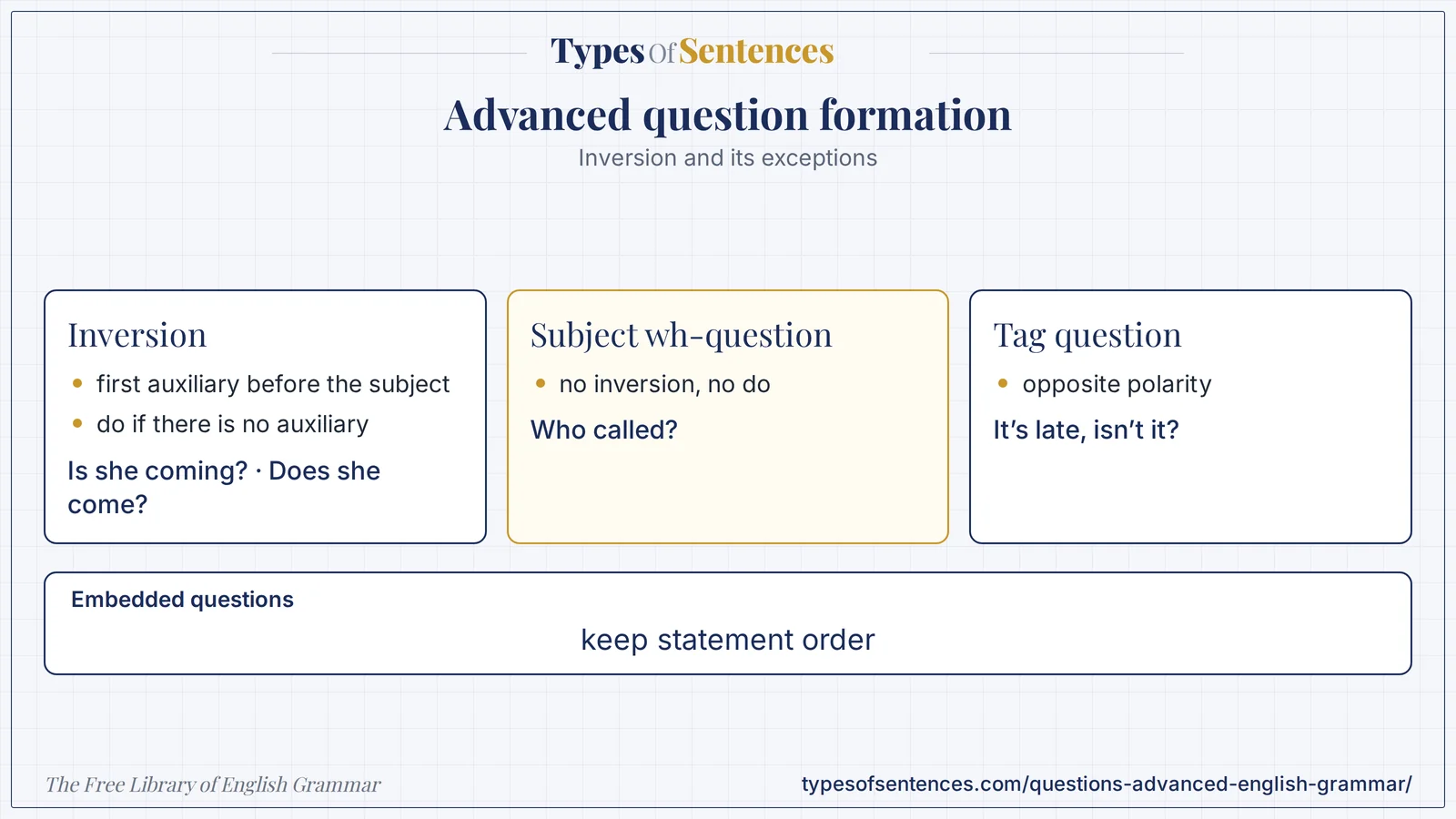
Summary: Main-clause questions invert the first auxiliary and the subject (Is she coming?), using do when there is no auxiliary (Does she come?); a wh-word comes first, but a subject wh-word needs no inversion (Who called?). Embedded questions keep statement order (I wonder where she is). Questions come in many types: yes/no, wh, alternative, tag, echo, negative, indirect, and rhetorical. The type conveys function and attitude: bias, politeness, surprise, or an assertion in disguise.
- Inversion in main-clause questions; statement order in embedded ones.
- Subject wh-questions: no do (Who called?).
- Tags: opposite polarity (It’s late, isn’t it?); same polarity for sarcasm or interest.
- Rhetorical questions: positive = strong negative; negative = strong positive.
What You’ll Learn
- 1. Advanced Question Formation: Types of Questions
- 2. Complex Wh-Questions
- 3. Indirect Questions and Polite Forms
- 4. Negative Questions
- 5. Echo Questions
- 6. Tag Questions: Advanced Uses
- 7. Rhetorical Questions
- 8. Questions as Speech Acts
- 9. Intonation and Punctuation of Questions
- 10. Common Errors in Question Formation
- 11. Exercises
- 12. Test Your Knowledge
- 13. Frequently Asked Questions
- 14. Conclusion
1. Advanced Question Formation: Types of Questions
| Type | Form | Example | Typical function |
|---|---|---|---|
| yes/no | auxiliary + subject + verb | Is she coming? Does she like tea? Have you finished? | neutral request for yes or no |
| wh- | wh-word + inverted auxiliary | Where is she? What did you buy? Why are they late? | request for information |
| subject wh- | wh-word as subject; no inversion | Who called? What happened? | — |
| alternative | yes/no question with or | Do you want tea or coffee? Is it red or blue? | a choice |
| tag | statement + inverted auxiliary + pronoun | It’s late, isn’t it? | confirmation |
| declarative (rising intonation) | statement order with a rising tone | You’re leaving? | surprise; checking |
| echo | repeats a prior utterance | You did WHAT? A what? | clarification; surprise |
| negative | negative auxiliary | Didn’t you know? Isn’t it lovely? | bias; surprise |
| indirect (embedded) | statement order in a clause | Could you tell me where she is? | politeness |
| rhetorical | any form | Who knows? Isn’t it obvious? | assertion without an answer |
The inversion of the first auxiliary is the same rule as in the chapter on inversion, and the do-support is part of the NICE properties in the chapter on advanced verb concepts. The rest of this chapter looks at what each type adds.
2. Complex Wh-Questions
| Pattern | Example | Notes |
|---|---|---|
| multiple wh-words | Who bought what? Who said what to whom? Where did you meet whom? | only one wh-word is fronted; the others stay in place; the answer is a list of pairs: Maria bought bread; Tom bought milk. |
| long-distance (extracted) | What do you think she said? Who do you believe she met? Where do you expect him to be? | the wh-word comes from a subordinate clause; the main verb takes do-support; the embedded clause has statement order |
| preposition stranded | Who did you speak to? What are you looking at? | informal and normal |
| preposition fronted (formal) | To whom did you speak? At what are you looking? (rare) | formal; only with whom and which |
| who vs whom | Who did you see? / Whom did you see? (formal) | whom as object is formal; after a preposition it is required in fronted form |
| which vs what | Which book do you want? (a limited set) / What book do you want? (open) | which for a known set |
| how compounds | How many people came? How long did it take? How often do you go? | — |
| how come | How come you’re late? | no inversion; informal; means why |
| emphatic wh-questions | What on earth are you doing? Why ever not? Whoever called? | intensifiers (on earth, ever) |
| whose | Whose book is this? Whose is this? | possessive wh-word |
| Statement order (embedded) | Inversion (main clause) |
|---|---|
| Do you know where she lives? | Where does she live? |
| I wonder what he wants. | What does he want? |
| Can you tell me how much it costs? | How much does it cost? |
| Where do you think she lives? | — |
| Who do you say called? | — |
3. Indirect Questions and Polite Forms
| Direct | Indirect (polite) | Notes |
|---|---|---|
| Where is the station? | Could you tell me where the station is? | the embedded clause has statement order |
| What time is it? | Do you know what time it is? | the main clause inverts; the embedded does not |
| Is she coming? | I wonder whether (if) she is coming. | a statement: no question mark |
| Where does he live? | Do you happen to know where he lives? | happen to softens |
| Can I park here? | I was wondering if I could park here. | past progressive for remoteness |
| Where is the bathroom? | Would you mind telling me where the bathroom is? | mind + -ing |
| Is it possible to change seats? | Is it possible for me to change seats? | — |
| Degree of directness | Example |
|---|---|
| direct | Where is the station? |
| conventionally indirect | Can you tell me where the station is? |
| more indirect | Could you possibly tell me where the station is? |
| very indirect (a statement) | I wonder if you could tell me where the station is. |
| hint | I’m trying to find the station. |
A question that contains an indirect question ends with a question mark if the main clause is a question (Do you know where she lives?) and with a period if the main clause is a statement (I wonder where she lives.). Politeness is achieved by embedding, by modal remoteness (could, would), and by hedges. The modal forms are explained in the chapter on modality.
4. Negative Questions
| Question | Bias or implication | Example context |
|---|---|---|
| Do you like it? | neutral | a genuine question |
| Don’t you like it? | the speaker expected yes (surprise or disappointment) | You are not eating it. |
| Do you not like it? (formal) | the same, more emphatic or formal | — |
| Isn’t it lovely? | the speaker expects agreement | an exclamation in the form of a question |
| Haven’t you finished yet? | surprise or impatience | — |
| Wouldn’t you agree? | a request for agreement; polite | argument |
| Why don’t we go? | a suggestion | — |
| Why didn’t you say so? | criticism or reproach | — |
| Don’t you know? | disbelief | — |
| Who doesn’t like chocolate? | rhetorical: everyone likes it | — |
The answers to negative questions cause trouble. In English the answer agrees with the facts: Don’t you like it? — Yes (I do like it) or No (I don’t like it). In some languages the answer agrees with the question, so a learner may say Yes to mean “Yes, you are right, I do not like it.” A safe answer repeats the clause: Yes, I do or No, I don’t. The negation itself is explained in the previous chapter.
5. Echo Questions
| Type | Example | Function |
|---|---|---|
| recapitulatory echo (yes/no) | A: I saw Tom. B: You saw Tom? | checks that the hearer understood |
| echo with a wh-word in place | A: She’s moving to Oslo. B: She’s moving to where? | asks for a repetition of a missed word |
| surprise echo | A: He won a million dollars. B: He won WHAT? | expresses disbelief |
| partial echo | A: She bought a Ferrari. B: A what? | — |
| declarative question | You’re leaving? | statement order; rising intonation |
| short forms | Huh? Pardon? Come again? Sorry? | a request for repetition |
| echo with do | A: I never said that. B: You never said that? | — |
An echo question keeps the order of a statement and repeats the part of the previous utterance that the speaker wants to query. The stress and intonation show whether it asks for clarification or shows surprise: You did WHAT? (stress on what, a rise). They are common in spoken English and rare in formal writing, except in dialogue.
6. Tag Questions: Advanced Uses
| Pattern | Example | Notes |
|---|---|---|
| positive statement + negative tag | You like it, don’t you? | confirmation; the usual pattern |
| negative statement + positive tag | You don’t like it, do you? | — |
| positive + positive (same polarity) | So you like it, do you? You’ve got a new car, have you? | sarcasm, suspicion, or interest |
| negative + negative | You don’t like it, don’t you? (rare) | sarcastic |
| I am | I am late, aren’t I? (aren’t I) | amn’t I only in Scottish and Irish English |
| imperative | Open the door, will you? Don’t be late, will you? Let’s go, shall we? | a polite or insistent request |
| there | There is a problem, isn’t there? | there repeats |
| negative words take positive tags | Nobody called, did they? He hardly came, did he? | the clause is already negative |
| this and that | That’s good, isn’t it? | it in the tag |
| everyone, someone, no one | Everyone left, didn’t they? | they |
| modals and semi-modals | You can swim, can’t you? You ought to go, shouldn’t you? You had better go, hadn’t you? | repeat the first auxiliary |
| I think, I suppose (the tag refers to the subordinate clause) | I don’t think he’s coming, is he? I suppose she’s right, isn’t she? | — |
| invariant tags (informal) | You’re coming, right? It’s good, eh? You’ll help, okay? It’s late, innit? (British informal) | — |
| Intonation | Meaning | Example |
|---|---|---|
| rising | a real question; the speaker is not sure | You’re coming, aren’t you? (↗) |
| falling | confirmation; the speaker expects agreement | It’s a lovely day, isn’t it? (↘) |
| rising with negative tag after a positive | polite request or hesitant check | You couldn’t help me, could you? |
| rising with same polarity | suspicion or surprise | So you took it, did you? |
The tag always has a pronoun and an auxiliary. When the statement has no auxiliary, the tag uses do: She likes tea, doesn’t she? In a tag after a negative-bearing word (hardly, rarely, nobody), the tag is positive. A tag can also soften a request or express uncertainty, in which case it is a matter of tone and not only of grammar; see the chapter on pragmatics.
7. Rhetorical Questions
| Rhetorical question | Meaning | Rule |
|---|---|---|
| Who knows? | Nobody knows. | positive question = strong negative statement |
| Is that fair? | That is not fair. | — |
| What difference does it make? | It makes no difference. | — |
| Who cares? | Nobody cares. | — |
| Isn’t it obvious? | It is obvious. | negative question = strong positive statement |
| Who doesn’t like chocolate? | Everybody likes chocolate. | — |
| Haven’t I told you a hundred times? | I have told you many times. | — |
| How should I know? | I don’t know. | a defensive rhetorical reply |
| What’s the point? | There is no point. | — |
| Function | Example | Context |
|---|---|---|
| persuasion | Can we afford to wait? Do we want our children to inherit this? | speeches and editorials |
| challenge | Who are you to tell me what to do? | argument |
| irony and humor | Could it be any hotter? | speech |
| topic-opener (answered by the writer) | What causes inflation? Two factors are important. | academic and popular writing |
| involvement of the reader | Have you ever wondered why the sky is blue? | introductions |
A rhetorical question uses the form of a question to make a statement. Polarity items such as any and ever are possible in positive rhetorical questions (Who cares about any of this?), a sign that the speaker means a negative. In writing, rhetorical questions engage the reader but should be used sparingly: a series of them can seem manipulative. A question that the writer answers immediately, as a signpost, is a legitimate device in explanation and in teaching, and is treated among other rhetorical devices in a later chapter.
8. Questions as Speech Acts
| Form | Act | Example |
|---|---|---|
| Can/Could you …? | request | Could you open the window? |
| Would you mind …ing? | polite request | Would you mind closing the door? |
| Will you …? | request or order | Will you be quiet? |
| Would you like …? | offer | Would you like some tea? |
| Shall I …? | offer | Shall I help you? |
| Shall we …? Why don’t we …? What about …? | suggestion | Shall we go? What about a walk? |
| Why don’t you …? | advice | Why don’t you ask her? |
| Do you want to …? | invitation | Do you want to come? |
| Isn’t it …? | invitation to agree | Isn’t it lovely? |
| Do you mind if I …? | request for permission | Do you mind if I sit here? |
Offers use some and not any because they expect a positive answer (Would you like some tea?), while a neutral question uses any (Do you have any tea?). The choice of modal (can, could, would) controls the degree of politeness. A listener usually answers the act, not the form: Can you open the window? — Sure is an answer to a request, not to a question about ability.
9. Intonation and Punctuation of Questions
| Situation | Punctuation | Example |
|---|---|---|
| direct question | question mark | Where is she? |
| indirect question in a statement | period | She asked where I lived. I wonder where she is. |
| statement containing an indirect question, but asked as a question | question mark | Do you know where she lives? |
| series of questions | question mark after each, capitalized | Where? When? Why? |
| series within one sentence | one question mark at the end | Where, when, and why did it happen? |
| rhetorical question | question mark | Who knows? |
| polite request in question form | question mark (or period in some styles) | Could you send me the report? |
| quoted question | question mark inside the quotation | “Where are you going?” she asked. |
| emphatic combination | ?! in informal writing | You did what?! |
In speech, rising intonation marks yes/no questions, tags of real doubt, and echo questions; falling intonation marks wh-questions, tags of confirmation, and rhetorical questions. In formal writing, the question mark is enough, and the use of ?! and multiple question marks should be avoided.
10. Common Errors in Question Formation
| Error | Correction | Rule |
|---|---|---|
| Where you are going? | Where are you going? | inversion |
| What you want? | What do you want? | do-support |
| Did you went? | Did you go? | base form after did |
| Who did called? | Who called? | no do with a subject wh-word |
| I wonder where is he. | I wonder where he is. | statement order in an embedded question |
| Do you know where is the station? | Do you know where the station is? | — |
| He asked what did I want. | He asked what I wanted. | reported question |
| Why you are late? | Why are you late? | inversion |
| How much it costs? | How much does it cost? | — |
| You are late, isn’t it? | You are late, aren’t you? | the tag repeats the auxiliary and the subject |
| She likes tea, isn’t she? | She likes tea, doesn’t she? | do in the tag |
| Nobody called, didn’t they? | Nobody called, did they? | a negative word takes a positive tag |
| You didn’t see him, did you? — Yes. (meaning: I did not) | No, I didn’t. | answer the fact |
| Where do you think where she lives? | Where do you think she lives? | one wh-word |
Edit: Where you are going, and what you want, and did you went, and who did called, and I wonder where is he, and do you know where is the station, and she likes tea, isn’t she, and nobody called, didn’t they?
- Where you are going: Where are you going.
- what you want: what do you want.
- did you went: did you go.
- who did called: who called.
- I wonder where is he: I wonder where he is.
- do you know where is the station: do you know where the station is.
- isn’t she: doesn’t she.
- didn’t they: did they.
- Result: Where are you going, and what do you want, and did you go, and who called? I wonder where he is. Do you know where the station is? She likes tea, doesn’t she? Nobody called, did they?
Recap in 12 seconds
Watch the lesson build itself: Main-clause questions invert the auxiliary; subject wh-questions do not; tags use opposite polarity. The video has no sound.
Exercises
Part A: Forms and Inversion (Exercises 1–7)
Exercise 1: Form a question: She has finished.
Show Answer
Answer: Has she finished?
Exercise 2: Form a question: She likes tea.
Show Answer
Answer: Does she like tea?
Exercise 3: Form a question about the subject: Someone called.
Show Answer
Answer: Who called?
Exercise 4: Edit: Where you are going?
Show Answer
Answer: Where are you going?
Exercise 5: Edit: Who did called?
Show Answer
Answer: Who called?
Exercise 6: Edit: Did you went?
Show Answer
Answer: Did you go?
Exercise 7: Name the type: Do you want tea or coffee?
Show Answer
Answer: An alternative question.
Part B: Complex Wh-Questions and Indirect Questions (Exercises 8–14)
Exercise 8: Explain the answer to Who bought what?
Show Answer
Answer: A list of pairs (person + item).
Exercise 9: Edit: I wonder where is he.
Show Answer
Answer: I wonder where he is.
Exercise 10: Make polite: Where is the station? (Could you tell me …)
Show Answer
Answer: Could you tell me where the station is?
Exercise 11: Edit: Do you know where is the station?
Show Answer
Answer: Do you know where the station is?
Exercise 12: Name the construction: Where do you think she lives?
Show Answer
Answer: A long-distance (extracted) wh-question.
Exercise 13: Choose: (Who/Whom) did you see? (formal)
Show Answer
Answer: Whom.
Exercise 14: Does how come take inversion: How come you’re late?
Show Answer
Answer: No.
Part C: Negative and Echo Questions (Exercises 15–19)
Exercise 15: What does Don’t you like it? imply?
Show Answer
Answer: The speaker expected you to like it.
Exercise 16: Give a safe answer to Don’t you like it? (you do like it)
Show Answer
Answer: Yes, I do.
Exercise 17: Name the type: You did WHAT?
Show Answer
Answer: An echo question (surprise).
Exercise 18: Name the type: She’s moving to where?
Show Answer
Answer: An echo question with a wh-word in place.
Exercise 19: Name the type: You’re leaving?
Show Answer
Answer: A declarative question.
Part D: Tags (Exercises 20–25)
Exercise 20: Add a tag: You like it, ___?
Show Answer
Answer: don’t you.
Exercise 21: Add a tag: I am late, ___?
Show Answer
Answer: aren’t I.
Exercise 22: Add a tag: Nobody called, ___?
Show Answer
Answer: did they.
Exercise 23: Add a tag: Let’s go, ___?
Show Answer
Answer: shall we.
Exercise 24: Edit: You are late, isn’t it?
Show Answer
Answer: You are late, aren’t you?
Exercise 25: What does rising intonation on a tag show?
Show Answer
Answer: A real question.
Part E: Rhetorical Questions and Speech Acts (Exercises 26–30)
Exercise 26: Restate: Who knows?
Show Answer
Answer: Nobody knows.
Exercise 27: Restate: Isn’t it obvious?
Show Answer
Answer: It is obvious.
Exercise 28: Name the act: Would you like some tea?
Show Answer
Answer: An offer.
Exercise 29: Why is some used in offers?
Show Answer
Answer: The speaker expects a positive answer.
Exercise 30: Punctuate: I wonder where she is
Show Answer
Answer: I wonder where she is. (a period)
Test Your Knowledge
Ready to check what you learned? Answer all 10 questions, then submit. You need 80% (8 of 10) to pass. Your answers are not stored.
View correct answers and explanations
Question 1: Which is correct?
✓ Correct Answer: C – Where are you going?
Inversion in the main clause.
Question 2: Which is correct?
✓ Correct Answer: D – Who called?
No do with a subject wh-word.
Question 3: Which is correct?
✓ Correct Answer: B – I wonder where he is.
Statement order in the embedded clause.
Question 4: Which tag is correct?
✓ Correct Answer: C – You are late, aren’t you?
Repeat the auxiliary and subject.
Question 5: Which tag is correct?
✓ Correct Answer: B – Nobody called, did they?
A negative word takes a positive tag.
Question 6: Which is a rhetorical question?
✓ Correct Answer: A – Who knows?
It means nobody knows.
Question 7: What does Don’t you like it? imply?
✓ Correct Answer: C – the speaker expected yes
Negative questions show bias.
Question 8: Which is an echo question?
✓ Correct Answer: D – You did WHAT?
It repeats and queries.
Question 9: Which is more polite?
✓ Correct Answer: B – Could you tell me where the station is?
Indirect and modal.
Question 10: Which question mark rule is correct?
✓ Correct Answer: A – I wonder where she is.
An indirect question in a statement takes a period.
Frequently Asked Questions
What is advanced question formation?
Advanced question formation is the study of the complex forms and functions of questions: multiple and long-distance wh-questions, indirect and polite questions, negative, echo, tag, and rhetorical questions.
What are advanced questions?
Advanced questions are questions that go beyond a simple yes/no or wh-question, such as Who said what to whom?, Wouldn’t you agree?, or You did WHAT?
What are complex question types?
Complex question types include multiple wh-questions, long-distance wh-questions, indirect questions, negative questions, echo questions, tag questions with the same polarity, and rhetorical questions.
What is question formation advanced learners need?
The question formation advanced learners need includes inversion with auxiliaries and do, no inversion in embedded questions, subject wh-questions, and the formation of tags.
What are interrogative structures?
Interrogative structures are the grammatical forms used to ask questions: inversion, do-support, wh-words, tags, rising intonation, and embedded clauses.
Why do some questions not expect an answer?
Rhetorical questions have the form of a question but make a statement. A positive rhetorical question suggests a negative answer (Who knows?), and a negative one a positive answer (Isn’t it obvious?).
How do I make a question polite?
Embed it (Could you tell me where …), use modal remoteness (could, would), add a hedge (by any chance, happen to), and use a rising tone.
Conclusion
You now have a deep study of questions: the types and their forms, complex wh-questions, indirect and polite questions, negative questions and their bias, echo questions, tag questions and their intonation, rhetorical questions, questions as speech acts, punctuation, and the common errors. You can form and use questions with expert control.
When you ask a question, decide what you want it to do, and then choose the form that does it. This chapter ends Part 3; next, you begin Part 4, on discourse and cohesion, with reference and deixis.
- Huddleston, Rodney, and Geoffrey K. Pullum. The Cambridge Grammar of the English Language. Cambridge University Press, 2002.: the reference analysis of interrogative clauses, tags, and echo questions.
- Quirk, Randolph, et al. A Comprehensive Grammar of the English Language. Longman, 1985.: the classic treatment of questions and tag questions.
- Biber, Douglas, et al. Longman Grammar of Spoken and Written English. Longman, 1999.: corpus evidence on questions in conversation.
- Garner, Bryan A. Garner’s Modern English Usage, 5th ed. Oxford University Press, 2022.: usage guidance on who and whom and on tags.
- Merriam-Webster Dictionary: rhetorical question: the dictionary entry.
Last reviewed: October 29, 2026. How it was made: drafted with AI assistance, then checked with automated tests (structure, links, answer keys, spelling) and against the sources above. A person has not yet read this chapter line by line. Found a mistake? Report it.