Syntax and sentence processing ask a question that grammar books seldom ask: what does a reader do, moment by moment, as a sentence arrives? A reader does not wait for the full stop and then analyze the sentence. The mind builds a structure word by word, commits to a reading as early as it can, and revises when the next word does not fit. Most of the time this works without effort, because English tends to put the information in an order that the reader’s mind expects. When it does not, the reader stumbles: The horse raced past the barn fell. The words are grammatical, yet most readers must go back.
This chapter explains sentence comprehension in practical terms. You will study how readers parse sentences incrementally and the strategies that they use, garden path sentences (temporary ambiguity) and how to repair them, structural ambiguity, heavy noun phrase shift and the preference for putting long constituents last, the limits of working memory and what they mean for embedding, and the implications for writing. Understanding how readers process sentences is the best way of understanding syntax from the reader’s side, and of understanding syntax well enough to write sentences that are easy to parse. The chapter ends with a checklist for editing. Thirty editing exercises and a quiz follow.
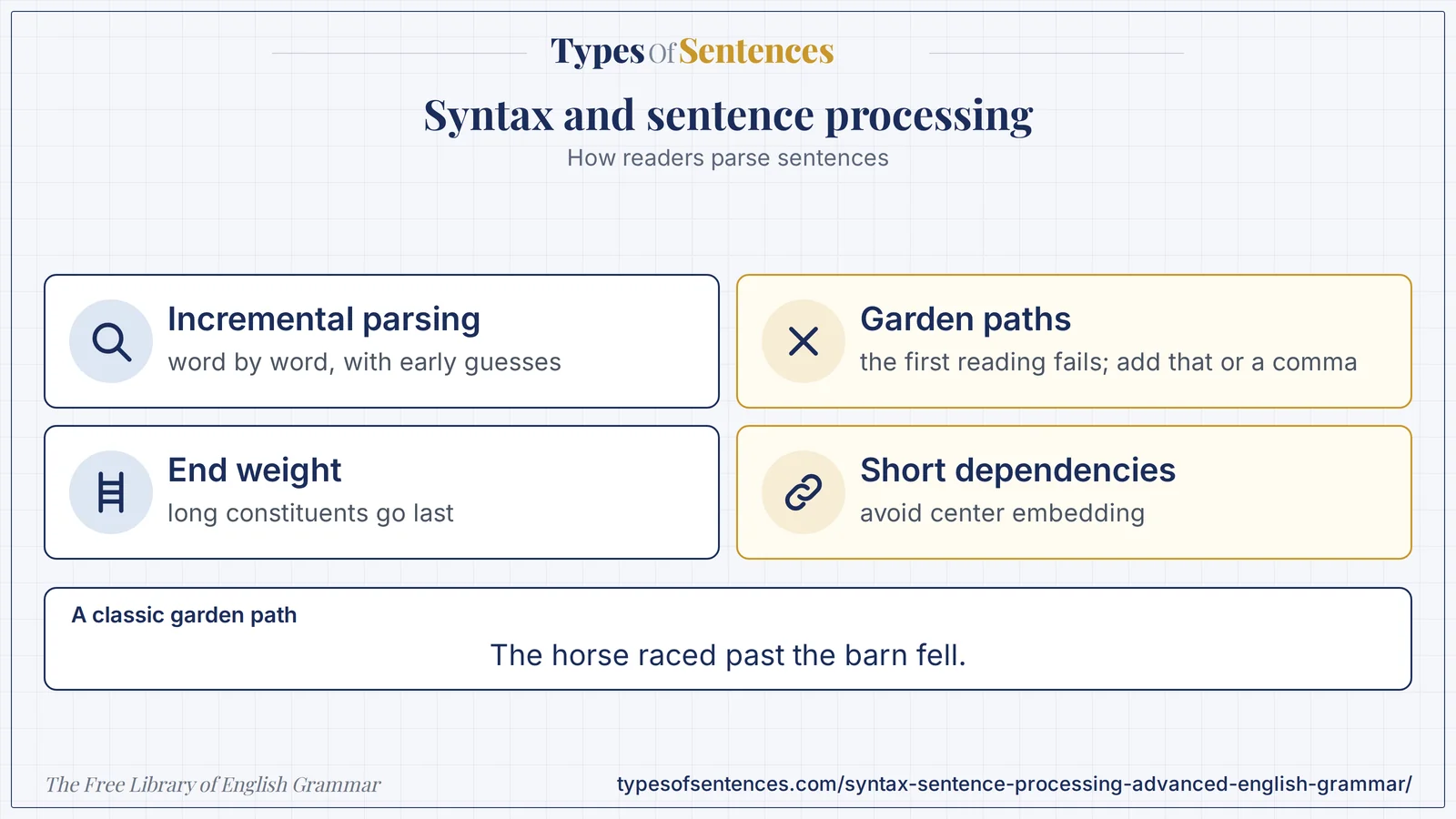
A reader builds meaning as the words come in. The reader guesses the structure early, usually by choosing the simplest reading, and goes back if the guess turns out wrong. A sentence that makes the reader go back is harder to read, even if it is correct.
Why it matters: A writer can help by putting the main subject and verb close together, putting long phrases last, marking clauses with commas and small words such as that, and avoiding sentences that invite a wrong first reading.
Summary: Readers parse sentences incrementally, committing early to the simplest structure (minimal attachment) and attaching new material to the clause that is currently being processed (late closure). When later words contradict the first reading, a garden path effect occurs and the reader must reanalyze (The horse raced past the barn fell). Structural ambiguity (I saw the man with the telescope) allows more than one reading. Short constituents are easier before long ones, so heavy noun phrases tend to move to the end (heavy NP shift; end weight). Working memory limits the depth of embedding and the distance between a word and the word it depends on; center-embedded clauses are especially hard, and right-branching structures are easier. Writers reduce the load by keeping dependencies short, signaling structure with punctuation and function words, and ordering information from known to new.
- Readers parse word by word; they guess early.
- Garden paths: the first reading fails; add that, commas, or reorder.
- Long constituents go last (end weight).
- Short dependencies; avoid center embedding.
What You’ll Learn
- 1. Syntax and Sentence Processing: How We Process Sentences
- 2. Garden Path Sentences: Temporary Ambiguity
- 3. Structural Ambiguity: Two Parses at Once
- 4. Heavy NP Shift and the Principle of End Weight
- 5. Working Memory and Syntax: Complexity Limits
- 6. Implications for Writing: Reader-Friendly Syntax
- 7. Common Problems and a Worked Example
- 8. Exercises
- 9. Test Your Knowledge
- 10. Frequently Asked Questions
- 11. Conclusion
1. Syntax and Sentence Processing: How We Process Sentences
| Idea | Meaning | Example |
|---|---|---|
| incremental processing | the reader interprets each word as it arrives and builds a structure at once | after The horse raced … the reader already treats raced as the main verb |
| parsing | assigning grammatical structure to a string of words | finding the subject, verb, and object |
| commitment | choosing one analysis before the sentence is complete | the first reading |
| reanalysis (repair) | going back and revising when the first reading fails | a regression in eye movements; a longer reading time |
| expectation (prediction) | the reader anticipates the next word or structure | after Neither, the reader expects nor |
| working memory | the limited capacity for holding unfinished material | holding a subject until its verb arrives |
| constraint | information that favors one analysis (word frequency, plausibility, context, punctuation, intonation) | The defendant examined by the lawyer versus The evidence examined by the lawyer |
| processing cost | the extra effort that a structure requires | center-embedded clauses |
| reading time | a measure used in experiments | longer reading time at a difficult word |
| eye tracking and brain recordings | methods used to study processing | regressions to earlier words; event-related potentials |
| Parsing strategy (proposed in garden-path research, Frazier and others) | What it says | Example |
|---|---|---|
| minimal attachment | prefer the analysis with the fewest nodes (the simplest structure) | She put the book on the table. reads on the table as where she put it |
| late closure | attach new words to the clause or phrase currently being processed | While Anna dressed the baby … the reader takes the baby as the object of dressed |
| subject-first preference | take the first noun phrase as the subject | The editor the author praised … is harder than The editor praised the author |
| argument over adjunct | prefer a phrase that completes a verb’s needs over one that only adds information | He gave the book to the man |
| frequency and lexical bias | prefer the more common usage of an ambiguous word | raced as a simple past verb rather than a participle |
| plausibility | prefer the analysis that makes sense | The key opened the door (not The door opened the key) |
| context and discourse | prefer the analysis that fits the preceding sentences | — |
| prosody | in speech, intonation marks the structure; in writing, punctuation does | Let’s eat, Grandma. |
Models of sentence processing differ. Serial models propose that the reader builds one analysis at a time, guided by strategies such as minimal attachment; constraint-based models propose that the reader weighs many sources of evidence at once and holds several analyses in parallel. The evidence supports a combination. For writers the practical point is the same: readers form a first reading quickly and are sensitive to every cue, so the writer should give the right cues early. This view is consistent with the account of how sentences are organized for readers in the chapter on information structure.
2. Garden Path Sentences: Temporary Ambiguity
A garden path sentence is a grammatical sentence that leads the reader to an initial analysis that proves wrong, so that the reader must go back. The name comes from the phrase “to lead someone down the garden path”. The ambiguity is temporary: by the end of the sentence only one reading is possible.
| Garden path sentence | What the reader first thinks | Actual structure | Repair |
|---|---|---|---|
| The horse raced past the barn fell. | raced is the main verb; The horse raced past the barn is a sentence | a reduced relative clause: The horse (that was) raced past the barn is the subject; fell is the main verb | The horse that was raced past the barn fell. |
| The old man the boats. | old is an adjective and man a noun | The old is a noun phrase (the elderly); man is the verb | The elderly crew the boats. |
| The complex houses married and single soldiers. | complex is an adjective and houses a noun | complex is a noun; houses is a verb | The complex provides houses for married and single soldiers. |
| While Anna dressed the baby spit up on the bed. | the baby is the object of dressed | dressed is intransitive; the baby begins a new clause | While Anna dressed, the baby spit up on the bed. |
| While the man hunted the deer ran into the woods. | the deer is what he hunted | hunted is intransitive | While the man hunted, the deer ran into the woods. |
| The teacher told the students the exam was easy. | the students the exam is a double object | the exam was easy is a clause: what she told them | The teacher told the students that the exam was easy. |
| The soldiers sent the message were delighted. | sent is the main verb | (who were) sent the message is a reduced relative clause | The soldiers who were sent the message were delighted. |
| The cotton clothing is made of grows in Mississippi. | cotton clothing is the subject and is made of a predicate | (the cotton that) clothing is made of is a relative clause | The cotton from which clothing is made grows in Mississippi. |
| Fat people eat accumulates. | Fat people is the subject and eat the verb | (what) fat people eat is the subject: accumulates is the verb | The fat that people eat accumulates. |
| The prime number few. | prime number is a noun phrase | The prime is a noun phrase; number is a verb (few an object) | — |
| I convinced her children are noisy. | her children is the object | her is the object, children are noisy a clause | I convinced her that children are noisy. |
| Until the police arrest the drunk driver is a danger. | the drunk driver is the object | arrest is intransitive; the drunk driver is the subject of is | Until the police arrest, the drunk driver is a danger. |
| The man who hunts ducks out on weekends. | ducks is the object of hunts | ducks is a verb (to duck out) | The man who hunts goes away on weekends. |
| Time flies like an arrow; fruit flies like a banana. | flies is a verb in both | fruit flies is a noun phrase, like a verb | — |
| After the musician played the piano was wheeled off the stage. | the piano is the object of played | played is intransitive | After the musician played, the piano was wheeled off the stage. |
| Source of the garden path | Pattern | Example |
|---|---|---|
| reduced relative clause | participle without that was | The student given the book left. |
| transitive verb used intransitively | a clause boundary missing a comma | While she wrote the letter arrived. |
| noun phrase versus clause object | a verb that takes both (know, believe, tell) | He knew the answer was wrong. |
| category ambiguity | a word that is a noun and a verb | The old man the boats. |
| relative pronoun omission | zero relative | The report the committee wrote surprised everyone. (fine) versus The report the committee wrote was published late (still fine) |
| coordination | where the coordinated phrase begins | The mother of the child and her husband |
| prepositional phrase attachment | verb or noun attachment | He put the apple on the table in the kitchen. |
| Repair technique | Example |
|---|---|
| add that or who | The teacher told the students that the exam was easy. |
| add the full relative clause (that was) | The horse that was raced past the barn fell. |
| add a comma after an introductory clause | While Anna dressed, the baby … |
| reorder | The baby spit up on the bed while Anna dressed. |
| use a different verb | The soldiers who received the message were delighted. |
| add a determiner or a connector | The old people man the boats. |
| break the sentence in two | — |
| read it aloud and fix any stumble | — |
Garden path sentences are curiosities, but they illustrate a principle that applies to every sentence: the reader’s first guess is usually the most frequent, simplest structure, so a sentence is hard to read to the extent that it requires the less frequent structure without warning. Commas and function words are the writer’s signals. See also the chapter on sentence variety for how the length and structure of sentences affect the reader.
3. Structural Ambiguity: Two Parses at Once
| Sentence | Reading 1 | Reading 2 | Source of ambiguity |
|---|---|---|---|
| I saw the man with the telescope. | I used a telescope to see him. | The man had the telescope. | prepositional phrase attachment (verb or noun) |
| Flying planes can be dangerous. | The activity of flying is dangerous. | Planes that are flying are dangerous. | flying as a gerund or an adjective |
| Visiting relatives can be boring. | To visit relatives is boring. | Relatives who visit are boring. | gerund or participle |
| The chicken is ready to eat. | The chicken can eat. | The chicken can be eaten. | the understood subject of the infinitive |
| Old men and women left. | Old men and old women. | Old men and women (of any age). | scope of the adjective in coordination |
| She told him to leave in the morning. | The leaving is in the morning. | The telling is in the morning. | attachment of the adverbial |
| The shooting of the hunters was terrible. | The hunters shot badly. | The hunters were shot. | subjective or objective genitive |
| I like cooking apples. | I like to cook apples. | I like apples used for cooking. | compound or phrase |
| The daughter of the colonel who was on the balcony waved. | The colonel was on the balcony. | The daughter was on the balcony. | relative clause attachment |
| Plastic bottle maker | a maker of plastic bottles | a bottle maker who is plastic | noun compound structure |
| They fed her dog biscuits. | They fed dog biscuits to her. | They fed her dog some biscuits. | double object or noun phrase |
| The police were told to stop drinking after midnight. | the stopping happens after midnight | the telling happens after midnight | adverbial attachment |
| Students and teachers who are late must sign in. | both groups who are late | only the teachers who are late | scope of the relative clause |
| I didn’t go because I was tired. | I stayed at home, and the reason was tiredness. | I went, but not because I was tired. | scope of negation |
| Local (temporary) ambiguity | Global (permanent) ambiguity |
|---|---|
| resolved by later words in the same sentence | remains after the whole sentence |
| the garden path: The horse raced past the barn fell. | I saw the man with the telescope. |
| affects processing | affects interpretation |
| fixed with punctuation or function words | fixed by rewording or context |
Structural ambiguity is treated fully in the next-but-one chapter, on ambiguity in English. In processing terms, the reader usually chooses one reading, often the one preferred by the parsing strategies (for example the attachment of a prepositional phrase to the verb), and may not notice the other. A writer who needs to avoid the second reading must remove it explicitly.
4. Heavy NP Shift and the Principle of End Weight
| Principle | Statement | Source |
|---|---|---|
| end weight | put long, complex constituents at the end of the clause | Quirk et al., 1985 |
| law of increasing members (Behaghel) | in a series, the shorter members come before the longer | Otto Behaghel, 1909 |
| early immediate constituents (Hawkins) | the parser prefers word orders that let it recognize the main constituents of a phrase as early as possible | John Hawkins, 1994 |
| given before new | known information precedes new information, and new information is often longer | see the chapter on information structure |
| Basic order (long phrase in the middle) | Heavy NP shift (long phrase last) | Why it is easier |
|---|---|---|
| She gave a collection of rare seventeenth-century manuscripts to the library. | She gave to the library a collection of rare seventeenth-century manuscripts. | the short phrase to the library comes early; the verb and its complements are recognized quickly |
| He explained the complicated procedure that the committee had devised to the new employees. | He explained to the new employees the complicated procedure that the committee had devised. | the long object is last |
| They put the book that he had bought in Paris last week on the table. | They put on the table the book that he had bought in Paris last week. | the verb’s other requirement (on the table) appears at once |
| He picked the heavy suitcase that she had left in the hall up. | He picked up the heavy suitcase that she had left in the hall. | a particle verb: a long object comes after the particle |
| A man who wanted to see you came in. | A man came in who wanted to see you. | extraposition of the relative clause |
| That the plan would fail was obvious. | It was obvious that the plan would fail. | extraposition of a long subject clause (it as a placeholder) |
| To finish the project on time under these conditions is difficult. | It is difficult to finish the project on time under these conditions. | extraposition of an infinitive clause |
| She told the story of her trip to Kenya to the children. | She told the children the story of her trip to Kenya. | double object order: the shorter goes first |
| Order of a short and a long object | Preferred pattern |
|---|---|
| give + short recipient + long theme | give her a very long and detailed explanation (short first) |
| give + long recipient + short theme | give it to the committee that reviews all such requests (the long recipient comes last, in a to phrase) |
| particle verbs | pick it up (a pronoun object goes between); pick up the large box of old files (a long object follows the particle) |
| verb + object + adverbial | She read the report carefully versus She read carefully the long report that her manager had written |
| subject clause | It is clear that … rather than That … is clear |
Heavy NP shift and extraposition show that English grammar offers alternative orders and that the choice between them is guided by the processing cost. Writers can use the same principle: if a sentence feels top-heavy or the verb is far from its object, move the long constituent to the end or replace it with a short one (it). The treatment of such alternatives in terms of fronting and postponement is in the chapter on fronting and postponement.
5. Working Memory and Syntax: Complexity Limits
| Structure | Example | Difficulty |
|---|---|---|
| right-branching (new material added at the end) | This is the dog that chased the cat that ate the rat that lived in the house. | easy: each clause can be closed before the next begins |
| left-branching (long material before the head) | The man whose brother’s wife’s sister’s husband I met yesterday … | moderate to hard |
| center-embedding (a clause inside the subject–verb span) | The rat the cat the dog chased killed ate the malt. | very hard: three subjects must be held until three verbs arrive |
| single center-embedding | The rat the cat killed ate the malt. | manageable but harder than the right-branching version |
| object relative clause | The reporter who the senator attacked admitted the error. | harder than a subject relative |
| subject relative clause | The reporter who attacked the senator admitted the error. | easier |
| long-distance dependency | What did you say that she thought he wanted? | cost increases with distance |
| stacked noun modifiers | the university student housing policy review committee report | hard: structure must be reconstructed |
| nested conditionals | If the plan, which, if approved, will cost more than planned, fails, … | hard |
| interrupting parentheticals | The report, which the committee, after long debate, approved, is long. | moderate |
| Concept | Meaning | Source or comment |
|---|---|---|
| working memory | a limited system for holding and manipulating information over a short time | Baddeley and Hitch (1974) |
| chunk limit | people can hold only a few chunks at once, estimated at about seven plus or minus two (Miller, 1956) and later at about four (Cowan, 2001) | estimates vary with the task |
| dependency length | the number of words between a word and the word it depends on; longer dependencies cost more | Gibson’s dependency locality theory (1998, 2000) |
| storage cost | the cost of keeping an unfinished dependency open | — |
| integration cost | the cost of connecting a new word to what is held | — |
| discourse referents | new entities that must be tracked add cost | — |
| interference | similar items in memory confuse each other | The lawyer the banker hired … (two similar noun phrases) |
| individual differences | readers differ in working-memory capacity, and in experience with complex prose | — |
| second-language processing | processing is slower and more affected by structure | — |
| Technique to reduce memory load | Example |
|---|---|
| keep subject and verb close | The committee approved the plan after a long debate. (not The committee, after a long debate about many issues, approved the plan.) |
| avoid center-embedding | The cat that the dog chased killed the rat. instead of three nested clauses |
| use right-branching and add clauses at the end | This is the cat that killed the rat that ate the malt. |
| break a long sentence into two | — |
| use a list with a lead-in | — |
| repeat the noun instead of a long pronoun chain | — |
| use active voice to keep the actor and action together | — |
| use signposts | There are three reasons. First, … |
| avoid long noun strings | the review committee for university housing policy |
The limit is not a limit on grammar, since the grammar allows unlimited embedding; it is a limit on what readers can process. This is why a sentence can be grammatical and unreadable. The practical corollary, that complexity should be arranged so that the reader can close each unit before opening the next, is the subject of the next chapter on complex sentence architecture, and is consistent with the readability guidelines in the chapter on readability.
6. Implications for Writing: Reader-Friendly Syntax
| Guideline | Why it helps | Before | After |
|---|---|---|---|
| keep the subject near its verb | less to hold in memory | The committee, which had been formed in March to investigate complaints about the new system, published its report. | The committee published its report. It had been formed in March to investigate complaints about the new system. |
| put long phrases last | end weight | She gave to a new student who had just arrived from another country a map. | She gave a map to a new student who had just arrived from another country. |
| add that where it helps | avoids a wrong first reading | He told his boss the report was late. | He told his boss that the report was late. |
| use commas after introductory clauses | marks the clause boundary | While she cooked the soup boiled over. | While she cooked, the soup boiled over. |
| avoid center-embedding | less to hold | The report the committee the council appointed wrote was long. | The council appointed a committee. The committee wrote a long report. |
| avoid reduced relatives that look like main verbs | prevents garden paths | The horse raced past the barn fell. | The horse that was raced past the barn fell. |
| place modifiers next to what they modify | avoids ambiguity | He saw a man in a car with a beard. | He saw a bearded man in a car. |
| use parallel structure | the parser predicts the pattern | She likes to swim, hiking, and cycling. | She likes swimming, hiking, and cycling. |
| mark coordination clearly | shows scope | old men and women | old men and old women (or women and old men) |
| avoid long noun strings | hard to reconstruct | local government housing policy review committee chairman | the chairman of the committee reviewing local housing policy |
| use extraposition for long subjects | avoids a top-heavy clause | That the committee, after months of study, had still not reached a decision surprised everyone. | It surprised everyone that the committee had still not reached a decision after months of study. |
| use signposts | sets expectations | — | The report has three parts: … |
| order information from known to new | easier integration | — | see the chapter on information structure |
| prefer the active voice with a clear agent | actor and action together | The decision to close the office was made by the board. | The board decided to close the office. |
| read aloud and fix stumbles | the ear detects processing problems | — | — |
- Read your draft slowly, as a reader who does not know what comes next.
- Mark every place where you stumble or have to reread.
- Diagnose the cause: a garden path, an ambiguous attachment, a long dependency, a center-embedded clause, or a top-heavy phrase.
- Apply the repair: add a signal, reorder, split, or simplify.
- Test with a reader who has not seen the text.
- Check again after revision, because repairs can create new problems.
| Context | Processing consideration |
|---|---|
| instructions and safety text | readers act on a first reading; avoid any ambiguity or garden path |
| legal and technical text | long sentences need lists and clear scope markers (see the chapters on legal and technical writing) |
| headlines | telegraphic style invites garden paths: Police Help Dog Bite Victim |
| speech | listeners cannot reread; use short sentences, repetition, and clear prosody |
| translation and second-language readers | plain structure and clear markers |
| digital text on small screens | shorter sentences and clearer markers |
7. Common Problems and a Worked Example
| Problem | Example | Repair |
|---|---|---|
| garden path | The soldiers sent the message were delighted. | The soldiers who were sent the message were delighted. |
| missing comma | After the musician played the piano was moved. | After the musician played, the piano was moved. |
| missing that | I told her the meeting was canceled. | I told her that the meeting was canceled. |
| subject far from the verb | The manager, who had worked there for twenty years and who knew everyone, resigned. | The manager resigned. She had worked there for twenty years and knew everyone. |
| center-embedding | The man the woman the child saw met left. | The child saw a woman who met a man who left. |
| ambiguous attachment | He photographed the girl with the camera. | Using a camera, he photographed the girl. |
| top-heavy phrase | The proposal to extend the opening hours of the library to midnight during the examination period was approved. | The board approved the proposal to extend library hours to midnight during exams. |
| noun string | the university student housing committee review | the review by the university committee on student housing |
| long dependency | What do you think that she said that he wanted? | What do you think she said? |
| reduced relative with an ambiguous verb | The books left on the table disappeared. | The books that were left on the table disappeared. |
| ambiguous coordination | pickled onions and eggs | pickled onions and pickled eggs |
| too many parentheticals | The report, which, as you know, was late, was good. | The late report was good. |
| negation scope | All the students did not pass. | Not all the students passed. |
| headline ambiguity | Squad Helps Dog Bite Victim | Squad helps victim of dog bite |
| an object relative that is hard to track | The report the committee the council appointed wrote was long. | The council appointed a committee, which wrote a long report. |
Edit: The committee the council appointed wrote the report the minister the opposition criticized had requested and while the chairman read the document was passed around, and she told the members the vote would be late, and the old man the proposals, which, after long debate about the old plan, were approved.
- The committee the council appointed wrote the report the minister the opposition criticized had requested: two center-embeddings: The council appointed a committee, which wrote the report that the minister had requested. The opposition had criticized the minister.
- while the chairman read the document was passed around: a garden path (read is intransitive here): While the chairman read, the document was passed around.
- she told the members the vote would be late: she told the members that the vote would be late.
- the old man the proposals: a category garden path: the elders drafted the proposals (or the old man drafted the proposals).
- the proposals, which, after long debate about the old plan, were approved: interrupted subject and verb: After long debate about the old plan, the proposals were approved.
- Result: The council appointed a committee, which wrote the report that the minister had requested. (The opposition had criticized the minister.) While the chairman read, the document was passed around. She told the members that the vote would be late. After long debate about the old plan, the proposals were approved. (the passage is invented)
Recap in 12 seconds
Watch the lesson build itself: Readers parse incrementally and commit early, so garden paths, long dependencies, and center embedding make sentences hard. The video has no sound.
Exercises
Part A: Processing (Exercises 1–6)
Exercise 1: What does incremental processing mean?
Show Answer
Answer: Interpreting each word as it arrives and building structure at once.
Exercise 2: What is parsing?
Show Answer
Answer: Assigning grammatical structure to a string of words.
Exercise 3: What is minimal attachment?
Show Answer
Answer: A preference for the simplest analysis.
Exercise 4: What is late closure?
Show Answer
Answer: Attaching new words to the clause currently being processed.
Exercise 5: Why do readers reanalyze?
Show Answer
Answer: The first reading fails when later words contradict it.
Exercise 6: Name a cue that guides parsing.
Show Answer
Answer: Punctuation, function words, frequency, plausibility, context.
Part B: Garden Paths (Exercises 7–13)
Exercise 7: Define a garden path sentence.
Show Answer
Answer: A grammatical sentence that leads to a wrong first analysis.
Exercise 8: Repair: The horse raced past the barn fell.
Show Answer
Answer: The horse that was raced past the barn fell.
Exercise 9: Repair: While Anna dressed the baby spit up.
Show Answer
Answer: While Anna dressed, the baby spit up.
Exercise 10: Repair: The teacher told the students the exam was easy.
Show Answer
Answer: The teacher told the students that the exam was easy.
Exercise 11: Parse: The old man the boats.
Show Answer
Answer: The old = the elderly (noun phrase); man = verb.
Exercise 12: Name two repair techniques.
Show Answer
Answer: Add that or a comma; reorder; use a different verb.
Exercise 13: Is a garden path permanent ambiguity?
Show Answer
Answer: No; it is temporary (local).
Part C: Ambiguity (Exercises 14–18)
Exercise 14: Give the two readings of I saw the man with the telescope.
Show Answer
Answer: I used a telescope; the man had a telescope.
Exercise 15: Give two readings of Visiting relatives can be boring.
Show Answer
Answer: Visiting them is boring; relatives who visit are boring.
Exercise 16: Give two readings of old men and women.
Show Answer
Answer: Old men and old women; old men and women of any age.
Exercise 17: Rewrite to avoid ambiguity: pickled onions and eggs
Show Answer
Answer: pickled onions and pickled eggs.
Exercise 18: What is global ambiguity?
Show Answer
Answer: Ambiguity that remains after the whole sentence.
Part D: Heavy NP and Memory (Exercises 19–25)
Exercise 19: State the end-weight principle.
Show Answer
Answer: Put long, complex constituents at the end.
Exercise 20: Apply: She gave a collection of rare manuscripts to the library. (shift the long phrase)
Show Answer
Answer: She gave to the library a collection of rare manuscripts.
Exercise 21: Extrapose: That the plan would fail was obvious.
Show Answer
Answer: It was obvious that the plan would fail.
Exercise 22: Which is harder: center-embedding or right-branching?
Show Answer
Answer: Center-embedding.
Exercise 23: Which is harder: object relative or subject relative clauses?
Show Answer
Answer: Object relatives.
Exercise 24: What is dependency length?
Show Answer
Answer: The number of words between a word and the word it depends on.
Exercise 25: Simplify: The rat the cat the dog chased killed ate the malt.
Show Answer
Answer: The dog chased the cat that killed the rat that ate the malt.
Part E: Writing (Exercises 26–30)
Exercise 26: Name a guideline for reader-friendly syntax.
Show Answer
Answer: Keep subject and verb close; put long phrases last; add that and commas; avoid center-embedding.
Exercise 27: Repair: He told his boss the report was late.
Show Answer
Answer: He told his boss that the report was late.
Exercise 28: Repair: After the musician played the piano was moved.
Show Answer
Answer: After the musician played, the piano was moved.
Exercise 29: Why read aloud?
Show Answer
Answer: To hear the stumbles that mark processing problems.
Exercise 30: Name a context where garden paths are most dangerous.
Show Answer
Answer: Instructions and safety text; headlines.
Test Your Knowledge
Ready to check what you learned? Answer all 10 questions, then submit. You need 80% (8 of 10) to pass. Your answers are not stored.
View correct answers and explanations
Question 1: What is incremental processing?
✓ Correct Answer: A – interpreting each word as it arrives
Word-by-word interpretation.
Question 2: Which is a garden path sentence?
✓ Correct Answer: B – The horse raced past the barn fell.
A reduced relative.
Question 3: What is late closure?
✓ Correct Answer: C – attaching new words to the clause being processed
A parsing strategy.
Question 4: Which repair fixes While Anna dressed the baby spit up?
✓ Correct Answer: D – add a comma after dressed
The comma marks the boundary.
Question 5: Which structure is hardest for working memory?
✓ Correct Answer: C – center-embedding
Center-embedding.
Question 6: What does end weight say?
✓ Correct Answer: A – put long constituents at the end
Long phrases last.
Question 7: Which is the extraposed version of That the plan would fail was obvious?
✓ Correct Answer: D – It was obvious that the plan would fail.
Extraposition.
Question 8: Which reading problem is temporary?
✓ Correct Answer: C – a garden path
Local ambiguity.
Question 9: Which relative clause is easier to process?
✓ Correct Answer: B – subject relative
Subject relatives.
Question 10: What should you do to find processing problems in your own draft?
✓ Correct Answer: B – read aloud and mark stumbles
Read aloud.
Frequently Asked Questions
What are syntax and sentence processing?
Syntax is the structure of sentences; sentence processing is how readers and listeners build that structure in real time. Syntax and sentence processing together explain why some correct sentences are hard to read.
What is sentence comprehension?
Sentence comprehension is the process of understanding a sentence as it is read or heard: recognizing words, building structure, and interpreting meaning. Sentence comprehension is incremental.
What does parsing sentences mean?
Parsing sentences means assigning grammatical structure to them: finding the subject, verb, objects, and clauses. Readers parse sentences automatically, and linguists and computers parse them by rule.
What is syntactic processing?
Syntactic processing is the mental computation of sentence structure. Syntactic processing is influenced by frequency, plausibility, context, and punctuation.
How does understanding syntax help writers?
Understanding syntax helps writers predict where readers will stumble and arrange sentences so that the structure is clear on first reading.
What is a garden path sentence?
A garden path sentence is a grammatical sentence that leads the reader to a wrong first analysis, so that the reader must go back, like The horse raced past the barn fell.
How can I avoid problems of processing in my writing?
Keep subjects near their verbs, put long phrases last, add that and commas where a wrong first reading is possible, avoid center-embedding, and read aloud.
Conclusion
You now have a study of syntax and sentence processing: how readers parse incrementally, garden path sentences, structural ambiguity, heavy NP shift and end weight, working memory limits, and reader-friendly syntax. You can predict where a sentence will trip a reader and repair it.
When you edit, read as a reader who does not know what comes next. Next, you will study complex sentence architecture.
- Frazier, Lyn, and Janet Dean Fodor. “The Sausage Machine: A New Two-Stage Parsing Model.” Cognition 6 (1978): 291–325.: an early parsing model and parsing strategies.
- Gibson, Edward. “Linguistic Complexity: Locality of Syntactic Dependencies.” Cognition 68 (1998): 1–76.: dependency length and memory cost.
- Hawkins, John A. A Performance Theory of Order and Constituency. Cambridge University Press, 1994.: processing and word order.
- Traxler, Matthew J. Introduction to Psycholinguistics: Understanding Language Science. Wiley-Blackwell, 2012.: an introduction to sentence processing.
- Merriam-Webster Dictionary: syntax: the dictionary entry.
Last reviewed: October 29, 2026. How it was made: drafted with AI assistance, then checked with automated tests (structure, links, answer keys, spelling) and against the sources above. A person has not yet read this chapter line by line. Found a mistake? Report it.