Redundancy and economy are the two opposing forces that shape every language and every text. Redundancy is the repetition of information: the plural in three books is marked twice (by three and by -s), a past event is marked by yesterday and by -ed, and a speaker who says I repeat repeats on purpose. Economy is the tendency to say no more than is needed: to use a pronoun in place of a noun, to leave out a word that the listener can supply, to shorten a frequently used word. A language that were wholly redundant would be wasteful; one that were wholly economical would be fragile, because a single mistake or a noisy moment would destroy the message.
This chapter takes a broader view than the editing of wordiness (see the chapter on conciseness). You will study the idea of linguistic redundancy and its source in information theory, grammatical redundancy (agreement and related markers), lexical redundancy (pleonasm and its kinds), language economy (ellipsis, pro-forms, compression, and the principle of least effort), the balance between redundancy and clarity, and cultural and generic differences in the amount of explicitness that is expected. The practical aim is efficient writing and the habit of avoiding redundancy that does no work while keeping the redundancy that does. Thirty editing exercises and a quiz follow.
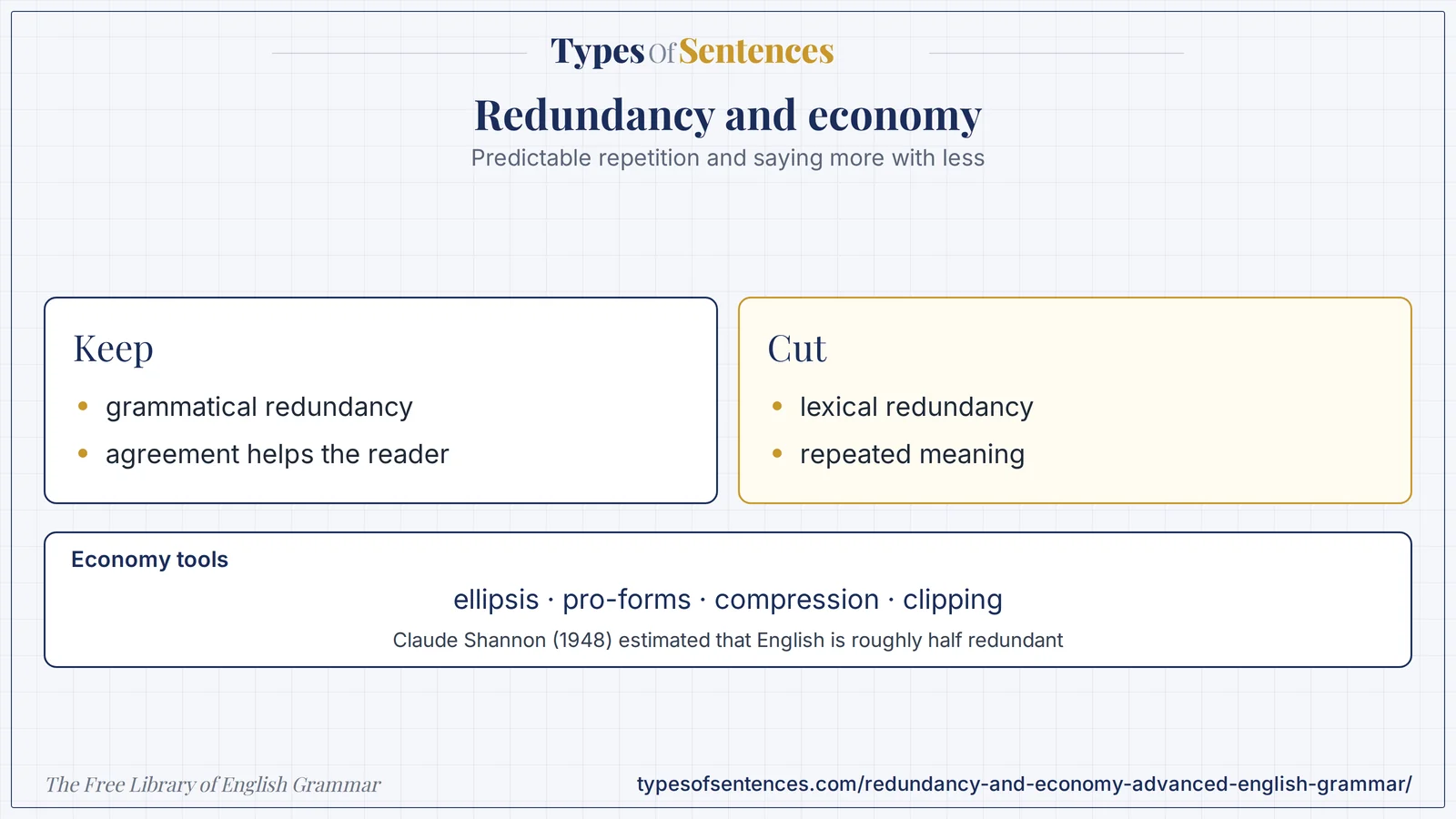
Language is partly predictable. When a word could be guessed from the others, that word is, in a sense, redundant. Redundancy is not always waste: it lets listeners catch mistakes, follow speech in noise, and check that they have understood.
Why it matters: Economy is the opposite pull: why say more than you need? Good writers feel both. They cut the repetition that adds nothing and keep the repetition that makes the message safe, clear, or memorable.
Summary: In information theory, redundancy is the part of a message that can be predicted from the rest; Claude Shannon (1948) estimated that English is roughly half redundant. Grammatical redundancy (agreement, plural and tense marking, do-support) repeats information and helps communication survive noise and error. Lexical redundancy (pleonasm: added bonus; tautology: free gift; redundant acronyms: PIN number) is often unnecessary. Economy shows in ellipsis, pronouns and other pro-forms, contractions, clipping, compounds, and the shortening of frequent words (Zipf’s principle of least effort); it is balanced against the hearer’s need for clarity (Horn’s Q and R principles). Redundancy helps in speech, instructions, safety warnings, legal drafting, and teaching; it harms when it is mere padding. Expectations of explicitness vary by genre and community.
- Redundancy = predictable repetition; economy = saying no more than needed.
- Grammatical redundancy usually helps; lexical redundancy is often waste.
- Economy tools: ellipsis, pro-forms, compression, clipping.
- Keep redundancy that protects clarity; cut the rest.
What You’ll Learn
- 1. Redundancy and Economy: What Is Redundancy?
- 2. Grammatical Redundancy: Agreement and Helpful Repetition
- 3. Lexical Redundancy: Pleonasm, Tautology, and Doubled Words
- 4. Economy in Language: Saying More with Less
- 5. Balance: Redundancy vs Clarity
- 6. Cultural and Genre Differences in Explicitness
- 7. Prediction, Compression, and Error Tolerance
- 8. Common Errors and a Worked Example
- 9. Exercises
- 10. Test Your Knowledge
- 11. Frequently Asked Questions
- 12. Conclusion
1. Redundancy and Economy: What Is Redundancy?
| Kind of redundancy | Description | Example |
|---|---|---|
| information-theoretic | the part of a message that can be predicted from the rest | after q in English, a u follows almost always |
| phonological | sound features that repeat cues | a vowel is long before a voiced consonant and also marked by spelling |
| morphological (grammatical) | the same information marked more than once | three books: number marked by three and by -s |
| syntactic | information signaled both by order and by form | He saw her: the roles are marked by order and by case |
| lexical (pleonasm) | words that add no new meaning | added bonus |
| semantic | the same meaning stated in different words | He was totally and completely exhausted. |
| discourse | repetition for cohesion or emphasis | repeating a key term across sentences |
| pragmatic | repetition to confirm understanding or to be polite | I repeat; as I said; “Right?” |
| Idea | Source | Meaning |
|---|---|---|
| redundancy as predictability | Claude Shannon, “A Mathematical Theory of Communication” (1948) | a measure of how much of a message is determined by the structure of the language; for English, with statistics over about eight letters, he estimated roughly half |
| guessing game | Shannon (1951) | readers can predict missing letters in text with surprising accuracy, which shows that text is redundant |
| channel and noise | information theory | redundancy lets a message survive errors and noise |
| error correction | coding theory | extra bits allow errors to be detected and corrected |
| cloze test | language testing | removing words at intervals and asking readers to restore them shows how predictable text is |
| frequency and predictability | corpus linguistics | frequent words and combinations are more predictable and more compressible |
| Helpful redundancy | Harmful redundancy |
|---|---|
| agreement and concord that help to find errors | added bonus, past history |
| repetition of a key term for clarity | padding that fills space |
| a safety warning stated twice | a long preamble before the point |
| repeating a name to avoid an ambiguous pronoun | repeating the same idea in three sentences |
| a summary at the end of a long text | a conclusion that merely repeats the introduction |
| “I repeat” on a radio channel | repeat again |
| restating a definition in a lesson | definitions where the reader knows the term |
| rhetorical repetition (Never, ever) | accidental repetition of words |
The distinction is between redundancy that does a job and redundancy that does not. The editing of the second kind is treated in the chapter on conciseness and wordiness; this chapter explains why the first kind exists, and how to tell the difference.
2. Grammatical Redundancy: Agreement and Helpful Repetition
| Feature | Redundant element | Example | Function |
|---|---|---|---|
| number agreement in noun phrases | demonstrative and noun both marked plural | these books (not these book) | confirms plurality; error detection |
| plural marked with a numeral | -s on the noun after a number | three books | English requires it; some languages do not |
| subject–verb agreement | -s on the verb with a third-person singular subject | She walks. | signals which noun is the subject |
| past tense with a past time adverbial | -ed and yesterday | Yesterday I walked. | English requires the tense; some languages use only the adverbial |
| negation in questions and negatives | do carries tense when not is present | She did not go. (tense marked on did, not on go) | a grammatical device |
| do-support | an extra auxiliary in questions | Do you know? | marks the question and carries tense |
| pronoun agreement | a pronoun repeats the noun’s number and gender | The woman said she would come. | tracks reference |
| sequence of tenses | tense in the subordinate clause echoes the main clause | He said that he was tired. | shows the time frame |
| article and noun | a before a singular count noun | a book | signals definiteness and number |
| reflexive pronouns | -self repeats the subject | She hurt herself. | shows coreference |
| concord in coordination | both … and, either … or | — | signals structure |
| emphatic do | I do like it. | — | emphasis |
| question tags | a tag repeats the auxiliary and the subject | She is late, isn’t she? | invites agreement |
| reduplication | a word repeated for emphasis or plural in some varieties | small small things (in some varieties of English) | intensity or distribution |
| spelling redundancy | -ed spelled even where the sound is /t/ | walked | keeps the morpheme visible |
| Why grammatical redundancy helps | Explanation |
|---|---|
| error detection and correction | a mismatch signals a mistake (these book) |
| noise resistance | a message in noise can still be understood if some information is repeated |
| parsing support | agreement shows which words belong together |
| clarity at a distance | a verb’s ending links it to a distant subject |
| learning and teaching | explicit marking makes the rule visible |
| redundancy across modes | spelling, sound, and punctuation overlap |
| hearer’s check | a repeated cue confirms the first |
| Languages differ in redundancy | English | Other language (tendency) |
|---|---|---|
| grammatical gender agreement | almost none | many (French, Spanish, German, Hindi) |
| case marking | pronouns only | many (German, Russian, Latin) |
| plural marking | on nouns | also on adjectives and verbs in some languages; absent in others (Chinese) |
| subject pronouns | required | often omitted where the verb ending shows the person (Spanish, Italian) |
| tense marking | required | not required where a time word suffices (Chinese) |
| articles | required | often absent (Hindi, Russian, Japanese) |
Each language spreads its redundancy differently: where one language marks information on the verb, another marks it on the noun, another in the word order, and another not at all. The loss of inflection in English (see the chapter on the history of English grammar) made it less redundant in some places and more in others (for example do-support and fixed word order). The structure of agreement is also studied in the chapter on morphology in English.
3. Lexical Redundancy: Pleonasm, Tautology, and Doubled Words
| Kind | Description | Examples (and a plain form) |
|---|---|---|
| pleonasm (redundant modifier) | an adjective or adverb that repeats a meaning already in the noun or verb | added bonus (bonus), advance planning (planning), basic fundamentals (fundamentals), close proximity (proximity), completely finished (finished), end result (result), final outcome (outcome), future plans (plans), past history (history), true fact (fact), unexpected surprise (surprise), new innovation (innovation), exact same (same), mutual cooperation (cooperation), sum total (total), very unique (unique), absolutely essential (essential), totally unnecessary (unnecessary) |
| tautology (repeating the same idea) | a phrase that says one thing twice | free gift, each and every, first and foremost, various different, one and the same, safe haven, null and void (in ordinary use) |
| redundant verb particles and prepositions | an adverb that repeats the verb’s meaning | join together, combine together, merge together, repeat again, return back, revert back, rise up, connect up, continue on, cooperate together |
| redundant acronym (RAS syndrome) | the last letter of an acronym repeated by a noun | ATM machine, PIN number, HIV virus, LCD display, ISBN number, VIN number |
| doubled prepositions | an extra preposition | off of, from whence, discuss about, emphasize on, enter into (in some uses), meet with (in some uses) |
| “reason … because” and similar | two words doing one job | The reason is because, the reason why |
| redundant intensifiers and qualifiers | words that add nothing | very important, really essential, quite perfect, somewhat unique |
| redundant verbs of giving | two verbs for one act | give and donate, meet and gather |
| redundant legal doublets | pairs from the history of law (some serve a function) | terms and conditions, cease and desist, aid and abet, any and all |
| redundant restatement of a comparison | more with -er, most with -est | more better, most unkindest |
| spelled-out quantity repeated | a number in words and figures | thirty (30) days (a safeguard in contracts) |
| redundant time and place words | a repeated frame | at 3 p.m. in the afternoon, in the year 2024, located in |
| repetition across clauses | a sentence repeating the idea of the previous | The results were important. They mattered a great deal. |
| wordy openers | a clause that repeats the topic | It is a fact that, The fact of the matter is that |
| unnecessary repetition of the subject | the subject repeated by a pronoun | My brother, he is a teacher. (informal and dialect use is another matter) |
| double possessive and genitive | a double marking | a friend of mine is standard; a friend of my is not |
| More examples by group | Plain form |
|---|---|
| absolutely necessary, completely eliminate, totally destroyed | necessary; eliminate; destroyed |
| circle around, surround on all sides | circle; surround |
| close together, gather together, assemble together | together; gather; assemble |
| consensus of opinion, general consensus | consensus |
| in my own personal opinion | in my opinion |
| refer back to, reflect back | refer to; reflect |
| reduce down, lower down, fall down | reduce; lower; fall |
| advance warning, advance reservations | warning; reservations |
| ask the question, mix together, plan ahead | ask; mix; plan |
| blend together, unite together, link together | blend; unite; link |
| revert back, return back, go back again | revert; return; go back |
| still remains, still continues | remains; continues |
| temporary reprieve (a reprieve is temporary) | reprieve |
| honest truth, real fact | truth; fact |
| tiny little, big huge | tiny; huge |
| over exaggerate, widow woman | exaggerate; widow |
| four-cornered square (a square has four corners) | square |
| 12 noon, 12 midnight | noon; midnight |
| each individual, every single | each; every |
| visible to the eye, audible to the ear | visible; audible |
- Check each candidate. Does the second word add a meaning, or only repeat the first? A gift is free, so free gift repeats; but free trial may distinguish a trial for which one does not pay.
- Some apparent redundancy is not redundant. Past history may be a stock phrase; advance planning may refer to the early stage of planning; mutual may distinguish a shared friend from a friend of one.
- Fixed expressions and legal doublets have their own justification (see the chapter on legal writing), though a plain-language drafter may remove them.
- Regional and variety differences: revert back and return back are common in some varieties of English (including Indian English); the plain revert or return is clearer for an international reader.
- Acronym redundancy (PIN number) is so common that many writers accept it in speech; in formal writing, drop the extra noun or spell out the term.
Lexical redundancy is the form that editors attack most, and rightly: it adds words without adding meaning. But it is an interesting product of the same forces that produce grammatical redundancy: speakers add words to be sure, to emphasize, and to fill a rhythm. The plain forms above are the ones that careful writing prefers.
4. Economy in Language: Saying More with Less
| Principle | Statement | Source |
|---|---|---|
| principle of least effort | speakers and writers tend to minimize effort; frequent words become short | George Kingsley Zipf, 1949 |
| Zipf’s law of abbreviation | the more frequent a word, the shorter it tends to be | Zipf |
| economy (Martinet) | language change is shaped by the balance between communicative need and the economy of effort | André Martinet, 1955 |
| Q-principle and R-principle | Q: say as much as you can (so the hearer need not infer more); R: say no more than you must (and let the hearer infer the rest) | Laurence Horn, 1984 |
| Gricean quantity maxims | make your contribution as informative as required, and no more | H. P. Grice, 1975 (see the chapter on pragmatics) |
| tension of speaker and hearer | the speaker wants to say less; the hearer wants enough information | Zipf and others |
| Economy device | How it saves words | Example |
|---|---|---|
| pronouns and pro-forms | a short word replaces a longer phrase | Priya said she would come. (she); do so; such |
| ellipsis | omitting what can be recovered | She can swim, and I can [swim] too. |
| gapping | omitting a repeated verb | Priya ate rice, and Raj [ate] bread. |
| zero relative | omitting that or who | The book [that] I read |
| zero complementizer | omitting that after a verb | I think [that] he left. |
| contraction | joining words | don’t, it’s |
| clipping | shortening a word | phone, exam, info |
| acronyms and abbreviations | initial letters | NASA, FAQ |
| blending | joining parts of words | brunch, smog |
| noun compounds | omitting prepositions and articles | bus stop for a stop for buses |
| nominalization | a clause compressed into a noun phrase | the decision to resign |
| participial reduction | omitting who is, that was | the man standing at the door |
| phrasal verbs | a verb and particle for a longer phrase | give up |
| conversion | a word used in a new class without extra morphology | to google |
| implicature | meaning conveyed without being said | Some students passed. (not all) |
| headline style | omitting articles and forms of be | Police arrest 2 |
| telegraphic speech and notes | omitting function words | Gone shopping. Back at 6. |
| elliptical answers | short answers | Where? In Pune. |
| numerals and symbols | a short sign for a long phrase | %, &, @ |
| code-switching and borrowed words | a single word from another language that says what a phrase would | deja vu, schadenfreude |
| Limits of economy | Example |
|---|---|
| ambiguity | She likes him more than Mary. (elliptical comparison) |
| garden paths from omitted words | The horse raced past the barn fell. |
| loss of redundancy for noisy channels | a shortened word is easy to mishear |
| loss of politeness | Send the file. versus Could you send the file? |
| loss of explicitness for outsiders | jargon and acronyms exclude readers |
| borrowing from other languages that readers do not know | — |
Economy is a force within language and within each text. In grammar it appears as ellipsis and pro-forms (see the chapter on ellipsis and substitution); in the lexicon as clipping, blending, and compounding; and in discourse as implicature. The writer’s economy, discussed in the chapter on conciseness, is a conscious application of the same tendency, held in check by the reader’s need for clarity.
5. Balance: Redundancy vs Clarity
| Context | How redundancy helps | Example |
|---|---|---|
| speech | listeners cannot reread, and noise and memory limit comprehension; speakers repeat and rephrase | As I said, … To repeat, … |
| telephone, radio, and aviation communication | critical messages are repeated and read back; spelling alphabets | Alpha, Bravo, Charlie (the NATO spelling alphabet); “read back” |
| safety warnings and instructions | repeating the key point prevents harm | Danger. Do not touch. Hot surface. |
| legal and financial documents | amounts in words and figures; doublets; defined terms repeated | thirty (30) days |
| teaching and learning | repetition and review fix material in memory | a recap at the end of a lesson |
| long documents | summaries, headings, and signposts repeat the structure | In summary, … |
| persuasion and rhetoric | repetition emphasizes and persuades | We will plan. We will build. We will finish. (anaphora) |
| coding and security | check digits and error-correcting codes | a check digit on a bank account number |
| second-language readers | repeating key terms aids comprehension | — |
| cohesion | repeating a key term keeps the topic visible | — |
| clarity in the face of ambiguity | repeating a noun instead of a pronoun | The report criticized the plan, but the plan was ignored. |
| Test: keep or cut? | If yes … |
|---|---|
| Does the repetition prevent a likely misunderstanding? | keep |
| Does it protect against a costly error (safety, money, law)? | keep |
| Does it help the audience (listeners, second-language readers) to follow? | keep |
| Does it serve emphasis or rhythm that you want? | keep |
| Does it only repeat a word’s own meaning (added bonus)? | cut |
| Does it repeat a sentence’s idea without developing it? | cut |
| Does it delay the point? | cut |
| Would the reader miss it if it were gone? | if no, cut |
| Medium | Typical level of redundancy | Reason |
|---|---|---|
| conversation | high | noise, memory, and interaction |
| public speech | high | listeners cannot reread; signposting and repetition |
| broadcast and radio | high | the channel is noisy; one chance to hear |
| instructions | moderate to high for critical steps | safety |
| academic writing | moderate (signposts, summaries) | readers can reread; precision matters |
| news writing | low in the body, higher in headlines and summaries | space and speed |
| business email | low to moderate | efficiency; but a clear action sentence |
| legal writing | moderate to high (defined terms; doublets) | avoidance of ambiguity |
| text messages | low | speed; shared context |
| poetry | variable: repetition is a device | pattern and emphasis |
The balance is a judgment, and it varies with the audience and the stakes. The clarity requirement of the chapter on readability sometimes calls for more redundancy (a definition, an example) and sometimes for less (a trimmed sentence). The question is always what the reader needs.
6. Cultural and Genre Differences in Explicitness
Communities and genres differ in how much they expect to be said explicitly and how much to be left to context. The anthropologist Edward T. Hall (Beyond Culture, 1976) described a contrast between “high-context” communication, in which much of the meaning is carried by the situation and shared knowledge, and “low-context” communication, in which meaning is mostly explicit in the words. The contrast is a tendency, not a classification of whole nations; individuals and settings vary, and a single community uses both.
| Dimension | Tendency toward more explicit wording | Tendency toward more implicit wording |
|---|---|---|
| reference | repeat nouns and spell out connections | use pronouns, ellipsis, and shared knowledge |
| requests | state the request directly | hint, or rely on the relationship |
| agreement and refusal | a clear yes or no | indirect signals |
| writing norms | a clear thesis; explicit signposts (a typical expectation in English academic writing) | a more gradual development, with the point inferred (in some other rhetorical traditions) |
| repetition | a single statement of each point | repeated or elaborated statement, sometimes as a mark of respect, emphasis, or oral style |
| politeness formulas | brief | elaborate greetings and closings |
| genre | technical and legal writing: explicit; speeches and oral genres: repetitive | poetry and proverbs: compressed |
| variety of English | low-redundancy business style | varieties that favor elaborate formulae (Kindly do the needful), and local forms of emphasis and repetition (small small things) |
| Caution | Explanation |
|---|---|
| avoid stereotyping | statements about “cultures” hide variation in class, region, age, and situation |
| a style is not a deficiency | elaborate repetition may be an accepted device, and the plain style is one convention among others |
| contrastive rhetoric is debated | early claims that rhetorical patterns follow first-language lines (Kaplan, 1966) have been criticized as oversimplified |
| write for the reader | choose the level of explicitness that your reader expects |
| mixed audiences | prefer a plain, explicit style that second-language readers can follow |
For an international readership, a plain, explicit style with clear structure is usually safest, as the chapter on business writing recommends. For a local readership or a particular genre, follow its conventions; and for any audience, avoid redundancy that merely pads.
7. Prediction, Compression, and Error Tolerance
| Phenomenon | How redundancy explains it |
|---|---|
| readers correct typos without noticing | the context predicts the intended word |
| Th_ qu_ck br_wn f_x can be read | missing letters are predictable |
| autocomplete and predictive text | models of redundancy predict the next word |
| text compression (zip files) | redundancy is removed to save space |
| spelling checkers | a misspelling is detected because it is unlikely |
| speech recognition in noise | context and grammar fill gaps |
| guessing words from context in a second language | redundancy supports inference |
| a cloze test | removing words shows how predictable they are |
| simultaneous interpreting | the interpreter predicts the end of a sentence from its structure |
| fast reading | readers skip predictable words |
The same redundancy that makes text compressible makes it robust. A message that could be shortened to its bare minimum would be fragile: a single error or an unfamiliar word would break it. This is why complete economy is neither achievable nor desirable, and why the practical goal is the right amount of redundancy for the channel and the reader.
8. Common Errors and a Worked Example
| Error | Example | Better |
|---|---|---|
| pleonasm | added bonus; advance planning | bonus; planning |
| redundant acronym | PIN number | PIN |
| doubled preposition | discuss about the plan | discuss the plan |
| redundant intensifier | very unique | unique |
| redundant particle | join together; revert back | join; revert |
| redundant restatement | The results were important and they mattered. | The results mattered. |
| redundancy that padded a sentence | It is a fact that it rained. | It rained. |
| cutting protective redundancy | removing a safety warning’s repetition | keep the repeated warning |
| over-economy that causes ambiguity | She likes him more than Mary. | She likes him more than Mary does. |
| ellipsis that fails | The manager asked the clerk to leave and the cashier to stay and the guard. | …, the cashier to stay, and the guard to wait. |
| clipping in formal writing | The prof did the exam. | The professor administered the examination. |
| over-explaining to experts | defining every term in an expert report | assume the field’s vocabulary |
| under-explaining to novices | unexplained jargon and acronyms | define terms |
| false economy of omitted articles | Council approved plan. | The council approved the plan. |
| legal doublets unexplained | any and all | all (plain style) or keep for precision in a contract |
Edit: It is a fact that the added bonus of the advance planning, which was completed totally and absolutely, was a very unique benefit, and the PIN number of the ATM machine should be repeated again to the customer and to each and every user, and the reason why is because the profits and the money were not enough in the future plans.
- It is a fact that: a wordy opener: delete.
- added bonus: bonus.
- advance planning: planning (or keep if early planning is meant).
- completed totally and absolutely: completed.
- very unique: unique.
- PIN number of the ATM machine: redundant acronyms: PIN of the ATM.
- repeated again: repeated (keep one: a safety message might justify saying it twice, but not again in the same phrase).
- each and every user: every user.
- the reason why is because: the reason is that.
- profits and the money: profits; future plans: plans.
- Result: The bonus of the planning, which was completed, was a unique benefit, and the PIN of the ATM should be repeated to every user, because the profits were not enough in the plans. (the passage is invented; the meaning of the final clause needs the writer’s decision)
Recap in 12 seconds
Watch the lesson build itself: Redundancy is predictable repetition; keep what protects clarity and cut the rest. The video has no sound.
Exercises
Part A: What Is Redundancy? (Exercises 1–6)
Exercise 1: Define linguistic redundancy.
Show Answer
Answer: Information that can be predicted from the rest of the message.
Exercise 2: Who estimated that English is roughly half redundant (1948)?
Show Answer
Answer: Claude Shannon.
Exercise 3: Give an example of grammatical redundancy.
Show Answer
Answer: Number marked twice: three books; agreement: these books.
Exercise 4: Does redundancy always waste words?
Show Answer
Answer: No; it can protect communication.
Exercise 5: Name a helpful use of redundancy.
Show Answer
Answer: A safety warning stated twice; a read-back on the radio.
Exercise 6: Name a harmful use.
Show Answer
Answer: Padding: added bonus; repeated ideas.
Part B: Grammatical and Lexical Redundancy (Exercises 7–14)
Exercise 7: Is these books redundant? Why keep it?
Show Answer
Answer: Yes; it confirms number and helps detect errors.
Exercise 8: Name a redundant element in Yesterday I walked.
Show Answer
Answer: The past marked by both -ed and yesterday.
Exercise 9: Plain: added bonus
Show Answer
Answer: bonus.
Exercise 10: Plain: PIN number
Show Answer
Answer: PIN.
Exercise 11: Plain: discuss about
Show Answer
Answer: discuss.
Exercise 12: Plain: revert back
Show Answer
Answer: revert.
Exercise 13: Plain: each and every
Show Answer
Answer: each (or every).
Exercise 14: Plain: the reason is because
Show Answer
Answer: the reason is that.
Part C: Economy (Exercises 15–21)
Exercise 15: Who proposed the principle of least effort?
Show Answer
Answer: George Kingsley Zipf.
Exercise 16: State Zipf’s law of abbreviation.
Show Answer
Answer: Frequent words tend to be short.
Exercise 17: Name two devices of economy.
Show Answer
Answer: Ellipsis, pronouns, clipping, contractions, compounding.
Exercise 18: Expand the ellipsis: She can swim, and I can too.
Show Answer
Answer: … and I can swim too.
Exercise 19: Name Horn’s two principles.
Show Answer
Answer: The Q-principle and the R-principle.
Exercise 20: Name a limit of economy.
Show Answer
Answer: Ambiguity; loss of clarity or politeness.
Exercise 21: Define a pro-form.
Show Answer
Answer: A short word that replaces a longer phrase (she, do so).
Part D: Balance and Culture (Exercises 22–27)
Exercise 22: Why is speech more redundant than writing?
Show Answer
Answer: Listeners cannot reread; noise and memory limit comprehension.
Exercise 23: Name a field where redundancy is a safeguard.
Show Answer
Answer: Aviation, safety, law, finance.
Exercise 24: Who described high-context and low-context communication?
Show Answer
Answer: Edward T. Hall.
Exercise 25: Is the contrast a classification of whole nations?
Show Answer
Answer: No; it is a tendency, with great variation.
Exercise 26: Give a test for keeping redundancy.
Show Answer
Answer: Does it prevent a likely misunderstanding or protect against error?
Exercise 27: What is the safest style for an international readership?
Show Answer
Answer: Plain and explicit.
Part E: Editing (Exercises 28–30)
Exercise 28: Edit: Each and every user must repeat the PIN number again.
Show Answer
Answer: Every user must repeat the PIN.
Exercise 29: Edit: It is a fact that the results were very unique.
Show Answer
Answer: The results were unique.
Exercise 30: Repair over-economy: She likes him more than Mary.
Show Answer
Answer: She likes him more than Mary does.
Test Your Knowledge
Ready to check what you learned? Answer all 10 questions, then submit. You need 80% (8 of 10) to pass. Your answers are not stored.
View correct answers and explanations
Question 1: What is redundancy in language?
✓ Correct Answer: A – information that is predictable from other parts of the message
Predictable information.
Question 2: Which is grammatical redundancy?
✓ Correct Answer: B – agreement markers such as these books
Agreement repeats information.
Question 3: Which is a pleonasm?
✓ Correct Answer: C – added bonus
Added bonus.
Question 4: Who estimated in 1948 that English is roughly half redundant?
✓ Correct Answer: D – Shannon
Shannon.
Question 5: Which shows economy in grammar?
✓ Correct Answer: C – ellipsis and pro-forms
Ellipsis and pro-forms.
Question 6: When does redundancy help?
✓ Correct Answer: A – in noisy channels, instructions, and safety warnings
Where errors are costly.
Question 7: Who proposed the principle of least effort?
✓ Correct Answer: D – Zipf
Zipf.
Question 8: Which is a redundant acronym?
✓ Correct Answer: C – ATM machine
The last letter already means machine.
Question 9: Why are frequent words short?
✓ Correct Answer: B – speakers shorten what they use often
Economy of effort.
Question 10: Who described high-context and low-context communication?
✓ Correct Answer: B – Edward T. Hall
Hall.
Frequently Asked Questions
What are redundancy and economy?
Redundancy is the repetition or predictability of information in language, and economy is the tendency to say no more than is needed. Redundancy and economy are balancing forces.
What is linguistic redundancy?
Linguistic redundancy is the part of a message that can be predicted from the rest, for example agreement markers, repeated number marking, and predictable words. Linguistic redundancy helps communication survive errors and noise.
What is language economy?
Language economy is the tendency of speakers to minimize effort: short frequent words, pronouns, ellipsis, contractions, and compression. Language economy is limited by the hearer’s need for clarity.
What is efficient writing?
Efficient writing gives the reader what is needed with no waste: it cuts padding, uses plain words, and keeps the redundancy that protects clarity. Efficient writing is not the same as the shortest text.
How do I go about avoiding redundancy?
Look for words that repeat a meaning already present (added bonus), for redundant acronyms, and for doubled phrases, and delete the repeated element, but keep repetition that guards against error. Avoiding redundancy is a matter of judgment.
Is all redundancy bad?
No. Grammatical redundancy, safety warnings, read-backs, summaries, and rhetorical repetition all have functions. Only redundancy that does no work should be cut.
Do cultures differ in redundancy?
Communities and genres differ in the explicitness that they expect, but the differences are tendencies and vary within every community, so avoid stereotypes and write for the reader.
Conclusion
You now have a broader view of redundancy and economy: the idea of linguistic redundancy, grammatical and lexical redundancy, the forces of economy, the balance with clarity, differences of explicitness, and the use of prediction and compression. You can tell redundancy that works from redundancy that wastes words.
When you edit, ask what a repeated element is doing. Next, you will study rhetoric and grammar.
- Shannon, Claude E. “A Mathematical Theory of Communication.” Bell System Technical Journal 27 (1948): 379–423, 623–656.: the information-theoretic idea of redundancy.
- Zipf, George Kingsley. Human Behavior and the Principle of Least Effort. Addison-Wesley, 1949.: the principle of least effort.
- Horn, Laurence R. “Toward a New Taxonomy for Pragmatic Inference: Q-based and R-based Implicature.” In Meaning, Form, and Use in Context, edited by Deborah Schiffrin. Georgetown University Press, 1984.: the Q and R principles.
- Hall, Edward T. Beyond Culture. Anchor Press, 1976.: high-context and low-context communication.
- Merriam-Webster Dictionary: redundancy: the dictionary entry.
Last reviewed: October 29, 2026. How it was made: drafted with AI assistance, then checked with automated tests (structure, links, answer keys, spelling) and against the sources above. A person has not yet read this chapter line by line. Found a mistake? Report it.