Scientific writing is the writing through which science is reported, checked, and built on. Its readers are other scientists, who read to learn what was done, to judge whether the evidence supports the conclusion, and often to repeat the work. For that reason scientific prose values objectivity, precision, and economy: every number has a unit, every term means one thing, every claim is as strong as the evidence and no stronger, and nothing is included that the reader does not need. Science writing has its own grammar as well, from the passive voice of the methods section to the present tense of established facts.
This chapter studies the style of scientific writing, the structure of the scientific paper (IMRaD) as it works in the sciences, scientific grammar (voice, tense by function, noun strings, and hedging), the conventions for numbers, units, symbols, equations, and scientific names, the laboratory report, scientific vocabulary and the avoidance of jargon, the description of graphs and tables, scientific communication to non-specialist readers, and the ethics of reporting data. It builds on the general chapters on academic writing and research writing, and concentrates on what is distinctive in science. Thirty editing exercises and a quiz follow.
A scientific paper tells a reader what question was asked, how it was investigated, what was found, and what it means, in the shortest accurate way. A reader should be able to check the numbers and, in principle, to repeat the experiment from the description.
Why it matters: Good scientific writing is not ornate. It prefers the exact word to the impressive one, the short sentence to the long, and the measured claim to the dramatic one.
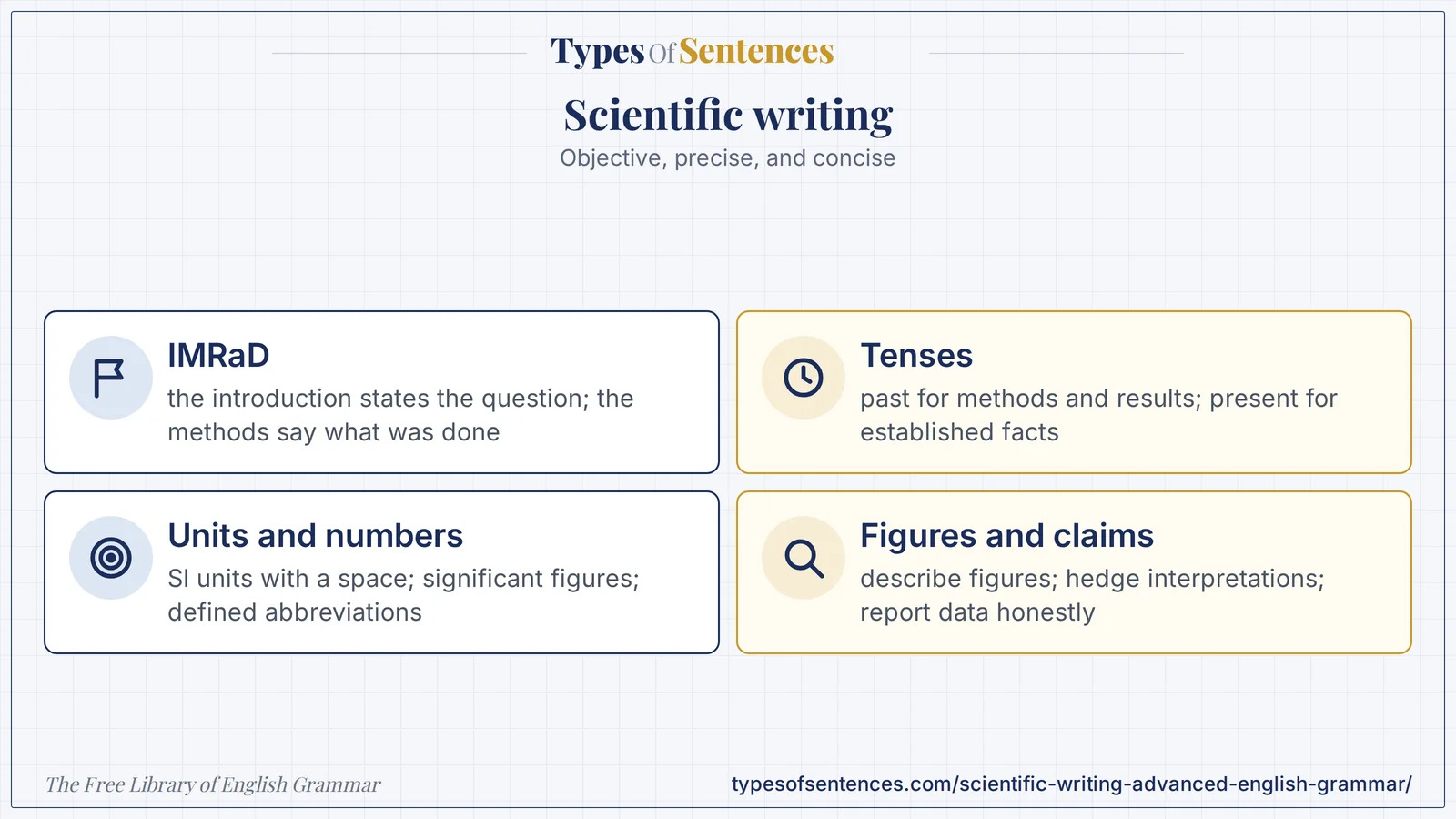
Summary: Scientific writing is objective, precise, and concise. The IMRaD structure organizes the paper: the introduction states the question, the methods describe what was done (past tense, often passive), the results report findings (past tense, with figures and tables), and the discussion interprets (present tense and hedging). Established facts take the present tense; specific studies take the past. Quantities are given in SI units with symbols and the correct number of significant figures; species names are italicized; abbreviations are defined. Graphs and tables are numbered, captioned, and described in the text. Scientific vocabulary is exact, and jargon is avoided for non-specialists. Honesty in reporting data is a basic duty.
- Objective, precise, concise.
- Methods and results: past; established facts: present.
- SI units with a space; significant figures; defined abbreviations.
- Describe figures; hedge interpretations; report data honestly.
What You’ll Learn
- 1. Scientific Writing: Style, Objectivity, and Precision
- 2. IMRaD in the Sciences
- 3. Scientific Grammar: Voice, Tense, and Noun Phrases
- 4. Numbers, Units, Symbols, and Names
- 5. Laboratory Reports
- 6. Scientific Vocabulary and Avoiding Jargon
- 7. Graphs and Tables: Describing Visuals and Integrating Them with Text
- 8. Scientific Communication to Non-Specialists
- 9. Ethics in Scientific Writing
- 10. Common Errors in Scientific Writing
- 11. Exercises
- 12. Test Your Knowledge
- 13. Frequently Asked Questions
- 14. Conclusion
1. Scientific Writing: Style, Objectivity, and Precision
| Feature | Practice | Example |
|---|---|---|
| objectivity | focus on the data and the method, not the writer’s feelings | The results indicate a 12 percent increase. (not I was thrilled to find …) |
| precision | exact terms, numbers, and units | The solution was heated to 80 degrees Celsius for 10 minutes. |
| conciseness | no unnecessary words | We measured the mass. (not We carried out a measurement of the mass) |
| clarity | one idea per sentence; clear subject and verb | — |
| accuracy | correct values and sources | check every number against the data |
| consistency | one term for one concept | sample, not specimen and sample for the same thing |
| caution | claims matched to the evidence | The data suggest that … |
| impersonality (where accepted) | passive or abstract subjects | The samples were incubated. This experiment shows … |
| plain structure | headings and numbered figures | IMRaD |
| Wordy | Concise |
|---|---|
| It is interesting to note that the temperature increased. | The temperature increased. |
| A large number of samples | Many samples |
| in the majority of cases | usually |
| due to the fact that | because |
| has the ability to | can |
| at the present time | now |
| in order to | to |
| with the exception of | except |
| was found to be significantly higher | was significantly higher |
| carried out an investigation of | investigated |
The general characteristics of academic style are discussed in the chapter on academic writing. In science, the emphasis falls on exactness and economy: the reader should not have to guess a value, a unit, or a meaning, and should not have to read a word that adds nothing. For the techniques of exactness, see the chapter on vagueness and precision.
2. IMRaD in the Sciences
| Section | Content in the sciences | Typical features |
|---|---|---|
| title | the main variables, the system, and the approach, in a precise phrase | Effect of temperature on the growth rate of E. coli |
| abstract | background, aim, method, key results with numbers, conclusion | 150–250 words; stand-alone |
| introduction | what is known; the gap; the hypothesis or aim | from general to specific; few citations beyond the essential |
| materials and methods | sources and specifications of materials; procedures; equipment; analysis | enough detail to repeat the work; past tense |
| results | data, with figures and tables; statistics | no interpretation; past tense |
| discussion | interpretation, comparison, limitations, implications | present tense; hedging |
| conclusion | the main finding and its significance | short |
| acknowledgments, funding, conflicts of interest, data availability | declarations required by journals | — |
| references | numbered or author–date, by the journal’s style | — |
| supplementary material | extra data and methods | — |
| Moves and typical phrases | Examples |
|---|---|
| introducing the field | X plays a central role in …; X is widely used in … |
| stating the gap | However, the mechanism remains unclear; little is known about … |
| stating the aim | The aim of this study was to determine whether …; Here we show that … |
| describing a method | Cells were cultured in … at 37 degrees Celsius for 24 h. |
| reporting a result | The mean concentration was 4.2 mg/L (SD = 0.3). |
| interpreting | These results suggest that …; This may be explained by … |
| stating limits | A limitation of this study is …; Further work is needed to … |
The general structure of the research paper and the moves of each section are treated in the chapter on research writing; the conventions of particular journals (the order of sections, the length, the style of references) vary, and the guidelines for authors of the target journal take precedence. Some fields, such as physics and mathematics, use different structures (for example a theorem and proof), and clinical research follows reporting guidelines for particular study designs.
3. Scientific Grammar: Voice, Tense, and Noun Phrases
| Function | Tense and voice | Example |
|---|---|---|
| established facts and general truths | present simple | Water boils at 100 degrees Celsius at sea level. |
| describing a figure or table | present simple | Figure 2 shows the growth curve. |
| reporting what authors state | present simple | Smith (2020) argues that … |
| methods (what was done) | past simple, often passive | Samples were centrifuged at 3,000 g for 10 min. |
| results (what was found) | past simple | The mean mass increased by 12 percent. |
| a body of research | present perfect | Several studies have shown that … |
| interpretation and conclusion | present; modal verbs | These data suggest that …; This may reflect … |
| future work | will, should, could | Future studies should test … |
| specific earlier studies | past simple | Lee (2021) found that … |
| Passive or active? | Example | Comment |
|---|---|---|
| passive in methods | The cells were washed twice with buffer. | the procedure matters more than the person |
| active with we (accepted in many journals) | We washed the cells twice with buffer. | shorter and clearer |
| active with the data or the study as subject | The data show that …; This study examined … | objective and concise |
| passive that hides who did the interpretation | It was concluded that … | prefer: We conclude that … |
| passive that makes the sentence awkward | The reaction was observed by us to proceed. | prefer: We observed that the reaction proceeded. |
| Noun phrases and agreement | Practice | Example |
|---|---|---|
| noun strings | avoid more than three nouns; use prepositions or hyphens | the temperature-dependent growth rate; (long) → the rate of growth that depends on temperature |
| data | plural in most scientific writing (the data are); some journals allow the singular | The data are consistent with the model. |
| criteria, phenomena, hypotheses, bacteria | plural forms of Greek and Latin words | one criterion; two criteria |
| number of / amount of | number for countable; amount for uncountable | a number of samples; an amount of water |
| fewer / less | fewer for countable; less for uncountable | fewer samples; less water |
| that / which | that restrictive (no comma); which non-restrictive (with commas) | The sample that was heated … The sample, which was heated, … |
| dangling modifiers | the modifier must match the subject | Using a pipette, we added 1 mL. (not Using a pipette, 1 mL was added.) |
| affect / effect | affect (verb: influence); effect (noun: result) | Temperature affects the rate. The effect of temperature … |
| significant | reserve for statistical significance | a statistically significant difference (p < 0.05); otherwise substantial |
| hedging | match claims to evidence | The results suggest that …; may indicate |
The choice of voice and tense follows the functions explained in the chapters on tense and aspect and on voice. Hedging, which is essential in the interpretation of data, is treated in the chapter on hedging. Scientific writing relies on complex noun phrases for compactness (the temperature dependence of the reaction rate constant), but long strings of nouns should be unpacked when they become hard to read.
4. Numbers, Units, Symbols, and Names
| Convention | Practice | Example |
|---|---|---|
| SI units | use the International System of Units | meter (m), kilogram (kg), second (s), kelvin (K), mole (mol), ampere (A), candela (cd) |
| space between number and unit | a (non-breaking) space | 25 kg; 10 mL; 37 °C (percent sign: 5%, or 5 percent, by journal style) |
| unit symbols | not pluralized; no period | 5 kg (not 5 kgs, 5 kg.) |
| symbols for quantities | italic; units upright | m = 2.5 kg |
| decimal point | a period in English (a comma in many other languages) | 3.14 |
| thousands separators | a space or a comma, by journal style | 10 000 or 10,000 |
| significant figures | give no more digits than the measurement supports | 2.5 g (not 2.50000 g) |
| uncertainty | state the measure and what it means | 12.3 ± 0.4 mg (mean ± SD, n = 5) |
| numbers in text | spell out one to nine in many styles; use numerals before units and for 10 and above | five samples; 12 samples; 5 mL |
| ranges | an en dash or to | 10–20 mL; 10 to 20 mL |
| percent and percentage | percent with a number; percentage without | a 12 percent increase; the percentage of cases |
| dates and times | unambiguous formats | 15 March 2024; 14:30 |
| scientific notation | a power of ten | 3.0 × 10⁸ m/s |
| species names | italicize the genus and species; capitalize the genus | Escherichia coli; E. coli after first use |
| gene and protein names | follow the nomenclature of the field | — |
| abbreviations | define at first use; use sparingly | polymerase chain reaction (PCR) |
| equations | number them; refer by number; punctuate as part of a sentence | Equation (2) shows … |
| chemical formulas | subscripts and correct case | H2O; NaCl |
| Problem | Example | Fix |
|---|---|---|
| missing unit | The sample weighed 25. | The sample weighed 25 g. |
| no space | 25kg; 37°C | 25 kg; 37 °C |
| plural symbol | 5 kgs | 5 kg |
| false precision | 12.34567 g (balance reads to 0.01 g) | 12.35 g |
| unit confusion | 5 mg/ml, mixed capitalization | 5 mg/mL |
| ambiguous “billion” | a billion cells | 109 cells (state the scale) |
| inconsistent decimals | 0.5, 0.25, .125 | 0.50, 0.25, 0.125 |
| italics errors | Escherichia coli (not italic) | Escherichia coli |
The details depend on the journal and the discipline, and the style manuals of the American Chemical Society, the American Medical Association, the Council of Science Editors, and other bodies are the authorities. The principle of exactness is the same as in the chapter on precision: no number without a unit, and no unit without a number.
5. Laboratory Reports
| Section | Content | Tips |
|---|---|---|
| title | what was investigated | specific |
| abstract | purpose, method, main results, conclusion | write last |
| introduction | background, theory, aim, hypothesis | brief and focused |
| materials and methods | materials, apparatus, procedure, safety | past tense, passive or we; enough to repeat |
| results | data tables and graphs; calculations; uncertainties | no interpretation; label units |
| discussion | interpret; compare with theory; sources of error; limitations | link to the aim and hypothesis |
| conclusion | answer the aim; summarize | short |
| references | sources cited | — |
| appendices | raw data; sample calculations | — |
| Error analysis language | Examples |
|---|---|
| sources of error | systematic error; random error; instrument error; human error (reading, timing) |
| uncertainty | The measurement has an uncertainty of ±0.05 mL. |
| evaluating accuracy and precision | The result differs from the accepted value by 3 percent. The results are precise but not accurate. |
| improvements | Using a digital balance would reduce the uncertainty. |
| reproducibility | Three trials were run; the standard deviation was 0.2. |
| Weak statement | Strong statement |
|---|---|
| The experiment went well. | The measured value (9.78 m/s²) agreed with the accepted value (9.81 m/s²) within 0.3 percent. |
| There were errors. | The main source of error was the timing (±0.2 s), which accounts for most of the 3 percent deviation. |
| We did the titration and got a result. | Titration of 25.0 mL of NaOH required 23.4 mL of 0.100 M HCl. |
| The graph shows a relationship. | Figure 1 shows that the period increases linearly with the square root of the length. |
- Follow the instructions of the instructor and the department for format and length.
- Write the methods as a record of what was done (past tense), not as instructions to the reader.
- Include units on every value and label every table and figure.
- Discuss errors quantitatively where possible.
- Do not copy a lab manual’s wording. Describe your own work in your own words.
6. Scientific Vocabulary and Avoiding Jargon
| Precise word | Common word and the difference | Example |
|---|---|---|
| hypothesis | not a guess; a testable explanation | The hypothesis predicts a linear relationship. |
| theory | a well-supported explanatory framework (not “a hunch”) | the theory of evolution; atomic theory |
| law | a statement of a regularity | Newton’s second law |
| model | a simplified representation of a system | a mathematical model |
| significant | statistically significant (p-value) | not “important” |
| correlation / causation | association / one thing produces another | Correlation does not imply causation. |
| accuracy / precision | closeness to the true value / closeness of repeated measurements | — |
| sample / population | the subset studied / the whole group | — |
| mass / weight | amount of matter / the force of gravity on it | — |
| quantity names (concentration, volume) | exact quantities | a concentration of 0.5 mol/L |
| variable | a quantity that can vary (independent, dependent, control) | — |
| evidence / proof | data that support / a logical demonstration | The data support (do not prove) the hypothesis. |
| Jargon (for non-specialists) | Plain version |
|---|---|
| The patients exhibited a reduction in pyrexia. | The patients’ fever went down. |
| The reagent was introduced into the vessel. | We added the chemical to the flask. |
| utilize a pipette | use a pipette |
| an elevated concentration of glucose | a high level of sugar |
| a statistically significant increase (to a lay reader) | an increase that is unlikely to be due to chance |
Technical terms are necessary in science, and the reader of a specialist paper expects them. But jargon that is used out of habit, or for readers outside the field, only hides the meaning. Define terms at first use, prefer the common word when it is exact, and keep the terms consistent. Words that have both a technical and an everyday sense (significant, theory, model, error) need care.
7. Graphs and Tables: Describing Visuals and Integrating Them with Text
| Visual | Use | Conventions |
|---|---|---|
| table | precise values, for comparison and lookup | a number and a title above; units in column headings; consistent decimals; no vertical rules in many styles |
| line graph | trends over a continuous variable | labeled axes with units; a legend; error bars where relevant |
| bar chart | comparisons among categories | a baseline at zero; labeled bars; error bars |
| scatter plot | relation between two variables | a fitted line only if justified; state the correlation or the equation |
| figure (diagram, image) | structure or process | a number and a caption below; scale bars; labels |
| equation | relations among quantities | numbered; defined symbols |
| Language of trends | Examples |
|---|---|
| increase | rose, increased, grew, climbed, went up, surged (sharp) |
| decrease | fell, decreased, declined, dropped, decreased steadily |
| stability | remained constant, stayed stable, leveled off, plateaued |
| fluctuation | fluctuated, varied, oscillated |
| peak and low | peaked at 40 degrees; reached a minimum of … |
| rate | increased rapidly, slowly, gradually, sharply, linearly, exponentially |
| comparison | was higher than; was twice as large as; differed from; was similar to |
| relation | was positively correlated with; was inversely related to; depended on |
| Describing a figure | Example |
|---|---|
| introduce and say what it shows | Figure 3 shows the effect of temperature on enzyme activity. |
| point to the main pattern | Activity increased with temperature up to 40 degrees Celsius and then fell sharply. |
| give numbers | At 40 degrees, activity was 2.5 times higher than at 20 degrees. |
| explain or qualify (in the discussion) | The fall above 40 degrees may reflect denaturation of the enzyme. |
| refer to the data (not the picture) | Activity was higher at 40 degrees (Figure 3). (not The graph is going up) |
- Refer to every figure and table in the text and say what the reader should notice.
- Do not repeat all the numbers in a table in the text; highlight the main pattern.
- Make a figure self-explanatory: a reader should understand it from the caption, axes, and legend.
- Label axes with quantities and units; do not use color alone to distinguish items.
- Do not manipulate figures (cropping that misleads, truncated axes, or altered images); present data as it is.
- Use the present tense for what a figure shows (Figure 3 shows), the past for what happened in the experiment.
8. Scientific Communication to Non-Specialists
| Genre | Reader | Features |
|---|---|---|
| lay summary or plain-language summary | the general public | no jargon; short sentences; the “so what” |
| press release | journalists | news first; a quote; a plain explanation |
| science news article or blog | interested readers | story, examples, analogy; accuracy retained |
| conference poster | specialists, passing by | visual; brief; key results |
| oral presentation | an audience | one idea per slide; plain words |
| grant proposal | reviewers, often from adjacent fields | significance; aims; method; feasibility |
| policy brief | decision-makers | recommendations; evidence; one or two pages |
| teaching materials | students | steps; examples; checks |
| Specialist | Lay version |
|---|---|
| We observed a 12 percent reduction in systolic blood pressure (p = 0.01). | Blood pressure fell by about 12 percent in the treated group, a difference unlikely to be due to chance. |
| The mechanism remains to be elucidated. | Scientists do not yet know how this works. |
| The assay exhibited high sensitivity. | The test detected the disease in most people who had it. |
Communicating science to the public requires accuracy without jargon, and honesty about uncertainty: a finding that is preliminary should be called so, and a result from a mouse study should not be reported as a result for people. The language of hedging (may, suggests) is as important here as in a paper. The principles of clear explanation are discussed in the later chapter on readability.
9. Ethics in Scientific Writing
| Principle | Practice |
|---|---|
| honest reporting of data | report all relevant results, including those that do not support the hypothesis; no fabrication or falsification |
| accurate methods | describe what was actually done |
| credit and authorship | include all those who made a substantial contribution; follow the guidelines of the journal for authorship |
| citation | give credit for ideas, data, and methods; avoid plagiarism and “salami” publication |
| image integrity | no inappropriate manipulation of images |
| conflicts of interest | declare funding and relationships that may be seen as influencing the work |
| ethical approval and consent | state approvals for studies with people or animals |
| reproducibility and data sharing | provide enough detail, and, where possible, data and code |
| avoiding overstatement | match conclusions to evidence |
Scientific communities treat fabrication, falsification, and plagiarism as serious misconduct, and journals have policies on authorship, data, and the use of writing tools. Follow the policy of the journal and the institution. Accurate, honest writing is the basis of the trust on which scientific progress depends.
10. Common Errors in Scientific Writing
| Error | Example | Fix |
|---|---|---|
| missing unit | The mass was 25. | The mass was 25 g. |
| no space before a unit | 25kg | 25 kg |
| wrong tense in methods | Samples are centrifuged. | Samples were centrifuged. |
| interpretation in results | Activity rose because the enzyme was activated. | Activity rose by 40 percent (Figure 3). |
| overclaiming | The data prove that … | The data suggest that … |
| “significant” for “large” | a significant increase (untested) | a substantial increase |
| data as singular (formal) | The data shows … | The data show … |
| dangling modifier | Using a pipette, 1 mL was added. | Using a pipette, we added 1 mL. |
| affect/effect confusion | The temperature effects the rate. | The temperature affects the rate. |
| jargon without definition | The PCR was run. | Polymerase chain reaction (PCR) was run. |
| non-italic species name | Escherichia coli | Escherichia coli |
| false precision | 12.34567 g | 12.35 g |
| unattributed claim | It is well known that … | Smith (2020) showed that … |
| wordiness | A large number of …; due to the fact that | Many …; because |
| figure not referred to | a figure with no mention | Figure 2 shows … |
| inconsistent terms | sample, specimen, and test piece for the same item | one term |
| “the graph shows an increase” without detail | — | Absorbance increased from 0.1 to 0.8 between 0 and 30 min (Figure 2). |
Edit: It is interesting to note that a large number of samples was heated to 80°C and the data shows that the temperature effects the rate significantly, which proves that Escherichia coli grows faster, and using a pipette, 1 ml was added, and the mass was 25.
- It is interesting to note that a large number of samples: wordy: Many samples.
- 80°C: 80 °C (with a space).
- the data shows: the data show.
- effects the rate significantly: affects the rate, and significantly only if tested.
- which proves that Escherichia coli grows faster: overclaiming and species name: which suggests that Escherichia coli grows faster.
- using a pipette, 1 ml was added: dangling and unit: using a pipette, we added 1 mL.
- the mass was 25: the mass was 25 g.
- Result: Many samples were heated to 80 °C, and the data show that temperature affects the rate, which suggests that Escherichia coli grows faster. Using a pipette, we added 1 mL. The mass was 25 g. (the experiment is invented)
Recap in 12 seconds
Watch the lesson build itself: Scientific writing follows IMRaD, uses past tense for methods and results, and reports data with care. The video has no sound.
Exercises
Part A: Style (Exercises 1–7)
Exercise 1: Name three features of scientific style.
Show Answer
Answer: Objective, precise, concise.
Exercise 2: Concise for due to the fact that:
Show Answer
Answer: because.
Exercise 3: Concise for a large number of:
Show Answer
Answer: many.
Exercise 4: Concise for in order to:
Show Answer
Answer: to.
Exercise 5: Concise for carried out an investigation of:
Show Answer
Answer: investigated.
Exercise 6: Why keep one term for one concept?
Show Answer
Answer: Different terms may be read as different things.
Exercise 7: What does IMRaD stand for?
Show Answer
Answer: Introduction, Methods, Results, Discussion.
Part B: Grammar (Exercises 8–14)
Exercise 8: Tense for established facts:
Show Answer
Answer: The present.
Exercise 9: Tense for methods:
Show Answer
Answer: The past (often passive).
Exercise 10: Tense for describing a figure:
Show Answer
Answer: The present.
Exercise 11: Fix: The data shows …
Show Answer
Answer: The data show …
Exercise 12: Fix: The temperature effects the rate.
Show Answer
Answer: The temperature affects the rate.
Exercise 13: Fix the dangling modifier: Using a pipette, 1 mL was added.
Show Answer
Answer: Using a pipette, we added 1 mL.
Exercise 14: When is significant appropriate?
Show Answer
Answer: For statistical significance.
Part C: Numbers and Units (Exercises 15–20)
Exercise 15: Fix: 25kg
Show Answer
Answer: 25 kg.
Exercise 16: Fix: 5 kgs
Show Answer
Answer: 5 kg.
Exercise 17: Fix: The sample weighed 25.
Show Answer
Answer: The sample weighed 25 g.
Exercise 18: How should a species name be written?
Show Answer
Answer: In italics, with the genus capitalized (Escherichia coli).
Exercise 19: Name the unit system used in science.
Show Answer
Answer: SI.
Exercise 20: Fix false precision: 12.34567 g (balance reads to 0.01 g)
Show Answer
Answer: 12.35 g.
Part D: Reports and Visuals (Exercises 21–26)
Exercise 21: Which section reports data without interpretation?
Show Answer
Answer: Results.
Exercise 22: What goes in the methods of a lab report?
Show Answer
Answer: Materials, apparatus, and procedure, in the past tense.
Exercise 23: Name two kinds of error.
Show Answer
Answer: Systematic and random.
Exercise 24: Describe a trend: values go up quickly
Show Answer
Answer: values rose rapidly.
Exercise 25: Refer to a figure:
Show Answer
Answer: Figure 3 shows …
Exercise 26: Name a rule for axes.
Show Answer
Answer: Label with quantity and unit.
Part E: Communication and Errors (Exercises 27–30)
Exercise 27: Plain for pyrexia:
Show Answer
Answer: fever.
Exercise 28: Fix: The data prove that …
Show Answer
Answer: The data suggest that …
Exercise 29: Name an ethical duty in reporting data.
Show Answer
Answer: Report all relevant results honestly.
Exercise 30: Fix: Studies show …
Show Answer
Answer: Smith (2020) showed …
Test Your Knowledge
Ready to check what you learned? Answer all 10 questions, then submit. You need 80% (8 of 10) to pass. Your answers are not stored.
View correct answers and explanations
Question 1: Which is a feature of scientific writing?
✓ Correct Answer: A – precision
Precision.
Question 2: Which tense is used for methods?
✓ Correct Answer: B – past
The past.
Question 3: Which tense is used for established facts?
✓ Correct Answer: C – present
The present.
Question 4: Which is correct?
✓ Correct Answer: D – The data show …
Data is plural.
Question 5: Which is correct?
✓ Correct Answer: C – 25 kg
Space and lowercase kg.
Question 6: Which is correct?
✓ Correct Answer: A – The temperature affects the rate.
Affect (verb).
Question 7: Which is a dangling modifier?
✓ Correct Answer: D – Using a pipette, 1 mL was added.
The modifier has no subject.
Question 8: How should a species name be written?
✓ Correct Answer: C – in italics, with a capitalized genus
Italic genus and species.
Question 9: Which is false precision?
✓ Correct Answer: B – 12.34567 g (balance reads to 0.01 g)
Too many digits.
Question 10: When should significant be used?
✓ Correct Answer: B – for statistical significance
Statistical significance.
Frequently Asked Questions
What is scientific writing?
Scientific writing is the writing used to report and discuss science: research papers, laboratory reports, reviews, and proposals. It is objective, precise, and concise.
What is science writing?
Science writing is a broader term, including scientific writing for experts and writing about science for the public. Science writing for the public must be accurate and avoid jargon.
What is scientific communication?
Scientific communication is the sharing of scientific work: papers, talks, posters, and public outreach. Scientific communication adapts the content and language to the audience.
What are laboratory reports?
Laboratory reports are structured accounts of experiments done in a course or lab: aim, method, results, discussion, and conclusion. Laboratory reports use the past tense for methods and quantitative error analysis.
What is scientific grammar?
Scientific grammar is the grammar typical of scientific texts: the passive in methods, the present tense for established facts, complex noun phrases, hedged interpretations, and plural data.
How should I write numbers and units?
Use SI units, put a space between the number and the unit, use unit symbols without a plural, give no more digits than the measurement supports, and state uncertainties.
How do I describe a graph?
Introduce it (Figure 3 shows …), state the main trend with numbers, use precise verbs of change, and interpret it in the discussion, not in the results.
Conclusion
You now have a deep study of scientific writing: its style, IMRaD in the sciences, scientific grammar, numbers and units, laboratory reports, vocabulary and the avoidance of jargon, graphs and tables, communication to non-specialists, ethics, and the common errors. You can write science clearly, exactly, and honestly.
When you write about science, give every number its unit and every claim its evidence. Next, you will study journalistic writing.
- Day, Robert A., and Barbara Gastel. How to Write and Publish a Scientific Paper. 8th ed. Cambridge University Press, 2016.: a standard guide to scientific papers.
- Council of Science Editors. Scientific Style and Format. 8th ed. University of Chicago Press, 2014.: conventions for units, names, and references.
- Alley, Michael. The Craft of Scientific Writing. 4th ed. Springer, 2018.: clear scientific prose.
- Bureau International des Poids et Mesures. The International System of Units (SI). 9th ed. BIPM, 2019.: the SI conventions.
- Purdue Online Writing Lab: Writing in the Sciences: reference pages on scientific writing.
Last reviewed: October 29, 2026. How it was made: drafted with AI assistance, then checked with automated tests (structure, links, answer keys, spelling) and against the sources above. A person has not yet read this chapter line by line. Found a mistake? Report it.