Journalistic writing is writing that tells readers what has happened, quickly and accurately, in language that anyone can follow. A news reader gives a story a few seconds before deciding whether to continue, and an editor may cut it from the bottom to fit a page, so the most important facts come first. Journalism has developed its own forms and its own grammar: the inverted pyramid, the lead that answers who, what, when, where, why, and how; the headline in the present tense with its articles missing; the direct quotation attributed with the plain verb said; and sentences short enough to be read at a glance.
You will study the style of news writing and of journalism style generally, the structure of a news story and the writing of the lead, headlines and their grammar, quotation and attribution, news grammar (sentence length, voice, and tense), the types of articles (news reports, features, and editorials), the ethics of accuracy and fairness, the process of reporting and writing on deadline, and the common errors. The aim is clear, accurate reporting that respects the reader and the people in the story. All the stories and names in the examples are invented. Thirty editing exercises and a quiz follow.
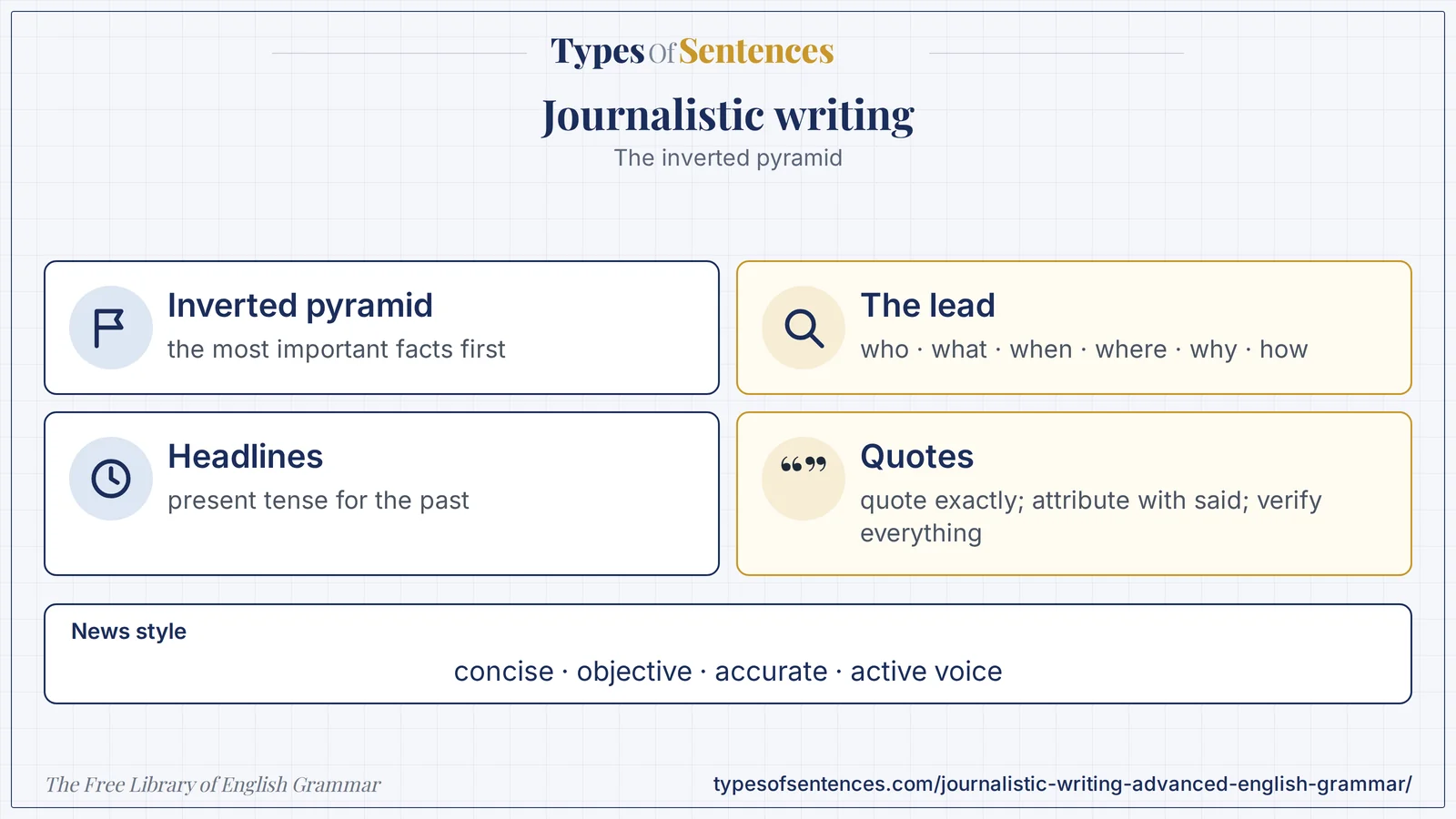
A news story answers the reader’s basic questions: who did what, when, where, why, and how. It answers them in the first paragraph or two, and then adds detail, context, and quotations in descending order of importance.
Why it matters: Good news writing is plain. It uses short sentences, strong verbs, and specific facts; it attributes claims to sources; and it keeps the reporter’s opinions out of the story.
Summary: News writing is concise, objective, accurate, and written in the active voice. The inverted pyramid puts the most important facts in the lead and the rest in order of decreasing importance. The lead answers who, what, when, where, why, and how, in about 25 to 35 words. Headlines use the present tense for past events, to for the future, and omit articles and forms of be. Quotations are exact and attributed with said; paraphrase and partial quotes are also used. Sentences are short and paragraphs are one or two sentences. Features, editorials, and reviews have their own structures and allow more voice. Accuracy, fairness, and the verification of facts come before speed.
- Inverted pyramid: most important first.
- Lead: who, what, when, where, why, how.
- Headlines: present tense for the past; omit articles and be.
- Quote exactly; attribute with said; verify everything.
What You’ll Learn
- 1. Journalistic Writing: Style and Principles
- 2. News Story Structure: The Inverted Pyramid and the Lead
- 3. Headlines: Grammar and Style
- 4. Quoting Sources: Direct Quotation and Attribution
- 5. Journalistic Grammar: Short Sentences, Active Voice, and Tense
- 6. Types of Articles
- 7. Accuracy, Fairness, and Ethics
- 8. The Process: Reporting and Writing on Deadline
- 9. Common Errors in Journalistic Writing
- 10. Exercises
- 11. Test Your Knowledge
- 12. Frequently Asked Questions
- 13. Conclusion
1. Journalistic Writing: Style and Principles
| Principle | Practice | Example |
|---|---|---|
| accuracy | verify every fact, name, number, and quotation | check the spelling of names and the figures |
| concision | short sentences and paragraphs; no wasted words | The council approved the budget on Tuesday. |
| objectivity and fairness | report facts; present all sides; keep opinion out of news | Opponents said the plan was costly; supporters said it would save money. |
| clarity | plain words; no jargon or officialese | The city will close the road. (not The roadway will be rendered inaccessible) |
| active voice | name the actor | Police arrested two men. |
| specificity | concrete details, exact numbers | A fire destroyed 12 shops in the market on Sunday night. |
| attribution | say who says or knows | the minister said; according to police |
| timeliness | what is new first | the latest development in the lead |
| human interest | people and consequences | a resident’s account |
| independence and accountability | no conflicts of interest; correct errors | a published correction |
| News writing | Academic writing |
|---|---|
| conclusion first (inverted pyramid) | conclusion last or after the argument |
| short sentences and paragraphs | longer sentences and paragraphs |
| plain words | specialist terms |
| attribution to named sources by said | citation by author and year |
| past tense for events | present for arguments, past for studies |
| quotations for voice and evidence | quotations for exact wording |
| neutral; no hedging stacks | hedging is central |
| written on deadline for a general reader | written over time for specialists |
Newsrooms follow a house style guide, such as the Associated Press Stylebook, the Reuters Handbook of Journalism, or their own, which sets the rules for numbers, dates, titles, abbreviations, and capitalization. Where a rule is given below, it is the usual practice, and the house style of the publication always overrides it. The general principle of plain, precise language is also treated in the chapter on vagueness and precision.
2. News Story Structure: The Inverted Pyramid and the Lead
| Part | Function | Example (invented story) |
|---|---|---|
| headline | tells the story in a few words | Council approves metro extension |
| lead (lede) | the most important facts: who, what, when, where, why, how | The city council on Tuesday approved a 12-kilometer metro extension, ending a three-year dispute over funding. |
| nut graf (for longer stories) | says why the story matters and what it is about | The line will link the airport to the old town by 2028 and is expected to carry 200,000 passengers a day. |
| body: supporting facts | details in descending order of importance | The vote was 14 to 6. Costs are estimated at 4,800 crore rupees. |
| quotations | voices of sources | “This is a historic day for the city,” Mayor Anita Rao said. |
| context and background | history and other views | Opponents argued that the money should go to buses. |
| ending | the least important detail (can be cut) | Work is due to begin in March. |
| Type of lead | Description | Example |
|---|---|---|
| summary (hard news) lead | the main facts at once | Two people died and 12 were injured when a bus overturned on the highway near Pune on Monday. |
| delayed (feature) lead | sets a scene before the point | The road was empty when the bus left at dawn. |
| anecdotal lead | a person’s story | For Lata Kumar, the flood began as a sound. |
| quotation lead | begins with a striking quote (use rarely) | “We lost everything,” said one resident. |
| question lead | a question (use rarely) | What would you do with 10 crore rupees? |
| contrast lead | two facts in contrast | Prices have fallen for six months. Rents have not. |
| Guideline for the lead | Practice | Example |
|---|---|---|
| one main idea | not several | — |
| length | about 25 to 35 words | — |
| active, strong verb | Police arrested … | — |
| the newest or most important fact first | — | — |
| specific, not vague | a precise number or place | 12 injured (not many injured) |
| answer who, what, when, where; why and how as space allows | — | — |
| avoid starting with the time or place unless it is the news | On Tuesday, … → The council approved … | — |
| avoid a question or a quotation as a default | — | — |
- Gather the facts and decide what is new and important.
- Write the lead first: one or two sentences that tell the story.
- Add the nut graf if the story needs context.
- Order the rest by importance, so that any paragraph could be the last.
- Insert quotations that add voice, opinion, or emotion, not those that repeat the facts.
- Check every fact and attribution before filing.
The inverted pyramid has a practical reason: an editor can cut the story from the bottom without losing the main facts, and the reader can stop at any point and still have the most important information. It reflects the principle of information structure (the new and important information first; see the chapter on information structure), but in reverse of the narrative order that most stories follow in speech. Other shapes (the hourglass, the narrative or chronological form, the question-and-answer format, the list) are used for features, explainers, and online stories.
3. Headlines: Grammar and Style
| Feature | Practice | Example |
|---|---|---|
| present tense for past events | the event is “now” in the headline | Minister resigns. (the resignation happened yesterday) |
| infinitive for the future | to + base form | PM to visit Delhi next week |
| present perfect or past (sometimes) for emphasis of a result | rare | — |
| omit articles and forms of be | save space | Prices rise (not The prices are rising) |
| strong, active verbs | — | Police arrest two men |
| short words | — | talks (not negotiations); bid (not attempt) |
| attribution with quotation marks (single quotes in some styles) | to avoid stating a claim as fact | Rao: ‘I will not resign’ |
| numerals even for numbers below ten | — | 2 die in crash |
| abbreviations only if widely known | — | UN, BBC (not unexplained initials) |
| punctuation: comma for and; semicolon between two statements; colon for attribution | — | Rao, Gomez to attend; talks resume |
| capitalization by house style | sentence case (first word and proper nouns) is now common | Council approves metro extension |
| Headline problem | Example | Fix |
|---|---|---|
| ambiguity (“crash blossom”) | Police Help Dog Bite Victim | Police help victim of dog bite |
| ambiguity of verb or noun | Squad Helps Dog Bite Victim | Squad helps victim of dog bite |
| wrong tense | Minister resigned yesterday | Minister resigns |
| vague | Changes announced | Council announces 3 new bus routes |
| too clever or misleading | a pun that hides the story | a plain, accurate headline |
| clickbait | You won’t believe what happened next | state the news |
| too long | — | cut to fit; keep the verb |
| inaccurate summary | a headline that claims more than the story | match the story |
Headline language is a form of telegraphic style, with the same kind of omission as in notes and signs (see the chapter on ellipsis and substitution). Because the omitted words make some headlines ambiguous, headline writers check for double meanings. Online headlines are also written for search and for sharing: a clear, specific headline serves both the reader and the search engine. The writing of headlines for the web is discussed in the chapter on writing for digital media.
4. Quoting Sources: Direct Quotation and Attribution
| Form | Description | Example |
|---|---|---|
| direct quotation | the source’s exact words, in quotation marks | “We will finish by March,” the contractor said. |
| partial quotation | a key phrase within a paraphrase | The mayor said the project was “long overdue.” |
| indirect quotation (paraphrase) | the content in the reporter’s words; no quotation marks | The contractor said the work would finish by March. |
| broadcast attribution first | the source before the claim (radio and television) | The contractor says the work will finish by March. |
| written source | according to a document or report | According to the audit report, 40 percent of the money was unspent. |
| Attribution verb | Use | Comment |
|---|---|---|
| said | the default, neutral verb | nearly always right |
| says | present tense in features and broadcast | — |
| told (a person) | a source speaking to the reporter or to someone | Rao told reporters … |
| added; noted; explained; said | neutral alternatives | use for variety only when they are accurate |
| according to | a document or an organization | — |
| claimed; alleged | suggest doubt; use only when appropriate and fair | legal and fairness risks |
| admitted; confessed | imply guilt | avoid unless that is clearly the meaning |
| stated; declared; asserted | formal; stronger | rarely needed |
| he said (with “said” after the quotation) | “…,” he said. | American practice |
| said + name (in some styles) | “…,” said Rao. | British and some other styles |
| Rule | Example |
|---|---|
| quote exactly; never change the words in a quotation | — |
| do not invent or “improve” a quotation | — |
| attribute the first time and whenever the speaker changes | — |
| put attribution at the end of the first sentence of a long quotation | “We will finish by March,” he said. “The weather is the only risk.” |
| identify the source clearly: full name and title at first mention; surname afterward (style varies) | Anita Rao, the mayor … Rao said |
| long multi-paragraph quotation: open quotation marks at the start of each paragraph; close only at the end of the last | — |
| punctuation: commas and periods inside the quotation marks (American style) | — |
| use quotations for opinion, emotion, and color, not for plain facts | The council approved the plan. (not a quotation) |
| paraphrase when the quotation is unclear or long | — |
| anonymous sources: explain why and what is known about them; follow the publication’s policy | a senior official who spoke on condition of anonymity |
| Source conditions (common terms) | Meaning |
|---|---|
| on the record | everything can be reported and attributed by name |
| on background | can be reported, attributed to a description (a senior official), not by name |
| off the record | not for publication (the exact meaning varies; agree the terms before the interview) |
| deep background | information to guide the reporter, with no attribution |
Quotations are evidence, and attribution is the safeguard that tells the reader who is responsible for each claim. The grammar of attribution (reporting verbs, tense, and the position of the attribution) is the subject of the chapters on advanced reported speech and on citing sources. A reporter must also be careful with serious allegations: say police said he was charged with theft, not he stole, and ask a lawyer when in doubt.
5. Journalistic Grammar: Short Sentences, Active Voice, and Tense
| Feature | Practice | Example |
|---|---|---|
| short sentences | average 15–20 words; one idea each | The fire started at 9 p.m. It spread to six shops. |
| short paragraphs | one or two sentences | — |
| active voice | subject–verb–object | The court sentenced him to five years. |
| passive (when the actor is unknown or unimportant) | — | A man was found dead in the river on Monday. |
| past tense for news events | the event is over | The bus overturned on Monday. |
| present perfect for recent developments | — | Prices have risen by 10 percent this year. |
| present tense for a current state or a continuing situation | — | The road remains closed. |
| reporting verbs: said in the past for newspapers | — | Rao said … |
| strong verbs, concrete nouns | — | The fire destroyed the market. |
| few adjectives and adverbs | let facts speak | — |
| parallel structure | lists in the same form | — |
| time element placement | after the verb, close to the action it modifies, avoiding ambiguity | The council approved the plan on Tuesday. (not The council on Tuesday approved unless emphasizing) |
| numbers | numerals for 10 and above, words for one to nine (AP); exact figures | 12 injured; five arrested |
| dates and days | day of the week for the past week; date beyond | on Monday; on March 15 |
| titles and names | full name and title at first mention | Prime Minister Anita Rao |
| abbreviations and acronyms | spell out at first mention unless known | World Health Organization (WHO) |
| serial comma | style guides differ (AP generally omits it; others use it) | follow the house style |
| contractions in quotations only | — | “We won’t go,” he said. |
| Avoid | Example | Better |
|---|---|---|
| officialese and jargon | The individual was apprehended. | Police arrested the man. |
| clichés and journalese | tragic; sparked; in the wake of; slammed; blasted; shocking; bombshell | specific facts and plain verbs |
| stacked adjectives | a shocking, tragic, brutal attack | an attack that killed three people |
| loaded words | The minister admitted that … | The minister said that … |
| editorializing | a disastrous decision | the decision was criticized by … |
| hedging stacks | may possibly allegedly have | Police said the man may have … |
| vague time | recently; lately | on Monday; in 2023 |
| stacked modifiers and noun strings | local government housing policy review committee chairman | the chairman of the committee reviewing housing policy |
| misplaced time element | He said Monday he would resign. (said on Monday? resign on Monday?) | He said he would resign on Monday. |
| dangling modifier | Walking home, the rain started. | As she walked home, the rain started. |
Journalistic grammar is the grammar of speed and clarity. Many of its choices are the reverse of academic writing: the active voice rather than the passive, short sentences rather than nominalizations, and plain, concrete words. A reporter writing a news story is writing for a general reader on deadline, and the discipline of the inverted pyramid and the short sentence works in the same way as the plain-language principles in the later chapter on conciseness and wordiness.
6. Types of Articles
| Type | Purpose | Structure and voice |
|---|---|---|
| news report (hard news) | report what happened, quickly | inverted pyramid; objective; attribution; past tense |
| news brief | a short item | one to three paragraphs |
| feature | tell a story in depth; human interest | a delayed lead; narrative; scenes and quotations; more voice |
| profile | portray a person | biographical detail, observation, quotations |
| explainer | explain a complex topic | questions and answers; context; graphics |
| investigative report | uncover hidden facts | documents, interviews, evidence; careful attribution |
| editorial | the publication’s opinion | argument; clear stance; present tense; persuasive devices |
| column or op-ed | an individual’s opinion | a personal voice; argument |
| review | evaluate a work or performance | description and judgment |
| interview or Q&A | present a person’s words | questions and answers |
| obituary | record a life | facts, achievements, quotations |
| sports report | report a game | lead on the result; scoring; quotes |
| business and data journalism | report on money and numbers | figures, charts, explanation; careful with statistics |
| photo caption | explain a picture | a present-tense sentence, then context |
| broadcast news script | spoken news | short, conversational, present tense; attribution first |
| News | Opinion |
|---|---|
| reports facts | argues a view |
| neutral language | evaluative language |
| “said” | “we believe” |
| labeled as news | labeled as opinion or editorial |
| both sides | a clear stance, with reasons |
The writing of opinion (editorials and columns) uses the argument strategies of the chapter on rhetorical strategies, but within the conventions of a newspaper: a clear stance, a strong lead, short paragraphs, and a firm ending. Readers should always be able to tell news from opinion, and the language of the two should not be mixed.
7. Accuracy, Fairness, and Ethics
| Principle | Practice |
|---|---|
| seek and report the truth | verify facts with more than one source where possible |
| minimize harm | take care with victims, children, and grieving people; consider the effect of a story |
| act independently | avoid conflicts of interest; do not accept payment from sources |
| be accountable | correct errors openly and promptly |
| fairness | give the subject of criticism a chance to respond; present relevant views |
| accuracy of numbers | check calculations; use percent and percentage points correctly; give a base for comparisons |
| avoid plagiarism | credit other publications and sources |
| attribute claims | do not state a disputed claim as fact |
| respect privacy | balance the public interest and private lives |
| avoid stereotyping | use inclusive, accurate descriptions |
| Numbers and statistics | Correct practice |
|---|---|
| percent versus percentage points | the rate rose from 10 percent to 12 percent: an increase of 2 percentage points, or 20 percent |
| absolute and relative change | give both (from 5 cases to 10 cases, a doubling) |
| averages | say mean, median, or mode where it matters |
| polls and surveys | sample size, margin of error, date |
| comparisons | compare like with like; give the base year |
| causation | do not imply cause from correlation |
Codes of ethics (for example those of professional journalists’ associations) set out these principles. Media law (defamation, contempt of court, privacy, and reporting restrictions) differs between jurisdictions, and reporters work with editors and lawyers when a story raises a risk. This chapter describes the language of journalism, and it is not legal advice.
8. The Process: Reporting and Writing on Deadline
- Reporting: find the facts, interview sources, check documents, and note the time, place, and exact words.
- Choose the angle: what is the news, and why should the reader care?
- Plan the structure: lead, nut graf, order of facts, quotations.
- Write the lead first, then fill in the rest in order of importance.
- Attribute every claim that is not an established fact.
- Edit: cut, tighten, check numbers, names, and quotations.
- Fact-check against notes and recordings.
- File and update as the story develops, and correct errors.
| Tip for writing on deadline | Reason |
|---|---|
| write the lead first and write it again | it organizes the story |
| write short; cut later | speed and clarity |
| leave a mark for missing facts and check them | avoid errors |
| use a template or the inverted pyramid | saves thinking time |
| read the story aloud | finds clumsy sentences |
| check names, numbers, and titles last | the most common errors |
9. Common Errors in Journalistic Writing
| Error | Example | Fix |
|---|---|---|
| buried lead | a story that begins with background | begin with the news |
| no attribution | The plan will cost 5 crore. | The plan will cost 5 crore rupees, officials said. |
| editorializing | a tragic, senseless attack | an attack that killed three people |
| clichés | sparked outrage; in the wake of | people protested; after |
| passive hiding the actor | Mistakes were made. | The department made mistakes, the report said. |
| loaded attribution verb | He admitted that he was late. | He said he was late. |
| stacked modifiers | the rich, powerful, controversial businessman | the businessman |
| wrong tense in a headline | Minister resigned yesterday | Minister resigns |
| ambiguous headline | Police Help Dog Bite Victim | Police help victim of dog bite |
| misquote | changing the words in quotation marks | quote exactly or paraphrase |
| unclear time element | He said Monday he would resign. | He said he would resign on Monday. |
| missing facts | no place or time | add where and when |
| jargon | The suspect was apprehended. | Police arrested the suspect. |
| long lead | 50-word lead sentence | 25 to 35 words |
| numbers errors | 10 percent increase from 5 to 10 | a 100 percent increase, from 5 to 10 |
Edit: In the wake of a tragic, senseless attack that sparked shock, it was reported that, on Tuesday, a man was apprehended, and the city, which is large and important, has been plunged into mourning, the minister admitted yesterday that mistakes were made.
- In the wake of a tragic, senseless attack that sparked shock: clichés and editorializing: delete.
- it was reported that: no source: police said.
- on Tuesday, a man was apprehended: officialese and passive: Police arrested a man on Tuesday.
- the city, which is large and important, has been plunged into mourning: cliché and padding: delete or give a fact: Three people died.
- the minister admitted yesterday that mistakes were made: loaded verb, passive, unclear time: The minister said on Wednesday that the department made mistakes.
- Result: Police arrested a man on Tuesday after an attack that killed three people, police said. The minister said on Wednesday that the department made mistakes. (the events are invented)
Recap in 12 seconds
Watch the lesson build itself: News writing puts the key facts in the lead, uses active voice, and quotes and attributes with care. The video has no sound.
Exercises
Part A: Style and Structure (Exercises 1–7)
Exercise 1: What are the five Ws and the H?
Show Answer
Answer: Who, what, when, where, why, how.
Exercise 2: What is the inverted pyramid?
Show Answer
Answer: Most important facts first, then less important.
Exercise 3: How long is a typical lead?
Show Answer
Answer: About 25 to 35 words.
Exercise 4: What is a nut graf?
Show Answer
Answer: A paragraph that says what the story is about and why it matters.
Exercise 5: Why can a story be cut from the bottom?
Show Answer
Answer: The least important facts are at the end.
Exercise 6: Name a type of lead.
Show Answer
Answer: Summary, delayed, anecdotal, quotation, question.
Exercise 7: News or opinion: The council approved the plan on Tuesday.
Show Answer
Answer: News.
Part B: Headlines (Exercises 8–13)
Exercise 8: Fix the tense: Minister resigned yesterday
Show Answer
Answer: Minister resigns
Exercise 9: Express the future: The PM will visit Delhi.
Show Answer
Answer: PM to visit Delhi.
Exercise 10: Which words are omitted in headlines?
Show Answer
Answer: Articles and forms of be.
Exercise 11: Fix the ambiguity: Police Help Dog Bite Victim
Show Answer
Answer: Police help victim of dog bite.
Exercise 12: What is clickbait?
Show Answer
Answer: A headline that tempts without informing.
Exercise 13: Why is a vague headline weak?
Show Answer
Answer: It does not tell the reader what happened.
Part C: Quotes and Attribution (Exercises 14–20)
Exercise 14: The default attribution verb:
Show Answer
Answer: said.
Exercise 15: Fix: He admitted that he was late. (neutral)
Show Answer
Answer: He said he was late.
Exercise 16: May you change words in a direct quotation?
Show Answer
Answer: No.
Exercise 17: What is a partial quotation?
Show Answer
Answer: A key phrase in quotation marks inside a paraphrase.
Exercise 18: What does “on background” mean?
Show Answer
Answer: Reportable, attributed to a description, not by name.
Exercise 19: Add attribution: The plan will cost 5 crore rupees.
Show Answer
Answer: The plan will cost 5 crore rupees, officials said.
Exercise 20: When use a quotation?
Show Answer
Answer: For opinion, emotion, and color; not for plain facts.
Part D: Grammar (Exercises 21–26)
Exercise 21: Tense for news events:
Show Answer
Answer: The past.
Exercise 22: Active: The man was arrested by police.
Show Answer
Answer: Police arrested the man.
Exercise 23: Plain for apprehended:
Show Answer
Answer: arrested.
Exercise 24: Fix: He said Monday he would resign.
Show Answer
Answer: He said he would resign on Monday.
Exercise 25: Name a cliché.
Show Answer
Answer: in the wake of; sparked outrage; slammed.
Exercise 26: Percent or percentage points: from 10 to 12 percent
Show Answer
Answer: 2 percentage points (20 percent).
Part E: Types and Errors (Exercises 27–30)
Exercise 27: Which type argues a view?
Show Answer
Answer: Editorial (or op-ed, column).
Exercise 28: Which type tells a story in depth?
Show Answer
Answer: Feature.
Exercise 29: Fix: a tragic, senseless attack
Show Answer
Answer: an attack that killed three people.
Exercise 30: Fix the buried lead:
Show Answer
Answer: Begin with the news, then give the background.
Test Your Knowledge
Ready to check what you learned? Answer all 10 questions, then submit. You need 80% (8 of 10) to pass. Your answers are not stored.
View correct answers and explanations
Question 1: What does the inverted pyramid put first?
✓ Correct Answer: A – the most important facts
The most important facts.
Question 2: Which is the usual attribution verb?
✓ Correct Answer: B – said
Said.
Question 3: Which tense is used for the headline Minister resigns?
✓ Correct Answer: C – present
Present for a past event.
Question 4: Which is the headline for a future event?
✓ Correct Answer: D – PM to visit Delhi
To + base form.
Question 5: Which is a cliché?
✓ Correct Answer: C – in the wake of
A stock phrase.
Question 6: Which is better?
✓ Correct Answer: A – Police arrested the man.
Plain and active.
Question 7: How long is a typical lead?
✓ Correct Answer: D – 25 to 35 words
About 25 to 35.
Question 8: Which is an editorial feature?
✓ Correct Answer: C – a clear stance and argument
Opinion with a stance.
Question 9: Which is a crash blossom?
✓ Correct Answer: B – Police Help Dog Bite Victim
An ambiguous headline.
Question 10: What must a direct quotation be?
✓ Correct Answer: B – exact
Exact.
Frequently Asked Questions
What is journalistic writing?
Journalistic writing is writing that reports news and information to the public: concise, objective, attributed, and organized with the most important facts first.
What is news writing?
News writing is the writing of news stories: an inverted pyramid structure, a lead that answers who, what, when, where, why, and how, short sentences, and attributed quotations. News writing stays neutral.
What is journalism style?
Journalism style is the set of conventions of the press: plain words, short sentences and paragraphs, the active voice, attribution with said, and a house style guide for numbers, titles, and punctuation. Journalism style favors clarity.
What is news grammar?
News grammar is the grammar typical of news: the past tense for events, the present perfect for recent developments, the present tense in headlines, active sentences, and the omission of articles in headlines.
What is the role of reporting?
Reporting is the gathering of facts: observing, interviewing, and checking documents. Reporting comes before writing, and it determines accuracy.
How do I write a good lead?
Put the most important and newest facts first, answer who, what, when, and where, use an active verb and specific details, and keep it to about 25 to 35 words.
How do I quote and attribute sources?
Quote exactly, attribute with said, identify the source by name and role, paraphrase when a quotation is unclear, and keep claims attributed to those who make them.
Conclusion
You now have a deep study of journalistic writing: its style, the inverted pyramid and the lead, headlines, quotation and attribution, news grammar, the types of articles, ethics, and the process of writing on deadline. You can write clear, accurate news.
When you write news, ask what is new and important, who says so, and how you know. Next, you will study creative writing techniques.
- Associated Press. The Associated Press Stylebook. Associated Press, current edition.: a widely used style guide for news writing.
- Brooks, Brian S., George Kennedy, Darrell R. Moen, and Don Ranly. News Reporting and Writing. 13th ed. Bedford/St. Martin’s, 2018.: a standard textbook of news writing.
- Harrower, Tim. Inside Reporting. 3rd ed. McGraw-Hill, 2013.: reporting and writing.
- Society of Professional Journalists. SPJ Code of Ethics. SPJ, 2014.: principles of journalistic ethics.
- Merriam-Webster Dictionary: journalism: the dictionary entry.
Last reviewed: October 29, 2026. How it was made: drafted with AI assistance, then checked with automated tests (structure, links, answer keys, spelling) and against the sources above. A person has not yet read this chapter line by line. Found a mistake? Report it.