Grammar in literature is the study of how an author’s grammatical choices create meaning, voice, and effect. A reader who has noticed that a narrator’s sentences are short and flat, or that a character never finishes a sentence, or that a long paragraph is one sentence, has noticed grammar, whether or not the word came to mind. Literary grammar takes these impressions and tests them: which structures produce the effect, what the alternative would have been, and what the choice contributes to the meaning of the work. It is a form of close reading in which the evidence is syntactic.
This chapter gives a method of stylistic analysis and applies it. You will study the grammar patterns that critics associate with particular authors, the artistic license of breaking grammatical rules, stream of consciousness and the grammar of thought, the representation of dialect and speech, and the use of grammar for characterization. The chapter includes close readings of short public-domain passages and shows how to write about grammar analysis in literature without merely labeling features. Grammar in fiction, in the narration and the dialogue, is a resource that the author chooses; the analysis of literary grammar helps the reader to see the choice. All other examples are original pastiche, labeled as such. Thirty editing exercises and a quiz follow.
A writer’s grammar is part of what the writer says. A story told in short sentences feels different from a story told in one long sentence, even if the events are the same. Close reading with grammar means asking what the structure of the sentences does.
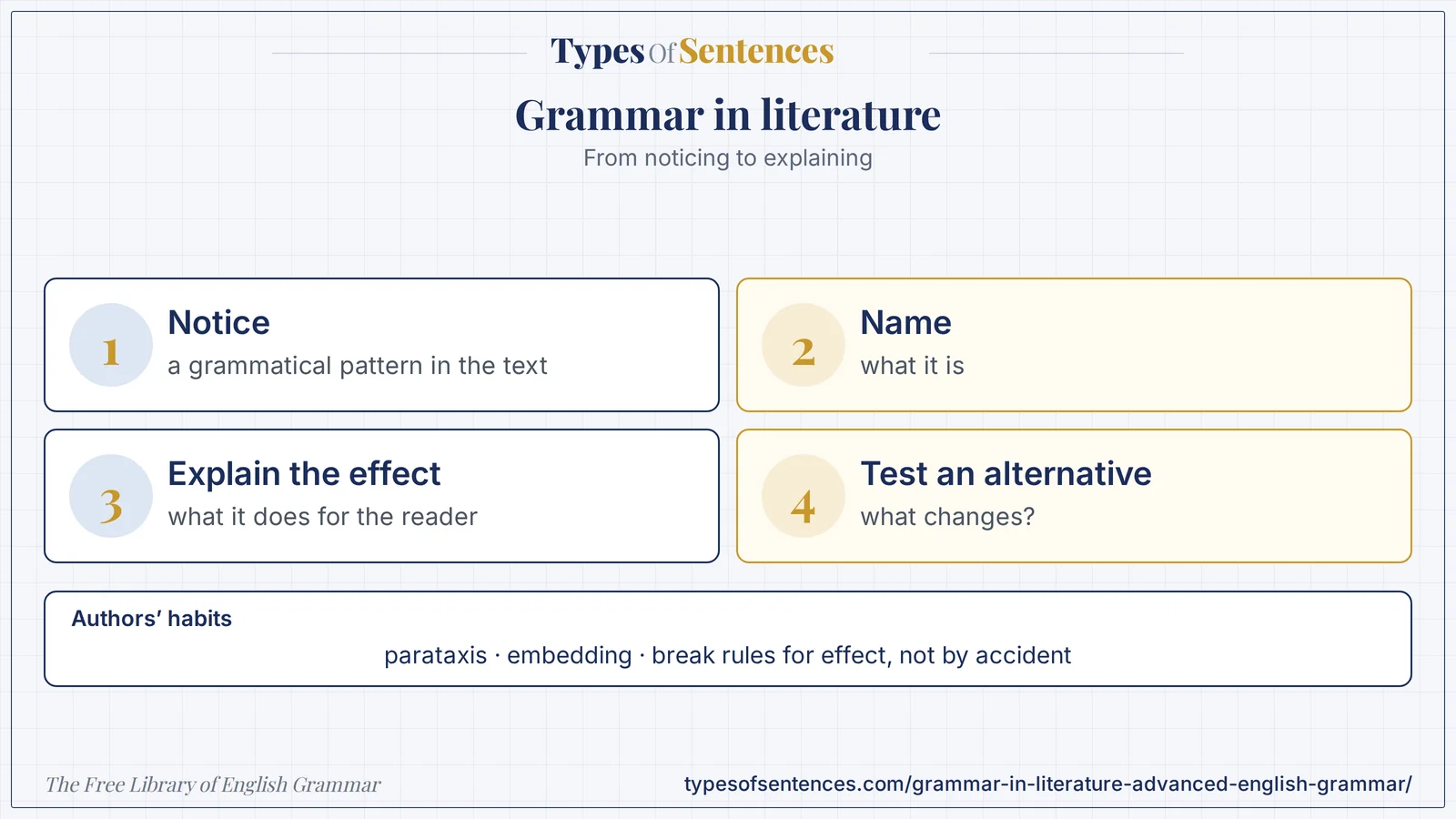
Why it matters: The method is to notice a feature, name it, ask what effect it has in context, and test it by imagining a change. The analysis is convincing when you can show how the grammar supports the meaning of the work.
Summary: Stylistic analysis examines the linguistic choices of a text (lexis, grammar, figures, cohesion) and relates them to meaning and effect. Authors are often characterized by grammatical habits: Hemingway’s short, additive, paratactic sentences; Faulkner’s long, embedded, cumulative and periodic sentences; Austen’s balanced and ironic syntax and free indirect style; Dickens’s lists and parallel lists; Woolf’s and Joyce’s stream of consciousness, which uses long sentences, minimal punctuation, and associative syntax. Writers break grammatical rules for effect (fragments, run-ons, unconventional capitalization, unmarked dialogue). Dialect is represented through nonstandard spelling and grammar, with attention to respect and readability. Characters are distinguished by their sentence length, formality, and pronoun use. A good analysis moves from observation to effect, uses evidence, and tests alternatives.
- Notice → name → explain the effect → test an alternative.
- Authors have grammatical habits: parataxis, embedding, irony, interior flow.
- Break rules for effect, not by accident.
- Represent dialect with respect.
What You’ll Learn
- 1. Grammar in Literature: Stylistic Analysis
- 2. Grammar Patterns in Authors: Plain, Embedded, Ironic, and Flowing Styles
- 3. Breaking Grammar Rules: Artistic License and Intentional Fragments
- 4. Stream of Consciousness: Grammar and the Flow of Thought
- 5. Dialect and Grammar: Representing Speech
- 6. Grammar for Characterization: Different Characters, Different Grammar
- 7. Famous Examples: Close Reading of Short Public-Domain Passages
- 8. Writing About Grammar in Literature
- 9. Common Pitfalls and a Worked Example
- 10. Exercises
- 11. Test Your Knowledge
- 12. Frequently Asked Questions
- 13. Conclusion
1. Grammar in Literature: Stylistic Analysis
| Level | What to look at | Questions |
|---|---|---|
| vocabulary (lexis) | concrete or abstract; formal or informal; repeated words; semantic fields | What kinds of words dominate? What do they suggest? |
| sentence structure | length; simple, compound, complex; fragments; run-ons | Is the syntax plain or elaborate? Does it speed up or slow down? |
| clause structure | main and subordinate clauses; embedding; branching; parataxis and hypotaxis | Are ideas joined by and or ranked by subordination? |
| phrase structure | noun phrase complexity; adjectives; adverbs; prepositional chains | Is description dense or sparse? |
| verbs | tense; aspect; voice; modality; kind of process (action, thought, state) | Who acts? Who thinks? Who is acted upon? |
| pronouns and reference | person; antecedents; we and they | From whose point of view? |
| word order | inversion; fronting; delay | What is emphasized or withheld? |
| cohesion | repetition; connectives; parallelism; ellipsis | How are the parts linked? |
| punctuation and layout | commas, dashes, semicolons; paragraphing; unmarked speech | What does the punctuation do to the pace? |
| sound and rhythm | alliteration; stress; cadence | How does it sound read aloud? |
| figures of speech | metaphor, irony, repetition | What do they contribute? |
| discourse and narration | narrator; point of view; free indirect style; dialogue | Whose voice is this? |
| Step in the method | Action | Example (invented) |
|---|---|---|
| 1 read and respond | note your first impression of the passage | The passage feels cold and rapid. |
| 2 identify features | list the notable linguistic features | short declarative sentences; few adjectives; and joining clauses |
| 3 name them | use the right terms | parataxis; plain diction; past tense |
| 4 explain the effect | connect each feature to its effect in the passage | the pace is brisk and the tone detached |
| 5 relate to meaning | connect to theme, character, or situation | the detachment mirrors the narrator’s numbness |
| 6 test an alternative | rewrite one feature and compare | a long, flowing version would soften the detachment |
| 7 support with evidence | quote and count | four of five sentences have fewer than ten words |
| 8 draw a conclusion | state what the grammar contributes | the syntax enacts the emotional state |
| Tool or approach | Idea | Source |
|---|---|---|
| checklist of linguistic and stylistic categories | a systematic list of lexical, grammatical, figurative, and cohesive features | Leech and Short, Style in Fiction (1981) |
| transitivity analysis | analyzing the kinds of processes (material, mental, relational, verbal) and who the participants are | M. A. K. Halliday, “Linguistic Function and Literary Style” (1971) |
| foregrounding | a feature that stands out from the norm and attracts attention | Prague School stylistics; Mukarovský |
| deviation and parallelism | departure from linguistic norms, and patterns of repetition that make features prominent | Leech |
| corpus stylistics | comparing a text with a reference corpus to find unusual frequencies | see the chapter on corpus linguistics |
Stylistic analysis is the application of linguistics to the study of literary texts. It differs from impressionistic criticism in that it asks the reader to show the linguistic evidence, and from mere feature-counting in that it demands an interpretation. The grammar involved is the grammar of this course: clause structure from the chapter on inversion and the chapters on complex sentences, voice, tense, and reported speech.
2. Grammar Patterns in Authors: Plain, Embedded, Ironic, and Flowing Styles
Critics have long described authors by their grammatical habits. The descriptions below are summaries of common critical observations, not complete accounts, and every author varies by work. The examples labeled “pastiche” are original sentences written in the manner described, and not quotations.
| Author (and tendency) | Grammatical features often noted | Effect | Pastiche (original) |
|---|---|---|---|
| Ernest Hemingway (the plain, additive style) | short declarative sentences; parataxis with and; concrete nouns; few adjectives and adverbs; repetition; understatement | restraint; emotion implied beneath the surface | The river was low and we crossed it. The water was cold and clear. We did not talk. |
| William Faulkner (the long, embedded style) | very long sentences; embedded relative and adverbial clauses; parentheses; repetition; delayed information; piled-up modifiers | memory and time pressing in; the density of the past | She remembered the house, which had stood empty since the summer her father, who had never forgiven the river, left, and the long days when nobody asked why. |
| Jane Austen (ironic balance) | balanced and antithetical sentences; formal syntax; abstract nouns; free indirect style; understatement | irony; social comedy; a narrator who is close to and apart from the heroine | It was a point of honor with the family that they should be thought less proud than they were, and a point of pride that this should be known. |
| Charles Dickens (the list) | long lists with parallel structure; accumulation; exaggeration; repeated sentence openings; comic names | satire; social panorama | There were clerks, and clerks’ clerks, and the clerks of those clerks, all copying what the first had copied. |
| Herman Melville (rhetorical and biblical) | long periodic sentences; parallelism; archaic and biblical rhythms; digressions | grandeur; philosophical weight | Though the sea lay quiet, though the sky was clear, yet in the quiet and the clearness something waited. |
| Virginia Woolf (the flowing style) | long sentences with semicolons and dashes; free indirect style; shifts between characters’ minds; recurring images | the movement of consciousness; time | She stood at the window; the street below, with its carts and clerks and the sudden light on a wet roof, seemed to her both utterly familiar and as if seen for the first time; and she thought of the party, the flowers, the hour. |
| James Joyce (interior monologue) | fragments; associative leaps; lists; omitted punctuation in the most famous chapter; puns and coinages | the texture of thought and speech | yes the bus and the rain and the green door and no I did not say |
| Mark Twain (the vernacular) | nonstandard grammar and spelling for a first-person narrator; short clauses; double negatives; repetition | authentic voice; humor; social criticism | I ain’t never seen nothing like it, and I don’t reckon I will. |
| R. K. Narayan (the plain English of an Indian setting) | simple syntax; clear, unadorned sentences; irony; local names and customs | gentle comedy; clarity for international readers | The postman came every day at ten, and every day Raman pretended not to wait for him. |
| Arundhati Roy (inventive compounds and capitalization) | invented compounds; unconventional capitalization; fragments; repetition; shifts in point of view | a child’s vision; defamiliarization | Hot Slow Yellow Noon. A small, bare, Foot-Slapping run. |
| Orwell (the plain essay style) | direct, concrete sentences; mostly active; short words; deliberate concision | argument by clarity | The plan was simple, and it was wrong. |
| Emily Dickinson (compression, in poetry) | dashes; ellipsis; unusual capitalization; syntactic compression | a spare, enigmatic voice | — |
| Contrast | Short, additive (parataxis) | Long, embedded (hypotaxis) |
|---|---|---|
| pace | fast, steady | slow, accumulating |
| relation of ideas | implied | explicit and ranked |
| effect on the reader | the reader supplies the connections | the reader follows the logic |
| emotion | understated | immersed |
| example in this chapter | Hemingway pastiche | Faulkner pastiche |
| Test | Question |
|---|---|
| Is the description of the author’s style based on the text in front of you? | avoid relying on the reputation |
| Does the feature recur? | one long sentence is not a style |
| Does it vary with the work or the narrator? | narrators differ from authors |
| Is there a competing feature? | authors use many devices |
The close relationship between sentence shape and effect is discussed in the chapters on fronting and postponement and on sentence architecture. The ability to write in the manner of an author (pastiche) is a good way of learning the grammar of a style, as the chapter on creative writing technique notes.
3. Breaking Grammar Rules: Artistic License and Intentional Fragments
| Rule broken | Literary use | Effect | Example (original) |
|---|---|---|---|
| sentence completeness (fragments) | a gesture, an image, a pause | emphasis; a thought in progress | The door. Open. |
| run-on and comma splice | a headlong rush of thought or action | breathlessness; speed | He ran, the street was empty, the lights were out, nobody called. |
| punctuation omitted | a flow of consciousness or speech | no stopping | and then she said that it was late and he said that it was not |
| quotation marks omitted | dialogue merged with narration | speech as part of the flow of the narrative | He said he was tired. I am tired too, she said. |
| conventional capitalization ignored | a sense of childhood, or of importance | defamiliarization | Big Important Things |
| invented words (neologism) | a new vision of the world | freshness | the moonshimmer on the river |
| noun used as a verb | energy and compression | vividness | She windowed the room with lamps. |
| abrupt tense shifts | memory and present collide | time distorted | She walks into the room. She walked into that room a thousand times. |
| person shifts | instability of self | alienation | I went home. You know how it is. He never came back. |
| second person | involvement; command | intimacy; pressure | You open the door and you know. |
| ungrammatical dialogue | character, dialect, emotion | authenticity | I ain’t got nothing to say. |
| repetition | obsession; ritual | emphasis; music | No. No. No. |
| very long sentences | immersion; thought | accumulation | a page-long sentence |
| very short paragraphs | shock | impact | Silence. |
| non-standard word order | archaism, poetic diction | estrangement | Of such things we do not speak. |
| unfinished sentences (aposiopesis) | interrupted speech or thought | tension; things unsaid | If you ever— |
| blank space and typography | visual meaning | emphasis | — |
| code-switching and foreign words | a bilingual or multilingual world | identity; authenticity | — |
| no verb (nominal sentences) | a list or an image | an impression | Rain. Neon. The smell of frying. |
| comma-less lists | a rush of items | speed | pots pans bowls spoons plates |
| unusual agreement | a character’s voice | characterization | The people was there. |
| mixed registers | comic or ironic effect | juxtaposition | — |
| questions without question marks | a flat, uncertain tone | inertia | what is the point |
| capitalized abstractions | personification, allegory | weight | Death and Time as characters |
| grammatical ambiguity used on purpose | multiple readings | richness | see the chapter on ambiguity |
| verb tense in narration (present for past) | immediacy | vividness | He walks in. He sits down. |
- Know the rule before you break it. The effect of a break depends on the reader’s sense of what is normal.
- Break it for a reason. Ask what the break contributes.
- Break it consistently. A pattern signals a choice; a random error signals a mistake.
- Do not break rules in a context that needs conventional prose (an exam, a report).
- When analyzing, name the rule and the effect, and do not simply say “the author ignores grammar”.
4. Stream of Consciousness: Grammar and the Flow of Thought
| Technique | Description | Grammatical features | Example (original) |
|---|---|---|---|
| stream of consciousness | a narrative method that presents the flow of a character’s thoughts and perceptions as they occur | associative syntax; shifts in time and subject without notice | the tea cooling and her mother’s hands and the smell of the school corridor and oh the letter |
| direct interior monologue | a character’s thoughts presented in the first person without a narrator | first person; present tense; fragments; deixis (now, here) | I should go. The bus. Why did I say that? |
| indirect interior monologue (free indirect discourse) | a blend of narrator and character: third person, past tense, but with the character’s words, exclamations, and questions | no reporting clause; third person; past tense; unembedded questions and exclamations | She would go, then. Why should she care what he thought? |
| psychic narration | the narrator summarizes thoughts in the narrator’s words | reporting verbs of thought; third person | She thought about the letter for a long time. |
| stream with minimal punctuation | the loss of punctuation to represent unbroken thought | run-ons; lack of commas and full stops | and I thought yes and the window yes and he said yes |
| parataxis and polysyndeton | a series joined by and | repeated and | and the street and the shop and the child |
| associative leaps | a sudden shift of topic triggered by an image | abrupt change of subject | — |
| repetition of words and phrases | a motif of thought | anaphora; refrain | yes … yes … yes |
| sensory fragments | impressions without verbs | nominal sentences | Heat. Dust. The cry of a seller. |
| time shifts | past, present, and future mixed | tense variation within a sentence | — |
| Grammar of free indirect discourse | Direct speech | Free indirect discourse | Reported speech |
|---|---|---|---|
| form | She thought, “I will go. Why should I care?” | She would go. Why should she care? | She thought that she would go and wondered why she should care. |
| person | first | third | third |
| tense | present or future | past (backshifted) | past (backshifted) |
| reporting clause | yes (she thought) | no | yes |
| questions and exclamations | direct | retained, unembedded | embedded (wondered why) |
| deictics | proximal (now, here) | proximal retained (now, tomorrow) | shifted (then, the next day) |
| voice | the character’s | a blend of narrator and character | the narrator’s |
Free indirect discourse is the technique by which a narrator’s sentences take on a character’s voice without a reporting clause. It is a staple of the novel from Jane Austen onward, and it is closely related to the grammar of reported speech described in the chapter on advanced reported speech. The deictic shifts that mark it are discussed in the chapter on reference and deixis. The phrase “stream of consciousness” was taken from the psychologist William James and applied to fiction in the early twentieth century; it is associated with Virginia Woolf, James Joyce, and William Faulkner, among others.
5. Dialect and Grammar: Representing Speech
| Method of representing speech | Description | Example (original unless noted) | Comment |
|---|---|---|---|
| nonstandard grammar | agreement, verb forms, negation of a dialect | We was going; I seen it; he don’t know nothing. | regular rules of a variety; effective and economical |
| eye dialect | spelling that signals pronunciation | gonna, wanna, lemme | light use is fine; heavy use harms readability and can mock |
| phonetic respelling | spelling changes for sounds | dis, dat | be careful with stereotyping |
| vocabulary and idiom | local words and expressions | y’all; reckon; lakh, crore | natural and economical |
| syntax and rhythm | sentence patterns of speech | Me, I never liked it. | rhythm carries the voice |
| code-switching | two languages in one speech | — | shows bilingual speakers |
| grammatical features of a variety | copula deletion, habitual be, tag formation | She tired. He be working. (features of some varieties of English) | linguistically regular; represent with knowledge and respect |
| explanatory note | an author’s note about the dialects used | Mark Twain’s explanatory note on the dialects in Adventures of Huckleberry Finn | the author says what is being represented |
| dialect in narration | the narrator uses the dialect | the opening of Twain’s Huckleberry Finn (1884), quoted in the close readings below | a vernacular narrator |
| standard narration with dialect dialogue | standard narration, local speech in quotation marks | — | the most common method |
| Indian English in fiction | features such as only for emphasis, the continuous with stative verbs, reduplication, and local terms | He came yesterday only. | authors have used these to convey voice and place |
| Principle | Why |
|---|---|
| use a few features consistently | a few marked features suggest a dialect without overwhelming the reader |
| prefer grammar and vocabulary to heavy respelling | readability and respect |
| know the variety | invented “dialect” sounds false and can offend |
| avoid caricature | nonstandard speech is not a mark of low intelligence |
| consider the narrator’s standard | a contrast of standard narration and dialectal speech has social meaning |
| read aloud and revise | speech is heard |
| accept that readers differ | some will find a dialect hard to read |
| when in doubt, listen to speakers | authenticity comes from listening |
| consult speakers of the community | a check against stereotype |
| be aware of history | some representations of speech have been used to mock communities |
Every dialect has its own regular grammar, as the chapter on grammar myths and controversies explains. A writer who uses a dialect in fiction is representing a system, not a set of errors. The effect on characterization, discussed in the next section, can be large: a character’s grammar tells the reader about region, class, education, age, and attitude, and sometimes the author means to criticize the reader’s own prejudices by showing how quickly they are formed.
6. Grammar for Characterization: Different Characters, Different Grammar
| Character (original) | Grammar features | Effect | Sample |
|---|---|---|---|
| a nervous young clerk | short, broken sentences; many hedges and fillers; questions; trailing off | uncertainty | I just thought—well, maybe, if it isn’t too much—could I ask something? |
| an authoritative judge | long, balanced sentences; formal vocabulary; subordination; modals of obligation | power; control | It is the finding of this court that the defendant, having been duly warned, must pay. |
| a child | simple sentences; repetition; and chains; immature agreement; concrete words | innocence | And then the dog came and he barked and I runned. |
| an elderly storyteller | long cumulative sentences; proverbs; repetition; archaic expressions | wisdom; slowness | It was in the year the river flooded, and I tell you, child, a flood is no small thing. |
| a bureaucrat | nominalizations; passives; abstract nouns | distance; evasion | The matter has been given consideration and a determination will be communicated. |
| a teenager | fragments; slang; discourse markers; quotatives | youth; informality | So I’m like, no way. And she’s like, whatever. |
| a scientist | precise terms; hedges; passive; long noun phrases | caution; expertise | The data would seem to suggest a correlation, although the sample was small. |
| an angry speaker | short imperatives; repetition; exclamations; interruptions | anger | No. Listen. I said no. Are you deaf? |
| a charming liar | smooth subordination; politeness; flattery; vagueness | deception | My dear friend, nothing, absolutely nothing, would please me more. |
| a stranger in a new country | simplified grammar; direct speech; literal translation of idiom | displacement | I am coming from far. Please, you help me? |
| a politician | inclusive we; rhetorical devices; evasion; passives | persuasion; avoidance | We will do what is right, and mistakes were made. |
| a villain who is polite | formal, correct grammar; euphemism; understatement | menace under courtesy | I would not recommend that you leave. |
| Resource | How it characterizes |
|---|---|
| sentence length | rapid versus measured thought |
| formality | status, education, situation |
| hedging and boosting | confidence or doubt |
| modal verbs | obligation, authority, doubt |
| pronouns | self-focus (I), inclusion (we), distance |
| questions and imperatives | the relationship to the listener (see the chapter on pragmatics) |
| voice | responsibility or evasion |
| politeness formulas | relationship and power |
| interruptions and overlap | dominance, nervousness |
| repetition | obsession, rhetoric |
| dialect and register | region, class, age, community |
| idiolect (a person’s own habits) | individuality |
A character’s speech is also characterized by what it does not say. Silence, evasion, and indirectness are grammatical choices, and the study of their meanings is the subject of the chapter on pragmatics. The narrator’s grammar characterizes the narrator, and the contrast between narrator and character is an important source of irony.
7. Famous Examples: Close Reading of Short Public-Domain Passages
| Passage (public domain) | Source | Grammar and effect |
|---|---|---|
| Now, what I want is, Facts. | Charles Dickens, Hard Times, 1854 | a fronted Now; a pseudo-cleft (what I want is) that builds toward the capitalized noun Facts; end focus; a speaker who reduces the world to a single category |
| Emma Woodhouse, handsome, clever, and rich | Jane Austen, Emma, 1815 | a name followed by three parallel adjectives (tricolon); ironic fullness: the list of virtues is also a list of the character’s advantages and her risks |
| Reader, I married him. | Charlotte Brontë, Jane Eyre, 1847 | a vocative that breaks the frame of the story; a short, plain, past-tense sentence with the verb as the climax; understatement of a long-delayed event |
| Call me Ishmael. | Herman Melville, Moby-Dick, 1851 | an imperative addressed to the reader; a name offered as a choice (call me), so that identity is a matter of naming; the shortest possible opening |
| Stately, plump Buck Mulligan came from the stairhead | James Joyce, Ulysses, 1922 | two preposed adjectives (an inversion of the usual order) that make the subject a figure of mock ceremony; the verb is delayed; a comic, theatrical entrance |
| Mrs. Dalloway said she would buy the flowers herself. | Virginia Woolf, Mrs Dalloway, 1925 | a reported-speech frame with a reflexive herself that is part of the character’s own voice (free indirect style begins); an ordinary action; domestic detail as the opening of a novel |
| You don’t know about me without you have read a book | Mark Twain, Adventures of Huckleberry Finn, 1884 | nonstandard without as a conjunction (“unless”), first person present, plain syntax: the narrator’s voice and class are established in a clause |
| Tomorrow, and tomorrow, and tomorrow | William Shakespeare, Macbeth | epizeuxis-like repetition with and (polysyndeton) to suggest the dull succession of days; the rhythm of a dragging time |
- Read the passage aloud.
- List its grammatical features (sentence type, order, repetition, tense, pronouns).
- Ask what each feature does in the context of the work.
- Ask what would change if the feature were altered.
- Connect the feature to a theme, a character, or an attitude.
- Write one sentence stating the result, with the evidence.
| Worked close reading (invented passage) | Observation |
|---|---|
| When she had finished the letter, which she wrote slowly, as if each word had to be carried a long way, she did not read it over, because she knew that if she did she would not send it. | — |
| sentence structure | one long sentence with four subordinate clauses (when, which, as if, because, that if), the main clause delayed (she did not read it over): a periodic build |
| verbs | past perfect (had finished) then simple past; the conditional would not send shows her anticipation of failure |
| modality | had to be carried: obligation applied to words; a metaphor of effort |
| punctuation | commas mark each stage, slowing the sentence |
| effect | the length and delay enact her hesitation; the final clause reveals the reason: the sentence withholds its own point as she withholds the letter |
| alternative | She finished the letter. She did not read it over. would be blunt and lose the reluctance |
| claim | the sentence’s structure mirrors the character’s hesitation |
Close reading with grammar becomes powerful when the grammatical observation and the literary interpretation support each other. The passages above are short on purpose; analyze longer passages in the same way. For the relation of these methods to the study of poetry, see the next chapter, and for the effects of rhetorical devices in prose, see the chapter on rhetoric and grammar.
8. Writing About Grammar in Literature
| Weak analytical sentence | Why weak | Stronger |
|---|---|---|
| The author uses short sentences. | describes only | The short declarative sentences, joined by and, give the scene a flat rhythm that suits the narrator’s numbness. |
| The sentence has a lot of clauses. | vague | The five subordinate clauses delay the main verb until the last line, so that the reader feels the character’s hesitation. |
| She uses the passive voice. | no effect | The passive (mistakes were made) removes the speaker from the action and reveals her evasion. |
| The writer breaks the rules. | no rule or effect named | The comma splices in the last paragraph accelerate the prose and suggest panic. |
| The dialogue is in dialect. | no analysis | The nonstandard agreement (we was) marks the character’s community and contrasts with the narrator’s standard English. |
| It is free indirect style. | a label only | Free indirect style (Why should she care?) lets the narrator’s sentence carry the character’s doubt without a reporting clause. |
- Start with an interpretive claim, not a feature list: say what the grammar does.
- Quote briefly and analyze closely. Respect copyright and quotation limits.
- Use accurate terms (parataxis, free indirect style, inversion) and explain them if needed.
- Connect the feature to meaning (theme, character, mood).
- Compare: with another passage or an imagined alternative.
- Avoid overclaiming. A feature supports an interpretation; it does not prove it.
- Avoid mere labeling. “This is a periodic sentence” is the start of an analysis, not the end.
- Keep the author and the narrator distinct.
| Structure of a paragraph of stylistic analysis | Example |
|---|---|
| claim | Austen’s syntax makes irony out of balance. |
| evidence | the balanced pair in her description of the family’s pride |
| analysis of grammar | the parallel clauses set two opposed qualities in matching form |
| effect | the balance reveals the contradiction |
| link | this sets up the novel’s criticism of social pretension |
9. Common Pitfalls and a Worked Example
| Pitfall | Example | Better |
|---|---|---|
| feature-spotting without interpretation | “There are many adjectives.” | explain what the adjectives do |
| unsupported claim | “Faulkner always writes long sentences.” | show examples; qualify |
| confusing narrator and author | “The author is cold.” | “The narrator’s tone is cold.” |
| ignoring context | analyzing a sentence apart from its scene | read the sentence in context |
| wrong terminology | calling a fragment a run-on | use the right term |
| overclaiming | “The comma proves the character is guilty.” | “The comma slows the sentence, which suggests hesitation.” |
| long quotation without analysis | a paragraph quoted and not discussed | quote briefly and analyze |
| treating every deviation as meaningful | a typo as artistic | distinguish a pattern from a slip |
| judging a dialect by standard rules | “This character’s grammar is wrong.” | describe the variety’s rules |
| anachronism | applying modern rules to an older text | consider the period |
| reading translation as original style | analyzing English syntax of a translated work as the author’s | note the translation |
| ignoring sound | analyzing only silent reading | read aloud |
| over-reading a single feature | one fragment is a style | look for patterns |
| plagiarizing analysis | copying a critic | cite sources |
| style without theme | — | connect to meaning |
Analyze (invented passage): The house was quiet. She could hear the clock, and the kettle, and her own breath. Outside it rained. Nobody came. Nobody had come for a week, or perhaps two, and the days had run together, and she had stopped counting, and she did not want to count them now.
- First impression: quiet, slow, resigned.
- Features: the first five sentences are short declaratives (4 to 7 words), then one long sentence of about 30 words joined by and.
- Parataxis and polysyndeton: the clock, and the kettle, and her own breath: accumulation of small sounds; and … and … and in the last sentence: the days running together.
- Repetition: Nobody came. Nobody had come: a tense shift (simple past to past perfect) that stretches the absence backward; anaphora.
- Verbs: mostly states and perception (could hear), few actions: passivity.
- Modality: perhaps: vagueness about time; did not want to: a hint of refusal.
- Effect: the grammar enacts loneliness: the short sentences are the days, the long final sentence is the blur.
- Alternative: a list of lively verbs would make her active and dissolve the mood.
- Claim: the passage uses short, then run-together, sentences to make the reader feel the loss of time. (the passage is invented)
Recap in 12 seconds
Watch the lesson build itself: Stylistic analysis notices a pattern, names it, explains its effect, and tests an alternative. The video has no sound.
Exercises
Part A: Stylistic Analysis (Exercises 1–6)
Exercise 1: Define stylistic analysis.
Show Answer
Answer: Studying the linguistic choices of a text and relating them to meaning and effect.
Exercise 2: Name a level of analysis.
Show Answer
Answer: Lexis, sentence structure, clause structure, verbs, pronouns, cohesion, punctuation.
Exercise 3: What is foregrounding?
Show Answer
Answer: A feature that stands out from the norm and attracts attention.
Exercise 4: Who wrote Style in Fiction?
Show Answer
Answer: Geoffrey Leech and Mick Short.
Exercise 5: Name a step of the method.
Show Answer
Answer: Identify features; explain the effect; test an alternative.
Exercise 6: Why test an alternative?
Show Answer
Answer: To see what the actual choice contributes.
Part B: Authors and Patterns (Exercises 7–13)
Exercise 7: Which style uses short declarative sentences with and?
Show Answer
Answer: Hemingway’s plain, paratactic style.
Exercise 8: Which style uses long embedded sentences?
Show Answer
Answer: Faulkner’s.
Exercise 9: Which author is known for balanced, ironic sentences and free indirect style?
Show Answer
Answer: Jane Austen.
Exercise 10: What is parataxis?
Show Answer
Answer: Clauses placed side by side without subordination.
Exercise 11: What is hypotaxis?
Show Answer
Answer: Subordination of clauses.
Exercise 12: Which author’s sentences follow the movement of consciousness with semicolons?
Show Answer
Answer: Virginia Woolf.
Exercise 13: What is a pastiche?
Show Answer
Answer: An imitation of an author’s manner.
Part C: Rule-Breaking and Stream of Consciousness (Exercises 14–20)
Exercise 14: Give a literary use of a fragment.
Show Answer
Answer: Emphasis, an image, a pause.
Exercise 15: Give a literary use of a run-on.
Show Answer
Answer: Breathlessness; a headlong thought.
Exercise 16: Why omit quotation marks from dialogue?
Show Answer
Answer: To merge speech with narration.
Exercise 17: Define free indirect discourse.
Show Answer
Answer: A blend of narrator’s and character’s voice without a reporting clause.
Exercise 18: Which person and tense mark free indirect discourse?
Show Answer
Answer: Third person, past tense.
Exercise 19: From whom was the phrase “stream of consciousness” taken?
Show Answer
Answer: William James.
Exercise 20: Name a technique of stream of consciousness.
Show Answer
Answer: Interior monologue; run-ons; associative leaps.
Part D: Dialect and Character (Exercises 21–26)
Exercise 21: What is eye dialect?
Show Answer
Answer: Nonstandard spelling suggesting speech.
Exercise 22: Why use a few features consistently?
Show Answer
Answer: It suggests a dialect without overwhelming the reader.
Exercise 23: What is a risk of heavy respelling?
Show Answer
Answer: Poor readability and caricature.
Exercise 24: What characterizes an authoritative judge?
Show Answer
Answer: Long balanced sentences, formality, obligation modals.
Exercise 25: What characterizes a bureaucrat?
Show Answer
Answer: Nominalizations and passives.
Exercise 26: Is a dialect a set of errors?
Show Answer
Answer: No; it is a rule-governed variety.
Part E: Close Reading and Writing (Exercises 27–30)
Exercise 27: Analyze: Call me Ishmael.
Show Answer
Answer: An imperative to the reader; identity as a matter of naming.
Exercise 28: Analyze: Reader, I married him.
Show Answer
Answer: A vocative breaks the frame; a short plain sentence for a climax.
Exercise 29: Improve: The author uses short sentences.
Show Answer
Answer: The short declaratives give the scene a flat rhythm that suits the narrator’s numbness.
Exercise 30: Name a pitfall of analysis.
Show Answer
Answer: Feature-spotting without interpretation; confusing author and narrator.
Test Your Knowledge
Ready to check what you learned? Answer all 10 questions, then submit. You need 80% (8 of 10) to pass. Your answers are not stored.
View correct answers and explanations
Question 1: What is stylistic analysis?
✓ Correct Answer: A – studying the linguistic choices of a text and their effects
Language choices and effects.
Question 2: Which describes Hemingway’s style as often characterized?
✓ Correct Answer: B – short declarative sentences joined by and
Plain parataxis.
Question 3: What is free indirect discourse?
✓ Correct Answer: C – a blend of narrator’s and character’s voice without a reporting clause
Blended voice.
Question 4: Which technique reproduces the flow of thought?
✓ Correct Answer: D – stream of consciousness
Stream of consciousness.
Question 5: Which novelist is known for long, flowing sentences that follow the mind?
✓ Correct Answer: C – Woolf
Woolf.
Question 6: What is eye dialect?
✓ Correct Answer: A – nonstandard spelling to suggest speech
Respelling.
Question 7: Why represent dialect with care?
✓ Correct Answer: D – to avoid caricature and keep the text readable
Respect and readability.
Question 8: What links a grammar feature to meaning in an analysis?
✓ Correct Answer: C – explaining the effect of the feature in context
The explanation of effect.
Question 9: Which is a rule-breaking device?
✓ Correct Answer: B – deliberate fragments
Fragments.
Question 10: Which is a good test of a stylistic claim?
✓ Correct Answer: B – imagine an alternative and compare the effect
Test an alternative.
Frequently Asked Questions
What is grammar in literature?
Grammar in literature is the study of how an author’s grammatical choices (sentence structure, voice, tense, punctuation, dialect) create meaning and effect in a literary work.
What is literary grammar?
Literary grammar is grammar considered as an artistic resource, including rule-breaking and the representation of speech and thought. Literary grammar is analyzed by linking structure to effect.
How do I write grammar analysis literature essays?
Read the passage aloud, list its grammatical features, explain the effect of each in context, test an alternative, and state a claim about meaning. Grammar analysis literature needs evidence and interpretation.
What is stylistic analysis?
Stylistic analysis is the linguistic study of the choices that make up a writer’s style, and of how those choices contribute to meaning. Stylistic analysis uses grammar, vocabulary, and sound.
What is grammar in fiction?
Grammar in fiction includes the narration’s tense and person, sentence shape, free indirect style, and the grammar of dialogue and dialect. Grammar in fiction characterizes narrators and characters.
Why do authors break grammar rules?
To create effect: speed with a run-on, emphasis with a fragment, flow with minimal punctuation, authenticity with dialect. The break is effective when it is deliberate and patterned.
Is dialect in literature incorrect grammar?
No. A dialect has its own regular grammar. Writers should represent it with knowledge and respect and avoid caricature.
Conclusion
You now have a study of grammar in literature: the method of stylistic analysis, the grammar patterns of authors, rule-breaking as artistic license, stream of consciousness and free indirect discourse, dialect, characterization, close readings, and the writing of analysis. You can read a literary text as a series of grammatical choices.
When you read a passage closely, ask what the grammar does and what would be lost if it were changed. Next, you will study grammar in poetry.
- Leech, Geoffrey N., and Michael H. Short. Style in Fiction. 2nd ed. Pearson, 2007.: a linguistic method for the analysis of fiction.
- Halliday, M. A. K. “Linguistic Function and Literary Style: An Inquiry into the Language of William Golding’s The Inheritors.” In Literary Style: A Symposium, edited by Seymour Chatman. Oxford University Press, 1971.: transitivity in literary analysis.
- Fowler, Roger. Linguistics and the Novel. Methuen, 1977.: language and narrative.
- Simpson, Paul. Stylistics: A Resource Book for Students. 2nd ed. Routledge, 2014.: a textbook of stylistic analysis.
- Merriam-Webster Dictionary: literature: the dictionary entry.
Last reviewed: October 29, 2026. How it was made: drafted with AI assistance, then checked with automated tests (structure, links, answer keys, spelling) and against the sources above. A person has not yet read this chapter line by line. Found a mistake? Report it.