Critical analysis is the careful examination of a text, an argument, or a body of evidence in order to judge how well it works. The word critical does not mean negative: it means that the reader asks questions instead of accepting what is said. What exactly is the claim? What is the evidence? What does the argument assume? Does the conclusion follow? Who produced the source, and why? Critical thinking is the habit of asking such questions, and analytical writing is the way of presenting the answers so that a reader can follow and test them.
You will study the difference between describing, analyzing, and evaluating, the analytical language of evaluation (adjectives, nouns, and verbs), a method for analyzing arguments and evaluating arguments, the criteria for evaluating sources, the structure and language of a critical response (agreeing, disagreeing, and qualifying), frameworks for analysis, the grammar that analysis relies on, and the pitfalls to avoid. The skills of analysis grammar are the ones that distinguish a critical essay from a summary. Thirty editing exercises and a quiz follow.
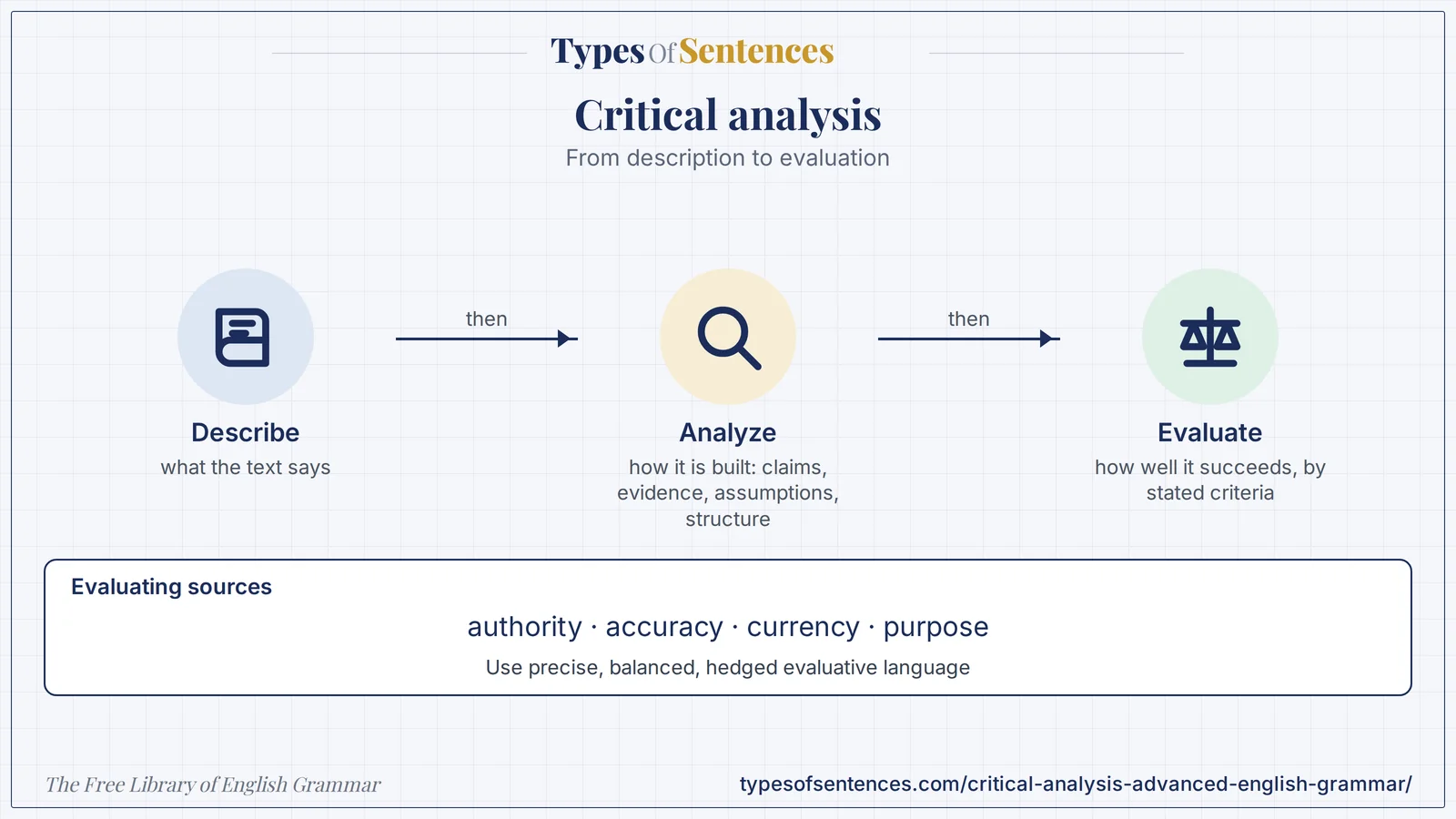
Describing says what a text says. Analyzing breaks it into parts and shows how they work. Evaluating judges how well they work. A critical analysis does all three, but its value lies in the second and third.
Why it matters: To write critically, you need a standard: criteria by which to judge, such as relevance, accuracy, logic, completeness, and fairness. Without a standard, an evaluation is only an opinion.
Summary: Critical analysis moves from description (what the text says) to analysis (how it is built: claims, evidence, assumptions, structure) to evaluation (how well it succeeds, by stated criteria). To analyze an argument, identify the conclusion, the premises, the evidence, the assumptions, and the reasoning; test the evidence and check for fallacies; consider alternatives. To evaluate a source, consider its author, purpose, evidence, currency, and bias. A critical response agrees, disagrees, or qualifies, with reasons. Analytical language is precise and balanced: evaluative adjectives and verbs, hedged judgments, and concessive structures. Frameworks such as criteria lists, SWOT, and Toulmin’s model give a structure.
- Describe → analyze → evaluate.
- Analyze an argument: conclusion, premises, evidence, assumptions, reasoning.
- Evaluate sources: authority, accuracy, currency, purpose, bias.
- Use precise, balanced, hedged evaluative language.
What You’ll Learn
- 1. Critical Analysis: What Is It?
- 2. Analytical Language: Evaluative Vocabulary and Critical Verbs
- 3. Analyzing and Evaluating Arguments
- 4. Evaluating Sources: Credibility and Bias
- 5. Writing a Critical Response: Agreeing, Disagreeing, and Qualifying
- 6. Analytical Frameworks
- 7. Writing a Critical Analysis
- 8. The Grammar of Analysis
- 9. Common Pitfalls in Critical Analysis
- 10. Exercises
- 11. Test Your Knowledge
- 12. Frequently Asked Questions
- 13. Conclusion
1. Critical Analysis: What Is It?
| Level | Question | Example (on an invented editorial about school start times) |
|---|---|---|
| description | What does the text say? | The author argues that schools should start at 8:30. |
| analysis | How is it built? What are its parts? | The argument rests on three reasons: sleep need, attendance data, and the experience of one district. |
| evaluation | How well does it work? By what criteria? | The sleep claim is well supported, but the attendance data come from one small district, so the generalization is weak. |
| response | What do I conclude, and why? | The argument is persuasive on health grounds, although it needs stronger evidence on cost. |
| Descriptive writing | Analytical or critical writing |
|---|---|
| The author lists three reasons. | The three reasons are not independent: the second restates the first. |
| The study used 200 students. | The sample of 200 is adequate for a general claim but not for a comparison of subgroups. |
| The report says prices rose. | The report’s claim that prices rose is supported by official data, but it ignores wage growth. |
| The article is about climate policy. | The article assumes that carbon pricing is politically feasible, which it does not argue. |
| Misconception | Reality |
|---|---|
| critical = negative | critical = careful and fair, including noting strengths |
| analysis = summary | analysis explains how and why, not only what |
| critical = my opinion | critical = a reasoned judgment by criteria and evidence |
| finding a flaw is enough | a good analysis also says whether the flaw matters |
| only experts can criticize | anyone can, with evidence and fairness |
Critical thinking involves attitudes (curiosity, open-mindedness, fairness, humility about one’s own bias) and skills (identifying arguments, assessing evidence, drawing inferences, and explaining reasons). In taxonomies of learning objectives such as Bloom’s, analysis and evaluation are higher-order skills. Rhetoric and persuasion, which critical analysis examines from the reader’s side, are the subject of the chapter on rhetorical strategies.
2. Analytical Language: Evaluative Vocabulary and Critical Verbs
| Evaluation | Adjectives | Example |
|---|---|---|
| positive | compelling, persuasive, convincing, robust, rigorous, well-supported, insightful, comprehensive, nuanced, coherent, balanced | The evidence is compelling. |
| neutral or mixed | limited, partial, selective, preliminary, tentative, narrow, general | The evidence is limited to one region. |
| negative | flawed, weak, tenuous, unsubstantiated, superficial, one-sided, biased, simplistic, inconsistent, misleading, unconvincing, circular | The argument is simplistic. |
| Critical verbs | Examples | Function |
|---|---|---|
| describing the argument | argues, claims, maintains, assumes, relies on, draws on, builds on | The author relies on one case. |
| evaluating positively | supports, reinforces, illustrates, demonstrates, strengthens, substantiates | The data strengthen the claim. |
| evaluating negatively | overlooks, ignores, neglects, fails to, undermines, contradicts, conflates, oversimplifies | The author overlooks cost. |
| questioning | questions, challenges, disputes, qualifies, complicates | This challenges the assumption that … |
| implying | implies, suggests, reveals, indicates, presupposes | This presupposes that … |
| balancing | acknowledges, concedes, recognizes, admits | The author acknowledges the limits. |
| Nouns for evaluation | Examples |
|---|---|
| strengths | a strength of the argument; the main merit; the clarity of the evidence |
| weaknesses | a weakness; a limitation; a gap; an inconsistency; a flaw in the reasoning; an unstated assumption |
| judgments | the validity of the claim; the strength of the evidence; the credibility of the source |
| Vague evaluation | Precise evaluation |
|---|---|
| This is a good argument. | This argument is persuasive because its evidence is recent, relevant, and drawn from several sources. |
| The author is wrong. | The author’s conclusion does not follow, because the premises do not rule out other causes. |
| The article is biased. | The article presents only the employers’ view and does not cite any worker survey. |
| This is bad. | The evidence is anecdotal and cannot support a general claim. |
| I don’t like the study. | The study’s small sample limits its generalizability. |
- Evaluate with reasons. Every evaluative word should be followed or preceded by the reason for the judgment.
- Hedge judgments where appropriate: The argument appears to rely on … See the chapter on hedging.
- Balance strengths and weaknesses: Although the evidence is limited, the reasoning is sound.
- Criticize the argument, not the person. Avoid ad hominem remarks.
- Avoid emotional language (stupid, ridiculous) and use precise, neutral terms.
3. Analyzing and Evaluating Arguments
- Identify the conclusion (the claim). What is the author trying to prove?
- Identify the premises (the reasons and evidence). What supports the claim?
- Identify the type of claim: fact, definition, cause, value, or policy (see the chapter on rhetorical strategies).
- Make hidden assumptions explicit. What must be true for the premises to support the conclusion?
- Test the evidence: relevance, sufficiency, credibility, recency, representativeness.
- Check the reasoning: does the conclusion follow? Are there fallacies?
- Consider alternatives and counterarguments: what other explanation or view is possible, and does the author address it?
- Check the definitions and the scope: are key terms defined, and do the claims cover what they say?
- Judge the overall strength and state it with a qualification.
| Question to ask | What it tests | Example (invented editorial) |
|---|---|---|
| What exactly is claimed? | the claim | Schools should start at 8:30. |
| What evidence is given? | the premises | a survey; one district’s attendance figures |
| Is the evidence relevant and sufficient? | evidence | one district is too few |
| What is assumed? | hidden assumptions | that sleep, not routine, explains the attendance rise |
| Does the conclusion follow? | reasoning | not necessarily |
| What is left out? | omissions | costs; transport |
| Who benefits from the claim? | bias and interest | the author works for a sleep-research center |
| What would change my mind? | openness | a larger study with a control group |
| Example analysis of a short argument (invented) | Analysis |
|---|---|
| “Attendance rose after the district delayed its start time, so later starts raise attendance.” | conclusion: later starts raise attendance; premise: attendance rose after the change; assumption: nothing else changed (post hoc reasoning); the evidence is one district, one year; the argument is weak as stated, and would be stronger with a comparison group and a longer period |
Fallacies and the structure of argument are described in the chapter on rhetorical strategies, and the presuppositions that arguments contain are in the chapter on pragmatics. A hidden assumption is often the weakest link, because the author does not defend it: part of the work of critical analysis is to bring it into the open.
4. Evaluating Sources: Credibility and Bias
| Criterion | Questions | Examples of evidence |
|---|---|---|
| authority | Who wrote it? What expertise? What affiliation? | credentials; institution; a record of publication |
| accuracy | Is it verifiable? Are sources cited? Are there errors? | citations; data that can be checked; corrections policy |
| currency | When was it produced? Is it out of date for this topic? | publication or update date |
| purpose | Why was it produced: to inform, persuade, sell, entertain? | an advertisement is not a research report |
| bias | Is there a stated or hidden interest? | funding; affiliation; selective evidence; loaded language |
| audience | Who is it for? | scholarly, professional, general |
| evidence | What kind and how good? | data, method, sample; or only opinion |
| consistency | Do other reliable sources agree? | cross-checking |
| relevance | Does it bear on your question? | — |
| Kind of source | Examples | Note |
|---|---|---|
| primary | original documents, data, interviews, experiments, letters | first-hand evidence |
| secondary | analyses and interpretations of primary sources | books, review articles |
| tertiary | summaries of secondary sources | encyclopedias, textbooks |
| scholarly (peer-reviewed) | journal articles reviewed by experts | rigorous but not infallible |
| popular and news | magazines, news sites | vary in quality; check |
| gray literature | reports, working papers, policy briefs | often not peer-reviewed |
| Kind of bias | Description |
|---|---|
| selection bias | the sample or the evidence is chosen to favor a conclusion |
| confirmation bias | seeking only what agrees with one’s view |
| publication bias | positive results are more likely to be published |
| funding or conflict of interest | the funder benefits from the result |
| framing | the way an issue is presented shapes the response |
| omission | relevant evidence is left out |
- Use “lateral reading”. Do not only read the source itself; open other tabs and check what other reliable sources say about the author and the claim.
- Use a checklist (such as the “CRAAP” test: currency, relevance, authority, accuracy, purpose) as a prompt, not as a mechanical score.
- Distinguish an unreliable source from a source with a viewpoint. Every source has a standpoint; critical analysis asks whether it is disclosed and whether the evidence is sound.
- Be careful with unfamiliar “journals” that charge fees and do not review papers; check an index or ask a librarian.
- State your evaluation of a source in the text when it matters: The report, commissioned by an industry group, may emphasize …
5. Writing a Critical Response: Agreeing, Disagreeing, and Qualifying
| Stance | Pattern | Example |
|---|---|---|
| full agreement, with extension | agree + add something | Smith’s argument is persuasive, and it can be extended to rural schools. |
| partial agreement (qualification) | while/although + agree, however + disagree | While Smith’s case for sleep is persuasive, her claim about cost is not supported. |
| disagreement with reasons | claim + because | Smith’s conclusion does not follow, because her evidence comes from one district. |
| reframing | offer a different way to see the issue | The question is not whether to start later, but how to adjust the whole day. |
| neutral evaluation | weigh without a verdict | The evidence is mixed: … |
| Function | Language | Example |
|---|---|---|
| stating agreement | I agree with X that …; X is right to argue that …; This is persuasive because … | This is persuasive because it rests on data. |
| stating disagreement | I disagree with X’s view that …; This overlooks …; X’s argument fails to … | This overlooks the cost. |
| qualifying | to some extent; up to a point; with the proviso that | — |
| giving reasons | because; since; given that; the reason is | — |
| conceding | admittedly; it is true that; granted | Admittedly, the data are limited. |
| concluding a judgment | on balance; overall; taken together | On balance, the argument is persuasive. |
- Distinguish a reasoned response from a personal reaction. I feel that this is wrong is a reaction; This is wrong because the premises do not support the conclusion is a response.
- Be fair to the other side. Present the argument in its best form (a “charitable reading”) before criticizing it.
- Support your response with evidence: from the text, from other sources, or from reasoning.
- Structure the response: a short summary, the evaluation by criteria, your overall judgment.
- Keep the focus on the text and its argument, not on the author’s character.
6. Analytical Frameworks
| Framework | Components or questions | Use |
|---|---|---|
| criteria-based evaluation | relevance, accuracy, logic, completeness, fairness, significance | any text |
| Toulmin | claim, grounds, warrant, backing, qualifier, rebuttal | analyzing arguments |
| rhetorical analysis | situation (speaker, audience, purpose, context), appeals (logos, ethos, pathos), style and structure | speeches, editorials, advertisements |
| SWOT | strengths, weaknesses, opportunities, threats | business and policy analysis |
| PESTLE | political, economic, social, technological, legal, environmental factors | business and policy analysis |
| compare and contrast | criteria for comparison; similarities and differences; significance | two texts or cases |
| cause and effect | causes, effects, mechanisms, alternative explanations | history, science, policy |
| stakeholder analysis | who is affected, how, and with what interest | policy, management |
| close reading | language, structure, and detail in a short text | literature and media |
| evaluating a study | design, sample, validity, reliability, bias, analysis, conclusions | empirical research |
| theoretical lenses | reading a text through a theory (for example feminist, postcolonial, Marxist, psychoanalytic) | the humanities |
| Framework | Sample question (invented topic: a city’s new bus policy) |
|---|---|
| criteria-based | Is the policy effective, affordable, and fair? |
| SWOT | Strengths: lower fares. Weaknesses: slow rollout. Opportunities: less traffic. Threats: funding cuts. |
| stakeholder | How are commuters, drivers, and shopkeepers affected? |
| cause and effect | What caused the fall in ridership, and what else might explain it? |
A framework gives the analysis a visible structure and protects against selective criticism: it makes the writer evaluate every item against the same criteria. State at the start which framework or criteria you are using, and why.
7. Writing a Critical Analysis
| Part | Content | Example |
|---|---|---|
| introduction | identify the text; give brief context and summary; state an evaluative thesis | Smith’s editorial argues for later start times. This analysis shows that her health case is strong, but her evidence on attendance and cost is weak. |
| body (by criteria) | one criterion or aspect per section or paragraph, with evidence from the text | Strength 1: the sleep evidence; Weakness 1: the single-district data; Weakness 2: the omission of cost |
| counterpoints | alternative views and the author’s response | — |
| overall judgment | weigh strengths and weaknesses | On balance, the argument is persuasive on health but incomplete on policy. |
| conclusion | significance; what would strengthen the argument | A multi-district study would settle the question. |
| Weak (descriptive) paragraph | Strong (analytical) paragraph |
|---|---|
| Smith says that attendance rose by 8 percent after the change. She also says that students were happier. Then she says that schools should start later. | Smith’s case depends on one figure: attendance rose by 8 percent after the change. The figure comes from one district over one year, so it cannot rule out other causes. Her claim that later starts raise attendance is therefore plausible but not demonstrated. |
| Feature of analytical writing | Practice |
|---|---|
| present tense for the text | Smith argues …; The article claims … |
| topic sentences that evaluate | Smith’s evidence on sleep is strong. |
| quotations used as evidence and analyzed | explain what each shows |
| transitions of contrast and concession | However; although; whereas |
| balance | strengths and weaknesses both addressed |
| reasoned judgment | each evaluation has a reason |
| neutral tone | no sarcasm, no personal attacks |
8. The Grammar of Analysis
| Structure | Use in analysis | Example |
|---|---|---|
| subordination of concession | shows balance | Although the sample is small, the effect is large. |
| subordination of reason | gives the basis of a judgment | The argument fails because the premises do not support the conclusion. |
| nominalization | names qualities and relations | the weakness of the evidence; the failure to consider cost |
| “this” + noun | refers to a claim or a step | This assumption is not defended. |
| reporting verbs with evaluative meaning | characterize the author’s move | Smith overlooks …; Smith concedes … |
| hedged evaluation | keeps the judgment accurate | The argument appears to rely on … |
| parallel structure | lists strengths or weaknesses | clear in structure, strong in evidence, weak in scope |
| quantifiers and scope | precision about how far a claim goes | some, most, all; in this case |
| negation | precision | not necessarily; not entirely |
| passive | focuses on the claim, not the author | It is assumed that … |
| conditionals | considers alternatives | If the sample were larger, the result might differ. |
| modal verbs | possibility, obligation | The author should have addressed …; This could mean … |
| colon and dash | introduce an analysis | The problem is clear: the sample is too small. |
| Weak | Strong |
|---|---|
| The author is a bit wrong. | The author’s conclusion goes beyond the evidence. |
| It’s not good. | The sample is too small to support a general claim. |
| The author doesn’t say why. | The author does not defend the assumption that sleep, not routine, explains the change. |
| The article says stuff about costs. | The article estimates costs but does not say how the estimate was made. |
The structures draw on grammar treated elsewhere in this course: concession and reason in the chapter on coordination and subordination; the information flow of the paragraph in the chapters on information structure and cohesion; and the discourse view of how texts persuade in the chapter on discourse analysis.
9. Common Pitfalls in Critical Analysis
| Pitfall | Example | Fix |
|---|---|---|
| describing instead of analyzing | The author says A, then B, then C. | Show how A, B, and C relate and whether they support the claim. |
| summary only | a long retelling | one short summary, then evaluation |
| opinion without reasons | I don’t like this. | State the criterion and the reason. |
| ad hominem | The author is biased because she is a woman. | Identify a documented conflict of interest, if there is one. |
| straw man | The author wants to abolish school. | Represent the argument fairly. |
| overgeneralizing from one example | This study is flawed, so all research is. | Limit the claim. |
| ignoring context | judging an old text by present standards without comment | consider the date and the situation |
| false balance | treating a weak view as equal to a strong one | weigh by the evidence |
| excessive hedging | It might perhaps seem somewhat weak. | The argument is weak because … |
| one-sided evaluation | only flaws, or only praise | address strengths and weaknesses |
| confirmation bias | accepting only what agrees with you | test your own view |
| mixing criteria | judging a study’s writing and its method as one | keep criteria separate |
| unsupported evaluation | The argument is flawed. | The argument is flawed because … |
| emotional language | a ridiculous claim | an unsupported claim |
Edit: The author says that later starts are good, and then she says that attendance rose, and I don’t like her argument because she is obviously biased and her claim is stupid, and all studies are flawed anyway, and it might perhaps be somewhat unconvincing.
- The author says … and then she says …: description: The argument rests on one figure: attendance rose by 8 percent after the change.
- I don’t like her argument: opinion without criteria: The argument is weak because the figure comes from one district.
- obviously biased: unsupported and ad hominem: The author works for a sleep-research center, which is a possible interest that should be declared.
- stupid: emotional: delete.
- all studies are flawed anyway: overgeneralization: delete.
- might perhaps be somewhat unconvincing: excessive hedging: is unconvincing as stated.
- Result: The argument rests on one figure: attendance rose by 8 percent after the change. The figure comes from one district, so the argument is unconvincing as stated. The author works for a sleep-research center, an interest that should be declared. (the editorial and the author are invented)
Recap in 12 seconds
Watch the lesson build itself: Critical analysis moves from describing a text to analyzing how it is built and evaluating how well it succeeds. The video has no sound.
Exercises
Part A: Levels and Meaning (Exercises 1–6)
Exercise 1: Name the three levels.
Show Answer
Answer: Description, analysis, evaluation.
Exercise 2: Does critical mean negative?
Show Answer
Answer: No (careful and fair).
Exercise 3: Descriptive or analytical: The author lists three reasons.
Show Answer
Answer: Descriptive.
Exercise 4: Descriptive or analytical: The reasons are not independent.
Show Answer
Answer: Analytical.
Exercise 5: Name a critical thinking attitude.
Show Answer
Answer: Curiosity, open-mindedness, fairness.
Exercise 6: Is analysis the same as summary?
Show Answer
Answer: No.
Part B: Language (Exercises 7–13)
Exercise 7: Give a positive evaluative adjective.
Show Answer
Answer: compelling, robust, persuasive.
Exercise 8: Give a negative evaluative adjective.
Show Answer
Answer: flawed, simplistic, tenuous.
Exercise 9: Give a verb of negative evaluation.
Show Answer
Answer: overlooks, ignores, fails to.
Exercise 10: Make precise: This is a good argument.
Show Answer
Answer: This argument is persuasive because its evidence is recent and varied.
Exercise 11: Make precise: The author is wrong.
Show Answer
Answer: The author’s conclusion does not follow from the premises.
Exercise 12: Make precise: I don’t like the study.
Show Answer
Answer: The study’s small sample limits its generalizability.
Exercise 13: Name a way to criticize fairly.
Show Answer
Answer: Criticize the argument, not the person; balance strengths and weaknesses.
Part C: Analyzing Arguments and Sources (Exercises 14–20)
Exercise 14: Name the first step in analyzing an argument.
Show Answer
Answer: Identify the conclusion (the claim).
Exercise 15: What is a hidden assumption?
Show Answer
Answer: An unstated premise needed for the argument.
Exercise 16: Name two tests for evidence.
Show Answer
Answer: Relevance, sufficiency, credibility, recency, representativeness.
Exercise 17: Name two criteria for sources.
Show Answer
Answer: Authority, accuracy, currency, purpose, bias.
Exercise 18: Define lateral reading.
Show Answer
Answer: Checking what other sources say about a source.
Exercise 19: Primary or secondary: a letter written during the events
Show Answer
Answer: Primary.
Exercise 20: Name a kind of bias.
Show Answer
Answer: Selection, confirmation, publication, funding.
Part D: Response and Frameworks (Exercises 21–26)
Exercise 21: Give a pattern of partial agreement.
Show Answer
Answer: While X is persuasive on …, it is weak on …
Exercise 22: Reasoned response or reaction: I feel that this is wrong.
Show Answer
Answer: Reaction.
Exercise 23: What does SWOT stand for?
Show Answer
Answer: Strengths, weaknesses, opportunities, threats.
Exercise 24: What does PESTLE cover?
Show Answer
Answer: Political, economic, social, technological, legal, environmental factors.
Exercise 25: Name the Toulmin elements.
Show Answer
Answer: Claim, grounds, warrant, backing, qualifier, rebuttal.
Exercise 26: Why use a framework?
Show Answer
Answer: It gives structure and prevents selective criticism.
Part E: Grammar and Pitfalls (Exercises 27–30)
Exercise 27: Add concession: The sample is small. The effect is large.
Show Answer
Answer: Although the sample is small, the effect is large.
Exercise 28: Fix: The author is a bit wrong.
Show Answer
Answer: The author’s conclusion goes beyond the evidence.
Exercise 29: Name a pitfall: The author is biased because she is a woman.
Show Answer
Answer: Ad hominem.
Exercise 30: Fix: It might perhaps be somewhat weak.
Show Answer
Answer: The argument is weak because …
Test Your Knowledge
Ready to check what you learned? Answer all 10 questions, then submit. You need 80% (8 of 10) to pass. Your answers are not stored.
View correct answers and explanations
Question 1: What is critical analysis?
✓ Correct Answer: A – careful examination and judgment by criteria
Careful and fair.
Question 2: Which is analytical?
✓ Correct Answer: B – The reasons are not independent: the second restates the first.
It explains relations.
Question 3: Which is a negative evaluative adjective?
✓ Correct Answer: C – flawed
Flawed.
Question 4: Which is a hidden assumption?
✓ Correct Answer: D – an unstated premise needed for the argument
An unstated premise.
Question 5: Which is a test of evidence?
✓ Correct Answer: C – relevance
Relevance.
Question 6: Which describes lateral reading?
✓ Correct Answer: A – checking what other sources say about the source
Cross-checking.
Question 7: Which is a reasoned response?
✓ Correct Answer: D – The argument fails because the premises do not support the conclusion.
It gives a reason.
Question 8: What does SWOT stand for?
✓ Correct Answer: C – strengths, weaknesses, opportunities, threats
A business framework.
Question 9: Which is ad hominem?
✓ Correct Answer: B – The author is biased because she is a woman.
Attacks the person.
Question 10: Which is a strong analytical sentence?
✓ Correct Answer: B – The sample is too small to support a general claim.
It gives a reason.
Frequently Asked Questions
What is critical analysis?
Critical analysis is the careful examination of a text, argument, or source to judge how well it works, by asking questions about its claims, evidence, assumptions, and reasoning.
What is analytical writing?
Analytical writing explains how a text or case is built and evaluates how well it works, using evidence and criteria, as opposed to merely describing or summarizing it.
What is critical thinking?
Critical thinking is the habit of asking questions, assessing evidence, drawing inferences, and explaining reasons, rather than accepting claims at face value.
What is analysis grammar?
Analysis grammar is the set of structures that analytical writing relies on: concessive and causal subordination, nominalization, “this” + noun, evaluative reporting verbs, hedging, and parallelism.
What does evaluating arguments involve?
Evaluating arguments involves identifying the claim, the premises, and the assumptions, testing the evidence, checking the reasoning for fallacies, and considering alternatives.
How do I evaluate a source?
Check its authority, accuracy, currency, purpose, and bias, compare it with other reliable sources (lateral reading), and consider what kind of source it is.
How do I disagree critically?
State the argument fairly, give your reason for disagreeing, support it with evidence or reasoning, concede what is true in it, and focus on the argument, not the author.
Conclusion
You now have a deep study of critical analysis: the move from description to analysis and evaluation, analytical language, the analysis of arguments, the evaluation of sources, critical response, frameworks, the writing of an analysis, the grammar of analysis, and the common pitfalls. You can read critically and write analytically.
When you analyze a text, ask what it claims, how it supports the claim, and what it assumes. Next, you will study business writing.
- Toulmin, Stephen E. The Uses of Argument. Updated ed. Cambridge University Press, 2003.: the structure of argument.
- Paul, Richard, and Linda Elder. Critical Thinking: Tools for Taking Charge of Your Learning and Your Life. 3rd ed. Pearson, 2013.: standards and elements of critical thinking.
- Anderson, Lorin W., and David R. Krathwohl, eds. A Taxonomy for Learning, Teaching, and Assessing. Longman, 2001.: the revised taxonomy of learning objectives.
- Lunsford, Andrea A., John J. Ruszkiewicz, and Keith Walters. Everything’s an Argument. 8th ed. Bedford/St. Martin’s, 2019.: analysis of arguments.
- Merriam-Webster Dictionary: critical: the dictionary entry.
Last reviewed: October 29, 2026. How it was made: drafted with AI assistance, then checked with automated tests (structure, links, answer keys, spelling) and against the sources above. A person has not yet read this chapter line by line. Found a mistake? Report it.