Research writing is the writing in which a researcher reports a systematic investigation: a question that was asked, how it was studied, what was found, and what it means. A research paper has a conventional shape, and each of its sections has its own purpose and its own language. The methodology section describes procedures in the past tense and often in the passive; the results section reports findings without interpreting them; the discussion section interprets, compares, and hedges. A reader of a research paper knows where to look for each kind of information, and the writer’s job is to put it where it belongs.
This chapter takes you through the sections of a research paper in turn: the abstract and introduction (with the moves that establish a niche for the study), the literature review, the methodology section, the results section, the discussion, and the conclusion. For each, it describes the purpose, the typical structure, and the grammar and vocabulary that serve it, and it gives guidance on tense and voice, academic tone, the writing process, and common errors. These are the basics of writing a research paper and of academic research reporting, with a clear view of research methodology. Thirty editing exercises and a quiz follow.
A research paper answers a question with evidence, and it shows its work so that others can judge it or repeat it. Each section does one job: introducing the problem, reviewing what is known, describing how the study was done, reporting what was found, and discussing what it means.
Why it matters: The language changes from section to section. The methods are told in the past tense, the results report facts, and the discussion uses cautious verbs such as suggest and may, because interpretation goes beyond the data.
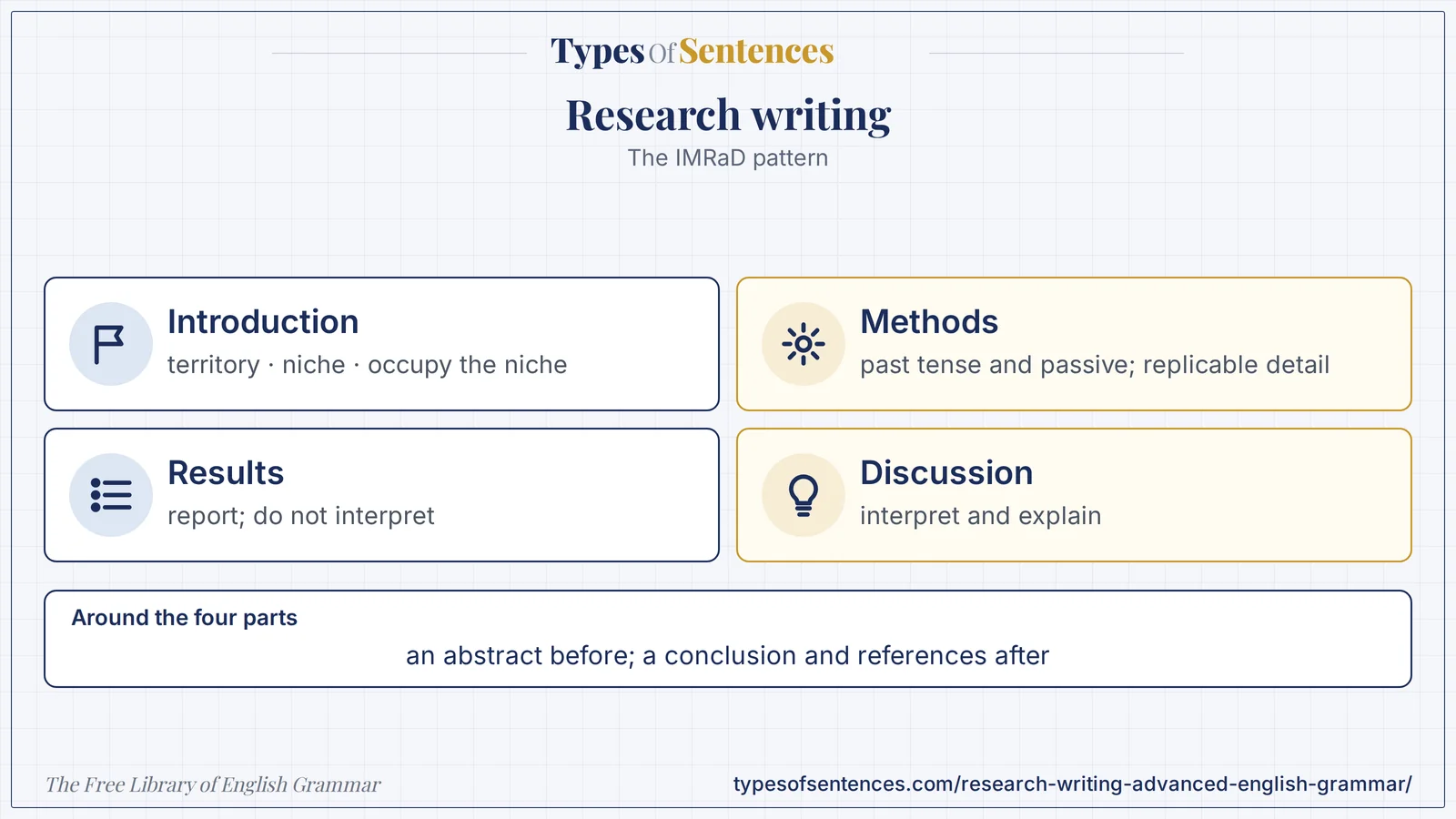
Summary: A research paper typically follows the IMRaD pattern: Introduction, Methods, Results, and Discussion, with an abstract before and a conclusion and references after. The introduction moves from the research area to a gap (a niche) to the aim of the study (Swales’s CARS model). The literature review synthesizes sources and identifies the gap. The methodology section describes design, participants, materials, procedure, and analysis in enough detail to allow replication, usually in the past tense and passive. The results section reports findings objectively, with tables and figures, without interpretation. The discussion interprets the findings, compares them with the literature, notes limitations and implications, and hedges claims. Tense, voice, and tone follow the function of each section.
- IMRaD: Introduction, Methods, Results, Discussion.
- Introduction: territory, niche, occupy the niche.
- Methods: past tense and passive; replicable detail.
- Results: report, do not interpret; Discussion: interpret and hedge.
What You’ll Learn
- 1. Research Writing: The Structure of a Research Paper
- 2. The Abstract and the Introduction
- 3. The Literature Review
- 4. The Methodology Section
- 5. The Results Section
- 6. The Discussion Section
- 7. The Conclusion and the Other Parts
- 8. Tense, Voice, and Tone by Section
- 9. The Process of Writing a Research Paper
- 10. Common Errors in Research Writing
- 11. Exercises
- 12. Test Your Knowledge
- 13. Frequently Asked Questions
- 14. Conclusion
1. Research Writing: The Structure of a Research Paper
| Section | Purpose | Question it answers |
|---|---|---|
| title and keywords | identify the topic precisely | What is it about? |
| abstract | summarize the whole paper | What was done and found? |
| introduction | establish the problem, the gap, and the aim | Why this study? |
| literature review | review what is known; locate the gap | What is already known? |
| methodology (methods) | describe how the study was done | How was it done? |
| results (findings) | report what was found | What was found? |
| discussion | interpret, compare, and evaluate | What does it mean? |
| conclusion | state the contribution and implications | So what? |
| references | list the sources cited | Where did the ideas come from? |
| appendices | supplementary material | What else is needed to evaluate it? |
| Paper type | Typical structure | Note |
|---|---|---|
| empirical (IMRaD) | Introduction, Methods, Results, Discussion | sciences and social sciences |
| humanities argument | introduction, sections organized by argument, conclusion | no separate methods section |
| literature or systematic review | introduction, search method, synthesis, discussion | — |
| thesis or dissertation | chapters for each IMRaD part plus a long review | longer and more detailed |
| theoretical paper | problem, framework, argument, implications | — |
| case study | background, case description, analysis, lessons | — |
| Shape of the paper | Description |
|---|---|
| hourglass | broad (the field) → narrow (the gap and aim) → narrow (methods and results) → broad (implications) |
| proportion (a rough guide) | introduction and review: 20–25%; methods: 10–15%; results: 20–25%; discussion: 25–30% |
The conventions vary by discipline and by journal, and the instructions to authors of the target journal override any general advice. The general features of academic style are in the chapter on academic writing, and the structure of essay-type arguments in the chapter on essay structure.
2. The Abstract and the Introduction
| Element of an abstract | Content | Example (invented study) |
|---|---|---|
| background | the problem or context in a sentence | Adolescent sleep loss is widespread, but its effect on memory is unclear. |
| aim | what the study did or asked | This study examined the effect of school start time on memory test performance. |
| method | design, participants, procedure | Memory scores of 200 students were compared before and after a 90-minute delay in start time. |
| results | the main findings, with figures | Scores rose by 12 percent in the delayed-start group. |
| conclusion | what the findings mean | Later start times may improve memory in adolescents. |
- Write the abstract last, so that it matches the paper. A typical length is 150 to 250 words, but follow the journal’s limit.
- Informative abstracts report the results; descriptive abstracts only describe the content (common in humanities).
- Use the past tense for what was done and found, the present for the conclusion and the aim of the paper (This paper examines …).
- Do not cite sources or include new information that is not in the paper.
| Move (Swales, CARS) | Function | Language | Example |
|---|---|---|---|
| Move 1: establish a territory | show that the area matters; review earlier work | Research on … has grown rapidly; … has been widely studied; It is well known that … | Research on adolescent sleep has grown rapidly (Smith, 2020). |
| Move 2: establish a niche | show a gap, a problem, or a question | However, few studies have …; little is known about …; it remains unclear whether … | However, few studies have examined rural schools. |
| Move 3: occupy the niche | state the aim, the questions, and the plan | This study examines …; The aim of this paper is …; We hypothesized that … | This study examines whether later start times improve memory in rural schools. |
| (optional) hypotheses or research questions | — | RQ1: Does …? H1: Students will … | H1: Memory scores will be higher in the delayed-start group. |
| (optional) outline and value | organization and contribution | The paper is organized as follows. … The findings contribute to … | The paper is organized as follows. |
| Research question and hypothesis | Form | Example |
|---|---|---|
| research question | a question the study seeks to answer | Does a later school start time improve adolescents’ memory? |
| hypothesis (alternative) | a testable prediction | Adolescents with a later start time will score higher on memory tests. |
| null hypothesis | no effect | There will be no difference in scores. |
| aim or objective | what the study intends | The aim is to measure the effect of start time on memory. |
A good introduction creates a niche by showing a gap that the study fills. The language of the gap (few studies, little is known, it remains unclear) is a standard signal. The introduction uses the present perfect for the state of research (Researchers have shown) and the present for the aim of the paper.
3. The Literature Review
| Purpose | Description |
|---|---|
| context | situates the study in the field |
| synthesis | combines the findings of many sources by theme |
| critique | evaluates the strengths and weaknesses of earlier work |
| gap | shows what is missing and where the study fits |
| justification | explains why the study’s question and method are appropriate |
| Organization | Description | When to use |
|---|---|---|
| thematic | by topics or issues | most reviews |
| chronological | by time, showing development | history of a field |
| methodological | by approach (quantitative, qualitative) | where methods differ |
| theoretical | by theory or school | a theory-driven study |
| funnel | from broad to narrow | introductions with a short review |
| Weak review | Strong review |
|---|---|
| a list of summaries, one source per paragraph | paragraphs organized by theme, each with your topic sentence |
| no evaluation | compares sources, notes strengths and weaknesses |
| no gap stated | ends with the gap and the question |
| out-of-date sources | a balance of recent and foundational work |
| unrelated sources | every source helps to build the argument |
| Function | Language |
|---|---|
| introducing a theme | A growing body of research suggests …; Several studies have examined … |
| showing agreement | Consistent with …; Similarly, X found … |
| showing contrast | In contrast, …; Whereas X …, Y … |
| criticizing | However, this study was limited to …; A limitation of this work is … |
| identifying the gap | Few studies have …; Less attention has been paid to …; It remains unclear whether … |
| moving to the study | Taken together, these studies suggest …; Given this gap, the present study … |
The skill of writing a literature review is the skill of synthesis, described in the previous chapter, on citing sources: combining sources by idea, with your own voice. The tense is usually the present perfect for the state of knowledge, the past for specific studies (Smith (2020) found), and the present for what a source argues. To search for sources, use databases such as the library’s catalog, Google Scholar, Scopus, Web of Science, or JSTOR (the availability depends on the institution), and prefer peer-reviewed work.
4. The Methodology Section
| Component | What to describe | Example (invented study) |
|---|---|---|
| design | the type of study | a quasi-experimental study with a pre-test and a post-test |
| setting | where and when | two rural secondary schools in Karnataka, January to March 2023 |
| participants (sample) | who and how many; how selected | 200 students aged 14–16, recruited by convenience sampling |
| materials and instruments | tests, questionnaires, equipment; their validity and reliability | a 40-item memory test (Cronbach’s alpha = .87) |
| procedure | steps in order | Students completed the test at 8:00 a.m. and again after the schedule change. |
| data analysis | the methods used | Scores were compared using paired t-tests. |
| ethics | approval and consent | The study was approved by the university ethics committee; participants gave informed consent. |
| limitations of the method | — | — |
| Verbs and structures | Examples |
|---|---|
| past tense and passive for procedures | Participants were recruited … Data were collected … Scores were compared … |
| past tense active (where accepted) | We recruited 200 students. We administered the test. |
| sequence words | first, then, next, after, finally, prior to, following |
| purpose | in order to, to, so that, for the purpose of |
| justification | because, since, as, given that, owing to |
| precision | numbers, units, names of instruments, software (with versions) |
| choice and alternatives | rather than, instead of, in preference to |
| Key term | Meaning |
|---|---|
| variable (independent, dependent, control) | what is manipulated; what is measured; what is held constant |
| sample and population | the group studied; the larger group it represents |
| random, convenience, purposive sampling | by chance; by availability; by judgment |
| validity | whether the instrument measures what it claims to |
| reliability | consistency of measurement |
| bias | a systematic error |
| qualitative, quantitative, mixed methods | non-numerical; numerical; both |
| experimental, quasi-experimental, survey, case study, ethnography, interview, content analysis | types of design |
| triangulation | using several sources or methods to check findings |
| replication | repeating a study to test a finding |
| Vague method statement | Precise method statement |
|---|---|
| Some students did a test. | Two hundred students aged 14 to 16 completed a 40-item memory test. |
| The data were analyzed. | Scores were compared using paired t-tests (two-tailed, alpha = .05). |
| We chose a sample. | Participants were selected by convenience sampling from two schools. |
| A questionnaire was used. | A 20-item questionnaire on a five-point scale (1 = strongly disagree, 5 = strongly agree) was used. |
5. The Results Section
The results section reports what was found, in an order that follows the research questions. It presents the data and points out the main patterns, but does not explain them: interpretation belongs to the discussion.
| Element | Convention | Example (invented) |
|---|---|---|
| order | follow the research questions or hypotheses | RQ1 first, then RQ2 |
| text | state the main findings, referring to tables and figures | As Table 1 shows, scores rose by 12 percent. |
| tables and figures | number them and give a clear title; refer to them in the text | Table 2 presents the mean scores by group. |
| statistics | report the test, the value, the degrees of freedom, and the probability (APA style) | t(198) = 3.21, p = .002 |
| descriptive statistics | means and standard deviations, percentages | M = 78.4, SD = 9.6 |
| negative results | report them too | No difference was found between the groups on the second measure. |
| qualitative results | themes, with illustrative quotations | Three themes emerged: … |
| tense | past for findings; present for describing a table or figure | Scores rose … Table 2 shows … |
| Reporting verbs for results | Examples |
|---|---|
| finding | found, observed, noted, identified, detected, recorded |
| showing | showed, indicated, revealed, demonstrated, displayed |
| change | increased, decreased, rose, fell, declined, remained stable, fluctuated |
| comparison | differed, was higher/lower than, exceeded, was similar to, correlated with |
| significance | was significant; did not reach significance; was statistically significant (p < .05) |
| Objective reporting | Interpretation (belongs in the discussion) |
|---|---|
| Scores were 12 percent higher in the delayed-start group. | This suggests that later start times improve memory. |
| The difference was statistically significant. | The difference is probably due to improved sleep. |
| Attendance rose from 90 to 95 percent. | Attendance rose because students were less tired. |
- Report, do not interpret. Avoid words such as because, suggests, and proves in the results.
- Be precise with numbers, and give the unit and the base (12 percent of 200 students).
- Distinguish “significant” (a statistical term) from “important”.
- Do not repeat every number from a table in the text; highlight the main points.
- Do not hide unexpected results. Report them honestly and discuss them later.
6. The Discussion Section
| Move | Function | Language | Example |
|---|---|---|---|
| restate the main finding | remind the reader | The main finding was that …; The results show that … | The main finding was that memory scores were higher in the delayed-start group. |
| interpret the finding | explain what it means | This suggests that …; This may reflect …; One possible explanation is … | This suggests that sleep affects memory consolidation. |
| compare with the literature | show agreement or difference | consistent with; in line with; contrary to; this differs from | This is consistent with Smith (2020). |
| explain unexpected results | offer reasons, cautiously | A possible reason is that …; It may be that … | A possible reason is that the second test was easier. |
| state implications | what follows for theory and practice | These findings imply that …; schools might consider … | Schools might consider later start times. |
| acknowledge limitations | show the scope of the study | A limitation of this study is …; The sample was small; Caution is needed in generalizing | Caution is needed in generalizing from two schools. |
| suggest further research | what to do next | Further research should examine …; Future studies could … | Future studies could include urban schools. |
| Overstated (avoid) | Appropriately hedged |
|---|---|
| The results prove that later starts improve memory. | The results suggest that later starts may improve memory. |
| Sleep causes better memory. | Sleep appears to contribute to better memory. |
| This study shows that all schools should change. | These findings indicate that schools might consider later start times. |
| The finding is obviously due to sleep. | The finding may be due to sleep, although other factors cannot be ruled out. |
- Hedge interpretations; the data support them but rarely prove them. See the chapter on hedging.
- Distinguish correlation from causation. Use is associated with unless the design supports a causal claim.
- Tie the discussion to the research questions and the literature, not only to the data.
- Be honest about limitations. They show that you understand the study’s scope, and they strengthen your credibility.
- The present tense is common for interpretation (This suggests), and the past for restating what was found (The study found).
7. The Conclusion and the Other Parts
| Part | Content | Note |
|---|---|---|
| conclusion | the main contribution; implications; limitations in brief; future directions | not a copy of the abstract; no new data |
| references | every source cited, in the required style | check against the text |
| appendices | questionnaires, instruments, long tables | labeled A, B, C |
| acknowledgments | thanks to funders and helpers | — |
| declarations | conflict of interest, ethics approval, data availability | as the journal requires |
| keywords | terms for indexing | from the title and abstract |
| Weak conclusion | Strong conclusion |
|---|---|
| This study looked at sleep. Sleep is important. | This study found that a later start time improved memory by 12 percent in two rural schools. If replicated, the finding supports policy that gives adolescents more sleep. |
| More research is needed. | Further research should test the effect in urban schools and over a longer period. |
8. Tense, Voice, and Tone by Section
| Section | Typical tense | Voice and person | Notes |
|---|---|---|---|
| abstract | past for what was done and found; present for the aim and the conclusion | mixed | concise |
| introduction | present perfect for the state of research; present for the aim | active or passive | Researchers have shown …; This study examines … |
| literature review | present perfect; past for specific studies; present for what a source argues | active, with the author as subject | — |
| methods | past | passive or active (we) according to the field | procedures |
| results | past for findings; present for tables and figures | mostly passive or with the data as subject | objective |
| discussion | present for interpretation; past for restating findings | active with the results or we | hedged |
| conclusion | present and present perfect | — | — |
| Tone feature | Practice |
|---|---|
| formality | no contractions, slang, or vague words |
| objectivity | neutral language; no emotion; evidence for every claim |
| hedging | match the strength of claims to the evidence |
| precision | exact numbers, units, and terms |
| consistency | one term for one concept; consistent abbreviations |
| cohesion | signposts and transitions between sections |
Tense and voice follow function: the past for what was done, the present for what is true or what the text does. The tense system is described in the chapter on tense and aspect. Many current journals accept we in methods (We recruited), while others prefer the passive; follow the guidelines of the journal.
9. The Process of Writing a Research Paper
- Define the question and the gap.
- Plan the method and, where required, obtain ethics approval.
- Collect and analyze the data.
- Write the methods and results first (they are the most concrete), then the discussion, then the introduction and review, then the conclusion, and the abstract last.
- Revise with a reverse outline: does each section do its job?
- Check the numbers against the tables and the data; check all citations against the reference list.
- Get feedback from a colleague or supervisor.
- Follow the journal’s instructions for format, length, and submission.
- Respond to peer review point by point, politely, with changes noted.
| Common reviewer comment | What it means | What to do |
|---|---|---|
| “The contribution is unclear.” | the gap and the aim are not stated clearly | strengthen the introduction |
| “The methods are insufficient to replicate.” | too little detail | add details and justification |
| “The results are interpreted too strongly.” | overclaiming | hedge and temper claims |
| “The literature review is a list.” | no synthesis | organize by theme |
| “The discussion repeats the results.” | no interpretation | explain and compare |
| “The language needs editing.” | unclear or ungrammatical prose | edit or use a language service |
Honesty is basic to research writing: report what was done, report all the results that bear on the question, give credit to sources, and describe the limitations. Fabrication, falsification, and plagiarism are serious breaches, and research ethics bodies and journals have policies on authorship, data, and conflicts of interest. All the studies and figures in this chapter are invented examples.
10. Common Errors in Research Writing
| Error | Example | Fix |
|---|---|---|
| interpretation in the results | Scores rose because students slept more. | Scores rose by 12 percent. |
| overclaiming in the discussion | The results prove that … | The results suggest that … |
| vague methods | Some students did a test. | Two hundred students completed a 40-item test. |
| wrong tense in methods | Students complete the test. | Students completed the test. |
| no gap in the introduction | a list of facts with no question | state the gap and the aim |
| list-like literature review | Smith says … Lee says … Rao says … | synthesize by theme |
| mixing results and discussion | explanations in the results | move them to the discussion |
| no limitations | — | state the limitations honestly |
| abstract with new information | a finding not in the paper | match the paper |
| inconsistent terms | participants … subjects … respondents | one term |
| statistics without context | p = .04 | report the test, the value, and the meaning |
| “significant” for “important” | a significant increase (not tested) | a substantial increase |
| causal claim from correlation | Sleep causes memory. | Sleep is associated with memory. |
| unreferenced claim | Many studies show … | Lee (2021) shows … |
| inconsistent numbers | text and table disagree | check |
Edit: Some students do a test, and the data was analyzed, and scores rise because students slept more, and the results prove that later starts are best, and many studies show this, and the sample was big enough.
- Some students do a test: vague and the wrong tense: Two hundred students aged 14 to 16 completed a 40-item memory test.
- the data was analyzed: vague and agreement: Scores were compared using paired t-tests.
- scores rise because students slept more: interpretation in the results, wrong tense: Scores rose by 12 percent (Table 1).
- the results prove that later starts are best: overclaiming (discussion): The results suggest that later starts may improve memory.
- many studies show this: unsourced: This is consistent with Smith (2020).
- the sample was big enough: vague: The sample (n = 200) was adequate to detect a medium effect.
- Result: Two hundred students aged 14 to 16 completed a 40-item memory test. Scores were compared using paired t-tests. Scores rose by 12 percent (Table 1). The results suggest that later starts may improve memory, consistent with Smith (2020). The sample (n = 200) was adequate to detect a medium effect. (the study and the figures are invented)
Recap in 12 seconds
Watch the lesson build itself: A research paper follows Introduction, Methods, Results, and Discussion, with an abstract, a conclusion, and references. The video has no sound.
Exercises
Part A: Structure (Exercises 1–6)
Exercise 1: What does IMRaD stand for?
Show Answer
Answer: Introduction, Methods, Results, Discussion.
Exercise 2: Which section answers “How was it done?”
Show Answer
Answer: Methods.
Exercise 3: Which section answers “What does it mean?”
Show Answer
Answer: Discussion.
Exercise 4: When is the abstract written?
Show Answer
Answer: Last.
Exercise 5: Name the three moves of the introduction (CARS).
Show Answer
Answer: Establish a territory, establish a niche, occupy the niche.
Exercise 6: Name the shape of the paper.
Show Answer
Answer: An hourglass.
Part B: Introduction and Review (Exercises 7–13)
Exercise 7: Name a signal of a gap.
Show Answer
Answer: few studies; little is known; it remains unclear.
Exercise 8: Name a research question for sleep and memory.
Show Answer
Answer: Does a later start time improve memory?
Exercise 9: Define a hypothesis.
Show Answer
Answer: A testable prediction.
Exercise 10: Name a way to organize a literature review.
Show Answer
Answer: Thematic, chronological, methodological, theoretical.
Exercise 11: What is a weak literature review?
Show Answer
Answer: A list of summaries.
Exercise 12: Which tense for the state of research?
Show Answer
Answer: The present perfect.
Exercise 13: Which tense for a specific study?
Show Answer
Answer: The past.
Part C: Methods and Results (Exercises 14–21)
Exercise 14: Which tense for methods?
Show Answer
Answer: The past.
Exercise 15: Make precise: Some students did a test.
Show Answer
Answer: Two hundred students completed a 40-item test.
Exercise 16: Define validity.
Show Answer
Answer: Whether an instrument measures what it claims to.
Exercise 17: Define reliability.
Show Answer
Answer: Consistency of measurement.
Exercise 18: Name a sampling method.
Show Answer
Answer: Random, convenience, or purposive.
Exercise 19: Report, do not ___ in the results.
Show Answer
Answer: interpret.
Exercise 20: Fix: Scores rose because students slept more. (results)
Show Answer
Answer: Scores rose by 12 percent.
Exercise 21: Significant or important: a statistical test result
Show Answer
Answer: Significant (a statistical term).
Part D: Discussion (Exercises 22–26)
Exercise 22: Hedge: The results prove that …
Show Answer
Answer: The results suggest that …
Exercise 23: Name a move of the discussion.
Show Answer
Answer: Interpret, compare, explain, imply, state limitations.
Exercise 24: Correlation or causation: is associated with
Show Answer
Answer: Correlation.
Exercise 25: Why state limitations?
Show Answer
Answer: They show scope and strengthen credibility.
Exercise 26: Which tense for interpretation?
Show Answer
Answer: The present.
Part E: Errors (Exercises 27–30)
Exercise 27: Fix: Students complete the test. (methods)
Show Answer
Answer: Students completed the test.
Exercise 28: Fix: Many studies show …
Show Answer
Answer: Lee (2021) shows …
Exercise 29: Fix: Sleep causes memory.
Show Answer
Answer: Sleep is associated with memory.
Exercise 30: Fix: participants … subjects … respondents
Show Answer
Answer: Use one term.
Test Your Knowledge
Ready to check what you learned? Answer all 10 questions, then submit. You need 80% (8 of 10) to pass. Your answers are not stored.
View correct answers and explanations
Question 1: What does IMRaD stand for?
✓ Correct Answer: A – Introduction, Methods, Results, Discussion
The standard structure.
Question 2: Which section describes how the study was done?
✓ Correct Answer: B – methods
Methods.
Question 3: Which tense is used for methods?
✓ Correct Answer: C – past
Past.
Question 4: Which is NOT part of the results?
✓ Correct Answer: D – statistical tests
Interpretation belongs to the discussion.
Question 5: Which is a signal of a gap?
✓ Correct Answer: C – few studies have examined …
A gap signal.
Question 6: Which is hedged?
✓ Correct Answer: A – The results suggest that …
Suggest.
Question 7: Which is the usual tense for the state of research?
✓ Correct Answer: D – present perfect
Researchers have shown …
Question 8: Which is a limitation statement?
✓ Correct Answer: C – The sample was small, so caution is needed.
It states scope.
Question 9: When is the abstract written?
✓ Correct Answer: B – last
After the paper.
Question 10: Which is a weak literature review?
✓ Correct Answer: B – a list of summaries, one source per paragraph
No synthesis.
Frequently Asked Questions
What is research writing?
Research writing is the writing in which a researcher reports a systematic investigation: the question, the method, the results, and the interpretation, in a conventional structure such as IMRaD.
What are research papers?
Research papers are texts that report original research or review existing research, with sections such as an abstract, introduction, literature review, methods, results, discussion, and references.
What is academic research?
Academic research is the systematic investigation of a question using accepted methods, reported to the scholarly community so that it can be evaluated and built on.
What is research methodology?
Research methodology is the set of methods and principles used in a study: the design, the sample, the instruments, and the analysis, together with the reasons for these choices.
How do I start writing a research paper?
Define the question and the gap, plan the method, collect and analyze the data, write the methods and results first, then the discussion, the introduction, the conclusion, and the abstract last.
What is the difference between results and discussion?
The results report what was found, objectively; the discussion interprets it, compares it with the literature, and states implications and limitations, with hedged language.
Which tense should I use in each section?
The past for methods and results; the present perfect for the state of research in the introduction; the present for the aim, for interpretation, and for describing tables and figures.
Conclusion
You now have a deep study of research writing: the structure of the research paper, the abstract and introduction, the literature review, methods, results, discussion, and conclusion, tense, voice, and tone, the writing process, and the common errors. You can write and revise a research paper.
When you write a research paper, ask what each section must do and what the reader will look for in it. Next, you will study critical analysis.
- Swales, John M. Genre Analysis: English in Academic and Research Settings. Cambridge University Press, 1990.: the CARS model.
- Swales, John M., and Christine B. Feak. Academic Writing for Graduate Students. 3rd ed. University of Michigan Press, 2012.: the language of the sections of research papers.
- American Psychological Association. Publication Manual of the American Psychological Association. 7th ed. APA, 2020.: reporting of methods and statistics.
- Hyland, Ken. Hedging in Scientific Research Articles. John Benjamins, 1998.: hedging in discussion sections.
- Purdue Online Writing Lab: Research and Citation Resources: reference pages on research writing.
Last reviewed: October 29, 2026. How it was made: drafted with AI assistance, then checked with automated tests (structure, links, answer keys, spelling) and against the sources above. A person has not yet read this chapter line by line. Found a mistake? Report it.