Grammar in poetry differs from grammar in prose in one crucial respect: a poem has two structures at once. It has the sentences and clauses of ordinary syntax, and it has the lines, stanzas, and meter of verse. The two do not always coincide. A sentence may run over several lines; a line may end in the middle of a phrase; a word may be moved from its usual place to fit a rhythm or a rhyme; an article or a verb may be left out because the poem cannot spare it. Poetic grammar is therefore the study of how syntax behaves under the pressure of a form, and of what poets gain by bending the rules.
This chapter explains the grammar of poems. You will study poetic license (the breaking of rules for effect), syntax in poetry (inversion, unusual word order, and long suspended sentences), ellipsis and compression, the relation of grammar and meter, enjambment (the sentence that crosses the line), and grammar for ambiguity. You will see how the structure of poems, from the sonnet to free verse to haiku, depends on poetic syntax, and read short public-domain lines closely. The study of poetry structure from the point of view of grammar helps the reader to see why a poem sounds and means as it does. Thirty editing exercises and a quiz follow.
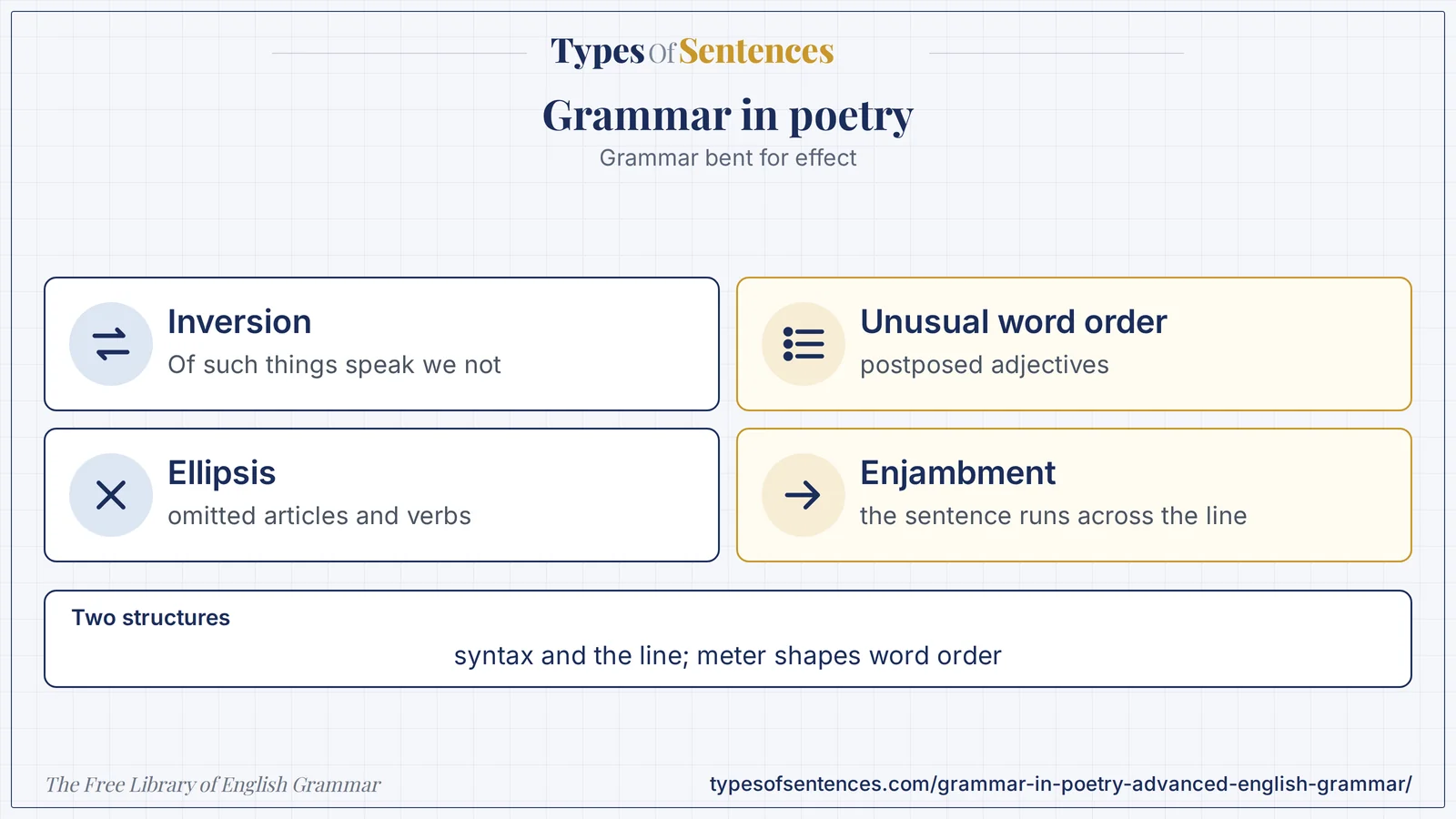
In a poem, the grammar and the line both matter. The poet can put words in an unusual order, leave words out, break a sentence across lines, or let a phrase mean two things. These are not mistakes; they are the tools of the form.
Why it matters: To read a poem grammatically, first find the sentences and their parts (subject, verb, object). Then look at where the lines and rhymes pull against them, and ask what the tension does.
Summary: Poetry bends grammar for effect (poetic license). Common devices are inversion (Of such things speak we not), unusual word order, postposed adjectives, ellipsis and omission of articles and verbs, archaic and shortened forms (o’er, thou), and long periodic sentences. Meter constrains grammar: stressed positions are filled by content words and unstressed by function words, and poets move or shorten words to fit. Enjambment lets a sentence run across a line break, creating suspense or double meaning; end-stopped lines make the line and the clause coincide. Poems also use grammatical ambiguity, including constructions in which one word serves two clauses (apo koinou). Forms have characteristic syntax: the sonnet’s turn, the ballad’s simple clauses, free verse’s parataxis and repetition, haiku’s cut. Analysis connects each grammatical feature to the poem’s meaning and sound.
- Two structures: syntax and the line.
- Devices: inversion, ellipsis, enjambment, ambiguity.
- Meter shapes word order and form.
- Analysis: find the sentence, then the tension with the line.
What You’ll Learn
- 1. Grammar in Poetry: Poetic License and Breaking Rules for Effect
- 2. Syntax in Poetry: Inversion, Unusual Word Order, and Suspended Sentences
- 3. Ellipsis in Poetry: Omitting Words and Compression
- 4. Grammar and Meter: Fitting Metrical Patterns
- 5. Enjambment: When Sentences Span Lines
- 6. Grammar for Ambiguity: Multiple Interpretations
- 7. The Grammar of Poetic Forms
- 8. Famous Examples: Close Reading of Short Public-Domain Lines
- 9. Common Pitfalls in Reading and Writing Poetic Grammar
- 10. Exercises
- 11. Test Your Knowledge
- 12. Frequently Asked Questions
- 13. Conclusion
1. Grammar in Poetry: Poetic License and Breaking Rules for Effect
| Departure from prose grammar | Poetic use | Effect | Example (original unless a source is named) |
|---|---|---|---|
| inversion of word order | object or complement before the verb | emphasis; rhythm; rhyme | Of such things speak we not. |
| postposed adjectives | adjective after the noun | a formal, archaic or musical tone | the night, silent and deep |
| fronting of adverbials | adverbial opening the line | scene-setting; suspense | Through the dark wood we walked. |
| ellipsis (omission of function words) | dropping articles, verbs, pronouns | compression; speed; intensity | Night. Wind. A lamp in the window. |
| archaic and poetic forms | thou, -eth, o’er, ne’er | solemnity; meter (fewer syllables) | o’er the hills |
| unusual agreement or case | nonstandard forms for voice or rhyme | character; surprise | The people was gone. |
| verbing and nouning | converted word classes | freshness | She moonlit the garden with her lamp. |
| coined compounds | invented words | vividness | sun-heavy afternoon |
| repetition of words and structures | refrain, anaphora, parallelism | music; emphasis | and still the rain, and still the rain |
| unusual punctuation and capitalization | dashes, capitals, no punctuation | pause; stress; flow | Emily Dickinson’s dashes and capitals |
| sentence fragments | a phrase as a poem | image; emphasis | A blue enamel basin. (an image line) |
| run-on lines | a long sentence over many lines | momentum | see enjambment below |
| unmarked questions | a question without a mark | tone; ambiguity | and what is that to me |
| unexpected tense and aspect shifts | present for past | immediacy | She walks in. It is 1950. |
| direct address (apostrophe) | speaking to an absent person or thing | intimacy; invocation | O wind, where do you go? |
| double negatives | emphasis or dialect | voice | I never saw no sea so wide. |
| grammatical ambiguity on purpose | two readings at once | richness | see the section on ambiguity |
| omitted relative pronouns | the road [that] we took | economy | — |
| omitted copula | The night [is] long. | compression | — |
| inverted subject and verb for rhyme | comes the dawn | rhyme at the line-end | — |
| fused words | skyward-gazing | compact imagery | — |
| unconventional syntax in modern poetry | fragments, lists, collage | a modern, discontinuous voice | — |
| Public-domain line | Source | Departure and effect |
|---|---|---|
| Of Man’s first disobedience, and the fruit | John Milton, Paradise Lost, 1667 | a genitive phrase (Of Man’s first disobedience) fronted before the verb that comes lines later: syntactic suspense |
| Because I could not stop for Death | Emily Dickinson, c. 1863 | a conjunction opening the poem (as if in the middle of a thought); a capitalized abstraction treated as a person |
| Tyger Tyger, burning bright | William Blake, The Tyger, 1794 | repetition of the vocative with no punctuation between; an adjective phrase after the noun |
| I wandered lonely as a cloud | William Wordsworth, 1807 | a simile in a plain first-person past tense; a postposed comparison |
| Death, be not proud | John Donne, Holy Sonnet X, 1633 | a vocative addressed to an abstraction; an imperative with a negative; a command to Death |
- Know the prose norm. A departure is felt only against the normal order.
- Ask what the departure achieves: emphasis, rhythm, compression, ambiguity, voice.
- Distinguish deliberate from careless deviation. A pattern across the poem signals design.
- Do not call a poem “ungrammatical” without saying which rule and why the poet breaks it.
- Remember that poems vary by period. What counts as a deviation in modern verse may be the norm in older verse.
Many of these devices are treated in prose terms in the chapters on inversion and fronting and postponement; poetry uses them more freely, because the form supplies the reader with the means to follow them. The rhetorical figures that poetry shares with persuasion are discussed in the chapter on rhetoric and grammar.
2. Syntax in Poetry: Inversion, Unusual Word Order, and Suspended Sentences
| Syntactic device | Description | Example (original) | Effect |
|---|---|---|---|
| anastrophe (inversion) | a reversal of the normal order of two words | Home I returned. for I returned home. | stress on the first word; rhythm |
| hyperbaton | a wider displacement of words | Of all the ships that sailed, the last she was. | archaic or oratorical tone |
| object-verb-subject order | the object first | The song the wind sang. | emphasis on the object |
| predicate adjective first | an adjective placed before its subject and verb | Silent were the hills. | a literary tone; mood |
| postposed adjective | an adjective placed after its noun | a night endless | formal, musical; rhythm |
| split constructions | a phrase interrupted | the long, in the dark, unending road | delay |
| appositive chains | several renamings | the moon, a coin, a lantern, an eye | accumulation |
| parenthesis | an interruption in dashes or brackets | The tide—it was late—turned. | intimacy |
| cumulative sentence | main clause first, modifiers after | She stood by the water, silent, her hands open, the evening spread like a cloth. | flow |
| periodic sentence | the main clause delayed | Though the night was long, though the road was lost, though the lamps went out, she walked on. | suspense |
| parataxis (series of short clauses) | short clauses side by side, with no connecting words | The door opened. The wind came in. The lamp went out. | speed; plain image; common in imagist and modern verse |
| anaphora | repeated openings | I will go … I will go … I will go … | music |
| list structure | items without verbs | Rain, wire, a bicycle, a stone. | image sequence |
| nominal (verbless) sentence | a sentence with no verb | Dusk. The river. A heron. | image |
| vocative | address to a person or thing | O river, hear me. | invocation |
| imperative | command | Look. | urgency |
| conditional sentences | hypothesis | If the sea were quiet … | speculation |
| question series | several questions in a row | What is a day? What is a year? | inquiry |
| tense shifts | a change of tense within a passage | It was winter. It is winter still. | memory and present |
| negative inversion | a negative adverb first, with the auxiliary before the subject | Never again will the river run so clear. | solemnity |
| Grammar of the long poetic sentence | Example (original) |
|---|---|
| a single sentence of several stanzas, with the main verb delayed | When the last light has gone from the hills, / and the birds have stopped, / and the road, / white as a thread, / has faded into the dark, // then we may speak. |
| a series of parallel subordinate clauses leading to a main clause | — |
| a sentence broken by dashes, with a delayed conclusion | — |
The unusual syntax of poems is not mere ornament: it directs the reader’s attention, slows or quickens the pace, and creates the sense of an utterance that is shaped and not merely spoken. The reader’s task is to reconstruct the normal order mentally (Of such things speak we not means We do not speak of such things) and to feel the difference. Long suspended sentences also test the reader’s memory, as the chapter on ellipsis and substitution notes for omission, and as the chapters on sentence processing and on complex sentence architecture explain for embedding.
3. Ellipsis in Poetry: Omitting Words and Compression
| Omission | Example (original) | Restored version | Effect |
|---|---|---|---|
| article omitted | Moon over harbor. | The moon is over the harbor. | a headline-like image |
| verb omitted (nominal sentence) | Dusk. A heron. | It is dusk. There is a heron. | compression; presence |
| copula omitted | The night long. | The night is long. | speed; a folk tone |
| subject omitted | Walks the road alone. | She walks the road alone. | intimacy; ambiguity of subject |
| relative pronoun omitted | the house I grew in | the house that I grew in | economy |
| conjunction omitted (asyndeton) | Sun, wind, rain, dust. | sun and wind and rain and dust | list as image |
| auxiliary omitted | You seen the river? | Have you seen the river? | voice |
| preposition omitted | Summer evenings we waited. | On summer evenings we waited. | compression |
| repeated verb omitted (gapping) | Some love the sea; others, the hills. | others love the hills | balance |
| object omitted | I wait, and listen. | listen to what? | openness |
| pronoun omitted | Gone, then. Gone. | She is gone. | grief |
| conditional marker omitted | Had I known, I would have stayed. | If I had known … | formality |
| unfinished sentence (aposiopesis) | If you were here— | — | broken speech |
| elliptical comparison | She loved him more than I. | more than I did | ambiguity |
| clipped imagist line | one leaf on a wet stone | one leaf is on a wet stone | pure image |
| Effect of ellipsis | Explanation |
|---|---|
| compression | more meaning in fewer words |
| intensity | the omitted words make the remaining words carry more weight |
| speed | fewer function words quicken the line |
| ambiguity | the reader supplies the missing words in more than one way |
| image over statement | nouns and adjectives without verbs present a scene |
| voice | speech-like omissions create an oral, informal tone |
| participation | the reader completes the poem |
Compression is characteristic of the shorter forms: epigram, haiku, and much modern verse. Ellipsis in verse follows the same grammar as ellipsis in prose (see the chapter on ellipsis), but with a heavier load on the omitted word, because the poem has fewer words to spare and often more than one way to supply what is missing.
4. Grammar and Meter: Fitting Metrical Patterns
| Concept | Meaning | Example |
|---|---|---|
| syllable | a unit of sound | sum-mer has two syllables |
| stress | emphasis on a syllable | SUMmer |
| foot | a unit of stressed and unstressed syllables | iamb: unstressed–stressed (to-DAY) |
| meter | the pattern of feet in a line | iambic pentameter: five iambs, ten syllables |
| scansion | marking the stresses of a line | — |
| grammatical stress | content words (nouns, verbs, adjectives, adverbs) are usually stressed; function words (articles, prepositions, auxiliaries, pronouns) usually unstressed | the BOOK on the TAble |
| promotion and demotion | a function word may take a stress in a stress position; a content word may lose one | — |
| caesura | a pause within a line, often at a syntactic boundary | — |
| Line (public domain) | Scansion (stress in capitals) | Grammar and meter |
|---|---|---|
| Shall I compare thee to a summer’s day? | shall I | comPARE | thee TO | a SUM | mer’s DAY | ten syllables; the unstressed function words (shall, I, thee, to, a) fill the weak positions; to is promoted into a stress position (William Shakespeare, Sonnet 18) |
| Death, be not proud, though some have called thee | DEATH, be | not PROUD, | though SOME | have CALLED | thee | a stressed vocative opening the line (a reversed first foot), then a regular pattern; the clause though some have called thee fills the line’s end (John Donne) |
| Of Man’s first disobedience, and the fruit | of MAN’S | first DIS | o-BE | di-ENCE | and the FRUIT | the grammatical phrase Of Man’s first disobedience fills most of the line; the noun phrase continues in the next (John Milton) |
| Technique to fit grammar to meter | Example (original) | Effect |
|---|---|---|
| inversion to place a stress or a rhyme | the hills of home I left (instead of I left the hills of home) | the rhyming word comes at the end |
| elision and contraction to cut a syllable | o’er, ne’er, e’en | fewer syllables |
| full pronunciation of an -ed ending to add a syllable | beloved as three syllables; blessèd | more syllables |
| choosing a longer or shorter synonym | begin versus commence | syllable count |
| omitting a function word | night falls for the night falls | a shorter line |
| adding an expletive or filler (a weakness) | do as an auxiliary (she doth go) to fill a syllable | padding |
| using a monosyllabic content word | dark, deep, still | a stressed beat |
| using a compound | moonlight as a stress pattern | one word with a stress pattern |
| line break at a syntactic boundary | the end of a clause at the line-end | end-stopped line |
| line break inside a phrase | a verb at the line-end and its object on the next | enjambment |
The relation of grammar to meter is a matter of fit. English function words are unstressed, so a line made of many function words (to the of the in a) is hard to scan; English content words carry the stresses. A poet writing in meter must therefore arrange the grammar so that the stressed words fall in the stressed places. This explains many inversions, and many of the unusual forms, in the older poetry. Free verse, which has no fixed meter, can use the natural speech stress of the sentence; its rhythm comes instead from syntax, repetition, and the line break.
5. Enjambment: When Sentences Span Lines
| Term | Meaning | Example (original) |
|---|---|---|
| end-stopped line | the line ends at a syntactic boundary (a clause or sentence) | The river rose at night. / The town slept on. |
| enjambment (run-on line) | a sentence or phrase continues past the end of the line without a pause | The river rose at night and took / The bridge, the road, the town. |
| caesura | a pause inside a line, often at a clause boundary | The river rose; // the town slept on. |
| stanza enjambment | a sentence continues from one stanza to the next | — |
| heavy enjambment | the line breaks between closely joined words (article and noun; preposition and object) | the / river; of / the sea |
| light enjambment | the line breaks at a natural pause (after a clause) | — |
| delayed enjambment | the break creates an unexpected meaning before the next line corrects it | She left him alone / with the dog (alone, then not) |
| Where the line breaks | Grammatical effect | Example (original) |
|---|---|---|
| after the subject | the verb is withheld | The tide / came in. |
| after the verb | the object is delayed | She carried / the lantern. |
| after a preposition | the noun is delayed | She waited by / the door. |
| after an adjective | the noun is delayed | a long / road |
| after an article | a strong break between article and noun | the / river |
| after a conjunction | a new clause begins on the next line | She stayed, and / the night passed. |
| after a relative pronoun | a clause hangs | the house that / nobody sold |
| after not | a negative reversal | It is not / over. |
| before a surprising verb | a twist | He promised her the sun, the moon, and / nothing. |
| mid-phrase compound | two meanings (as noun phrase, as clause) | the dog / ate |
| Effect of enjambment | Explanation |
|---|---|
| suspense | the reader waits for the end of the phrase |
| momentum | the sentence carries the reader on |
| surprise | the next line revises the sense of the first |
| emphasis | the word at the end of the line or the start of the next is stressed |
| ambiguity | the line-end may be read as a boundary or not |
| speech-like flow | run-on lines imitate thought and talking |
| tension | the conflict between line and sentence is the poem’s tension |
| visual shape | the lines look like what they describe |
The line is a unit of its own: the white space after it works as a pause even where the grammar goes on. Reading a poem therefore means holding two rhythms at once, the sentence’s and the line’s. A useful test is to read the poem as prose (ignoring line breaks) to find the sentences, and then as verse, to hear what the line breaks add. The way in which the mind processes such lines is related to the processing of long sentences discussed in the chapter on syntax and sentence processing.
6. Grammar for Ambiguity: Multiple Interpretations
| Source | Example (original) | Readings | Effect |
|---|---|---|---|
| line-break ambiguity | She left the house alone / and the dog | she was alone, or the house was alone | a second reading after the break |
| lexical ambiguity | I bear it | endure; carry | richness |
| structural ambiguity | the shooting of the hunters | they shoot; they are shot | double meaning |
| pronoun ambiguity | he spoke to him, and he left | either man left | a sense of blurred identity |
| apo koinou (one word serving two constructions) | the hills I see rise bright | I see the hills and the hills rise bright share hills | a word that does double work |
| missing punctuation | and then we saw the sea was black | we saw the sea; the sea was black | a sentence that turns |
| grammatical compression | love me less than all | less than all do; less than I love all | the poem declines to decide |
| tense ambiguity | I loved the river | past; or a past that continues | memory |
| punctuation as a hinge | What is, is. | — | a pause that makes two clauses |
| syllepsis | She lost her heart and her keys. | one verb in two senses | wit |
| reference to an unnamed addressee | you in a poem | the lover, the reader, the self | openness |
| negation scope | not all the roses died | — | — |
| modal ambiguity | I must go | obligation; certainty | — |
| empty subject | It is raining in the heart | weather; feeling | metaphor |
- Do not rush to resolve an ambiguity in a poem. The poet may want both readings.
- Identify the source: the line break, a word, the grammar, a missing mark.
- Test each reading against the rest of the poem.
- Describe the effect of holding both (richness, uncertainty, irony).
- Remember William Empson’s Seven Types of Ambiguity (1930), which argued that ambiguity is one of the main resources of poetic language (see the chapter on ambiguity).
7. The Grammar of Poetic Forms
| Form | Characteristic syntax | Example of the syntactic feature |
|---|---|---|
| sonnet | a developing argument across fourteen lines, often marked by a turn (volta) signaled by but, yet, so; a closing couplet that states the conclusion in a balanced sentence | Yet … Therefore … |
| ballad | short clauses, parataxis, repetition, simple past tense narrative, direct speech | She rode and rode, and nobody came. |
| blank verse | natural speech syntax in iambic pentameter with enjambment | long sentences across lines (Milton, Shakespeare) |
| free verse | speech-like syntax, parataxis, anaphora, lists; the line break as the main structural device | I celebrate myself, and sing myself (Walt Whitman, Song of Myself, 1855) |
| haiku | a cut (kireji in Japanese) that divides two images; nominal sentences; ellipsis | Old pond / a frog jumps in / the sound of water (a well-known haiku, paraphrased) |
| villanelle | two refrain lines repeated in a fixed pattern, with syntactic variation in context | a line whose meaning shifts as its grammatical context changes |
| sestina | end-words repeated in a pattern; syntax adjusts to bring the words to the line-ends | — |
| epigram | a compressed, balanced, witty sentence | antithesis in two lines |
| ode | a formal, elevated address; vocatives and apostrophe | O wild West Wind |
| elegy | laments; a series of questions and apostrophes | — |
| list poem (catalogue) | parallel noun phrases or clauses | — |
| prose poem | sentences and paragraphs; poetic devices without line breaks | — |
| concrete (shape) poetry | typography as syntax | — |
| dramatic monologue | one speaker; colloquial syntax; digressions; unconscious revelation | — |
| limerick | a fixed rhyme and a narrative joke; anapestic syntax | — |
| couplet verse | end-stopped lines; balanced clauses; antithesis | To err is human; to forgive, divine. (Alexander Pope) |
Each form places a grammatical demand on the poet: the sonnet demands an argument in fourteen lines, the villanelle a repeated line that gathers meaning, the haiku a compression into two images. The study of such demands is one of the main ways in which the study of poetry structure connects with the study of grammar. The relation of poetry to rhythm and sound is also discussed in the chapter on creative writing techniques.
8. Famous Examples: Close Reading of Short Public-Domain Lines
| Line | Source | Grammar and effect |
|---|---|---|
| Shall I compare thee to a summer’s day? | Shakespeare, Sonnet 18 | a question that is also a proposal (modal shall in the first person); the vocative-like thee; the poem will answer the question by showing that the comparison fails |
| Because I could not stop for Death | Emily Dickinson | a subordinate clause that opens the poem without a main clause (the main clause comes in the next line); the capitalized Death as an agent who stops for her; a past modal could not reversing the expected agency |
| Tyger Tyger, burning bright | Blake, The Tyger | a doubled vocative with a participial adjective phrase; no verb: an invocation; the rhythm of a chant |
| I wandered lonely as a cloud | Wordsworth, 1807 | a simple past-tense statement with an adjective used as an adverb (lonely) and a simile that ends the line |
| Of Man’s first disobedience, and the fruit | Milton, Paradise Lost | a prepositional phrase as the poem’s first words; the main verb (Sing) does not come until line six: a periodic sentence of great length |
| Turning and turning in the widening gyre | W. B. Yeats, The Second Coming, 1919 | a participle repeated (turning and turning) with no finite verb in the line, so that the line itself turns; the verbless clause suspends the sense |
| Death, be not proud, though some have called thee | Donne, Holy Sonnet X | a vocative and a negative imperative addressed to an abstraction; the concessive though clause begins the argument |
| I celebrate myself, and sing myself | Whitman, Song of Myself | two parallel clauses with the same object, joined by and; first person present; the repeated reflexive; a free-verse long line |
- Read the poem aloud, following the sentences and not only the lines.
- Find the main clauses and their subjects and verbs.
- Mark inversions, omissions, and unusual orders.
- Mark the line breaks and decide whether each is end-stopped or enjambed.
- Scan the meter if there is one, and note where the grammar and meter diverge.
- Ask what each feature does for the poem’s meaning.
- Write a claim and support it with the evidence.
| Worked reading (original four-line poem) | Observation |
|---|---|
| Slow the river comes / by the broken mill, / the evening on its back, / and nothing more to say. | — |
| sentence structure | one sentence over four lines; the main clause the river comes with an inverted opening (Slow the river comes) |
| inversion | the adjective Slow is fronted for emphasis and rhythm: the line itself moves slowly |
| enjambment | the break after comes delays the location; the break after mill turns toward a new image |
| ellipsis and absolute phrase | the evening on its back is an absolute phrase with no verb (compression); and nothing more to say lacks a subject or verb: exhaustion |
| ambiguity | nothing more to say may belong to the river, to the speaker, or to the scene |
| claim | the syntax enacts a tired, slow movement and leaves the last clause unfinished, so that silence ends the poem |
9. Common Pitfalls in Reading and Writing Poetic Grammar
| Pitfall | Example | Better |
|---|---|---|
| paraphrasing without analyzing | “The poet says the river is slow.” | Show how the inversion makes the line slow. |
| calling every departure “poetic license” | “It is just poetic license.” | Name the departure and its effect. |
| ignoring the sentence | reading line by line | find the whole sentence first |
| confusing line and clause | treating each line as a sentence | read through enjambments |
| forcing a prose order | rewriting a poem in prose and stopping | use the rewrite to see the effect |
| over-reading a single feature | one inversion as a theory | look for patterns |
| using archaic forms in new poems without purpose | thou in a modern poem | use only where the voice requires it |
| filler words to fit meter | do and did as padding | change the structure |
| inversion that confuses | Of the road long the end I saw not. | keep the order clear |
| bad enjambment | a break after the by accident | break at a purposeful point |
| punctuation inconsistency | mixed styles | decide a punctuation policy |
| ambiguity by accident | a misplaced modifier | check for unintended readings |
| reading the poet’s life instead of the grammar | — | keep to the text |
| treating the speaker as the poet | — | distinguish the persona |
| missing the sound | analyzing only silently | read aloud |
Analyze and revise (original lines): The wind, it was cold, and I did walk, with the hills of green seen by me, and the night did fall, and I never was seeing no light, o’er the which hills the stars were.
- The wind, it was cold: a repeated subject (The wind, it) without purpose: The wind was cold.
- I did walk: do used as padding for the meter: I walked.
- with the hills of green seen by me: a clumsy passive and inversion: I saw the green hills.
- the night did fall: padding again: the night fell.
- I never was seeing no light: a double negative with an odd progressive; if dialect is intended, keep a consistent dialect voice; otherwise: I saw no light.
- o’er the which hills the stars were: forced archaic inversion with the which: over the hills, stars (a nominal sentence).
- Result: The wind was cold. I walked. The night fell. I saw the green hills, and no light; over the hills, the stars. (a sample revision; the passage is invented)
Recap in 12 seconds
Watch the lesson build itself: Poetry bends grammar through inversion, unusual word order, ellipsis, and enjambment. The video has no sound.
Exercises
Part A: Poetic License (Exercises 1–7)
Exercise 1: Define poetic license.
Show Answer
Answer: The poet’s freedom to bend grammatical rules for effect.
Exercise 2: Name two departures from prose grammar.
Show Answer
Answer: Inversion, ellipsis, postposed adjectives, archaic forms.
Exercise 3: What is a nominal sentence?
Show Answer
Answer: A sentence without a verb: Dusk. A heron.
Exercise 4: Why is a departure felt?
Show Answer
Answer: Against the normal prose order.
Exercise 5: Rewrite in prose order: Of such things speak we not.
Show Answer
Answer: We do not speak of such things.
Exercise 6: Name a function of capitals in Dickinson’s poems.
Show Answer
Answer: Stress and personification.
Exercise 7: Is a pattern of deviation likely to be deliberate?
Show Answer
Answer: Yes.
Part B: Syntax and Ellipsis (Exercises 8–14)
Exercise 8: Name the device: Home I returned.
Show Answer
Answer: Anastrophe (inversion).
Exercise 9: Name the device: Dusk. The river. A heron.
Show Answer
Answer: Verbless (nominal) sentences; ellipsis.
Exercise 10: Restore: Moon over harbor.
Show Answer
Answer: The moon is over the harbor.
Exercise 11: Define a periodic sentence.
Show Answer
Answer: The main clause is delayed to the end.
Exercise 12: Define parataxis.
Show Answer
Answer: Short clauses placed side by side.
Exercise 13: What does ellipsis give a poem?
Show Answer
Answer: Compression, intensity, speed, ambiguity.
Exercise 14: What is a vocative?
Show Answer
Answer: A word of address (O river).
Part C: Meter and Enjambment (Exercises 15–21)
Exercise 15: What is an iamb?
Show Answer
Answer: An unstressed syllable followed by a stressed one.
Exercise 16: How many syllables in iambic pentameter?
Show Answer
Answer: Ten.
Exercise 17: Which words are usually stressed: content or function words?
Show Answer
Answer: Content words.
Exercise 18: Define enjambment.
Show Answer
Answer: A sentence or phrase continuing past the end of the line.
Exercise 19: Define an end-stopped line.
Show Answer
Answer: A line ending at a clause or sentence boundary.
Exercise 20: Define caesura.
Show Answer
Answer: A pause within a line.
Exercise 21: Why use o’er?
Show Answer
Answer: To save a syllable.
Part D: Ambiguity and Forms (Exercises 22–26)
Exercise 22: What is apo koinou?
Show Answer
Answer: One word serving two constructions.
Exercise 23: Who wrote Seven Types of Ambiguity?
Show Answer
Answer: William Empson.
Exercise 24: What signals the turn in a sonnet?
Show Answer
Answer: A conjunction such as but or yet.
Exercise 25: Name a feature of free verse syntax.
Show Answer
Answer: Parataxis, anaphora, lists, the line break.
Exercise 26: Name a feature of haiku syntax.
Show Answer
Answer: A cut between two images; nominal sentences.
Part E: Close Reading (Exercises 27–30)
Exercise 27: Analyze: Because I could not stop for Death
Show Answer
Answer: A subordinate clause opens the poem; Death is personified as an agent.
Exercise 28: Analyze: Tyger Tyger, burning bright
Show Answer
Answer: A doubled vocative and a participial phrase with no verb: an invocation.
Exercise 29: Name a first step in analyzing a poem’s grammar.
Show Answer
Answer: Find the sentences and their main clauses.
Exercise 30: Fix the padding: I did walk, and the night did fall.
Show Answer
Answer: I walked, and the night fell.
Test Your Knowledge
Ready to check what you learned? Answer all 10 questions, then submit. You need 80% (8 of 10) to pass. Your answers are not stored.
View correct answers and explanations
Question 1: What are the two structures in a poem?
✓ Correct Answer: A – syntax and the line
Sentences and lines.
Question 2: Which is inversion?
✓ Correct Answer: B – Home I returned.
Reversed word order.
Question 3: What is enjambment?
✓ Correct Answer: C – a sentence that continues past the end of a line
Run-on lines.
Question 4: Which words are usually stressed in English verse?
✓ Correct Answer: D – content words
Nouns, verbs, adjectives, adverbs.
Question 5: How many syllables are in iambic pentameter?
✓ Correct Answer: C – ten
Ten.
Question 6: What does ellipsis give a poem?
✓ Correct Answer: A – compression and intensity
Compression.
Question 7: What is a nominal sentence?
✓ Correct Answer: D – a sentence without a verb
Verbless.
Question 8: What signals the turn (volta) of a sonnet?
✓ Correct Answer: C – a conjunction such as but
But, yet, so.
Question 9: Who wrote Seven Types of Ambiguity?
✓ Correct Answer: B – William Empson
Empson.
Question 10: What is a good first step in analyzing poetic grammar?
✓ Correct Answer: B – find the sentences and main clauses
Find the sentences.
Frequently Asked Questions
What is grammar in poetry?
Grammar in poetry is the study of how syntax works in poems: inversion, ellipsis, enjambment, and the relation of sentences to lines and meter. Grammar in poetry differs from prose grammar because the form shapes it.
What is poetic grammar?
Poetic grammar is the set of grammatical choices and departures that poets use for effect: unusual word order, omission, archaic forms, and the use of the line. Poetic grammar is analyzed by linking features to meaning.
What is grammar in poems?
Grammar in poems is the syntax of poems: the clauses and phrases, how they are ordered, how they cross line breaks, and how they interact with rhyme and rhythm.
What is poetry structure?
Poetry structure is the organization of a poem: lines, stanzas, meter, rhyme, and form (sonnet, ballad, free verse). Poetry structure includes the syntactic structure of its sentences.
What is poetic syntax?
Poetic syntax is the arrangement of words and clauses in poetry, including inversion, ellipsis, and enjambment. Poetic syntax often delays, compresses, or doubles meaning.
Why do poets break grammar rules?
To fit meter and rhyme, to create emphasis and rhythm, to compress meaning, to create ambiguity, and to create a distinctive voice.
How do I analyze the grammar of a poem?
Read it aloud, find the sentences, mark inversions, omissions, and line breaks, scan the meter if there is one, and explain what each feature does for the meaning.
Conclusion
You now have a study of grammar in poetry: poetic license, syntax, ellipsis, grammar and meter, enjambment, grammatical ambiguity, the grammar of forms, and close reading. You can see how poems use grammar under the pressure of form.
When you read a poem, find the sentence first, then the line, and ask what the tension does. Next, you will study error analysis and correction.
- Leech, Geoffrey N. A Linguistic Guide to English Poetry. Longman, 1969.: grammar and deviation in poetic language.
- Empson, William. Seven Types of Ambiguity. Chatto and Windus, 1930.: ambiguity in poetry.
- Attridge, Derek. Poetic Rhythm: An Introduction. Cambridge University Press, 1995.: rhythm, meter, and syntax.
- Fussell, Paul. Poetic Meter and Poetic Form. Rev. ed. McGraw-Hill, 1979.: meter and form.
- Merriam-Webster Dictionary: poetry: the dictionary entry.
Last reviewed: October 29, 2026. How it was made: drafted with AI assistance, then checked with automated tests (structure, links, answer keys, spelling) and against the sources above. A person has not yet read this chapter line by line. Found a mistake? Report it.