Creative writing techniques are the means by which a writer turns language into experience: a scene the reader sees, a character the reader hears, a mood the reader feels. In expository writing, grammar serves clarity; in creative writing, grammar also serves rhythm, emphasis, and voice. A fragment can be a gasp, a long sentence can be a breathless run, and a plain, concrete image can do the work of a paragraph of explanation. This is why a good fiction writer needs to know the rules of grammar thoroughly: the effects of breaking them depend on the reader’s sense of what is normal.
You will study grammar as a tool of style (breaking rules on purpose), sentence variety, the principle of showing rather than telling, dialogue and the way that it is written and punctuated, point of view and narrative distance, the main literary devices, the creation of tone and a distinctive voice, narrative structure and the tenses of narrative, and the revision of fiction. These are the core literary techniques of fiction writing, with attention to the creative grammar behind them and to narrative techniques more broadly. All the passages in the chapter are original examples written for teaching. Thirty editing exercises and a quiz follow.
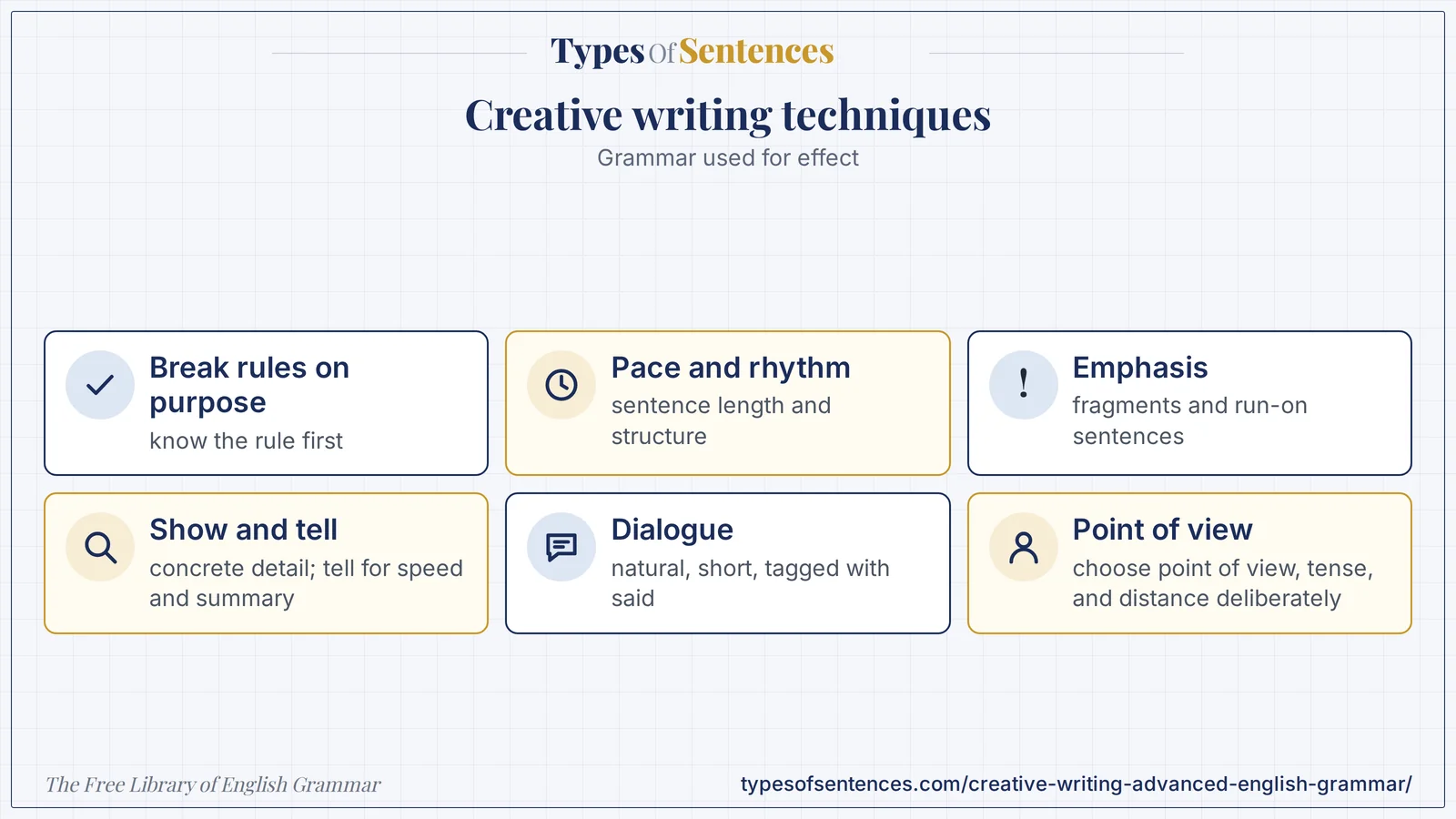
In creative writing, you want the reader to experience the story, not to be told about it. That means concrete details, strong verbs, speech that sounds like speech, and sentences whose rhythm matches the action.
Why it matters: Grammar is your instrument. Short sentences speed things up; long ones slow down or build. A fragment can land like a blow. The art is to know what each choice does, and to choose it on purpose.
Summary: Creative writing uses grammar for effect: sentence length and structure control pace and rhythm, fragments and run-on sentences create emphasis and flow, and word order and punctuation shape the reader’s attention. Showing uses concrete, sensory detail and strong verbs instead of abstract statements; telling is appropriate for summary and speed. Dialogue is written in short, natural lines with simple tags (said) and action beats, and a new paragraph for each speaker. Point of view (first, second, third limited, third omniscient) determines what the reader knows and how close they are to a character. Literary devices (metaphor, simile, imagery, symbol, irony, foreshadowing) add meaning. Voice is the distinctive personality of the prose. Narrative uses the past tense for the main line, the past perfect for backstory, and chosen structures for time.
- Know the rule; break it on purpose.
- Show with concrete detail; tell for speed and summary.
- Dialogue: natural, short, tagged with said, one speaker per paragraph.
- Choose point of view, tense, and distance deliberately.
What You’ll Learn
- 1. Creative Writing Techniques: Grammar as a Style Tool
- 2. Sentence Variety: Length, Structure, and Rhythm
- 3. Showing and Telling: Concrete Details and Sensory Language
- 4. Dialogue: Natural Speech, Tags, and Punctuation
- 5. Point of View and Narrative Distance
- 6. Literary Devices
- 7. Tone and Voice
- 8. Narrative Structure, Time, and Tense
- 9. Revising Fiction
- 10. Common Errors in Creative Writing
- 11. Exercises
- 12. Test Your Knowledge
- 13. Frequently Asked Questions
- 14. Conclusion
1. Creative Writing Techniques: Grammar as a Style Tool
Grammar rules describe what is standard in formal prose. A creative writer may depart from them, but a departure works only if the reader sees it as a choice and not as a mistake. The test is whether the effect justifies the break.
| Technique (rule-breaking) | Effect | Example (original) |
|---|---|---|
| sentence fragment | emphasis, a beat of silence, a thought | The door was open. Wide open. |
| run-on or comma splice (deliberate) | breathless speed; a stream of thought | She ran down the stairs, out of the house, across the road, nobody saw her, nobody called. |
| polysyndeton (many ands) | accumulation; a childlike or epic feel | He walked and walked and the road went on and the light went out. |
| asyndeton (no conjunctions) | speed; a list that feels complete | He came, he saw, he left. |
| sentence-initial conjunction | a natural, spoken rhythm | But she did not turn around. |
| one-word paragraph | a dramatic pause | Silence. |
| unusual word order (inversion, fronting) | emphasis and a literary tone | Gone were the days of the long summers. |
| repetition | rhythm and obsession | Rain, rain, and more rain. |
| split infinitive; preposition at the end | natural speech | She wanted to quietly leave. It was the room she was afraid of. |
| dialect, non-standard spelling (light touch) | character and place | “I ain’t goin’,” he said. |
| no punctuation or lowercase (rare) | a style of consciousness | used with care |
| second person (you) | intimacy or command | You open the door. You know before you look. |
| present tense in narration | immediacy | She opens the letter. Her hands shake. |
| Question to ask before breaking a rule | Why |
|---|---|
| Does it serve the meaning or mood? | a break must have a purpose |
| Will the reader read it as deliberate? | repeat the pattern or place it where it is clearly a choice |
| Is the pattern consistent? | a voice sets its own rules |
| Could the standard form do the same job better? | do not break rules only to look original |
| Does it hold up when read aloud? | rhythm is audible |
The grammar of fragments and fronting is treated in the chapters on fronting and postponement and on inversion; here the interest is the effect. A famous plain style in modern fiction, associated with writers such as Ernest Hemingway, uses short declarative sentences and repeated and; a different tradition, associated with writers such as Virginia Woolf, uses long, flowing sentences that follow the movement of a mind. The two are different uses of the same grammar.
2. Sentence Variety: Length, Structure, and Rhythm
| Variable | Choices | Effect |
|---|---|---|
| length | very short ↔ very long | short = speed, tension, emphasis; long = flow, reflection, accumulation |
| type | simple, compound, complex, compound-complex | variety keeps the reader alert |
| opening | subject, adverbial, participle, subordinate clause, inversion | changes emphasis and rhythm |
| position of the main clause | cumulative (main clause first); periodic (main clause last) | cumulative = natural, flowing; periodic = suspense |
| balance | parallelism, antithesis | shape and contrast |
| punctuation | comma, dash, colon, semicolon, ellipsis | pace and pause |
| repetition | anaphora, refrain | insistence, rhythm |
| Passage (original) | Effect |
|---|---|
| The train left. She stood on the platform. The platform emptied. She stood. | short sentences: stillness, loss |
| The train pulled away from the platform slowly, carrying with it the people she had known since childhood and the version of herself that had belonged to them, and she watched until the last carriage had gone round the curve and the rails were only rails. | one long sentence: building feeling, a mind following the departure |
| When the last carriage had gone, she turned. Nobody was there. | a subordinate clause then a short sentence: a beat of emptiness |
| Slowly, carefully, without a sound, he opened the door. | a series of adverbs: suspense |
| Open the door, she told herself, and open it now. | an imperative and a tag: voice and urgency |
| Not the money. Not the house. The letter. | fragments with anaphora: emphasis |
| Dull rhythm | Revised rhythm |
|---|---|
| She opened the door. She saw the room. She felt scared. She stepped inside. | The door opened onto a room she did not know. Scared, she stepped inside anyway. |
| It was raining and it was cold and the street was empty and he was alone. | Rain. Cold. The street was empty, and he was alone. |
| He was very tired and he sat down on the bed and he fell asleep quickly. | He sat on the bed and was asleep before his head touched the pillow. |
- Read your work aloud. The ear finds monotony that the eye misses.
- Match the sentence to the action: short for fast action and shock; long for reflection and description.
- Vary openings. Do not begin five sentences in a row with the subject.
- Use punctuation as pace: the dash for a sudden turn, the colon for a reveal, the semicolon for balance, the ellipsis for a trailing off.
- Do not vary for its own sake. Variety should serve the content.
The techniques of varying structure are also discussed in the later chapter on sentence variety. In creative writing the interest is less the correctness of a structure than its effect on the reader’s pace and attention.
3. Showing and Telling: Concrete Details and Sensory Language
| Telling (states) | Showing (dramatizes) |
|---|---|
| She was nervous. | Her fingers twisted the strap of her bag until the knuckles whitened. |
| The room was messy. | Clothes hung from the chair, and a cup with a skin of cold tea sat on the book. |
| He was angry. | He set the cup down so carefully that it rang. |
| It was a hot day. | The tar on the road had softened, and the dogs lay flat in the shade without lifting their heads. |
| The old man was kind. | The old man pressed a mango into each child’s hand, then pretended not to have seen them take another. |
| She loved him. | She kept the ticket stub in her purse for ten years. |
| The party was boring. | By ten o’clock, three people had checked their phones, and the host was refilling a bowl that no one had touched. |
| Sense | Example (original) |
|---|---|
| sight | The sky over the harbor turned the color of old brass. |
| sound | The fan clicked once on every turn. |
| smell | The kitchen smelled of cardamom and scorched milk. |
| taste | The tea was bitter at the edges, like a held grudge. |
| touch | The rail was cold and slightly sticky under her palm. |
| movement and the body | His breath caught on the stairs. |
| When to tell | Example |
|---|---|
| to summarize routine or transitions quickly | Over the next three weeks, they settled into a routine. |
| to pass time | Two years passed. |
| to give necessary background briefly | Her father had left when she was six. |
| to control pace | Between scenes of action, a short summary gives the reader rest. |
| when the telling has its own voice | a narrator’s witty summary |
| Filter words (often weaken a scene) | Without the filter |
|---|---|
| She saw the smoke rising from the field. | Smoke rose from the field. |
| He felt the cold seep through his coat. | The cold seeped through his coat. |
| I noticed that the door was open. | The door was open. |
| She seemed to be afraid. | Her voice shook. |
| He realized that he was alone. | He was alone. |
- Prefer concrete nouns and strong verbs to abstract nouns and adverbs: He stumbled instead of He walked unsteadily.
- Choose the telling detail: one or two specific details are better than a list.
- Show emotion through action, body, speech, and setting, not by naming the emotion.
- Do not show everything. Showing is slower; use it for the moments that matter.
- Watch for filter words (saw, felt, noticed, seemed), which put a layer between the reader and the experience, but keep them where the character’s perception is the point.
4. Dialogue: Natural Speech, Tags, and Punctuation
| Purpose of dialogue | Example |
|---|---|
| reveals character | “I don’t need help,” she said, and picked up the second bag. |
| moves the plot | “The bridge is closed. We’ll have to go round.” |
| reveals relationships | “Yes, Mother,” he said, in the voice he used for the bank. |
| creates subtext (what is not said) | “Nice weather.” “Is it?” (the tension is elsewhere) |
| gives information naturally | avoid “As you know, Bob” speeches |
| sets pace | short lines speed up a scene |
| Feature of natural speech | How it is written | Example |
|---|---|---|
| contractions | used freely in dialogue | I don’t know. We’ll see. |
| fragments | common | Maybe. Not yet. |
| interruptions | em dash | “But I thought—” “Don’t.” |
| trailing off | ellipsis | “I just wish …” |
| hesitations and fillers | used sparingly | “Well … I mean, it’s possible.” |
| repetition and echo | — | “Fine.” “Fine.” |
| dialect and register | a few words and rhythms, not heavy spelling | “Come on, yaar, don’t be like that.” |
| questions answered with questions | — | “Are you coming?” “Do I have a choice?” |
| Convention | Rule (American style) | Example |
|---|---|---|
| new speaker, new paragraph | start a new paragraph when the speaker changes | — |
| quotation marks | double quotation marks; single for a quotation inside | “She said, ‘Go,’” he told me. |
| comma before a tag | comma inside the quotation marks | “I’m leaving,” she said. |
| question or exclamation with a tag | no comma; the tag is lowercase | “Where are you going?” she asked. |
| action beat | a sentence of action, with a period | “I’m leaving.” She picked up her keys. |
| dialogue then narration of the same speaker | the same paragraph | “No.” He looked away. |
| tag in the middle | lowercase continuation if the same sentence | “If you go,” she said, “don’t come back.” |
| interruption | em dash, no space | “Wait—” |
| British variant | single quotation marks are common | ‘I’m leaving,’ she said. |
| Tag choice | Example | Comment |
|---|---|---|
| said | “I’ll go,” she said. | almost invisible; the best default |
| asked, replied | — | natural for questions and answers |
| action beat instead of a tag | “I’ll go.” She stood up. | shows action; no tag needed |
| no tag when the speaker is clear | — | keeps a rapid exchange fast |
| colorful tags (hissed, chortled) | — | use rarely; some verbs cannot be “said” |
| adverb tags (said angrily) | — | usually better to show the anger in the words |
| speech and a non-speech verb (“Yes,” she smiled.) | — | a smile cannot speak; use two actions: “Yes.” She smiled. |
| Weak dialogue | Stronger dialogue |
|---|---|
| “As you know, John, our company was founded in 1990,” she said informatively. | “Twenty years we’ve been here,” she said, and looked at the empty desks. |
| “I am very angry with you,” he said angrily. | “You said you’d be here.” He put the keys down. “You said.” |
| “Hello. How are you? I am fine. Thank you.” | “Hi.” “Hi.” “You look tired.” |
Speech that is reported rather than quoted (She said that she would go) and the blending of narrator and character (free indirect style: She would go, then; what did she care?) are treated in the chapter on advanced reported speech. Narrative can mix direct speech, reported speech, and free indirect speech for variety and for closeness to the character’s thoughts.
5. Point of View and Narrative Distance
| Point of view | Pronouns | Example (one scene, original) | Effect |
|---|---|---|---|
| first person | I, we | I closed the letter and did not look at him. | intimate; limited to what the narrator knows; voice is central |
| second person | you | You close the letter and do not look at him. | immediate, unusual; can be intrusive |
| third person limited | he, she, they | She closed the letter and did not look at him. | close to one character’s perceptions; the most common in modern fiction |
| third person omniscient | he, she, they; the narrator knows all | She closed the letter; he, who had expected a fight, felt only relief. | wide knowledge; a narrator’s voice |
| third person objective (camera) | he, she | She closed the letter. She did not look at him. | no access to thoughts; the reader infers |
| multiple points of view | — | alternating chapters or sections | a range of perspectives |
| free indirect style | third person with the character’s voice | She closed the letter. Well, that was that. | blends narrator and character |
| Choice | Options | Effect |
|---|---|---|
| tense of narration | past (most common) or present | past: a story that has happened; present: immediacy |
| reliability | reliable or unreliable narrator | an unreliable narrator makes the reader question the account |
| distance (psychic distance) | far (a summary: It was a hot summer) to close (Sweat ran down her back, and God, she hated this town) | the closer the distance, the more of the character’s voice and thought |
| consistency | stay within the chosen perspective | head-hopping (moving into several heads in one scene) confuses readers if unplanned |
| knowledge | what the narrator can know | limited points of view cannot know others’ thoughts |
| Distance (same moment, original) | Level |
|---|---|
| It was evening, and a woman was walking home. | far |
| Maya was walking home. It was evening. | a little closer |
| Maya walked home through the dusk, tired and thinking about the exam. | close |
| Maya’s feet hurt. Exam tomorrow. God, why had she said yes? | very close (free indirect style) |
Point of view is a matter of grammar as well as of strategy: the person (I, you, she), the tense, and the deictic words (here, now, this, that) all place the reader in a position relative to the story, as described in the chapter on reference and deixis. A shift in deixis can show a shift in distance: that evening is farther from the character than this evening.
6. Literary Devices
| Device | Definition | Example (original) |
|---|---|---|
| simile | comparison with like or as | The silence sat in the room like a guest who would not leave. |
| metaphor | a direct identification of two things | The city was a hive that never slept. |
| extended metaphor | a metaphor developed over several sentences | — |
| personification | human qualities given to non-human things | The wind complained at the window. |
| imagery | language that appeals to the senses | the smell of wet earth after rain |
| symbolism | an object or event that stands for an idea | a locked door that stands for a secret |
| motif | a repeated element | the recurrence of water |
| irony (verbal) | saying the opposite of what is meant | “What lovely weather,” he said, in the pouring rain. |
| irony (situational) | the opposite of what is expected | A fire station burns down. |
| irony (dramatic) | the reader knows what the character does not | — |
| foreshadowing | a hint of what will happen | the crack in the dam wall in chapter one |
| flashback | a return to an earlier time | — |
| in medias res | beginning in the middle of the action | — |
| allusion | a reference to another work or event | — |
| hyperbole and understatement | exaggeration and playing down | I waited a century; a slight delay |
| oxymoron and paradox | contradiction as a figure | a deafening silence |
| alliteration, assonance, consonance | repeated sounds | soft sibilant sounds |
| onomatopoeia | a word that imitates a sound | buzz, thud, hiss |
| metonymy and synecdoche | a name or a part for the whole | the crown (the monarchy); hands (workers) |
| juxtaposition | placing things side by side for contrast | a wedding and a funeral on one street |
| antithesis | balanced contrast | small hands, large dreams |
| Fault | Example | Fix |
|---|---|---|
| cliché | as cold as ice; heart of gold | a fresh, specific image |
| mixed metaphor | We must nip this problem in the bud before it snowballs. | keep one image |
| dead metaphor treated as live | — | — |
| over-explained symbol | The locked door, which symbolized his secret, … | let the reader infer |
| overwriting (purple prose) | piling adjectives and figures | choose the one that works |
| unclear image | — | make it concrete |
A figure of speech works when it makes the reader see something new or feel something exactly. If a comparison could appear in any story, it is probably a cliché. The persuasive use of figures (rhetorical schemes and tropes) is described in the chapter on rhetorical strategies.
7. Tone and Voice
| Concept | Definition | Created by |
|---|---|---|
| tone | the attitude of the writer or narrator toward the subject (wry, tender, bitter, playful, formal) | diction, imagery, detail, sentence rhythm |
| mood | the feeling that the text creates in the reader | setting, imagery, pace |
| voice | the distinctive personality of the writing | word choice, sentence patterns, imagery, point of view, rhythm, what is noticed |
| register | the level of formality | vocabulary and grammar (see the chapter on register) |
| style | the sum of a writer’s habitual choices | — |
| The same event in four tones (original) | Tone |
|---|---|
| The bus was late, as it always was, and Priya made a small, private bet with herself that it would be later still. | wry |
| The bus was late. Priya stood and watched the empty road, and felt the whole day tilt away from her. | somber |
| The bus was late, which gave Priya time to appreciate how very much she hated the bus. | comic |
| The bus had not come. In the cold, her breath rose and thinned, and she waited. | spare and lyrical |
| Ways to develop a voice | Practice |
|---|---|
| read widely and note how writers handle diction, sentence length, and image | imitate a passage (pastiche) and then depart from it |
| write in the voice of a character | use the character’s vocabulary and rhythm |
| choose the details that only your narrator would notice | — |
| control diction: formal, colloquial, regional, technical | — |
| listen to speech and record it | — |
| revise to remove generic phrasing | keep what sounds like you or your narrator |
| stay consistent within a piece | a voice that wavers breaks the spell |
- Match tone to content, or play against it deliberately (a light tone for a dark subject can be powerful).
- Keep the narrator’s voice consistent in vocabulary and rhythm.
- Let the character’s voice differ from the narrator’s in dialogue and in free indirect style.
- Do not mimic; absorb. A voice grows from many influences and from writing a great deal.
8. Narrative Structure, Time, and Tense
| Element | Description | Example |
|---|---|---|
| exposition | introduces character, setting, situation | — |
| inciting incident | the event that starts the story | a letter arrives |
| rising action | complications and conflict | — |
| climax | the point of highest tension and the turning point | — |
| falling action | consequences | — |
| resolution (dénouement) | the outcome | — |
| conflict | the force against the character (person, society, nature, self) | — |
| setting | time and place | — |
| theme | the idea the story explores | — |
| Narrative time | Technique | Tense use |
|---|---|---|
| main story line | the past simple | She opened the door and walked in. |
| background or events before the main line | past perfect (briefly), then back to the simple past | She had lived there as a child. She remembered the stairs. |
| ongoing background action | past progressive | Rain was falling as she crossed the yard. |
| a habitual past | would or used to | Every summer they would walk to the river. |
| immediacy | the present simple or progressive | She opens the door. |
| foreshadowing the future | future in the past | She did not know that she would never come back. |
| flashback | begin with past perfect, shift to the simple past, return with a cue | — |
| Scene versus summary | Use |
|---|---|
| scene (dramatized, in real time) | for key moments: conflict, change, revelation |
| summary (compressed) | for routine, transitions, and background |
| pacing | alternate them to control speed |
The use of the tenses and aspects in narrative is an application of the system described in the chapter on tense and aspect: the simple past carries the sequence of events, the progressive sets the background, and the past perfect shows what happened before. Fiction uses them flexibly, but a clear command of them keeps the reader oriented in time.
9. Revising Fiction
- Let the draft rest, then read it as a reader.
- Revise the structure first: the opening, the order of scenes, the climax, and the ending.
- Revise character and conflict: does each character want something, and does each scene change something?
- Revise scenes: are the key moments dramatized and the minor moments summarized?
- Revise point of view and tense for consistency.
- Line-edit: cut filter words, weak adverbs, clichés, and repetition; strengthen verbs and images.
- Revise dialogue: read it aloud; cut small talk that does nothing; trim tags.
- Check rhythm: read aloud for sentence variety.
- Proofread for grammar, spelling, and punctuation (see the later chapter on editing and proofreading).
- Get feedback from readers and decide which comments to follow.
| Before | After (line edit) |
|---|---|
| She walked slowly and sadly into the dark, scary room, feeling very nervous. | She stepped into the dark room. Her heart was loud. |
| “I hate you,” she said angrily, and she slammed the door really hard. | “I hate you.” The door slammed. |
| It was a dark and stormy night, and the wind was howling like a wolf. | The wind came off the hills in long pulls, rattling the shutters. |
10. Common Errors in Creative Writing
| Error | Example | Fix |
|---|---|---|
| naming the emotion (telling) | She felt sad. | Show it in action or detail. |
| adverb-heavy tags | “No,” he said angrily. | “No.” He turned away. |
| information dumped in dialogue | “As you know, we met in 1990.” | reveal in context |
| head-hopping | several characters’ thoughts in one scene | one point of view per scene |
| inconsistent tense | She walked in and sees the room. | She walked in and saw the room. |
| clichés | as cold as ice | a fresh image |
| mixed metaphors | nip it in the bud before it snowballs | one image |
| purple prose | shimmering, glittering, glowing, gleaming | one exact detail |
| stilted dialogue | “I am going to the store now.” | “I’m off to the shop.” (or “store”) |
| flat rhythm | every sentence the same length | vary the sentences |
| punctuation of dialogue | “I’m leaving.” she said. | “I’m leaving,” she said. |
| “said” replaced by odd verbs | “I know,” he smiled. | “I know.” He smiled. |
| over-explaining | He frowned, which showed he was confused. | He frowned. |
| unclear pronoun reference | She told her sister that she was wrong. | She told her sister, “You’re wrong.” |
| starting with the weather or waking up | It was a sunny morning. She woke up. | begin in the story |
Edit: It was a dark and stormy night, and she felt very sad and angrily said, “I hate you.” she smiled. She walked in and sees the room which was like an oven, and he was as cold as ice, and she noticed that the door was open.
- It was a dark and stormy night: a cliché opening: begin with an image: Thunder rolled behind the hills.
- she felt very sad: telling: She sat on the stairs with her coat still on.
- angrily said, “I hate you.” she smiled: adverb tag, punctuation, and “smiled” cannot be a speech verb: “I hate you,” she said. Then she smiled, because it was not true.
- walked in and sees: tense shift: walked in and saw.
- like an oven: stale simile: The room held the day’s heat like a closed fist.
- as cold as ice: cliché: He did not look up.
- she noticed that the door was open: filter: The door was open.
- Result: Thunder rolled behind the hills. She sat on the stairs with her coat still on. “I hate you,” she said. Then she smiled, because it was not true. She walked in and saw the room, which held the day’s heat like a closed fist. He did not look up. The door was open. (the passage is an invented example)
Recap in 12 seconds
Watch the lesson build itself: Creative writing uses sentence length, fragments, word order, dialogue, and point of view to create effects. The video has no sound.
Exercises
Part A: Grammar and Style (Exercises 1–7)
Exercise 1: Name a deliberate rule-break and its effect.
Show Answer
Answer: A fragment for emphasis; a run-on for speed; polysyndeton for accumulation.
Exercise 2: What is asyndeton?
Show Answer
Answer: A list without conjunctions.
Exercise 3: What is polysyndeton?
Show Answer
Answer: Many conjunctions in a row.
Exercise 4: When is a rule-break justified?
Show Answer
Answer: When it serves the meaning or mood.
Exercise 5: Name an effect of a very short sentence.
Show Answer
Answer: Speed, tension, emphasis.
Exercise 6: Name an effect of a long sentence.
Show Answer
Answer: Flow, reflection, accumulation.
Exercise 7: What is a periodic sentence?
Show Answer
Answer: The main clause comes last.
Part B: Showing and Telling (Exercises 8–13)
Exercise 8: Show: She was nervous.
Show Answer
Answer: Her fingers twisted the strap of her bag until the knuckles whitened.
Exercise 9: Show: He was angry.
Show Answer
Answer: He set the cup down so carefully that it rang.
Exercise 10: Remove the filter: She saw the smoke rising.
Show Answer
Answer: Smoke rose.
Exercise 11: Name two filter words.
Show Answer
Answer: saw, felt, noticed, seemed.
Exercise 12: When is telling appropriate?
Show Answer
Answer: For summary, transitions, and pace.
Exercise 13: Name the five senses.
Show Answer
Answer: Sight, sound, smell, taste, touch.
Part C: Dialogue (Exercises 14–20)
Exercise 14: Correct: “I’m leaving.” she said.
Show Answer
Answer: “I’m leaving,” she said.
Exercise 15: What is the best default tag?
Show Answer
Answer: said.
Exercise 16: When does a new paragraph start?
Show Answer
Answer: When the speaker changes.
Exercise 17: Fix: “Yes,” she smiled.
Show Answer
Answer: “Yes.” She smiled.
Exercise 18: What punctuates an interruption?
Show Answer
Answer: An em dash.
Exercise 19: What is subtext?
Show Answer
Answer: What is meant but not said.
Exercise 20: Name the American quotation marks.
Show Answer
Answer: Double quotation marks.
Part D: Point of View and Devices (Exercises 21–27)
Exercise 21: Name four points of view.
Show Answer
Answer: First, second, third limited, third omniscient.
Exercise 22: Which point of view is limited to one character’s perceptions?
Show Answer
Answer: Third person limited.
Exercise 23: What is head-hopping?
Show Answer
Answer: Moving unplanned among characters’ thoughts in a scene.
Exercise 24: Define simile.
Show Answer
Answer: A comparison with like or as.
Exercise 25: Define metaphor.
Show Answer
Answer: A direct identification of two things.
Exercise 26: Define foreshadowing.
Show Answer
Answer: A hint of what will happen.
Exercise 27: Name the fault: as cold as ice
Show Answer
Answer: Cliché.
Part E: Voice and Structure (Exercises 28–30)
Exercise 28: Which tense carries the main story line?
Show Answer
Answer: The simple past.
Exercise 29: Which tense shows events before the main line?
Show Answer
Answer: The past perfect.
Exercise 30: Define voice.
Show Answer
Answer: The distinctive personality of the writing.
Test Your Knowledge
Ready to check what you learned? Answer all 10 questions, then submit. You need 80% (8 of 10) to pass. Your answers are not stored.
View correct answers and explanations
Question 1: Which is a fragment used for effect?
✓ Correct Answer: A – The door was open. Wide open.
A deliberate fragment.
Question 2: Which is “showing”?
✓ Correct Answer: B – Her fingers twisted the strap of her bag.
A concrete detail.
Question 3: Which is the correct dialogue punctuation?
✓ Correct Answer: C – “I’m leaving,” she said.
A comma inside the quotation marks.
Question 4: Which is a metaphor?
✓ Correct Answer: D – The city was a hive.
A direct identification.
Question 5: Which is a filter word?
✓ Correct Answer: C – noticed
Noticed.
Question 6: Which point of view uses I?
✓ Correct Answer: A – first person
First person.
Question 7: Which tense carries the main line of a past narrative?
✓ Correct Answer: D – simple past
Simple past.
Question 8: Which is a cliché?
✓ Correct Answer: C – as cold as ice
A stock phrase.
Question 9: Which is a good default dialogue tag?
✓ Correct Answer: B – said
Said.
Question 10: Which is head-hopping?
✓ Correct Answer: B – moving among several characters’ thoughts in one scene
Unplanned shifts.
Frequently Asked Questions
What are creative writing techniques?
Creative writing techniques are the methods writers use to create vivid fiction and poetry: showing with concrete detail, sentence variety, dialogue, point of view, literary devices, and voice.
What are literary techniques?
Literary techniques are devices and strategies used in literature, such as metaphor, simile, imagery, symbolism, irony, foreshadowing, and flashback. Literary techniques add meaning and effect.
What is creative grammar?
Creative grammar is the use of grammar for effect in literary writing: fragments, run-ons, inversion, repetition, and punctuation for rhythm. Creative grammar works when the writer knows the standard rule.
What is fiction writing?
Fiction writing is the writing of invented stories: novels, short stories, and scenes. Fiction writing depends on character, conflict, setting, point of view, and language.
What are narrative techniques?
Narrative techniques are the methods of telling a story: point of view, narrative time and tense, scene and summary, dialogue, and structure. Narrative techniques control what the reader knows and when.
What does “show, don’t tell” mean?
It means conveying emotions and situations through concrete details, actions, and dialogue instead of stating them. Telling is still useful for summary and pace.
How do I write good dialogue?
Write natural, short lines; use contractions and fragments; use said or action beats; start a new paragraph for each speaker; and let some meaning remain unsaid.
Conclusion
You now have a deep study of creative writing techniques: grammar as a style tool, sentence variety, showing and telling, dialogue, point of view, literary devices, tone and voice, narrative structure and tense, revision, and common errors. You can use language deliberately to create experience.
When you write a scene, ask what the reader should see, hear, and feel, and which sentence structure carries it. Next, you will study writing for digital media.
- Gardner, John. The Art of Fiction. Knopf, 1984.: psychic distance and the craft of fiction.
- Burroway, Janet, Elizabeth Stuckey-French, and Ned Stuckey-French. Writing Fiction: A Guide to Narrative Craft. 10th ed. University of Chicago Press, 2019.: a textbook of fiction technique.
- Lanham, Richard A. Analyzing Prose. 2nd ed. Continuum, 2003.: the analysis of prose style.
- Fowler, Roger. Linguistics and the Novel. Methuen, 1977.: language and narrative.
- Merriam-Webster Dictionary: narrative: the dictionary entry.
Last reviewed: October 29, 2026. How it was made: drafted with AI assistance, then checked with automated tests (structure, links, answer keys, spelling) and against the sources above. A person has not yet read this chapter line by line. Found a mistake? Report it.