Grammar and translation meet whenever a text written in English must be read in another language, whether by a professional translator, by a machine, or by a reader who reads English as an additional language. A sentence that is easy for a native reader, because the reader unconsciously resolves its ambiguities and decodes its idioms, may be very hard to render: the translator must decide what it refers to, what touch base means, who the actor of a passive is, and whether flies is a verb or a noun. The more of those decisions the writer makes in advance, by writing clearly, the better and cheaper the translation will be.
This chapter explains how to write translatable English and English for global audiences. It covers writing for translation (clear structures, avoiding ambiguity), idioms and their literal alternatives, cultural references and universal alternatives, sentence complexity, controlled language such as Simplified Technical English, machine translation and the grammar that works with it, and the wider practice of writing international English for global communication. The advice is the same as the advice of plain language, with extra attention to the points where languages differ, which is the study of translation grammar. Many of the examples are invented, and the chapter describes tendencies and standard practice, not the behavior of any particular translation tool, which changes constantly. Thirty exercises and a quiz follow.
If you want your English to translate well, write it so that it can be understood without guessing: short sentences, one idea each, clear subjects, the same word for the same thing, no idioms, no jokes that depend on English, and no references that only one culture knows.
Why it matters: A translator or a machine has to make a choice for every ambiguity. If you remove the ambiguities in advance, the translation is faster, cheaper, and more accurate.
Summary: Translatable English uses short, complete sentences with explicit subjects, consistent terminology, and unambiguous reference; it keeps that in relative and complement clauses, avoids noun strings, avoids idioms and phrasal verbs with several meanings, and avoids cultural references, puns, and humor. Idioms should be replaced by literal wording (kick the bucket becomes die). Controlled languages, such as the aerospace standard ASD-STE100, restrict vocabulary and grammar for clarity. Machine translation, now mostly neural, works best on simple, explicit, consistent text, and the human practices of pre-editing and post-editing improve results. Software text must be internationalized: strings should not be concatenated, because word order, gender, and plural forms differ across languages. Dates, units, and currencies should be unambiguous. Translators need context, glossaries, and style guides. Writing for translation is an extension of plain language and of clear international English.
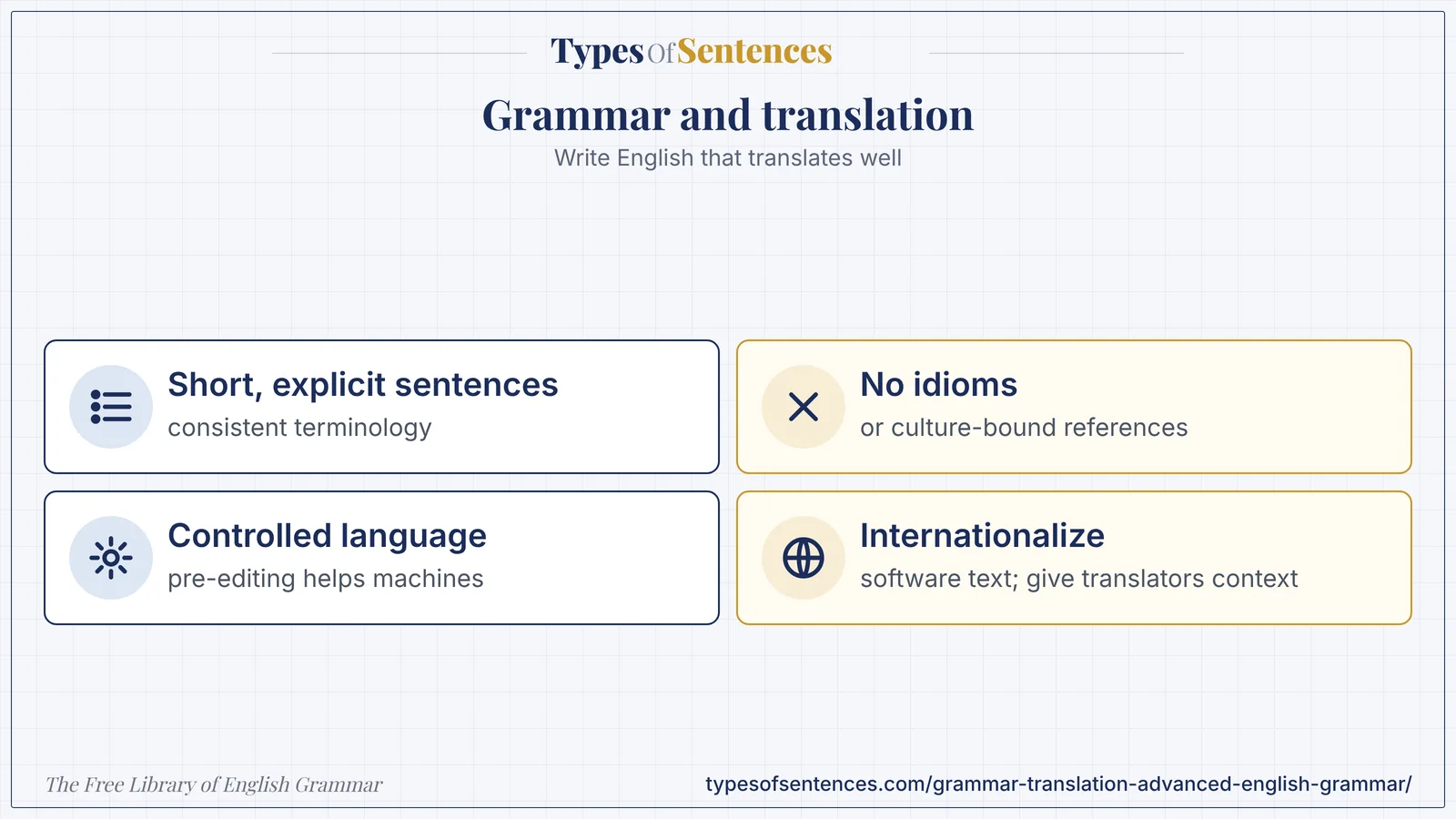
- Short, explicit, consistent sentences.
- No idioms or culture-bound references.
- Controlled language and pre-editing help machines.
- Internationalize software text; give translators context.
What You’ll Learn
- 1. Grammar and Translation: Writing for Translation
- 2. Idioms and Translation: Literal Alternatives
- 3. Cultural References: May Not Translate
- 4. Sentence Complexity: Simpler Is Easier to Translate
- 5. Controlled Language: Technical Writing and Limited Vocabulary
- 6. Machine Translation: Grammar That Works
- 7. International English: Writing Globally Comprehensible Text
- 8. Working With Translators: What They Need
- 9. Common Problems and a Worked Example
- 10. Exercises
- 11. Test Your Knowledge
- 12. Frequently Asked Questions
- 13. Conclusion
1. Grammar and Translation: Writing for Translation
| Term | Meaning | Note |
|---|---|---|
| source language and target language | the language translated from and into | English is the source here |
| translation | conveying the meaning of a text in another language | — |
| localization (L10n) | adapting a product or text to a particular place, including language, units, dates, and culture | more than translation |
| internationalization (i18n) | designing a product or text so that it can be adapted without redesign | a design step before localization |
| transcreation | creative adaptation of a message, for example an advertising slogan | — |
| translation memory (TM) | a database of previously translated segments reused in later work | rewards consistent wording |
| CAT tool | computer-assisted translation software that uses memory and glossaries | — |
| machine translation (MT) | translation by software | see below |
| pre-editing | editing the source text to make translation easier | — |
| post-editing | a human correcting machine-translated text | — |
| glossary or termbase | an approved list of terms and translations | — |
| style guide | instructions on tone, format, and conventions | — |
| source text quality | the main factor in the quality of the translation | “garbage in, garbage out” |
| back-translation | translating the result back into the source language to check | a limited test |
| Guideline for translatable English | Before | After |
|---|---|---|
| write complete sentences | Because of the delay. | The delay caused a problem. |
| use short sentences (about 20 words or fewer) | The system, which was installed last year, and which has been maintained by our team, which also handles training, needs an upgrade. | Our team installed the system last year. We also maintain it and train its users. It needs an upgrade. |
| one idea per sentence | Check the oil and if it is low add oil but do not overfill. | Check the oil. If it is low, add oil. Do not overfill. |
| state the subject | Needs to be signed. | You must sign the form. |
| use the same word for the same thing | Press the button. Then click the key. Then tap the switch. | Press the button. Then press the button again. |
| keep that and which in clauses | The file you saved is lost. | The file that you saved is lost. |
| avoid noun strings | customer service request tracking system update | an update to the system that tracks customer service requests |
| avoid ambiguous pronouns | The manager told the clerk that she was late. | The manager told the clerk, “You are late.” |
| repeat a noun instead of a distant pronoun | — | repeat the noun |
| avoid -ing ambiguity | Visiting relatives can be boring. | Relatives who visit can be boring. |
| avoid ambiguous modifiers | Only apply on Monday. | Apply only on Monday. |
| avoid homonyms and double meanings | The bank is near the bank. | The bank is near the river. |
| avoid phrasal verbs with several meanings | Put off the meeting. | Postpone the meeting. |
| use the active voice | The report was written by the team. | The team wrote the report. |
| use articles correctly | — | keep a, an, the; they help the translator |
| avoid ellipsis (omitted words) | The first is red; the second, blue. | The first is red. The second is blue. |
| avoid long coordination | — | split |
| avoid negation in questions | Don’t you want to come? | Do you want to come? |
| avoid double negatives | not unlikely | likely |
| avoid conditionals with inversion | Should you need help, call us. | If you need help, call us. |
| write numbers and dates clearly | 03/04/2024 | 4 March 2024 |
| avoid references to “above” and “below” in documents that may be reformatted | — | refer to a named section |
| avoid relying on punctuation for meaning | a comma that changes the meaning | reword |
| avoid tricky punctuation (semicolons used for subtle effects) | — | use full stops |
| avoid “it” without a clear antecedent | It is important that it works. | It is important that the system works. |
| avoid “this” without a noun | This is a problem. | This delay is a problem. |
| use verbs, not nominalizations | The implementation of the plan … | We implemented the plan … |
The guidelines are those of plain language (see the chapter on conciseness and wordiness and the previous chapter on plain language), with extra attention to points where languages differ: languages that drop subjects, languages with different word order, languages with grammatical gender, and languages in which the passive or the article work differently. A writer does not need to know the target languages; the writer needs to remove the ambiguities that any translator would have to resolve by guessing.
2. Idioms and Translation: Literal Alternatives
An idiom is a fixed expression whose meaning is not the sum of its words. A translator who knows the source language can interpret it and look for an equivalent in the target language, but a machine, or a non-native reader, may translate it word for word. For texts that will be translated, replace idioms with literal wording.
| Idiom | Literal alternative | Idiom | Literal alternative |
|---|---|---|---|
| kick the bucket | die | a piece of cake | easy |
| it’s raining cats and dogs | it is raining heavily | break the ice | start a conversation |
| under the weather | ill | hit the nail on the head | be exactly right |
| spill the beans | reveal a secret | the ball is in your court | it is your decision |
| cost an arm and a leg | be very expensive | once in a blue moon | very rarely |
| let the cat out of the bag | reveal a secret | bite the bullet | accept something unpleasant |
| barking up the wrong tree | making a wrong choice | burn the midnight oil | work late at night |
| cut corners | do something cheaply and badly | call it a day | stop working |
| get cold feet | become nervous | go the extra mile | make extra effort |
| hit the road | leave | in the same boat | in the same situation |
| on the same page | in agreement | touch base | talk |
| circle back | return to the topic | take it offline | discuss it privately, later |
| move the needle | make a real difference | low-hanging fruit | an easy task with good results |
| think outside the box | think creatively | at the end of the day | finally |
| the elephant in the room | an obvious problem that nobody discusses | back to square one | back to the start |
| a blessing in disguise | a good result from a bad event | beat around the bush | avoid the main point |
| bring to the table | offer | by the book | strictly following the rules |
| rule of thumb | a practical guide | ballpark figure | rough estimate |
| dead in the water | failed | run out of steam | lose energy |
| the last straw | the final problem | throw in the towel | give up |
| up in the air | undecided | play it by ear | decide as it happens |
| out of the blue | unexpectedly | a storm in a teacup | a small problem made to seem large |
| a white elephant | a useless and costly thing | take it with a pinch of salt | be skeptical |
| sit on the fence | not choose a side | face the music | accept the consequences |
| pull someone’s leg | joke with someone | sleep on it | think about it overnight |
| a hot potato | a difficult issue | the whole nine yards | everything |
| get the ball rolling | begin | hold your horses | wait |
| jump the gun | start too early | miss the boat | miss an opportunity |
| when pigs fly | never | the tip of the iceberg | a small visible part of a bigger problem |
| in a nutshell | briefly | cut to the chase | get to the point |
| a game changer | something that changes the situation completely | a no-brainer | an obvious decision |
| off the record | unofficial | on the back burner | delayed |
| learn the ropes | learn the basics | keep an eye on | watch |
| drop the ball | fail to act | in hot water | in trouble |
| wild goose chase | a useless search | the final nail in the coffin | the event that ends something |
| let sleeping dogs lie | do not disturb a problem | a red herring | a false clue |
| hit the books | study | bend the rules | break a rule slightly |
| a dime a dozen | very common | save for a rainy day | save for hard times |
| Why idioms are hard to translate | Example |
|---|---|
| the meaning cannot be derived from the words | kick the bucket |
| the image is culture-specific | storm in a teacup |
| a literal translation may be absurd or offensive | raining cats and dogs |
| the target language may have a different idiom with a different image | a different animal or object for the same idea |
| the tone may differ | an informal idiom in a formal text |
| a machine may translate each word | — |
| readers may not notice the idiom is an idiom | — |
| idioms often hide in verbs and prepositions (put up with) | — |
| idioms vary by variety of English | — |
| they date quickly | — |
Some idioms are so common that they are part of ordinary English (in fact, of course); the practical test is whether a non-native reader who has learned English from a textbook would understand the phrase. If in doubt, use the literal version. Idioms are treated as language in their own right in the Basic chapter on common idioms; the point here is only that they are a risk for translation.
3. Cultural References: May Not Translate
| Reference type | Example | Universal alternative |
|---|---|---|
| sports metaphors (baseball) | step up to the plate; hit it out of the park; touch base | take responsibility; do it very well; contact |
| sports metaphors (cricket) | a sticky wicket; hit for six; bat on the front foot | a difficult situation; do very well; act confidently |
| sports metaphors (American football) | a Hail Mary pass; Monday-morning quarterback; the ball is in your court | a last desperate attempt; someone who criticizes after the event; it is your decision |
| holidays and festivals | as busy as Black Friday | very busy |
| foods and drinks | as American as apple pie; a cup of tea (as a unit of calm) | typical of the United States; a calm moment |
| brands | Google it; the Rolls-Royce of laptops | search for it; the best laptop |
| TV, film, and literary references | a Kafkaesque process; a Cinderella story | a confusing and illogical process; a story of sudden success |
| historical references | a Waterloo; a Pyrrhic victory | a final defeat; a victory that costs too much |
| religious or biblical references | a good Samaritan; the patience of Job | a kind stranger; great patience |
| political references | a Watergate-style scandal | a scandal |
| geographic references | across the pond | across the Atlantic Ocean |
| units | miles, Fahrenheit, pounds, gallons | kilometers, Celsius, kilograms, liters (or both) |
| dates | 4/3/24 | 4 March 2024 |
| currency | $5 (which dollar?) | 5 US dollars; ₹500 |
| time zones | 3 p.m. Eastern | 15:00 UTC−5; give the city |
| numbers | lakh, crore; billion (older UK) | million; thousand million (or state the number) |
| names | a name that is famous only locally | a short explanation |
| gestures and customs | give a thumbs-up | approve |
| humor, puns, and wordplay | a pun on English homophones | a plain statement |
| slang | a lit party | an exciting party |
| proverbs | a stitch in time saves nine | early action saves effort |
| seasonal references | in the spring (northern hemisphere) | in March–May in the northern hemisphere |
| school systems | freshman year; Grade 12 | first year of university; the final school year |
| legal and administrative terms | a 401(k); a PAN card | explain the concept |
| food and drink words | biscuit (US versus UK) | cookie or biscuit; describe |
| place names used as metaphors | Hollywood; Silicon Valley; Bollywood | the film industry; the technology industry |
| body-related idioms | keep your chin up | stay positive |
| religion-specific greetings | — | a general greeting |
| colors with cultural meanings | a white wedding | a wedding (avoid assuming that white is a color of joy or of mourning) |
| numbers with cultural meanings | 13 as unlucky; 4 in some Asian cultures | avoid using such numbers in examples without reason |
| formality and address | first-name basis | consider the culture’s norms |
| references to “we all know” | as we all know | state the fact |
| local acronyms | NHS, IRS, UPSC | spell out and explain |
| examples with local context | — | use international examples or several |
| images that carry cultural meaning | — | check with local reviewers |
| calendar systems | — | state the calendar if it matters |
| paper sizes and formats | Letter, A4 | state the size |
| telephone and address formats | — | follow the local format |
- Ask who will read the text and what they know.
- Replace local references with explanations or international examples.
- Give both units if readers may use either system.
- Avoid humor that depends on language or culture.
- Have a reader from the target culture review important material (localization review).
- Do not assume your culture is the default.
4. Sentence Complexity: Simpler Is Easier to Translate
| Complex source | Simpler source |
|---|---|
| The committee, having considered the proposals that had been submitted by the departments, which varied in quality, decided to postpone its decision. | The departments submitted proposals. The proposals varied in quality. The committee decided to postpone its decision. |
| Because the supplier, who had been warned, did not deliver, we canceled the order, which caused delays. | The supplier did not deliver. We had warned the supplier. So we canceled the order. This caused delays. |
| It is believed by many experts that, were the rules to be changed, compliance would improve. | Many experts believe that compliance would improve if the rules changed. |
| Not only did the system fail, but also the backup, which had been tested, did not start. | The system failed. The backup also did not start, although we had tested it. |
| Having been told that the meeting, which was scheduled for Monday, had been moved, she … | Someone told her that the meeting had moved from Monday. She … |
| The report that the manager whom we hired last year wrote has been published. | We hired a manager last year. The manager wrote a report. The report has been published. |
| If, however, the payment, which is due on the first, is late, a fee applies. | The payment is due on the first. If it is late, a fee applies. |
| The more we test, the more we learn. | The more we test, the more we learn. (a short parallel structure is acceptable) |
| Whoever applies first gets the prize. | The first person to apply gets the prize. |
| The system is easy to use, reliable, cheap, and, importantly, secure. | The system is easy to use. It is reliable and cheap. It is also secure. |
| The fact that it rained, which nobody expected, spoiled the event. | It rained. Nobody expected this. The rain spoiled the event. |
| Our policy is to be as clear as possible, and in the event of any unclear wording, to ask. | We write clearly. If something is unclear, ask us. |
| We will, as soon as we have the figures, which are due next week, send the report. | The figures are due next week. We will send the report when we have them. |
| What the customer wants is not what the customer needs. | The customer wants one thing and needs another. |
| The proposal, which, if approved, will cost more than planned, was rejected. | The proposal would cost more than planned. The board rejected it. |
| Rule of thumb for sentence structure | Reason |
|---|---|
| keep the subject, verb, and object close together | the translator can see the core structure |
| put the main clause first | — |
| avoid more than one subordinate clause in a sentence | nested clauses cause errors |
| avoid center embedding | see the chapters on syntax and on complex sentence architecture |
| use a list for several parallel items | clear structure |
| use short coordinated clauses with explicit connectors | and, but, because |
| avoid sentences that depend on tone of voice | — |
| write a full sentence for each instruction | — |
| avoid questions as headings if the target language does not use them | — |
| use consistent tense | — |
| avoid mixing statements and questions | — |
| prefer positive statements | — |
The relation of sentence length and structure to processing was discussed in the chapters on syntax and sentence processing and on complex sentence architecture. The rule for translation is the same as for any reader who cannot ask the writer a question: make the structure visible. Simplifying a sentence for translation does not mean making the content simple; it means separating the units of meaning, and the translator can recombine them as the target language requires.
5. Controlled Language: Technical Writing and Limited Vocabulary
| Controlled language | Description | Note |
|---|---|---|
| Simplified Technical English (ASD-STE100) | a controlled language for aerospace and defense maintenance documentation, maintained by ASD, the European aerospace and defense industries association; it has writing rules and a dictionary of approved words with approved meanings | widely used in aviation maintenance; the specification is updated regularly, so consult the current issue |
| Caterpillar Fundamental English (1970s) | an early controlled language developed for the manuals of a heavy-equipment manufacturer | an early example of the idea |
| Kodak International Language and other corporate languages | corporate controlled languages | — |
| Basic English (C. K. Ogden, 1930) | a simplified version of English with a vocabulary of 850 words | a historical project |
| Plain English and plain language guidelines | not a controlled language but related | see the previous chapter |
| Global English style guides (for example John Kohl, The Global English Style Guide, 2008) | guidelines for writing English for translation and international readers | — |
| rationalized French (GIFAS) and similar systems for other languages | controlled languages in other languages | — |
| Typical rule in a controlled language (as in ASD-STE100, in outline) | Effect |
|---|---|
| use only approved words, each with one approved meaning | removes ambiguity |
| keep sentences short (limits are given for procedural and descriptive writing) | — |
| write one instruction per sentence | — |
| use the active voice and the imperative for instructions | — |
| use the simple tenses (the present, the past, and the future) | — |
| avoid long noun clusters (a limit is given) | — |
| use articles and the word that where they help | — |
| do not use phrasal verbs or idioms with several meanings | — |
| avoid gerunds as nouns where unclear | — |
| use the same word for the same thing | — |
| use the full form (do not) in procedures | — |
| use lists for sequences | — |
| use warnings and cautions in a fixed pattern | — |
| state the reason after the instruction where useful | — |
| do not use words that are not in the dictionary without defining them | — |
| write numerals and units consistently | — |
| Benefit of controlled language | Limit |
|---|---|
| clarity and safety in procedures | less suited to creative or persuasive writing |
| consistent terminology and savings in translation (more reuse from translation memory) | requires training and tools |
| better machine translation results | a restricted vocabulary may feel stilted |
| accessibility for non-native readers | the rules must be maintained |
| checkable by software | — |
The details of the specification should be taken from the current official document, which is maintained by its owner and updated from time to time; the rules summarized above are the general character of such systems. The lesson for ordinary writers is the one that the controlled languages teach: when precision and translation matter, limit the vocabulary, one word for one meaning, and the grammar, one structure for one function. This is the principle of consistent grammar in the chapter on technical writing.
6. Machine Translation: Grammar That Works
| Point | What it means | Practical advice |
|---|---|---|
| history | rule-based systems, then statistical systems (from the 1990s), then neural machine translation (widely adopted from about 2016) | quality improved greatly, but errors remain |
| strengths | fluent output; good for gist; good on common language pairs and plain, well-formed text | — |
| weaknesses | ambiguity, idioms, rare terms, long or nested sentences, missing context, gender and number agreement, numbers and negation | check these points |
| source quality | the cleaner the source, the better the output | pre-edit |
| pre-editing | simplifying the source before translation | use the guidelines in this chapter |
| post-editing | a human corrects the machine output; the level (light or full) depends on the purpose | — |
| terminology | machines may translate a term differently each time | use a glossary where the tool allows |
| names and brand terms | may be translated or mangled | mark them as not to be translated |
| numbers, dates, and units | must be checked | — |
| negation | a missed not can reverse the meaning | check negatives in important texts |
| gender | languages differ; a gender-neutral English sentence may be given a gender in the target language | check if it matters |
| pronouns and dropped subjects | languages that drop subjects may lose the referent | repeat nouns in the source |
| ambiguity | the machine picks one reading | remove ambiguities |
| formality | languages with formal and informal address (for example tu and vous) | know which is needed |
| confidentiality | public online tools may store text | do not paste confidential or personal text into a public tool unless the terms allow it |
| legal, medical, and safety texts | errors can be serious | use qualified human translators and review |
| back-translation as a test | translating the result back may hide errors (it can look fine while the translation is wrong) | use a bilingual reviewer |
| multiple tools | different tools give different results | compare and check |
| use for reading versus publishing | good for understanding a foreign text; riskier for publication | — |
| tools improve over time | — | test again periodically |
| do not claim certainty | — | state when a text is machine translated |
| Pre-editing example (invented) | Source as written | Pre-edited source |
|---|---|---|
| idiom | We need to hit the ground running. | We need to start quickly. |
| ambiguous pronoun | The engineer told the manager he was wrong. | The engineer told the manager, “You are wrong.” |
| noun string | project management software update schedule | the schedule for updating the project management software |
| phrasal verb | Please look into it. | Please investigate it. |
| passive without agent | The form has been lost. | We lost the form. |
| homonym | The bank approved the loan near the bank. | The bank approved the loan for a house near the river. |
| elliptical comparison | She likes him more than Priya. | She likes him more than Priya likes him. |
| long sentence | — | split |
| fragment | Done. | The work is done. |
| missing subject | Hope this helps. | I hope this helps. |
| slang | This is a no-brainer. | This is an easy decision. |
| humor | It’s a piece of cake, if you like cake. | It is easy. |
| negative question | Don’t you agree? | Do you agree? |
| abbreviation | ASAP | as soon as possible |
| inconsistent term | user, customer, client | customer |
| date | 3/4 | 3 April (or 4 March) |
| measure | a 10-foot pole | a pole 3 meters (10 feet) long |
| uncertain scope | old men and women | old men and old women |
| it | It is clear that it works. | It is clear that the system works. |
| this | This causes delays. | This problem causes delays. |
Machine translation is a fast-moving field, and the practical advice above is general: simple, explicit, consistent source text gives better results with any tool. The study of how ambiguity affects processing, in humans and machines, is treated in the chapter on global Englishes for varieties and in the chapters on ambiguity and on syntax and sentence processing.
7. International English: Writing Globally Comprehensible Text
| Issue | Guidance | Example |
|---|---|---|
| choose and state a variety | American, British, or another; be consistent | color or colour, not both |
| spelling and vocabulary differences | avoid words with different meanings in different varieties | biscuit, pants, football |
| dates, times, and units | unambiguous formats; state the time zone | 4 March 2024, 15:00 UTC |
| numbers | use figures; avoid lakh and crore without explanation | 5 million (or 50 lakh) |
| currency | state the currency | USD 5; INR 500 |
| names | give names in a consistent order; note the family name | Priya Nair |
| gender | avoid gendered assumptions; some languages need gender | they; or repeat the noun |
| formality | plain, polite | — |
| humor and irony | avoid | — |
| directness | state the request clearly; avoid hints | Please send the report by Friday. |
| politeness | include polite forms that are not obscure | please, thank you |
| sentence length and structure | short and explicit | — |
| abbreviations and acronyms | spell out first use | — |
| idioms and metaphors | avoid | — |
| phrasal verbs | prefer single verbs | — |
| text expansion | translated text is often longer (commonly cited increases are of the order of 15 to 30 percent for some language pairs), so leave room in layouts | — |
| text direction | some languages (Arabic, Hebrew, Urdu) are written right to left | design layouts that can be mirrored |
| fonts and characters | use Unicode and fonts that support the target scripts | — |
| sorting and searching | vary by language | — |
| images and symbols | check for cultural meaning | — |
| colors | check for cultural meaning | — |
| accessibility | plain language and alt text translate better and help everyone | — |
| legal requirements | vary by country | — |
| contact information | international formats | +91 80 1234 5678 |
| addresses | may have different structures | — |
| local examples | use several or neutral examples | — |
| punctuation conventions | quotation marks and decimal separators differ by language | — |
| capitalization | differs (for example nouns in German) | — |
| file names and codes | avoid non-ASCII characters where systems require | — |
| voice and tone | adapt, do not merely translate | — |
| review by local readers | test the translation with readers in the market | — |
The differences among varieties of English that a global writer must expect are described in the chapters on British vs American English and on contrastive analysis; the choice of a variety should be stated and kept consistent.
| Software and interface text (internationalization) | Problem | Better |
|---|---|---|
| concatenated strings | “You have ” + n + “ new messages” breaks in languages with different word order or plural forms | use complete sentences with placeholders, and let translators reorder them |
| plural forms | English has two (one, other), but other languages have more (for example Russian and Arabic have several categories) | use plural rules provided by localization libraries, not a hard-coded s |
| gender | a sentence like “You are a registered user” may need a gendered form in other languages | avoid gender-dependent text or provide variants |
| placeholders without context | {0} sent {1} | give translators notes explaining each placeholder |
| abbreviations in buttons | Msg; Info | use full words if space allows |
| text in images | cannot be translated easily | use live text |
| hard-coded dates and numbers | — | use the locale’s format |
| space for expansion | buttons sized for English | allow room |
| culture-specific icons | — | test with local users |
| jokes and Easter eggs | — | avoid |
| error messages | long technical text | short, plain, and translatable |
| one string for several meanings | Close (shut) and Close (near) | separate strings with notes |
| reused strings | a word that means different things in different places | give each use its own string |
| capitalization for effect | — | follow the target language’s rules |
| sort order | — | use locale-aware sorting |
| units | — | convert by locale |
| right-to-left layout | — | mirror the layout |
| names and forms | a single “first name” and “last name” field | allow for other naming systems |
8. Working With Translators: What They Need
| What translators ask for | Why |
|---|---|
| context | a sentence out of context may have several meanings; screenshots and notes help |
| a glossary of approved terms | consistency |
| a style guide | tone, formality, and conventions |
| reference material | earlier translations; related documents |
| clear, final source text | changes during translation are costly |
| segmentation-friendly text | complete sentences; no breaks in the middle of a sentence |
| editable source files | not only PDFs |
| notes on what not to translate | names, codes, brand terms |
| explanations of puns, jokes, and wordplay | so that an equivalent can be created (transcreation) |
| target audience and purpose | a legal text, a manual, and an advertisement need different approaches |
| the variety wanted for the target language | for example the regional variety |
| time | translation needs time for review |
| a contact person for questions | — |
| review process | a second reader or a local reviewer |
| consistent use of terms in the source | allows reuse of translation memory |
| the same wording for repeated content | — |
| alt text and captions provided | — |
| correct source grammar | errors in the source are translated too |
| feedback after delivery | improves later work |
| respect for the translator’s expertise | — |
- Write the source clearly using the guidelines above.
- Check the source for ambiguity, idioms, cultural references, and inconsistent terms.
- Prepare a glossary and a style guide.
- Give context (notes, screenshots, a description of the audience).
- Freeze the text before translation, where possible.
- Translate (human, machine with post-editing, or both).
- Review with a reader of the target language.
- Test the product (layout, links, forms).
- Collect feedback and update the glossary.
9. Common Problems and a Worked Example
| Problem | Example | Better |
|---|---|---|
| idiom | We’ll touch base next week. | We will talk next week. |
| ambiguous pronoun | The manager told the clerk she would be promoted. | The manager told the clerk, “You will be promoted.” |
| long nested sentence | — | split into short sentences |
| sports metaphor | a sticky wicket | a difficult situation |
| phrasal verb with several meanings | put off the meeting | postpone the meeting |
| noun string | customer service request tracking system | the system that tracks customer service requests |
| missing subject | Needs approval. | The proposal needs approval. |
| humor | — | plain statement |
| US-only reference | the IRS | the tax authority |
| unit confusion | 10 feet | 3 meters (10 feet) |
| ambiguous date | 03/04/2024 | 4 March 2024 |
| inconsistent terms | user / customer / client | customer |
| concatenated software string | “You have ” + n + “ items” | a complete string with a placeholder |
| abbreviation without definition | ASAP | as soon as possible |
| assuming gender | The nurse said she … | The nurse said they … (or repeat the noun) |
| elliptical structure | Some like tea; others, coffee. | Some people like tea. Other people like coffee. |
| mixed registers | — | one register |
| ambiguity in headings | Visiting Relatives | Visits to Relatives |
| text in images | — | live text |
| no context for translators | a list of isolated strings | add notes and screenshots |
Rewrite for translation (invented source): Hi team, just a heads-up: we’re gonna touch base on the Q3 numbers ASAP, since the CEO wants us to hit the ground running. Basically, if you can’t make it, no worries, but it’d be great if somebody could put together the slides — it’s a piece of cake, and the sooner it’s done the better. Cheers!
- Identify the readers: an international team, with several first languages, and the text may be translated.
- Hi team, just a heads-up: Dear team, please note:
- we’re gonna touch base on the Q3 numbers ASAP: contraction, slang, idiom, and abbreviation: We will meet to discuss the third-quarter figures by Friday, 8 March. (the date is an invented placeholder; ASAP is replaced by a date).
- since the CEO wants us to hit the ground running: idiom and an abbreviation: The chief executive officer wants us to start quickly.
- Basically, if you can’t make it, no worries: filler, contraction, and an idiom: If you cannot attend, please tell me.
- it’d be great if somebody could put together the slides: a phrasal verb and an indirect request: Please prepare the slides. (or Could one of you prepare the slides?).
- it’s a piece of cake: an idiom: The task is easy.
- the sooner it’s done the better: a comparative structure: Please finish it by Thursday, 7 March.
- Cheers!: a regional informal closing: Best regards,
- Result: Dear team, please note: we will meet to discuss the third-quarter figures by Friday, 8 March. The chief executive officer wants us to start quickly. If you cannot attend, please tell me. Please prepare the slides. The task is easy. Please finish it by Thursday, 7 March. Best regards, [name]. (the message is invented; the dates are placeholders)
- Note: the revision is plainer and less friendly in tone; if friendliness matters, add a short, literal courtesy (Thank you for your help).
Recap in 12 seconds
Watch the lesson build itself: Translatable English uses short, explicit, consistent sentences and avoids idioms and culture-bound references. The video has no sound.
Exercises
Part A: Writing for Translation (Exercises 1–7)
Exercise 1: Define localization.
Show Answer
Answer: Adapting content to a specific place, including language, units, dates, and culture.
Exercise 2: What is pre-editing?
Show Answer
Answer: Editing the source text to make translation easier.
Exercise 3: What is post-editing?
Show Answer
Answer: Human correction of machine-translated text.
Exercise 4: Why keep that in relative clauses?
Show Answer
Answer: It makes the structure explicit.
Exercise 5: Rewrite: Needs to be signed.
Show Answer
Answer: You must sign the form.
Exercise 6: Rewrite: customer service request tracking system
Show Answer
Answer: the system that tracks customer service requests.
Exercise 7: Rewrite: 03/04/2024
Show Answer
Answer: 4 March 2024.
Part B: Idioms (Exercises 8–14)
Exercise 8: Literal: kick the bucket.
Show Answer
Answer: die.
Exercise 9: Literal: a piece of cake.
Show Answer
Answer: easy.
Exercise 10: Literal: spill the beans.
Show Answer
Answer: reveal a secret.
Exercise 11: Literal: touch base.
Show Answer
Answer: talk.
Exercise 12: Literal: under the weather.
Show Answer
Answer: ill.
Exercise 13: Literal: break the ice.
Show Answer
Answer: start a conversation.
Exercise 14: Why are idioms hard to translate?
Show Answer
Answer: Their meaning is not the sum of their words, and the images are cultural.
Part C: Cultural References and Complexity (Exercises 15–21)
Exercise 15: Universal alternative: step up to the plate.
Show Answer
Answer: take responsibility.
Exercise 16: Universal alternative: across the pond.
Show Answer
Answer: across the Atlantic Ocean.
Exercise 17: Make international: 10 feet.
Show Answer
Answer: 3 meters (10 feet).
Exercise 18: Split: The committee, having considered the proposals, decided to postpone its decision.
Show Answer
Answer: The committee considered the proposals. It decided to postpone its decision.
Exercise 19: What is a good sentence length for translation?
Show Answer
Answer: About 20 words or fewer.
Exercise 20: Why avoid center embedding?
Show Answer
Answer: Nested clauses cause errors.
Exercise 21: Why avoid humor in translated text?
Show Answer
Answer: It depends on language and culture.
Part D: Controlled Language and Machine Translation (Exercises 22–27)
Exercise 22: What is ASD-STE100?
Show Answer
Answer: A controlled language for aerospace maintenance documentation (Simplified Technical English).
Exercise 23: Name a rule of controlled language.
Show Answer
Answer: One approved word for one meaning; short sentences; one instruction per sentence.
Exercise 24: Who created Basic English in 1930?
Show Answer
Answer: C. K. Ogden.
Exercise 25: Name a weakness of machine translation.
Show Answer
Answer: Ambiguity, idioms, missing context, gender and number agreement, negation.
Exercise 26: Why not paste confidential text into a public tool?
Show Answer
Answer: It may be stored or used.
Exercise 27: Why use qualified human translators for legal and medical texts?
Show Answer
Answer: Errors can be serious.
Part E: Internationalization (Exercises 28–30)
Exercise 28: Why avoid concatenating strings in software?
Show Answer
Answer: Word order and plural forms differ across languages.
Exercise 29: Name something translators ask for.
Show Answer
Answer: Context, a glossary, a style guide, final source text.
Exercise 30: Rewrite for translation: It’s a piece of cake.
Show Answer
Answer: The task is easy.
Test Your Knowledge
Ready to check what you learned? Answer all 10 questions, then submit. You need 80% (8 of 10) to pass. Your answers are not stored.
View correct answers and explanations
Question 1: Which idiom is hard to translate literally?
✓ Correct Answer: A – kick the bucket
An idiom.
Question 2: What is a good translation-friendly sentence length?
✓ Correct Answer: B – about 20 words or fewer
Short sentences.
Question 3: What is localization?
✓ Correct Answer: C – adapting content to a specific locale, not just translating it
More than translation.
Question 4: What is controlled language?
✓ Correct Answer: D – a restricted vocabulary and grammar for clarity
Restricted vocabulary and grammar.
Question 5: Which is better for translation?
✓ Correct Answer: C – The bank (the financial institution) opens at nine.
Remove ambiguity.
Question 6: Why keep that in relative clauses in translation-friendly writing?
✓ Correct Answer: A – it makes the structure explicit
Explicit structure.
Question 7: What is post-editing?
✓ Correct Answer: D – human correction of machine-translated text
Human correction.
Question 8: Why avoid concatenating strings in software messages?
✓ Correct Answer: C – word order and plural forms differ across languages
Languages differ.
Question 9: Which is more translatable?
✓ Correct Answer: B – We will talk on Monday.
Literal and specific.
Question 10: ASD-STE100 is
✓ Correct Answer: B – a controlled language for technical writing
Simplified Technical English.
Frequently Asked Questions
What is grammar and translation?
Grammar and translation is the study of how the grammar of the source text affects translation, and how to write English that translates well. Grammar and translation matters most for ambiguity, idioms, and complex structures.
What is translatable English?
Translatable English is English written to be easily translated: short, explicit, consistent sentences without idioms, cultural references, or ambiguity. Translatable English also helps non-native readers.
What is English for global audiences?
English for global audiences is English written so that readers from different countries and languages can understand it: plain structure, clear dates and units, no unexplained idioms. English for global audiences is related to plain language.
What is translation grammar?
Translation grammar is the grammar of what changes when a text is translated: word order, articles, tense, gender, and pronouns. Translation grammar helps writers to anticipate problems.
What is global communication?
Global communication is communication across countries and languages, and it needs clear writing, awareness of cultural differences, and, often, translation. Global communication benefits from plain, consistent English.
Can machine translation handle idioms?
Not reliably. Neural machine translation can handle some common idioms but often fails on rarer ones; replacing idioms with literal wording gives better results.
Should I write differently if my text will be translated?
Yes: use short, explicit sentences, consistent terms, no idioms or humor, unambiguous dates and units, and give translators context and a glossary.
Conclusion
You now have a guide to grammar and translation: how to write for translation, handle idioms and cultural references, simplify sentences, use controlled language, work with machine translation, write international English, and help translators. You can write English that travels.
When you write for readers in other languages, ask what a translator would have to guess, and remove the guess. Next, you will begin Part 12 with advanced grammar myths.
- ASD (the European aerospace and defense industries association). ASD-STE100 Simplified Technical English. (current issue): the specification of a controlled language.
- Kohl, John R. The Global English Style Guide: Writing Clear, Translatable Documentation for a Global Market. SAS Institute, 2008.: guidelines for translatable English.
- Ogden, C. K. Basic English: A General Introduction with Rules and Grammar. Kegan Paul, 1930.: a historical simplified English.
- Esselink, Bert. A Practical Guide to Localization. John Benjamins, 2000.: localization and internationalization.
- Merriam-Webster Dictionary: translation: the dictionary entry.
Last reviewed: October 29, 2026. How it was made: drafted with AI assistance, then checked with automated tests (structure, links, answer keys, spelling) and against the sources above. A person has not yet read this chapter line by line. Found a mistake? Report it.