Legal writing is the writing of lawyers, legislators, judges, and others who create and apply rules: contracts, statutes, court judgments, briefs, legal memoranda, and notices. It has a reputation for being dense and old-fashioned, and some of that reputation is deserved. But much of legal language has a purpose: a contract or a statute must say exactly what the parties or the legislature meant, and must still say it when a hostile reader tries to find another meaning. Legal language is therefore built for precision, and it has developed formulas and technical terms in order to achieve it.
This chapter studies legal English as a variety of language. You will meet its characteristics (precision, formality, archaic expressions, and doubled phrases), the main legal documents and their structures, legal grammar (the modals shall, must, and may, conditions and provisos, the passive voice, and long sentences), legal vocabulary and Latin terms, the sources of ambiguity and how to avoid them, and the plain language movement, which seeks to make the law accessible without losing accuracy. This is an introduction to legal style, not legal advice: the meaning and effect of legal documents depend on the law of each place, and anyone with a legal question should consult a qualified lawyer. Thirty editing exercises and a quiz follow.
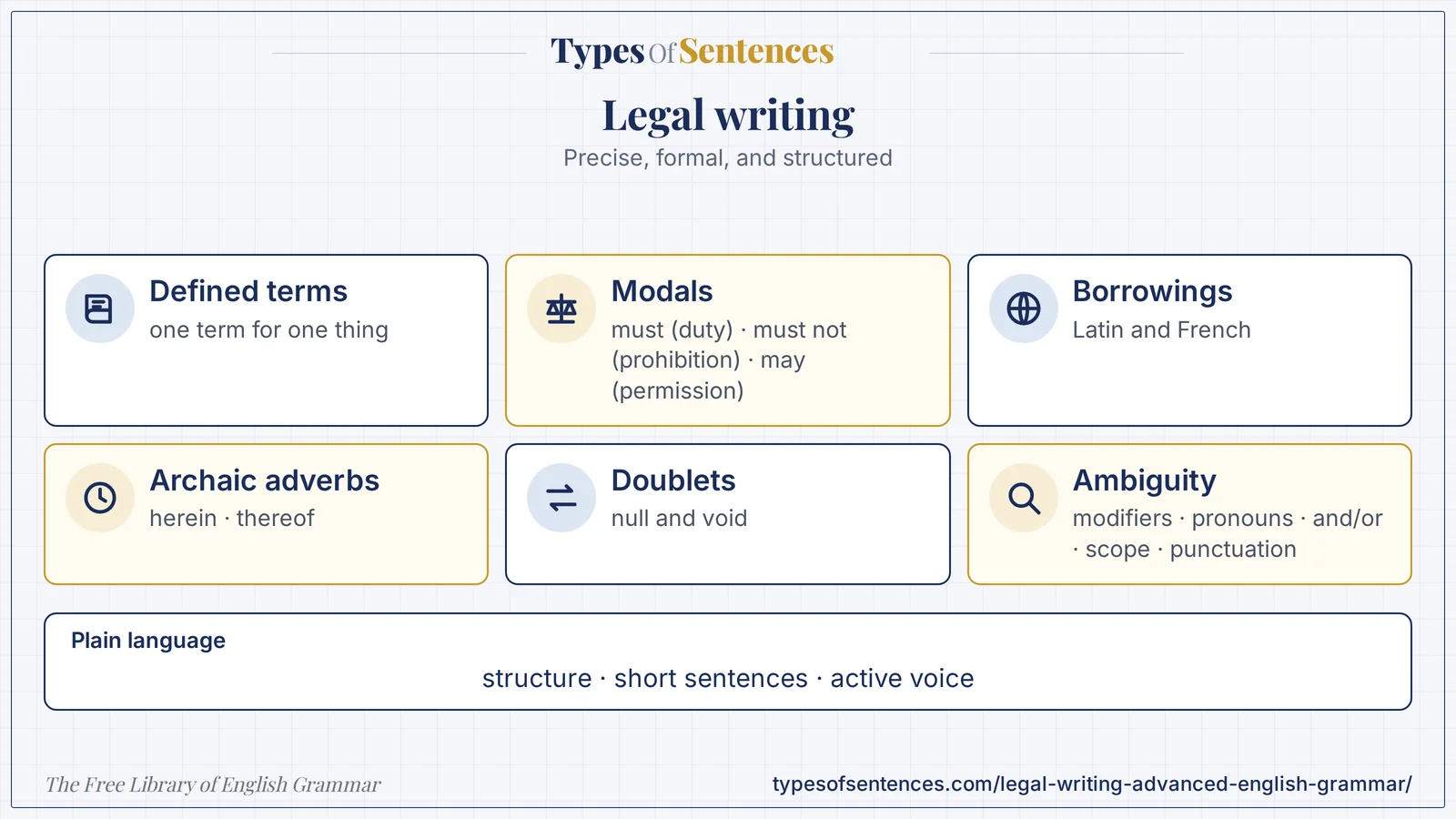
Legal writing tries to remove doubt. If two readers can take a clause in different ways, one of them may end up in court, and so the writer of a contract or a statute spends great effort on exact words, defined terms, and careful structure.
Why it matters: The price of this care is that legal documents can be hard to read. Modern practice tries to keep the precision and shed the clutter: to write the law in plain English that is as exact as the traditional form.
Summary: Legal writing is precise, formal, and structured. It uses defined terms, technical vocabulary, Latin and French borrowings, archaic adverbs (herein, thereof), and doublets (null and void). Its documents (contracts, statutes, briefs, memoranda) have conventional parts. Its grammar relies on modal verbs of obligation and permission (shall, must, may), conditions (if, unless, provided that, subject to), the passive, and long, embedded sentences. Ambiguity arises from vague terms, misplaced modifiers, unclear pronouns, and/or, and punctuation. The plain language movement advocates clear structure, short sentences, active voice, and everyday words, while keeping legal accuracy.
- Precision above all: define terms; use one term for one thing.
- Modals: must (duty), must not (prohibition), may (permission).
- Ambiguity: modifiers, pronouns, and/or, scope, punctuation.
- Plain language: structure, short sentences, active voice, everyday words.
What You’ll Learn
- 1. Legal Writing: Characteristics of Legal Language
- 2. Legal Documents and Their Structures
- 3. Legal Grammar: Modal Verbs, Conditions, Passive, and Sentence Structure
- 4. Legal Vocabulary: Technical Terms and Latin Expressions
- 5. Avoiding Ambiguity
- 6. The Plain Language Movement
- 7. Writing a Legal Document or Memo
- 8. Common Errors in Legal Writing
- 9. Exercises
- 10. Test Your Knowledge
- 11. Frequently Asked Questions
- 12. Conclusion
1. Legal Writing: Characteristics of Legal Language
| Characteristic | Description | Example |
|---|---|---|
| precision | exact words; defined terms; one term for one thing | “Business Day” means a day other than a Saturday, Sunday, or public holiday. |
| formality | full forms; no contractions; formal vocabulary | The Tenant shall not assign this lease. |
| technical vocabulary | words with fixed legal meanings | consideration; tort; estoppel; indemnity; lien; jurisdiction |
| Latin and French terms | inherited from the history of English law | bona fide; prima facie; force majeure |
| archaic adverbs | here-, there-, where- compounds | herein, hereby, hereinafter, thereof, whereas, aforesaid |
| doublets and triplets | pairs or triples of near-synonyms | null and void; terms and conditions; cease and desist; give, devise, and bequeath |
| long sentences | conditions and exceptions embedded in one sentence | a single sentence of 100 words in a statute |
| repetition instead of pronouns | the noun is repeated to avoid doubt | the Tenant … the Tenant … (not he or it) |
| passive and impersonal forms | duties and rights without naming the actor | Notice shall be given in writing. |
| nominalization | processes as nouns | the termination of this agreement; failure to perform |
| capitalized defined terms | terms given a special meaning in the document | the Company, the Agreement, the Effective Date |
Several features have historical causes. Legal English was shaped by the mixture of English, French, and Latin in the Middle Ages, when the law was written in Latin and Law French. Doublets such as null and void and will and testament often join an English word and a French or Latin one, so that all readers would understand. The scholar David Mellinkoff described these habits in his book The Language of the Law (1963), and argued that many of them have outlived their purpose.
| Archaic or wordy | Modern plain equivalent |
|---|---|
| hereinafter referred to as | called |
| the party of the first part | the Seller (a defined term) |
| witnesseth | (delete) |
| aforesaid; said (as a determiner) | this; that; the |
| prior to; subsequent to | before; after |
| in the event that | if |
| null and void | void |
| any and all | all (or any) |
| by means of | by |
| for the purpose of | to |
| pursuant to | under |
| notwithstanding the foregoing | despite this |
The relation of legal language to the register system is discussed in the chapter on register and style: legal English is an example of a “frozen” or very formal register in which stability is valued above variation.
2. Legal Documents and Their Structures
| Document | Purpose | Typical parts |
|---|---|---|
| contract (agreement) | create enforceable obligations between parties | title; date; parties; recitals (background); definitions; main obligations; payment; term and termination; representations and warranties; liability; boilerplate; signatures |
| statute (act) | legislation | long title; sections and subsections; definitions; provisions; penalties; schedules |
| regulation or rule | detail under a statute | — |
| court judgment (opinion) | decide a case | facts; issues; reasoning; decision (order) |
| brief (written argument) | persuade a court | statement of facts; issues; argument; conclusion and relief requested |
| legal memorandum | analyze a legal question for a lawyer | question presented; brief answer; facts; discussion; conclusion |
| pleading (complaint, petition, defense) | state a party’s case in court | parties; facts; claims; relief sought |
| opinion letter | give legal advice to a client | facts; question; analysis; conclusion |
| notice | inform formally | who, what, when; action required |
| will | state how property passes | declarations; bequests; executors; signatures |
| policy and terms of service | set rules for users | plain-language summary; definitions; rules |
| Part of a contract | Function | Example |
|---|---|---|
| title and date | identify the document | Service Agreement dated 1 April 2024 |
| parties | who is bound | between Alpha Ltd (“the Supplier”) and Beta Ltd (“the Client”) |
| recitals (“whereas” clauses) | background; the reason for the agreement | Whereas the Supplier provides software services … |
| definitions | fix the meaning of terms | “Services” means the services described in Schedule 1. |
| operative provisions | the main obligations | The Supplier shall provide the Services. |
| payment | amounts and dates | The Client shall pay the fees within 30 days of invoice. |
| term and termination | duration and ending | Either party may terminate by giving 30 days’ written notice. |
| representations and warranties | statements of fact and promises | Each party warrants that it has authority to enter into this Agreement. |
| liability and indemnity | who bears loss | — |
| boilerplate (standard clauses) | governing law; entire agreement; notices; assignment; severability; force majeure; counterparts | This Agreement is governed by the laws of … |
| signatures | execution | — |
| Brief or memorandum method (IRAC) | Content |
|---|---|
| Issue | the legal question |
| Rule | the law that applies (statute, case) |
| Application (analysis) | how the rule applies to the facts |
| Conclusion | the answer |
The form of each document follows the law of the place and the practice of the court or the profession, and many documents use templates. Legislative drafting in many countries uses numbered sections, subsections, and paragraphs, and in some (including India and other Commonwealth jurisdictions) uses provisos introduced by Provided that. The details differ, and the reader should consult the rules that apply.
3. Legal Grammar: Modal Verbs, Conditions, Passive, and Sentence Structure
| Modal | Intended meaning in legal drafting | Example |
|---|---|---|
| shall | a duty (traditionally); often misused for other meanings | The Tenant shall pay the rent on the first day of each month. |
| must | a duty (preferred by many plain-language drafters) | The Tenant must pay the rent on the first day of each month. |
| shall not; must not | a prohibition | The Tenant must not sublet the premises. |
| may | permission or discretion | The Landlord may inspect the premises on 24 hours’ notice. |
| may not | prohibition (but can be read as “might not”) | prefer must not or is not entitled to |
| will | a statement of future fact (not a duty), or a duty in some styles | The Supplier will deliver on 1 May. |
| should | a recommendation (not binding) | The Client should keep a copy. |
The word shall is notorious: the legal drafting expert Bryan Garner has pointed out that it is used in contracts and statutes to mean at least five different things (a duty, a prohibition, a recommendation, a future fact, and “is” in the sense of a definition). Many plain-language drafters and some jurisdictions now prefer must for duties, may for permissions, and must not for prohibitions. Whatever the choice, use each modal for one meaning only. The modal verbs are described in the chapter on modality.
| Condition word | Meaning | Example |
|---|---|---|
| if | a condition | If the Client fails to pay, the Supplier may suspend the Services. |
| unless | if … not | Unless otherwise agreed, the notice period is 30 days. |
| provided that | a condition or a limit (a proviso) | The Tenant may keep a pet, provided that the pet does not cause a nuisance. |
| subject to | this is limited by another provision | Subject to clause 5, the Supplier shall refund the fee. |
| in the event that | if (formal) | In the event that either party defaults, … |
| where; whenever | in circumstances in which | Where the Client gives notice, … |
| notwithstanding | despite another provision | Notwithstanding clause 5, … |
| on condition that | a strict condition | — |
| except that; save that | an exception | — |
| deemed | treated as, even if not | Notice is deemed received two days after posting. |
| Feature | Practice | Example |
|---|---|---|
| passive voice | used for duties without an actor, but can hide who must act | The report shall be submitted by 31 March. (by whom?) |
| active voice | clearer: names the actor | The Contractor must submit the report by 31 March. |
| long sentences | embedded conditions can obscure the main clause | state the main rule first, then the conditions, or use a list |
| lists (tabulation) | break up complex conditions into (a), (b), (c) with a clear lead-in | The Tenant must (a) pay the rent; (b) keep the premises clean; and (c) report damage. |
| singular and plural | be clear whether a term includes the plural | In this Agreement, the singular includes the plural and the reverse. |
| gender | use gender-neutral drafting | the Tenant must … they … (or repeat the term) |
| numbers | write the number in words and figures (traditionally) | thirty (30) days; plain style: 30 days |
| dates and periods | precise: within 30 days of the date of this notice | whichever is later |
| definitions | capitalized terms, used consistently | “Effective Date” means … |
The conditionals, which are the grammar of legal rules (If A, then B; unless C), are described in the chapter on advanced conditionals. The passive and its omission of the agent are treated in the chapter on voice; in legal drafting, the agent should usually be named when the duty must be assigned.
4. Legal Vocabulary: Technical Terms and Latin Expressions
| Term | Meaning | Example |
|---|---|---|
| bona fide | in good faith; genuine | a bona fide purchaser |
| prima facie | at first sight; sufficient unless disproved | a prima facie case |
| inter alia | among other things | The report covers, inter alia, costs. |
| ipso facto | by that very fact | — |
| mutatis mutandis | with the necessary changes | The same terms apply, mutatis mutandis. |
| pro rata | in proportion | payable pro rata |
| per se | in itself | not illegal per se |
| de facto / de jure | in fact / by law | the de facto leader |
| ex parte | from one side only | an ex parte order |
| sub judice | under judicial consideration | the matter is sub judice |
| ultra vires | beyond one’s legal power | an ultra vires act |
| res judicata | a matter already decided | — |
| amicus curiae | friend of the court | — |
| habeas corpus | a writ to bring a detained person before a court | — |
| pro bono | for the public good; free legal work | — |
| quid pro quo | something in return | — |
| mens rea / actus reus | guilty mind / guilty act | — |
| caveat emptor | let the buyer beware | — |
| force majeure (French) | an unforeseeable event beyond the parties’ control | a force majeure clause |
| Technical term | Meaning (general) |
|---|---|
| consideration | something of value exchanged in a contract (common-law systems) |
| tort | a civil wrong, apart from breach of contract |
| indemnity | a promise to cover another’s loss |
| liability | legal responsibility |
| warranty | a promise or assurance about a fact or a product |
| jurisdiction | a court’s authority; or the territory of a legal system |
| lien | a right to hold property until a debt is paid |
| estoppel | a bar to denying what one has earlier asserted |
| injunction | a court order to do or not do something |
| plaintiff / claimant; defendant | the party who sues; the party sued |
| appellant; respondent | party who appeals; party who answers an appeal |
| affidavit | a sworn written statement |
Legal terms may have different meanings in different legal systems, and an ordinary word may have a special meaning in law (consideration, party, action, execute). A reader who is not a lawyer should read legal terms in the context of the document and its definitions, and consult the definitions clause first. Latin terms should be used only if they are necessary, and explained for non-specialist readers.
5. Avoiding Ambiguity
| Source of ambiguity | Example | Fix |
|---|---|---|
| modifier attachment | The Supplier shall deliver the goods to the Client in good condition. (delivered in good condition, or goods in good condition?) | The Supplier shall deliver the goods in good condition to the Client. |
| scope of and and or | Employees who are over 50 and with 10 years of service or in management … (grouping unclear) | Employees who are (a) over 50 and have 10 years of service, or (b) in management … |
| and/or | the Landlord and/or the Tenant | either or both of the Landlord and the Tenant; or the Landlord, the Tenant, or both |
| unclear pronoun | The Supplier shall notify the Client when it is ready. (who is ready?) | … when the goods are ready. |
| such and said without a clear antecedent | such notice; said party | that notice; the Tenant |
| vague terms | reasonable time; promptly; substantial | a defined period (within 14 days), or an intended standard |
| quantifier scope | Each of the buyers shall pay a fee. / All buyers shall pay a fee. | state whether each pays a fee or all pay together |
| a missing or extra comma | a list without a serial comma | use the serial comma and, if necessary, rewrite as a list |
| shall with several meanings | — | use must, may, must not |
| “between … and …” (inclusive or exclusive) | between 1 and 10 March | from 1 March to 10 March, both inclusive |
| time references | the “end of the month”; “days” | calendar days; business days (defined) |
| dangling modifier | Having considered the evidence, the contract was signed. | After the parties considered the evidence, they signed the contract. |
A frequently cited example of the importance of punctuation is a 2017 decision of a United States court of appeals, in which a statute’s list of exempt activities lacked a serial comma and the court treated the list as ambiguous, which affected the overtime pay of a group of delivery drivers. The example shows how a single comma can decide a case, and why careful drafters use the serial comma or restructure a list. The detailed treatment of ambiguity in language is in the chapter on ambiguity in English.
| Rules of interpretation (common-law countries) | Meaning |
|---|---|
| plain meaning | words are given their ordinary meaning unless defined |
| ejusdem generis | in a list of specific items followed by a general term, the general term covers only items of the same kind |
| expressio unius est exclusio alterius | the express mention of one thing excludes others |
| noscitur a sociis | a word is known by the company it keeps |
| contra proferentem | an ambiguity in a contract is read against the party that drafted it |
| specific over general | a specific provision overrides a general one |
- Define terms in a definitions clause, and use them consistently.
- Repeat the noun instead of using a pronoun where there is any doubt.
- Use lists for complex conditions, with a clear lead-in and a clear connector (and or or) at the end of the list.
- Put modifiers next to what they modify.
- Avoid and/or. Say exactly what is meant.
- Use vague standards deliberately and only where they serve the purpose (reasonable care), not by accident.
6. The Plain Language Movement
| Original | Plain-language redraft |
|---|---|
| The Lessee shall, at his own expense, keep the leased premises in good and substantial repair and condition. | The Tenant must keep the property in good repair at the Tenant’s own cost. |
| In the event that the Purchaser shall fail to make payment in accordance with the terms hereof, the Vendor shall have the right to terminate this Agreement. | If the Buyer does not pay as this Agreement requires, the Seller may end it. |
| Notice of termination shall be given by the party desirous of terminating this Agreement not less than thirty (30) days prior to the date of termination. | A party that wants to end this Agreement must give at least 30 days’ notice. |
| It is hereby agreed and declared by the parties hereto that … | The parties agree that … |
| Plain-language principle | Practice |
|---|---|
| organize for the reader | a table of contents, headings, a summary, key information first |
| use short sentences | about 20 words on average (a common guideline) |
| use the active voice | name the actor |
| use everyday words | if for in the event that; before for prior to |
| use “you” and “we” in consumer documents | address the reader |
| use lists and tables | for conditions and steps |
| define terms; use them consistently | — |
| avoid unnecessary Latin and archaic words | — |
| test the document with readers | — |
| Examples of the movement | Description |
|---|---|
| Plain English Campaign (United Kingdom) | a campaign for clear public information |
| Plain Writing Act of 2010 (United States) | requires federal agencies to use clear communication |
| Clarity (an international association of lawyers) | promotes plain legal language |
| modern statutes and consumer-rights legislation in several countries | require that consumer contracts be in plain, intelligible language |
| writers on legal style (Garner; Kimble) | advocate plain legal writing |
The aim of the movement is not to make the law vague. A plain-language contract can be as precise as a traditional one, and often is more precise, because the effort to simplify exposes unclear thinking. The balance is between precision (the document can bear only the intended meaning) and clarity (the reader can understand it without a lawyer). The objective of plain language is also discussed in the later chapter on readability.
7. Writing a Legal Document or Memo
- Identify the purpose and the reader. Is it a contract for the parties, a brief for a judge, or a memo for a client?
- Gather the facts and the law. Check that the facts are accurate and that the law applies to the jurisdiction.
- Plan the structure by the conventions of the document type.
- Define key terms and keep to them.
- Draft in plain, precise language: short sentences, active voice, one idea per sentence.
- Check ambiguity: modifiers, pronouns, and/or, quantifiers, and punctuation.
- Check consistency: terms, numbers, cross-references, dates.
- Have another person read it as a hostile reader would.
- Proofread every name, number, and date.
| Memo section | Content | Language |
|---|---|---|
| question presented | the legal question, with the key facts | Under …, is …, when …? |
| brief answer | the conclusion in a few sentences | Probably yes. … |
| facts | relevant facts, accurately and neutrally | The Tenant paid … The Landlord gave notice on … |
| discussion (IRAC) | rule, application, counterarguments, conclusion for each issue | The rule is …; here, …; however, … |
| conclusion | the overall answer and next steps | — |
Legal analysis uses the argument skills described in the chapter on rhetorical strategies, applied to a rule-based system: a rule, the facts, and the application. Hedging is also needed: a memo should say how confident the writer is (likely, probably, unclear).
8. Common Errors in Legal Writing
| Error | Example | Fix |
|---|---|---|
| shall for several meanings | The Court shall be deemed to have jurisdiction. | The Court has jurisdiction. (use is or has for a statement) |
| and/or | the Landlord and/or the Tenant | either or both of the Landlord and the Tenant |
| unclear pronoun | when it is ready | when the goods are ready |
| inconsistent defined terms | the Company … the Corporation … the Firm | one term |
| archaic padding | The party of the first part hereinafter referred to as … | The Seller |
| passive hiding the actor | The fee shall be paid. | The Client must pay the fee. |
| doublets | null and void; any and all | void; all |
| long unbroken sentence | a 150-word clause | a list with a lead-in |
| vague time | promptly; within a reasonable time (where a date is needed) | within 14 days |
| modifier misplaced | the goods to the Client in good condition | the goods in good condition to the Client |
| missing serial comma | A, B and C | A, B, and C (or a list) |
| number mismatch | thirty (20) days | thirty (30) days (or 30 days) |
| unneeded Latin | ipso facto in a consumer notice | by that fact |
| said as a determiner overused | said Tenant | the Tenant |
| mixing modals | shall … must … will for the same duty | one modal for a duty |
Edit (plain and precise): The party of the first part (hereinafter referred to as “the Lessor”) shall, in the event that the party of the second part shall fail to make payment of the rent in accordance with the terms hereof, and/or shall be in breach thereof, have the right to terminate this Agreement, null and void, any and all obligations notwithstanding, and notice shall be given.
- party of the first part … the Lessor: archaic: the Landlord; the other party: the Tenant.
- in the event that … shall fail to make payment of the rent in accordance with the terms hereof: If the Tenant does not pay the rent as this Agreement requires.
- and/or shall be in breach thereof: or otherwise breaches this Agreement.
- shall … have the right to terminate: the Landlord may end this Agreement.
- null and void, any and all obligations notwithstanding: delete or restate: The Tenant’s obligations to pay arrears continue. (if intended)
- notice shall be given: passive: The Landlord must give 14 days’ written notice.
- Result: If the Tenant does not pay the rent as this Agreement requires, or otherwise breaches this Agreement, the Landlord may end it by giving 14 days’ written notice. The Tenant’s obligation to pay arrears continues. (the clause is an invented teaching example, not legal advice)
Recap in 12 seconds
Watch the lesson build itself: Legal writing relies on defined terms, set modals, borrowed and archaic forms, and careful control of ambiguity. The video has no sound.
Exercises
Part A: Characteristics (Exercises 1–7)
Exercise 1: Name three characteristics of legal writing.
Show Answer
Answer: Precision, formality, technical vocabulary, archaic expressions, defined terms.
Exercise 2: What is a doublet?
Show Answer
Answer: A pair of near-synonyms, such as null and void.
Exercise 3: Name an archaic adverb.
Show Answer
Answer: herein, hereby, thereof, aforesaid.
Exercise 4: Plain for prior to:
Show Answer
Answer: before.
Exercise 5: Plain for in the event that:
Show Answer
Answer: if.
Exercise 6: Plain for null and void:
Show Answer
Answer: void.
Exercise 7: Why are defined terms capitalized?
Show Answer
Answer: To show that they have the special meaning in the document.
Part B: Documents (Exercises 8–12)
Exercise 8: Name three parts of a contract.
Show Answer
Answer: Parties, definitions, obligations, term, boilerplate, signatures.
Exercise 9: What are recitals?
Show Answer
Answer: The background (“whereas”) clauses.
Exercise 10: What does IRAC stand for?
Show Answer
Answer: Issue, Rule, Application, Conclusion.
Exercise 11: What is a proviso?
Show Answer
Answer: A clause beginning Provided that that adds a condition or limit.
Exercise 12: Name a legal document that decides a case.
Show Answer
Answer: A judgment (opinion).
Part C: Grammar (Exercises 13–20)
Exercise 13: Which modal means a duty (plain style)?
Show Answer
Answer: must.
Exercise 14: Which modal means permission?
Show Answer
Answer: may.
Exercise 15: Which means a prohibition?
Show Answer
Answer: must not (shall not).
Exercise 16: Why is shall criticized?
Show Answer
Answer: It is used with several meanings.
Exercise 17: Make active: The fee shall be paid. (by the Client)
Show Answer
Answer: The Client must pay the fee.
Exercise 18: Name a condition word.
Show Answer
Answer: if, unless, provided that, subject to.
Exercise 19: What does deemed mean?
Show Answer
Answer: Treated as, even if not true in fact.
Exercise 20: What is tabulation?
Show Answer
Answer: Breaking a complex sentence into a lettered list.
Part D: Vocabulary and Ambiguity (Exercises 21–27)
Exercise 21: Meaning: bona fide
Show Answer
Answer: in good faith; genuine.
Exercise 22: Meaning: prima facie
Show Answer
Answer: at first sight.
Exercise 23: Meaning: inter alia
Show Answer
Answer: among other things.
Exercise 24: Meaning: mutatis mutandis
Show Answer
Answer: with the necessary changes.
Exercise 25: Fix: the Landlord and/or the Tenant
Show Answer
Answer: either or both of the Landlord and the Tenant.
Exercise 26: What does contra proferentem say?
Show Answer
Answer: Ambiguity is read against the drafter.
Exercise 27: What does ejusdem generis mean?
Show Answer
Answer: Of the same kind: a general term covers items like those listed.
Part E: Plain Language (Exercises 28–30)
Exercise 28: Redraft: The Lessee shall keep the leased premises in good repair.
Show Answer
Answer: The Tenant must keep the property in good repair.
Exercise 29: Name a plain-language principle.
Show Answer
Answer: Short sentences, active voice, everyday words, lists, defined terms.
Exercise 30: Does plain language mean vague language?
Show Answer
Answer: No.
Test Your Knowledge
Ready to check what you learned? Answer all 10 questions, then submit. You need 80% (8 of 10) to pass. Your answers are not stored.
View correct answers and explanations
Question 1: Which is a characteristic of legal writing?
✓ Correct Answer: A – precision
Precision.
Question 2: Which is a doublet?
✓ Correct Answer: B – null and void
Doublet: two near-synonyms.
Question 3: Which modal is often preferred for a duty in plain style?
✓ Correct Answer: C – must
Must.
Question 4: Which means “in good faith”?
✓ Correct Answer: D – bona fide
Bona fide.
Question 5: Which is a plain equivalent of prior to?
✓ Correct Answer: C – before
Before.
Question 6: Which marks permission?
✓ Correct Answer: A – may
May.
Question 7: Which is a proviso?
✓ Correct Answer: D – Provided that the pet does not cause a nuisance, …
Provided that.
Question 8: Which is a source of ambiguity?
✓ Correct Answer: C – and/or
And/or.
Question 9: Which is a plain redraft?
✓ Correct Answer: B – The Tenant must keep the property in good repair.
Plain and exact.
Question 10: Which rule reads ambiguity against the drafter?
✓ Correct Answer: B – contra proferentem
Contra proferentem.
Frequently Asked Questions
What is legal writing?
Legal writing is the writing used in law: contracts, statutes, briefs, memoranda, judgments, and notices. It aims at precision and has conventional forms and a technical vocabulary.
What is legal language?
Legal language is the variety of English used in law, with defined terms, technical and Latin vocabulary, archaic adverbs, doublets, and long, structured sentences. Legal language is built for exactness.
What is legal grammar?
Legal grammar is the set of grammar choices that suit legal drafting: modal verbs of duty and permission (must, may), conditions and provisos, the passive and its alternatives, and lists for complex rules.
What are legal documents?
Legal documents are texts that create, state, or apply legal rights and duties: contracts, statutes, wills, pleadings, briefs, notices, and judgments.
What is legal style?
Legal style is the manner of writing in law. Traditional legal style is formal, dense, and precise; modern legal style favors plain language that keeps the precision.
What is the plain language movement?
The plain language movement is the effort to write legal and official documents so that ordinary readers can understand them, using clear structure, short sentences, active voice, and everyday words without losing accuracy.
Is this chapter legal advice?
No. It describes how legal English works. The meaning of any legal document depends on the law of the place and the facts, and legal questions should be put to a qualified lawyer.
Conclusion
You now have an introduction to legal writing: the characteristics of legal language, the main documents and their structures, legal grammar, legal vocabulary and Latin terms, the sources of ambiguity, the plain language movement, and the process of writing. You can read legal English with more understanding, and draft with more care.
When you write a rule, a contract, or a notice, ask whether any reader could take it differently from the way you intend. Next, you will study scientific writing.
- Mellinkoff, David. The Language of the Law. Little, Brown, 1963.: the classic history and critique of legal language.
- Garner, Bryan A. Legal Writing in Plain English. 2nd ed. University of Chicago Press, 2013.: plain-language legal drafting.
- Garner, Bryan A. A Dictionary of Modern Legal Usage. 2nd ed. Oxford University Press, 1995.: legal usage, including shall.
- Tiersma, Peter M. Legal Language. University of Chicago Press, 1999.: a linguistic study of legal language.
- Purdue Online Writing Lab: Legal Writing: reference pages on legal writing.
Last reviewed: October 29, 2026. How it was made: drafted with AI assistance, then checked with automated tests (structure, links, answer keys, spelling) and against the sources above. A person has not yet read this chapter line by line. Found a mistake? Report it.